
PART VII
While drives to control non-whites conditioned Jacksonian “Democracy,” slavery controversies intensified as the Age of Jackson drew to a close. Jackson’s politics had acted like preliminary grades of a hill. With the Compromise of 1850 and the Kansas-Nebraska Act, Southerners started to careen down the road to disunion.
So posterity thinks. But Disunionists at the time feared that victories on fugitive slaves and Kansas yielded too little protection at slavery’s fringes and too much complacency inside the southern establishment. From that perspective, a perspective destined to produce extraordinary efforts to make a South in the mid- and late 1850s, the late 1840s and early 1850s did not look like the beginning of a slide towards secession. Rather, mid-century crises looked like little bumps on a trail wandering heaven knows where.
CHAPTER 26
Immediately after the Texas Annexation Controversy, a different sort of sectional crisis transpired. Enslaved Texas, once in the Union, offered slaveholders obvious practical benefits, as almost all Democrats affirmed and most Southern Whigs could not deny. But the so-called Mexican Cession of land gained from the Mexican War was not so clearly destined to attract slaveholders.
Southern debates over whether slaves could labor extensively in the largely arid Mexican Cession area never waxed very hot. National debate instead exploded over whether slavery was too morally depraved to enter a republic’s virgin turf. Once again, as in gag rule days, mostly words were at stake.
Words were more lethal than ever. In the North, a mainstream majority in the late 1840s, not just the tiny abolitionist minority of the mid-1830s, drove towards a national congressional declaration that slaveholders should be banned from the Mexican Cession. Within the South, a notorious critic made external condemnation seem more threatening. Cassius Clay of Kentucky sought collaboration with Yankee assaulters. That defection from within and those poisonous words without led to wider and deeper southern intransigence than the more obviously practical matter of Texas had inspired.
1
Annexation probably insured a physical war with Mexico and a resulting verbal confrontation over slavery. But had America annexed less land, its enraged neighbor just might have been mollified.
Mexican officials believed that Texas ended at the Nueces River. Texans claimed instead that their empire sprawled 100 miles further south, to the Rio Grande. With the Rio Grande rather than the Nueces marking its boundary, the Texas accession would also swell thousands of square miles upwards, since the Rio Grande flowed west and north of what would become the state’s boundaries.
In June-July of 1845, when Texans were weighing Mexico’s offer of independence against America’s offer of annexation, Lone Star leaders asked if America would secure all disputed turf. President Polk answered that “we will maintain all your rights of territory.”1 Thus did Sam Houston’s diplomacy yield its final, fullest fruit.
Polk’s conception of fruitful land extended beyond the Rio Grande. The President also meant to press Mexico for Pacific Ocean outlets, especially San Francisco. The American President first tried symbolic pressure. He ordered Zachary Taylor, American commander of troops on the Lone Star State’s border, to camp on the allegedly Mexican side of the Nueces River. That encampment would establish the American trans-Nueces claim. At the same time, by remaining on the Nueces and not marching on the Rio Grande, Taylor might soothe Mexican negotiators. Polk sent diplomats to Mexico City to buy California and to secure the Rio Grande as the United States-Mexico border.
In January of 1846, when negotiations in Mexico City stalled, President Polk ordered Zachary Taylor from the Nueces to the Rio Grande. The general marched down in late March. A month later, Mexicans crossed the Rio Grande to ambush Taylor’s force. The gory news reached Washington on May 9,1846, four hours after Polk’s cabinet had agreed to war but before the President had sent his war message to Congress. The President immediately asked for a national war to repel an alleged invasion.2
2
Polk’s Democratic Party swiftly drove declaration of war through Congress. But several Southern Whigs used scarce minutes of debate to doubt whether Mexican invasion of disputed territory justified American invasion of Mexico. John C. Calhoun, once again senator from South Carolina, also urged delay in declaring war. The Mexican government, speculated Calhoun, might repudiate Taylor’s ambushers.3
This protest was abortive. Only a handful of Whigs dared vote against punishing Mexicans for killing American boys. Calhoun’s bravery extended only to abstaining. Even John Quincy Adams reluctantly voted to supply Polk’s army.
While Whigs were thus uncomfortably implicated in the Democracy’s war, they felt comfortably patriotic in advocating that conquered territory be returned. Democrats usually urged that Mexican land be kept, to pay costs of repelling Mexican “invasion.” Whigs usually answered that whoever had invaded first, American armies were now invading Mexico. Some Whigs were willing to keep San Francisco as partial indemnity. For the rest, Whigs’ motto was clear-cut: No Territory.4
No Territory was the most promising strategy the National Whig Party ever deployed on a slavery issue. No Territory meant no Union-straining crisis, for no territorial slavery controversy could occur unless territory was acquired. No Territory meant also no resumption of the party-straining Texas issue, where Northern Whigs had unyieldingly opposed territory for the Slavepower and Southern Whigs had accordingly to choose between losing their party or losing the Deep South.
No Territory furthermore enabled the party’s two wings to espouse the same policy for opposite reasons. Northern Whigs argued that non-annexation of Mexican territory stopped slave extension, for the Mexican tropics were historically and climatically fit for slave labor. Southern Whigs argued that No Territory stopped free labor extension, for much of Mexico was too arid for slave labor and the South lacked enough slaves to settle the rest. Behold the Whig Party, for once united on a slave policy—because for once agreed on how to say no to territory rather than yes or no to slavery.5
No Territory especially benefited that long-suffering South Carolina Whig, Waddy Thompson. Thompson had for years been a rare species: a persistent Whig in John C. Calhoun’s state after Calhoun repudiated Whiggery. That awkward position plus John Quincy Adams’s needling had turned Waddy Thompson, in gag rule times, into a sputtering fire-eater. Thompson had then become, in Texas times, that even lonelier politician: the Southerner who opposed Robert Walker’s Texas safety valve. Thompson had argued that Southerners, by populating Texas, would depopulate the South.
After annexation produced war, Waddy Thompson added that the South could not and would not people a Mexico Cession. During the previous 12 months, Thompson told an upcountry South Carolina audience on October 4, 1847, only 2,000 of 300,000 European immigrants had stepped South. The rest, free laborers with “imported sentiments hostile to our welfare,” would march on Mexico. The underpopulated South, unable to compete with a population surge originating abroad, would additionally never live happily with “worthless and troublesome” Mexicans of a mongrelized race. Thompson “would consent to be gibbeted, or, if dead, that his bones be dug up and made manure of, if ever a slaveholding state was formed out of” Mexico. Better No Territory than turf destined for free laborers.6
Because Texas was seductive, Thompson’s earlier No Territory argument had won over few Carolinians, however much his fear that the West would depopulate Carolina fit the Carolina mentality. But now Mexican halfbreeds rather than American slaveholders controlled the frontier ripe for annexation; and this time Carolinians relished Thompson Whiggery. John C. Calhoun, who with Whigs had found Polk’s war message troubling, now found the possible fruits of Polk’s war alarming. Southerners were better off staying home, declared Calhoun, than living amongst mongrelized Mexicans.
Calhoun revised No Territory to allow annexation of Mexican territory west of Texas. But he favored no annexation below the Rio Grande. He deplored the further advance of American armies. He would withdraw troops to a string of defensive forts guarding the Rio Grande and points west.7
Where Calhoun and most South Carolinians rejected acquisitions south of Texas, growing numbers of Southwestern Democrats increasingly sought all of Mexico. The burgeoning All-Mexico movement, the antithesis of Whigs’ No Territory solution, swept up many, although never most, Democrats North and South as Polk’s armies advanced on Mexico City. From Northern Democrats’ perspective, Mexico would offer trade routes to the Pacific as well as much land to develop. From Southwestern Democrats’ perspective, Mexico offered tropical turf for slaveholders.8
That expansionist southwestern stance, so different from the Calhoun-Waddy Thompson fear-of-expansionism stance, left South Carolina reactionaries more than ever isolated from New South imperialists. This confrontation within the Lower South over a Mexico Cession would prove fleeting. The similar imminent clash between Deep Souths, Old and New, over Caribbean Expansion would prove more long-lasting—and more destructive of efforts to make a South.
3
Contention over how much, if any, of Mexico should be annexed swiftly spilled into dispute over whether slaveholders should be barred from annexed territory. This newest slavery question emerged on August 8,1846, when President Polk asked Congress for a $2,000,000 appropriation to conduct negotiations with Mexico. In response, a Northern Democrat, David Wilmot of Pennsylvania, moved that slavery be banned in any territory negotiated from Mexico. The House passed Polk’s appropriation bill with Wilmot’s Proviso attached, 85–79. Southerners voted almost unanimously against, Northerners almost unanimously for making lands acquired from Mexico off-limits to slaveholders. Only southern power over the Senate plus one helpful Yankee Whig, John Davis of Massachusetts, prevented a bipartisan Yankee coalition from pronouncing slaveholders too depraved to enter the Mexican Cession.9
David Wilmot’s Proviso recalled the last time a Northerner had initiated a major congressional slavery controversy. James Tallmadge of New York, whose Tallmadge Amendments had precipitated the Missouri Controversy, bore resemblance to the Wilmot Proviso’s author. Both Tallmadge and Wilmot were Jeffersonian/Jacksonian states’ righters. Both resented the minority South’s dominance over the majority party opposing Federalist/Whig nationalism. Where Tallmadge would declare Republicans such as himself as fit to rule as the Virginia Dynasty, Wilmot would annoint Yankees such as Martin Van Buren as more proper republican statesmen than Slavepower annexationists.
Tallmadge differed in being antislavery as well as anti-Slavepower. The New Yorker helped end slavery in his own state. He then moved to terminate slavery in Missouri. David Wilmot never moved to eliminate the institution anywhere. Behind the Pennsylvania Democrat’s famous proviso lay the central distinction in northern slavery politics ever after: the difference between a radical seeking to end slavery in old slave areas and a moderate seeking to contain the Slavepower from entering an unenslaved new area.
Tallmadge would invade an already enslaved domain in part because he regretted blacks’ enslavement. Wilmot regretted only Slavepower impositions on whites. He had no “morbid sympathy for the slave.” Wilmot sought a white man’s mecca, where “my own race and own color can live without the disgrace” of “association with negro slavery.” David Wilmot, less antislavery than James Tallmadge, may have been more anti-black than John C. Calhoun.10
That reactionary racism furthered Wilmot’s mainstream impact. Yankees who disliked blacks relished lily-white liberalism. The Wilmot Proviso also well expressed Northern Democrats’ fear that further appeasing Southerners would hand Whigs the North. Martin Van Buren’s worst scenario had long been a national war to secure still more land and power for the Slavepower than Texas’s potential five slave states might already provide. The Wilmot Proviso placed the North’s Van Burens in the lead in declaring that white soldiers were dying to expand republicanism rather than Slavepower.
The relatively few Yankee crusaders against slavery also found Wilmot’s mere containment proposal attractive. By supporting the not-so-radical Wilmot Proviso, abolitionists might duck the taint of extremism. Meanwhile, by helping to secure moderates’ national proscription of the Slavepower, extremists might raise Yankee consciousness. With color-blind abolitionists joining Northern Democrats and Whigs in declaring David Wilmot’s racially motivated Proviso sublime, the North was coming together as never before against the Slavepower.
4
North/South disagreement over barring slavery from any new Mexican Cession, plus Democratic/Whig disagreement over whether a Mexican Cession should transpire, left President Polk increasingly concerned about establishing a national agreement. The longer war persisted, the more Mexican land American armies controlled, the stronger became the All-Mexico movement, the more determined became David Wilmot’s anti-Slavepower forces, and the more resolute became Whigs’ No Territory dedications. How could escalating conflict yield a two-thirds consensus for a treaty ending the war? Worse, Mexicans would agree to no treaty. An exasperated Polk, in October of 1847, ordered his chief negotiator in Mexico City, Nicholas P. Trist, home.
The miffed subordinate lingered. Trist was accordingly in Mexico City in late 1847 when the Mexicans asked for new negotiations. The defrocked negotiator emerged with the treaty Polk had originally sent him to Mexico City to negotiate. Mexico agreed to “sell” America the Rio Grande border, California, and all territory between. The “purchase” price: a bargain, $15,000,000.
Polk received these delightful results of his underling’s insubordination in February 1848. Trist’s terms both approximated Calhoun’s limited cession proposals and involved much less annexation than the military situation made possible. The treaty was accordingly a viable compromise between No Territory and All-Mexico. After the Senate gave its consent, 38–14, a relieved President and nation could turn fuller attention to David Wilmot’s Proviso.11
5
The Wilmot Proviso did not produce a Texas-like instant southern explosion. A year transpired between Wilmot’s 1846 proposal and the South’s fully developed fury. But the eventual southern response featured a rarely unanimous intransigence. Whigs, Democrats, and Calhounites, lately at odds over how large a Mexican Cession, if any, would help the South, all now agreed that Congress must not bar Southerners from benefiting from the new empire, even if few benefits were possible.
More benefits might have beckoned if the All-Mexico movement had triumphed. More extensive tropical land might have tempted more Southerners to migrate. But the Mexican Cession had been restricted to the same latitude as Texas. Most land west of the Lone Star State was an arid desert. The only obvious agrarian mecca, California, was 700 miles beyond the nearest South.
A speculative southern debate ensued over whether the Mexican Cession would attract slaveholders, assuming the Wilmot Proviso could be defeated. Whigs, having lately called for No Territory, almost always termed the Mexican Cession worthless and/or counterproductive for the slavocracy. Democrats, having often of late urged an All-Mexico solution, often called the portion of Mexico ceded at least fractionally useful. Whigs were most convincing when arguing that slaves would be, at best, marginally used in New Mexico and Utah. From posterity’s objective viewpoint, slaves could have worked in mines or factories. But from most Southerners’ subjective perspective, cotton and sugar were the path to wealth; and virgin cotton land in Texas and Arkansas beat experimenting with unfamiliar enterprises underground in New Mexico.
Because of cotton mania, Democrats made most sense when urging that slaves could be, at worst, quite useful in California. In the mid-nineteenth century, the area’s agricultural potential was rumored to be rich; and in the twentieth century, riches would in fact flow to California cotton producers. To Democrats who speculated that cotton might become King of California, banning the institution also revived claustrophobic nightmares of Texas times: of a Lower South caged from expansion and the repository of Upper South blacks.12
Still, differences abounded between the Mexican Cession and Texas. Pre-annexation Texas was already enslaved. Its agricultural value was already proven. Its geographical position, bordering Louisiana and Arkansas, already had attracted Deep South migration. If unannexed, it could become a nearby English guard over an American racial prison.
In the Mexican Cession, on the other hand, Mexican law had banned slavery. Agricultural potential ranged between unproven and unlikely. The region was too far from southern black belts, especially with huge areas of uninhabited Texas in between, to excite many slaveholder visions of immediate migration or of imminent racial imprisonment. Every practical racial, economic, and political southern value looked more attainable by peopling empty Texas and hacking it into five slave states than by, for example, trying out slaves in New Mexico mines.
More important still, the Mexican Cession did not conjure up the practical danger Southerners spied in every other antebellum slavery crisis: exposure on the South’s flanks, where the slave system was weakest. Close by Texas, Missouri, and Kansas inspired immediate senses of crisis and drives to conquer. Distant New Mexico, Utah, California, and Oregon inspired slower senses of crisis, little attempt to populate, and sullen acquiescence in defeat after strident confrontations. Yet Southerners remained exercised enough about the Mexican Cession to demand that the Wilmot Proviso’s verbiage be excised. Why this latest concern with “mere” words?
6
Most Southerners raged primarily because David Wilmot’s holier-than-thou stance was so insulting.13 Southern Whigs, who always called the Mexican Cession useless to slaveholders, focused on the inequity of being branded as republican outcasts more exclusively than did Southern Democrats, who sometimes stressed that slaves might be useful in California. When the Georgia Whig Alexander Stephens labeled “the Wilmot Proviso a humbug” as a practical matter, with all the pecuniary value of “goat’s wool,” especially Lower South Democrats thought the metaphor a bit overdone. But Democrats agreed with Stephens that the Proviso was above all “an insult to the South,” our own government’s intolerable “expression to the world” that we “deserve public censure and national odium.”14
David Wilmot, censurer, called up that odious stream of word associations no Southerner could abide: immoral equals inferior equals slave equals “nigger”—equals necessity to combat such pilloring of southern equality. As Peter Daniel of Virginia, a Democrat and an associate judge of the United States Supreme Court, explained to Martin Van Buren, David Wilmot’s moral “pretention” was “fraught with dangers far greater than any that can flow from mere calculation of political influence or of [economic] profit.” Wilmot “pretends to an insulting exclusiveness or superiority on the one hand, and denounces a degraded inequality or inferiority on the other.” A Wilmot Proviso advocate “says in effect to the Southern man, Avaunt! you are not my equal and hence are to be excluded.”15 The question, reiterated Joseph Mathews, governor of Mississippi, in his January 1848 inaugural address, is “whether citizens of the slave states are to be considered as equals.”16
Scientific no less than egalitarian assumptions demanded that Southerners deny they were too degraded to expand. The American nation was Darwin’s before Darwin. A nation seizing territory from neighboring civilizations defined surrendering the right to grow as forfeiting the right to live. Healthy civilizations expand. Diseased civilizations wither. “You are obliged to go forward,” declared Governor Francis Pickens of South Carolina on the eve of secession. “You must increase, and the moment you stand still, it will be the law of your destiny to decay and die.”17
Southerners often questioned whether the David Wilmots would allow slavery to live after forcing slaveholders to stand still.18 Once Yankee moralists forbade slaveholders from national territories, the Cuffee-like mask might be thrown off. Former agitators against “only” slave expansion might then agitate against slavery itself and for the same reason: because Yankee republicans could not bear anti-republican Slavepower.
The Slavepower retained precarious power to stymie Wilmot’s vocabulary. The Wilmot Proviso could be blocked in the Senate, so long as every southern senator remained true to the homeland. But one defector to the enemy was enough to plaster that detested label, unequal, and that despised position, enslaved, on every Southerner, in and out of Congress.
Defections looked possible in a land where so many had so recently articulated the premise of external critics: that slavery was wrong. Defections were the more possible where potential turncoats were senators, politicians with patronage and power to be gleaned from collaborating with defamers. While Yankee politicians, being Yankees, had to be viewed with great suspicion, southern politicians, being politicians, had to be suspiciously surveyed too.
As with the extremest gag rule, Calhoun and his followers demanded that Southerners in the two-party establishment repudiate suspect vocabulary. This time, two-party politicians did not need reminders that they would appear vulnerably disloyal if they endorsed Van Burenite words. The resulting cascade of southern curses at Wilmot made the South master of its own fate.
But let just a couple of congressional collaborators voice Yankee oaths and verbal mastery would perish. The Proviso would pass. Then far more than words could be lost. The declaration that slavery was unfit to expand might establish an irrepressible momentum to ban the institution from obviously enticing territory later no less than from possibly forbidding territory now. With slaveholders proscribed from expanding and new northern states alone entering the Union, northern majorities could abolish slavery at their pleasure. With southern citizens submitting to insult and with southern politicians gaining patronage by submitting to the North, self-esteem would evaporate, will to endure would dissipate, and morale would collapse.
The South, concluded Calhoun in his major speech on the Proviso, would then become “a mere handful” of states, imprisoned “forever.” The national government would “entirely be in the hands of the nonslaveholding States—overwhelmingly.” Could we then be safe “at the entire mercy” of Yankee “justice and regard for our interests?”19 Seldom had Southerners possessed such a practical stake in defending their theoretical equality—or found the necessity for self-defense so insulting and infuriating.
7
At this moment of heightened awareness of verbal power, a southern heretic spread the wrong words. Context explains why Cassius Clay of Kentucky was disturbing. Clay’s voting support, never more than 10% of the Kentucky electorate, was itself no immediate menace. But Cassius Clay’s threat to collaborate with Wilmot Proviso supporters represented a breech in the southern fortress at a moment when unity seemed crucial.
Cassius Clay’s Kentucky was even more custom-designed for internal dissent than was Virginia, locale back in 1832 of the most extensive Upper South debate over ending slavery.20 At mid-century, a third of Virginia’s population was enslaved, compared with but a fifth of Kentucky’s. Worse, while slaveholders dominated fat black belts in almost the entire eastern half of Virginia, Kentucky’s slavocracy controlled a far narrower, whiter, and more surrounded black belt, running diagonally northeast to southwest through the center of the state. In this fabled Bluegrass area, slanting from Lexington past Bowling Green, percentages of slaves averaged around 25%, a Middle South average. East of the Bluegrass, a semi-mountainous area three times thicker in geographic width averaged under 5% slaves. West and north, an area half as thick as the Bluegrass averaged around 15% slaves. Over a third of the state’s counties contained under 10% slaves, over a half under 20%.
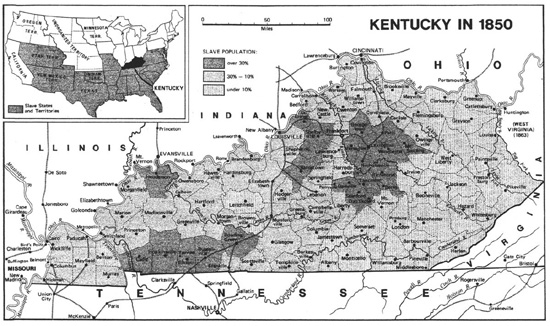
Kentucky, while not as southern as Virginia, was more western. Kentuckians suffered from the usual western problem: too much land, not enough laborers. Slavery, prime solution to labor shortages deeper in the Southwest, could never be as widespread in Kentucky’s cooler climes. A low percentage of slaves arguably intensified the labor shortage, for potential white settlers preferred free Ohio, immediately to Kentucky’s north.
Cassius Clay grew up a rich father’s heir on White Hall Plantation, near the confluence of slaveholding and nonslaveholding Kentucky.21 He came to intellectual maturity at Yale College in thickly populated New England. Clay witnessed New Englanders thriving “luxuriously on a soil which here would have been deemed the high road to famine.”22 New England, with its rocky land, teemed with free labor enterprise and dense population. Kentucky, with its lush terrain, was sluggish amidst slave labor and sparse population. Free laborers would rarely rush where slaves trod. Nor would whites work hard where sweating was deemed “nigger.” Kentuckians, to flourish in western competition for whites, must push out slaves.
Cassius Clay did not, upon returning from New England, see how to begin pushing. If the Kentucky legislature paid to send blacks to Africa, excessive taxation would deter white emigrants. If the legislature allowed 200,000 free blacks to stay, white emigrants would head to whiter midwestern frontiers.
Cassius Clay’s favorite Kentucky law at least prevented the bad situation from growing worse. The Law of 1833 barred slaves from being imported into Kentucky except by emigrants for their own use. That ban, together with Kentucky’s drain of bondsmen to the Lower South, helped ease Kentucky’s slave percentage down from 24% in 1830 to 21.5% in 1850.
Clay’s first campaign involving slavery sought to preserve this first step. In 1840, Robert Wickliffe, Jr., son of the very wealthy slaveholder “Iron Duke” Wickliffe, agitated for Clay’s state legislative seat by urging repeal of the Law of ‘33. When Clay called the edict right because slavery was wrong, Wickliffe branded him “disloyal.” Kentucky’s real traitors, Clay answered, valued aristocratic property more than majority interests.23
Clay won the election. He would never win again. Driven from the legislature as an extremist the following year, he determined to make Kentucky more extreme. His Lexington True American, a weekly newspaper inaugurated in June of 1845, brought class warfare implications of the anti-Wickliffe campaign to full consciousness. The Bluegrass newspaper also displayed Clay’s cure for Kentucky’s labor shortage. The solution did not charm Iron Duke.
Clay’s remedy would have been no delight to Iron Duke’s slaves either. The Lion of White Hall, Clay’s appropriate nickname, proposed using the threat of post-nati emancipation to intensify sale of slaves to the Lower South. The Kentucky legislature, Clay urged in 1845, should declare female slaves born after a certain date free when they reached 21. In 1851, Clay would advocate freeing male and female slaves born after 1860 when they reached maturity.
In both campaigns, Clay predicted that Iron Duke and fellow slaveholders would beat the deadline. Some would unload their investments in New Orleans slave auctions. Kinder masters would send their people back to Africa. The legislature, a third of a century hence, could easily compensate patriarchs for those few blacks “of the best quality” who remained.
A population rush to whitened Kentucky, cheered Clay, would ensue. Kentucky’s 200,000 slaves had kept out 1,000,000 whites. Kentucky’s emancipation would pull in millions of emigrants. Manufacturing would blossom, for enterprising white laborers would buy more for themselves than Iron Duke dribbled out for slaves. Schools would flourish, for a large white population would make for extensive public education. Labor would intensify, for no more “niggers” would be around to make hard work degrading. “Give us free labor,” concluded Cassius Clay, “and we shall, indeed, become ‘the garden of the world.’”24
The Lion of White Hall here pulled old proposals to whiten the least-enslaved South into a fresh synthesis. His view that the state should pass future emancipation, hoping that slaves would be sold down river before emancipating birthdays, recalled dismal results of New Jersey-New York laws early in the century. Clay’s proposed legislative encouragement of marketing slaves in Lower South black belts copied Thomas Jefferson Randolph’s motion in the Virginia Slavery Debate. His desire to draw in whites by pushing out blacks resembled Henry Brawner’s prayers for Maryland.
Cassius Clay joined to those Old Eastern ways of removing slaves the newest western entrepreneurial vision. His notion that ending slavery would entice free farmers, thereby enriching land speculators, paralleled Pearl Andrews’s argument several years earlier in Texas. The cautious Andrews, however, had appealed to the wealthy. The bold Clay would appeal over the elite’s obstructionary heads to nonslaveholders resentful of the Iron Dukes. Clay’s resulting ideological amalgam, while highly racist, conditional, and conservative, was also the most radical form of southern reform yet. It called on the white majority to outvote the propertied elite and to expel the black minority.
That heretical notion made Cassius Clay a Kentucky household name. Everyone, chuckled a fellow emancipator, “wants to see what sort of monster C. M. Clay is. They expect to see a face … made of brass & iron.”25
They assuredly saw a strapping Westerner. The Lion of White Hall was over six feet tall, hard and hulking, with a thick square face and a solid chin. His reformist credentials were equally solid. “Cash” Clay had sacrificed $40,000 to free his slaves before talking about other people’s slaves. Bluff, hardy mid-Americans liked that sincerity.
Kentucky frontiersmen also admired a man who risked his life for his principles. Clay shunned the examples of James Birney and Pearl Andrews, who fled north upon intimations of possible lynchings. Cassius Clay, brawling frontiersman, never ran from anything. He seized his bowie knife over such crowning concerns as the genealogies of shorthorn bulls and the origins of Bluegrass seed. He hounded one foe into suicide. He slashed another’s skull to the brain. He was such a pro with bowie knives that he filled a pamphlet with his expertise. He was so determined to be heard that he mounted podiums twirling pistols.
In mid-1845, Clay crammed the Lexington True American’s office with heavier artillery. Iron Duke, to smash the Lion’s press, would have to bomb out two four-pound cannon, sundry lances and rifles, and a keg of powder. Clay scorned fear of “treasonable and revolutionary enemies of constitutional liberty. … We can die, but cannot be enslaved.”26
While self-defense, the Kentuckian believed, justified extra-legal brawling, Clay remained otherwise a domesticated reformer. He pointed out to practical Americans that his proposals would free no one for over three decades.27 “We should not,” he counseled a fellow agitator, “needlessly offend any one.”28 Cassius Clay was no fanatic hunting martyrdom. He was a determined politico who fanned nonslaveholders’ racist and class hatreds.
Clay’s challenge, like Pearl Andrew’s Galveston foray, excited slaveholders’ uneasiness about democratic processes. Even if 99 out of 100 slaves were Cuffees, should any black be exposed to seditious ideas? Even if most nonslaveholders wished to have all blacks in their neighborhoods enslaved, might they prefer having no blacks around? In 1844 the national Congress had decided that national republicanism required expunging slavery-inspired gag rules. In 1845, citizens in Lexington, Kentucky, had to decide whether slavery was compatible with Cassius Clay’s democratic challenge.
In mid-August 1845, his head perhaps turned by typhoid fever, his pen surely driven by venom at the Wickliffes, Clay impelled immediate decision. “Remember,” he wrote, “you who dwell in marble palaces, that there are strong arms and fiery hearts and iron pikes in the streets, and panes of glass only between them and the silver plate on the board and the smooth-skinned women on the ottoman.” Remember, you Wickliffes, that “the day of retribution is at hand—and the masses will be avenged.”29
Iron Duke’s cronies, not anxious to charge Clay’s cannon, secured an injunction against this demand for lower-class revolt. Clay, seeking to abolish slavery by legal process, handed over his armed newspaper office. His press was exiled to Cincinnati. “Thus,” lamented Clay, “on the 18th day of August 1845, were the Constitutional liberties of Kentucky overthrown; and an irresponsible despotism of slaveholding aristocracy established on their ruins.”30
Slaveholders who had expelled the “seditious” press offered their usual rationalization for undemocratic control: Clay’s newspaper supposedly fomented slave insurrection. Clay ridiculed the excuse. Fantasies about “insurrection in Kentucky, where there are about six whites to one black,” were absurd. The oligarchy, charged Clay, really feared majoritarian reform in a state where non-slaveholding outnumbered slaveholding families three to one. Slave insurrection was the “Bug-a-boo” used to legitimize “Austrian vigilance.” As much as he hated slavery because of its “wrongs to the blacks” and its impoverishing of nonslaveholders, he hated it more “because it will not allow law … allow constitutions … allow Republicanism.”31
Clay proceeded to detour around localistic repression. The Louisville neighborhood further north, unlike the Lexington neighborhood further south, relished a free press. Clay re-established his newspaper up in the Ohio River city. Frustrated Bluegrass vigilantes could not lynch him inside that alien locality.
Cassius Clay’s opponents were driven back to enchaining his ideas the democratic way, by raising issues and winning elections. In the 1845–9 period, Bluegrass politicians attacked Kentucky reformers’ first containment, the Law of 1833, which outlawed most slave importation. In 1848, the Law of 1833 narrowly survived a legislative test. In 1849, modifications tantamount to repeal were passed. A vote for delegates to a convention, charged with writing a new Kentucky constitution, was coincidently imminent. Cassius Clay and his sympathizers hoped to use the new election to regain the old statute. They provoked the most searching southern debate on slavery since that supposedly final discussion, the Virginia Slave Controversy of 1832.
A convention meeting in Frankfort, the state capital situated halfway between Cassius Clay’s stronghold of Louisville and his opponents’ stronghold of Lexington, initiated confrontation. The eleven reformers, when signing the first call for the provoking convention, declared Kentucky’s founding fathers wrong to think that slavery would ease the state’s labor shortage. Too few slaves came to Kentucky. Too many whites turned elsewhere. “While the immense stream of [white] immigration has been passing population, wealth, mechanic and manufacturing skill and industry into the States north of us, it seems to have avoided Kentucky as though she had been a land of pestilence.” The “withering blight must be ended.” Whites proud to labor must replace workshirking slaves.32
On April 25,159 delegates met in Frankfort to endorse those themes. Henry Clay, Cassius Clay’s cousin and Kentucky’s most famous statesman, chaired the convention and gave it political respectability. Robert J. Breckinridge, the renowned Presbyterian clergyman, gave the major speech and added religious sanction. Breckinridge would “transmit to our posterity” an implacable “hatred of, and hostility to, this most atrocious of all human institutions.” But prudence required reformers to seek no more now than re-enacting the Law of 1833 and empowering a future legislature to emancipate. Breckinridge would rally non-slaveholders, “the only class from whom aid can be expected,” by emphasizing that banning black imports would save white jobs.
Some delegates wished a more extreme crusade, seeking termination of slavery now. Others urged a quieter campaign, showing that reformers were not fanatics. Cassius Clay stood in the middle with Breckinridge. “How are we to get at the nonslaveholders,” he asked, “but by agitation?” Still, agitation best captured “the ear of the people” when dressed up as moderation. “We fanatics,” said Clay, “are willing to take your compromise.” The Frankfort convention agreed to a Breckinridge-Clay campaign aimed at reinstalling the Law of 1833 and permitting a future legislature to remove slaves.33
In the ensuing four-month canvass, a reforming colleague, William M. O. Smith, best summed up Cassius Clay’s case. On a June Court Day in Paris, Kentucky, the widely admired Smith began his heretical statement with a southern heretic’s necessary disclaimer. He was no outside agitator. He was born and bred a Kentuckian. No “maukish sensibility in favor of the slaves” moved him. “But looking as I do to the interests of the white population, I wish to be clear of them.”
Kentucky could get clear of blacks cheaply and easily. Slaves must be barred from entering, and bondsmen born after 1860 must be declared free when they grew up. Most post-nati slaves would be sold south before age 21. The rest could be cheaply sent to Africa. Then Kentucky would no longer have “to play second fiddle to those vile Yankees.”
Kentucky, continued William M. O. Smith, was second best because a halfway house, fully benefiting from neither northern nor southern solutions to labor shortage. The northern free labor solution worked best when abundant free laborers labored energetically. Scarce free white labor worked badly in Kentucky, “because slaves have made all labor … dishonorable.” Most Kentucky white free laborers, determined to avoid being considered “white negroes,” acted as if hard work was “nigger” work. Most whites elsewhere preferred second-best lands in Ohio to degraded work in Kentucky. Labor shortfall, sloppy wage earners, “and vicious habits of all kinds” abounded.
Kentucky’s sloppy form of slavery could not take up the slack. Slavery worked best, Smith maintained, when blacks were abundant and masters were imperious. Kentucky slaves would never be abundant, for labor-starved Lower South planters could use slaves more profitably in more tropical climes. Kentucky masters would never be imperious, for they were too democratic and apologetic. In South Carolina and eastern Virginia, an aristocrat scorned pure democracy and ruled like “a feudal baron.” In Kentucky, planters lauded democracy and proclaimed bondage “a great evil.”
Slaves latched onto masters’ ambivalence. The “faltering hand” of authority encouraged “the governed to become refractory.” Governors countered with bribes. The “half free indolent negro” responded with a splendid demonstration of “how to work least for most.”
Leniency, admitted Smith, made border slavery milder. But “if slavery must exist in a community, let it be slavery and not this halfway sort of slavery.” Most Kentucky defenders of slavery conceded that Providence would ultimately drain the “evil” away. As soon as lawmakers gave Providence a nudge, first by banning blacks from coming in, then by encouraging slaveholders to sell out, free laborers would mass to the Bluegrass.34
William M. O. Smith was right that most of his opponents believed slavery would fade from Kentucky. True, a few so-called Perpetualists, led by Beverley Clarke, asserted that docile black slaves outworked rowdy white Irishmen. A few others argued that Kentucky often put Ohio’s economy to rout. But Cassius Clay’s foes, rejecting Beverley Clarke, usually called slavery a curse, doomed in Kentucky.
George W.Johnson’s article in The Frankfort Yeoman typified the establishment’s position. Johnson reminded readers that Cassius Clay, although sometimes narrowing the issue to the Law of 1833, sometimes agitated for emancipation of slaves born hereafter. Clay called compensation to owners unnecessary, for someday-to-be-freed slaves could be sold out of Kentucky.
This cynical non-emancipation, charged George W. Johnson, violated Kentucky benevolence. Kentuckians were bribed to betray family retainers or to desert Kentucky. “If the citizen is conscientiously opposed to selling his slaves, to whom he is attached, and if he loves his native land too well to emigrate, then he is punished for the noblest feelings of our nature.”
Nor would the Lower South tolerate “a sudden deluge of blacks.” Rather than let faltering Kentuckians push the “dregs of their slave population” upon the tropics, the Cotton Kingdom would ban slave imports. Yet Kentucky’s post-nati law would still be on the books, freeing blacks. Cassius Clay’s statecraft would yield “200,000 slaves breeding free negroes in a republic of whites!!!”
A better way, cheered Johnson, was in process. Kentucky’s slowly increasing white population depressed slave values at home. The Lower South’s steadily advancing western frontier increased slave prices abroad. Kentucky masters would slowly move south or gradually sell bondsmen down river. This whitening of Kentucky, achieved “by the unerring wisdom of the Eternal Legislator,” would transpire “without danger, crime, or disturbance of society, by the easy, gradual, and unseen, but imperative action of the law of nature.” If Clay would hush, slavery and blacks “will gradually disappear from Kentucky in 70 years.”35
This typical Kentucky “proslavery” position in the debate of 1849 was as little “proslavery” as was Virginia conservatives’ position in the debate of 1832. Once again an Upper South establishment called whitening the state salutory but legislative interference pernicious, for the “curse” was draining away of its own natural accord. A tobacco kingdom near Yankeeland was yet another time considered, in Thomas R. Dew’s phrase, too far north to remain permanently southern.
8
South Carolina planters, if pressed to choose between William M. O. Smith’s legislative encouragement of the slave drain and George Johnson’s diffusion through private slave sales, would have condemned both. Kentucky voters considered the choice the most important of the half-century. Contestants condemned each other as pirates, fanatics, murderers, oligarchs, rapists, bandits, thieves. Slaves pretended not to hear the charges. Nonslaveholders mulled over appeals for class revolution. Slaveholders muttered about incendiary language.
Ugly accusations soon provoked angry assaults. On June 15 at Foxtown, less than an hour’s jaunt from White Hall, Cassius Clay and one Squire Turner, a slaveholder, met in public debate. Turner treated the crowd to a reading of Clay’s inflammatory 1845 True American issue, calling for lower-class revolt. When Clay denied he was Jacobinical, Cyrus Turner, Squire’s son, branded Cassius a liar and smashed him in the face.
Clay grabbed for his knife. He was clubbed to earth. The Turner clan swarmed at him. Tom Turner, Cyrus’s brother, pressed a pistol at Clay’s temple. The gun sputtered. Tom screamed for another. Cyrus sank a dagger into Clay’s side. Cassius heard someone exalt that the Lion was dead.
Clay, fighting unconsciousness, lurched to his feet. Squeezing a bowie knife, he staggered after Cyrus. Turner slipped. Clay leaped atop and slashed out Cyrus’s bowels. With one flash of the bowie knife, Cassius Clay captured the stridency of a border confrontation over slavery’s fate.36
With the same deadly motion, Clay illustrated why he was doomed to lose this election. Clay survived to defend carrying knives and slaying Turner as lamentable but necessary self-defense. He had at least, he wrote, kept himself off “that long list of tamevictims, who have been murdered in the South, for exercising the liberty of speech.” Slavery, he exclaimed, “can no more live without the pistol and bowie knife, than the body without the soul.”37
But as most Kentuckians saw it, only fanatics created need for bowie knives. If Kentucky’s slavery ended Clay’s way, it would perish in blood. Most Kentuckians preferred bloodless termination. When election day arrived, Clay’s version of how to get rid of slaves attracted only 10% of the voters.
9
When the Kentucky Constitutional Convention met at the end of the year, more extreme Southwesterners endeavored to use the landslide against Cassius Clay to consolidate permanent slavery. Beverley Clarke, Perpetualists’ leader, sought a constitutional guarantee that slaves could be forever imported. If a future legislature banned slave imports with another “infamous Law of 1833,” Clarke worried, “the increased demand for laborers” would “be supplied not with blacks but with whites.” Ohioans would pour in, “imbued with the spirit of fanaticism and abolitionism.” After awhile, Kentucky “will become abolitionized.” Beverley Clarke here sounded like Abel P. Upshur, determined that English migrants have no chance to emancipate Texas.
Clarke called emancipation “wretched policy.” Slavery, he soared, “elevates the morals … and enhances the happiness of both races.” He favored “perpetual slavery.” He “made that statement with a full knowledge of its length and breadth, height and depth.”38
John S. Waller spoke for most delegates in marveling at Beverley Clarke’s “sublimated abstractions.” Clarke’s proslavery notions, declared Waller, “are new to me.” If slavery is “a blessing in the abstract—a blessing per se,” every Southerner should urge “all possible means for the enslavement of the entire black population on earth.” No one could maintain “a position so monstrous.”39
James Guthrie, president of the Convention, was not prepared to join Waller in discussing “the abstract question, whether slavery is an unmitigated curse … or an absolute blessing.” But President Guthrie proclaimed that someday slavery in Kentucky “will cease.” Cheap white laborers would eventually crowd into Kentucky. Depreciated slaves would be forced South. What folly, then, “to provide in this Constitution for the perpetuity of slavery.”40
Waller and Guthrie commanded the Convention. Delegates voted 55 to 32 against Clarke’s motion to ban future Laws of 1833.41 The legislature of 1850, thrown the problem by the Convention, agreed to a compromise law. Slaves could be imported. But such imports could not be sold for five years. Since half a decade would be an eternity should black imports turn troublesome, Perpetualists would eventually demand repeal of this, as they termed it, virtual Law of 1833.42
Kentucky’s debate over slavery had stalled, not ended. The stalling place was close to where Virginia controversy had momentarily ceased. Where Virginia legislatures in 1832–3 had exerted some, but not much, governmental pressure to drain blacks out, the Kentucky legislature of 1850 placed some, but not much, governmental inhibition on blacks coming in. Both compromise positions endorsed the sine qua non of Conditional Termination: that low percentages of blacks were essential before the institution could be ended. Majorities in both northerly slave states preferred that private slave sales would silently drain blacks southwards.
10
Cassius Clay would not accept that drifting verdict. Kentuckians’ distaste for slavery and dismay about underpopulation, he believed, invited agitators to press on. He knew agitation must seek a slow end to the Peculiar Institution, with the central condition that the emancipated state must be lily-white. His magic formula remained a legislative decree of future emancipation, to accelerate present sale of Kentucky’s slaves down south. So urging, Clay ran for governor in 1851. “For the first time in a slave state in the history of nations,” he hoped, “a regularly organized” third party will permanently agitate “for the overthrow of oppression.”43
That strategy required the South no less than the North to permit permanent agitation. In the North, free-soilers campaigned in election after election, slowly educating the mainstream and slightly increasing their votes each time. In Kentucky, Cassius Clay had secured a 10% beginning in 1849; and his argument held promise of gradually rallying more nonslaveholders as it became more familiar.
That was exactly the ongoing debate slaveholders were determined to abort. Republics never are overly tolerant of dissent when their most basic institutions are under foreign or domestic siege; and the Old South’s republican slaveholders turned especially proscriptive when faced with continual heresy. The atmosphere combined a little physical violence with much screaming about disloyalty, insurrectionists, enemies of law and order. Peace-loving souls who preferred that slavery and blacks be sent elsewhere might risk a heretical campaign once. But if reformers lost the first time, as heretics normally will, the disposition to brave it all again and again took the abnormal imperviousness of a “Cash” Clay.
Most of Clay’s followers were not that willing to be permanently stigmatized as outcasts. They had other missions, other causes, and no desire to live eternally as pariahs among their folk. The Reverend Robert J. Breckinridge, one of Clay’s most important allies in 1849, articulated the moderates’ submission to the intense pressure for conformity: “Having proved myself faithful to my convictions, I shall now prove myself faithful to the Commonwealth.”44
Clay wrote to Breckinridge that he could “complain of no one,” least of all so brave a cleric, for “you like myself have suffered in this.” Clay knew “your sphere is the moral, mine the political.” The politician saw that the churchman could not forever risk his important religious work, not over a constant reagitation the Kentucky majority thought “premature.” Just do what you can, begged the increasingly lonely reagitator. “A word now and then will do much.”45
The Reverend’s word now and then was no match for the establishment’s incessant declarations that “Cash” Clay must not convulse Kentucky over and over again. On election day, 1851, Cassius Clay’s visible support dropped to 3000 votes, 3% of those voting. A discouraged Cassius Clay now saw need of outside support before inside waverers would step forth. He would form an alliance with northern freesoilers. Then he could emerge as the Southerner waxing most powerful in the newest national establishment.46
11
A Cassius Clay-David Wilmot alliance was an ideological natural. Like Pennsylvania’s Wilmot, Kentucky’s Clay was more whitener than abolitionist. Both cared most that blacks be contained outside their areas. Both understood each other’s usefulness. Clay’s bid to form a southern wing of a containment party made Yankee containers seem more national and conservative. No need for outsiders to meddle in the South. Northerners could just hem slavery in. Then southern allies, bolstered by national patronage and prestige, might draw southern dissent out of hiding.
If Cassius Clay became Kentucky’s patronage-wielding boss inside a national administration, he could no longer be dismissed as outside the establishment. Kentuckians might then freely debate, with no lynch mobs roaming or bowie knives flashing or crowds demanding loyalty, whether moving blacks beyond Kentucky was disloyal to Kentucky whites’ interests. Then Clay supporters might re-emerge and white migrants might mass to the Bluegrass.
Clay’s shift to a northern alliance resembled Pearl Andrews’s shift to an English alliance. Neither could prevail unaided, despite persuasive population booster rhetoric, in a semi-closed world where persuasion was not enough. Both prayed that outside aid would crack their worlds wide open. Both relished the prospect of a continual free debate over how to people the frontier. Both would have better chances to win that debate if nonslaveholding migrants, Englishmen in Andrews’s case and Ohioans in Clay’s, came to an ever-whiter area.
Cassius Clay remained the more persistent threat. Andrews had bailed out when slavery heresies provoked dangerous hostility. Andrews’s potential collaborators, those cautious English antislavery lords, had pulled back when America pushed in. But the knife-wielding Cassius Clay was in this war against the Slavepower for the duration. His potential collaborators, Yankee freesoilers, were no less permanently determined to cage the Slavepower. Clay’s wish to speak as David Wilmot’s southern voice made a united southern stance against the Wilmot Proviso the more vital.
So urged Wilson Lumpkin, the influential Georgia planter, ex-governor, and ex-United States senator. Heretics such as Cassius Clay, Lumpkin privately wrote John C. Calhoun, “are to be found in all the southern states.” Such leaders “will be encouraged, at no distant day, to hoist the antislavery banner. … Then it will soon be recorded—the slaveholding states, were.”47
Even if Clay’s efforts for legislative encouragement of diffusion continued to be routed, slave sales to the Lower South could make Kentucky slowly less southern. The Bluegrass State someday “must be free, we admit,” wrote the editor of Debow’s Review after watching Clay’s defeat. The day would come “when the superior southern demand shall draw off by degrees her slaves, and the continued increase of white population shall make the relative proportion of colors but a fraction of what it is now.”48 The tiny fraction of Delaware blacks, added James Hammond, made her “no southern or slave state.” As for the rest of the Border South, Hammond wrote John C. Calhoun, “I would infinitely prefer disunion … for fear of future Clays.”49
12
Hammond here expressed a central reason why southern extremists were developing a crisis mentality. These most worried of Southerners saw David Wilmot’s and Cassius Clay’s simultaneous emergence as a sign that the clock was ticking against the Deep South. The North appeared to be growing more hostile, the Border South more disposed to debate its southernness. “The settlement of the slavery question ought not to be postponed,” a Mississippian wrote John C. Calhoun. Since “we are much stronger now, than we shall be two or five years hence,” we must immediately “force Virginia, Maryland, Kentucky, & Missouri to make common ground with us.” An important Georgian declared that only “an early dissolution of the Union” and a truly “consolidated” southern republic could “stop the process by which some states … are becoming free, viz, by ridding themselves of their slaves.” A South Carolina leader urged that the slavery question must be met imminently, “and the sooner I think the better. … How long will Maryland, Western Virginia, Kentucky, Eastern Tennessee and even the western part of N. Carolina feel it their interest to retain slaves?” As James Hammond’s brother summed up this extremist position, the Proviso crowd, “disguise it as they may,” wished “to abolish slavery in the States.” We must therefore “break up” the Union swiftly, before “Ky., Md., Mo. & Tennessee draw off.”50
13
Southern centrist politicians called extremist fears exaggerated. Cassius Clay’s possible impact, like California’s geographic location, seemed to moderates too remote to justify instant disunion. Still, draining of Upper South slaves onto Lower South turf and Cassius Clay’s effort to intensify the diffusion made David Wilmot’s attempted containment seem a little alarming, even in less alarmist circles.51 New York and Pennsylvania, Albert Gallatin Brown of Mississippi reminded the United States Senate in 1853, were once slave states. They sent many blacks southwards and ultimately freed the rest. “Virginia, Maryland, and the border states are now undergoing the same process.” Within thirty years, the Lower South would contain eight million blacks. “When they become profitless or troublesome, we, too, want a South to which we can send them. We want it, we cannot do without it and we mean to have it.”52 That view of the distant future, and especially southern resentment of David Wilmot’s immediate insult, made the question how, not whether, Southerners would resist the Proviso.