
CHAPTER 13
A movement to cleanse the South of free blacks accompanied the campaign to import Africans for cleansing. Both crusades drove the gospel that all blacks needed southern masters to an extreme. Each extremism could be dismissed as lunatic antics, except that portions of the mainstream sought the alleged lunacy. Both extreme proposals appeared as if out of nowhere in the 1850s. Each streaked toward almost capture of some state legislatures on the eve of the Civil War.
Reenslavers of free blacks deployed the more promising strategy. Where reopeners had to blast (or sneak) past federal law, reenslavers only had to convince southern lawmakers. Where reopeners faced the apprehension that African alleged savages would convulse the South, reenslavers wished to rid the South of free blacks’ allegedly convulsive presence. Yet despite its advantages, the reenslavement excitement fizzled as swiftly as the reopening craze. Both frustrations left extremists the more on the hunt for a final solution.
– 1 –
A startling statistic: In 1860, slightly more free blacks lived in the enslaved South than in the free North. A less startling statistic: The 250,751 southern free blacks comprised only 6 percent of the South’s 1860 blacks. But as always in matters southern, the overall average masked divisive exceptions. Free blacks comprised 2 percent of the Lower South’s 1860 black population, 7 percent of the Middle South’s, 49 percent of Maryland’s, and 91 percent of Delaware’s. At the South’s Maryland/Delaware northeastern fringe, a North American middle ground between slavery and freedom, supposedly existing only south of the United States, thrived surprisingly.
Whether massed overwhelmingly in Delaware, threateningly in Maryland, or spottily elsewhere, most free blacks endured dismaying economic conditions and racial prejudices. Free blacks’ economic opportunities usually remained tenuous, their possessions limited, and their wages low. They could not vote or serve on juries or testify against whites. Often they could be reenslaved if convicted of a petty crime, or if they left their state and returned, or if a white guardian failed to vouch for their good behavior.
Despite these exploitations, southern free blacks sometimes crept ahead. A few climbed miles ahead. Free mulattoes especially soared, boosted by whites’ prejudice that blacks needed some white blood to succeed. Lightened blacks even sometimes became that southern anomaly, brown slaveholders. A South Carolina ex-slave mulatto, William Ellison, possessed an important cotton gin as well as 900 acres and sixty-three slaves. This brown master’s slaveholdings exceeded 99 percent of white slaveholders’. Six Louisiana free blacks owned still more slaves, including Andrew Dubuclet, a sugar planter worth a quarter million dollars. This heretical evidence cast doubt on the orthodoxies that all blacks must be enslaved, and that only whites could be slaveholders, and that no middle ground of free browns could exist.1
The defense of slavery, responded the Richmond South in 1858, “stands upon the theory … that nature intends” every black “for the status of servitude. … If one Negro may be free, why not another?” Unless no Negro is capable of self-government, our whole system is “a logical absurdity.” Or as a Virginia legislator exclaimed, I “would not own a slave for one moment, … if I was convinced that the God of nature who smiles upon this land, intended that freedom should be the lot of that race.”2
To make slavery last longer than a moment, declared the Aberdeen (Mississippi) Sunny South, we must “prove the sincerity of our avowed convictions.” Have we repudiated the old “maudlin sensibility” that “human servitude” violates “individual liberty”? Do we believe that the “radical inferiority of the Negro” makes a black freedman “incapable of individual culture?” If so, we must demonstrate “our conviction by reducing the free [black] population to bondage.”3
The reduction of liberated blacks to servitude would eliminate more than defective belief. Maryland’s and Delaware’s crawl away from slavery would be reversed. Slaves’ potentially disruptive interaction with liberated blacks would vanish. White wage earners’ free black competitors would disappear. “We can only have a healthy state of society,” declared the Mobile Daily Register, “with but two classes—white and slave.”4
But how should that third class of free blacks be eliminated? An uncompromising proslavery mentality would have demanded that all blacks, all supposedly helpless, all must immediately be given the mercy of a master. The compromising democratic mentality, however, intruded, dictating that freedmen retained some choice. Thus reenslavement proposals always included the qualification that black freedmen, to escape slavery, could choose to depart the state.
The departure option paralyzed whites’ capacity to remove all free blacks. Economically, a labor-starved culture hardly welcomed the departure of black workers by the tens of thousands. Moreover, free blacks’ coerced departure seemed cruel, especially to the paternalists who had freed them, particularly when freedmen had prospered without masters and/or when cherished enslaved family members would have to be left behind.
Thus in 1859–60, some 1193 outraged white Mississippians petitioned their legislature, deploring the fate awaiting eighty-two successful free Americans, if lawmakers passed departure/reenslavement. The black freedmen, declared the petitions, had financed their own freedom, bought their own farms, established their own shops, preserved their own families, and served their white neighbors. These boons to the community, if harried out of the South, would be ripped from enslaved spouses and/or children and deprived of their property.
Mississippi petitioners cited the plight of A. L. Chevis of Hinds County, for thirty-five years a valued barber and bricklayer for whites. This outstanding freedman, who had never made “his residence here objectionable,” now faced exile from his slave wife and eight children. Reenslavement/departure’s victims would also include Edward Hill of Hinds County, for more than twenty years the owner of a blacksmith shop that whites treasured. Now this successful southern entrepreneur would have to risk his chances among racist Yankees, despite knowing “nothing of the manners, habits, and customs of the people in the Northern States.”
Yet another victim would be Jordan Cheeves of Warren County, freed for good military labor in the War of 1812, now infirm. How “cruel and unjust to drive him in his old age from the country he, in his youth, fought to protect.”5 Or as these petitions all indirectly asked, must a paternalistic domestic institution smash blacks’ domiciles and consign southern paternalists’ family friends to the heartless North? When the question took that form, pitched battles beckoned over a heartbreaking (and labor-draining) plan to obliterate the supposedly impossible middle ground between enslaved blacks and free whites.
– 2 –
Extremists’ assault on the middle ground came to one of its two spectacular climaxes in, where else, the capital of southern extremism. In Charleston, South Carolina, impoverished white nonslaveholders led the onslaught on free blacks. Another supposed southern impossibility provoked the assault. According to proslavery dogma, poor white mudsills only existed in the North. Slavery supposedly consigned only black serviles to muddy tasks, elevating all white citizens above grimy toil.
This proslavery fancy aside, dirt-poor rural nonslaveholders usually worked their own few muddy acres. Though they suffered the mud, these petty landowners suffered no confusion with southern chattel slaves, lashed to work masters’ fields. Nor could poor rural farmers be confused with Yankee “wage slaves,” paid a pittance to sweat in city factories. But southern class problems pressed more painfully on white urban nonslaveholders. These white mudsills received meager pay to perform the same menial labor as blacks.
Urban poor whites’ plight especially soured class relations in late antebellum Charleston. During the 1850s, Charleston’s masters sold slaves to the more prosperous Southwest at a record pace. White immigrants moved in to fill the unskilled labor vacuum. From 1850 to 1860, some 5623 Charleston slaves departed and 3300 whites arrived, over half of them foreign immigrants. For the first time, Charleston had a white majority.
Impoverished white newcomers especially loathed rich free blacks, almost all of them mulattoes. In 1860, two-thirds of Charleston’s free black male freedmen occupied skilled labor positions, compared to only half of the white immigrants. The richest free brown skilled laborers displayed not only whitened black skin but also superior finery, to the fury of white nonskilled laborers, whose race supposedly monopolized whiteness and superiority.
Charleston’s brown-skinned irritant remained small in size. In 1860, only 19 percent of Charleston’s blacks were free. Only 25 percent of the freedmen owned property. Still, fifty-five free browns owned at least one slave plus at least $2000 worth of real estate. The wealthiest brown commanded fourteen slaves and $40,075 worth of real estate. The brown elite, managing their carpenter, tailor, and millwright shops by day, cherished their exclusive Brown Fellowship Society at night. Snobby browns held unwhitened blacks at a distance and comfortably rubbed shoulders with their white customers as members of the Grace Episcopal Church. Were white mudsills equal to these brown achievers?6
Leonidas Spratt feared that the city’s white wage slaves would rise against a social system that generated such questions. His solution, reopening the African slave trade, sought to import black mudsills to replace white mudsills. White mudsills had a better idea: Expel uppity browns and elevate downtrodden whites. Bridling at “the degradation, …hardship, and injustice of having the entire free Negro population thrust upon us as competitors,” white laborers wished to remove “from our body politic this cankerous sore, and stand among our fellow citizens as equals.”7
Would-be equals at the bottom of the white social ladder found their leadership several rungs higher. The Charleston reenslavement movement’s directors included James M. Eason, a mechanic who owned an iron foundry and six slaves, and Harry T. Peake, who supervised the South Carolina Railroad’s shop and owned nine slaves. Eason and Peake competed for skilled labor contracts against rich browns. Often, provokingly respectable browns won the jobs. In retaliation, provoked white entrepreneurs coalesced with equally provoked white mudsills, both seeking to oust all free blacks. The coalition posed an ominous challenge to the few free brown entrepreneurs, to the more numerous free black mudsills, and to the much more numerous white squires who patronized the browns’ workshops and shared membership in Grace Episcopal.
Many of Charleston’s upper-class patrons shielded their favorite mulattoes from the Eason-Peake storm. The protective patriarchs thus added another anomaly to this crazy quilt reenslavement drama, starring folks that this enslaved society supposedly precluded. Just as no black supposedly should have been freed, and no brown should have existed or been rich, and no white should have been a mudsill, so only owners should have felt paternalistically obligated to protect a laborer. According to proslavery gospel, unless a superior owned an inferior as he possessed dogs and horses and wives and children, he would become a cannibalistic capitalist, devouring all those less powerful.
Charleston paternalists’ uplift of browns mocked that crabbed theory of paternalism (as did James Buchanan’s caring relationship with his paid white house servant, Miss Hetty). Patriarchs sought to protect esteemed mulattoes that they did not own (and had sometimes proudly and paternalistically freed). All free people, the Charleston lawyer Christopher Memminger explained to the South Carolina legislature, have “rights … to the protection of our laws.” Memminger would especially protect his fellow brown worshippers at Grace Episcopal. They possessed a “most estimable character,” more so than lower-class whites who “are demoralizing our slaves.”8
In the spirit of this politically indiscreet preference for cultivated browns over uncultivated citizens, South Carolina paternalists stymied proposals for reenslavement/departure in South Carolina’s upper-crust legislature in both 1859 and 1860. But white mudsills mustered the legal ammunition to retaliate. Previously unenforced laws, by being newly enforced, could send brown aristocrats scurrying beyond the state, to the horror of white patriarchs.
According to the state’s legal code, blacks remained enslaved unless they possessed both manumission papers and a court-appointed guardian, responsible for their good behavior. Moreover, when city paternalists allowed petted slaves to pick an employer and pocket most of the wages, the notquite freedmen had to buy expensive slave badges. In previous permissive times, few blacks had bothered to save manumission papers or to secure a court-appointed guardian or to purchase slave badges.
Disgruntled white plebeians had only to locate a politician who would enforce the black codes. They found their enforcer in Charleston’s Mayor Charles Macbeth, who wished their political support. In the fall of 1860, as Mayor Macbeth’s agents combed Charleston for blacks without proper papers and/or badges, over 1000 of Charleston’s 3000 free blacks despairingly left for the North.
Memminger, one of Charleston’s greatest lawyers, could do nothing to stem this legal savagery. Savaged evacuees included families that had enjoyed freedom for two generations (but had not the papers to verify their founder’s manumission). Those frightened into departure often suffered severance from relatives and friends, in the manner of slaves sold down the river. Those pressured to leave also included some star American Horatio Alger types, lately risen from enslaved beginnings, now removed like a wealthy Cherokee banished down a trail of tears.9
A less paternalistic ruling class would have cynically sacrificed a third of the city’s free blacks (and would have accepted new laws that would have savaged the other two-thirds). Free blacks had become useful scapegoats, deflecting impoverished whites’ fury away from the culture’s establishment and toward the brown fringe. At this unprecedented moment when the Charleston riffraff got uppity with the silk stocking crowd, the resentful did not assault the slaveowners or free the slaves. Instead, angry white mudsills insisted that nonowned folk who bore nonwhite skin must be ousted.
By embracing this escape valve for lower-class steam, upper-class patriarchs would have defused trouble. Instead of lording it over poorer whites and uplifting middle-class browns, slaveowners would then have patronized only slaves and allowed all whites to submerge all browns. Then racial prejudice would have united rich and poor whites, all treating each other as equals, all striving to keep nonwhites inferior.
But with genteel patriarchs rejecting this crass solution, the story had reached a precarious juncture. White toilers had not ousted all free browns, and white patriarchs had not reversed departed freedmen’s plight. The impasse demonstrated the Lower South establishment’s strength, despite its inconsistencies. Although the proletarians’ reenslavement shove had been aborted, white menials only had muttered their resentment. Although Charleston patriarchs had lost a third of “their” free browns to a merciless deportation scheme, they had mercifully helped two-thirds of their freed slaves to defy ouster and still had suffered no mudsill attack on slavery itself.
But Leonidas Spratt had his point. A revolt from the lily-white bottom against competition with blacks might ascend from the crusade to deport middle-class browns to a campaign to oust the aristocrats’ slaves. With all nonwhites, free or enslaved, driven from the city, white nonmasters would monopolize employment opportunities. This escalated crisis could especially erupt if Northern Republicans handed the loathsome (to the patriarchs) Charles Macbeth a patronage job, to arouse the rabble against the rich.
– 3 –
While Charleston’s reenslavement crisis spotlighted Lower South squires’ powerful grip, even when (rarely) challenged, Maryland’s reenslavement epic illuminated Border South slaveholders’ loosening grasp, amidst ceaseless erosion. In Charleston, a small number of unskilled whites confronted a small number of skilled browns inside the urban fringe of an overwhelmingly rural civilization, with slavery’s future not even an issue. In Maryland, in contrast, large planters confronted large numbers of both manumitting masters and free blacks inside a fabled plantation area, with rural slavery’s future in a pivotal Border South black belt at the crossroads.
When free blacks’ numbers rose to equal slaves’, one borderland crossroad had already been reached. In Delaware, where around 20 percent of the population was black throughout the 1790–1860 period, that crossroad had been passed by 1800, when 57 percent of blacks were free. In 1860, enslaved Delaware was mostly a dim memory, with the state’s free blacks outnumbering slaves twelve to one and the fifteen slave states almost down to fourteen.
In 1860, neighboring Maryland approached Delaware’s 1800 crossroads. Maryland’s blacks, a quarter of the state’s population in 1860, then included 83,942 freedmen and 87,189 slaves. The commingling of equally large masses of enslaved and free blacks could provoke more slaves to sprint for freedom. More slaves’ flight toward liberty in neighboring free labor states could provoke more slaveowning capitalists to move their investment toward safe Lower South states. More free blacks, by providing more good labor and good order, also could impel more whites to doubt that only slavery could control large numbers of blacks.
Maryland’s legislature initially faced these subversive possibilities three decades before the state’s 1859–60 reenslavement showdown. By 1830, Maryland’s 1790 ratio of thirteen slaves to one free black had already plunged to two to one. Then in 1832, another southern crossroad in a neighboring state inspired the Maryland legislature’s first effort to abort free blacks’ increasing presence. After the Nat Turner insurrection, the Virginia legislature staged far from the only and far from the last full-scale southern consideration of abolition.
In an 1832 discussion as searching as the Virginians’, Maryland legislators came to a more conclusive verdict: All blacks thereafter freed must be deported. When a master manumitted a slave, lawmakers decreed, the Maryland State Colonization Society must remove the freedman to the state’s colony near Liberia, called Maryland in Africa. Only a court could grant the liberated soul a renewable annual permit to stay, and only if “extraordinary conduct and character” had been proved. The legislature pledged over $200,000 to ensure that nonextraordinary freedmen involuntarily departed.10
Only voluntary departures ensued. “Not one Negro has been forced to leave the State,” the Maryland State Colonization Society complained in 1858. On “many” occasions, “we have… used every endeavor” to enforce deportation. But “some man of influence” has always secured a court’s “permission” for the freed black “to remain.”11 The paternalism of the influential remained alive and well after slavery, in Maryland no less than in Charleston.
After 1832, with most free blacks remaining in Maryland, with some enslaved blacks fleeing to the North, with other borderland slaves sold to the Lower South, and with more border masters turning slaves into freedmen, the plurality of slaves over freedmen continued to shrink. By 1860, the shrinkage had almost polished off slavery in North Maryland (meaning the tier of counties closest to free labor Pennsylvania). In North Maryland’s metropolis of Baltimore, the ratio of slaves to free blacks plunged from one to three in 1830 to one to twelve by 1860. In North Maryland’s rural areas, the ratio dipped from one to one to one to three. North Maryland had been proved too urban, too close to Yankee meddlers, too unsuited for large plantations—in short too far north for much slavery.
South Maryland, meaning the rest of the state, seemed too far south for such trouble, which made slavery’s decline here a headline Old South story.12 South Maryland had been a bulwark of the institution ever since colonial times. In 1860, 46 percent of South Maryland’s population was still black, besting the Lower South average. No other black belt area in the Border South and only eastern Virginia in the Middle South displayed such extensive plantation areas. Not even Virginia’s James River planters outdid the dandies who developed South Maryland’s lush eastern and western shores of the Chesapeake Bay. Yet South Maryland’s ratio of slaves to free blacks dropped from three to one in 1830 to two to one in 1860.
In the three Eastern Shore counties at the southeastern extremity of Maryland, the ratio plunged further. Dorchester, Worcester, and Somerset counties contained a 40 percent black population throughout the antebellum period. Yet the three counties’ ratio of slaves to free blacks sank from two to one in 1830 to one to one in 1860. These plantation-dominated counties provoked the climactic crisis over free blacks in 1859–60. Dorchester County initiated the reenslavement movement. Worcester County supplied the great leader. Somerset County came to the most reactionary decision.
THE MARYLAND REENSLAVEMENT CONTROVERSY
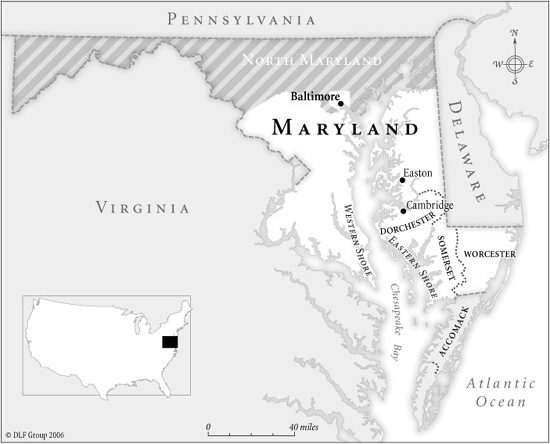
Reactionaries in these three half-emancipated Eastern Shore counties confronted freedom’s contagions both outside and inside their area. On the east, barely enslaved Delaware loomed. To the south, Accomack County, Virginia, sported many nonslaveholding fishermen, object of Governor Henry Wise’s intense suspicion. To the west sprawled the Chesapeake Bay, one of fugitive slaves’ favorite waterways toward the free labor North.
Comparisons with other endangered border areas indicate the Eastern Shore’s special predicament. North Maryland, while closer to the free North, contained far lower black concentrations. Western Missouri, while surrounded on three sides in Kansas times, contained only half the Eastern Shore’s density of blacks. South Maryland’s Western Shore of the Chesapeake Bay, while even blacker in population than the Eastern Shore, suffered no neighbors as deeply infected as Delaware and Accomack County.
Libertarian ideas within the three especially besieged Eastern Shore counties swirled as contagiously as liberty without. Nowhere else in the United States did as dense a concentration of plantation slaves work side by side with as dense a concentration of free blacks. Nowhere else in the South’s blackest belts had so many planters freed so many slaves. Nowhere else in the Old South did liberating and reactionary masters stage such a showdown.
On one side of this schism in the Eastern Shore ruling class, manumitting masters cherished pragmatic paternalism. To avoid slavery’s premature collapse, they adjusted to free and open conditions. In the manner of North Maryland slaveholders who lived close to the South’s northern border, the Eastern Shore’s manumitting masters used credible promises no less than savage lashes to keep slaves from daring relatively easy (albeit still risky) flights toward freedom. Emulating a long-standing practice in Baltimore, many Eastern Shore patriarchs promised their slaves freedom after a period of resourceful toil. Sometimes, seven years of hard work would secure the reward. More often, creditable toil during the master’s lifetime would earn liberty after the owner’s death.
This semienslaved system most resembled American colonials’ indentured servitude system. Impoverished seventeenth- and eighteenth-century immigrants had often paid their way to American with seven years of slavish labor in the New World. Then they had been freed. Initially, black labor in the Chesapeake Bay area had evolved from indentured servitude to perpetual slavery. Now, the Eastern Shore evolution crept backward toward freedom, from permanent to temporary servitude.
Paternalists, when acting as temporary masters, envisioned a future as temporary employers. While still owners of slaves, these pragmatists would prepare supposedly depraved blacks for freedom. After emancipation, employers of freed blacks would prepare wards for the final solution. Wholly redeemed blacks would eventually return to Africa, with the returning voyagers carrying American democracy, free labor, and Christianity back to their unredeemed homeland.
Where perpetual slaveholders saw blacks as perpetual children, temporary masters believed that benevolent parents prepare children to grow up. They meant to teach irresponsible enslaved wards to become responsible free workers. They saw no reason to tremble that wards who had almost grown up (their free black workers) would rouse the wards who had half grown up (their enslaved workers) to run away from a paternalistic regime that would be benevolent in all its stages. They affirmed that God had put heathens in America so that paternalists could prepare ex-Africans to redeem Africa. While Christian providence slowly evolved, evolutionary slavery allowed a property holder to procure decent work from temporary slaves.
This heady combination of crassness and Christianity brought the flexibility of Latin American slavery to the usually racially inflexible North American slaveholders. The Eastern Shore manumitters rejected a two-class theory of enslaved blacks and free whites. They affirmed the three-class slave society rampant in Cuba and Brazil, with a huge middle ground of manumitted blacks.
In the three Eastern Shore counties, conventional masters stormed at the heresy. They denied that American blacks’ rescue of Africa was a cosmic certainty, that paternalism could be saved by manumitting slaves, that black savages could be trained to be like white employees, and that free blacks would fail to infect enslaved blacks with visions of liberty. Orthodox slaveholders found themselves trapped in a world with heretics just outside, free blacks abundant inside, and compromising whites mastering half the terrain. Their crisis mentality needed only a spark to ignite a firestorm.
– 4 –
As usual in exposed border areas, fugitive slaves lit the first spark. Especially in Dorchester County, whites experienced the most provocative border scenario: an ongoing series of gang runaways, allegedly provoked by a northern Liberty Line that extended inside the South. On the Eastern Shore, freedom’s agitators supposedly included free blacks, who taught by their very presence that liberty need not be reserved for whites, and white strangers, who helped slaves flee toward liberty. The Baltimore Sun reported two results of Dorchester County’s blur of slavery and freedom:
October 31, 1857. “A Grand Stampede” of Dorchester slaves. 30 escaped, making 44 in two weeks, 15 belonging to one robbed capitalist. He offers a $3100 reward.
July 31, 1858. “SLAVE STAMPEDE—There was another slave stampede in Dorchester County, Md. last week.” Seven slaves worth $10,000+ absconded.
Such stampedes could impel owners to sell more slaves to safer Lower South areas. With more slaves fleeing north, more owners selling slaves south, and more masters offering future freedom to keep slaves toiling, slaveowning capitalism looked to be spinning out of control—and out of Maryland. Seeking to restore equilibrium, the Convention of Slaveholders of the Eastern Shore of Maryland met in Cambridge, Dorchester County’s largest town, on November 3–4, 1858. Near the convention site, a white named Haslet languished in prison, having allegedly run off seven slaves, as northern abolitionists’ paid agent. Yet another alleged heretic, James L. Bowers, having allegedly also run off slaves, had himself been run off with a festive coat and feathers.13
Alas, the allegations could not be legally proved. Only whites could testify against whites in white men’s republican courts. Only blacks knew about a supposed abolitionist agent’s supposed sabotage. Delegates to the Convention of Slaveholders thus declared that they faced triple peril: paralyzed legal deterrence inside, “the influence of abolition from abroad,” and “freenegroism in our midst.” In response, the Maryland legislature must “manfully and without hesitation” act up to the principle that “free-negroism and slavery are incompatible with each other.” If legislators fail to expel or reenslave free blacks, Marylanders would in effect “acknowledge to the world that they have not the energy and determination to protect their domestic institutions from gradual overthrow.”14
Agitated Eastern Shore reenslavers needed to arouse serene Maryland areas. Otherwise, too few legislators would favor reenslavement/departure. In hopes of rallying Baltimore, serene about its 25,680 free blacks compared to its 2218 slaves, the Eastern Shore conclave took its cause to the city. The November 1858 Cambridge Convention of Slaveholders called a statewide slaveholders’ convention to convene in almost-emancipated Baltimore in June 1859. The Baltimore assemblage, resolved the Eastern Shore convention, must press the next state legislature to make the ultimate decision: Either abolish free blacks immediately or allow slaves to become free blacks gradually.
Baltimoreans considered abolition of the middle ground too fanciful to bother considering. Not one delegate from the host city showed up in early June 1859, when the slaveholders’ convention came to town. The spurned delegates gave passing thought to moving to Frederick. They relented after a couple of Baltimoreans tardily appeared. At least all parts of the drifting Maryland establishment now deigned to listen, if some Eastern Shore fossil called the drift away from slavery disastrous.
Curtis W. Jacobs gave the drifters an earful. Jacobs, Worcester County’s favorite reactionary, had risen to Eastern Shore prominence as the leader of the 1858 Cambridge convention. He would imminently rise to statewide notoriety as leader of the reenslavers’ climactic 1860 legislative effort. In both these impassioned endeavors, sandwiched around his June 1859 agitation at the Baltimore slaveholders’ convention, Curtis Jacobs drew on his uniquely broad experience in colliding Souths. With his wife, Jacobs owned not only fifty-six slaves in Maryland (only eighty other Marylanders owned as many or more) but also a few in almost-emancipated Delaware, his native state, and thirty-six in Alabama, his ideological mecca.15 This champion of Maryland’s reenslavement/departure solution epitomized the wider problem. Jacobs could easily become the wholly Lower South planter who threw up his hands at the Border South’s irresolute drift.
Jacobs urged instead that the Maryland legislature must “terminate free Negroism at an early date, and on the most advantageous terms to our white population.” While “a prudent discrimination should be made in the case of meritorious and aged free negroes,” the rest should be forced to choose between leaving the state, selecting a master, and accepting state conscription. The state should sell “said conscript slaves,” in small quantities and at a “low” price, payable in “installments,” to nonslaveholders or owners of a few slaves. Then we would “enable our citizens of limited means” to become slaveholders. Otherwise, “lazy, degraded, immoral” free blacks, “like the locust clouds of Egypt, shall spread out over our State in all directions, paralyzing our energies, demoralizing our people, and devouring our substance.”16
Curtis Jacobs’s proposition was either genius or madness. The conscript plan was Extremism with a capital E. It would triple the number of Maryland slaveholders and double the number of slaves, if free blacks chose conscription over departure. It would obliterate the Latin American–style middle ground of free blacks and reverse eighty years of Maryland’s drift away from slavery, whichever option the freedmen chose. It would force the most compromised slave state, save only for Delaware, to swallow the most uncompromising version of reenslavement/departure, flavored with the uncompromising possibility of conscripting some 80,000 free Americans to be largely nonslaveholders’ slaves.
In the June 1859 slaveholders’ convention, Judge J. Thompson Mason declared Jacobs a genius. “The great question at issue was simply this,” urged the judge: “Shall Maryland become a Free State or a Slave State?” Curtis Jacobs realized, cheered Mason, that Maryland’s house divided could no longer stand. Marylanders could no longer survive both classes of blacks in the same place, with the one paid “off in cash, whilst the other, with an imploring look, would seem to say, ‘shall I get nothing.’”
Of convention delegates who considered Jacobs’s genius more like madness, U.S. Senator James Pearce, chairman of the resolutions committee, was the most appalled. Faced with Jacobs’s conscription, free blacks would flee the state, warned Pearce, deducting “nearly 50 percent from the household and agricultural labor furnished by people of this color.” Rather than our free blacks being “idle, vicious, and unproductive,” declared the U.S. senator, “a large portion of our soil could not be tilled without their aid.” Nor would “the great body of the people of Maryland” deprive more than 80,000 blacks “of the right to freedom which they have acquired by our laws and the tenderness of their masters, whether wise or unwise.”
A state without sufficient “white people to do the work,” concluded James Pearce, could not afford to require hardworking free blacks “to remove or go into slavery.” That choice was also morally as monstrous as “the highwayman who demands of the traveler his money or his life.” Pearce’s fellow delegates overwhelmingly agreed. They voted 59–33 against Jacobs’s proposition that “free negroism should be abolished.”
After slaveholders in the 1859 Baltimore convention had affirmed two to one that a reenslaver was a highwayman, and with Maryland nonslaveholders outnumbering slaveholders seven to one, the 1858 Cambridge convention’s plan to ask the 1860 Maryland legislature for reenslavement/departure invited another mauling. Still, eight months after the Baltimore slaveholders’ convention had in effect invited the Eastern Shore’s favorite spokesman to go live among fellow Alabama spirits, Curtis Jacobs asked compromising Maryland legislators to act like William Lowndes Yancey. In February 1860, as chairman of the Committee on Colored Population of Maryland’s House of Delegates, Jacobs reported out a bill that would have reenslaved all blacks freed after 1832, unless they departed the state by May 1.
If Maryland continued to drift toward Delaware’s “sickly sentimentalism,” Jacobs told legislators, black freedmen “would either destroy the white population … or the whites, in self defense, would destroy” the blacks. Divided Marylanders must instead resolve to “have but one mind, one will, one God” and “but two classes—white freemen—negro slaves.” Then Maryland, having adopted Alabama’s enlightened proslavery faith, and having quarantined itself from Delaware’s deplorable antislavery contagion, would “stand or fall with the South.”
Jacobs conceded that “some of Maryland’s free blacks are industrious.” Yet even the “few industrious ones” wreak damage, for they drive “an equal number of our native whites … out of the State.” Meanwhile, the “vast majority” of free blacks are “so much dead weight upon the State.” They labor badly and contaminate dreadfully, turning cheery slaves into desperate runaways. They are “the pabulum on which abolition feeds and lives in our midst.” If the legislature votes against “reclaiming our beloved state from the thralldom and blighting influence of free-negroism,” Maryland will be ruined by “her own madness.”17
The state’s shocked reaction showed the power of its middle-ground mentality. In the House of Delegates and in the Baltimore newspapers, Jacob’s foes called free blacks fine laborers. They praised the humanitarians who freed their slaves for good service. They termed slavery without freedom’s incentives a monstrous system, dependent on terror to reduce fellow humans to servility. They continued to pray that hardworking slaves would become hardworking free laborers, then hardworking missionaries to Africa.18
Stung by this overwhelming condemnation, Jacobs threatened to resign, certainly from the legislature and perhaps from the state. Compromising legislators then decided that uncompromising anti-Jacobsism, like Jacobsism itself, had gone too far. Seeking a revised middle ground, the legislators barred future manumission. They also authorized any county to hold a local referendum on whether to appoint a Board of Commissioners, charged with insuring that propertyless free blacks hired themselves out for a year.
This diluted version of Jacobsism failed almost as completely as the undiluted conception. In November 1860, most North Maryland counties refused even to vote on the Board of Commissioner proposal. South Maryland voters rejected the scheme by almost a four to one margin. Only the Eastern Shore’s Somerset County voted to establish the board, which only had power to ensure that free blacks labored. Even Dorchester County, where reenslavement had started, and Worcester County, Jacobs’s own, rejected the diluted clamp on free blacks. Jacobs’s rout confirmed that a step beyond the crossroad had been taken. Maryland would continue meandering up Delaware’s northward path, with no swerve back Alabama’s way.19
The different outcomes of the South Carolina and Maryland reenslavement crises showed that the two most dissimilar Souths headed in opposite directions. In Charleston, where free blacks’ numbers remained trivial, angry white plebeians ousted a third of the browns. In Maryland, where free blacks almost outnumbered slaves, not a soul had to depart. South Carolina gentlemen were serene enough about slavery’s internal strength to balk at reenslavement consolidations. Yet half of the Eastern Shore gentry became so distressed about slavery’s waning clout that they desperately sought reenslavement. The other half of the Eastern Shore upper crust remained so content with free blacks that they buried Curtis Jacobs’s attempt to play William L. Yancey in Maryland. The stage was set for South Carolina disunionists to fear that Abraham Lincoln’s Southern Republicans would be an immediate menace inside Maryland unionists’ middle ground.
– 5 –
The reenslavement effort, like the reopening attempt, had its revealing anticlimax after its climactic episodes. In the eastern Upper South, where free blacks were omnipresent, the Jacobs panacea largely failed. But in the western Upper South, where fewer free blacks resided, reenslavers slightly succeeded.
The older, seaboard Upper South states had nurtured ancient Jeffersonian qualms about slavery and multiple manumissions. The newer, more frontier Upper South states displayed less apologetics and fewer freed slaves. Thus in 1860, where the eastern Border South’s Delaware and Maryland contained over 100,000 free blacks (over half the two states’ black population), the western Border South’s Kentucky and Missouri contained under 15,000 free blacks (under 4 percent of their black populations). So too, where the eastern Middle South’s Virginia and North Carolina contained almost 70,000 free blacks, the western Middle South’s Tennessee and Arkansas contained under 3500.
This difference highlighted an important fact. The eastern and western Upper Souths differed from each other as much as the eastern Lower South differed from the western tropics. Just as reactionary South Carolina could never be confused with expansive Louisiana, so western Missouri’s nouveau frontiersmen could not be confused with eastern Maryland’s aristocratic dandies. But then why should reenslavement have come closer to success out west, where few blacks resided?
Because areas mostly devoid of free blacks remained mostly devoid of practical reason to resist the reenslavers. Where scant free blacks labored, scant labor would be lost if the liberated departed. Furthermore, scant liberating masters would be there to protest against their wards’ deportation.
With practical reason to oppose reenslavement slight, the panacea offered proslavery extremists easy rewards. Those who would reenslave free blacks, like those who would reopen the African slave trade, conceived that whites did not believe universally enough or passionately enough (or at all) in the abstraction that all blacks must be enslaved. Sluggish belief bred not only free blacks but also political moderation. Zealous belief would breed not only reenslavement/departure but also intransigent politics. As a tool to shock the sluggards into cheering for slavery’s genius, the abstraction that freedom and blacks must be severed was a cheerleader’s delight—especially where orthodox amens would cost few free blacks their liberty.
Yet the shock of reenslavement/departure extremism might also goad the silent toward denouncing a travesty. Of those out west who had previously held their tongues, Tennessee’s U.S. Supreme Court Justice John Catron became the most prominent protester against the reenslavement/departure shock. Catron, it will be recalled, had secured President-elect James Buchanan’s secret intervention in the so-called Dred Scott Decision. He had sought Buchanan’s help not to perpetuate slavery but to save the Union. His horror was northern extremists, not least because they empowered southern extremists. If the Supreme Court settled the territorial issue, he hoped, abolitionists and disunionists would vanish, southern calm would return, and his way of easing slavery away might slowly spread. His way: allowing some of his nominally enslaved blacks to live like respected, respectable freemen. And now in 1859, the convulsed South proposed to force perfectly respectable freemen to be slaves or to leave!
This movement in the wrong direction impelled Tennessee’s greatest jurist to go public with his outrage. Catron would not “mince words.” No “Christian country … this side of Africa” could abide the monstrosity that “the strong” could “capture the weak and enslave them.” His heart especially went out to folk who had been free for generations, who had only a speck of black blood, who owned prime property, and who worshipped in our best churches. The “great bodies of Christian men and women” will not “quietly stand by and see their humble co-workers sold on the block.”20
Catron was half right. In southern areas without many free blacks, half of the great body of Christians thrilled to the cheer that providence created all blacks to be slaves. The other half of western Upper South folks considered reenslavers to be outrageous rabble-rousers. With outrage battling cheers to a standstill, state after state fell into deadlock. In 1859–60, reenslavement/departure swept the Tennessee House but lost in the Senate, captured the Missouri and Florida legislatures but fell before both governors’ vetoes, secured two victories in the Mississippi legislature but lost on the third reading. Even in Arkansas, where the 1859 legislature decreed that free blacks must depart the state before January 1, 1860, or suffer reenslavement, the threat partially failed. Some 500 free blacks fled Arkansas before the deadline. The next legislature allowed the remaining 144 to retain freedom.21
– 6 –
Arkansas’s retreat meant that pre–Civil War reenslavers shoved not one free black into bondage, not even where free blacks were few, not even where Charleston’s proletariat rallied against brown laborers’ competition, not even where Maryland’s free blacks’ numbers almost overtook slaves’. Of the approximately 250,000 free blacks in the South when the reenslavement campaign commenced, only around 1000 South Carolina and 500 Arkansas free blacks ever traveled up exiles’ trail of tears. The skimpy yield recalled African slave trade reopeners’ slim catch from their ocean of tears: the almost 200 African unfortunates on the Wanderer.
The moral of both losing attempts at purification, to the South’s Judge Catron: Southern extremism was counterproductive and moderation safe. The judge’s moderation had so far yielded nothing more dangerous to slavery than his verbal diatribes against reenslavement and his own few slaves’ loosened chains. That loosening stood counterbalanced by Catron’s so-called Dred Scott Decision and by the judge’s failure to acknowledge or aid his own mulatto son, except once to give him twenty-five cents!22
The endlessly defeated reopeners and reenslavers, however, saw moderation’s ascendancy as dangerous. Compromised viewpoints like Catron’s had made first Delaware’s, now Maryland’s middle ground unconquerable for proslavery zealots. Moreover, Catron’s dictum that slavery equaled “might makes right” would help lead the judge and several hundred thousand Upper South anti-Confederates into the arms of northern moderates, after disunion and war engulfed the Lower South.
Three years before the reenslavement furor, Virginia’s Henry Garnett had predicted that compromised opinion would pave the northern South’s path toward the North. Maryland, wrote Garnett in 1856, is already “rotten to the core on the subject of slavery.…We could only rely on her for a few years longer.” In the next few years, as agitators farther south observed Curtis Jacobs’s futility, they thought Garnett’s prediction prescient. “Attachment to the institution is weakening on our frontier, where it ought to be the strongest,” wrote the Montgomery Advertiser, after hearing about Jacobs’s desperation in the Eastern Shore slaveholders’ 1858 Cambridge convention. “Are we not hemmed in, cramped, encircled, driven to a corner?”23
A year later, after watching Jacobs repudiated in the Baltimore statewide slaveholders’ convention, the New Orleans Crescent called Maryland “already well-nigh half-abolitionized” and Delaware only nominally enslaved. “Black Republicanism is gradually undermining the outposts of slavery, and will obtain possession of them in a few years.”24 At this uncomfortable moment, with Buchanan’s proslavery initiatives coming up empty, slavery’s frustrated defenders suffered four shocking lessons in how Yankee meddlers might invade a compromised borderland.