
Despite teething problems with the Ju 87, the RLM ordered 216 Ju 87 A-1s into production and wanted to receive delivery of all machines between January 1936 and 1938. The Junkers production capacity was fully occupied and licensing to other production facilities became necessary. The first 35 Ju 87 A-1s were therefore produced by the Weserflug Aircraft Company Limited (WFG). By 1 September 1939, 360 Ju 87 As and Bs had been built by the Junkers factories at Dessau and Weserflug factory in Bremen. By 30 September 1939, Junkers had received 2,365,196 Reichsmark (RM) for Ju 87 construction orders. The RLM paid another 243,646 RM for development orders. According to audit records in Berlin, by the end of the financial year on 30 September 1941, 3,059,000 RM had been spent on Ju 87 airframes. By 30 June 1940, 697 Ju 87 B-1s and 129 B-2s alone had been produced. Another 105 R-1s and seven R-2s had been built.
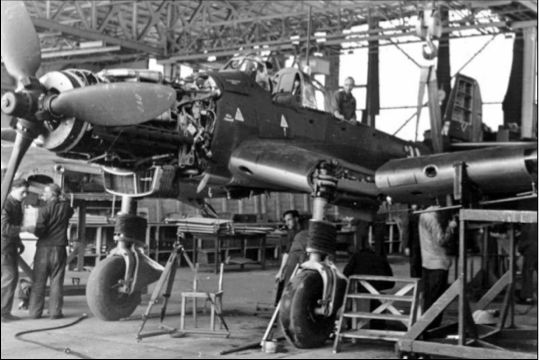
A Ju 87D during wing installation
The range of the B-2 was not sufficient, and it was dropped in favour of the Ju 87 R long-range versions in the second half of 1940. The 105 R-1s were converted to R-2 status and a further 616 production R-2s were ordered. In May 1941, the development of the D-1 was planned. It was ordered into production by March 1942. However, the expansion of the Junkers Ju 88 production lines to compensate for the withdrawal of Dornier Do 17 production meant this did not take place. The Weserflug plant in Bremen experienced production shortfalls. This prompted Erhard Milch to visit and threaten the company into meeting the RLM's Ju 87 D-1 requirements on 23 February 1942. To meet these demands, 700 skilled workers were needed. Skilled workers had been called up for military service in the Wehrmacht. Junkers were able to supply 300 German workers to the Weserflug factory, and as an interim solution, Soviet prisoners of war and Soviet civilians deported to Germany. Working around the clock, the shortfall was made good. WFG received an official commendation. By May 1942, demand increased further. Chief of Procurement General Walter Herthel found that each unit needed 100 Ju 87s as standard strength and an average of 20 per month to cover attrition. Not until June–December 1942 did production capacity increase, and 80 Ju 87s were produced per month.
By 17 August 1942, production had climbed rapidly after Blohm & Voss BV 138 production was scaled down and licence work had shut down at WFG. Production now reached some 150 Ju 87 D airframes per month, but spare parts were failing to reach the same production levels. Undercarriage parts were particularly in short supply. Milch ordered production to 350 Ju 87s per month in September 1942. This was not achievable due to the insufficient production capacity in the Reich.
The RLM considered setting up production facilities in Slovakia. But this would delay production until the buildings and factories could be furnished with the machine tools. These tools were also in short supply, and the RLM hoped to purchase them from Switzerland and Italy. The Slovaks could provide 3,500–4,000 workers, but no technical personnel. The move would only produce another 25 machines per month at a time when demand was increasing. In October, production plans were dealt another blow when one of WFGs plants burned down, leaving a chronic shortage of tailwheels and undercarriage parts. Junkers director and member of the Luftwaffe industry council Carl Frytag reported that by January 1943 only 120 Ju 87s could be produced at Bremen and 230 at Berlin-Tempelhof.
Decline and end of production
After evaluating Ju 87 operations on the Eastern Front, Hermann Göring ordered production limited to 200 per month in total. General der Schlachtflieger (General of Close-Support Aviation) Ernst Kupfer decided continued development would "hardly bring any further tactical value". Adolf Galland, a fighter pilot with operational and combat experience in strike aircraft, said that abandoning development would be premature, but 150 machines per month would be sufficient.
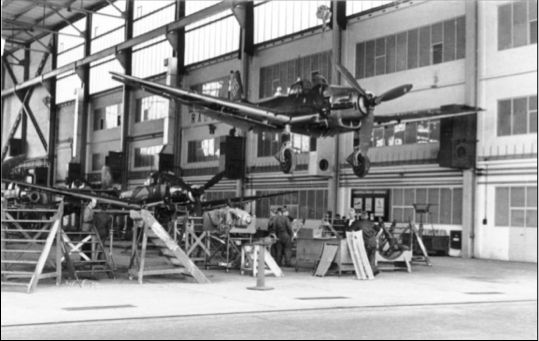
Two Junkers Ju 87 Ds near completion
On 28 July 1943, strike and bomber production was to be scaled down, and fighter and bomber destroyer production given priority. On 3 August 1943, Milch contradicted this and declared that this increase in fighter production would not affect production of the Ju 87, Ju 188, Ju 288 and Ju 290. This was an important consideration as the life expectancy of a Ju 87 had been reduced (since 1941) from 9.5 months to 5.5 months to just 100 operational flying hours. On 26 October, General der Schlachtflieger Ernst Kupfer reported the Ju 87 could no longer survive in operations and that the Focke-Wulf Fw 190F should take its place. Milch finally agreed and ordered the minimal continuance of Ju 87 D-3 and D-5 production for a smooth transition period. In May 1944, production wound down. 78 Ju 87s were built in May and 69 rebuilt from damaged machines. In the next six months, 438 Ju 87 Ds and Gs were added to the Ju 87 force as new or repaired aircraft. It is unknown whether any Ju 87s were built from parts unofficially after December 1944 and the end of production.
Overall, some 550 Ju 87 As and B2s were completed at the Junkers factory in Dessau. Production of the Ju 87 R and D variants were transferred to the Weserflug Company, which was to produce 5,930 of the 6,500 Ju 87s produced in total. During the course of the war, little damage was done to the WFG plant at Bremen. Attacks throughout 1940-45 caused little lasting damage and succeeded only in damaging some Ju 87 airframes, in "contrast" to the Focke-Wulf plant in Bremen. At Berlin-Templehof, little delay and damage was caused to Ju 87 production, despite the heavy bombings and large-scale destruction inflicted on other targets. The WFG again went unscathed. The Junkers factory at Dessau was heavily attacked, but not until Ju 87 production had ceased. The Ju 87 repair facility at the Wels aircraft works was destroyed on 30 May 1944, and the site abandoned Ju 87 links.