
The Communists adopted a combined political-military strategy, which recognized that lack of support in the South and the looming US presence stood in the way of eventual unification. In order to build support they used propaganda and hatred of Diem’s regime amongst the Vietnamese peasantry. This allowed them to use villages and strategic hamlets as cover and rest areas. Once the Viet Cong had established itself in the countryside, it had a platform from which to launch attacks on the Army of the Republic of Vietnam (ARVN), and US troops and officials.
The government in the North was aware that the Americans lacked the will to maintain a long war, and were committed to a passive strategy themselves. However, since the battle of Ia Drang in November 1965, they were equally aware of the advantage which the US possessed in firepower, and the damage it could inflict in conventional large-unit battles. As a result, it reduced its own large unit operations, switching instead to small scale attacks & harassment spread quite evenly throughout the country. Until 1968, most operations were carried out by small Viet Cong cells, spread across the South. After they were virtually destroyed in the countryside after Tet, the North Vietnamese Army (NVA) assumed a larger role. From 1965–1972 over 95 per cent of its assaults were conducted by units smaller than a 300—600-man battalion, forces which stressed high mobility and surprise, thereby depriving US and ARVN firepower of prime targets for their strategy of attrition.
By carrying the war into neighbouring Laos and Cambodia, the Viet Cong and NVA were able to build command centres out of reach of US forces, and retreat beyond South Vietnam’s borders when pursued by hostile troops. The final stage in the North’s plan to unify the country was to launch a conventional offensive, using large numbers of NVA troops supported by the Viet Cong and other elements of the South Vietnamese population. The first attempt at implementing this strategy, in the Tet Offensive was a disaster, and it took the North a further four years, during the Easter Offensive, to be in a position to launch their next significant attempt to invade the South.
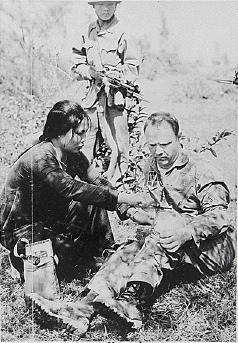
US Air Force Captain, Wilmer N. Grubb, is given first aid while being guarded by his captors in North Vietnam, January 1966
NARA
The quality of the Communist guerrilla fighter, and NVA regular was regarded by their enemy to be extremely high. Demonstrating a fanatical devotion to their cause, which helped sustain them in extremely dangerous conditions, and extreme tactical ingenuity, the typical soldier was well-disciplined, loyal, and sufficiently trusted to make low level operational decision for themselves.
Maintaining the link between the government, army, and supplies in the North with the Viet Cong and regular NVA troops fighting in the South required the construction of an intricate and well-protected artery: the Ho Chi Minh Trail which was started in 1959. Taking advantage of weak States in Laos and Cambodia, it relied heavily on access through these countries in order to avoid interdiction from the ground. In parts, some of it was mere dirt track, but by 1969 most was paved or gravel-based and capable of carrying heavy traffic. Soviet and Chinese engineers played a key role in developing the trail, transforming it into a 16,000 km chain of roads, waterways, paths and tunnels. By 1968 a 5,000 km oil pipeline had been added, with accompanying pumping stations positioned along the route.
Several thousand NVA troops would also make the trek to the South each month, with each journey taking approximately six months. Casualty rates could be high: sickness, enemy troops, and the constant threat posed by US aerial bombardment meant around 10 per cent of those who set off down the trail never completed their journey.
With the gradual escalation of US involvement, the North itself became a target. During the period of the Rolling Thunder campaign alone, over 640,000 tonnes of explosives were dropped on North Vietnam. In order to survive, North Vietnam had to establish a sophisticated air defence network. This network consisted of regional teams who were centrally coordinated from a hub at the Air Defense Command Headquarters. Most of the teams were equipped with early warning radar, Soviet-produced surface to air missiles, and missile guidance systems. In the air, the first line of defence was provided by Chinese MiG jet fighters, which proved more manoeuvrable than the US fighters sent to combat them. In total, 1737 US aircraft were destroyed and 1741 airmen killed, captured, or missing in action during the war.
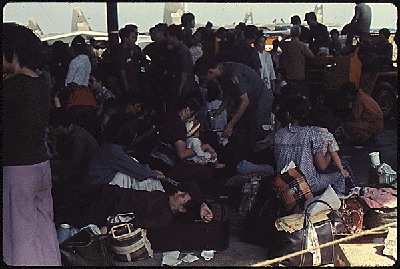
Vietnamese soldiers and civilians en route to the US at a stopover, Utapo, Thailand, 4 April 1975
The ceasefire lasted until December 1974, when North Vietnamese forces attacked Phuoc Long Province in South Vietnam. In spite of President Gerald Ford’s protests – Nixon having resigned in August over the Watergate scandal – the US did not provide any military backing for the beleaguered government in the South. As Communist troops approached Saigon, President Thieu resigned on 21 April 1975, and nine days later, his successor Duong Van Minh announced the country’s surrender to North Vietnam. All remaining US officials were evacuated from the US embassy via helicopter to ships waiting off the Vietnamese coast. Although US estimates suggest over 22,000 Vietnamese officials and their families were airlifted out of the country, and onto new lives in the US, many were left stranded on the roof of the embassy to await their fate at the hands of the conquering North Vietnamese.
In the aftermath of victory, Saigon was quickly renamed Ho Chi Minh City, and the country was formally unified on 2 July 1976.