
While it is possible with every other president involved with South East Asia 1945–73 to base an evaluation of their policies on hard evidence; with John F. Kennedy the situation is complicated by two significant issues. Firstly, more than any other president, Kennedy appeared to operate multiple, and arguably contradictory, strategies towards South Vietnam, and secondly, he was assassinated before he had the opportunity to fully implement his policies for the region. As a result, Kennedy’s role in the US escalation in South East Asia is perhaps more open to debate than that of Truman, Eisenhower, Johnson, or Nixon.
Vietnam was not a major issue for either the government or US public when Kennedy assumed office in January 1961. During the three transitional meetings which took place between Kennedy and his predecessor, Eisenhower, Vietnam was only mentioned once. For Eisenhower, the more pressing problem was the growing threat to Laos from the communist organization, Pathet Lao. However, Kennedy was already very well-informed about the issues surrounding the viability of South Vietnam. He had previously met Diem during the former provincial governor’s visit to the United States, and then visited the country in 1951, later declaring it to be the ‘cornerstone of the free world in South East Asia’.
It is easy to see why many historians regard Kennedy’s policies in office as representing both a significant escalation from those pursued by his predecessor and leaving his successor with little choice but to fully Americanize the war. From the start of his presidency, Kennedy was presented with clear alternatives with regard to his policy in Vietnam, yet at each stage chose the one representing an escalation in US involvement. As such, given the situation faced by his successor in1963–65, it can be reasonably argued that Kennedy would also have sent US ground troops to stabilize the Republic of Vietnam. Examples of these policies are the huge increase in the number of advisors from approximately 750 in January 1961 to over 16,000 by the time of his assassination in November 1963. He also decided to rapidly increase the air war, authorizing the use of US pilots, chemical defoliants, and helicopter gunships for the first time. These measures made the South increasingly reliant on US military support, and ultimately restricted the options available to Johnson during the crises of 1964–65.
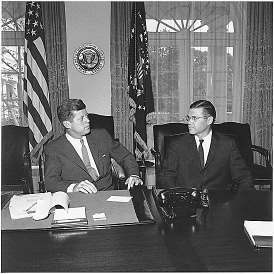
The President and Secretary of Defense, Robert McNamara, 19 June 1962
NARA
Furthermore, both in public and in private, Kennedy rejected any talk of withdrawing from Vietnam. His famous interview with Walter Cronkite on 2 September 1963 featured an outright dismissal of this option, condemning it as ‘a great mistake’. In the weeks prior to his death, his private actions reinforced this attitude. The last National Security Agency Memorandum which he authorized – NSAM–263 – clearly commits the US to ultimate withdrawal by the end of 1965, but only if the condition on the ground meant that US assistance was no longer required.
Similarly, the first NSAM written for Johnson – NSAM–273 – recommending a tougher line against the communist insurgency was, with minor differences to the version approved by Lyndon Johnson, written for Kennedy. Dated 21 November 1963, the opening section of the document states very clearly the current US position with regards to South Vietnam:
It remains the central object of the United States in South Vietnam to assist the people and Government of that country to win their contest against the externally directed and supported communist conspiracy.
Such a document would not have been prepared unless there was a realistic hope that it would receive a sympathetic response from the President.
Kennedy’s Defense Secretary, Robert McNamara, challenged this hawkish view of Kennedy’s in his 1995 account In Retrospect, claiming that ‘I think it highly probable that . . . he would have pulled us out of Vietnam.’ The evidence to support this claim lies in what Kennedy did not do, as much what he did. Critically, he refused to fully Americanize the war. When General Maxwell Taylor recommended sending a ‘flood control’ team of 8,000 marines in October 1961, Kennedy rejected this option. In a similar way, he was pressurized throughout his presidency to deploy troops to both Laos and South Vietnam, but preferred to keep US troops out of something which he fundamentally believed was a South Vietnamese problem. By the time of his assassination in November 1963, Kennedy had become persuaded by various advisors, including McNamara, and Sen. Mike Mansfield that the situation in Vietnam was virtually irretrievable, and that plans for withdrawal, already formulated, should be implemented.
Kennedy’s approach to South East Asia was governed by the related desires of preserving US credibility in the Cold War, while preventing the loss of further land in Asia to Communism. In this, as well as the commitment to defend South Vietnam, his policies owed much to the legacy bequeathed to him by Eisenhower. In spite of this, the legacy he bequeathed in turn to Lyndon Johnson, was a South Vietnam entirely reliant on the US for its political leadership and military survival. With the massive escalation of US involvement in the region, without a corresponding increase in stability, the options available to Johnson were limited, and none of these could realistically included a rapid US withdrawal.