
By late 1967, the US command in Vietnam was issuing optimistic statements about weakening of the communist forces and the likelihood that the war would be won. The US estimated they had inflicted 220,000 kills by the end of 1967, bringing the mythical ‘crossover point’ within range. Westmoreland went so far as to claim that there were only 285,000 communists left in South Vietnam. In November, his trusted group of advisors, the so-called ‘wise men’, met on 1 November and gave Lyndon Johnson and the war effort their full backing. In November 1967, Westmoreland was brought home by Johnson to spread optimism about the ‘light at the end of the tunnel’.
However, these statements were based to a considerable extent on wishful thinking. In its eagerness to make the situation look hopeful, the US command was underestimating the actual size of the Communist forces. In previous years, a tradition had grown up of declaring a truce for a few days during Tet, the Vietnamese New Year, to allow people on both sides to celebrate this very important holiday with their families. During Tet of 1968, which came at the end of January, the Communists announced a truce but then launched a stunning offensive, attacking almost every major city in South Vietnam. Thirty-six of the country’s forty-four regional capitals were attacked by a combined North Vietnamese Army (NVA) and Viet Cong of over 84,000 men. One Communist unit even got inside the walls of the US Embassy in Saigon and remained for several hours before being killed. The Communist forces appear to have been trying to win the war at a single blow. They hoped that the ARVN would disintegrate in panic and confusion, and that the civilian population would join in a mass uprising against the Nguyen Van Thieu’s unpopular government. Thieu, a former Minister of Defence, was elected President in 1967.
The Tet Offensive was a heavy military defeat for the Communists, costing them over 54,000 fatalities and failing to inspire a popular revolt amongst the ARVN and wider South Vietnamese population. These losses weakened the Viet Cong organization in the countryside drastically, and it never completely recovered. The communist apparatus in the South became much more dependent on North Vietnamese support than it had been up to this point. However, in terms of the psychological damage inflicted upon the US, it was a significant victory. Firstly, in the eyes of many Americans it opened up a ‘credibility gap’ between what the government and military was saying about the progress of the war, and what was really happening on the ground. The Tet Offensive made it obvious that the Communist forces were far stronger than US spokesmen had admitted. When the same spokesmen said after the Tet Offensive that the Communists had been badly weakened, they were telling the truth for a change, but they had a lot of trouble persuading anyone to believe them.
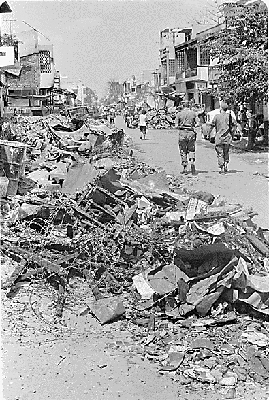
Rubble and the remains of barbed wire, after the Saigon suburb Cholon was burnt by South Vietnamese Army troops to flush out Viet Cong after the Tet offensive in early 1968
NARA
Furthermore, the Tet Offensive brought the brutality of the war into the homes of most Americans. The US Air Force had been bombing South Vietnamese villages for years and during Tet it was forced to bomb South Vietnamese cities. Similarly, the ARVN had been killing prisoners since the formation of the republic; during Tet the image of General Nguyen Ngoc Loan, chief of police in South Vietnam, shooting an unarmed, captured Viet Cong guerrilla added weight to the arguments of those protesting against the war. The Communists also committed atrocities, of course; they appear to have killed several thousand civilians in the city of Hue during the period they held parts of that city. That, however, did not happen within sight of Associated Press photographers or NBC cameramen.
These factors made the US news media much less enthusiastic about the war than they had been previously. Reporters like Walter Cronkite from CBS turned publicly against the war, ‘It seems more certain than ever that the bloody experience in Vietnam is to end in stalemate’, while his NBC counterpart Frank McGee commented that ‘The cities are no longer secure, the Saigon government is weaker than ever . . . we must conclude that the grand objective . . . is not nearer, but further, from realization.’
Militarily, Tet had a dramatic impact on American’s approach to the war. The US and ARVN victory had come at a high price. Over 3,000 US servicemen died between January and April 1968, and the total number of US soldiers reported killed in Vietnam during the year 1968 was about 16,500, the highest number for any year of the war. Westmoreland’s response was to request 206,000 more troops, believing that the huge losses suffered by the Viet Cong had effectively brought them to the brink of defeat.
Politicians in Washington drew different conclusions from the Tet Offensive. The Senate Foreign Relations Committee hearings on the war, which took place 11–12 March, called for a fundamental review of the war, while Johnson’s group of trusted ‘wise men’, meeting on 25 March, decided that victory in Vietnam was not ultimately achievable, and advised the President to refuse the request. Johnson heeded the message: on 31 March he announced a cessation of Rolling Thunder and called on the North to open peace talks. Within a year, his successor in the White House would have started the process of US withdrawal.