
CHAPTER THREE
‘The longest stick that I have’
News of the astonishing defeat at Bannockburn was received in Northumberland with trepidation, as the report of two tax collectors shows:
Richard and Robert began to tax the goods of the said men [of Northumberland] in the seventh year [of Edward II], and they sat at Morpeth in the said county; and suddenly there arrived Stephen Segrave and many others with him and they told them that the lord king was retreating from Stirling with his army and was coming towards England, and on this they were terrified. They fled, and, like others of the county, stayed in enclosed towns and castles and forts. And immediately afterwards, before the 1st August, there came Edward Bruce and Thomas Randolph leading the Scottish army . . .1
Lanercost names the leaders of this raid as Edward Bruce, James Douglas and ‘John’ Soules (by which presumably is meant William Soules, Lord of Liddesdale). The Scots entered Northumberland at Norham and marched the length of the county to Newburn on the Tyne, where they stayed three days, devastating, burning and intimidating Newcastle as William Wallace had done in 1297. Lanercost goes on to say that they crossed into Durham, but there they did not burn much because the inhabitants bought them off. However, they traversed the bishopric, carrying off cattle and prisoners. They crossed into Richmondshire but they did not enter the town of Richmond. Then, gathering together their forces, they turned north-west into Swaledale ‘and other valleys’, following the old Roman road. At Stainmore they carried off yet more cattle; but at the Reycross they met with resistance organised by Andrew Harclay of the Carlisle garrison. In the account of the king’s receiver of victuals at Carlisle it is recorded that the garrison lost 16 horses in an action there on 4th August 1314,2 a loss which suggests Harclay’s detachment came off worse. They then burnt the towns of Brough, Appleby and Kirkoswald.3 Kirkoswald’s small castle is thought to have been destroyed on this occasion;4 and it is recorded in a case in the court of King’s Bench that Scots entered Westmorland on 8th August, the day on which the county court of Westmorland was due to be held; but the Scots came around the castle of Appleby and prevented the court from taking place.5Penrith did not lie directly in the raiders’ path, but it seems to have sustained some damage, for the tenants of the Honour at Penrith and Castle Sowerby were subsequently granted a year’s protection from purveyance ‘on account of their losses during the late inroad of the Scots’.6 Scotby had already been destroyed in July; at Carlatton a fall in bond rents was said to be due to burning of the vill by the Scots on the Thursday after the feast of St. Lawrence (15th August); and Salkeld, which did lie directly in the raiders’ homeward path, had been visited in April by Edward Bruce’s men and now suffered a further loss of rents and destruction of the watermill.7 The raiders returned home by way of Lanercost Priory, trampling crops with their stolen cattle. By this it appears that they were making for Liddesdale, keeping well clear of the Carlisle garrison. On hearing of this raid, the people of Copeland bought off the Scots with 600 marks for peace from Christmas to Midsummer.
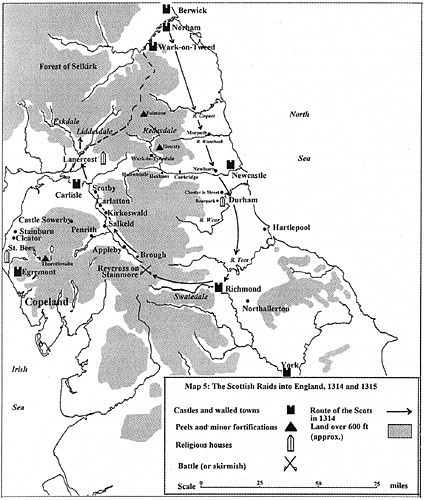
Prior to Bannockburn Robert I had concentrated on the tactical plane, throwing strategy to the wind in his efforts to survive. This first Scottish raid into England after Bannockburn appears to mark a new departure in the evolution of a broader Scottish strategy, inspired by victory in the open field. There is no documentary evidence for any change in the thinking of Robert and his commanders; this is, rather, an interpretation of events. The new Scottish strategy is characterised by increasingly long-distance raids carrying the devastation of hobelar warfare deep into northern England; secondly by concentrated pressure on two strategic points, Carlisle and Berwick; and thirdly by involvement in Ireland. The combination was only partially successful. The raids ravaged wide areas of northern England, but without forcing the English to make peace; of the strategic towns, only Berwick fell to the Scots and not until 1318, whereas Carlisle survived assault in 1315 and 1316; and intervention in Ireland ended in catastrophe in 1318. But Robert I continued long-distance raiding into northern England right up until 1322, and briefly revived it in 1327; and he persisted in interfering in Ireland. Altogether the period from Bannockburn to the peace of 1328 saw an unparalleled Scottish military hegemony in Britain, during which the mounted raids that swept across the north of England demonstrate the powerlessness of Edward II’s government in the face of Scottish aggression. ‘From the faces of two or three Scots, a hundred English would flee.’8
The outline narrative of these raids is familiar from the pages of Lanercost and other chronicles, but what is not so widely appreciated is the quality of independent evidence corroborating the narratives. The incursions they describe were spectacularly successful in demoralising the northern communities, in breaking the will to resist and most especially in the extraction of cash in return for truce. Discipline among the raiders was essential for such a system to work since English communities would not pay over large sums to the Scots if they thought that they were going to be robbed in any case. Comparison with the invasion led by Wallace in 1297 is instructive; Wallace’s occupation seems at times to have degenerated into a riot of plundering; but breach of the terms of truce was unusual during the raids of Robert’s reign.9
One does not have to search far for the motives of the Scots who participated. For the moss-troopers or hobelars on expeditions into England, patriotism, service to one’s lord, and self-interest happily coincided. There was some looting of course; but the main object of raiding was cash, more efficiently extracted through the taking of hostages than through straightforward robbery. The loot was divided out between the Scottish lords and their men. According to later usage one third of a prisoner’s ransom was reserved to the lord.10 Apart from money, and captives taken to secure payment, the Scots sought to drive off cattle which in Scottish society was the most potent expression of wealth. Cattle hides were also valuable for making harness and light armour from boiled leather. In the border districts sheep and other farm animals were also driven off from English manors; but only cattle could make a longer journey to Scotland. Inanimate booty could include practically anything. There are references to the taking of grain,11 but not enough to support the idea that raids were motivated by famine in Scotland. Precious metals, harness and armour were all especially sought after; while even household effects, books and muniments were carried off. The list of goods stolen from a Lancashire manor in 1322 included oxen, armour, weaponry, a chalice, vestments, books, bedclothes, and even pots and pans.12 A commodity which the Scots valued particularly was iron. When they raided Furness in 1316, the Lanercost Chronicle relates how ‘especially were they delighted with the abundance of iron which they found there, for Scotland is not rich in iron’.13 The Scots needed iron for the manufacture of armour and weapons, of which they were chronically short, and which they were currently importing from Ireland and the Continent. This may also explain their many visits to Corbridge, ‘the centre of the Tyneside ironware trade’.14 Similarly, their arrival in Durham on market day may not have been entirely fortuitous. The Scots, then, could steal as much for utility as ‘for gredynes’. While there were positive gains to be had for the Scots, the primary objective of the raids was negative: to drive off the enemy, burn crops, destroy his settlements, and steal his livestock. Whatever could not be easily carried off to Scotland on horseback was destroyed, and the main instrument of devastation was fire. Most contemporary buildings, churches and castles excepted, were of wood. Mills and barns were favourite targets. Growing crops burnt readily in dry weather; in wet, they would be trampled down by the stolen herds.15 The Scots were remarkably thorough in both destroying and in looting. At Hexham and Bearpark they cut down fruit trees; at Bamburgh they even dug up the rabbit warren.16
Refinements in raiding tactics were adopted during the period. Chronicle accounts give an impression of significant changes in the nature of the forces involved. Wallace’s invasion had been predominantly an infantry affair, and Robert I’s raids prior to Bannockburn seem to have conformed to this precedent. In the raids discussed in the previous chapter Robert is said to have led ‘a large army’ and ‘a great army’, and this fits in with the intensive wasting of the countryside described.17 Presumably he used horsemen to carry out the raid in 1312 on Durham, the only excursion outside the border counties prior to 1314. Cavalry is not specified in sources until after Bannockburn, from which point the increasingly long distances traversed by the raiders leave no doubt that they were mounted. The narrative of Jehan le Bel, describing the 1327 raid, confirms this impression.18 Robert’s early raids, then, were infantry invasions; but they differed in other respects from Wallace’s invasion. Whereas Wallace had confronted Berwick, Carlisle and even Newcastle, Robert took no interest at this stage in major strategic prizes outside Scotland. Steering clear of population centres and strong castles, he visited softer targets – manors, villages and monasteries. Furthermore, while Wallace spent six weeks in England, Robert’s incursions, mounted or otherwise, were all of short duration. The customary period of military service of course had a bearing on the length of campaigns. In England and Scotland alike the period of free service which the king was entitled to was 40 days; but though Edward II might (sometimes) pay to maintain troops in the field after that time had elapsed, one supposes that at first Robert I could not.
Another important (and obvious) development after Bannockburn is that the Scots penetrated deeper and deeper into England. This was partly a natural consequence of victory and growing audacity on the part of Scottish commanders. But it was also a result of the thorough pillaging of more northerly parts. Having made a wasteland of border areas, they were forced to ride further south in search of plunder. The reliance on mounted troops is confirmed by Jehan le Bel who participated in the Weardale campaign of 1327. His vivid description of the Scots on campaign is well known but still worth repeating briefly. The means of transport were ideally suited to the terrain:
. . . one and all are on horseback, except for the camp-followers [la ribaudaille], who are on foot, that is to say the knights and squires are mounted on great runcies, and the other folk of the country are all on little hackneys. And they do not bring wheeled vehicles, because of the various mountains through which they pass in this country.19
Camp-followers seem out of place in swift raiding parties; but it is easy to envisage a rabble of scavengers following in the wake of the mounted raiders, picking over leftovers in the devastated villages. The booty was carried home by sumpter horses. Much more mobile and versatile than heavily armoured knights, the raiders could not easily be brought to battle by the English. The dangers and discomforts of chasing the Scots in 1327 are narrated by Le Bel with vivid detail: the breakneck pursuit lasting several days; the pitfalls of trying to second-guess what direction the enemy might take; false reports and alleged sightings of the enemy; the misery of camping in the open; saddle sores, lack of sleep, food and water; and endless saturating rain. The Scots coped better than the English with the conditions. They brought nothing with them but little bags of oatmeal, which they baked into cakes on a flat stone, and gorged on the beef of stolen cattle. In this way they were able to move independently of supply lines. There were also changes in the routes adopted by the raiders. From 1314 to 1319 they came to prefer a characteristically U-shaped itinerary: down the Northumbrian plain on the east coast, across the Pennines by way of the great river valleys, and homewards through the western march. This route was determined by the distribution of wealth in the region, the Scots showing a greater interest in the richer eastern march than in the west. It was also dictated by prudence. Laden with spoil and slowed by prisoners and stolen cattle, they were more susceptible to attack on the homeward journey, and preferred to return by the mountains and moorlands of the west. As it was, they were ambushed by English garrisons on at least two occasions.20 The precaution of riding homewards by the western route was inappropriate to the demonstrations of Scottish military strength in 1322 and 1327. These developments in tactics may relate to changes in the leadership of the expeditions. From Bannockburn to 1322 Robert I led only one raid into England; it is rather Thomas Randolph Earl of Moray and James Douglas who figure as the leaders of the mounted raids deep into England characteristic of the post-Bannockburn period.
The Scottish raids were intended by Robert I to goad the English into recognition of his title and sovereignty. It is questionable how effective they were in this respect; but there was a pattern: each raid was followed by a period of negotiation. Directly after the raid of August 1314 King Robert sent a letter directly to Edward II, expressing his desire for peace and giving credence to his emissary.21 Truce was established on the marches from 6th October and continued until the following spring, but negotiations were interspersed with periodic recourse to arms by both sides. Talks between the English and Scots were scheduled to take place at Durham on 20th October, both about the exchange of prisoners taken in battle and about ‘a perpetual peace’.22 But the men of northern England put little faith in these negotiations and bought their own peace from the Scots. Moray was at Durham on the 17th, and before negotiations with envoys of the King of England opened he had guaranteed immunity from raiding to the ‘Community of the Bishopric’ in return for 800 marks.23 Arrangements for an exchange of prisoners taken at Bannockburn were apparently finalised at these talks; but negotiations broke down soon afterwards, perhaps as soon as they proceeded to the substantive issue of Scottish kingship. On the 24th the garrison of Newcastle was ordered to be provisioned with arrows and victuals in apparent expectation of a raid; and the tax collectors in Northumberland reported that Robert himself led another invasion of Northumberland after the feast of St. Andrew (30th November).24 This may have brought the English back to the table, for fresh negotiations began, this time at Dumfries. In October 1314, ostensibly at the request of King Philip, Edward II had ‘granted’ a truce to the Scots; but further negotiations which took place at Dumfries during this truce had collapsed by Christmas.25 Early in 1315 another large invasion threatened. The alarm was not so much for Northumberland, now virtually overrun, as for Durham and Yorkshire. The Durham truce was due to expire on 20th January; and a special emergency conference of Yorkshire magnates held in York Minster reported to the king on 3rd January that an invasion was imminent. A muster at Northallerton was planned for 20th January; and a levy of 2d in the mark on parish valuations was taken to raise money to keep the forces of four captains in the field.26 In response four keepers, recommended by the York assembly, were appointed by the king for the defence of Yorkshire, and 12 barons whose presence was needed on the eastern march were exempted from attending parliament. Fifteen other lords were ordered to attend them.27 Scots were present in Durham in the week 3rd to 9th February 1315, but the source of this information, a marginal entry on the account of the cellarer of Durham Priory, may relate either to an embassy, or to Scots collecting the money due for the truce.28 In February and March a proposal was under consideration which seems to have related to the kingship of Scotland.29 If this was the case, it was confined to the Anglo-Scottish marches. Elsewhere hostilities continued unabated; in February the English recaptured the Isle of Man, and in May the Scots invaded Ireland.
From the end of 1314 chronicles lapse into general lamentations about the severity of raids, and it is impossible to tell from escheators’ accounts whether devastation of any particular estate was recent or the result of previous incursions. It is no longer possible to discern the effects of particular Scottish incursions in the border counties; and resistance in Northumberland, beyond castles and walled towns, collapsed utterly. Clearly Robert was tightening his grip on northern England while negotiations continued. Tynedale, which since the twelfth century had been held by Kings of Scots as part of their English fiefs, returned to their faith. Scottish partisans had been active in that area since 1307 and many local lords had always supported the Scottish cause. Lanercost states that Tynedale did homage to the King of Scots and then attacked Gilsland, and the Historia Aurea bears this out:
At this time the people of North Tynedale, deserting the King of England and his faith, gave themselves up completely to the King of Scotland. They treated their neighbours the Northumbrians inhumanely, carrying off their goods and taking them away as captives. The women too went riding in warlike manner, stealing the goods which their men did not care about, such as shorn wool and linen and carried them off.30
The Scots occupied North and South Tynedale, as well as the valley of the main river including Haltwhistle, Hexham and Corbridge. In 1315, 12 vills of South Tynedale complained to the English king’s parliament, claiming that they had paid £20 15s. as a fine to William de Soules (to whom Robert had given the manor of Wark-in-Tynedale) in order that they should not have to do fealty to him and that they could remain outside his lordship. Soules had made them attend his court all the same; and the vills were consequently subjected to night-time raids by the men of Cumberland and Westmorland.They asked the king that they might be allowed to enter the neighbouring counties of Cumberland and Westmorland.31 Referring to later events the Historia Aurea adds that ’King Robert of Scotland conferred that land of North Tynedale upon Sir Philip de Mowbray, who fortified for himself a stronghold near the chapel of Falstone.32 It appears, then, that lands in Tynedale were being granted out by Robert, and that the Scots and their allies were fortifying their possessions. Clearly this was no temporary occupation; and such activities were not confined to the regalian liberty of Redesdale. Robert I also granted out other English lands: in Cumberland he granted lands belonging to Sir Richard de Kirkebride to Sir Walter Corri, his supporter.33 These grants are not proof that Robert was thinking in terms of permanent conquest; it is rather the sort of aggressive posturing that might be expected. Destruction was not yet so widespread on the western march, where resistance was stiffer, and the mountains impeded the Scottish advance; and the western march continued taking truce much longer than the east.34
In June 1315 the Scots invaded Durham. Lanercost says they entered the bishopric around 29th June. Walter of Guisborough gives the most detailed account:
In the year 1312 [sic] Sir Robert Bruce came into the Bishopric of Durham with a great army and so secretly had he come that he found people sleeping soundly in their beds. He sent Sir James Douglas to the district of Hartlepool with many armed men while he himself remained at the vill of Chester [le Street]. Sir James despoiled the said town and he led back as captives many burgesses and many women. Having collected much booty from the whole countryside they all returned to their own country . . .35
Hartlepool may have been selected for two reasons: it had been one of the English fiefs of the Bruce family but now refused to recognise Robert’s lordship; and it may already have been serving as a naval base for attacks on the Flemings and Scottish privateers. Lanercost adds that the townspeople took to sea in ships to escape the destruction. Inland, Robert de Graystanes tells how the complacent Prior Burdon of Durham was surprised by the Scots at his manor of Bearpark a week after Midsummer (1st July), losing much of the Priory’s cattle and many of his own household accoutrements. There is confirmation of this story in the proceedings against Prior Burdon which led to his deposition in 1322.36 As a result of this raid the bishopric bought truce in return for 1,600 marks, apparently for two years.37
Edward Bruce’s presence in Ireland, from May 1315 to October 1318, seems to have profoundly affected the war in northern England. The Scottish effort now divided between northern England and Ireland, and the Scots seem never to have attacked in both theatres simultaneously. A massed attack in one theatre may have required a transfer of forces from the other. Raids on northern England from this point became less frequent but more penetrating, more spectacular and more destructive when they did occur. A striking illustration of the shift to a grand Irish Sea strategy is the siege of Carlisle (22nd July to 1st August 1315). Certainly it was provoked by the ambush at the Reycross and raids into Scotland by the Carlisle garrison;38 but it was also a spectacular bid for a major strategic prize and was carried on in tandem with increased pressure on both Berwick and Carrickfergus.39
The best narrative of the siege is the original and vivid Lanercost account, clearly written by an eye-witness. Here there is space to mention only a few aspects. That the siege was attempted is testimony to the confidence of the Scots at this juncture; that it failed was due to their shortage of material and expertise:
On every day of the siege [the Scots] assaulted one of the three gates of the city, sometimes all three at once; but never without loss, because there were discharged upon them from the walls such dense volleys of darts and arrows, likewise stones, that they asked one another whether stones bred and multiplied within the walls. Now on the fifth day of the siege they set up a machine for casting stones next to the Church of the Holy Trinity . . . but there were seven or eight similar machines within the city besides other engines of war.40
The Scots built a siege-tower (or ‘belfry’) but before it even reached the walls it stuck under its own weight in ground saturated by the torrential rains of the summer. In an effort to fill up the moat they poured in bundles of hay and corn, but the material was simply swallowed up in the swollen waters. Their drawbridges proved too heavy and sank into the moat altogether. Finally the chronicler’s explanation for the abandonment of the siege, the approach of Pembroke’s expedition, indicates that even after Bannockburn the Scots could not risk a major battle in open territory. The siege had two principal effects: firstly it established Andrew Harclay’s reputation as valiant defender of the western march, and his role was acknowledged in the depiction of Harclay hurling spears from the battlements which adorned the initial capital on the charter subsequently granted to the city.41 Secondly, Lanercost remarks on the devastation which befell the countryside surrounding Carlisle during the siege, and this is borne out by other sources.
Penrith, Carlatton and Castle Sowerby were raided by the Scots on St. James’ Day (25th July 1315). At around this time James Douglas entered Copeland, harried the countryside around Egremont, despoiled the manors of Cleator and Stainburn, and robbed St. Bee’s Priory.42 On 30th July an all-out assault was launched on the eastern wall as a diversion, while Douglas’s men tried to scale the western side. He may have been wounded in the assault. On 1st August Robert gave up the siege, abandoning his engines of war, and marched off in some disarray, which allowed the defenders to capture two Scottish knights, John de Morreve and Robert Bard.43 The city remained under threat for some time to come, however, and its gates remained walled up until February 1316.
After the siege of Carlisle there were no significant raids into England for almost a year. Edward II permitted local commanders to take truces in February 1316 until Whitsun (30th May) or longer.44 In March negotiations between the kings seem to have recommenced.45 Probably a truce until Midsummer 1316 was eventually agreed at some level, though no documentary evidence of it exists. At any rate a stand-off prevailed. Scottish energies were absorbed by Ireland, where Edward Bruce had waged two campaigns back-to-back, and by the exertion of growing pressure on Berwick. English commanders (or chevetaignes) on the English marches deterred Scottish raids, but made only feeble attempts to advance into Scotland. The earls of Pembroke, Lancaster and Arundel were in turn given commands on the marches, but none of them carried an offensive deep into Scotland. Lack of money was a factor; famine caused the price of supplies to soar, and rendered it well-nigh impossible to assemble concentrations of armed men. Negotiations continued intermittently, but the Scots applied sustained pressure on Berwick and Carlisle.46 The burning of the minor peel of Thornthwaite in Cumberland in September 1315 is the only instance of Scottish activity in England at this time.47
Around Midsummer 1316 the Scots mounted their first serious attack on Yorkshire. There was a lull in the fighting in Ireland at this time, as resistance at Carrickfergus was ready to collapse, and veterans were probably withdrawn from there specially for this attack. A correspondent at York on 27th June reported that Robert was collecting his forces in the Park of Duns.48 English chronicles indicate that the Scots rode down Tynedale and through the Bishopric of Durham.49 Although the bishopric continued to purchase immunity from burning, there are signs of desertion by tenantry at Barnard Castle which might be due to this raid, for Pentecost rents due on 30th May were greatly reduced.50 New sources for corroborating narrative accounts become available from 1316: the revisions of parish valuations for ecclesiastical taxation. On 16th July 1317 Archbishop Melton’s official ordered a reassessment of valuations in the archdeanery of Richmond and this was completed by 27th July, entitled the Prima Nova Taxatio to distinguish it from subsequent revisions. The Prima Nova Taxatio covers the deaneries of Richmond, Catterick, Lonsdale and Copeland in the diocese of York, but not the northern dioceses of Carlisle or Durham.51 While medieval parish valuations rarely correspond to the actual value of the livings,52 it is reasonable to suppose that the worst affected parishes received the greatest relief. For the sake of clarity only parishes which received reductions of 50 percent or more on the original valuation are plotted on Map 6; they correspond well with the known route of the invaders. The Prima Nova Taxatio shows clearly that the Scots crossed the River Tees at Barnard Castle. Mortham was very severely affected; that parish was granted a reduction amounting to 98 per cent on its original valuation; and the vill of the same name was one of the very few settlements to be abandoned as a result of the destruction caused by these raids.53 The Scots appear to have divided into three groups; one party rode up Teesdale into the Eden valley and burnt Penrith and Carlatton;54another approached Richmond and was bought off by the nobles of the liberty who negotiated with them from the safety of the castle.55 The reduction in the valuation of West Witton in Wensleydale suggests that a third party of raiders followed the valley of the Ure into Lancashire. Perhaps payment of tribute had the desired effect of preserving property, for the parish of Richmond did not receive a substantial reduction in the assessment. Lanercost names Swaledale as the raiders’ main route west, stating that they then rode to Furness, sixty miles to the west. The Scots crossed from Yorkshire into Kendal and Lonsdale. Lancashire was thus affected by Scottish raids for the first time, and it may be because of destruction by the Scots that the county did not contribute to the subsidy granted in 1315.56 But it should be remembered that Thomas of Lancaster, now in the political ascendant, had every reason to protect his own Honour of Lancaster from taxation as the Scottish menace grew on the western march. The town of Lancaster itself cannot have been far from the raiders’ path but there is no evidence that it was attacked on this occasion. Some of the Scots crossed the sands into Furness, where they were impressed by the abundance of iron.57 They returned home by way of the Cumberland coast. This is unlikely to have been the first time the Scots entered Copeland; every parish except one in the deanery of Copeland had its valuation reduced by over 50 percent, and for that reason it is unnecessary to identify the Copeland parishes individually. A greatly enlarged English garrison at Cockermouth from 15th July to 5th August 1316 indicates the threat to security in this area.58
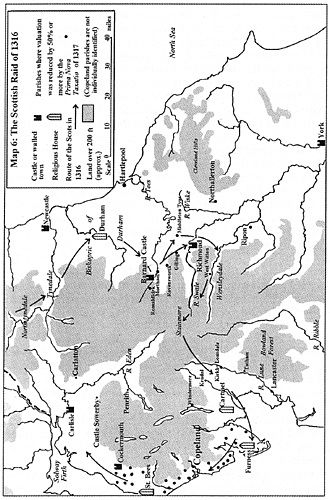
An attempt by Lancaster to mount a campaign in August 1316 failed abysmally in the midst of widespread crop failures and lack of will on the part of king and magnates. Scottish incursions continued; the mill, the whole vill and the corn of Scotby, in the Honour of Penrith, were reportedly burnt by the Scots on 29th October 1316.59 From December 1316 to Spring 1318 it is unclear whether formal truces were in place. The English earl of Arundel successfully established a powerful presence on the marches to Midsummer 1317, but without launching a significant offensive. A truce had been agreed to last from November 1316 until Christmas, and it seems that this was successively extended, so that in the event Arundel’s army was largely inactive.60 In Ireland however the war continued unabated; and Robert and Edward Bruce together led a wide-ranging campaign from January to May 1317.61
On Robert’s return to Scotland the English expected immediate resumption of hostilities, and planned a campaign for the summer. On 13th July Edward II wrote to Pembroke and Bartholomew Badlesmere that after Midsummer the Scots had been mustering, and he feared an invasion was already in progress.62 Yet there are no reports of Scottish raids that summer; the English campaign was abandoned; and the stand-off endured. Until the next spring there is little evidence of hostilities on any scale either in Ireland or in England. The famine continued, preventing the mustering of armies; but this did not prevent Scottish intrigues in northern England. In September 1317 the Northumberland revolt erupted, led by the local knight Gilbert de Middleton, but probably inspired by Robert. It opened with the robbery of two cardinals. These were Luca Fieschi and Gaucelme de Jean, papal legates sent to settle a variety of ecclesiastical disputes in England, and to impose a two-year truce on the Anglo-Scottish conflict.63 Robert ignored the truce, both because the papacy and legates failed to acknowledge his kingship, and because he was on the brink of capturing Berwick. He prevented publication of the papal bull in Scotland and had the cardinals’ messengers assaulted and their letters torn up. In September 1317 the cardinals were on their way to Scotland to threaten Robert I with excommunication and to impose terms unacceptable to the Scots. It was obviously in Robert’s interest to hire Northumbrian schavaldores to waylay the cardinals, thus escaping direct involvement in the scandal of such an assault, though there is no proof that Scots were directly involved. The English rebels had their own reasons for attacking the cardinals. They wanted to prevent Louis Beaumont from taking his seat as Bishop of Durham; and they held to ransom both Louis and his brother Henry. Aided by the Scots and possibly also by Lancaster, the schavaldores captured peels and castles in Northumberland and Yorkshire; one of the rebels, John de Lilleburne, captured the first-rank castle at Knaresborough and held it against the king in the name of the earl of Lancaster.
In the spring of 1318 the lull on the borders ended abruptly. On the night 1st to 2nd April 1318, the Scots led by Douglas scaled the wall of Berwick at a section where the guard had been bribed. The traitor is named as Peter or Sym of Spalding. The castle garrison, under Roger Horsley, held out until June 18th.64 Wark-on-Tweed surrendered on 21st May; Harbottle and Mitford fell at around the same time ‘because relief did not reach them on the appointed day’,65 and Scottish control of the east march became absolute. The following month, they seized the opportunity to launch a devastating raid, of scale and range hitherto unprecedented. The timing of this raid, late April or early May 1318, may have been significant. It took place during a truce between Robert I and the community of Durham, and it appears to have been partly intended as a sharp reminder to keep up with the instalments of tribute.66 Furthermore it is possible that the Scots intended to support Lancastrian revolt in England. But whether or not there was any more elaborate reason for it, this raid was a pointed defiance of the two-year papal truce. In a number of ways, therefore, this raid was intended to accelerate progress towards Scottish political aims. The leaders were Moray and Douglas.67
A principal source for tracing the routes of the invaders in Yorkshire in 1318 is the second revision of parish valuations to take account of war-damage, the Nova Taxatio made in 1318 to assist in collection of a papal tenth.68 Northumberland was not included, ecclesiastical incomes in the devastated region having collapsed altogether. In the Nova Taxatio of Carlisle Diocese the valuation of every parish was reduced by over 50 percent, reflecting damage caused by raids since 1307, and the same is true of the deanery of Copeland, a part of the diocese of York. There is no point in mapping the reassessment for either of these areas. The Durham Nova Taxatio is not mapped here either; but it is significant that the greatest reductions in parish valuations there occur in the upland parishes (Stanhope, Middleton in Teesdale) and around Hartlepool, the target of a second assault in 1318, a reprisal for the capture of a Scottish ship by the townsfolk.69 In Yorkshire, which the Scots had not previously penetrated to any great extent, the Nova Taxatio provides a striking illustration of the widespread extent of war damage; parishes where the valuation was reduced by 50 percent or more are plotted on Map 7.

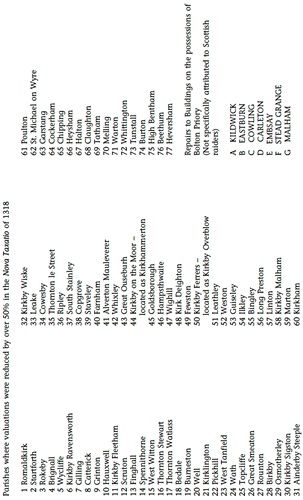
The raids on Yorkshire in 1318 and 1319 have been the subject of a short but valuable study by Dr. Kershaw. In his discussion of the Scots’ itinerary Kershaw did not attempt to distinguish between the two raids. He utilised not only the printed Nova Taxatioreassessments, but also repairs to buildings on the estates of Bolton Priory; lapsed rents on the Bolton Priory estates; and the exemptions of 46 named vills from the lay subsidy of 1319.70 The exemptions of 1319 appear to be likelier to relate to consideration of that year’s raid; but most of Kershaw’s conclusions for 1318 hold good. The Scottish raiders entered Yorkshire at two points. One group crossed the Tees at Barnard Castle; another by way of Yarm or Low Dinsdale seems to represent those who had attacked Hartlepool. The western party was making for Richmond. Not all the chronicles record that Richmond was held to ransom a second time in 1318,71 but this seems likely in view of its readiness to pay up in 1316. As the Scots continued their southward progress, raiding parties were dispatched into Wensleydale. The next town in the path of the main advance was Ripon, which they spared in return for 1,000 marks, a sum agreed by negotiation with the townsfolk who had crowded into the Minster for safety. Six hostages were taken by the raiders to secure payment, but the townsfolk avoided paying and did not redeem the hostages until ordered to by Edward II.72 Nevertheless, the valuations of the church livings of Ripon are all greatly reduced in the Nova Taxatio. Nearby Fountains Abbey also paid the Scots a fine, but did not escape destruction of its property. In the Nova Taxatio Archbishop Melton reported to the exchequer that a large part of the Scottish army stayed at Fountains and many of the granges and outlying places were despoiled.73 The Scots then rode on to Knaresborough.
The second, eastern raiding party rode directly down the centre of the Vale of York to Northallertonshire which was devastated by all accounts.74 Not only was this liberty directly in the raiders’ path, its destruction could also have been a warning to its lord, Louis de Beaumont, the new Bishop of Durham, not to upset the system of payment for immunity which the Scots had established with the bishopric. After burning Northallerton, the Scots rode along the course of the River Wiske as far as Ripon and Boroughbridge.75The front along which the raiders had been advancing, broad at first, had now narrowed considerably, both in order to avoid the city of York where resistance might be expected to concentrate, and in preparation for turning westwards up the Pennine dales. On the Sunday before the Ascension (28th May) the Scots burned Boroughbridge,76 where they broke into the king’s granary and carried away corn. Eleanor de Monkton, who had the farm of the town, was pardoned £30 in consideration of the damage they caused.
The two wings of the Scottish army converged in the Honour of Knaresborough. The current keeper of Knaresborough Castle was ordered to maintain horse and foot at the king’s wages on the approach of the Scots on 28th May.77 An inquisition bears out the Lanercost Chronicle’s assertion that the town of Knaresborough was damaged. It claims that 140 houses were destroyed and only 20 left standing.78 Damage was recorded at many other locations in the liberty, mostly in the Forest of Knaresborough, which was searched thoroughly for refugees hiding there with their cattle; and Archbishop Melton reported that the Scots stayed in the parish of Pannal and burned it on leaving.79 Not all the looting, burning of homes and barns and trampling of crops in this area was actually related to the Scottish raid, for the surrounding countryside had been wasted while royalist forces besieged the Lancastrian garrison under Lilleburne in Knaresborough Castle from 5th October 1317 to 29th January 1318. A levy had been imposed throughout Yorkshire and cash was raised to buy off the rebels, but the king’s tenants in Knaresborough and Clarhowe had been exempted from this by reason of the damage the siege had caused.80 This raises the possibility that the Scots may not have arrived at Knaresborough by coincidence. In January the earl of Moray was rumoured to be approaching to relieve Lilleburne, and it is just possible that when Moray arrived in May he expected to find Lilleburne still holding the castle. The Scots camped in the Forest of Knaresborough, and rather than making a concentrated attack in the direction of York, they made sorties east and west from their lair. The parish of Tadcaster, eight miles from the city, was ‘destroyed and wasted by the Scots’; and a petition complaining of war damage at Wetherby probably also relates to the activities of this expedition.81
Following the typical U-shaped itinerary, the raiders crossed the Pennines by several routes. The most southerly of these was through Airedale, where the parishes of Adel, Calverley, Guiseley, Bingley, Kildwick and others into Ribblesdale as far as Giggleswick were all awarded reductions in assessment on recognition of war damage; Hampsthwaite, Calverley (and Weston in Wharfedale) were described as ‘scarcely sufficient to maintain a chaplain’.82 Repairs were made to the buildings on the property of Bolton Priory at Cowling, Eastburn, Kildwick and Carleton. Another band of Scots proceeded along Wharfedale, laying waste the parishes of Leathley, Weston and Ilkley. Lanercost says that they attacked and laid waste the town of Skipton in Cravene. They certainly visited destruction on Bolton Priory’s grange at Halton (where there were repairs to buildings and lapse of rents, servants fled, and demesne and tithe corn were taken and destroyed) but there is no evidence that they attacked the priory itself.83 They followed the River Wharfe as far as Arncliffe and Kettlewell where they crossed into Ribblesdale and thence into the valleys of the Greta and Wenning into Lonsdale. The Airedale raiders rode through Skipton and into Amounderness. Then, turning northwards, they linked up with the Wharfedale group, causing great destruction in the north of Lancashire. In the reassessment of parishes, the Scots are said to have burnt all the parishes of Lancaster for six days; Warton, Cockerham and Garstang were ‘totally burnt’. Preston and Kirkham parishes were also described as ‘burnt and destroyed’,84 but war damage this far south in Lancashire in 1318 is not corroborated by independent sources. However, the county was excused most of the lay subsidy of 1319, and the town of Lancaster was excused from contributing ‘because the town was destroyed by diverse comings of the Scots, so it was said’.85 Nothing further is known of the raiders’ return journey. On 4th June the magnates of Yorkshire had been ordered to mobilise horse and foot in defence, but there is no record of resistance to the raiders.86
There were further alarms during the remainder of this year,87 but there do not seem to have been any other significant raids. Robert I had other priorities during this period. He intended to send a reinforcement to Ireland in 1318 and may well have done so.88But the Irish adventure came to an end in October of that year, with the defeat and death of his brother Edward at the Battle of Fochart, and the recapture by the English of Carrickfergus Castle. At the beginning of 1319 the Scots attempted to destroy Dunstanburgh Castle in Northumberland (still under construction); while on the western march, Moray was negotiating a truce with the men of Cumberland and Westmorland on 25th January, for which he was demanding 600 marks.89
The sources for the invasion of 1319 are not so full as those for 1318. There is disagreement among the chronicles on some points; parish valuations were not re-adjusted to take account of the damage caused on this occasion; and the fact that the Scots traversed much the same ground as they had done the previous year renders it impossible to be certain what evidence relates to this expedition and what to the previous one. Far to the north the English besieged Berwick from 8th to 18th September, Lancaster and the king having mended fences in a desperate attempt to save honour and incomes.90 Robert I was not in Berwick; but he was believed to have bound himself by oath to rescue the defenders before a certain time.91 In launching the raid of 1319 he clearly intended to distract the English from pursuing the siege and advancing further into Scotland. The first that is heard of the Scots is that they entered Yorkshire before 3rd September, while the English army was approaching Berwick. The Scalacronica and Brut narratives say that the Scots entered England by the western march. They may have crossed to the eastern march by way of Tynedale, for according to the Historia Aurea they ‘depopulated’ Northumberland, the Bishopric of Durham and Northallertonshire on their way into Yorkshire.92
There was a widespread belief that the 1319 expedition was an attempt to capture Queen Isabella, then at York. This seems ambitious, worthy of any exploit by modern ‘special forces’; but independent chronicles are consistent in their story of how a spy in York confessed the plot to Archbishop Melton and the citizens and offered to lead them to where the enemy lay in wait.93 The Flores Historiarum alleges that an English guide, Edmund Darel, assisted the Scots who were again led by Moray and Douglas.94 This chronicle and others suggest a stealth in the movements of the Scots which, while consistent with a plot to capture the Queen, is quite inconsistent with the idea that they wanted to draw the English army away from Berwick.95 Either way this expedition follows the pattern of increasingly purposeful raids directed towards political ends, in this case the capture of a hostage so important as to force the English to sue for peace. As the author of the Vita Edwardi II says, ‘Indeed if the Queen had at that time been captured, I believe that Scotland would have bought peace for herself’.96
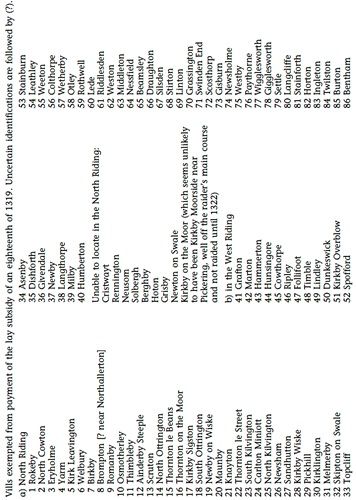
There was no reassessment of parish valuations after the raid of 1319; but there survive two lists of vills exempted from the current lay subsidy: one in the Close Rolls, the other in the Enrolled Accounts of subsidies.97 Together these name 49 North Riding vills and 57 in the West Riding exempted from the tax on account of burning by the Scots. Plotted on Map 8, they reveal a trail of destruction along the River Wiske in the Vale of York; a dense concentration just south of Northallerton; some damage around Boroughbridge and Myton-on-Swale (the scene of the battle); and finally a string of affected villages in Wharfedale, upper Ribblesdale and Lonsdale which mark the Scots’ homeward routes. Care must be taken in the interpretation of these lists; much of the damage alluded to will relate to destruction caused in the raid of the previous year. Furthermore the exemptions were clearly the result of pressure from local lords, and a lord influential in court circles would have had no trouble in securing an exemption for his vills in the area. The Close Roll names the lord petitioning on behalf of each exempt vill: 22 vills belonged to Eleanor Percy; 16 to the Abbot of Fountains; and John de Haneby had a stake in 15 of the exempted vills. On the other hand, lords out of favour or without influence may have been unable to gain exemption for their vills, however badly affected. For example, the Scots are known to have visited Easingwold in 1319, but because its lord, the Earl of Lancaster, was out of favour at the time the lists were drawn up, no mention is made of it.
The English administration and the court of the Queen were both at York, and the city was convinced that it was the target of attack. A garrison was maintained at York Castle from 4th to 13th September, and the Vicars Choral of York Minster paid a guard to keep watch along their section of the city wall for five nights consecutively. Queen Isabella was sent off to safety in Nottingham.98 In fact the Scots never came nearer than 10 miles from the city;99 but the story of a conspiracy to capture Isabella is not unrealistic. Subsequent attempts to capture individuals of importance were made no doubt to increase the Scots’ diplomatic leverage; and in Yorkshire at this time allegations of spying or guiding the Scots are common.100 The author of the Vita Edwardi II relates that a spy was captured and betrayed the plan. The invaders were discovered to be camped in secrecy at Myton-on-Swale. Archbishop Melton was instructed to resist the Scots; but only three days beforehand the king had ordered up to Berwick the whole of the Yorkshire militia.101 ‘Like another Thurstan’, Melton improvised an army of citizens, peasantry from surrounding vills, and clergy which included the staff of the chancery and the chancellor himself, John de Hothum, Bishop of Ely. The predominance of clergy in his rabble gave to the episode the name the ‘Chapter of Myton’. On 12th September Melton led this crowd out of York and across the Swale at Myton to confront the Scots.102 Placing themselves between the bridge and the English, the Scots set fire to haystacks, and from behind this smokescreen attacked Melton’s force. Fighting on foot, they easily overcame the English, who had no men-at-arms and were mostly inexperienced in war. Great slaughter ensued and many of the English drowned trying to cross the river. The mayor of York was killed, and several royal servants were taken prisoner including the notary Andrew Tang.103
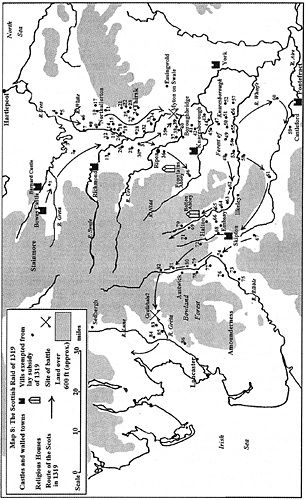
News of the battle reached the English army before Berwick on 14th September. Immediately counsels divided. Northern lords, led by Lancaster, wanted to give up the siege and return to their estates to defend them against the Scots; the king and southern lords were anxious to press on with the siege, but the army began to melt away. Thus the ‘Chapter of Myton’ necessitated the abandonment of the siege of Berwick. Yet the victory was not followed up by the Scots in Yorkshire. Rather than advancing on York, they stayed in the vicinity of Myton, causing further damage at Boroughbridge,104 and at the nearby vills of Milby, Langthorpe and Humberton. Two chronicles report that the Scots reached Castleford on the River Aire (the southernmost point which the Scots reached during this period)105 and some followed the river westwards. On 13th October the York garrison was dismissed, so presumably the Scots were well clear of York by then.106 Wharfedale seems to have been the route taken by the majority of raiders, judging by the succession of exempt vills through the Forest of Knaresborough and along the north bank of the Wharfe as far as Grassington. The grange at Halton, newly rebuilt by the canons of Bolton since the Scots’ last visitation, was burnt again and 43 of the canons’ oxen were stolen by the raiders; and their manor house and tithe barn at Embsay were also destroyed. The canons fled to safety in Skipton Castle.107
As a result of Scottish depredations Lancashire was excused payment of the current lay subsidy on 28th October,108 so the Scots probably caused widespread destruction on their way northward. As in 1318, the Scots entered Lancashire by two routes, some through Lonsdale by way of Austwick and others by the valley of the Greta. One further incident seems to relate to the Scots’ homeward journey, an ambush in a mountain ravine:
In returning homewards through western parts of England, they were set upon by a throng of Englishmen at Gratirhals, a very narrow pass. But the Scots prevailed and the English were scattered, and many were killed, including Sir Henry Fitz Hugh, and they returned with great rejoicing to their own country taking many knights and squires with them.109
‘Gratirhals’ refers to the valley of the Greta; but there are two rivers of this name; one flows west–east from Stainmore through Bowes Forest and into the Tees, the other east–west into Lonsdale. As Henry fitz Hugh held Bowes Castle from the Earl of Richmond,110 it may be that the tributary of the Tees is intended; but the Lonsdale location is more in keeping with the Scots’ return journey. Edward II had meanwhile taken up position at Newminster Abbey in Northumberland to catch the Scots on their return, but he failed to guard the western march. This appalling lapse can only be explained by a reliance on faulty intelligence, and the earl of Lancaster was now blamed for this and much besides. Following his involvement in the Northumberland revolt, the earl was popularly believed to be corresponding with the Scots. The raiders escaped across the western marches ‘like a puff of smoke’ after three weeks in England.111
Before the end of the year the Scots mounted another raid, this time on the western march. It was of shorter range and duration, but appears to have been even more intensely destructive than those visited on Yorkshire. Yet again leadership of the raiders is credited to Moray and Douglas. They crossed into Gilsland around the feast of All Saints (1st November), laying waste houses and barns full of grain recently harvested; then ravaged as far south as Brough on Stainmore. They returned after ten or twelve days and devastated Cumberland before retiring to Scotland with a great spoil of cattle and prisoners.112 The accounts of the receiver of victuals at Carlisle include large quantities of wheat, barley and beans taken by the Scots from his depot at Holm Cultram Abbey.113 This raid could well have been retaliation for non-payment of a local truce.114 Even before the Scots had returned home, the trusted English royal official Robert Baldock was on his way to Berwick with proposals for a truce.115 It was agreed that the peace should last for two years, from 21st December 1319 to Christmas 1321.116 The author of the Vita Edwardi II states that this was motivated by Edward II’s need to go to France to perform homage in person; and as an afterthought adds that it was to relieve the sufferings of Edward’s northern liegemen.117 But some progress was being made towards a lasting peace. This two-year truce was to serve as the model for the thirteen-year truce of Bishopthorpe in 1323.118
From November 1319 to January 1322 there was peace on the borders for two years, giving Robert I a chance to recover from defeat in Ireland and Edward II an opportunity to confront and vanquish the baronial opposition. The year 1322 saw three Scottish raids into England, on Durham, Lancashire, and the East Riding of Yorkshire. The particularly severe raid on the Bishopric of Durham lasted from 15th to 30th January.119 It was remembered simply as ‘the burning of the bishopric’, and by all accounts it was a terrible demonstration of the raiders’ destructive capacity. We can only guess as to why the Scots targeted Durham at this stage. Durham Priory may have refused to resume paying tribute on the outbreak of war; and it is tempting to link this possibility with the deposition in January of the accommodating Prior Geoffrey de Burdon by the warlike Bishop Louis de Beaumont.120 Furthermore the Scots probably acted in support of the earls of Lancaster and Hereford, leaders of a revolt currently raging in England. On 15th January Moray had issued letters of protection to Lancaster’s emissary who was en route to ask for help from Robert; and according to an agreement later found on the corpse of the earl of Hereford after the battle of Boroughbridge, Moray, the Stewart and Douglas were to join Lancaster and Hereford in making war on their enemies in England, Wales and Ireland.121 The actions of these three Scottish magnates in 1322 can be interpreted as a deliberate wasting of the power of Lancaster’s enemies, the Beaumonts. Moray established himself at Darlington as though poised to intervene in the civil war further to the south. Walter the Stewart led a Scottish detachment to Richmondshire (a district which could be relied upon to pay up) and he extracted from it a fine to avoid devastation. Douglas ravaged the district around Hartlepool, another favourite target of the Scots.122 The Scots did not venture far into Yorkshire but spent a fortnight in Durham, making a thorough job of the destruction of the bishopric. Robert de Graystanes asserts that the whole eastern plain of Durham was devastated, and that barns full of grain were burnt down causing famine in the following summer. Orders were given for fresh revision of parish valuations to take account of the devastation in Durham, but no schedule of revised valuations has been found.123 The records of Durham Priory are very far from complete at this juncture, but a ‘sudden and catastrophic’ loss of income on Durham Priory’s estates, known to have occurred sometime between 1319 and 1327, was surely the result of this devastating raid.124
The Scots maintained pressure on the marches throughout the spring. In March the mayor of Newcastle reported news of an invasion, for which however there is no other evidence.125 On the west, too, the Scots threatened to attack. Andrew Harclay, having gone for assistance against the Scots to both factions in the civil war and having received satisfaction from neither, made a truce with the Scots, withdrew his forces from the border and marched to Boroughbridge to prevent a conjunction between the earl of Lancaster and the Scots.126 There, on 16th March 1322, he defeated in battle the forces of the rebel earls Hereford and Lancaster, quelling the revolt against Edward II. Hereford died in battle; Lancaster was executed. For this valuable service Harclay was created earl of Carlisle.127
English preparations for a campaign went on regardless and Robert I launched a pre-emptive strike to divert the impending invasion of Scotland. Edward II had called a muster for 1st August; on 1st July the Scots invaded on the west march. At least two separate forces crossed the border, one led by Robert and described by the Lanercost writer, and later that led by Moray and Douglas:
Robert de Brus invaded England with an army by way of Carlisle in the week before the Nativity of S. John the Baptist [c. 17th June], and burnt the bishop’s manor at Rose, and Allerdale, and plundered the monastery of Holm Cultram, notwithstanding that his father’s body was buried there; and thence proceeded to lay waste and plunder Copeland, and so on beyond the sands of Duddon to Furness.128
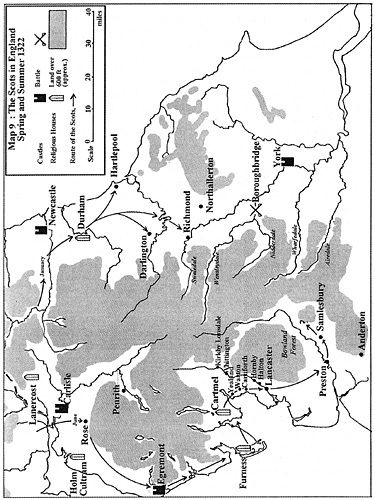
Robert passed by Egremont, burning two of the castle’s water mills around Midsummer.129 Although the Abbot of Furness entertained him and paid a ransom to preserve his lands, the Scots nevertheless plundered and burned them, and then moved on to Cartmel (where they spared the priory) and across the sands towards the town of Lancaster. They visited Yealand Redmayne and Whittington, burned the vill of Netherkellet, and destroyed tenements at Torrisholme, driving refugees before them.130 Lanercost reports that the town of Lancaster was burnt except for two religious houses. Here Robert met up with Moray and Douglas, who had arrived by way of Kendal, Whittington, Hornby Castle and Quernmore Forest on 2nd July. They had run into some resistance, for two of the Scots were taken prisoner on Hornby Moor. The Scots stayed at Lancaster for four days and nights in the fortnight after Midsummer. There was extensive damage, shown by a list of decayed rents in the town which mentions trampling of crops and spoliation. Townsfolk subsequently petitioned for the right to take timber to rebuild the town, and the castle too was burned.131 The combined Scottish force then rode to Preston, visiting Moorholme and Skerton (where the whole village was burned, and corn in the fields trampled down) on the way. Lanercost says that here only the house of the Minorite Friars was spared from burning. A rent roll of tenants at will at Preston in 1324 shows slight evidence of destruction by the Scots, but perhaps recovery had been swift. Again the inhabitants had subsequently to petition for timber to help with rebuilding.132 Some Scots rode 15 miles further south; and an inquisition reveals details of pillaging at Samlesbury manor a little to the east of Preston.133 On the return journey the Scots stayed around Carlisle for five days trampling crops and destroying what they could. They crossed back into Scotland on 24th July. An entry in Bishop Halton’s register supports this, but asserts that the Scots stayed about Carlisle for eight days.134 In addition to being a necessary gathering of supplies in preparation for the impending English invasion of Scotland, the raid may have had other purposes. In Lancashire the Scots were probably searching for the great cattle herds of the recently executed earl of Lancaster, which they may previously have refrained from stealing. Furthermore the intensive wasting of Cumberland could well have been directed against the growing influence of Harclay on the western marches.
This spectacular raid on Lancashire could not of course prevent the English invasion of Scotland in August 1322. Edward II’s huge army of almost 20,000 infantry, many heavily armed, bypassed Berwick and marched up Lauderdale towards Edinburgh. Robert had ordered the evacuation of all livestock from Lothian, a ‘scorched-earth’ retreat depriving the English of forage. Edward had arrived at Musselburgh on the coast near Edinburgh by 19th August without encountering any opposition; and at the port of Leith he awaited for two days the arrival of his supply ships. This fleet however had been scattered by Flemish privateers and wrecked by storms. Given the sheer size of the army, supplies must already have been low. Famine and disease were soon rife in the camp. Before the month was out the whole expedition was back across the border.135 Edward returned to England on about 2nd September, but he announced his intention of remaining in the north. On 26th September he wrote from Durham to the constables of four northern castles, rebuking them for inactivity in the face of Scottish incursions. In his letter the Scots were said to be entrenched around Norham Castle and making a determined effort to capture it. The four were Bamburgh, Warkworth, Dunstanburgh and Alnwick – suggesting that Wark-on-Tweed was either in Scottish hands or had been slighted. The Scots were re-asserting their control of Northumberland, and refugees were now flooding into Yorkshire.136
On the western march, after the failed invasion of Scotland, Andrew Harclay commanded at Carlisle a huge concentration of cavalry, 280 men-at-arms (of whom four were bannerets and 30 knights) and 500 hobelars.137 But this formidable power ceased to be in the king’s pay at the end of September. It then disbanded, and Robert struck immediately. On 30th September he crossed the Solway Firth at Bowness and ravaged the vicinity of Carlisle for five days, until 5th October. The devastation of the district around Carlisle, the third recent wasting that the area had endured, had made it impossible for Harclay’s army to regroup. Harclay went south into Lancashire to raise forces; but Robert swept on, raiding Castle Sowerby, Scotby and Carlatton on his way across the Pennines.138Lanercost alleges that he was from the first seeking a confrontation with Edward’s entourage, and that he was informed of the whereabouts and meagreness of Edward’s forces by spies. This expedition too can be interpreted as an attempt to force the English to concede sovereignty to Scotland by the capture of an important hostage.
English reactions were unco-ordinated. On 2nd October Edward II, travelling southwards from Barnard Castle, became aware of Robert’s presence on the west march, and summoned ten northern magnates including Harclay to attend him at ‘Blakehoumor’, a location on the North Yorkshire Moors. They were to impose a levy of all able-bodied men between the ages of 16 and 60. Later the king was outraged when Harclay failed to appear.139But after the ravaging of his lands and dispersal of his men, Harclay could not give chase immediately to Robert; he went south into Lancashire to muster forces:
This he did, having taken command of the county of Lancaster so that he had 30,000 men ready for battle; and since the Scots were in the eastern march, he brought his forces by western parts to reach the king.140
One of the Lanercost authors is favourable to Harclay, interpolating in the original text an explanation of Harclay’s motives and actions; but Harclay may not still have been the devoted servant of Edward II. His regrouped force moved from Lancashire over the Pennines, but delayed long enough to ravage Airedale;141 and he may have been awaiting the outcome of events rather than rushing to the king’s aid. Edward can scarcely have believed that there was a threat to his personal safety as yet. With him were Pembroke, Richmond and the recently created earl of Louth, John de Birmingham, who had 74 mounted men-at-arms and 115 hobelars in his retinue; he expected to be met by Harclay with more troops.142 Archbishop Melton at Nun Monkton thought the Scots were near Richmond as early as 5th October; but at this date his panic may yet have been unjustified, for according to most accounts Robert had not yet left Carlisle.143 Then on 13th October Edward was informed that the Scots were at Northallerton. That evening, from his camp at Rievaulx, he began frantically issuing orders to Pembroke, Richmond and Beaumont to assemble magnates and militia ‘to attend with all possible power’ in the morning at ‘Blakehoumor’. Moray was now only 15 miles away at Malton.144
Scottish movements in Yorkshire can only be interpreted as an attempt to confront the person of the English king. The main Scottish army occupied the Vale of York, destroying Thirsk and other parishes in that vicinity.145 Some chronicles report that Ripon was attacked and many people killed, but a letter in the Chapter Act Book of Beverley says that the men of Ripon made a composition with the Scots.146 Suddenly on 14th October from the west the Scots converged on the royal party, and Edward fled from Bylands Abbey to Rievaulx. The presence of Moray at Malton 15 miles to the north west of Rievaulx on the day before the battle, together with destruction of the coastal parishes of Whitby and Guisborough, implied by the revision of parish valuations,147 suggests that Moray had been sent around the North Yorkshire Moors in pincer fashion to catch Edward in flight from the main Scottish force. As that force began advancing uphill towards Rievaulx, the English took up a hilltop position near Coxwold and Old Bylands to bar its progress and give Edward time to escape.148 The earl of Richmond, the French magnate Henry de Sully and other prisoners were taken; and the Scots obtained a windfall of abandoned harness and silver plate from the royal household at Rievaulx.149 Edward, ‘chicken-hearted and luckless in war’, was suddenly forced to flee via Pickering, Bridlington and Burstwick, taking ship to York, having abandoned all his valuable household effects to the Scots.150
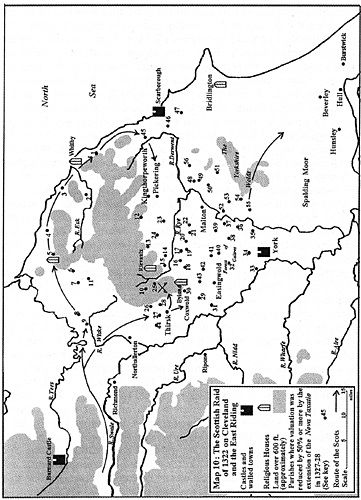
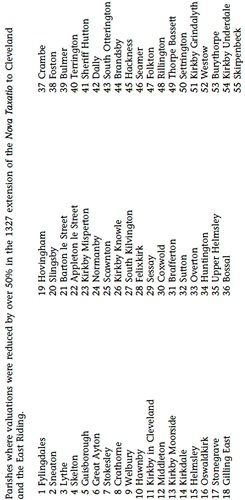
Moray now occupied the Vale of Pickering, another of Lancaster’s properties which he may have spared hitherto. At Malton he had made an agreement with the men of the Vale not to burn the district for a ransom of 300 marks.151 Nevertheless a manor house was damaged by raiders at ‘Kingthorpeworth’, and the keeper of the Honour of Pickering was captured.152 In 1327 parish valuations in the archdeaconries of Cleveland and the East Riding were revised, and this provides an indication of which areas were most severely affected by this raid.153 Coastal parishes were destroyed, probably as the eastern wing of the Scottish army under Moray had advanced towards the English court.154 On the flight of Edward II, the Scots took possession of the East Riding, unaffected by the raids until now. Most of the canons of Bridlington were evacuated. Those who remained sent an emissary to the Scots at Malton, choosing Robert de Bayntone, ‘one of our canons, because his parents lived among them, so that the monastery and our manors might be spared from the flames’. When the Scots arrived, the canons offered accommodation and nine Scottish horsemen with 18 horses were billeted in the monastery.155
The college of Beverley prepared to hide their treasures, as this letter shows:
If the townspeople make a composition for the town and church, as Ripon did, well and good. But if sudden danger comes take Sir Alan with you and no one else, and secretly place the relics of the Saints and the inner chest [of St. John’s shrine] in the treasury in the best place you know. And if great necessity arises, remove the silver plates of the outer chest and place them in a certain place.
The college also wrote to Robert on 20th October, begging protection, and according to Adam Murimuth they bought off the Scots for £400.156 The men of Spaldingmoor and ‘those north of the Humber’ paid ransoms; and the Meaux chronicle records that the Scots ‘raised their standard’ at Hunsley, near Beverley.157
The chronicles are more struck by the audacity of the Scots in entering the East Riding than by the destruction they wrought there. Judging by the revised parish valuations in these southerly areas, the payment of ransoms did help to preserve property values. The map of revised valuations suggests that a part of the Scottish army, presumably that under Robert, had turned south after the battle, devastating Hovingham, Terrington, Sheriff Hutton and the Forest of Galtres, almost as far as York. Somewhere to the north of York Moray rejoined this force; but the united army probably turned back before 22nd October when the York garrison was reduced to its normal level.158 There are a few clues as to how the Scots returned home. Ravaging was reported at Cottingley in Airedale; Barnard Castle estates are said to have been burnt around the feast of St. Jude (28th October); and finally at Skipton Castle the garrison was increased from 16th October to the 18th ‘on account of great danger which then at that time threatened, in those parts, from the attacks of the Scots who burnt the said districts, despoiled and totally destroyed them’.159 One of the chroniclers reports that the Scots were forced to return home because of the onset of winter, and this may be a reference to heavy rains and flooding which occurred in Yorkshire at this time.160 One party of Scots raided Teesdale on their way home, on 28th October. Lanercost states that the raiders returned to Scotland on 2nd November, having been one month and three days in England,161 the longest time they had yet spent there.
Even this raid, though disastrous for the north of England and for the‘ personal prestige of the monarch, had no effect on English policy towards Scotland. Edward II had no intention of giving up his claims and as early as February 1323 was preparing for yet another campaign.162 But during the winter Andrew Harclay, who had been the north’s most vigorous defender, made a unilateral peace with the Scots, surrendering all claim to Scotland.163 The region was plunged once more into a state of emergency. The prospect of peace had considerable local support, according to the sympathetic author of the Lanercost Chronicle:
. . . the poor folk, middling people and farmers in the northern parts were not a little delighted that the King of Scotland should freely possess his own kingdom on such terms that they themselves might live in peace.164
Harclay was perhaps a natural leader; but he was also grasping, rapacious and commanded no broad base of support among the local gentry. Their jealousy of him brought about his downfall. He was surprised in Carlisle Castle, easily arrested and executed for treachery. Thus Edward II destroyed his kingdom’s main bulwark against the Scots, but did not recognise it and in the spring of 1323 continued doggedly with preparations for a campaign. To increase pressure on Edward, the Scots began threatening another invasion of Lancashire. But the prospect of a French war now loomed, and Edward was forced to reconsider. At a council in Bishopthorpe on 30th May 1323 a thirteen years’ truce with Scotland was resolved upon, pending conclusion of a final peace.165 Even then, Robert’s harrowing of the north was not quite over; there was more to come in 1327.
From 1314 to 1322 the Scottish raids into England became not only progressively more destructive and more wide ranging, but also increasingly purposeful in their timing, their methods and their targets. Realising the insensitivity of the English administration towards the north of the country Robert grasped the need to direct his attacks more pointedly at the administration. To achieve this dissident elements in England were offered and received military support; at first mere gentry such as Middleton and Lilleburne, and afterwards the heavy-weights, Lancaster and Harclay. He conceived of capturing an important prisoner whom the English could not fail to redeem, such as the Queen or Edward II himself. But Robert’s growing ingenuity only illustrates the point that the devastation of northern England was not having the desired effect on the government. Before relinquishing their claims to Scotland Edward and his magnates abandoned the north to over a decade of destruction.
EFFECTS OF THE RAIDS ON RURAL COMMUNITIES
To gain some idea of how war affected agrarian society, we should survey the five main aspects of the rural economy: sheep-farming, cattle-farming, arable farming, rental incomes and the peasantry. The succession of natural disasters looms large: crop failures caused by torrential rainfall from 1315 to 1318; sheep disease in the years 1313–17; and cattle murrain from 1319. In his entry for 1316, the author of the Flores Historiarum states that ‘in the kingdom of England three cruel scourges afflicted the people most horribly even unto death’, and he identifies them as the raids of the Scots, the famine, and pestilence.166
During the years of the Scottish raids many of the sheep flocks of northern England diminished in size and wool exports sank dramatically. But the role of warfare in bringing this about can be exaggerated; and there is an alternative explanation of the disruption in the sheep epidemic of 1313–17, a result of heavy rainfall. A useful source for the fortunes of the peasant sheep farmer are the renders of wool and lamb tithes. The Prior of Durham was rector of the Northumberland parishes of Norhamshire and Islandshire (known jointly as ‘North Durham’) situated right against the Scottish border. It is estimated from the wool tithe receipts that as many as 3,600 sheep were maintained by wool producers in these parishes.167 Up to 1314 the wool tithe from these parishes amounted to five or six sacks of wool.168 Just across the Tweed from Scotland, these flocks should have been a prime target for marauding Scots; and the fact that renders showed no decline as late as 1314 is a strong indication that the Priory was buying off the Scots to secure immunity from raiding for these parishes.169 After 1314 there is a hiatus in the accounts of the Priory which corresponds to the worst years of the Scottish raids, but during this time we know from chronicle sources that the area suffered dreadfully from the ravages of both Scottish and English armies. The next tithe proctor’s account is a retrospective compilation covering the years 1317–20, which makes no mention of wool or lamb tithes.170 The next available figure after that is for 1328, when only two sacks and 18 stone of wool were collected.171 Yet by the accounting year 1330/31 the wool render had returned to its pre-war level of six sacks.172 From this it seems that although wool production was very severely affected during the raids, the recovery was total and relatively swift. Undoubtedly many peasant producers had withdrawn their flocks as they themselves fled from the Scots. An increase in income from the ‘small’ tithes (of lambs, wool and other commodities) of these parishes in the 1330s leads Dr. Lomas to suggest that sheep farming was expanding at the expense of arable farming.173 The evidence of a recovery in sheep farming at Norhamshire and Islandshire is supported by that of wool tithe renders of Ponteland.174 During the truce year 1323/24 both the wool and the lamb render had made a recovery, with 140 lambs sold and 14 stone of wool. By 1329/30 income from wool tithes had surpassed the 1312 figure.175 The remarkably swift recovery suggests that Northumberland flocks had been preserved, perhaps by evacuation of flocks from the war zone.
Further to the south, the records of Durham Priory allow some insight into the fortunes of a large-scale wool producer. Wool sales at Durham dropped dramatically during the 1310s and did not easily recover. In the 1308/9 account 20 sacks of good wool were sold; in 1318/19 sales had dropped to half of this.176 The overall size of the flock at Durham is unknown; but what information there is suggests a serious decline in size. At Le Holm, the main Durham sheep farm, there were 1,195 sheep of all categories in 1310; in 1323 there were only 580.177 The accounts of Durham’s nearby cell of Jarrow may provide an analogy with what was happening to the flocks of the mother house. In 1313 the Jarrow monks had 275 sheep of all kinds and 133 lambs; in 1321 this had dropped to 168 sheep and 67 lambs; in 1326 to 10 sheep and 30 lambs.178 The loss was not easily made good. But were the Scottish raiders to blame? They are known to have disrupted sheep farming in Durham on at least two occasions: in 1315 they drove off ‘a large number’ of sheep, and in 1322 during the ‘burning of the Bishopric’ flocks had to be evacuated to Cleveland and 40 of the better sheep were lost ‘in the abominable depredations of the Scots and others’.179 Yet these were exceptional occasions; as a rule Durham Priory was able to pay off the Scots to keep its livestock safe. Although there is no positive evidence either way, the serious decline in Durham wool sales and in the size of the Jarrow flocks is more likely to have been caused by disease, a much greater agent of sheep destruction than marauding Scots. Murrain was ravaging the flocks of other northern communities at around this time.180
On this evidence the tentative conclusion must be that the Scottish war was the cause of serious but temporary disruption to sheep farming along the borders; but that further south, in Durham, sheep murrain of 1315 was chiefly responsible for a severe and long-lasting decline in the size of the Priory’s flock. On this basis one has to remain sceptical of the testimony of the ‘Inquisitions of the Ninth’ in 1341, which suggest that the Scottish raids of this period had a lasting impact upon wool and lamb tithes in Yorkshire and Lancashire; though it is possible that the evidence of the Inquisitions for other sectors may be perfectly valid.
Medieval cattle were also vulnerable to disease. Lanercost records the spread of the cattle murrain:
(1319) At the same time the plague and the murrain of cattle which had lasted through the two preceding years in the southern districts broke out in the northern districts among oxen and cows, which after a short sickness generally died; and few animals of that kind were left so that men had to plough that year with horses.181
Dr. Kershaw has tentatively identified the disease as rinderpest; and its effects were devastating. At Bolton Priory the number of oxen on demesnes fell from 139 in 1318/19 to 53 in 1320/21; and the cattle herd fell in size from 225 head in 1318/19 to only 31 before the Scots arrived in 1319. Nostell Priory lost 59 oxen and 400 cows and calves to the epidemic. Further north, at Ponteland, six oxen died in 1319/20 ‘of the pest current in the countryside’.182 But cattle were also the prime target of the Scottish raiders. It is difficult to escape the view that the north of England must have been progressively denuded of cattle during most of the period 1312–1322. The absence of cattle from the region during the 1310s and early 1320s is evident from three recurring features in manorial accounts: shortage of plough oxen; the near impossibility of finding tenants for pasture, described either as ‘herbage’ or ‘agistment’; and abandonment of the woodland and high seasonal grazings or ‘sheilings.’ The most widespread complaint in manorial accounts is not physical damage by the Scots, but rather the inability to obtain a decent price for grazings as a result of the flight of the tenantry and the evacuation of herds. At Hexham winter and summer agistments in Alwentondale, worth £20 in peacetime, brought in only 10s. in 1315; at Barnard Castle revenue from grazings was greatly reduced ‘because of the lack of animals on account of the Scottish raids’; at Moorholme, Cockermouth, Skipton, and almost every other manorial account which survives from the war years the same excuse is offered.183 As the cattle were driven off by raiders or evacuated by their owners, so the sheilings were abandoned. On the Alnwick estates, a sheiling at Alnham on the slopes of the Cheviots paid no rent from 1315/16 until the account ended in 1318. The keeper of Hexham provides a list of abandoned tenements in the Allendale district, which, to judge by the placenames, are all seasonal pastures – Eskynscheles, Yarrug, Grenerrug, Botland and Nove Terre. These, too, do not recover during the period of account (1315–17). Pastures in Inglewood, which earlier in the war were used to conceal cattle, were also abandoned. They also seem to have been among the last tenements on the western march to recover: during the truce, in 1323/24, the holdings of Highhead and Selwra in Inglewood still paid no rent, while rents in Plumpton and from seven other agistments were reduced ‘for default of animals and destruction of the countryside by the Scots’.184 The Earl of Lancaster’s great cattle-ranching operation in the western Pennines seems to have been greatly diminished by the raid of 1322. The rental of the lands formerly belonging to the earl shows that the productivity of vaccaries in Blesedale and Wyresdale was reduced because ‘all other of the lord’s beasts there were driven away by the Scots’, making it impossible to ‘demise’ (or let out) herbage. In Blackburnshire positive evidence of Scottish activity is limited, but here, where previously the de Lacy earls had maintained 2,400 head of cattle at the turn of the century, there were at Michaelmas 1324 only 415 recorded.185
But the sector most severely affected by the Scottish war was surely tillage, vulnerable at every stage to devastation. Ploughing was inhibited by the theft of draught oxen by the raiders, or their evacuation by the owners; and plough oxen were more liable to abduction than other cattle because they were kept at the manor farm during the summer months, whereas other cattle were safe on the high sheilings. At Wark-on-Tweed, the keeper of the estate accounted for the reduction in profit from arable demesne with the claim that ‘there were beasts enough neither to graze nor till the land’.186 Sowing was also occasionally disrupted by war. Antony Lucy, keeper of the Liberty of Hexham in 1315/16, reported that the demesne lands (the lands which the lord reserved to his own use) rendered no profit:
nor was it possible for the said land to be sown by the keeper during the said time, on account of the frequent attacks of the Scots, nor did any one wish to take herbage on the said land for the same reason, and also on account of the shortage of animals.187
Crops were especially vulnerable when growing, and the burning of crops is referred to repeatedly in both chronicles and manorial accounts. Hay and corn were burnt when the Scots arrived unexpectedly at Bearpark in Durham in 1315.188 Demesne rents at Salkeld near Penrith were reduced in 1323/24 ‘because the tenants were so destroyed by the Scots who burnt the vill and the corn entirely on the first of this year’.189 Standing crops were also trampled by the herds of stolen cattle driven north; for the Scots this appears to have been a favourite and effortless means of destroying livelihoods.190 Harvesting at Stamfordham near Embleton was interrupted in 1313/14 when the labourers tying up sheaves were attacked by the Scots.191 Grain remained vulnerable even after it had been gathered in, for barns were invariably of wooden construction and burned easily. Reference has already been made to the burning of barns on the western march in the autumn of 1319, and in Durham early in 1322, which caused severe scarcity that summer.192Mills, too, were obvious targets for the Scots, and destruction of water and windmills is noted at Norham, Bamburgh, Penrith and many other places.193 These expensive structures represented considerable investment and could not easily be replaced. It is this destruction of capital equipment that explains the slowness of arable farming to recover.
The effects of war on grain production are illustrated by the cash income from the sheaf tithes of Durham Priory’s churches at Norhamshire and Islandshire (Chart 1).194 The tithes were extremely sensitive to military activity; this we might expect from two parishes situated on the border itself. Yet Durham Priory’s ability to buy off the Scots staved off the impact of war until relatively late; these border parishes seem to have been protected until 1315/16. But then as with the wool tithes in the same parishes, a dramatic fall occurs. Although the price of wheat soared on account of the crop failure, the cash income from the sheaf tithe plummeted, indicating that grain production had fallen away to almost nothing in 1316. No explanation for the fall is given in the sources; but given the exposed position of these parishes, one can scarcely ascribe the collapse of these revenues to harvest failure. The Scots must have destroyed the miserable harvest of 1316 and the two succeeding years, probably because the priory failed to pay protection money. Thereafter, the tithes of 1319 are said to have been ‘destroyed’ by the English army, then encamped nearby at the siege of Berwick.195 These tithe incomes never fully recovered, and in that respect the contrast with the swift recovery of sheep farming in the same area is striking. The same sources also contain records of ‘mulcture’ or income from the mills in these parishes. From 1300 this had been a steady £3.10s., dropping to £1 in 1313 but recovering in 1314 and 1315. The Bursar’s Account Roll for 1316/17, however, contains a note to the effect that all the mills in the parishes had been destroyed. This is repeated in the subsequent roll; and income from this source is not mentioned again until 1329, when the much reduced figure of £1. 3s. 0d. is recorded. This same pattern, a sudden collapse of income during the 1310s, is replicated in the records of the sheaf tithes of Holy Island, Durham’s cell in the parish of the same name. Holy Island tithes had brought in £112 per annum, but in 1326 they were worth only £47, and they continued to decline, to £21 in 1327 and £15 in 1328.196
Another aspect of the war’s impact on arable farming is a curtailment of arable acreage. Terra frisca or terra vasta, both of which are usually translated as ‘wasteland’, was not necessarily unproductive,197 but in the wake of the Scottish raids countless acres of ploughland, demesne, husbandlands and bovates are recorded as frisc, and it is evident that these lands which had once regularly produced corn were now greatly under-exploited if not abandoned. The desertion of arable land is especially marked in Northumberland. When accounts begin at Wark-on-Tweed in 1323 there were 936 acres of arable demesne ‘which no-one dared to cultivate for fear of the Scots’ and 416 of untilled husbandland.198 All over Northumberland, the situation was the same: Hexham, Little Ryhill, Shotton and Alnwick all had the same problem, the mass desertion of tenants.199 West of the Pennines the situation was the same: Robert Tilliol’s manor of Scaleby, which included 24 acres of demesne and 40 bovates, rendered nothing in 1321 because the country was so wasted by the Scots.200 At Penrith only 15 acres of demesne land out of 120 were demised to tenants in 1317/18; and at Castle Sowerby all 2541/2acres of demesne, together with 664 acres of assartments, lay frisc and uncultivated.201Examples could be multiplied, but these instances give some idea of the extent of the waste caused by the desertion of the tenantry.
The catastrophic effect of the war on rental income of all kinds is attested by constant repetition of the same refrain in manorial accounts throughout the north of England: ‘unable to rent out for more on account of the frequent raids of the Scots’ or ‘on account of the poverty of the tenants’. From the frequency with which these phrases appear it seems that the flight of the tenantry from the war zone was a much more widespread problem than the actual depredations of the raiders. Detailed and accurate pictures of how raiding affected the payment of rent can be constructed from accounts of two individual estates. The first is at Alnwick, where an account covers the period 1314–18; and Dr. Scammell calculated that agricultural rents on the estates fell by 4.1, 16.5 and 28.6 per cent in successive years.202 The account reveals successive rent reductions in an effort to retain tenants, and a steady diminution in the acreage rented out:

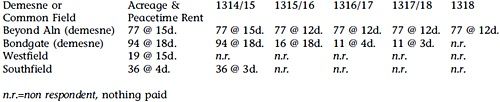
The explanations offered for this catastrophic decline in rental income are: ‘the destruction made in the countryside by frequent Scottish attacks’; ‘the impoverishment of the countryside’ by the same; and simply ‘default of tenants’. Rents kept up best on the demesne lands, demesne being generally better quality land than bondland or land in common fields and therefore the last to be abandoned.
Another estate for which detail is available is the Honour of Penrith (Chart 2).203 Here the decline of rental income may be related to specific raids through a set of accounts spanning the period 1307/8 to 1329/30. The graph shows income from all rents (soke, bond and demesne) in these years. But the nature of the evidence requires that it be handled with caution. The graphs are not independent of one another; the same official, the keeper, accounted to the exchequer for all the manors. The uniformity of the first five years reveals the artificiality of the process; here the keeper of the Honour simply paid the exchequer the sum which it had come to expect. No explanation is available for the sudden hike of 1312/13; and thereafter the keeper seizes upon the Scottish raids as excuses for reducing his render. It becomes clear that fluctuations in rental income are only loosely related to the Scottish raids; in several instances income rises even though that manor had been raided the previous year. Most strikingly, the raids of 1322 and 1327 fail to prevent a rise in the income from all the manors. There are, then, many other factors at work besides the Scots, though the only indication of natural disaster is an isolated reference to flooding in 1317, and another to a storm in 1327/28.204 The gradual recovery after 1322 may be due to the truce with Scotland, to genuine improvement in economic conditions, or to a more stringent supervision of incomes following the reform of the exchequer. exchequer. Despite all the caveats, however, the impact of the four raids in successive years from 1314 had a depressing effect upon the levels of this category of revenue; and the accounts repeatedly complain of ‘the poverty and destruction of the tenant’, ‘lack of tenants’ and an ‘inability to let at a dearer rent’. Altogether the revenues from the Penrith manors bear out Dr. Miller’s suggestion that the cumulative effect of repeated raids was the real cause of the chronic impoverishment of the region.205

In the 1310s, the Bishopric of Durham affords a stark contrast to the desolation of Northumberland and Cumberland. The rental income of Durham Priory infra aquas (that is, between the waters of Tyne and Tees, the bishopric) increased steadily from £356 in 1291/92 to £455 in 1316/17, the war having no apparent detrimental effect. 206 No records survive for the lands of the Bishop of Durham; but during episcopal vacancies the lands of the Bishop of Durham were taken into the king’s hands, so that after the death of each bishop and before the appointment of the next, the royal accounts afford a window on episcopal estates. Episcopal vacancies occurred in 1311, 1316/17 and 1333. There is mention of Scottish activity during the vacancy of 1316/17, when assized rents stood at £432, but the fall in rents since the account of 1311 was a mere three percent.207 It seems that rental incomes in Durham barely suffered at all during the very period when they fell dramatically at Alnwick and Penrith; the only factor that can account for this is that the policy of purchasing immunity from raiding by the Scots endured longer in Durham than elsewhere, protecting rents and agricultural incomes. But at some time in the 1320s rental income in Durham had suffered a serious reverse. By 1329/30 the rents of the Priory had fallen to £391, a drop of 14 percent on the figure for 1316.208 The likeliest occasion of the fall is the ‘burning of the bishopric’ in 1322, so the rents in 1329/30 were probably recovering from this earlier nadir.
In evaluating the evidence of Penrith, Alnwick and other estates, the rents of the Bishop and Prior of Durham serve to some extent as a ‘control’. Estates in Durham were protected from Scottish raids longer than any others in the north by the payments for truces. The stability of rents in the bishopric up to c.1317 provides powerful support for the view that war was responsible for the collapse of rental income elsewhere in the region. Famine, murrain and flooding were common throughout the north; auditors and accountants presumably exaggerated losses to the same extent in Durham as elsewhere in the north. War was the only factor that did not obtain in Durham, and the maintenance of high levels of rental income in Durham while they fell dramatically elsewhere shows that war damage was chiefly responsible for the devastation of the north in these years.
Before leaving the topic one might ask, ‘What of the individual peasant cultivators?’ Professor Barrow has stressed with every justification that King Robert showed humanity and restraint in the aftermath of Bannockburn;209 but it should be remembered that for the English peasantry his war spelt high taxes, military service, poverty, ruin and death. While non-payment of rent is no proof of depopulation, there are many references to the flight of the tenantry. At Christmas in 1313 it is recorded that a great part of the men of Cumberland ‘took their goods with them to divers parts of the kingdom in flight as best they could for fear of the Scots’.210 Bishop Halton of Carlisle, confirming the church of Addingham to Carlisle Priory, accused the Scots of having ‘wasted and robbed their lands and possessions [and] killed their men and farmworkers’.211
The depopulation of Northumberland is remarkable. On the manor of Acomb only two individuals remained on their holdings, others having left, taking their goods and chattels; two others remained at Wall; and at Erington, only one man and his son stayed on, in spite of the raids.212 Across the Pennines at Stenton it was reported in 1316 that no-one had lived there for four years past.213 Not that this depopulation resulted from the actions of the Scots alone; at Cockermouth the English garrison were also partly responsible for driving people away from the area.214
One document more than any other conveys the full impact of the Scottish raids on the northern peasantry. It is an inquisition, taken on 10th January 1326 as to the ability of the men of Easingwold and Huby to pay the farm of 260 acres in the former township and 60 in the latter.215 Easingwold and Huby are situated in the Forest of Galtres in the Vale of York, ten miles north of York city. They were smitten by Scottish raids in 1319 and again in 1322. Brief explanations are offered in the case of each tenant. At Easingwold 84 tenants are described as unable to pay the farm. The Scots were blamed specifically for the ruin of 57 of these: 13 had been killed at the Battle of Myton in 1319; nine at the Battle of Bylands in 1322; and another nine killed by the Scots either at Easingwold or at places unspecified. Among these last, one John Baker, tenant at will of an acre and a half, was burnt to death in his house at Easingwold when the Scots arrived there in 1322. Seven other tenants had been driven from the neighbourhood by poverty or destruction caused by the Scots; 10 died in poverty; 17 were reduced to beggary; and the holdings of 17 others are described simply as ‘impoverished, burnt and destroyed’. The tenants of Huby suffered similar fates. It is a rare glimpse of the fate of individual peasants; and a reminder of the brutality of the war.
NOTES
1 E159/102, m.114d; Lanercost, pp. 210–11; Bridlington, p. 47 and Melsa ii, 332.
2 E101/14/31, ff. 9d, 10; discussed in J.E. Morris, ’Cumberland and Westmorland Military Levies in the time of Edward II’, CWAAS new series, iii (1903), 317–19.
3 Lanercost, p. 211; E372/166, m. 32.
4 J.F. Curwen, Castles and Towers (CWAAS, Extra Series xiii, Kendal 1913), pp. 150–53.
5 KB27/218, m. 72d.; CCR 1313–18, pp. 127–28.
6 CPR 1313–17, p. 186.
7 E372/166, m. 32. Destruction of Carlatton is included in 7 Edward II, and therefore reads literally as 1313; but since that was a time of truce, this seems to be a mistake.
8 Walsingham i, 142.
9 C. McNamee, ‘William Wallace’s Invasion of Northern England, 1297’, NH xxvi (1990), 40–58.
10 D. Hay, ‘Booty and Border Warfare’, TDGNHAS 3rd Series xxxi (1954), 157–63.
11 CIM ii, nos. 385, 408; Merton College MCR 5987; E101/378/4, f. 8d; CCR 1318–23, p. 65.
12 Hay, op. cit., pp. 149–53; Farrer, Lancashire Inquests, ii, 163.
13 Lanercost, pp. 216–17.
14 C.M. Fraser, ‘The Pattern of Trade in the North-East of England, 1265–1350’, NH iv (1969), 47. See also F.W. Dendy, ‘Purchases at Corbridge Fair in 1298’, AA 2nd series ii (1906), 1–8; Rot. Scot. i, 115 .
15 Lanercost, pp. 211, 238.
16 SC6/1144/3; Correspondence, Inventories, Account Rolls and Law Proceedings of the Priory of Coldingham, ed. J. Raine (Surtees Society xii, 1841), pp. 22–23; SC6/950/3.
17 Lanercost, pp. 194, 197.
18 Le Bel, pp. 47–48.
19 Le Bel, pp. 47–48.
20 See pp. 72, 93.
21 RRS v no. 40, pp. 328–30.
22 Rot. Scot. i, 131; CDS v no. 593, p. 238.
23 Raine, Scriptores Tres, Appendix XCIV, p. cxiii.
24 E159/102, m. 114d; Lanercost, p. 212; Barbour, The Bruce XIII, 742–54.
25 Rot. Scot. i, 133.
26 SC1/35/37, calendared in CDS v no. 598, p. 239; Reg. Greenfield i, 103, 155, 271; v, 43–45; Raine, Northern Registers, pp. 243–49.
27 Rot. Scot. i, 136–37; CCR 1313–18, p. 205; Maddicott, Lancaster, pp. 167–8.
28 DCD Cellarer’s Roll, 1313–14, m. 4.
29 CDS iii no. 474, p. 91; a notary was assigned to draw up a process on Anglo-Scottish relations, Phillips, Aymer de Valence, p. 85; Raine, Northern Registers, p. 237.
30 Lanercost, p. 212; Melsa ii, 333; V.H. Galbraith, ‘Extracts from the Historia Aurea and a French Brut’, EHR xliii (1928), 209.
31 Rot. Parl. i, 293; G.W.S. Barrow, ‘A note on Falstone’, AA (5th Series) ii,149–50; RRS, no. 424, p. 665.
32 ‘Historia Aurea’, 209. Duncan dates this grant to the second half of 1317, RRS v no. 428, p. 665
33 Summerson, Medieval Carlisle ii, 219; Duncan, ‘War of the Scots’, p. 129.
34 See below pp. 133, 135.
35 Guisborough, p. 396; Lanercost, p. 213; Priory of Coldingham, ed. J. Raine (Surtees Society, xii, 1841), pp. 22–23, which Raine dates incorrectly to 1327.
36 Barrow, Robert Bruce, p. 198; Raine, Scriptores Tres, p. 96; Coldingham,ed. Raine, pp. 22–23; DCD Loc. XXVII, 30, 31, described in Scammell, ‘Robert I’, p. 329.
37 See below pp. 135, 160 n.50.
38 See above p. 72, below, p. 154.
39 Vita Edwardi II, pp. 61–62.
40 Lanercost, pp. 213–15 and also English Historical Documents, ed. D.C. Douglas (London, 1975) iii, 265–67; and discussed in detail and with map by Summerson, Medieval Carlisle i, 215–19.
41 Plate [ ].
42 E372/166, m. 34; The Chronicle of St. Mary’s Abbey, York, ed. H.H.E. Craster and M.E. Thornton (Surtees Society cxlviii, 1933 for 1934), p. 68.
43 CDS iii no. 465, p. 88.
44 Rot. Scot. i, 153.
45 Rot. Scot. i, 154.
46 See below pp. 149–51.
47 CDS v no. 628, p. 244.
48 CDS iii no. 440, p. 83, which I would be inclined to date to 29th June 1316; Duncan, RRS v ‘Introduction’, p. 138 and no. 99, pp. 376–77.
49 Lanercost p. 216; Melsa ii, 333; BL MS Cotton Domitian A XII, f. 41d.
50 E372/167, m. 34.
51 E179/67/9, m. 37. This bears no relation to the printed Nova Taxatio in Taxatio Ecclesiastica Angliae et Walliae Auctoritate P. Nicholai IV circa A.D. 1291, ed. J. Topham (Record Commission, 1802), pp. 306–9.
52 I. Kershaw, Bolton Priory (Oxford, 1973), pp. 67–68.
53 M. Beresford, ‘The Lost Villages of Yorkshire, Part II’, Yorkshire Archaeological Journal xxxviii (1952–55), 217.
54 E372/166, m. 32.
55 Lanercost, p. 216.
56 J.F. Willard, ‘The Scotch Raids and the Fourteenth Century Taxation of Northern England’, University of Colorado Studies v, No. 4 (1908), 239.
57 Lanercost, pp. 216–17.
58 CCR 1313–18, p. 496; E159/92, m. 40.
59 E372/166, m. 32.
60 Rot. Scot., i, 166–68;
61 See below pp. 182–84.
62 CDS iii, no. 562, p. 108.
63 M. Prestwich, ‘Gilbert de Middleton and the Attack on the Cardinals, 1317’, in Warriors and Churchmen in the High Middle Ages: Essays to Karl Leyser, ed. T. Reuter (London, 1992), pp. 179–194; Duncan, RRS Introduction, pp. 140–43; R. Hill, ‘An English Archbishop and the Scottish War of Independence’, Innes Review xxii (1971), 65–66; Foedera i (II), 317.
64 Peter of Spalding is well attested as a man at arms at Berwick, from 1310 Bodleian Library MS Tanner 197, f. 11d; Barbour, The Bruce XVII, 23; Scalacronica, p. 58.
65 Society of Antiquaries MS 121, f. 30; Lanercost, p. 220.
66 Lanercost, p. 221; Bridlington, p. 55; ‘Historia Aurea’, p. 209. See below pp. 137–38.
67 Le Livere de reis de Brittanie, ed. J. Glover (R.S., 1865), p. 334.
68 E179/67/9, m. 26. Taxatio Ecclesiastica, pp. 297–309.
69 CDS iii no. 602, p. 114; SC1/19/142; E179/67/9, m. 25.
70 I. Kershaw, ‘The Scots in the West Riding, 1318–19’, NH xvii (1981), 233 and 236.
71 Melsa ii, 335 and BL MS Cotton Domitian A XII, f. 42d report this; but ‘Historia Aurea’ and Lanercost do not.
72 Lanercost, p. 221; Melsa, p. 335; KB27/248, m. 70d; E179/67/9, m. 23.
73 Melsa ii, 335; BL MS Cotton Domitian A XII, f. 42d; E179/67/9, mm. 26.
74 Reg. Melton i, no. 394, p. 120.
75 E179/67/9, m. 23 details destruction of the Archbishop of York’s manors at Ripon, Monkton, Thorp, Northlathes and Otley.
76 CIM ii no. 385, p. 95; E372/166, m. 18d; CCR 1318–23, p. 65.
77 CPR 1313–18, p. 544.
78 Lanercost , p. 221; CIM ii no. 392, pp. 98–99.
79 E179/67/9, m. 26.
80 SC8/204/10165; CCR 1313–18, p. 575; CPR 1327–30, p. 152.
81 E179/67/9, m. 26; Le Livere de reis de Brittanie, p. 334 confirms that they came within eight miles of York; CDS iii no. 856, pp. 156–57.
82 E179/67/9, m. 26.
83 Lanercost, p. 221; Kershaw, Bolton Priory, p. 15. Only Bridlington p. 55 claims that Bolton Priory was sacked.
84 E179/67/9, m. 23.
85 E359/14, m. 13d; Willard, ‘Scotch Raids’, p. 239.
86 Rot. Scot. i, 182.
87 Rot. Scot. i, 189, 190–91.
88 See below, p. 185.
89 Duncan, RRS v, Introduction, pp. 145–46.
90 Maddicott, Lancaster, pp. 247–51.
91 CCW 1244–1326, pp. 501–2.
92 Scalacronica , p. 66; ‘Historia Aurea’, pp. 210–11.
93 Vita Edwardi II, p. 95; Trokelowe, p. 103; Flores Hist. iii, 188–89.
94 Flores Hist. iii, 188–89; Lanercost, p. 226.
95 BL MS Cotton Cleopatra D III, f. 153d.
96 Vita Edwardi II, p. 95.
97 CCR 1313–18, pp. 166–67, dated 25th November 1319; E359/14, mm. 12d, 13d.
98 E159/93, m. 23d; York Minster Library, VC6/2/4.
99 They reached Walton, 10 miles from York, CIM ii no. 453, p. 112.
100 E372/168, mm. 42–44d ; JUST 3/75, m. 34 and JUST 3/76, mm. 26d, 31, 36.
101 Vita Edwardi II, p. 95; CDS iii, no. 664, p. 124.
102 The best accounts are in BL MS Cotton Cleopatra D III, f. 153d, and Vita Edwardi II, pp. 95–97; Bridlington, p. 56. Thurstan was a twelfth-century archbishop who defeated the Scots at the Battle of the Standard in 1138.
103 CDS iii no. 680, p. 129.
104 CIM ii no. 489, p. 121; E359/14, m. 12d.
105 Bridlington, p. 58; Melsa ii, 337.
106 E159/93, m. 23.
107 Kershaw, Bolton Priory, pp. 16, 124.
108 E159/100, m. 37d; Willard, ‘Scotch Raids’, p. 239.
109 ‘Historia Aurea’, p. 209, which dates the incident to 1318. Bridlington, p. 58 confirms that the Scots took this route homewards in 1319.
110 ‘Historia Aurea’, p. 209.
111 Trokelowe, p. 103; Vita Edwardi II , pp. 97–98 ; Lanercost, p. 227; Maddicott, Lancaster, pp. 248–51.
112 Lanercost, pp. 227–28.
113 E101/378/4, f. 8d.
114 Duncan, RRS v Introduction, pp. 145–46.
115 BL MS Add. 17362, f. 9d.
116 RRS v no. 162, pp. 433–37.
117 Vita Edwardi II , pp. 102–3.
118 Duncan, RRS v, Introduction, pp. 147, 161.
119 BL MS Cotton Julius D IV, f. 123 says it took place after the feast of St Hilary (13th January); Fraser, Northern Petitions no. 133, pp. 179–81 specifies 15th to 31st January.
120 J. Scammell, ‘Some Aspects of Medieval English Monastic Government: The Case of Geoffrey de Burdon, Prior of Durham (1313–1321)’, Revue Bénédictine lxviii (1958), 226–50.
121 Maddicott, Lancaster, pp. 301–2.
122 Raine, Scriptores Tres, pp. 102–3; Lanercost, p. 230; Fraser, Northern Petitions, no. 133, pp. 179–81.
123 E159/96, m. 28; the printed Nova Taxatio for Durham is substantially that of 1318.
124 R.A. Lomas, ‘Durham Cathedral Priory as a Landowner and Landlord, 1290–1540’ (Durham University Ph.D Thesis, 1973), p. 150. Other traces of this destruction may survive in later records, c.f. Raine, Scriptores Tres, pp. 46–47 where damage to the manors of Ketton and Wardley is mentioned, and R. Surtees, History and Antiquities of the County Palatinate of Durham (London, 1816) i (I), 2–3, a record of damage to the parishes of Dalton, Morton and Hesilden.
125 CDS iii no. 749, p. 140.
126 Summerson, Medieval Carlisle i, 247; Lanercost, p. 230.
127 CPR 1321–24, p. 90; Vita Edwardi II, pp. 120–21; Lanercost, pp. 231–35; Maddicott, Lancaster, pp. 310–11.
128 Lanercost, pp. 237–38; Fordun ii, 349; Reg. Halton ii, 216–17 says that the raid began on 6th June, and this may refer to Douglas and Moray’s raiders.
129 E372/172, m. 48d.
130 W. Greenwood, The Redmans of Levens and Harewood (Kendal, 1905), pp. 31–32; E159/102, m. 177d; Farrer, Lancashire Inquests ii, 165, 178n; E159/97, m. 55. South Lancashire in the Reign of Edward II, ed. G.H. Tuppling (Chetham Society i, 3rd series, 1949), pp. xxxvi–xxxvii.
131 Farrer, Lancashire Inquests ii, 116, 168, 172; CDS iii no. 761, p. 142.
132 Farrer, Lancashire Inquests ii, 163, 107, 172–73, 175, 178; CDS iii no. 838, pp. 154–55; CCR 1323–27, p. 679.
133 Tuppling, South Lancashire, pp. xxvi, xxvii; CCR 1323–27, pp. 207–8; Farrer, Lancashire Inquests ii, 162–63.
134 Lanercost, p. 238; Reg. Halton ii, 216–17.
135 Fryde, Tyranny and Fall, pp. 129–30.
136 CDS iii nos. 783, 784; CCR 1323–27, p. 679.
137 Lanercost, p. 239; BL MS Stowe 553, f. 61d.
138 E372/173, m. 48d.
139 CCR 1318–23, p. 680; Lanercost, p. 239; Bridlington, p. 79; Fryde, Tyranny and Fall, pp. 130–31.
140 Lanercost, p. 239.
141 Bridlington, p. 82; E372/173, mm. 48–49.
142 E101/16/16, m. 1.
143 MS Reg. Melton, OF 442v, NF 562v, calendared in Reg. Melton i, no. 61, p. 19; R.M. Hill, The Labourer in the Vineyard (Borthwick Papers No. 35, 1968), pp. 12–13.
144 CCR 1318–23, p. 681; Barrow, Robert Bruce, p. 243; SC1/49/52.
145 JUST 3/76, m. 26d; E372/168, mm. 42–45.
146 Adae Murimuth Continuatio Chronicorum, ed. E.M. Thompson (R.S., 1889), pp. 37–38; Memorials of Beverley Minster, ed. A. F. Leach (Surtees Society cviii, 1903) ii, 20.
147 See n. 155 below.
148 Le Livere de Reis de Brittanie, p. 345–46; Barbour, The Bruce XVIII, 348–522; A.D.H. Leadman, ‘The Battle of Bylands Abbey’, Yorkshire Archaeological Journal viii (1884), 475–88. Barrow, Robert Bruce, pp. 243–44 identifies the place as Scawton Moor.
149 BL MS Stowe 553, ff. 69, 112d.
150 CDS iii no. 791, p. 147; Bridlington, pp. 79–80.
151 CIM ii no. 891, p. 222.
152 North Riding Record Society, new series ii (1895), 245–46.
153 E179/67/9, m. 23. This is the Nova Taxatio for Cleveland and the East Riding. The map drawn by D. Robinson shows all the parishes, Beneficed Clergy in Cleveland and the East Riding,1306–1340 (Borthwick Papers no. 37, 1969).
154 E179/67/9, m. 23.
155 Bridlington, pp. 79–82.
156 Leach, Memorials of Beverley Minster, ii, 20–21; Murimuth, pp. 37–38.
157 BL MS Cotton Domitian A XII, f. 43; Melsa ii, 346.
158 BL MS Stowe 553, f. 63.
159 E159/100, m. 125; E372/172, mm. 51–53; E159/103, m. 176.
160 Murimuth,pp. 37–38. The mill of Kirkdale was flooded at Michaelmas, JUST 1/1119A, m. 3.
161 Lanercost, p. 241.
162 CCR 1318–23, pp. 645–46.
163 See below pp. 154–55.
164 Lanercost, p. 242.
165 See below pp. 234–37.
166 Flores Hist. iii, 173–74.
167 AHE ii, 409. A sack or bale of wool is generally taken to be 364lbs, the produce of 240 to 280 sheep, E.M. Carus-Wilson and O. Coleman, England’s Export Trade, 1275–1547 (Oxford, 1963), p. 13.
168 DCD BAR 1308/9; DCD PNA 1314/15.
169 See below pp. 132–33.
170 DCD PNA 1317–20.
171 DCD PNA 1328(B).
172 DCD PNA 1330/31.
173 R. Lomas, North-East England in the Middle Ages (Edinburgh, 1992), p. 59.
174 The rector of Ponteland was Merton College, Oxford. Merton College MCR, nos. 5983, 5984, 5985, 5986, m. 2.
175 Merton College MCR, nos. 5995a, 5995b.
176 DCD BAR 1308/9, 1318/19.
177 DCD Livestock Accounts, 1310, 1323.
178 The Inventories and Account Rolls of Jarrow and Monkwearmouth, ed. J. Raine (Surtees Society xxix, 1854), pp. 11–15.
179 Priory of Coldingham, ed. Raine, pp. 22–23; DCD Livestock Account, 1323.
180 AHE, ii, 727, 755; I. Kershaw, ‘The Great Famine and Agrarian Crisis in England’, P&P lix (1973), 20–22; Kershaw, Bolton Priory, pp. 80–84.
181 Lanercost, p. 228. There is evidence of ploughing with horses at the Hospital of St. Giles in Hexham, The Priory of Hexham, ed. J. Raine (Surtees Society xlvi, 1865) ii, 131.
182 Kershaw, ‘Great Famine’, pp. 25–26; Kershaw, Bolton Priory, Tables XI and XII, pp. 96–98; W. Dugdale, Monasticon Anglicanum (London, 1846) vi, Part I, 90; Merton College MCR, no. 5988.
183 SC6/1144/3, m. 1; SC6/835/2, m. 2; Farrer, Lancashire Inquests, ii, 164; SC6/824/18, m. 2; SC6/1147/23 (Skipton, where there is evidence of murrain as well as of war damage). One could keep adding to this: e.g., E372/164, m. 34 (Wigton, Melmerby, Stenton and Kirkebride in Cumberland, 1316); E372/174, m. 51 (Bamburgh, 1318–24).
184 SC6/950/1 (Alnwick); SC6/1144/3 (Hexham); E372/171, mm. 40, 40d.
185 Farrer, Lancashire Inquisitions, pp. 177–78, 185, n. 1; G.H. Tuppling, An Economic History of Rossendale (Chetham Society, 1927), comparing Tables I and II with pp. 31–32.
186 SC6/952/12, 13.
187 SC6/1144/3, m. 1.
188 Coldingham, ed. Raine, p. 22.
189 E372/173, m. 49d.
190 Lanercost, pp. 213, 238; Farrer, Lancashire Inquests ii, 172–73.
191 DL29/1/3, m. 2d, an apparently isolated case of the Scots molesting the estates of the Earl of Lancaster.
192 Lanercost, pp. 227–28; Raine, Scriptores Tres, p. 102.
193 DCD PNA 1330–1; SC6/950/3; E372/166, m. 32; Kershaw, Bolton Priory, pp. 123–24; SC6/952/12 (Wark-on-Tweed). K.M. Longley, ‘The Scottish Invasion of 1327: A Glimpse of the Aftermath’ (Wigton Church Accounts, 1328–9), CWAAS 2nd series lxxxiii (1983), 65 shows a tithe mill at Waverton rendering nothing because burnt by the Scots, and another at Dockray destroyed by flood.
194 Sources are as follows:
DCD PNA 1300–1 1319 DCD PNA 1317–21
DCD BAR 1310–11 1320 @ @ @
DCD BAR 1314–15(B) 1327 DCD PNA 1327–8
DCD PNA 1314–15 1329 DCD PNA 1329–30
DCD PNA 1315–16(B) 1330 DCD PNA 1330–31
DCD BAR 1316–17(B) 1335 DCD PNA 1335–6
DCD PNA 1317–21 1338 Lomas, North-East
1318 “ “ “ England, p. 59.
The national average wheat prices is taken from T.H. Lloyd, The Movement of Wool Prices in Medieval England (EcHR Supplement 6, 1973). They are intended only as a general guide.
195 PNA 1317/21.
196 DCD Holy Island Status 1326, 1328.
197 NCH viii, 214, n.4; B. Harvey, ‘The Population Trend in England between 1300 and 1348’, TRHS 5th series xvi (1966), 33.
198 SC6/952/12.
199 SC6/ 1144/3; Calender of Inquisitions Post Mortem vi no. 560, p. 357; SC6/ 950/1.
200 Calender of Inquisitions Post Mortem vi no. 279, p. 166.
201 E372/173, m. 48.
202 SC6/950/1; Scammell, ‘Robert I’, p. 387.
203 Sources are as follows:
1307–8 SC6/824/28
1308–9 SC6/824/29
1311–17 E372/166, m. 32
1317–27 E372/173, mm. 48–49
1327–30 SC6/824/31
204 E372/166, m. 32; E372/173, m. 49.
205 E. Miller, War in the North (University of Hull Publication, 1960), pp. 8–12.
206 Lomas, ‘Durham Cathedral Priory,’ pp. 100–4.
207 Comparing SC6/1144/17 (1311) with E372/164, m. 34 (1316–17).
208 Lomas, ‘Durham Cathedral Priory’, p. 101.
209 Barrow, Robert Bruce, p. 231.
210 E159/100, m. 110d.
211 Summerson, Medieval Carlisle i, 220.
212 SC6/1144/3, m. 1.
213 E372/172, m. 51.
214 CIM ii no. 297, p. 75.
215 E159/100, m. 37; G.C. Cowling, The History of Easingwold and the Forest of Galtres (Huddersfield, 1967), p. 29.