
CHAPTER 12
And Caesar's spirit, ranging for revenge,
With Ate by his side come hot from hell,
Shall in these confines with a monarch's voice
Cry ‘Havoc’ and let slip the dogs of war.
Julius Caesar, III, i, 296–98
DURING THE TWO AND A HALF CENTURIES BEFORE THE GLORIOUS Revolution, England—and then Britain—had never been much of a military power. To be sure, the English (and Welsh) had crushed the French in several decisive battles in the Hundred Years War (c. 1337–1453), and had roundly defeated the Armada in 1588. Yet for most of this period the British Isles were involved in internal warfare, dealing with rebellions and Civil Wars.
During the two and a half centuries after the Glorious Revolution, Great Britain became a—and then the—major power in European and subsequently in world affairs.
How did this revolutionary change come about and what were its results? How did the British manage—as no state had since the fall of Rome—to so effectively let slip the dogs of war?
The Revolution of 1688 put in place a number of institutional changes that made the transformation of British military might possible. Replacing James II with William and Mary turned France into the national enemy, starting what has been called the Second Hundred Years War. At the same time the power of the monarch gradually decreased. By recognizing parliament as the dominant branch of government, the British state was able to raise huge sums of money to pay for the ever-growing costs of war. This enabled it to tap the vast human resources of Ireland and Scotland to man the army and navy as well as an expanding empire. By bringing the army under the control of parliament, the public accepted the standing army, if only as a necessary evil, and in both armed forces a long-serving cadre of officers and men developed.1
But these institutional changes did not necessarily produce military greatness. During both the Nine Years War (1688–97) and the War of the Austrian Succession (1740–48) Britain's military record was at best undistinguished, particularly compared to its magnificent performance during the War of the Spanish Succession (1701–14). One man—John Churchill, duke of Marlborough—made the difference.
The Sinews of War
William of Orange took a tremendous risk in invading England in November 1688. The Stadholder of the Netherlands expected to sail against the prevailing westerly winds (which providentially, so many believed, became a ‘Protestant Wind’ from the east), while risking attack from James's navy. He was able to denude the Netherlands of troops for the invasion because Louis XIV had shifted soldiers away from the Dutch border to the Rhineland. William invaded England because he wanted to use British resources to defeat the king of France. Bishop Gilbert Burnet, who knew William III well, believed that saving the Netherlands from the French was ‘the governing passion of his life’.2
Offering the thrones of England, Scotland and Ireland and the Principality of Wales to William and Mary fundamentally altered Britain's military policies and direction. It was a metamorphosis as momentous as the Norman Conquest. Both 1066 and 1688 shifted England/Britain's military efforts back to Europe, as the monarch used the resources of his new kingdom to defend his continental possessions. After 1066 it was Normandy; after 1688 it was the Netherlands and—following the accession of George I in 1714—Hanover. For half the years between the Glorious Revolution and the Battle of Waterloo in 1815, Britain and France were at war. While there was considerable anti-French sentiment before 1688, afterwards the French became the habitual enemy. Sergeant John Millner, who fought in the War of the Spanish Succession, called them ‘proud, haughty and lofty’. Others saw the war in terms of a new framework of holding the balance of power in Europe, which has ever since been a bulwark of British foreign policy. As early as 1697 the House of Commons thanked William III for giving England ‘the honour of holding the Balance of Europe’. Four years later Joseph Addison reiterated this view when he wrote:3
'Tis Britain's care to watch o'er Europe's fate
And hold in balance each contending state.
Ironically, the change in monarchy brought about a decline in the power of the monarch. Within a few years of the revolution the king controlled only 3 per cent of the government's revenue, as compared to the 75 per cent that Charles I enjoyed.4 William III spent much time—as much as he could—in the Netherlands, which limited his ability to exercise power in England. As a woman, his successor Anne (r. 1702–14) was not expected to wield much authority and certainly could not lead her troops into battle. George I's (r. 1714–27) limited English and his attachment to his native Hanover lessened his influence in England. His son, George II (r. 1727–60) was the last British monarch to lead his troops into battle, at Dettingen in 1743. Dramatists reflected this change: although the warrior king was commonplace in Shakespeare, by the eighteenth century he had virtually disappeared from the stage.5
As the crown lost power parliament gained it, becoming the dominant political body in the land. War ensured that parliament would never again be dismissed as it had been by the Stuarts. Because the Declaration of Rights (1688) laid down that a standing army could not exist without parliamentary approval, and the Mutiny Act (1689) had to be passed every twelve months, parliament became an annual event—as it has been ever since. In addition, taxes had to be passed to service the National Debt that was created to pay for wars. Over the next half century the growth of political parties and the office of prime minister, both lubricated by patronage to manage annual parliaments, produced political stability. Large landowners, mainly peers, ran parliament by directly controlling the House of Lords and about a fifth of the seats in the Commons. Thus, those with the most representation paid the most taxation. And they did so with a surprising willingness.6 Many felt that they were getting good value for their money. After the great victory at Blenheim in 1704, one Tory squire (a member of a party not noted for its enthusiasm for taxes, and of the class that bore the burden of the land tax) remarked that taxpayers had got ‘more for the four shillings in the pound than they had ever seen before’.7
War was unbelievably expensive, requiring huge amounts of supplies. For instance, each day during the Nine Years War William III's 100,000-man army required 150,000 pounds of bread, 300,000 pints of beer, 120,000 pounds of cheese, wine, meat, etcetera, plus 1,600,000 pounds of fodder for the horses—making a total of 400,000 tons of provisions per annum, not including boots, ammunition, weapons or uniforms. Britain spent 9 per cent of its gross national income on the military between 1689 and 1697, and 10 per cent from 1702 to 1713: Queen Anne's wars cost fifty-six million pounds. About 40 per cent of governmental expenditures went to the army and 35 per cent to the navy.8
In raising money to pay for war, Britain had two advantages: an economy that had increased significantly during the second half of the seventeenth century, and the development of efficient mechanisms for tapping this expanding economy for revenue. Industries such as textiles, shipbuilding, metallurgy and mining grew. Foreigners marvelled at the abundance of cheap coal which the English burned to escape the rigours of their weather, and were most impressed by the cornucopia available for purchase in London's shops, the city having grown to become Europe's largest. The post, which only cost a penny within the capital, and numerous coffee houses, facilitated the rapid exchange of ideas and information. Thus, Lloyd's Coffee House, a popular rendezvous for merchants and ships’ captains, became the centre of a new industry, mercantile insurance, which was vitally necessary to protect trade, the heart of this spectacular expansion. During this period imports rose by 600 per cent and exports by 650 per cent.9
The Civil War had shown how it was possible for new forms of taxation to extract large sums of money. By the end of the war Oxfordshire paid £60,000 a year in taxes—seventeen times more than it paid in the much hated ship-money assessment of the 1630s—mostly through excise duties raised on popular necessities such as beer, salt and soap.10
There were two ways of raising money to pay for a war: first through borrowing, and second through taxation. The two are connected since people will only lend the government money if they are confident that a stable political and revenue system will ensure that the money will be repaid.
The foundation of the Bank of England in 1694 enabled the government to borrow large sums very quickly and at reasonable rates. Lenders felt their money was being spent wisely by first-rate administrators, such as William Lowndes, the Secretary to the Treasury from 1695 to 1724, who coined the adage ‘take care of the pence and the pounds will take care of themselves.’ The Bank of England's first governor, Michael Godfrey, was killed in the trenches at the Siege of Namur in 1695 while discussing finances with William III, an indication of the bank's key military role. Between 1694 and 1714 the government borrowed forty-six million pounds from the bank at interest rates of 6–8 per cent. The military advantages were obvious. For instance, in 1694 the Bank of England's loan of £1,200,000 enabled Admiral Edward Russell to sail a main fleet into the Mediterranean, and use Cadiz as a winter berth—two firsts.11
Taxes are never popular and yet after 1688 there were remarkably few complaints about them. For one thing the size of the economy increased rapidly, so while taxes as a percentage of the gross national income grew two and half times, total revenue rose four and an eighth fold. Furthermore, excise taxes were (like VAT) hidden in the cost of goods. ‘Excises seem the most proper ways and Means to support a government in a long war,’ wrote Charles Davenant in An Essay on the Ways and means of Supplying War (1695), ‘because they would lie equally upon the whole, and produce a great sum’.12 The land tax, which was based on a proportion, usually 20 per cent, of the notional rent of a piece of land, produced an even greater amount. From 1660 to 1688 royal revenues doubled, largely due to customs on tea and sugar, averaging two million pounds a year. But between 1689 and 1702 they increased by 227 per cent to £5,530,000 a year, thanks mainly to the land tax. During the Nine Years War the land tax raised twenty-seven million pounds, nearly half the crown's revenue.
Unlike excise duties not everyone paid the land tax, which was mostly borne by wealthy landowners, notably peers. Because those who were paying the piper wanted to call the tune, parliamentary interference in military affairs increased. Whigs, many of whom were prosperous merchants, wished to spend money to protect trade, while Tories, who paid much of the land tax, tended to be more pacific. The navy came in for special attention. As Professor Rodger has astutely observed, ‘The importance of 1689 to naval history is not that parliament created English sea power, but that it began to take it over.’ For instance, the 1694 Supply Bill specified how many ships and of what rate should be used for convoys, while that of 1708 ordered fifty-eight vessels to be employed against French privateers. Naval officers found parliamentary interference most irritating. Admiral Sir Cloudesley Shovell grumbled that ‘there is no storm as bad as one from the House of Commons’.13 (He may have changed his mind during the 1707 gale that drove his fleet into the Isles of Scilly, with the loss of two thousands lives, his own included.)
‘All Europe is embroiled in war’
In 1702 an anonymous British Army officer, who claimed several years’ service abroad, published A Military Dictionary Explaining all Difficult Terms in Martial Disciple, Fortification and Gunnery. Looking back on the Nine Years War, which had only ended three years earlier, and forward to the War of the Spanish Succession, which had broken out the year before and was to last another dozen years, the unknown officer observed that ‘all Europe is embroiled in war’.14 In many ways the two wars were (like the Revolutionary and Napoleonic Wars) one long conflict with a break in the middle. As far as Britain was concerned the world wars were a direct result of the Glorious Revolution, and William III's assumption of the British crown to use its armed forces to protect the Netherlands from the French.
The first of these conflicts, the Nine Years War, began for Britain on 7 May 1689 when William III declared war on France. Basically, it was a war of attrition, fought in the Low Countries. After being beaten at Steenkirk in 1692 and at Landen the following year, William captured the heavily defended fortress of Namur in 1695, enhancing his military reputation. By now all sides were war-weary. The bad weather of 1693 produced the worst continental famine for centuries. Although the Treaty of Ryswick, which ended hostilities in 1697, recognized William as the British king, and gave the allies only modest gains, the British public were delighted. ‘It is impossible to conceive what joy the peace brings here,’ William admitted on his return to London.
During the Nine Years War, for the first time since Henry VIII's campaigns of the 1540s, England sent large forces to fight on the continent. One in seven English adult males served in the army. On the other hand that army comprised roughly 10 per cent of the allied forces. At the beginning of the war in 1689 many British officers were purged on suspicion of being loyal to James II, and several regiments mutinied because Henry Shales, the Commissioner General, embezzled £70,000 of their pay. As the war dragged on the army gradually improved under William, who introduced howitzers and heavy mortars, and trained soldiers in throwing grenades and fighting at night. While William was a brave man, he was less than a stellar field commander. But he was good at building and maintaining alliances, and thus laid the foundations for British success in the War of the Spanish Succession, which broke out in 1701.
A year earlier Charles II of Spain had died, bequeathing his throne to his grandson Philip, who was also the eldest son of the Dauphin and thus second in line to the succession of the French throne. The prospect of Spain's worldwide empire passing into French control threatened to turn the balance of power head over heels. In addition, Louis XIV reneged on his promise to recognize William and his heirs as sovereigns of Britain. Deeply concerned by these developments, Britain and the Netherlands, under William III, went to war with France. Soon afterwards, on 8 March 1702, William died. His successor, Anne, escalated the war by sending John Churchill, later duke of Marlborough, to the continent to command the allied forces fighting France. For the first two years of the war Marlborough built up an Anglo-Dutch-Imperial alliance, but could barely campaign with his forces because the Dutch were reluctant to risk their contingent. Chaffing under such restrictions, he complained to a friend that without such impedimenta ‘I believe we should have had a very easy victory.’15
Two years later Marlborough got his victory, although it was far from an easy one. In 1704, having concentrated his troops at Coblenz on the Rhine, he marched south-east towards the Danube, neglecting to inform the Dutch government of his plans. On 13 August he met the French Army at Blenheim, on the north bank of the Danube. The two sides drew up facing each other across the River Nebel, the allies on the east bank, the French and Bavarians on the west. Their north flanks were anchored by some hills, their south by the Danube, the French having turned the village of Blenheim on the river into a strongpoint. The country was flat, and even today, driving around the battlefield, which has changed little, you can see it was the perfect site for a titanic struggle.16
Fighting began at eight in the morning when, Sergeant Millner recalled, ‘Both Armies cannonaded each other very smartly and vigourously with several batteries.’ The barrage went on until noon ‘with great loss’. Then Marlborough attacked Blenheim village with fifteen cavalry squadrons and twenty infantry battalions, but failed to dislodge the French; a third of the allied troops became casualties. In the next phase fighting shifted towards the centre, where the allies threw four pontoon bridges over the Nebel, but again were pushed back with heavy fatalities. From two to three that afternoon the battle hung in the balance, tilting perhaps towards the French. ‘Before three I thought we had lost the day,’ recalled Chaplain Josias Sandby. Both Marlborough and the duc de Tallard, the French commander, sent in their cavalry reserves. By five it seemed the confrontation would end in stalemate. Yet within an hour Marlborough wrote to his wife asking her to tell her friend the queen ‘that her army has had a glorious victory’. The allied cavalry had broken French resistance in the centre, and the infantry had captured the village of Blenheim, driving tens of thousands of the enemy in panic fear into the Danube, where many drowned.17
‘The victory we obtained,’ Marlborough wrote home that night, ‘is greater than has been known in the memories of men.’ Chaplain Francis Hare agreed. It was the first time the French had been beaten on land for a hundred and fifty years. Another chaplain, Samuel Noyes, boasted to Archbishop John Sharp of York that ‘the number of the slain is very great … abundance drowned in the Danube’.18 Twenty thousand of the enemy lay dead, as compared to twelve thousand allied troops. Louis XIV's hopes of dominating Europe were equally moribund: Marlborough's reputation and that of the British Army were made.
But the war was far from over. After being beaten at Ramillies in 1706, Louis offered peace, which the allies spurned. Two years later, after a third great victory at Oudenarde, the war degenerated into a series of sieges in the Low Countries, the so-called cockpit of Europe, which became a charnel house as bloody as it was to become from 1914 to 1918. Because the Low Countries were geographically central to the warring powers, and had river and canal systems that allowed them to transport and cache huge supply dumps, very large armies could be concentrated in the region. Thus 161,000 men were able to confront each other at Malplaquet in 1709. Claimed as Marlborough's last great victory, it was a Pyrrhic one, ‘a very murdering battle’ the duke admitted, in which the allies lost twice as many men as the French. But Marlborough had not lost his skills. His turning those formidable defences, the Ne Plus Ultra lines in northern France in the summer of 1711 was a masterpiece of military genius.
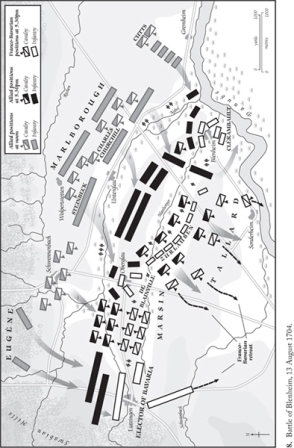
8. Battle of Blenheim, 13 August 1704.
Marlborough's Military Genius
John Churchill was born in 1650. His father, Winston, was a minor gentleman whom parliament had fined heavily for fighting for Charles I. So John grew up poor, which might explain his worst vice—avarice. He was educated at St Paul's School, London, and entered the court as a page to James, duke of York. A contemporary described him as ‘one of the handsomest men ever seen’. As a young man he did not let his looks go to waste, pleasuring many a mistress, including the king's, Barbara Villiers, duchess of Cleveland. According to one story Charles II discovered them in bed together. ‘Go; you are a rascal,’ said the king, ‘but you do it for your bread.’ His lovers helped Churchill's military career. At the age of seventeen he was commissioned into the Grenadier Guards. He served in Tangier and as a marine officer at sea during the Dutch Wars. Sometime in the winter of 1677–78 Churchill, by now a colonel, married Sarah Jennings, an intimate friend of Anne, later the queen. He rose in James II's favour, partly because his sister, Arabella, was the king's mistress. He played a crucial role in crushing Monmouth at Sedgemoor. But James's favour did not stop Churchill from deserting the king in November 1688, and going over to William III. Churchill explained that he had acted from ‘the inviolable dictates of my conscience’. Even though William made Churchill earl of Marlborough, he never fully trusted him.19 For instance, Marlborough's stellar service fighting the Jacobites in Ireland did not save him from being arrested for treason and briefly imprisoned in the Tower in 1692.
What made Marlborough such a great general—some say the greatest in British history?20
He had an excellent military education, serving as a junior officer in Tangier, at sea and on the continent. He was, it goes without saying, very brave, and his presence on the battlefield always reassured his troops. ‘It is quite impossible for me to express the joy which the sight of this man gave me at this critical moment,’ remembered Captain Robert Parker of the Battle of Bouchain (1711), when Marlborough posted himself next to his company (see ill.22). He did not order Parker's men to advance against overwhelming odds, for as the captain recalled, ‘it was the sense of the whole army, both officer and soldiers’ that their general would never squander their lives in hopeless ventures.’21 Marlborough rarely punished, and would often give tired and wounded soldiers a ride in his coach. ‘The known world could not produce a man of more humanity,’ raved Corporal Matthew Bishop, who served under him.22 Field Marshal Montgomery, who had the same knack, observed that Marlborough could keep his finger on the pulse of his army.23 Troops esteemed Marlborough in much the same way as they were to idolize Monty, nicknaming him ‘Corporal John’.
Since a corporal was then more of a quartermaster responsible for supplies, Marlborough's moniker could have been a compliment to his outstanding skills as a logistician. His army was superbly prepared, supply depots having been established along the route of march enabling them to move fast without having to live off the land. After the 250-mile march to the Danube in 1704 there were new shoes waiting for the men before they fought at Blenheim. ‘Never was there a march with more order and regularity and with less fatigue,’ Captain Parker recalled.24
Marlborough had a sense of Grand Strategy, being fully aware of the importance of sea power, and the contemporaneous campaigns fought in Spain and the Mediterranean. As a battlefield commander he was highly energetic, even in his sixties, galloping from place to place to spot the enemy's weak points. He had a good eye for the lie of the land, taking advantage of dead ground to manoeuvre his forces. He had excellent staff officers, who collected intelligence. He coordinated artillery, infantry and cavalry into effective battle groups. Always he seized the initiative, attacking the enemy to force them to concentrate their troops to hold his, and then used his reserves to assault the vulnerable spot from which the other side had withdrawn soldiers, thus shattering their line. Most important, he greatly increased the lethality of his infantry's firepower by using the new flintlock musket in a system of platoon volleys.
By the outbreak of the War of the Spanish Succession in 1701 the flintlock musket with its bayonet had completely replaced the pike. It was sturdy, reliable, used a flint to ignite its charge, being quick to reload. Its one-ounce musket ball did terrible damage. During the eighteenth century the famous Brown Bess inflicted 40 per cent of battle casualties, a much higher proportion than would later rifles (see ill.19). It even revolutionized frontier warfare against indigenous peoples such as American Indians.25
In addition to this new weapon the British adopted platoon firing, which Brent Nosworthy has called ‘the most effective controlled fire system that would be used in the history of the smooth-bore musket’.26 In theory, each regiment of foot was divided into eighteen platoons, who were subdivided into three groups, each of which was distributed about the lines of men three deep, that in battle were arrayed sixty to a hundred yards from the enemy. Each group of platoons would fire in rotation, producing a volley every ten seconds. This the colonel, or more often the lieutenant colonel, controlled as he stood in front of his men (except, of course, when the platoon immediately behind was about to fire). Because the lines of British infantry were only three deep, they could shift fire to the flanks far more effectively than the enemy, whose lines were four, five, sometimes six deep. Platoon firing with a flintlock demanded highly trained, long-serving soldiers, men from the bottom of society, drilled and flogged into unthinking automatons. ‘Armies, which used to be full of great and noble souls,’ lamented John Blackadder, ‘are now turned to a parcel of mercenary, fawning, lewd dissipated creatures; the dregs and scum of mankind.’27
The effects of this new system can be readily seen by looking at three battles. Before platoon firing was instituted only eight thousand (or 5.6 per cent) of the 150,000 men who fought at Steenkirk in 1692 were killed or wounded. After its implementation, 32 per cent of the 109,000 men who took part at Blenheim in 1704 became casualties. The system may have reached it bloody apogee in 1709 when the British Royal Regiment of Ireland faced their compatriots in French service at Malplaquet. The former decimated the latter, killing one enemy for every fifteen rounds fired, far higher than the normal ratio of one to 250–400 shots.28
Statistics hide the real horror. Captain Robert Parker described the process at Malplaquet:29
When we advanced within a hundred paces of them, they gave us the fire of one of their ranks: whereupon we halted, and returned the fire of our six platoons at once; and immediately made ready the six platoons of our second fire, and they then advanced upon them again, gave us the fire of another rank, and we returned them a second fire, which made them shrink: however, they gave us the fire of the third rank after a scattering manner, and then retired into the wood in a great disorder, on the which we sent our third fire after them, and saw them no more.
The comte de Mérode-Westerloo told his brother what it was like to be at the receiving end of flintlock platoon fire at Blenheim:30
The men were so crowded in upon one another that they could not even fire, let alone receive or carry out orders. Not a single shot of the enemy missed its mark, while only those few of our men at the front could return the fire.
Only the best trained soldiers could withstand such punishment. Corporal Matthew Bishop was in the front rank of Sir Richard Temple's Regiment (The Royal Dragoons) at Malplaquet. A French volley killed the men on his left and right, bowling them over, nearly bringing him to the ground. Bishop called two men from the second rank forward to fill the gap. They did. Almost immediately one was hit in the head, the other in the groin. Bishop called a man from the third rank forward, but he was so terrified that he hid behind him. Bishop harshly ordered the fellow forward, which he did ‘as bold as a lion’. After taking and giving many more volleys, the French withdrew.31
Marlborough had an advantage that many generals fighting overseas lack—the firm support of the government back home. In part this was due to his immense popularity, the product of his charm, and, more important, his ability to win victories. During his lifetime, some 67,000 lines of verse were written in his praise. With mounting victories his army became better regarded back in England. It was ‘full of excellent officers,’ wrote Daniel Defoe, ‘who went from the shop and behind the counter into the camp, and who distinguished themselves by their merits and gallant behaviour.’32 Marlborough's political friends, such as Sidney Godolphin, the queen's chief minister, helped retain parliamentary support, while his wife's friendship with Anne was crucial. The intimacy, which had begun as an adolescent crush between the plain Jane of the lower fourth and the fetching games mistress, was an attraction of opposites. Anne, fourteen, chubby, awkward, and uncertain; Sarah a confident, beautiful, self-assured nineteen-year-old. The friendship survived both women's marriages, Anne's to George, a boring Danish prince, and Sarah's to John, an up-and-coming army officer.
Unlike his wife, Marlborough possessed considerable diplomatic skills. To use a modern analogy, he combined the genius of a fighting general, such as Montgomery or Patton, with those of a brilliant coalition leader, such as Eisenhower. Like Ike, everyone liked ‘Corporal John’. Added to his undoubted charm was an abundance of tact and affability. ‘He is as skilled as a courtier as he is brave as a general,’ thought the Electoress Sophia of Hanover.33 Marlborough had to have such skills since he always commanded allied armies in which the British contingent were in a minority. At Blenheim, of the allies’ sixty-five infantry battalions, and 160 cavalry squadrons, only fourteen (22 per cent) and nineteen (11 per cent) respectively were British.34 Able to work well with other allied generals, such as Prince Eugene of Savoy, the leader of the imperial forces, who became a dear friend, Marlborough was unvanquished. As Captain Parker, who served for a decade under Marlborough, concluded, ‘he never fought a battle which he did not gain, nor laid siege to a town which he did not take.’35
Yet this glorious career ended in failure. For one thing, Marlborough's wife fell out with the queen after accusing her of being a lesbian. A year later Anne dismissed the duke and duchess of Marlborough from all their offices both at court and in the army. For another he allowed the war to go on for too long. The terms that the allies won in 1713 at the Treaty of Utrecht could readily have been obtained three to five years earlier without the effusion of so much blood. But as Charles Davenant, one of England's first economists, recognized as early as 1696, the Glorious Revolution had greatly extended Britain's war-making capabilities, permitting the nation to carry on fighting long after it was necessary.36
The Post-War Army
When the war finally ended in 1714 most people were thoroughly weary of fighting, and longed desperately for peace. Abel Evans, that deservedly little known poet, expressed the public's feelings:37
Thank heaven! At last our wars are o'er;
We're very wise and very poor:
All our campaigns at once are done:
We've ended where we just begun,
In perfect peace, long may it last.
As usual the transition from war to peace was difficult. Whereas 106,000 men were demobilized in 1697 at the end of the Nine Years War, 157,000 were discharged at the end of the War of the Spanish Succession. Although they comprised only 2.6 per cent of the population of the British Isles, they represented about a third of the total adult male working poor, the group least able to find steady civilian employment. Some sought salvation in matrimony. With that in view, Patrick Smith, an officer in the Royal Scots, wrote to his brother, ‘I must say the smallness of our pay here, and the little expectations we have of preferment in times of peace,’ requesting, ‘for me pray look out for an heiress.’38 Others turned to crime: highway robbery rose by 52 per cent, burglary by 54 per cent and horse theft by 62 per cent. The title of J.R.'s Hanging not punishment enough for murtherers, highway-men and house breakers (1701) suggested one popular way of dealing with criminal veterans.39
Ironically, those veterans who remained in the army, which by 1720 had shrunk to eighteen thousand men (the same size as Sardinia's), spent much of their time dealing with criminals, trying to stop smuggling.40 Since soldiers received a share of what they collected from unpaid duties, anti-contraband operations could be profitable. For example, between 1713 and 1723 troops seized 192,515 gallons of brandy and over a million pounds of tobacco—those, at least, were the amounts they reported. Britain lacked a police force, so magistrates and justices of the peace welcomed the army's help. In addition, if things went wrong—as they did in Glasgow in 1725, when troops opened fire on a mob, killing eight and wounding nineteen—the civilian authorities could always blame the military.41 In Ireland the twelve-thousand strong garrison maintained the ascendancy of Protestants over Catholics.
Between the spring of 1737 and that of 1743 a typical infantry regiment based in England spent only 1 per cent of its time dealing with riots and 20 per cent operating against smugglers. It spent 62 per cent of its time on the march, and only 16 per cent garrisoned together as a unit, profoundly affecting its character.42 Since most Englishmen associated barracks with both slavery and with James II's attempts to use the army to restore popery, few troops were quartered in large units, there being only six thousand barrack spaces in England in 1697. Because the 1629 Petition of Right forbad the billeting of soldiers in private houses, they were lodged in public ones, with all the attendant opportunities for drunkenness and mayhem. Units tended to be dispersed. For instance, in 1726, of the thirty companies of 1st Foot Guards in London, ten were based in Southwark; nine in Holborn; two each in Clerkenwell and St Giles; and one in Spitalfields, Whitechapel, St Sepulchre, Shoreditch, Folgate, East Smithfield and St Katherine's.43 Calvary regiments were similarly dispersed, although they tended to be stationed in the Midlands and East Anglia, where fodder for horses was more plentiful. The dispersal of soldiers lessened cohesion at the battalion and regimental level, encouraging them to identify more with their own companies and platoons, squadrons and troops, which may not have been a bad thing since most of the army's operations—policing, operating against smugglers, aiding the civil powers—were conducted by small units.
In view of their policing roles, it is surprising that attitudes towards the military improved—at least if the stage is an indication. To be sure, because many soldiers were billeted in London, and presumably would attend the theatre, it might not be wise to portray them negatively. David Garrick thought so. In Miss in Her Teens (1746) the heroine, alluding to both the battlefield and bedroom, declares, ‘I love these men of Arms, they know their Trade.’44 Stage names reflected a more positive attitude to military men—Captain Brazen, Colonel Bully and Corporal Toddy being replaced by Steadys, Worthies and Britons. Popular songs, such as ‘The British Grenadiers’, ‘Britons Strike Home’, ‘The Roast Beef of Old England’ and ‘Over the Hills and Far Away’, also reflected this shift. So did the rising popularity of army and navy ballads, which were increasingly aimed at middle-class tastes.45
Towards the end of the 1730s the nation was becoming ever more bellicose. After decades of peace and prosperity under the premiership of Robert Walpole, the public wanted war with Spain. Some desired it because they hoped to make money by opening up Spain's American colonies for trade, others from the same sort of jingoism that led the United States into another Spanish war in 1898. Like the sinking of the U.S.S. Maine, Captain Robert Jenkins's tale of how some Spanish coastguard had sliced off his ear and insulted King George as he sailed the Spanish Main outraged a public all too ready to be outraged, pushing Britain into war in 1739. Admiral Edward Vernon's attack on Porto Bello, Panama, the following year was as glorious a victory as his assault on Cartagena, Spain, in 1741 was an ignominious defeat. Between 1740 and 1744 Admiral George Anson's fleet sailed around the world, returning with £600,000 of Spanish booty. On land the War of Jenkins’ Ear, which turned into the War of the Austrian Succession in 1740, went poorly. George II was worsened by the French at Dettingen. Two years later in 1745, French volley fire overwhelmed his second son, the duke of Cumberland, at Fortenoy where he led the allied forces with more courage than common sense. Fortunately for his reputation, the Scots Rising of 1745 required his services back home, enabling the duke to beat a far less formidable foe at Culloden.
The Royal Navy
In the generation after the Glorious Revolution, Britain became the world's leading naval power. The size of the fleet rose from 173 ships totalling 101,892 tons to 247 ships weighing 167,219 tons: the average tonnage grew from 589 to 677 tons. Britain's advantage over France increased. In 1690 the British had 83 ships of the line, the French 89. Fifteen years later, in 1705, the British led the French by 122 to 105 ships. The Royal Navy continued to maintain its lead so that by 1715 it had 119 ships of the line to 62 French. After the War of the Spanish Succession the French fell out of contention, with only 27 ships to 102 British.46 The quality of the naval officer corps also improved. Between 1702 and 1712, 43 per cent of the 695 men commissioned as lieutenants came from the merchant marine. No matter their backgrounds, however, naval officers adopted the style and manners of the gentry. These professionals were able to take full advantage of new technologies, such as the introduction of the steering wheel in the 1690s—a generation before the French. Instead of shouting orders down to below decks via a relay of men, the officer of the deck gave them directly to the helmsman standing at the steering wheel beside him, lessening confusion and ensuring commands were executed promptly.
At the start of the Nine Years War the French did surprisingly well at sea, being able to evade the Royal Navy and allow James II to land and fight in Ireland in 1689–90. They beat a combined British and Dutch fleet at the Battle of Beachy Head in June 1690, largely due to the incompetence of its commander Arthur Herbert, earl of Torrington. He was court-martialled, after parliament passed legislation removing his privilege as a peer to be tried by the House of Lords. To the surprise of many, and to the outrage of more (and of the Dutch in particular), Torrington was acquitted.
The Royal Navy atoned for its disgrace two years later in May 1692 at the Battle of Cap de la Hogue, a four-day fight that resulted in the destruction of fifteen French vessels, and ended French hopes of invading Britain. As a result they resorted to privateering, which like the German submarine campaigns of the two world wars, was the weapon of the weaker naval power. Both were effective. But unlike the U-boats operating from St Malo in the Second World War, the fifty privateers based in that port were able to make a huge profit from the two hundred prizes they captured in 1692 alone. So the British had to adopt the convoy system. Although this tied down huge numbers of their surface vessels, convoys worked: between 1706 and 1707 ship losses fell from 125 to 39.47 Convoys were as successful as they were boring. John Baltharpe, a petty officer aboard the St. David, grumbled:48
As we go up, so they come down,
And so our Convoys, they go around:
No better way was ever taken,
Nor will be when the same's forsaken.
Nonetheless, convoys and foreign trade helped foster the development of a blue-water navy, able to project power over long distances. Using the wind, which was free, and able to carry six months’ stores, a sailing ship could operate independently of land bases. Standard designs decreased the costs of shipbuilding. In the 1690s developments in the smelting of non-ferrous metals lowered the price of copper that was used to sheath the ships’ hulls to thwart the growth of seaweed (which slowed the vessel), and the appetites of wood borers, which were notoriously ravenous in tropical waters.49 Before 1688 the Royal Navy had attempted only one major blue-water expedition—to Hispaniola in 1655. Between 1688 and 1697 the navy sent five expeditions to the Caribbean. From 1701 to 1713 eleven were dispatched there, as well as a further four to North America.50 The capture of Gibraltar in 1704 and Minorca in 1708 opened the Mediterranean to British sea power. Britain's role in the War of the Quadruple Alliance (1718–20), an attempt to thwart Spanish ambitions, was almost wholly at sea, which indicates her growing naval power. The need for shipbuilding supplies turned the Baltic into a critically strategic arena. By 1715 Plymouth had replaced Portsmouth and Chatham as the navy's main base, an indication that after making an alliance with the Dutch, the North Sea and English Channel were no longer the navy's principal areas of operations.
The navy became both popular and profitable. In 1711 Henry St John, Viscount Bolingbroke, boasted that the sea ‘is our frontier’. Joseph Addison has one of his characters, ‘Foxhunter,’ a boneheaded Tory squire, boast in 1715, ‘Our wooden walls are our security and we may bid defiance to the whole world.’ In 1750 the newspaper, the Old England, bragged:51
We have done exceedingly well without a large land army; but we never have done nor never can do well without a numerous fleet, in good conditions, plentifully supplied, and commanded by brave and experienced officers.
War and the Making of a British State
The Revolution of 1688 had two effects that have not received the attention they deserve. First, it helped consolidate a British state and then an empire. Second, it made a standing army acceptable for both civilians and officers. The two were intimately linked.
The establishment accepted the standing army because its officer corps, who had mostly bought their commissions, were members of the ruling elite. Even if—as younger sons sometimes do—they were tempted to run rogue, the Mutiny Act, which parliament had to pass each year as well as annual appropriation bills, was an effective check on any tempted to emulate Oliver Cromwell and the major generals. In each county the lord lieutenant and gentry controlled the militia, which had links with regular units, making a standing army more palatable. Regular officers such as Lieutenant General Humphrey Bland, one of the century's most distinguished commanders, accepted the army's subservience to civil authority. ‘I have throughout my book taken every occasion to inculcate the necessity of Legal Military Subordination,’ he wrote in the preface to A Treatise of Military Discipline (1727). General Bland was proud of being a member of a corps that reported to the civilian authorities, writing that ‘Instead of being those servile Tools (which is so much apprehended), of bringing their country into Slavery, they [the officer corps] have behaved themselves with a Zeal for its liberty.’
War had become a gentleman's profession, not an ideological, theological or patriotic passion. Thus, men from the same nation, such as the Irish at Malplaquet, could fight on either side, firing point blank at each other with terrible effect and without recriminations. A month after the Battle of Oudenarde in 1708, John Blackadder recalled how ‘The French Officers and ours, as if it had been concerted between them, went out between the two camps, and conversed with each other, and called for their acquaintances, and talked together as friends.’52 Enemies could become professional colleagues, agreeing with General Bland's widely influential Treatise of Military Discipline that ‘The Military Profession has, in all ages, been esteemed the most Honorable, for the dangers that attends it.’53 General George Washington, for example, owned a first edition of the book, which he urged his officers in the Continental Army to read so as to better prepare them to beat the British.
The acceptance by soldiers and civilians alike of the standing army afforded both officers and men the hope of long-term careers, and a promotional hierarchy up which most, either through their abilities or their purses, tried to climb. Ambition became part and parcel of military culture. As Sir John Cope, a subaltern who had just joined the Royal Regiment of Dragoons, wrote to his patron, Thomas, baron Raby, in 1708, ‘I hope your excellency will not think I aim at preferment too soon, for I see ‘tis everybody's endeavour to rise as fast as they can.’54 On the other hand, those whose ambitions were disappointed, complained. ‘There is no man of my quality in the Island of Britain that hath served so long as Captain (which is now Fourteen years), as I have done,’ wrote John Campbell in 1709. ‘Men who were at school when I was a captain are now in posts superior to me.’55
With the development of the mess system, life as an officer—war notwithstanding—became more comfortable. As they lived and ate together, cohesion between officers of the same unit grew. In 1705 Lieutenant Colonel James Cranston wrote home asking for some more pewter to be sent out for his regimental mess, explaining that ‘Officers now here, especially those of any character live much higher than they did in the last war.’56
While the aristocracy continued to dominate the officer corps, new military families developed, in which son followed father, often into the same regiment, being largely dependent on their pay. All of Sir James Agnew's eight sons became professional officers. Half pay, which was introduced in 1712, enabled army officers without family wealth to enjoy a career in both war and peace. Take that of William Brereton, who was commissioned in the Horse Grenadiers as an ensign in 1695. He transferred into the dragoons and then the infantry in the hope of getting a promotion, which did not come until 1710 when he was made a captain. During the War of the Austrian Succession (1740–48) he won his majority, being promoted lieutenant colonel in 1746, fifty-one years after he was first commissioned. Brereton's career illustrates the long service of the regimental officer corps. In 1740 in the infantry lieutenant colonels had an average of thirty-five years service, majors thirty and a half, captains twenty-seven and lieutenants nineteen, the figures for the cavalry being almost identical.57 That same year the Army List was first privately published. In 1741 the Woolwich Military Academy was opened for the training of artillery and engineering officers.
Enlisted men also began to have long careers. Take Donald MacLeod, who was born on Skye in 1688. After his mother developed post-natal depression and his father left home, MacLeod went to live with his grandfather in Inverness. Hungry, he ran away, to be robbed of his last shilling by a highwayman. At the age of nineteen MacLeod enlisted in the Royal Scots. He fought at Donawart, Blenheim, Liège and Malplaquet. After the War of the Spanish Succession he served in Ireland, and was wounded in 1715 at Sheriffmuir. He transferred to the Black Watch for internal security duties in the Highlands, before being sent to Germany. He fought at the Battle of Fontenoy (1745) where he killed a French colonel, looting the corpse of 145 ducats. MacLeod missed the ‘45, being in Ireland at the time, but was sent to North America, being wounded at Louisburg and Quebec (where his plaid was used to carry the dying General James Wolfe in 1759). Even though he was admitted to Chelsea Hospital in 1759, he was discharged to fight on the continent the following year, being twice wounded. Donald MacLeod returned to the colours for the American Revolution to serve as a ninety-year-old drill sergeant.58
The Revolution of 1688 virtually completed the formation of a British state, which Linda Colley has described as ‘an invention forged above all by war’. She goes on to argue that British culture has ‘largely defined itself through fighting’, war having played a critical role in the formation of a British nation.59 But there was nothing inevitable about the emergence of a United Kingdom of England, Scotland, Ireland and Wales. Externally and internally they had different societies. They shared no common religion: England was Anglican and Nonconformist; Scotland and Ireland were Catholic and Presbyterian; the Welsh were Nonconformist and like the Highland Scots and Irish proudly spoke their own language. England and Scotland had different legal systems. Not until 1707 did England and Scotland share a common parliament, something England and Ireland did not enjoy (if that is the right word) until 1801. To borrow a phrase from the debate over sterling joining the euro, the three nations lacked ‘convergence’. The differences were so great that the three kingdoms had to be hammered together with much military force.
For the Scots, overwhelming English power made the marriage painfully necessary. According to Christopher Whately and Derek Patrick, in an age of nation-state building the Scots ‘were failing to cut it’.60 When they tried to go it alone, as by attempting to establish a colony at Darién in Panama in 1698–1700, the results were catastrophic. Bad planning, incompetence, a terrible climate, as well as English and Spanish opposition, resulted in the colony's failure and a huge loss of money and life. ‘We have,’ Anthony Fletcher of Saltoun lamented to the Scots parliament in 1703, ‘appeared to the rest of the world more like a conquered province than a free independent people.’61 Four years later the same parliament passed an act uniting Scotland with England.
War played a more direct role in shaping English attitudes to union, which changed rapidly before the 1707 Act. Only seven years earlier, Sir Edward Seymour, the Tory leader, warned parliament against union, declaring that ‘whosever married a beggar could only expect a louse for her portion.’62 Once the War of the Spanish Succession broke out, Marlborough and Sidney Godolphin urged a merger to protect Scotland's security and ensure it remained a rich reservoir of recruits for the armed forces.63 In 1706 Daniel Defoe supported union because Scotland was ‘an inexhaustible treasure of men … the best soldiers in the world’.64
Because the military experience of the Revolution of 1688 was extremely bloody and resulted in Protestant domination, the links between England and Ireland were far weaker than with Scotland. In Ireland the War of the Two Kings (1689–91) was fought with an all too familiar loss of life. It has been estimated that 100,000 (4.5 per cent) of its population died, about a quarter in combat and the rest from war-related diseases and starvation, while another 39,000 (1 per cent) were forced into exile.65 At the end of the fighting in the diocese of Derry only three hundred of a stock of 250,000 cattle were left alive, and two horses (both lame) out of 460,000.66
After James II's defeat at the Boyne on 1 July 1690, guerrilla warfare predominated, and the fighting became especially brutal. A Williamite soldier described how the Irish insurgents would cork the barrel of their muskets, and put a quill into the touch hole, before hiding them in a stream. ‘You may search till you are weary before you find one gun,’ he complained, ‘But yet when they have a mind to do mischief, they can all be ready in an hour's warning.’67 William's forces reacted with accustomed ferocity. Frederick, earl of Athlone's diary for 1691 has the following entries:68
27 March, spy dressed as woman, hanged.
2 April, killed 32 rebels in skirmish, 9 prisoners.
6 April, ambushed rebels, 1 killed, 9 taken prisoner, of whom 7 hanged.
9 April, ‘several’ rebels hanged.
19 April, ambushed rebels, 20 killed, 5 prisoners, all hanged.
In a letter to Sir Robert Southwell, dated 10 August 1690, Colonel William Wolseley described how his unit had just hanged three Tories, ‘the chiefest and greatest rogues’, and slain eighty to a hundred more in combat. He concluded that ‘an Irishman is to be taught his duty only by the rod.’69
For over the next century Irishmen, or at least Catholic ones, were taught their duty by a system of penal laws, as cruel as apartheid, which held them in thrall to Protestants. For instance, a Protestant could buy any horse—no matter its value—from a Catholic for no more than five pounds. If Catholics converted, they inherited the whole of their parents’ estates, leaving nothing for siblings. Protestants wielded political power: Catholics were denied the right to vote, graduate from university or hold crown offices including military commissions.
No wonder many Catholics left the land of their birth, sometimes as immigrants, more often to join the armies of Britain's enemies. Between 1691 and 1791 half a million Irishmen, known as the Wild Geese, served in foreign armies, the majority in the French. They fought with great glory: Voltaire called them ‘the bravest soldiers’. Jonathan Swift added that the Wild Geese were ‘able to distinguish themselves in so many parts of Europe, by their valour and conduct above all other nations’.70 While the tradition of foreign mercenary service was not new (between 1586 and 1611 twenty thousand Irish men had served in Flanders alone), after the Treaty of Limerick (1691) formalized the system, the stream of mercenaries became a flood.
In spite of the horrors of Anglo-Scots and especially Anglo-Irish warfare in the half century before 1688, in the following fifty years the English Army became the British Army. This was part of a wider process in which a growing sense of Britishness dominated the isles. Dr Johnson thought this a thoroughly good idea because ‘it brings everything to a certainty’. The eighteenth was the only century in history when poets used the words ‘British’ and ‘Britain’ more often than ‘England’ and ‘English’.71 Military command reflected this trend. Only seven of the British regiments that fought at Blenheim had English commanding officers, five had Scots and four Irish. Of the twenty-five generals at Malplaquet, twelve were English, ten were Scots and three Irish. The integration of the senior-officer ranks was the culmination of the conquests of Scotland and Ireland, which came out of the British Civil Wars and the Revolution of 1688. Those events had been coercive, even brutal. Yet the transformation of the English to the British Army was surprisingly enlightened, being highly beneficial for many Irish and Scots—as Colonel Blackadder and Sergeant MacLeod would attest. For a century and a half before 1688, hundreds of thousands of Scots and Irish had fought overseas as mercenaries. Afterwards more and more of those who would in the past have served foreign monarchs joined—and thus made—the British Army. In Britain's armed forces many of them prospered. With an eighth of Britain's population, Scots constituted a quarter of the army's officers and 37 per cent of the navy's in the first half of the eighteenth century. Far from facing a glass ceiling, over time their chances of promotion increased. Sir Andrew Melville, a Scot, admitted he was made major ‘because my time had come’. While in 1714 only 12 of 81 colonels (14 per cent) were Scots, over the next 49 years, of the 374 men promoted colonel, 78 (21 per cent) were from north of the border.72 Even English attitudes to the Irish modified. In 1688 the anonymous play, The Late Revolution: or the Happy Change of 1688, called them ‘slaves … like toads and serpents made to be destroyed’. Yet in 1746 Thomas Sheridan wrote a play entitled The Brave Irishman.73