
CHAPTER 7
We are all diseas'd,
And, with our surfeiting and wanton hours
Have brought ourselves into a burning fever
And we must bleed for it.
Henry IV, Part 2, IV, 1, 61–64
IN APRIL 1786 THOMAS JEFFERSON AND JOHN ADAMS WERE TOURING England, the nation from which the United States had just won a war of independence. They made a pilgrimage to Edgehill, the first battle in the first of three British revolutions that culminated in their own. Adams was irate at the locals’ ignorance of what had happened at Edgehill. ‘Tell your neighbours and your children that this is holy ground,’ the future president declared, ‘all England should come in pilgrimage to this hill once a year.’1
Now each year many thousand people do come to Edgehill, and to the other Civil War battlefields, not as pilgrims but as re-enactors (and spectators). It is no accident that today the largest and most consistent groups who commemorate the past in the United Kingdom are the members and fans of the Sealed Knot and the English Civil War Society, who every summer dress up to refight the battles of the mid-seventeenth century. They do so both because it is fun and because war has an enduring fascination. But they could choose to re-enact other conflicts, such as the Napoleonic Wars (a fight in which the British played a distinguished role) or the Second World War (clearly a struggle between good and evil). Yet they select the British Civil Wars because—even after over three and a half centuries—these wars still speak to numerous audiences.
No event in the history of the British Isles had a greater effect on world history than the Civil Wars which broke out in Scotland in 1639, continued until the restoration of the monarchy in 1660, and were in many ways unresolved until the Glorious Revolution of 1688–92. These wars were a defining moment: G. M. Trevelyan argued that they were the most important happening in our history; Simon Schama called them ‘the crucible of our modern history’. But in order to assess the impact of these wars (which will be the subject of Chapter 8), we must first examine their nature, causes, outbreak and progress.
The Nature of the Civil Wars
Almost since the first shot was fired, historians have differed over what to call these wars. At the time phrases such as ‘these unnatural wars’ or ‘civil wars’ were commonplace. Soon they became known as ‘The Great Rebellion’. Great because it was significant; rebellion because it was illegitimate. This view predominated until the nineteenth century when Thomas Babington Macaulay argued that the Civil Wars were essentially a Herculean struggle between liberty and despotism, which the former won, thus making possible the glories of Victorian England. Towards the end of the century, S. R. Gardiner portrayed the turmoil as a Puritan Revolution, in which Godly Protestants resisted the Counter-Reformation of pseudo-Catholic royalists. In more recent times Karl Marx and his followers have interpreted the breakdown of mid-seventeenth-century England as the first great Bourgeois Revolution. During this period the gentry supposedly rose—or at least the mere gentry came to the top—as the aristocracy experienced a crisis. Lately, revisionist historians have stressed the short-term, even accidental nature of events, in which the acts of individuals played a more important role than the seemingly inevitable and impersonal forces that the Reformation set in motion a century before. Some have suggested that the Civil Wars were essentially Wars of Religion; others that they were the last great baronial revolt.2
Whatever to call them has been, and still is, a matter of much debate. Contemporaries recognized the conflict's complex nature, the first use of the term ‘Civil Wars’ being in a pamphlet of 1643.3 Yet two points are crystal clear: that the conflicts affected every part of the British Isles, and that they were a series of wars. They opened with the First Bishops’ War of 1639 and the Second Bishops’ War of 1640. The First English Civil War lasted from 1642 to 1646, the Second took place in 1648, while the Third lasted from 1649 to 1651. Fighting in Scotland started with the First Bishops’ War in 1639 and ended in 1651 with the Battle of Worcester. The Irish Revolt of 1641 began the Wars of the Confederation, which lasted until 1653, being followed by the brutal Cromwellian Settlement in which hundreds of thousands lost their lands, being forced to move to the barren province of Connaught or driven into exile. Since many died—more in relative terms than in any British war before or since—describing them as wars is obvious. They should also be called British, because they affected every corner of the isles, being the first major event in the history of England, Scotland and Ireland together. These events were, first, caused by conflicts between the three kingdoms, and, second, resulted in fundamental changes in the relations between them.4 Thus I prefer to call this multinational and complicated conflict ‘the British Civil Wars’.
Naming the events of the middle of the seventeenth century is not a tidy process—which is appropriate, since they were far from tidy events. In most Civil Wars there have been clear determinants of each side, be they regions (as in America), sects (as in Ulster or Lebanon), ethnicity (as in Sri Lanka or Nigeria), or ideology (as in Russia or China). While such determinants prevailed in the Irish and Scots Civil Wars, they were not as clear-cut in the English ones. Except for Middlesex, in no English county were all the members of parliament, including those who represented boroughs, on the same side. As Lucy Hutchinson, the wife of a leading parliamentarian, recalled, ‘Every Country had the civil war, more or less, within itself.’ The way in which ‘the flame of war broke out’, she believed, confused her contemporaries.5 Richard Ward used the same simile of fire in his Anatomy of Warre (1642) to blame the eruption of the conflagration on a lack of understanding. ‘As children through ignorance of the nature and peril of Fire often fall thereinto and are burnt, so men not acquainted with the nature and danger of war, too often desire it and too soon rush into it.’6 A roundhead song, ‘The Zealous Soldier’, written in August 1642, before the fighting really began, expressed a sense of innocent, even naive enthusiasm:
For God and his cause I'll count it gain
To lose my life. Oh can one happier die
Than to fall in battle to maintain
God's worship, truth, extirpate Papacy?
John Taylor, the water poet (and retired naval veteran), had a ready explanation for such misplaced zeal:7
Methinks the proverb should not be forgot
That wars are sweet to those who know them not.
Another poet, Samuel Butler, confessed that people could not explain the outbreak of war:8
When Civil Fury first grew high
And men fell out, they knew not why.
Bulstrode Whitelock, a lawyer and member of parliament, reflected this sense of puzzled ignorance when he wrote to his wife in July 1642:9
It is strange to note how we have insensibly slid into the beginnings of a civil war, by one unexpected accident after another, as waves of the sea, which have brought us thus far, and scarce we know how.
Thomas Knyvett, a Norfolk gentleman, knew whom to blame. ‘The one party now grows as resolute as the other is obstinate,’ he told his wife in May 1642. But he did not know where to go, adding ‘Oh Sweet heart, I am now in a great strait what to do.’ Eventually he fought for the king, because, as the inscription on his tombstone explained, ‘Here lies loyal Knyvett, who hated anarchy.’10
The Bishops’ Wars
It was the fear of anarchy that disturbed most Englishmen, as the British Isles drifted into a war that first began in Scotland in 1639. The outbreak of two wars between England and Scotland, known as the Bishops’ Wars, can be traced back to 1603, when James VI of Scotland became James I of England, thus giving the two nations a joint monarchy but little else in common. His successor, Charles I, aimed at strengthening the links between the two nations by enhancing the Scottish system of bishops (hence the wars’ nomenclature), and attempting to force the Scots to accept a new prayer book. They refused to do so, rioting in St Giles Cathedral on 23 July 1637, the day the new liturgy was first used. Some Scots even threw stones at black and white dogs, whose coats allegedly resembled bishops’ copes, to show their contempt for episcopacy. Tens of thousands of Scots signed (some with their own blood) a covenant vowing to reject the new prayer book as well as bishops, both of which they saw as English and—worse still—papist innovations. Thus they became known as covenanters, who, as one of their pamphlets explained, ‘are driven in such straits as we must either …. Suffer the ruin of our estates, or else … fall under the wrath of God’.11
Charles rejected the advice of John Stewart, earl of Traquair, that it would take a permanent garrison of forty thousand English soldiers to make the Scots accept the new liturgy. To do so, he wrote, underlining his words to show the strength of his feeling (the only time but one he ever did so), was because it would quite literally be ‘damnable’, jeopardizing his immortal soul.12 Charles, as was his wont, attributed the worst of motives to his enemies: their real objective, he convinced himself, was to establish a banana republic, as ludicrous as, say, that of Venice, which would condemn his dominions to anarchy. Once Charles accepted this specious argument, war became both logical and inevitable.
The Bishops’ Wars were far more important politically than militarily because they were waged incompetently, and because both sides shied away from hard fighting. When they came to unwelcome blows, they shadow-boxed with great restraint and scant enthusiasm.
Charles's plans for the First Bishops’ War were ambitious. A contingent of Irish Catholics were to land near Carlisle, as their fellows in Ulster harassed the province's Scots settlers. With an expeditionary force of five thousand troops James, marquess of Hamilton, invaded the Firth of Forth region, but failed to prevent the covenanters from taking either Aberdeen or Edinburgh Castle. After routing the royalists at the ‘Trot of Turriff’, a Scottish force commanded by Sir Alexander Leslie, a veteran who had fought as a Dutch and Swedish mercenary, invaded England. On 30 May 1639 Charles joined his army of twenty thousand men at Berwick. Neither side wanted to fight: few Englishmen were willing to hazard their lives for an unpopular king; most Scots shrank from fighting their divinely anointed sovereign. On 4 June Henry Rich, earl of Holland, led a mixed army of a thousand cavalry and three thousand infantry on a reconnaissance into Scotland. Since the former could ride faster than the latter could march, particularly on hot summer days when most foot soldiers lacked water bottles, the cavalry were on their own when they came across Leslie's men at Kelso. Unwilling to attack, Holland retreated. This pusillanimous episode shattered the morale of the English forces. Before Kelso an English officer boasted, ‘here is a gallant company of cavaliers as brave in courage as in clothes.’ Afterwards a captain quaked, ‘The Scots are very strong … our army is very weak.’13 Negotiations opened on 10 June, and a week later both sides agreed to start demobilizing within forty-eight hours.
Charles's defeat forced him to call a parliament in April 1640, the first in over eleven years. Relations between the king and commons rapidly broke down, and early on the morning of 5 May Charles suddenly dismissed parliament, confident that he could use Irish troops to quell both the commons and the covenanters. Thus he started the Second Bishops’ War.
The king left London on 20 August 1640 to join his northern army. The same evening a huge Scottish army crossed the Tweed at Coldstream and advanced towards Newcastle. Forty thousand strong, it amounted to 4 per cent of the total Scottish population.14 Even though Charles had at least twenty-five thousand men arrayed on the border, they were poorly trained. ‘We were never disciplined, nor mustered,’ one of them wrote in his diary.15 Sir Edward Conway could only collect three thousand infantry and fifteen hundred cavalry to march the four miles from Newcastle to Newburn to try and stop the invaders from crossing the Tweed. Like many battles, that of Newburn began on 28 August in a haphazard way. Each side was on one bank of the river, waiting for the tide go out to let them cross. An English trooper, annoyed by the arrogant way in which a Scots officer stared at him, opened fire, wounding the fellow. Fighting mad, the covenanters waded across the river, routing the enemy. The only heroes of the Second Bishops’ War were a couple of Welsh soldiers who stood and fought to the death, as their English comrades skedaddled for Newcastle.16 The Scots easily seized the counties of Northumberland and Durham, forcing the king to sign a treaty at Ripon on 26 October.
At times during the Bishops’ Wars it seemed as if a madness swept the land. Many English draftees tried to dodge fighting the Scots. One hung himself. In Kent, Henry Oxinden got two of his tenants exempted. In Lincolnshire and Essex conscripts cut off their big toes so they could not march north.17 The troops that did so were poorly led. An observer noted that their commander, Thomas Howard, the earl of Arundel, ‘had nothing martial about him but his presence and looks’.18 The marquess of Hamilton, leader of the amphibious attack on the east coast, did not want to go to Scotland, telling the king ‘next to hell I hate this place’. He became even more loath to fight after his mother vowed personally to shoot him if he ever set foot in their native land.19
The royal army was as poorly equipped and fed as it was led. Unlike the Scots, only senior English officers had tents, leaving the men to sleep on the ground. Many of the pistols issued to the soldiers had broken butts, or ones that had been poorly glued together. In theory, this made them far more lethal to the firer than the target: in practice, the point was moot because the firing mechanisms rarely worked, and many pistols lacked touch holes. When soldiers’ pay was docked to cover the cost of repairing the deficiencies in their weapons, some of them mutinied, for which two were hanged. Others resorted to fragging. ‘Our soldiers are so disorderly that they shoot bullets through our own tents,’ an officer wrote home, ‘the king's tent was shot through once.’20 ‘Most of them beggarly fellows,’ wrote one officer about King Charles's bad bargains. Sir John Poulett agreed that the king had ‘the fewest volunteers that I ever saw in any army’. Sir Edmund Verney told his son that ‘Our men are very raw, our arms of all sort naught, victuals scarce and provisions for horses worse. I daresay there was never so raw, so unskillful and so unwilling an army brought to fight.’ Lord Conway agreed that the troops were ‘more fit for Bedlam or Bridewell’ than the king's service.21
So scared was one company of recruits of being ambushed by latter-day Robin Hoods that as they marched north through Sherwood Forest they doubled their guards.22 Yet the most disturbing thing about the English troops was not their poor fighting ability, but the crimes they committed which, noted Sir Jacob Astley, proved that they were ‘all the archknaves in the kingdom’.23 In Selby, Yorkshire, soldiers beat up their own officers and civilians. In Derbyshire they tore down enclosures. In Marlborough, Wakefield, Derby, London and Cirencester, they broke into jails to free comrades and those who had refused to pay taxes to fight the Scots. In Essex levies murdered a pregnant woman, and plundered several houses. They mutinied in Royston, Beccles and Cambridge. Troops beat up Oxford undergraduates, whom they despised as both draft dodgers and as the privileged progeny of an Anglican bastion. Pressed men from Staffordshire tore down fences around a game park in Uttoxeter for kindling.24
The religious context of many outrages was obvious. In Suffolk conscripts started wearing white sheets to parody bishops’ surplices. In churches in Hertfordshire and Essex troops chopped up the recently installed altar rails for firewood. The most notorious outrages were the murder of officers whom conscripts suspected of being Catholics. At Faringdon, Oxfordshire, recruits, outraged at Lieutenant William Mohun (who was rumoured to be a papist) for almost cutting off a drummer's hand after the lad hit him with his stick, attacked the officer when he was upstairs in a tavern having dinner. They forced him to crawl out on the beam from which the inn sign hung, beating and stoning him until he fell to the ground. Convinced he was dead, they tossed him into a dung heap. Barely alive, Mohun crawled out. So they stabbed him, cudgelled his brains, and dragged the lieutenant's corpse through the town to place it in the pillory. At Wellington some conscripts from Devon suspected that their officer, Lieutenant Compton Evers, was a papist, so they murdered him and looted his body, on which they found a crucifix, which confirmed their worst suspicions. The only way that Francis Windebanke, scion of a distinguished Catholic family, could convince his new company that he was a Protestant, and thus get them to obey him, was to order them to kneel and sing psalms, before issuing them with drink and ‘stinking tobacco’. Thus Captain Windebanke convinced ‘the Godly’ that he was such a jolly good fellow that he could not possibly be a papist.25 Many ordinary folk protested vehemently against such crimes. ‘We find ourselves oppressed with the billeting of unruly soldiers, whose speeches and actions tend to the burning of our villages,’ declared a Yorkshire petition, ‘as we cannot say that we possess our wives, children and estates in safety.’26
The Irish Rebellion, 1641
Nonetheless the impact of the Bishops’ Wars in preparing the king's subjects for Civil War was limited. What changed attitudes—with the decisiveness of the 1914 invasion of Belgium, Pearl Harbor, or 9/11—was the outbreak of the Irish rebellion in October 1641.
Admittedly, this sea change would not have been possible had not Charles's defeat in the Second Bishops’ War, and his need to raise the £860 a day he had agreed in the Treaty of Ripon to pay the Scots army for their costs of occupying Northumberland and County Durham, forced him once again to call parliament in November. Known as the Long Parliament (since it sat on and off from 1640 to 1660), during its first year it tried to devise a constitutional form of monarchy that limited the king's power and ensured parliaments were called at least every three years. All that this excellent plan lacked was a king who was willing to be a constitutional monarch.
Matters came to a head in late 1641 with the outbreak of a rebellion in Ireland, which more than anything else, at least in the short term, precipitated the Civil War. As we have seen, the English conquest of Ireland was comparatively recent, being completed with the earl of Tyrone's surrender in 1603. Most Irish Catholics resented the English and Scots, especially those Protestant settlers who had stolen their lands. In Ireland religion was the cursed divide. ‘I see plainly,’ explained Thomas Wentworth, earl of Strafford, Charles I's Lord Lieutenant of Ireland in 1634, ‘that so long as this kingdom continues popish, they are not a people for the crown of England to be confident of.’27
As has so often been the case, England's difficulties were Ireland's opportunity. In the autumn of 1641, with king and parliament deadlocked over a constitutional settlement, throughout Ireland Catholics spontaneously rose against the alien oppressors. ‘The crisis has burst upon us with the suddenness of a violent torrent,’ wrote Sir John Temple, Irish Master of the Rolls, as he cowered inside Dublin Castle: inflamed by Jesuits, the rebels ‘march on furiously destroying all the English, sparing neither sex nor age, most barbarously murdering them, and that with greater cruelty than was ever used amongst Turks or Infidels’.28
Thousands were massacred with a brutality that became more gruesome with every telling. Babes were reported snared on pikes, or cut from their mothers’ wombs, children were roasted on spits, daughters were raped—all as parents and spouses were forced to watch. According to Treason in Ireland for blowing up of the King's English Forces with 100 Barrels of Gunpowder (1642)—a pamphlet whose title aroused memories of Guy Fawkes—at Rockoll, accompanied by bagpipes, which ‘they played exceedingly loud’, the rebels ‘cruelly murdered’ an English family. At Nassey they slew Henry Orell, his wife and daughter ‘in the most barbarous manner that ever was known’.29 At Athy they hanged an English woman by her hair from her door, and boiled a maidservant alive in a beer vat. At Kilkenny they raped Mrs Atkins, who was heavy with child, before ripping open her womb, and then tossing mother and child into a fire. In County Tyrone sixteen Scots children were purportedly hanged alive, and a fat Caledonian killed, to be rendered into candles. The rebels tied another victim to a tree, slit open his belly, pulled out his intestines to see whether ‘a dog's or Scotchman's guts were the longer’.30
Such atrocity stories lost nothing in the telling as they crossed the Irish Sea to England, particularly when they were brought by thousands of terrified refugees, and illustrated by cheap stomach-churning woodcuts. Estimates as to the number of victims grew exceedingly. Devereux Spratt, a clergyman from Tralle, reported that the papists had massacred a hundred and fifty thousand Protestants; both Richard Baxter and Lucy Hutchinson put the figure at two hundred thousand, while in 1646 Sir John Temple thought three hundred thousand had died. Since there were fewer than a hundred thousand Protestants in Ireland, contemporary estimates were grossly exaggerated, twenty, thirty, perhaps fortyfold.31
Even so, it would be hard to overstate the effect their deaths had on the rest of the British Isles. Like the massacres in 1857 at the start of the Indian Mutiny (or, if you prefer, the First War of Indian Independence), these killings united Englishmen in righteous anger to punish the perpetrators. In April 1642, 37 per cent of the pamphlets published in England touched on the rebellion in Ireland.32 Four days after its outbreak, Secretary of State Sir Edward Nicholas wrote from London to the king that ‘the alarm of popish plots amaze and fright the people here more than anything’.33 ‘O what fears and tears, cries and prayers, day and night, was there then in many places, and in my dear mother's house in particular!’ remembered Joseph Lister of Bradford, ‘I was about twelve or thirteen years old, and though I was afraid to be killed, yet was I weary of so much fasting and praying.’ Looking back, Richard Baxter, the minister from Kidderminster, agreed that ‘the terrible massacre in Ireland, and the threatening of the rebels to invade England were the chief reasons why the nation moved to a state of war’.34
It took nearly a year to do so.
All Englishmen agreed that an army must be raised to exterminate the Irish rebels in a war of virtuous revenge.35 But they could not agree who should control it. Many no longer trusted the king, particularly after 5 January 1642 when he demonstrated his disdain for any constitutional limits on his authority by staging a military coup d'état. At the head of a company of heavily armed soldiers, Charles marched into the commons chamber to arrest the five members whom he believed were the ringleaders hell-bent on treason. But, as the king plaintively noted, looking around the chamber from the speaker's chair, ‘the birds have flown’. Forewarned, they had taken refuge in the City of London. Frustrated, the next day, like a dazed driver staggering away from a road accident, Charles and his family left London for Windsor. Their departure was so hasty that there were no bedsheets for them at the castle. It was the first of many uncomfortable nights the king was to endure as England drifted into Civil War.
The nation did so over what Charles called ‘The Fittest subject for a king's quarrel’.36 Fearful that he would use the army, which was being raised to put down the Irish Rebellion, to crush them first the House of Commons passed a Militia Bill depriving the king of his long-standing right to appoint army officers. Charles refused point-blank. ‘You have asked of me that was never asked of a king and with which I would not trust my wife and children,’ he angrily told the parliamentary deputation who begged him to sign the bill.37
So it was over this fundamental issue—the control of the army—that the king and parliament went to war. Both would have fervently agreed with Mao Zedong that political power came out of the barrel of a gun—or, at least, a musket. Without the control of the armed forces, declared Charles, ‘Kingly power is but a shadow.’38 So on 23 April 1642 he tried to seize the muskets and other weapons held in the arsenal at Hull. In the first clear act of military rebellion, the governor, Sir John Hotham, refused to open the city gates. Humiliated, Charles toured the north of England seeking support. After watching the king trying to raise troops, William Salisbury, a distinguished soldier from Denbighshire, lamented that we ‘are like to embroil the kingdom in a perpetual war’.39
Writing to his wife that summer, Bulstrode Whitelocke, the parliamentarian lawyer, ruminated about what such a war would be like: ‘We must surrender up all our laws, liberties, properties and living into the hands of insolent Mercenaries, whose rage and violence will command us.’ Among the first casualties, Whitelocke was sure, would be ‘reason, honour and justice’. The world that he and his wife had loved would be turned upside down, with base folk lording it over the noble, the profane usurping the pious; fields would be laid waste, goods pillaged, and the land would bleed itself to death. Whitelocke concluded that ‘you will hear other sounds, beside those of drums and trumpets, the clattering of armour, the roaring of guns, the groans of wounded and dying men, the shrieks of deflowered women, the cries of widows and orphans’.40
One key event mitigated the horrors of Civil War, by preventing it from becoming an international conflict in which foreign troops intervened. Between 1634 and 1640 without parliamentary approval Charles had extended the levy of ship money to inland counties, raising £880,000. The ship-money fleet was well built. Its officer corps, personified by Sir John Pennington and Captain William Rainsborough, made the Royal Navy ‘an increasingly coherent and professional force’. Naval officers were a distinct group with their own character, whom Charles ignored—at his peril.41 Thus in early 1642 parliament was able to seize control of the navy since the commissioned and warrant officers believed the king favoured popery. According to Edward Hyde, earl of Clarendon (Charles's counsellor who later wrote a History of the Rebellion and Civil Wars), the loss of the navy was of ‘unspeakable ill consequences’.42 Control of the navy would have allowed the king to bring Irish troops to England, and to internationalize the Civil War by getting help from fellow European monarchs. He could have used the navy to blockade London, decimating parliament's trade and thus their customs revenues. He might even have taken the capital, ending the war by capturing (to use Clausewitz's phrase) the enemy's ‘centre of gravity’.43 But it was not to be. The Civil War was bad enough without becoming—like, say, Vietnam or Afghanistan—the cockpit for the ambitions of great powers. It remained a British conflict, in which parliament used the navy to support land operations, such as the invasion of Scotland, and to mop up royalist strongholds such as Tenby, south Wales. With the loss of the navy, the worst the royalists could do was to encourage Irish privateers.44
The First English Civil War, 1642–46
Charles formally declared the First English Civil War at Nottingham on 22 August 1642, when he raised the royal standard bearing his coat of arms as well as the motto ‘Give Caesar his due,’ and ordered all rebels to return to their allegiance. For the king the war was a matter of retaining what was his by right, and punishing those subjects, perhaps misled by wicked agitators, for their treasonable follies. By formally going to war, Charles found a cause, something in which an uncertain man could believe, giving him much wanted certainty. The night after he planted his standard in the ground, the hole being hastily dug with knives and hands, a wind blew it down into the mud. Quite clearly, putting down a rebellion would not be as easy as the king anticipated. The First English Civil War lasted for nearly four years, the campaigns being determined by the seasons.
Because the war broke out in the autumn, the 1642 campaign was relatively short. By declaring war, Charles forced trimmers off the fence, the majority of whom—once they had gathered in their harvest—came down on his side. This gave him enough men to fight the first pitched battle at Edgehill, Warwickshire, on 23 October 1642. The roundheads and cavaliers were evenly matched: the king had 2,800 cavalry, 10,500 infantry, 1,000 dragoons, and 20 cannon; parliament fielded 2,150 horse, 12,000 foot, 720 dragoons, and from 30 to 37 artillery pieces.45 Initially, the royalists had the strongest position, having drawn up the bulk of their forces at dawn on Edgehill Ridge. This long escarpment, 350 feet high (then denuded of trees), dominated the rolling country to the north-west, where the rebel forces assembled. Because the commander of the parliamentary forces, Robert Devereux, third earl of Essex, refused to budge, the king (perhaps provoked by a short and ineffective roundhead bombardment) ordered his troops to move down the slope. Here they faced the enemy a thousand yards away. On both sides infantry were stationed in the middle, with the cavalry on the flanks, artillery between formations, and the few dragoons posted behind bushes as sharpshooters.

3. Major battles in the British Isles, 1486–1748.
The royalists did not complete their move down the slope until about two in the afternoon, when the gunners fired at the massed ranks on the other side. Cannon did little damage, especially to the roundheads, since the soft ground absorbed many balls. At about three o'clock Prince Rupert, the king's nephew and crack cavalry commander, ordered his troopers on the right flank to charge. They advanced at the trot for about two hundred yards. Trumpeters sounded the gallop. The royalist horse swept through Sir James Ramsey's cavalry, stationed on the parliamentary left, hacking and slashing the fleeing enemy for two miles until they reached Kineton, where they stopped to plunder the parliamentary baggage train. Much the same thing happened on the royalist left flank, where Henry Wilmot's horse broke Sir William Balfour's and Sir Philip Stapleton's cavalry, chasing them to Kineton, where they also joined in the plunder. By the time Rupert was able to regroup his men, and return to Edgehill, he was too late to play any further part in the fighting.
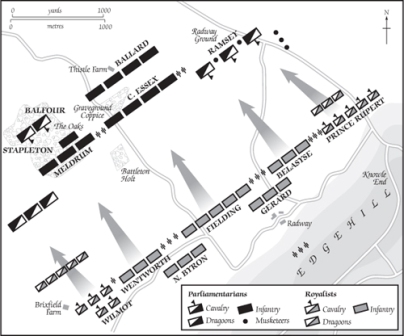
4. Battle of Edgehil, 23 October 1642.
With the parliamentary cavalry shattered, and his own horse lost to looting, Sir Jacob Astley ordered the king's infantry to advance. They did so, remembered the future James II (who as a young boy watched the battle from the ridge), ‘with a slow steady pace, and a very daring resolution’.46 Seeing the royalists move towards them, Essex's infantry brigade broke and ran. Edward Montagu, Lord Mandeville, begged his soldiers to stay and fight, beating some of them with a cudgel, but to no avail. Only 6,400 foot remained to meet the advance of over 10,000 of the king's men.
The battle came to what contemporaries called ‘push of pike’. Clarendon recalled, ‘the remaining foot on both sides stood their grounds with great courage.’ Although many of the king's soldiers were armed only with clubs, they stayed in their ranks, picking up muskets from the dead and wounded. ‘And the execution was great on both sides,’ reported Clarendon.47 Yet neither side came apart. ‘The foot being engaged in such warm and close service, it were reasonable to imagine that one side should run and be disordered,’ Prince James recalled. ‘But it happened otherwise, for each side, as if only by mutual consent retired some few paces.’ What occurred next was, concluded the king's second son, ‘A thing so very extraordinary.’48 Those few musketeers who had not expended the dozen or so rounds they had been issued continued firing in a desultory fashion. A few of the remaining parliamentary infantry bolted. But the rest stood. The two sides gazed at one another, and did nothing. Like two punch-drunk pugilists, the infantry had fought themselves to exhaustion. They could no longer move. Their burn-out was both physical (most men having been up marching since four or five that morning) as well as psychological. The result was inconclusive. For the overwhelming majority who fought there, Edgehill was their first experience of combat.
It took the royalists a fortnight to follow up their advantage. They marched towards the capital, stopping on 12 November to brush aside parliamentary forces at Brentford. The sack of the town—mild by continental standards, or even by those that took place later in the war—so terrified Londoners that the following day the trained bands came out en masse to Turnham Green to protect their city. ‘Remember the cause is for God and the defence of yourself and your children,’ General Philip Skippon reminded them. ‘Pray heartily and fight heartily, and God will bless us.’ That evening, after much praying and little fighting, both sides heartily withdrew, the royalists having concluded that ‘it had been madness’ for them to try and take London.49 Here the king lost his best chance of capturing the rebels’ main base, of crushing parliament and perhaps establishing an absolute monarchy. Thus Charles's reverse doomed the British Isles to a decade-long Civil War, a commonwealth, even a Glorious Revolution. Turnham Green was a turning point in the Civil War—for it was not bloody enough to be called a battle. So the aptly named Turnham Green deserves to be commemorated by more than an underground station on the District Line, and a couple of signboards put up by the local council. After Turnham Green, both sides returned to their winter depots—London and Oxford—to rest, and prepare for the coming campaign season.
During 1643, the war's first full year, there were numerous battles including Braddock Down, Stratton, Lansdown and Roundway Down in the western theatre and Adwalton, Winceby and Hull in the northern one. The central campaign, however, revolved around Prince Rupert's capture of Bristol on 26 July. While inspecting this prize, England's second city, Charles learned that Colonel Sir George Massey, the governor of Gloucester, thirty-five miles up the River Severn, was willing to yield the city so long as he could salve his honour by doing so personally to his sovereign. When the king arrived at Gloucester, Massey reneged. Determined to teach him a lesson, Charles insisted on capturing the city. The earl of Essex responded by mobilizing his forces around London post-haste to relieve Gloucester, the key point that controlled the River Severn and access to South Wales.
Unable to take Gloucester, Charles raised the siege on 5 September, and pursued Essex back to London. Having slowed the parliamentary withdrawal at Aldbourne Chase on 18 September, two days later the royalists managed to block their retreat at Newbury, fifty miles west of the capital. The two sides were evenly matched, the king having eight thousand foot and six thousand horse, and Essex ten thousand infantry and four thousand cavalry. Because the First Battle of Newbury was fought in hedgerow country, the king's superiority in cavalry was not as advantageous as it would have been in open terrain such as Edgehill. At seven in the morning of 20 September, fighting began for control of the field's central feature, Round Hill. Newbury was an incoherent melee in which artillery played an unusually important role. When nightfall ended the fighting, there was no clear-cut winner. Having exhausted all their eighty barrels of powder (four times more than fired at Edgehill), the royalists had to withdraw to Oxford, permitting Essex and his men to retire to the security of London.
Both sides used the winter to regroup and prepare for the 1644 campaign season. Realizing that it was losing, parliament signed an alliance, known as the Solemn League and Covenant, with the Scots, who in early 1644 invaded the North of England. Charles dispatched Prince Rupert to capture Newark so as to secure his lines of communication with his northern army under the earl of Newcastle. On 14 June the king sent Rupert with an ambiguous set of orders to relieve York, which he did on 21 June, setting the stage for the war's largest battle.50
Forty-six thousand soldiers met at Marston Moor, five miles west of York, on 2 July 1644. A contestant called the battlefield ‘the fairest ground for such use as I have seen in England’. Marston Moor was set in open country, with few natural defensive features. The troops were drawn up in the usual fashion, with the infantry in the centre and the cavalry on the flanks. Between the two sides a road and a ditch gave cover for a line of royalist musketeers, known as the ‘Forlorn Hope’. Determined to force a confrontation, Rupert lined up most of his men by nine in the morning. The allied army of Scots and parliamentary troops arrived much later. Indeed by early evening, sure that the enemy would not be ready until the next day, Rupert withdrew for a meal and Newcastle retired to his coach for a smoke. ‘About half an hour after seven o'clock,’ recalled Leonard Watson, the parliamentary scoutmaster,51
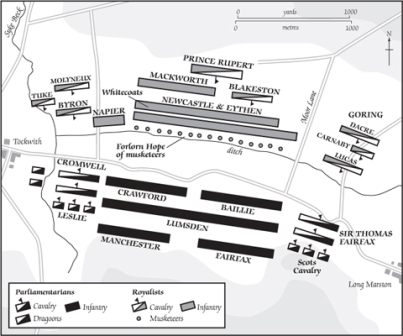
5. Battle of Marston Moor, 2 July 1644.
we seeing the enemy would not charge us, we resolved by the grace of God, to charge them, and so the sign being given we marched down to the charge. In which you might have seen the bravest sight in the world: two such disciplined armies marching to the charge. We came down the hill in the bravest order, and with the greatest resolution that was ever seen.
After the allied army moved forward across the road, winkling the ‘Forlorn Hope’ from their ditch, the battle took place in three sectors virtually at the same time and independently of each other. On the west flank Cromwell's horse clashed with Rupert's. At first it seemed as if the prince had the advantage, particularly after Cromwell had to withdraw to have a superficial neck wound dressed. When the Scots commanded by David Leslie (an able general who had learned his trade under Gustavus Adolphus) charged on their wiry little ponies, the balance swung towards the allies. Cromwell was able to rout Rupert's cavalry, and (most important), by retaining control of his own troopers, regrouped so as to return to continue fighting. On the eastern flank things were not going so well for the allies. Sir Thomas Fairfax's troops found the ditch in front of the enemy's position a serious obstacle. Although four hundred parliamentarians managed to cross it, they could not break the enemy in almost an hour's hand-to-hand fighting. George Goring's cavalry charged the allies, who ran in panic and confusion. Meanwhile, in the centre the main battle was taking place between the ranks of infantry. It was a chaotic, bloody shoving match. As General Lawrence Crawford's parliamentary foot managed to gain the upper hand, Newcastle's infantry, aided by Sir William Blakeston's cavalry managed to drive a wedge through the middle of the allied line. The battle hung in the balance. Suddenly, as night was about to fall, Cromwell's regrouped cavalry attacked the king's infantry in the rear. Many royalists panicked, a few surrendered. For an hour or two in the moonlight three thousand of Newcastle's Whitecoat Regiment fought on stubbornly, refusing all quarter.
Marston Moor was, as Cromwell exalted, ‘an absolute victory obtained by the Lord's blessing’.52 Fifteen hundred allied soldiers had perished, as had three thousand—perhaps as many as four thousand—of the king's men. Except for the Whitecoats, the majority of those who died were hacked to pieces as they broke and tried to escape from the field.
But the king made up for his loss in the north with a victory in the south-west.
On 29 March 1644 General Sir William Waller's parliamentary army of ten thousand men had beaten Lord Forth and Sir Ralph Hopton's six thousand royalists at Cheriton. Greatly encouraged by parliament's first real victory, Essex marched his field army from London towards Abingdon, which he captured on 26 May, threatening the king's main base at Oxford. With only two weeks’ food left, Charles withdrew his troops from Oxford west to Worcester. The roundheads followed in hot pursuit, but their generals, the earl of Essex and Sir William Waller, quarrelled and parted company. The former went to the West Country to fight Prince Maurice, Rupert's brother; the latter pursued the king, who had advanced on Buckingham, thus threatening the parliamentary heartland of East Anglia. At this point Charles lost his nerve. Turning back, he brushed against Waller's army at Cropredy Bridge on 29 June, as the two armies were marching almost parallel on either side of the River Cherwell. Waller lost seven hundred men, including deserters, which broke his army's morale, and allowed the king to turn west to pursue Essex's troops.
The Lostwithiel campaign of 1644 was Charles's most brilliant military achievement. Perhaps Cropredy had endowed him with enough self-confidence to eschew his habit of accepting the advice of the last person to give it. Anyway, he skilfully coordinated his forces on a wide front, where thick hedges and sunken roads (similar to the Bocage that bogged the Allies down in Normandy in 1944) rendered communications extremely difficult. Charles drove Essex's forces westwards through Devon to Cornwall. Taking Lostwithiel on 21 August, he trapped the enemy in the peninsula on the west bank of the River Fowey. The capture of Castle Dore ten days later convinced Essex that he was beaten. It was, he admitted, ‘the greatest blow we have ever suffered’.53 That night, as his cavalry under Sir William Balfour slipped through the royalist lines, Essex escaped in a fishing boat, leaving Sir Philip Skippon to negotiate a surrender.
Charles let victory slip through his fingers, allowing the roundheads to lay down their arms and march away to fight another day. They recovered with amazing speed, forcing the king to chase them back to London. Once again their paths crossed at Newbury. Because parliament had combined its forces, the two sides were evenly matched with fifteen thousand men apiece. The earl of Manchester's roundheads blocked the king's advance on London, as Waller's men, having made a fifteen-mile flanking movement around the enemy, attacked their left on 27 October. The two forces failed to coordinate their assaults, and Cromwell, for some unexplained reason, did not charge with his usual elan. That evening, after sunset ended the fighting, Charles extricated himself from a dangerous situation by a night march through a fifteen-hundred-yard gap in the enemy's lines. He reached the safety of Oxford on 1 November.
The third full year of fighting, 1645, turned out to be decisive. The king suspected as much, confiding to his wife that 1645 might be ‘the hottest for war of any that has been yet’, adding that it would be determined by ‘the battle of all for all’.54
Realizing that the war was going badly, that they had fought poorly at the Second Battle of Newbury, and that 1645 would be the decisive year, parliament established a New Model Army. It was a mighty force, largely because in April 1645 parliament had passed the Self-Denying Ordinance that stripped high-born but incompetent officers of their commissions, leaving the New Model to be commanded by men chosen, not for their pedigrees, but for proven professionalism. The other ranks, especially the horse troopers, were well trained, superbly led, promptly paid and highly motivated.
When he left his base at Oxford on 7 May, Charles clearly under-estimated this New Model Army, because he divided his own forces, sending three thousand men under Lord George Goring to the West Country, while retaining the remaining eight thousand. To maintain communications with Ireland, the king moved north to relieve Chester, which Sir William Brereton was investing. On hearing that the Siege of Chester had been raised, and in order to thwart Fairfax—the parliamentary commander-in-chief, who had just encircled Oxford—Charles shifted east, capturing Leicester, and thus threatening Essex and Suffolk, the parliamentary base. This reverse forced Fairfax to give up the Siege of Oxford and join Cromwell to confront the royal army.
Forewarned, Charles was not forearmed. He was out hunting when he learned of the New Model's approach. Although outnumbered by ten thousand to fifteen thousand, the king had little choice but to stand and fight on a gentle ridge about a mile north of the village of Naseby.55 By about nine on the morning of 14 June the sun burnt off the morning mists to reveal both sides drawn up in the traditional formation, with infantry in the centre and cavalry on the flanks. Since the roundheads were in dead ground south of Broad Moor, the royalists moved forward at about ten or eleven (the accounts vary). Soon the horse got too far ahead of the foot, and had to wait for them to catch up, as the parliamentary troops, screened by a ‘Forlorn Hope’ of musket men, moved over the rise, where they could look downhill at the advancing foe.
Coming under fire from Colonel John Okey's dragoons on their right flank, Rupert's horse charged and broke Henry Ireton's cavalry. Once again the stag-hunting squires tallyhoed too fast and much too far. The royalist cavalry did not stop until they reached the enemy baggage train, a little to the north-west of Naseby, which they spent the rest of the battle plundering. On the right flank Cromwell advanced his cavalry at a steady pace, so as not to lose control on the difficult muddy ground. For about an hour the Ironsides fought hand to hand with Sir Marmaduke Langdale's Northern Horse. Seeing that his horse troopers were about to break—the first of the fear-stricken men having already galloped past him—Charles wanted to lead his cavalry reserves in one last desperate charge. The war, however, was not to have a Hollywood ending, with Charles and Cromwell fighting it out hand to hand. Grabbing his sovereign's bridle, Robert Dalzell, earl of Carnwath, shouted ‘Will you go unto your death?’ This gesture, combined with an ambiguous order, panicked the reserves who rode hell for leather back to Leicester, leaving the infantry to their fate.56
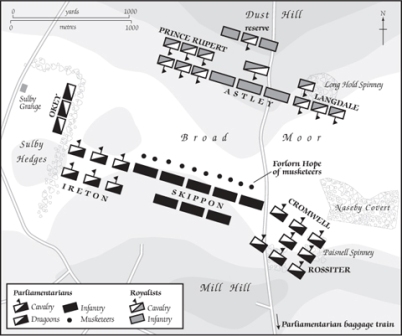
6. Battle of Naseby, 14 June 1645.
All this time the foot had been slugging it out in the centre. At first it seemed as if the more experienced royalists, who included the king's superb Welsh infantry, would prevail over the larger numbers of the New Model Army. But after an hour, as Fairfax sent in his own fresh regiment of foot, and Cromwell's horse and Okey's dragoons attacked, the king's infantry disintegrated so precipitously that most were captured.
For parliament, Naseby was a famous victory: the roundheads killed five hundred royalists, took three hundred wagonloads of booty worth a hundred thousand pounds, and captured four thousand royalist prisoners, whom they paraded through the streets of London. The parliamentary army jammed 680 prisoners into Lambeth Palace, and caged the rest in the open on Tothill Fields, where they suffered the further indignity of having to listen to puritan sermons—in Welsh! For the king, even more serious than the loss of men and materiel was the capture and publication of his private correspondence, which revealed the full extent of his perfidy. Charles had schemed to have French and Irish troops intervene in England, while he offered the Orkney and Shetland Islands to Sweden in return for its help.57
Even though the First English Civil War dragged on for nearly another year, after Naseby the royalists lost much support and all hope of winning: from then on everything else was a mopping-up. Clarendon rightly called Naseby ‘a battle for a crown’.58 In July 1645 Goring gave up the west at the Battle of Langport. Rupert surrendered Bristol on 10 September. Two weeks later, after the parliamentary forces beat a royalist army commanded by the king at Rowton, Charles lost Chester, his main link to Ireland. In May 1646 Charles had surrendered himself to the Scots, the last royalist garrison to capitulate being Harlech ten months later.
Even if the First English Civil War petered out more with a whimper than a bang, the loss of life had been enormous and the fighting ferocious. Surprisingly, the war had been fought with relatively few atrocities, especially when compared with the wars in Scotland and Ireland or most other Civil Wars. Sixteen massacres are known to have taken place during the First Civil War, in which perhaps a hundred and fifty parliamentarians and five hundred royalists were murdered. As the fighting dragged on, as soldiers got more war weary, and as propaganda became harsher, atrocities, especially by parliamentarians, tended to become more common, setting a pattern for the Second Civil War.59 At Basing House a hundred royalists were killed in hot blood following a horrific assault. The cold-blooded massacres of prisoners—as at Holt Castle, Denbighshire, Hopton Castle, Shropshire, and Barthomley, Cheshire—were unusual. For one thing, Englishmen spoke the same language and could negotiate a surrender—unlike the Welsh camp-followers whom the roundheads slaughtered after Naseby, who, unable to speak English, could not explain that they were not Irish.60 To be sure, parliamentarians routinely hanged Irish prisoners, soldiers and civilians, even bilingual ones. At Lyme Regis it was reported that a mob killed an old Irishwoman by rolling her over a cliff in a nail-studded barrel.61 After parliament passed an ordinance on 24 October 1644 that ‘no quarter shall henceforth be given to any Irishman, or Papist born in Ireland’ captured on land or at sea, things got even more brutish. When Sir Thomas Mytton took Shrewsbury in February 1645, and hanged a dozen Irish prisoners of war, Prince Rupert retaliated by stringing up an equal number of parliamentarians. The commons were outraged. They ordered the earl of Essex to explain to Rupert—who as a foreigner apparently did not appreciate the nuances of English lynching—that ‘there was a very great difference between an Englishman and an Irishman’.62
Civil War in Scotland
Back on 26 October 1640, at the end of the Second Bishops’ War (and twenty-two months before the outbreak of the First English Civil War), Charles had signed the Treaty of Ripon, in which he conceded almost all of the Scots demands. Afterwards he went to Edinburgh to confirm his concessions. But peace with Scotland was fleeting, lasting less than three years. North of the border there were two wars. The first broke out after the Lowland Presbyterians made an alliance, the Solemn League and Covenant, in September 1643 with the English parliamentarians, which led to their invasion of the North of England and subsequent decimation at Marston Moor. The second was a Civil War within Scotland, a conflict between the Lowlanders and the Highlanders, who were divided by geography, culture, language and religion. The Lowlanders were more economically advanced, spoke English and were Presbyterians; the Highlanders were organized into clans, lived on the economic margins, spoke Gaelic and tended to be Catholic.
The two wars came together during the campaigns of James Graham, marquess of Montrose. The scion of one of Scotland's leading families, Montrose had initially supported the covenant. By 1643 he was so disillusioned with the ambitions of the kirk that he sent the king an offer to raise the Highlands. After the covenanters invaded England in 1644, Charles accepted. Montrose's first rising was a fiasco: he was lucky to escape to England with his life. In August 1644, in disguise, he returned to the Highlands with a couple of companions, having a silk royal standard hidden around his waist. This time he was far more successful. Clansmen flocked to the king's colour. In September at Tippermuir they confronted a contingent under John Elcho, earl of Wemyss, whose battle cry was ‘Jesus and no Quarter!’63 Defeated, the covenanters got what they proffered. Although outnumbered two to one, at Inverlochy the following February, Montrose's troops slew fifteen hundred covenanters for the loss of eight of their own. In May they killed half of Colonel John Hurry's covenanters at Auldearn; in July and August they defeated General William Baillie at Alford and Kilsyth.
In some respects Montrose's campaigns were less a struggle between dour Lowlanders and free-spirited Highlanders than they were a clan feud between the earl of Argyle's Campbells and the MacDonalds, many of whom were Ulstermen led by the earl of Antrim. Such feuds were very common: between 1573 and 1625 there were 365 of them. They were also very costly: half of Alistair Moir MacLeod's twenty-eight male dependants died in a single feud.64 Because these feuds got caught up in a wider conflict, war in Scotland was far bloodier than it was south of the border. After routing the covenanters outside Perth, Montrose's men boasted that they could walk the three miles back to the town using the enemy dead as stepping stones without once touching the ground. An eyewitness of their plunder of Nairn ‘saw no man in the street but was stripped naked to the skin’.65 After accepting the surrender of some Campbells commanded by Zachary Malcolm at Lagganmore in Glen Euchar, Montrose's troops locked them and their women in a barn, then set it alight, roasting all but two alive.66 No wonder at Auldearn the covenanters stood their ground: unfortunately, they did so on a bog and thus lost half their men. After the Battle of Inverlochy where casualties were just as high, the poet Ian Lom MacDonald surveyed the corpse-strewed field and the loch bloody with floating carcasses:67
You remember the place called Tawney Field?
It got a fine dose of manure
Not the dung of sheep or goats,
But Campbell blood well congealed.
Ancient clan hatreds robbed the bard of all pity:
To Hell with you, if I cared for your plight
As I listen to your children's distress,
Lamenting the band that went into battle
The howling of the women of Argyle.
Alasdair MacColla, Montrose's kinsman and second in command, was just as callous: jubilant at the slaughter of sixteen Campbell lairds, he lamented that their pregnant wives had been spared.68 All sides committed atrocities. In 1645 the covenanters butchered a hundred rank and file of the garrison of Asiog Castle, Ayrshire, who surrendered on promise of quarter, saving the thirty-six officers to be hanged later at leisure. A couple of years afterwards General David Leslie, Lord Newark, meted out a similar fate to the royalist defenders of Dunaverty Castle.69
Montrose was a born leader: energetic, an outstanding guerrilla warrior, he inveigled the enemy into fighting on his terms. Two-thirds of his men were veterans, either of the Ulster campaign of 1641–42 or the Thirty Years War. Fighting in all weathers, they set the Highlands ablaze. Yet his men were outnumbered, especially after David Leslie's covenanters returned home following their victory at Marston Moor. The two armies met at Philiphaugh, where on 13 September 1645 Leslie's men surprised and routed Montrose's forces. Many of them were slaughtered; their leader managed to escape to Norway.
Civil War in Ireland
As we have seen, the Irish Rebellion of 1641 produced a tremendous backlash in England. In the following year Charles sent an army to crush the rebels, who united to form a Catholic confederate government, based in Kilkenny, which established a quasi-independent Irish state. For eleven years the highly complicated Wars of the Confederation took place in the island, where as many as four armies operated at the same time. The outbreak of the English Civil War in August 1642 saved the Confederation of Kilkenny because Charles had to withdraw his forces to fight parliament in England. Twelve months later the king signed a peace treaty with the confederation, which soon after sent a few Catholic Irish troops to England to fight on Charles's side. In 1645 Pope Innocent X dispatched Archbishop Giovanni Rinuccini to Kilkenny with a large supply of arms and money to help the confederates win toleration for Catholics and what would much later become known as ‘home rule’. The confederation became increasingly divided and in desperation made a secret treaty with the king using Edward Somerset, earl of Glamorgan, as an intermediary. Charles, realizing he had conceded much too much, promptly repudiated the treaty. Parliament's victory in the First English Civil War sealed the confederation's fate. Unable to unite the Irish, Rinuccini returned home in February 1649. Six months later Oliver Cromwell landed in Ireland.
Compared to England, or even Scotland, Civil War in Ireland was much more savage and complicated. The English were determined that the Irish should pay—in as many ways as possible—for the 1641 rebellion. In March 1642 parliament passed the Adventurers’ Act, which hoped to raise a million pounds from the sale of two and a half million acres of land confiscated from the rebels, thus setting the pattern for the 1650s.70 To enforce the act an army of twelve thousand Scots invaded Ulster in August. They were commanded on alternate days by Sir Robert Munro and Edward, Viscount Conway—which did little to enhance the effectiveness of the troops, whom an English officer correctly called ‘the scum of that country’. For instance, John Erwyn, with a gang of Scots soldiers, broke into Mary Mullen's house, grabbed her, slashing her head and fingers with his sword, as she screamed repeatedly, ‘Dear John, do not kill me, for I have never offended you!’ Then he thrust his sword under her right breast into her heart, stripped her naked, and—just to make sure she was dead—placed a live coal on her forehead.71
Such savagery was encouraged at the very top. Charles told his forces in Ireland to ‘prosecute the said Rebels and Traitors with fire and sword’.72 The Lords Justices in Dublin instructed James Butler, marquess of Ormonde, ‘to burn, spoil, waste, consume, and demolish all the places, towns, and houses where the said rebels are … and to kill and destroy all the men there inhabiting able to bear arms’. The earl, who had just hanged the defenders of Naas, had few scruples about obeying such commands, particularly as the rebels held his wife and children hostage. When Secretary of State Conway ordered Colonels Crawford and Gibson to lead a punitive expedition to ravage Counties Wicklow and Kildare he wrote, ‘you are to kill, slay and destroy all the rebels you can there find.’73 The king's soldiers needed little official encouragement, ‘so earnestly did they desire to have the killing of more of the rebels,’ a journalist explained. Another related that after the rebels called ‘our men English dogs and Scotch dogs’, they ‘put them all to the sword’.74
The full horror of the fighting in Ireland, which British forces conducted with the casual cruelty characteristic of a S.S. Einsatzgruppen on the Eastern Front, can be seen in the diary of an anonymous officer who took part in a search and destroy mission through County Wicklow in November 1641 (see ill.9).75 On 28 November the English caught two spies, whom they hung on the castle wall at Newcastle. The next day ‘were taken and hung some men and women'; their numbers and offences the diarist apparently felt not worth recording. Later that day two more Irish were hanged, and one shot for trying to stop the troops rustling his cattle. When the English reached Wicklow on the morrow, they hanged three people, including a pregnant woman. After being ambushed on their way to Bray, they killed eight prisoners, and nonchalantly shot and killed a peasant as he was innocently ploughing his fields.
Such expeditions were the bloody norm, since the English preferred to destroy rather than search. For instance, William Damon's diary of a two-week foray against the rebels—which was published in 1642 in England under the title Welcome news from Ireland—reported how ‘we marched … burning and pillaging all the way’. This eyewitness account of atrocities becomes numbingly tedious.76 On every day but two the English burned villages and hanged rebels—a couple on 5 April, four on the 6th, eight on the 7th, fourteen on the 8th, and on the 12th ‘We rested at Malborough, and that night hanged 3 poor Rogues … all dying without any show of penitence.’ After helplessly watching the Irish kill parliamentary prisoners at the Battle of Knocknanoss in 1647, an English officer cheerfully noted how his troops made the rebels ‘pay the price of their insolent attempt by putting the greatest part of them to the sword’. Day after day the slaughter continued. ‘We were killing till night as fast as we could,’ the officer concluded.77 An English diarist recorded that at Clontarf the ‘soldiers got very good pillage, and so left the town burning’. The following summer Roger Boyle, earl of Orrery, reported that at Limerick ‘We had a fair execution [i.e. massacre] for about three miles, and indeed it was bloody, for I gave order to kill all, although some prisoners of good quality were saved.’78 Colonel Michael Jones, the parliamentary commander in Ireland, ordered six hundred prisoners killed in cold blood on the grounds that they were deserters: he even hanged his own nephew, Elliot, for going over to the crown.
In many respects Ireland became one huge ‘free fire zone’ in which, as Ulick Bourke, the earl of Clanricarde admitted, English troops murdered, plundered, mutilated and ransomed to their hearts’ content. Apart from an English lieutenant who was reported hanged for murdering a woman in May 1642, they did so virtually unchecked, and with an excess that horrified even hardened veterans of the Thirty Years War, such as Sir James Turner. Such behaviour, both Turner and Clanricarde warned, was counter-productive because it encouraged further resistance and atrocities from the other side.79
Pleas for humanity fell on deaf ears because the fighting in Ireland had got out of control. Neighbour fought neighbour to settle old festering feuds. Irish warfare not only brutalized the conflict in England, but exacerbated the intensity of feelings throughout the rest of the British Isles. It led to violent and spontaneous iconoclasm, the destruction of religious images by soldiers.80 The parliamentary practice of hanging the Irish they took prisoner in England led to further outrages that augmented animosities on all sides, and encouraged the conviction that they were fighting a holy war in which there could be no compromise. Take for instance the evidence of a woman—known as MW—whom Irish troops captured in June 1644. She alleged that they ‘killed my husband and my child, both before my face, and stripped and wounded me and a child of five years old: and it was thought that I could not live…. But our cause was God's.’
The Second English Civil War, 1648
Even if Charles I never gave up believing that his cause was God's, by the spring of 1646 he had come to realize that it was lost—if only for the time being. Early on the morning of 27 April he slipped out of his main base in Oxford in disguise, recognizing that the First English Civil War was over. It had left hundreds of thousands dead and wounded, without producing a solution—or at least one the king would accept. By now a growing number of parliamentarians were coming to the dreadful conclusion that Charles could not be trusted. Thus on 10 June Sir Charles Erskine, a Scots commissioner to the Westminster Assembly, wrote to his wife, ‘We are in no less expectation of troubles than when you left us, every hour producing strong effects and changes in affairs, so that honest men can hardly know what way to walk.’81
Certainly on leaving Oxford Charles hardly knew what way to walk. After skirting the north of London, the king meandered through East Anglia, and then Nottinghamshire, where in early May he surrendered to the Scottish occupying army just outside Newark. Here he was, Charles told his wife, ‘barbarously baited’ by Presbyterian preachers, who tried to convert him. Since their missionary efforts were as ineffectual as their purses were empty, in February 1647 the Scots transferred the king to parliament in return for a promise that their debts be paid.82 The following June Cornet George Joyce abducted Charles from parliament's custody at Holdenby House, Northamptonshire, handing him over to the army, who held him at Hampton Court, from which he escaped in November. Once free, Charles dithered over where to go next, before opting for the Isle of Wight. Here on Boxing Day 1647 he signed a secret Engagement with the Scots (who had become terrified by the growth of radicalism south of the border), promising to accept Presbyterianism for three years if they invaded England and restored him to power. Thus, with a stroke of his pen, ‘Charles R’ began the Second Civil War, and, in effect, signed his own death warrant. He did so, as he had told the army commanders in August 1647, because he was convinced that ‘You cannot be without me…. You will fall to ruin if I do not sustain you.’83 The king banked on the growing dissatisfaction with parliament and the army, and the strong popular desire to return to a sense of normality which Martin Parker voiced that year in his best-selling ballad:84
…all things will be well,
When the King enjoys his own again.
Fighting in the Second Civil War started in Wales. Angry that his men had not got their arrears of pay, Colonel John Poyer seized Pembroke Castle, prompting other disgruntled roundheads to commandeer Tenby and Chepstow, and declare for the king. On 1 May 1648 parliament ordered Cromwell to take eight thousand troops to crush the rebellion, which he did at St Fagans on 8 May. It took him until 11 July to capture Pembroke Castle. Poyer was sent to London, where he was court-martialled and shot.
During the Second Civil War, the roundheads were disinclined to treat prisoners kindly—as Michael Hudson learned. A quiet, even plain-spoken man, Hudson studied at Oxford, where he graduated as a Doctor of Divinity, before becoming a royal chaplain. After helping the king escape from Oxford in April 1646, Hudson went into hiding, was arrested by the army, escaped, and was re-arrested. He escaped once more disguised as a porter balancing a barrel of apples on his head. The Second Civil War enabled him to show his true colours. In June 1648 at Woodcroft House, Northamptonshire, he staged a royalist rising, which two roundhead companies under Colonel Thomas Waite, a local MP and later regicide, easily put down. Since one of Waite's kinsmen had been killed in the fighting, the colonel denied ‘that rogue Hudson’ quarter, driving him up to the roof of Woodcroft House where he was pushed off the edge. Hudson clung for dear life to a battlement. So, royalist hagiographers claimed, the roundheads hacked off his hands at the wrist. Hudson fell to the moat, and, as he tried to use his stumps to swim to the bank, they smashed in his head. Afterwards Trooper Wood, a grocer from Stamford, bragged that he had cut out the reverend doctor's tongue as a souvenir.85
Horrible as such incidents were, they pall beside the brutality of the Siege of Colchester.86 At Blackheath on 30 May seven thousand men under Sir Thomas Fairfax routed a group of royalists, mainly from Kent, and two days later drove the remnants back to Rochester, where ‘huddled into a crowd of confused destruction’, an eyewitness recalled, the royalists ‘were overwhelmed’. The survivors fled, some to be slain in St Neots, the rest seeking refuge in Colchester, where Fairfax's army surrounded them. The fighting quickly became savage. After capturing the house of Sir Charles Lucas (a veteran royalist commander) a few hundred yards south of Colchester's walls, the roundheads ran amok. They burst into the family vault, tearing open Lady Lucas and her daughter Lady Killigrew's coffins, and dismembered the corpses of Sir Charles's mother and sister, throwing arms and legs about the vault, and clipping hair to wear as favours in their hats.
Two weeks later, at three in the afternoon of 13 June, Colonel Marchmount Needham's regiment assaulted the Headgate, where the London Road entered the city wall. The struggle went on until midnight. ‘Here you might see the limbs of men, horses, fire, dust confused together in one horrid Chaos,’ an eyewitness reported.87 Having lost their colonel, two captains and a hundred other ranks, Needham's roundheads went berserk, slashing and killing like lunatics. They took no prisoners. But they did not win the day. Their defeat heartened the king's men. ‘I earnestly desire you not to be dismayed, for we trust in God,’ the royalist Robert Vesey wrote home to his wife the next day, before, more mundanely, asking her to send him some clean linen.88 On 6 July, Sir Charles Lucas and Sir George Lisle (veteran of the Thirty Years War) led a large raiding party across a narrow footbridge over the River Colne to recapture the parliamentary stronghold at East Mill. It was as neat a piece of action as the war had ever seen. One observer noted that the royalists sallied out ‘as if it had been a sporting skirmish amongst tame soldiers at a general muster’, killing nineteen enemy and pitching their cannon into the river, before making a dignified withdrawal. In return, Fairfax paid three grenadiers three shillings apiece, and twenty assault troops half a crown each, to storm the gate house, which they did. After a grenade blew up a magazine the ninety royalist defenders surrendered.
A week later, stories that the royalists were using poisoned shot started to circulate: ‘Our soldiers,’ observed a parliamentary officer, ‘were exasperated with the loss of blood of their fellow soldiers, many being slain with chewed or poisoned bullets.’89 In cold blood the roundheads executed twenty prisoners taken with suspect ammunition. John Rushworth, a member of parliament who acted as a war correspondent, reported that the royalists had amputated the fingers of several wounded officers, including a colonel, to loot their rings and were using scythes to cut off the enemy's feet.90
After eleven pitiless weeks Colchester's garrison of 3,531 surrendered on 28 August, with but a barrel and a half of powder left, having devoured the last dog, cat and most of the horses. ‘It was a sad spectacle to see,’ remembered Rushworth, ‘so many fine houses burnt to ashes, and so many inhabitants sick and weak.’91 Fairfax immediately arrested Lisle, Lucas and Sir Bernard Gascoigne (a Tuscan mercenary). By two the next afternoon a court martial had condemned them to death. Five hours later Lucas and Lisle were shot for breaking the parole they had given after surrendering in the First Civil War. Gascoigne, the Italian, was reprieved so as not to upset overseas opinion. Even though they had broken their word as gentlemen, Lucas and Lisle instantly became royalist martyrs: it was said that the grass never again grew on the spot where they fell (not true, but there is a marker there today). Within a few days eight pamphlets appeared condemning this ‘most barbarous unsoldierly murder’. People were horrified that England had sunk to the abyss of the Thirty Years War, where such killings were accepted. Edmund Verney, who was himself to be murdered three years later during the sack of Drogheda, called the shootings ‘horrid and barbarous’.92 It was to set a precedent for another execution that was to take place outside the Banqueting Hall in Whitehall the following January.
On 8 July 1648 a Scottish army invaded England to fulfil the Engagement they had signed the previous December to restore Charles, who had agreed to accept Presbyterianism for at least three years. Thus, a parliamentary newspaper complained, the Scots brought ‘their lice and their Presbytery’ with them. Six weeks later the Scots fought a climactic battle at Preston. Unlike Naseby, Marston Moor or Edgehill, Preston was a long drawn-out, dispersed and extremely confused battle that lasted from 17 to 19 August. Cromwell reported he had never seen his troopers ‘so exceedingly battered’. On the battle's opening day his men fought Marmaduke Langdale's English royalists among the hedgerows and narrow lanes of Ribbleton Moor. According to Captain John Hodgson, a roundhead veteran, the initial Scots resistance was slight. The first enemy his Lancashire militia company encountered were huddling in a ditch. Soon, however, the going got tough. ‘There was nothing but fire and smoke,’ Hodgson remembered, adding that ‘The bullets flew freely.’93 Gradually, the royalists were pushed west into Preston, where around the bridge across the River Ribble fighting lasted until nightfall. That evening the Scots commander, the duke of Hamilton, decided to withdraw towards Warrington, where he hoped to take up a strong defensive position behind the River Mersey. At Wigan Sir James Turner's Scots cavalry refused to charge. When Trooper Patrick Grey shot his captain, whether deliberately or by accident, he was executed on the spot. But that did not stop the Scots retreat turning into a rout.94 Hours later, using the same phrase he had employed after Naseby, Cromwell told William Lenthall, Speaker of the House of Commons, ‘Surely, Sir, this is nothing but the hand of God.’95 By now the army was convinced that the king must die and that God's hand was behind the trial and execution of Charles I on 30 January 1649 for, inter alia, waging two cruel and unnecessary wars against His people.
The Third Civil War, 1649–51
The execution of Charles I did not bring peace. Far from it. Instead it precipitated two brutal conflicts, first between England and Ireland, and then England and Scotland. But the death of the king did in a way make a clean sweep, allowing the new republic to try and settle the Irish question. Within six months Oliver Cromwell, who had come to dominate the army, which in turn had taken over the government, set sail for Ireland with a large expeditionary force. In August he assured his senior officers that God wanted them to crush those papist savages, and told the rank and file to think of themselves as Israelites ordained to extirpate idolatry from Canaan. Crossing the Irish Sea was a far more turbulent going-over than that of the Red Sea, for according to Chaplain Hugh Peters (who prided himself on being something of an expert on both maritime and mortal transitions), Cromwell was sicker than any man he had ever seen. In Dublin the general announced that ‘God hath brought him thither … for the carrying out of the great work against the barbarous and bloodthirsty Irish.’96
Cromwell wasted no time starting His great work. On 10 September he began the Siege of Drogheda, the strategic town that controlled the mouth of the River Boyne.97 Well protected by a wall a mile and a half long, twenty feet high, six foot thick at the base and four at the top, dotted with 29 guard towers and defended by 319 cavalry and 2,221 infantry, Drogheda was a tough nut to crack. ‘He who could take Drogheda could take Hell,’ boasted its governor, Sir Arthur Aston, the peg-legged veteran. (He had lost his leg five years earlier in a riding accident while trying to impress some ladies with his equestrian prowess.) Aston spurned Cromwell's demand to surrender, so after a heavy bombardment the English stormed the town. It was a Promethean struggle. When a cannonball struck off his legs, Colonel William Warren continued fighting on his stumps. The third assault, which Cromwell led in person, succeeded. Several thousand roundheads poured through the breach. They beat Aston to death with his wooden leg, and set fire to St Peter's church, where a thousand enemy had taken refuge. ‘We refused them quarter,’ Cromwell reported, ‘we put to the sword the whole number of defendants.’ The thirty or so of those who were spared were transported to Barbados. Cromwell's chaplain gloated that over 3,500 enemy perished at Drogheda for the loss of sixty-four roundheads.98
Half as many enemy died the following month at Wexford. After a traitor opened the gates on 11 October, Cromwell's men charged into the town. Without orders they ran amok. Two boatloads of refugees sank, drowning 330 folk, many of them civilians. Without mercy the roundheads butchered priests and friars, who approached them brandishing crucifixes, naively assuming that this would mollify the enemy rather than infuriate them. Cromwell's men also massacred two hundred women at the Market Cross as they begged for quarter. ‘Seeing thus the righteous hand of God upon such a town and people,’ explained Cromwell, ‘we thought it not good nor just to restrain our soldiers from right of pillage nor doing execution upon the enemy.’99 But there was no excuse for the massacre at Wexford, which took place during surrender negotiations, unlike that at Drogheda, which could be justified according to the rules of war because the garrison had rejected a demand to capitulate.100
The Irish bloodletting continued. In early November four hundred men were killed at Carrick, where the defenders hurled stones down from the walls. Tired and ill, Cromwell's troops continued to campaign through the winter. ‘I tell you,’ their commander reported to parliament, ‘a considerable part of your army is fitter for a hospital than the field.’101 In February 1650 the army massacred the two hundred defenders of Callan who had refused to surrender. After taking the small outpost of Thomastown, Cromwell hanged a sergeant and a corporal, since they were the most senior soldiers left alive. After Gowran Castle surrendered a few days later, all but one officer was shot and a Catholic priest hanged.102
But the roundheads did not have everything go their way. After an eleven-day artillery bombardment had breached the walls at Clonmel, County Tipperary, at eight in the morning of 9 May, a thousand of them stormed through the gap, to find themselves trapped: the defenders had built a corral of stones, timber, and even dung, in front of which was a six-foot trench. As those in the front cried ‘back!’ and those at the back shoved forward, the defenders stabbed at the roundheads with pikes, slashed them with swords, and raked them with muskets and grapeshot.103 Cromwell was as angry ‘as ever he was since he first put on a helmet against the king’, observed an officer in Sir John Clotworthy's regiment, ‘for he was not used to being thus repulsed.’104 A fortnight after the worst defeat of his career, Cromwell sailed for home to deal with the growing problem of Scotland.
As the Montrose campaign had demonstrated, fighting in Scotland was far more vicious than that in England (although less so than in Ireland). But the cruelty of Cromwell's 1650 invasion of Scotland came less from a policy of deliberate brutality and more from arrogance compounded by desperation. The Ironsides who marched north across the border that summer did not think much of the Scots. Their streets were empty, their women were poorly dressed ‘pitiful sorry creatures’, who constantly whined that the lairds had drafted their menfolk.105
The two sides met at Dunbar on 3 September. The Scots seemed to have the upper hand for Cromwell's forces were trying to retreat south. As a cold wet dawn broke, and a thin moon waned, Cromwell unleashed his infantry against the centre of the Scots lines. ‘I never beheld a more terrible charge of foot than was given by our army,’ reported a veteran correspondent. The roundheads caught the enemy unawares: many Scots officers had left their units to bed down in more comfortable billets; most soldiers lacked lighted match to fire their weapons. An observer wrote:106
The Foot threw down their Arms, and both Horse and Foot Ran several ways…. We pursued them as far as Haddington, killing, wounding them all the way, there were about 4,000 slain in this place, and in the pursuit about 10,000 taken Prisoners, most of which are wounded…. We lost not forty men.
In many ways, down even to the date of its climactic confrontation, 3 September, the Worcester campaign was a replay of Dunbar. A year after his father's execution, Charles II returned to Scotland where on New Year's Day 1650 he was crowned king. With ill grace he took the covenant, and converted to Presbyterianism. Confident that the English would flock to join his standard, on 3 August 1651 he crossed the border at the head of sixteen thousand Scots troops. They were a ramshackle lot: the soldiers plundered with an enthusiasm that their senior commanders reserved for quarrelling amongst each other, or for making pessimistic predictions. General David Leslie was convinced that his army ‘would not fight’, while the duke of Hamilton considered the invasion ‘very desperate’.
The Scots reached the strategic city of Worcester on 23 August, and had less than a week to rest and mend the city's crumbling walls before Cromwell arrived with twenty-eight thousand men. He attacked at five in the morning of 3 September. After about two hours’ fighting, royalist resistance collapsed. The slaughter was appalling, ‘what with the dead Bodies of the Men and the Dead Horses of the Enemy filling the streets,’ remembered Bulstrode Whitelocke.107 The Scots paid a terrible price for their loyalty to the king, two thousand, perhaps three thousand of them perishing in the campaign, while Charles, after many an adventure, managed to escape to France. The victors, who claimed to have lost only two hundred men, had no doubt whom to thank. ‘We are the people that the Lord hath done all this for,’ exulted one of them. ‘The Lord of Hosts was wonderfully with us,’ thought Robert Stapleton. Oliver Cromwell boasted that ‘the Lord appeared so wonderfully in His mercies.’108
Cromwell's rejoicing was, however, more than a little premature.