
Chapter 5
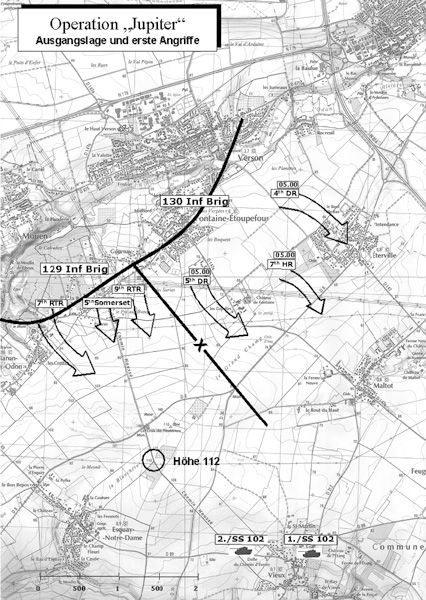
This time, the 43rd Scottish Division received the mission of finally taking Hill 112 and creating the prerequisites for the continued advance over the Orne. At 0445 hours on 10 July 1944, the British fifteen-minute artillery preparation was started from more than 1,000 guns, including naval artillery. When it was over, the lead battalions of the 129th and 130th Infantry Brigades moved out. Eterville was rapidly taken by the 4th Dorsetshire Regiment with assistance from Crocodile flamethrower tanks. The village was then subjected to counterattacks the entire day.
After tough fighting, the area northwest of Maltot was taken in the afternoon, some two kilometers east of Hill 112. Even the open terrain to the high ground was almost crossed, when the counterattack launched by schwere SS-Panzer-Abteilung 102 in the direction of Hill 112 as well as Maltot started to show effect. For the time being, the situation at Maltot stabilized for the Germans. The Tigers intervened at just the moment when the British wanted to start their decisive push to the Orne.

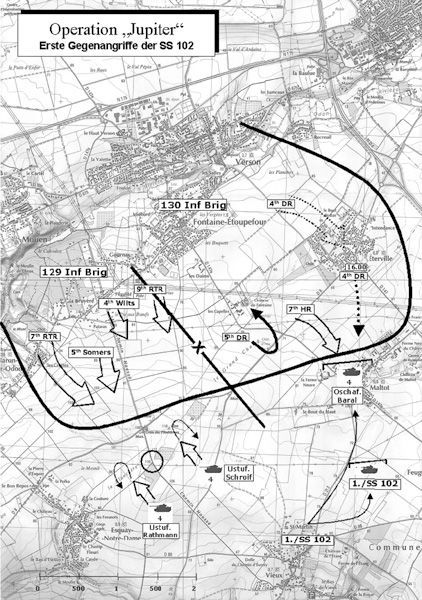
On the day before the British attack, schwere SS-Panzer-Abteilung 102 had received orders shortly after 2000 hours to move to the northern outskirts of St. Martin (northeast of Vieux). The road march started at 2230 hours and proceeded via Maiset and Amayé-sur-Orne. Tiger 211 became disabled along the way. The two companies of the battalion—the 3rd Company had not yet closed into the area of operations—received the following mission: Attack Hill 112 (2nd Company) and the area east of it (1st Company). In all, some twenty-seven Tigers were operational.
As it dawned on 10 July 1944, there was an aerial attack, whereby two Tigers were destroyed.
The 7th Hampshire Regiment was receiving fire not only from the front but also from several Tigers of the 1st Company in an elevated position some 1,000 meters northeast of St. Martin. Four Tigers under SS-Oberscharführer Baral reached Maltot the same time as the Scots did. They moved through the village, went into position on the northern outskirts and then saw several Churchills in front of them.
With the Tigers racing across from St. Martin was SS-Unterscharführer Will Fey:
Our four tanks led the reconnaissance into Maltot. We had to protect the flank of our Tiger tanks on Hill 112. Off we went at top speed over the open fields. We reached the edge of the village. Wasting no time, we pushed through the hedges. There, in front of us, were four Sherman tanks [Churchills]. Two rounds finished off the one on the left; the one next to him suffered the same fate, and the platoon leader pushed forward to knock out a third. The fourth sought safety in racing back along the road. It was a great boost for our young tank crew. (J. J. How, Hill 112. English translation of the German original corrected.)
To state it mildly, the British had reported the capture of Maltot at 0915 hours a bit prematurely. The 5th Dorsetshire Regiment, which was moving on Maltot from the right, received such strong fire that it had to pull back to the Chateau de Fontaine. By this time, one British tank after another was being knocked out in Maltot. The situation was becoming critical for the Scots. It was only through artillery barrage fire and large swarms of Typhoon fighter-bombers that the German attacks against Maltot could be held up. At 1600 hours, the 4th Dorsetshire Regiment was also moved to Maltot so as to reinforce the remnants of the Hampshire Regiment. These forces were decimated on the way there. That night, the first British forces were withdrawn from Maltot. Both battalions had lost approximately 50 percent of their personnel on this one day.
The fighting developed as follows on the forward slope of Hill 112: At 0530 hours—using German time, which was two hours ahead of British time—the attack of the battalion’s two tank companies started with two operational platoons. The 3rd Platoon of SS-Untersturmführer Rathmann was on the left; the 1st Platoon of SS-Untersturmführer Schroif was on the right. A meeting engagement against the 7th Battalion of the Royal Tank Regiment (northeast of Baron) and the 9th Battalion of the Royal Tank Regiment (on both sides of the Fontaine Etoupefour–Maltot road) started from a movement to contact. The so-called “Patch of Woods of Half Trees” (Wäldchen der halben Bäume)—so named because of what the artillery fire had done to it—hard northwest of Hill 112 was taken. Tiger 213 of SS-Unterscharführer Piller received a hit from an antitank gun of the 4th Wiltshire Regiment and had to return to the rear. Three enemy tanks and an antitank gun were knocked out.
The following account of the British attack to the northwest past Hill 112 is found in J. J. How’s book, Hill 112:
A nasty surprise was awaiting the men of Wessex. At a quarter to three in the morning a battalion of new Tiger tanks arrived on the German side of the hill and moved into the village of St. Martin. These fifty-six ton Tigers were Germany’s most feared weapon. Neither the British nor the Americans had anything to compare with them. There were never more than three battalions of them fighting in Normandy, and all fought in the British sector. The 102 SS Heavy Tank Battalion was the Tiger battalion of the IInd SS Panzer Corps. It had been eighteen days on the road from Holland. It should have been in the IInd SS Panzer Corps counter-attack on the Scottish corridor. It was just as well for the British that they had failed to turn up, for had these “Kings of the Battlefield” been present at Cheux and le Valtru, who knows what the outcome might have been.
As dawn streaked the sky in the east the British bombardment suddenly flashed brighter in the sky above Hill 112. The distant sound of the guns was followed by a scream and howl as shells crashed down amongst the Tiger tanks in the orchards of St. Martin.
The Tiger tanks that had early that morning arrived in St. Martin had joined the battle. Two companies, about twenty [tanks] in number, had first moved up the German slope and halted at the hedge facing the little wood from the east. They were above the morning mist; the sun was trying to break through. Allied aeroplanes suddenly swooped out of the sky, dropped their bombs, circled and dived with all machineguns firing. It was the 10th SS Panzer Grenadiers who suffered the casualties. The noise deadened the senses. The hilltop was being pounded by shellfire. Nothing of the fierce battle raging there could be seen.
Commanding the 2nd Company was Hauptsturmfuehrer (Captain) Endemann. His wireless wasn’t working. He was transmitting orders by hand signal. He took the company past the little box-shaped wood and on to the plateau. Corporal Piller’s Tiger was immediately hit and had to pull back. Rathsack fired and knocked out a British tank. Untersturmfuehrer (Lieutenant) Schroif knocked out two more and an anti-tank gun. Endemann disappeared into the smoke and dust and was not seen or heard of again.
The 3rd Company moved on to the eastern side of the plateau. Hans Richter was a Tiger commander with this company:
A solid armour-piercing shot went clean through the turret. It took with it the head of the gunner, Hans Kruckner. It took also my left forearm and smashed my right one. It peppered my chest with bits of metal and sent a splinter into my right eye. That was the end for us. I was sure that I would bleed to death. “Reverse!” I shouted. The gun-loader tore at my headphones. He tied the cable around my left upper arm to stop the bleeding. I was getting weaker. But I managed to get out of the turret. This is it, I thought, as I staggered across an open field in a din of crashing shellfire. Another Tiger came roaring past. It stopped. “We’ll take you!” Strong arms lifted me up. First onto the back of the [tank], and then, when the firing got worse, into the turret. I lay semi-conscious on the turntable [turret floor]. I remembered an ambulance—doors open—the entrance to a village. I heard someone say: “Main artery! Take him! Quickly!”
Little wonder that for the Churchills of the 7th Royal Tank Regiment, which were supporting the Somersets, things got steadily worse:
Lieutenant Colonel Gaisford blinded in one eye and Major Fleming killed in his tank, “C” Squadron suffered terribly, losing six tanks.… The Somersets were decimated.
The Somersets would be lucky to hold on to what they had won. Of the sixteen rifle company officers who had moved up the hill, only four remained. One company was under the command of a Sergeant. The carrier platoon commander, who was to have arrived with his men to help clear the plateau, was dead. The surviving Churchill tanks had pulled back to hull-down positions. And it was there, on the reverse slope hidden by the crest, that the Somersets were digging in. They had left only lightly manned observation posts higher up along the line of the road.
Plotting the progress of the British offensive in his battle headquarters was the commander of the 10th SS Frundsberg Division, [SS-Oberführer] (Brigadier) Harmel:
Whilst our divisional and the corps artillery, together with the mortars of the 8th Werfer Brigade, brought down a heavy curtain of fire to prevent the British from developing their attack on the top of Hill 112, the armoured [personnel carrier] battalion of the 21st SS Panzer Grenadier Regiment and the 10th SS Reconnaissance Battalion were moved forward to counter-attack at Maltot with the support of Tiger tanks from the 102 SS Heavy Battalion.
Meanwhile the Hampshires had fought their way through Maltot and were digging in four hundred yards further south. The company on the left flank of the advance was missing. Then comes an entry in the battalion war diary: “0955 hours … Imperative to withdraw—Tiger tanks and infantry attacking from the south-east and the south-west.”
Infantry pushing forward from Château Fontaine to try to make contact with the Hampshires ran into three more Tigers in a little wood west of Maltot. Captain “Crasher” White, “in a soft cap and brandishing a cane,” rushed forward with two anti-tank guns. He was not seen again. These men of the 5th Dorsets could do nothing about those impregnable monsters. They were forced to retire leaving many dead in the corn.
The commander of the 2./schwere SS-Panzer-Abteilung 102, SS-Hauptsturmführer Endemann on Tiger 221, whose radio set had become disabled, moved too far to the right in rolling terrain and has been missing ever since. Heavy British fire with smoke rounds and aerial attacks forced the open terrain to be abandoned. The 1./schwere SS-Panzer-Abteilung 101 destroyed several enemy tanks. When the 3rd Company attacked later on, three Tigers were knocked out. The first one lost was Tiger 311 of SS-Untersturmführer Streu, who was killed. Then Tiger 312 of SS-Unterscharführer Richter was knocked out. Richter’s arm was torn off, and he had to have the stump tourniqueted with an intercom cable. The Tiger of SS-Unterscharführer Novy was also lost, with Novy being captured.
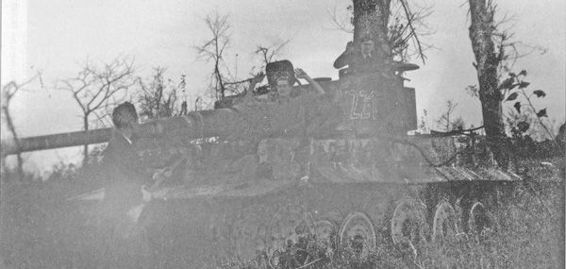
Years after the war, this out-of-focus photograph showing Endemann’s Tiger 221 surfaced in private hands. Since the left track is missing, it may have been hit in the running gear and become immobilized. The crew was probably either killed or taken into captivity. (Jean Restayn)
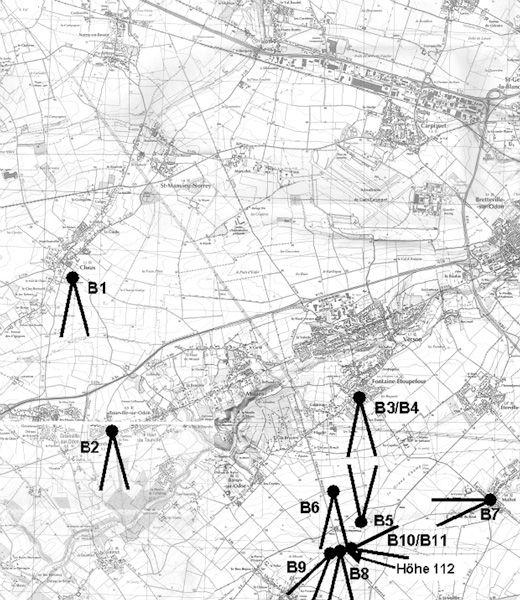
This map marks the vantage points for the various terrain images that deal with the fighting for Hill 112. There are British viewpoints (B1–B4 and B6), the German viewpoint (B5 and B7) and general views from the hill itself (remaining markers).
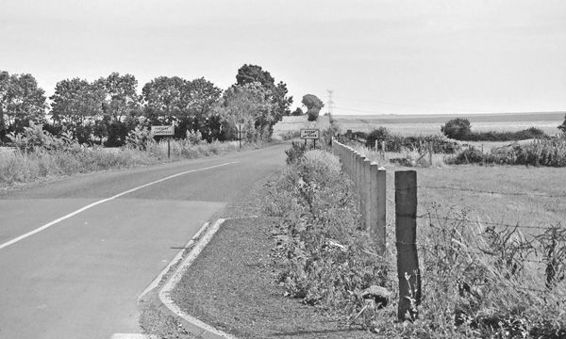
This view from the southern edge of Fontaine-Etoupefour shows that the difficulties for the British were just starting with the crossing of the Odon. The road leading away from the observer heads directly towards the eastern edge of Hill 112 across several kilometers of completely open terrain. This is the reason why the subsequent fighting waged back and forth for several weeks and why the Tigers were able to employ their superior range to great effect. About 200 meters farther down the road, there was an almost rectangular fruit orchard off to the left that was covered with low-standing trees and vegetation. It temporarily offered the British some concealment, until the orchard was swept away several days later by artillery.
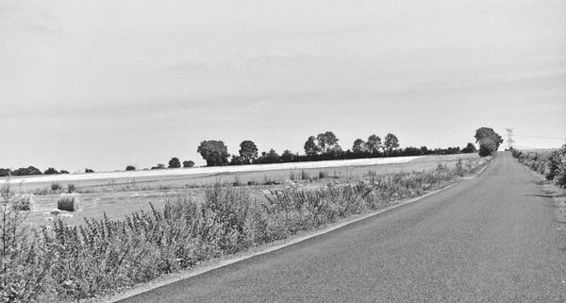
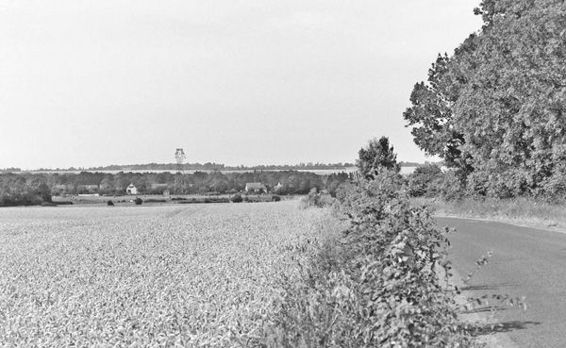
The same road seen from the perspective of the German defenders. The enemy could be attrited from forward positions long before he even approached within range of Hill 112, which was located about 1.5 kilometers behind this vantage point.
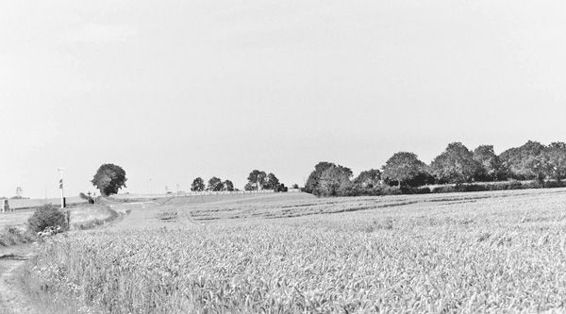
The view past the fruit orchard to the south to the intersection of D8 and D36. The cross is a memorial to the fighting. Hill 112 is about 1,000 meters beyond and off to the right. The tall stand of trees in the middle of the image marks the crest of the hill today.
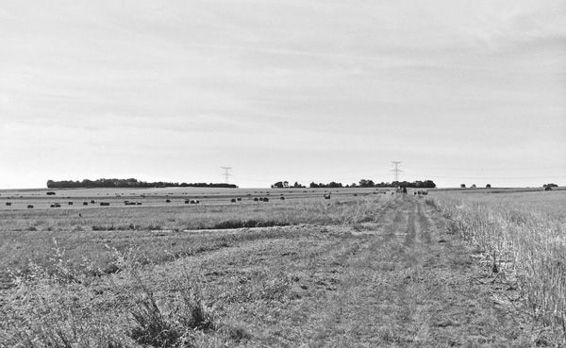
View of Hill 112 from the direction of Maltot. To the left is the highest point of the hill. To the right is the previously mentioned fruit orchard. The rectangularly shaped patch of woods on the hill was appropriately referred to as the Wäldchen der halben Bäume (“Patch of woods of half trees”) after it had been hit numerous times by artillery.

This view from Hill 112 to the south clearly demonstrates why the British had to gain control of that high ground. They would have had a clear shot to the Orne (in the middle of the photograph) and then into the open terrain south of Caen. That would have created the decisive breakthrough.
An account of the fighting by the 7th Battalion of the Royal Tank Regiment, which was employed frontally against Hill 112, is contained in Peter Beale’s Tank Tracks:
On the right of 9 RTR, 7 RTR were attacking Hill 112 in support of 129 Brigade. They had made substantial progress, but at 0933 hrs a strong enemy counter-attack was made on Hill 112. 7 RTR suffered a number of casualties including their CO, Lt.-Col. Gaisford, who lost an eye, and the 2 i/c Major Bob Fleming who was killed. The right flank of 9 RTR’s advance was thus enfiladed, and anti-tank fire was also reported from the high ground dominating Maltot to the west of the River Orne. The impetus of the attack was failing—two Tigers were in Maltot making the advance of the infantry extremely difficult and A Squadron’s movement was hampered by a troop of Tigers at the southern slope of Hill 112, firing north-east.
At 1156 hrs A Squadron were still struggling to support the infantry in Maltot who were now confronted with another Tiger. The German infantry were now counter-attacking and only nine tanks of A Squadron were left. Major Douglas Ballantine, OC A Squadron, dismounted in an attempt to make contact with the CO of the 7th Hampshires (Lt.-Col. D.W.G. Ray), but was severely wounded by mortar fire and subsequently died.
By 1200 hrs 2 i/c A Squadron (Capt. Bert Mockford) reported that he had only four tanks capable of fighting, and further reports stated that counter-attacks were being made with tanks and infantry from north-east and south-west of Maltot.
The battalion was disposed as follows:
B Squadron and elements of A in hull down positions on spur south of Chateau de Fontaine with infantry and anti-tank guns dug in.
C Squadron had joined Battalion HQ in forward rally after release by 4th Dorsets. BHQ had been mortared and shelled periodically causing severe casualties among the wounded that had been brought in.
From 1300 to 1600 hrs there was a stalemate, the enemy making no attempts to push their counter-attack any further. A new plan was devised whereby A Squadron 7 RTR (Major Dick Joscelyne) were to put the 5th Battalion Duke of Cornwall’s Light Infantry (5 DCLI) on Hill 112 and C Squadron 9 RTR to put 4th Dorsets into Maltot. B Squadron were to give support from the right in the opening phase. 4 Armoured Brigade were waiting to go through.
The advance began at 1640 hrs and despite anti-tank fire from south-west of Maltot C Squadron had put the infantry into the village by 1700 hrs. But ten minutes later C Squadron were being shot at from the rear, for once again enemy tanks had infiltrated under cover of the spur north-east of Hill 112. Eight Tigers were also moving in on the left flank, and the infantry were pulling out of Maltot under pressure.
At 1935 hrs C Squadron was also forced to withdraw under the cover of supporting fire from B Squadron. Mortaring and shelling was almost continuous and at 2030 hrs all tanks rallied at the FUP; later they moved to join A Echelon north-east of Mouen to replenish and collect reinforcements.
Under the cover of darkness, an immediate counterattack was supported at Maltot north of the road to St. Martin. As a result of the heavy enemy fire, it only advanced a few hundred meters and was finally broken off.
Contrary to normal practice, the fighting continued during the night. The Scots succeeded in establishing themselves on Hill 112.
The tide turned at first light on 11 July 1944, however. The hill was taken under attack from two sides, this time from the side facing Esquay as well. Only Eterville could not be taken back. The counterattack to reestablish the old main line of resistance at Hill 112 began at 0515 hours.
SS-Rottenführer Trautmann has provided an impression of the intensity of the fighting:
At first light on 11 July, we executed our attack towards the north—determined to take the hill this time by storm! We attempted to approach the hill in a concealed fashion through a shallow defile on the side of Hill 112 that faces Aunay. A short-range reconnaissance aircraft, comparable to our Fieseler Storch, turned in a wide spiral above us, came back and then turned to the west in a steep curve. [This was] for us a bad omen: these machines were superbly equipped with radio equipment.
Probably no more than ten minutes had gone by when the dance number from Hell increased to a hurricane. High-explosive rounds landed on the turret and the hull; tree bursts plucked off the crowns of trees. Our mechanized infantry [III./SS-Panzer-Grenadier-Regiment 29] could no longer raise their heads, and many great comrades remained lying on the slope.
Our Tigers knocked out a few Churchills [which were supporting the 5th Duke of Cornwall’s Light Infantry] in rapid sequence. You could say that the so-called box woods, a cattle pasture that was ringed by a square hedgerow, was packed to the brim with all sorts of knick-knacks!
When Knecht’s tank was being badly threatened from two sides, we went to his aid. We came roaring up at 20 kilometers an hour over ditches and through earthen walls and took up Tommy in our sight picture while still moving. After the third round, which penetrated the jacket of his main gun, the turret remained half out of the hull.
The enemy was bringing in antitank guns all the way over to the left in the hedgerow-ringed cattle pasture. The crews were spreading the gun trails apart in an agitated fashion and were already taking their first casualties as they were doing this. The Anglo-Saxons sure were brave!
In the meantime, we had slowly worked out way up to them and quickly made the positioning of the dark brown guns a wasted effort.
Once again, the enemy fired a thick wall of smoke, which pinpointed our tanks shortly before they reached the high ground. In this milky soup, our Tiger received several hits on the rear and the turret. Our tank commander ordered the driver: “Forward, step on it!”
This smoke had to end somewhere—and then we were through it.
“Driver, stop!”
We had a sight in front of us that every Tiger [crew] could only wish for. The Tommies were clearing their positions barely 100 meters in front of us. Halftracks and carriers curved back and forth and loaded up personnel and equipment. Our tank commander gave a brief fire command: “Radio operator: Engage when ready … Loader: Load AP … Gunner: Engage at will … ”
Two Churchills, which had been posted directly in front of us in the undergrowth as security, were set ablaze while they were still aiming their main guns at us. We then fired high-explosive rounds and the turret machine gun at the numerous targets being presented. The fog had disappeared in the meantime.
The following radio message came from our company commander, [SS-Obersturmführer] Kalss, again and again: “Pull back immediately to the company’s location.” We really would have liked to have kept on pursuing the bolting enemy!
Three enemy tanks, eight antitank guns and fifteen armored vehicles were destroyed by the Tigers. Tiger 232 of SS-Unterscharführer Winter received a hit from an antitank gun. The 1st Company attacked through a defile along the side of Hill 112 facing Avenay; in the process, it exploited the smoke that the English were firing. The Tigers knocked out seven enemy tanks and eight antitank guns. The Tiger crew of SS-Oberscharführer Canesius mistakenly engaged a neighboring tank—that of SS-Oberscharführer Knecht—with three rounds. It missed, however, because its main gun was out of adjustment. A Tiger of the 3rd Company was hit and set ablaze. The acting commander of the 3rd Company, SS-Untersturmführer Klust, was relieved by the battalion commander because he had refused—certainly not without some justification—to attack into terrain where the visibility was restricted by the smoke rounds.
In contrast to the fighting at Hill 112, the fighting for Maltot turned out to be less successful for the Germans. Chester Wilmot, a war correspondent of the BBC, described the fighting:
By now that wood was enveloped in smoke—not the black smoke of hostile mortars but white smoke laid by our guns as a screen for our infantry who were now being forced to withdraw.
We could see them moving back through the waist-high corn, and out of the smoke behind them came angry flashes as the German tanks fired from Maltot. But even as the infantry were driven back another battalion was moving forward to relieve them, supported by Churchill tanks firing tracer over the heads of the advancing men. They moved right past our hedge and out across the corn. The Germans evidently saw them coming, for away off on our right flank machine-guns opened up and then the nebelwerfers …
A straddle of Moaning Minnies sent Wilmot diving for cover, “forcing as much of myself as possible into an old German dugout.” The Hampshires were withdrawing with three hundred of their men killed, wounded or missing. But someone had blundered. The Dorsets were already moving forward to help them. They found in Maltot not the Hampshires but the enemy Tiger and Panther tanks:
Jerry must have been observing every move and allowed us to come right up close, thus cutting us off. Suddenly the whole party was cut down by a burst of fire from a Spandau … No one dared to put his head above the corn, as soon as Jerry observed the slightest movement a burst of fire would be the reply. The high-velocity 88 mm cannon of the [tanks] opened up to the right of them and to the left of them. A blinding flash in the corn, and men were lying killed and wounded before the sound of the gun had reached them. A dull thud, a fountain of earth thrown into the air, and a Churchill tank was in flames. Carriers and anti-tank guns were being torn apart. The few Churchills not sending spirals of smoke into the air ran for the safety of the ridge behind them. What hope had they against the superior guns of the German tanks. Major Whittle kept going with his Bren carrier, “with the corn almost level with the sides, and wishing it were much higher.”
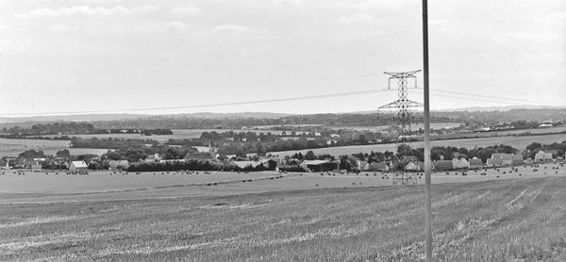
This photograph demonstrates why the British attacked frontally. The view from Hill 112 to the southwest towards Esquay shows how the terrain was even steeper and could be dominated by flanking fires.
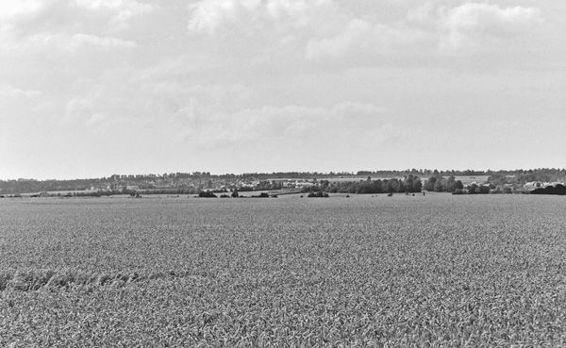
View from Hill 112 to Maltot. The village, slightly elevated in relation to the surrounding terrain, had clear views of Hill 112 from certain vantage points. Consequently, it was the German objective to control the village as much as possible.
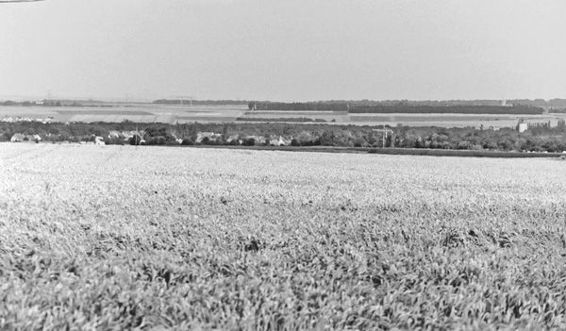
A similar view from Hill 112, this time to the east towards Feugerolles. In the left background behind that village, St. Martin can be identified. The village is in a depression, which facilitates lateral movements of forces.
The fighting on this day also continued after the onset of night. J. J. How described this in his book, Hill 112:
Waiting and watching at the foot of the German slope was Untersturmfuehrer (Lieutenant) Martin Schroif. He had been there in his Tiger tank since midday. The heavy [tanks] had been withdrawn from the summit to avoid the British artillery fire. He had heard the shell fire rise in a great crescendo and had watched as the hilltop disappeared in great clouds of dust and smoke.
I saw panzer grenadiers coming back down the slope and I then knew that the British must have attacked again and that we would be sent to drive them back. It was almost dark when the order came. On the right I could see the Tigers of No 1 Company already moving on to the slope. My objective was the Kastenwäldchen [Box Woods]: We got to within about three hundred metres of it. I halted the company and opened fire. I pushed forward on the left into a hollow in the ground. We couldn’t have been more than a hundred metres away. We fired with machine-guns and sent high explosive into the tree tops. Machine-gun fire rattled on the armour and we could see the muzzle flashes of the anti-tank guns.
The 10th SS Frundsberg Division had not waited. It was important not to allow the British to dig in with anti-tank guns. The panzer grenadiers were attacking with the Tiger tanks and two companies of 9th SS under command [probably two companies of SS-Panzer-Regiment 9].
It was confusion that dominated this battle on the top of the hill. At night darkness and fear are natural partners. An exploding shell is a flash of blinding light, a crack of doom, and a shower of sparkling red-hot splinters. Battle is fought in a gigantic display of death-dealing fireworks. Tank crew are blind but for the flashes of light that throw everything into startled view. It is a brave man who will man an anti-tank gun kneeling in a shower of splinters showering down from the tree tops.
Casualties were heavy on both sides. The German infantry could not get forward through the heavy and accurate British artillery fire: the Tiger tanks feared to move closer without infantry protection. The stalemate was broken when it was discovered that the British were not holding the front edge of the wood. The panzer grenadiers took it over. The Tiger tanks moved forward with them.
One of the German tanks got to within fifteen yards of the British command post. Major Roberts and Sergeant Hill tackled it with a PIAT, but the bomb failed to explode. The German tank then moved off. Others, however, continued manoeuvring all over the battalion area and having, as they doubtless believed, cleared the wood, they came up over the crest of the ridge on either side of the orchard and started moving down the northern slopes.
It must have been two of these Tigers that crossed the plateau and moved down the British slope, moving blindly into the trenches of the Wiltshires. They did not open fire and no one thought they could be the enemy until Major Jeans saw the black cross. One Tiger crashed past Private Pipe, upsetting his mug of tea. It roared, a great blob in the darkness, “moving in the direction of the Somersets.”
I dreamt I was in a tropical forest and huge trees were crashing down on me.
“Are you alright, sir? Are you alright?”
It was the corporal. A Tiger tank had come through the hedge and gone right over me, crushing my compass and binoculars which were laid out by my side. It had halted not far away—a darker patch in the night. I called for a two-inch mortar flare and took up the No 1 position on the gun.
Alas for Captain Perks’s chance of knocking it out, the mortar flares had been left behind. The Tiger clanked uncertainly away into the night.
By midnight the battle for the little wood had settled down uncomfortably with the Cornish Light Infantry much reduced in numbers. They were holding one half of the wood and the panzer grenadiers were a hundred yards away along the bottom hedge. An optimistic report that the Kastenwäldchen was in German hands had sent the Tiger tanks back down the hill. Panzer Group West received a report that Hill 112 had been recaptured.
Just before midnight the commander of the 9th SS Hohenstaufen Panzer Grenadier Regiment [either SS-Panzer-Grenadier-Regiment 19 or SS-Panzer-Grenadier-Regiment 20] arrived with the news that the divisional columns were meeting head-on with supply vehicles moving back from the front. In many, of the narrow country lanes there was no room to pass. The panzer grenadiers had taken to their feet and were marching the last seven kilometres.
Battle and disorganisation follow each other just as night follows day. As at Maltot, so at the little wood on top of the hill, but with the added disadvantage that enemy bombardment and counter-attack had ushered in darkness to compound the confusion and uncertainty. The Cornishmen had been given no time to sort themselves out: one company was still missing and another was so weak from casualties that it was unable to take over the front edge of the wood as had been arranged. The battalion commander had about three hundred infantrymen; he had the battalion six-pounder anti-tank guns and four seventeen pounders of the Royal Artillery. It was very dark. There had been no chance to examine the lay of the land. The enemy was close by, with German machine-guns hammering the darkness with nervous strings of tracer from the far end of the wood.
All night long the artillery fire from both sides plastered the hill. “We got no sleep,” said one of the panzer crewmen who was sitting it out at the foot of the hill. Zemlitz, the runner from 10th SS, said he went to sleep despite the continuous shell fire, he was so exhausted: “One of our mortar sections, firing at the greatest possible elevation into the little wood, gave it everything, but the Engländer [Englishmen] had moved in in strength.”
The Duke of Cornwall’s Light Infantry hung on, wondering what the dawn would bring. About three o’clock in the morning the panzer grenadiers of the 9th SS Hohenstaufen Division arrived and dug in on the German slope. Like the Cornishmen, they had had no sleep for over twenty-four hours.
It was the British who attacked first. With the first streaks of dawn fifteen Sherman tanks came suddenly into view from behind the British crest. They roared over the road, past the Calvary cross, and on along the track of the ancient Roman road to the little wood. The Scots Greys, for it was they, were working on the theory that the faster they went the less likely was the enemy to turn them into “Ronson Lighters.”
They were answering the call of Lieutenant-Colonel James for help in turning those German machine-gunners out of the bottom end of the wood. It didn’t take them long. The Germans had adopted their usual defence: small forward outposts with the bulk of the troops and the [tanks] held hidden on the reverse slope.
The growing light of dawn revealed a greater danger. Lieutenant-Colonel James had climbed a tall tree. He could see the low ground beyond: “Enemy infantry in large numbers forming up to attack!” was his shouted warning. He remained at his dangerously exposed vantage point to shoot the British artillery on to the target.
Back on the crest overlooking the village of Esquay an observation officer of the 94th Field Artillery was excitedly shouting orders to his battery five miles back at Cheux. The Western slope of 112 was alive with German infantry and [tanks].
The Germans attacked at 0615 hours. By that time the hill had all but disappeared in the smoke and dust of the artillery fire.
Leading the attack from the south was the company of Tiger tanks commanded by Untersturmfuehrer Martin Schroif. In a series of bounds, one lot of [tanks] covering the others, they climbed up the slope in a hail of shellfire. They rolled on past the panzer grenadiers, who looked up with unshaven, dusty sweat-covered faces and waved as the Tigers roared on. They were happy in the knowledge that they were not alone, that the [tanks] would sort it out for them. Schroif was three hundred yards from the Kastenwäldchen, where he had been during the attack the night before. Through the dust and smoke he saw the vague shapes of two Shermans. He fired twice in rapid succession and knocked them both out. He looked at his watch. It was twenty minutes to seven. Shellfire was falling. The British were mixing in more smoke. He pushed on towards the edge of the wood, where he knocked out a third Sherman tank and put several anti-tank guns out of action. Unterscharfuehrer (Corporal) Winter in [Tiger] No 232 was hit by an anti-tank gun firing from the northern edge of the plateau.
Tigers were also leading the attack up the hill from the Esquay side, using a sunken lane which gave some cover. A British spotting plane, a Lysander, was now circling in the skies above, sending targets back to the artillery. Within minutes a great barrage of shells had almost blotted out the slope. Trautmann, a wireless operator in one of the Tigers, has described the attack
… shells were exploding on the hull and turret; they were breaking off the branches in the tree tops! Our panzer grenadiers couldn’t even raise their heads. Many brave comrades were left dead on the slopes.
This advance from the west brought the German tanks to the large paddock extending beyond the wood. It was here that the remnants of the “lost” company of the Duke of Cornwall’s Light Infantry had dug in. Wireless Operator Trautmann continues his account:
On our left was an enclosure where our opponents were trying to bring an anti-tank gun into action. The crew was frantically pulling down the fence, and it was here that they suffered their first casualties. Brave they were, those Anglo-Saxons! In the meantime we had worked our way closer, and we quickly made the manhandling of that dark-brown gun a superfluous exercise!
As the Tiger tank worked its way past the paddock and the wood beyond, it was fired at and hit several times by anti-tank guns. None of them penetrated. The Cornishmen were learning the dangerous way that they were wasting their time firing a six-pounder anti-tank gun at a Tiger tank. Neither this gun nor the 75 mm gun of a Sherman would penetrate the front armour of a Tiger, even at very close range.
The British were sending supplies across the plateau and bringing back the wounded. To hide this from the enemy they had laid a thick smoke screen. The Tiger tank pushed on cautiously:
This smoke must come to an end soon—suddenly we were through! Scarcely a hundred yards in front of us the Tommies were getting out. Trucks and carriers were curving this way and that, loading and unloading. Our commander came through on the intercom “Armour-piercing-fire when ready! Hull machine-gun—fire when ready!” Two Shermans were standing on guard directly in front of us. Even as they were traversing their guns we sent them up in flames. All the time our company commander was coming through on the radio: “Pull back immediately! Pull back! Pull back level with the company!” [See above for more accurate translation of the German original. Note also that Trautmann’s original account refers to these tanks as Churchills.]
The Scots Greys had lost five of their Shermans. They were hopelessly outnumbered and outgunned by far heavier tanks. Only the Sherman Firefly with the seventeen-pounder gun had any chance at all against a Tiger. They retreated back over the British crest. From hull-down positions they continued to give what support they could.
The Cornwalls were on their own again. The battalion dead lay everywhere. Amongst them was Lieutenant King killed whilst standing on an embankment to direct the artillery fire, hit, it seems, by shrapnel from the barrage he had himself brought down. Little could be done for the wounded. The Bren carriers had been destroyed whilst trying to get them back to safety. Just one of the Tiger tank companies claimed in its war diary to have destroyed eight of them. The same company claimed also the destruction of three anti-tank guns. Destroyed or not, it made little difference to the Cornishmen, who were unable to man them in the withering fire of the enemy [tanks]. Many anti-tank crewmen lay dead or wounded.
The little wood was a conspicuous landmark, perched on top of the hill on the enemy side. It was a convenient size for the artillery to neutralise and steadily blow to pieces: “Their shells burst amongst the trees, throwing splinters downwards and searching out the narrow slits without head cover which was all in the way of defences that the troops had been able to dig for themselves.” They watched from these holes in the ground, bleary-eyed from lack of sleep, nerves twisted to the last turn, as one great Tiger tank after the other prowled round and round, throwing high-explosive into what was left of the trees and machine gunning anything that looked suspicious. It seemed to them that all was lost. It was only a matter of time. They would be overrun.
But the attacking panzer grenadiers, too, were in a bad state. They had been caught in the open by the killing power of the British artillery, “defensive fire such as we East Fronters had never known; the Russians had never [had] as many guns as this.” The slopes leading up to the Kastenwäldchen were covered with German dead and wounded. The Tiger tanks might roam at will around the wood; only the panzer grenadiers could take it over. They were decimated, disorganised and demoralised, unable to move. Stalemate. The Germans were pulling back to think again.
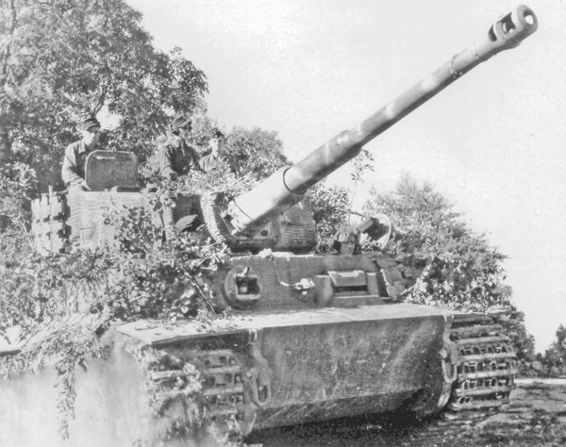
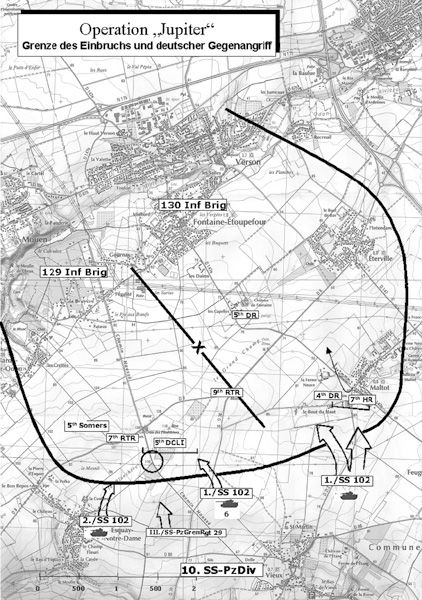
In the days that followed, the fighting raged with differing degrees of intensity for the high ground and the terrain between the Odon and the Orne. At the beginning, this fighting was supported by Tigers of schwere SS-Panzer-Abteilung 101; later on, this support was provided solely by schwere SS-Panzer-Abteilung 102. What remained of schwere SS-Panzer-Abteilung 101 was moved to the area around Bretteville-sur-Laize (south of Caen) on 13 July 1944, where it was intended for it to assist in stabilizing the situation along the Bourguébus. The tough battles of attrition between the Odon and the Orne southwest of Caen lasted for the Tigers of schwere SS-Panzer-Abteilung 102 until the end of July. The British XII Corps was able to perform its mission, which was to exert permanent pressure in this sector in order to prevent the withdrawal of as many potential German reserves as possible.
Here is a detailed account of the continued operations in this area:
On 12 July 1944, Tigers 212 and 214 were positioned in order to observe and screen Hill 112. Even before first light, portions of the high ground were again occupied by the British, because the German infantry outposts had to pull back from the hill due to the intense enemy artillery fire.
On the next day, Tigers 212, 213 and 233 again occupied screening positions.
The 1st Company took Hill 112 again around 0400 hours. On its right was the 2nd Company. Tiger 321 of the 3rd Company 102 was west of the hill; from the same company, the Tiger of SS-Untersturmführer Schienhofen was in St. Martin. He was joined in screening there by two Tigers of the 2nd Company. In all, there were twelve Tigers operational.
On 14 July 1944, two Tigers performed screening duties; there were nine operational tanks in all. Due to the threat of air attack, the 2nd Company moved to Amayé.
At the start of 15 July 1944, the situation remained unchanged. During the day, the British pounded the high ground with the heaviest of artillery fire. As a result, only the Tigers could remain on it. Tiger 212 of SS-Unterscharführer Kuhlemann had to be sent to the rear after receiving a direct hit by artillery. An enemy attack at 2230 hours was turned back. At this point, only eight Tigers were operational.
On 16 July 1944, the 2nd Company bivouacked in a fruit orchard south of St. Martin, while one tank screened on Hill 112. Seven Tigers were still operational. Grenadiers from the 10. SS-Panzer-Division “Frundsberg” dug in on the hill. The “Box Woods” had completely changed its appearance. Trees reduced to barren stumps by artillery fire rose skyward. From this point on, it was referred to as the Wäldchen der halben Bäume (“patch of woods of half trees”). The 1st Company was employed northwest of Maltot, where four Churchills were knocked out.
The Tigers were employed again on 17 July 1944 to screen.
The situation in the sector of the 2./schwere SS-Panzer-Abteilung 102 was stable on 18 July 1944. While screening, Tiger 224 of SS-Unterscharführer Oberhuber knocked out three enemy tanks and an antitank gun towards evening. Only five Tigers were operational.
The 3rd Company was hit by a heavy bombing raid. Five of its seven tanks were hit and were unavailable for an extended period of time. The remaining two tanks were sent to the other two companies.
On 19 July 1944, it was quiet in the sector of the 2nd Company, which was screening. Eight tanks were again operational. English armored ambulances recovered the dead; German soldiers helped them.
Two British antitank guns that were brought forward on 20 July 1944 were knocked out by the screening tanks. At 2000 hours, the 2nd Company was relieved by the 1st Company. It then marched through Amayé and into the woods east of Lieu des Pres, where it received urgently needed rest.
The most exposed and isolated of the British posts were those at the Le Bon Repos crossroads and the Maison Blanche farm five hundred yards farther up the hill. They had been captured a few nights earlier by the Glasgow Highlanders.
Some men from the Welsh arrived one night and took over. With the light of dawn the Welshmen realised that they were in full view of the enemy who were in Esquay, four hundred yards down the road, and on the slopes on both sides. Any movement brought a sniper’s bullet. They were imprisoned in their trenches all through the long summer day. Food in fourteen-man packs they collected at night. They tossed the tins from one trench to another, counted out the cigarettes and sweets, and looked thoughtfully at the sheets of toilet paper also provided, hoping that it would be only in the dark that the urge came to use it. Confined to their narrow trenches throughout the hours of daylight, they passed the time warming up the tins and making frequent brews of compo tea over the sickly fumes of a Tommy Cooker. From time to time there would be a diversion: the snout of a long 88mm gun would appear over the bald hump of the hill and the turret of the Tiger tank that owned it would come slowly into view. A couple of rounds would swoosh past leaving a vacuum that took the breath away and threatened to collapse the lungs.
These Tommies who had pushed well forward into German territory and pinched the outposts were seen by the enemy as a provocation and a nuisance. 10th SS had taken over [10. SS-Panzer-Division Frundsberg”]. They would do something about it. One afternoon they attacked with assault groups of panzer grenadiers, six Tiger tanks and supporting artillery fire. The outpost at La Maison Blanche was quickly overrun. Some survivors escaped back over the crest to the safety of the British slope. The battle at Le Bon Repos, however, went on until well into the night. No one came back from there.
The 21st of July 1944 was quiet. The 1st Company screened with some of it elements, the 2nd Company performed maintenance and the 3rd Company attempted to fix the damage caused by the air raid.
On 22 July 1944, the 2nd Company was alerted. It initially moved up to Amayé with eight tanks, where it received the mission to advance to Maltot along the road and to the right of it. Two Tigers were lost during the march. Heavy artillery fire started. Four Churchills that attempted to leave the village were knocked out.
SS-Sturmmann Trautmann has provided a first-hand account of this fighting:
There were things going on in Maltot the entire night. You could make out movements with the binoculars. We were also able to repeatedly ascertain the sound of tracks during the night.
A few Tigers got the mission to clear Maltot. Our tank commander ordered us to move out: “Panzer marsch!” We had scarcely left the vegetation when we transitioned to the attack. The humming noise in the headphones and the noise of the engine and the tracks drowned out the inferno outside.
Only dim light penetrated into the radio-operator’s station from the [commander’s] cupola. He could identify the face of the driver off to the left over the transmission. If the radio operator leaned back, he could see his tank commander up above in the cupola. The hatch was usually open, despite the heavy fire.
The Canadian-occupied village got closer and closer. Soon you were ale to see individual fighting positions between the trees and the bushes of the gardens by the houses. The artillery observer above, who was constantly following us, had reported our approach to his batteries a long time ago. They were then doing their part to ensure we were welcomed properly.
Impacting artillery rounds tossed up the dry earth, covered the buildings and turned over walls. When the clouds of dirt are ripped asunder, you can get a quick glimpse of the church tower, from which a tattered Red Cross flag was hanging from its highest opening.
Boy, an entire salvo of rounds was now coming over us! Our tank commander fidgeted up there impatiently on his seat, eyed with a quick glance our surroundings and issued a fire command to our gunner with his practiced calmness and exactitude: “Off to the left … 500 … muzzle flash!”
Albert traversed the turret. Four enemy tanks were rolling towards us on the road running perpendicular into us. Long hull; small, compact turret: Churchills. Our tank commander gave directions to only engage the first and then the last of the olive-green giants. Fire when ready!
The first Churchill was turning in place; it had been immobilized! While the radio operator was taking the dismounting crew in his sights, the second tank was already burning. Oil-black clouds of smoke blocked out the sun. The two middle tanks curved wildly about. They saw that they were boxed in on the road and had to go over the embankment. Their fate was quickly sealed: Tank number 3 received two hits in the hull above the running gear. No one climbed out. The final tank was eliminated with two rounds in the rear. Seconds later, fine, white smoke climbed out of the hatches. With a terrible bang, the rear deck hatches weighing hundreds of pounds flew into the air. A stream of flames shot out of the engine compartment; it soon hit the ammunition as well.
Suddenly, there were small, black explosive puffs above the ground in front of us! Immediately following that was a radio message directed to us: “Watch out! AT on the edge of the woods!”
We reacted as quick as lightning: “more to the right … more to the right … quicker!” Then: “A touch left … stop!” The turret traversed with a slight humming noise. Kaboom! The concussion from the main guns snapped our heads back. Another two rounds and then we continued.
The fire slowly abated, but close-air-support aircraft then appeared and plastered us with their rockets.
“Button up!”
We had been running around for three hours. In the meantime, a few Tigers had gone around Maltot. We could figure out from the radio traffic that we could advance no further. One Tiger had received a few antitank-gun rounds. Two of the crew were wounded. We had to wait until the patch of woods that flanked us was cleared.
The attempts by the grenadiers to eliminate the antitank-gun belt were not crowned with success. The efforts of several Tigers in flanking positions to fire into Maltot also did not help. As a result, the Tigers had to withdraw in the fading light of day.
The 2nd Platoon eliminated three antitank guns on the northern edge of Feuguerolles-sur-Orne. During the night, the forces transitioned to screening operations 600 meters north of Feuguerolles at the fork in the road 600 meters south of the church at Maltot. Seven Tigers of the 1st Company were employed on Hill 112 and engaged the infantry of the 5th Wiltshire Regiment that were hard north of Maltot. The regiment had retaken the town on this day.
On 23 July 1944, eight Tigers of the 2nd Company were in position. In the morning, they turned back a British tank attack; six enemy tanks were knocked out. Two additional British tanks were also knocked out by the 1st Company, which was employed to the left. After German infantry had closed up, the tanks were pulled back to a covered position 200 meters behind the main line of resistance. One Tiger continued to screen at the northern exit of Feuguerolles. Tiger 214 of SS-Unterscharführer Kuhlemann suffered running gear damage after it was hit by artillery.
On 24 July 1944, eight Churchills attempted an advance on St. Martin from Maltot; all eight were destroyed by the tanks of the 1st Company.
The 2nd Platoon of the 2nd Company supported an attack east of the Orne from positions northeast of Feuguerolles. This support met with limited success, since visibility was limited and the engagement range was too great.
On 25 July 1944, the 2nd Company continued to screen as it had previously done and engaged enemy movements on Hill 67 and on the northern outskirts of St. André-sur-Orne. Three enemy tanks and four antitank guns were eliminated. A large swarm of medium bombers plowed up Hill 112 and the terrain as far as St. Martin. Following them, large numbers of fighter-bombers swooped in. The Tigers were peppered with harmless hits. As if a miracle, there were no losses among the screening tanks. The results would have most certainly been different with the more lightly armored Panzer IV. The 3rd Company relieved the 1st Company on Hill 112. The latter company then encamped at Cropton.
The 26th of July 1944 saw the 1st Company employed against enemy movements on Hill 67 and on the northern outskirts of St. André-sur-Orne from positions west of Feuguerolles. Again, three enemy tanks and four antitank guns were knocked out. One Tiger, that of SS-Unterscharführer Oberhuber, was penetrated on the driver’s side by a flank shot from an antitank gun. The crew bailed out; the driver was killed and the radio operator lost an arm.
The situation remained unchanged for the 2nd Company. In the morning, it opened fire numerous times against the enemy east of the Orne.
The days that followed were relatively quiet; a portion of the tanks continued to screen.
The operations of this battalion at the end of July 1944 were intentionally covered in more detail in order to demonstrate that there was not a constant stream of large-scale operations. But it was just these numerous skirmishes and pinprick enemy actions that ended up being so grueling on the crews. In addition, there were the constant barrages that were built into the artillery harassment fire plans as well as the obligatory attacks from close-air-support aircraft. The crews were constantly in a state of anxiety; they did not know when large-scale attacks would come. In the time remaining when they were not involved in active operations, they had to work on their tanks, which had also been placed under duress due to the constant wear and tear and battle damage, in order to keep them operational. The numerous bits of artillery shrapnel and automatic weapons fire of the fighter-bombers led to frequent mechanical problems, for example, when air ventilator blades were damaged or coolant leaked out.
On 1 August 1944, schwere SS-Panzer-Abteilung 102 was pulled from the line and moved into the area around Vire and to the east of it in order to support the 9. SS-Panzer-Division “Hohenstaufen.” We will discuss this operation later. In the meantime, let us take a look at the situation as it developed on the other end of the area of operations in question, the area to the east of Caen.
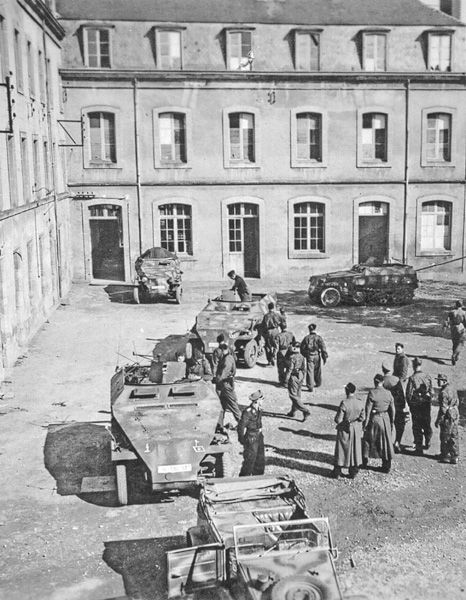
Every battalion had a reconnaissance platoon that was usually equipped with the Sd.Kfz. 251, such as seen here.
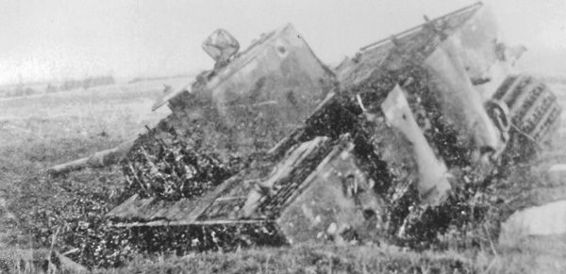
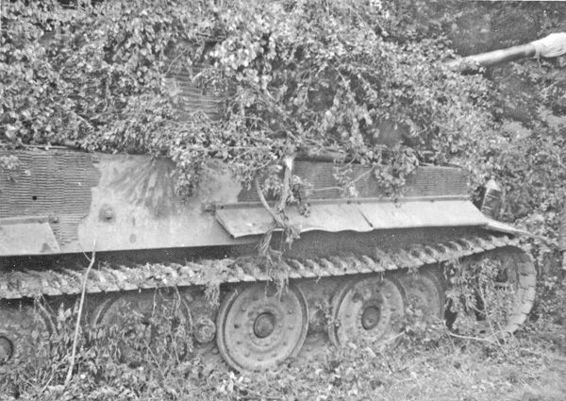
A Tiger of schwere SS-Panzer-Abteilung 102 that was knocked out on 10 July 1944. It can be identified by the Blitzrune (“lightning rune”) on the rear hull. Below: In between operations, the tanks had to be camouflaged carefully so as not to be identified by the enemy aircraft that were constantly in the air.
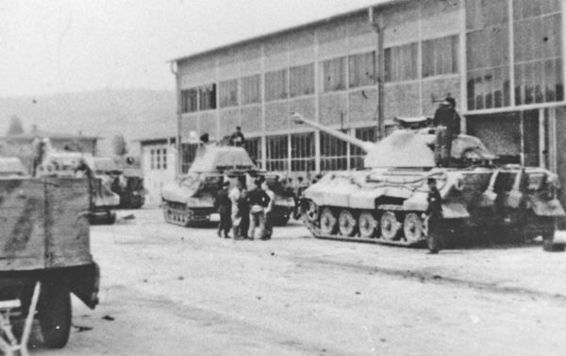
This sequence of photographs shows the 1st Company of schwere Panzer-Abteilung 503. Pz.Kpfw. VI Ausf. B (King Tiger)preparing to rail load at Eisenach. The crews are replacing the regular tracks with “transport” tracks, designed to allow the tanks to pass railroad maximum-width requirements.
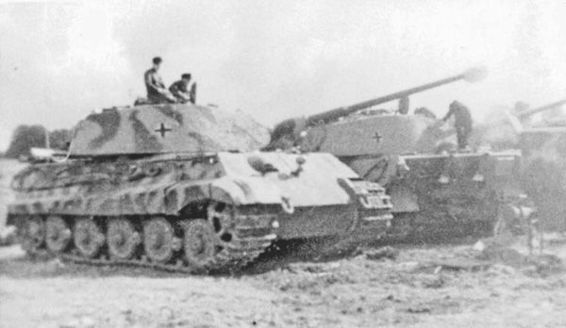
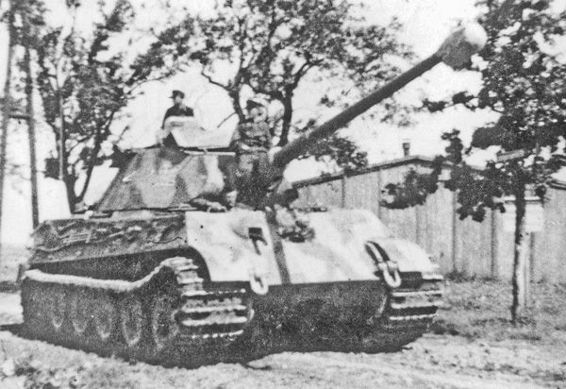
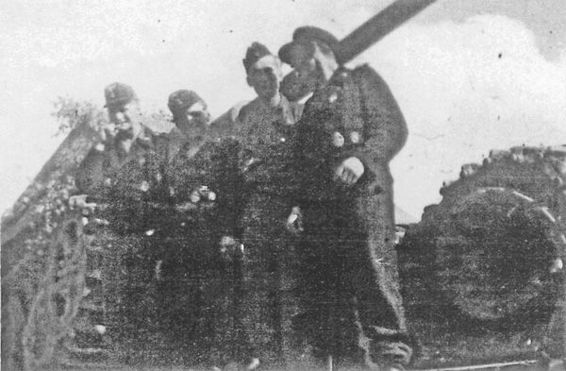
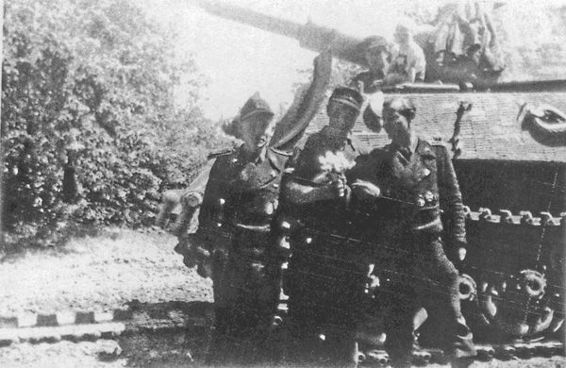
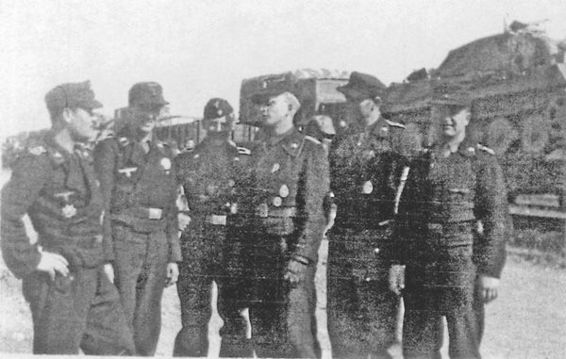
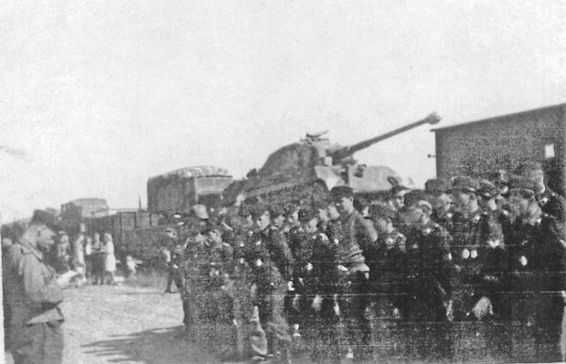
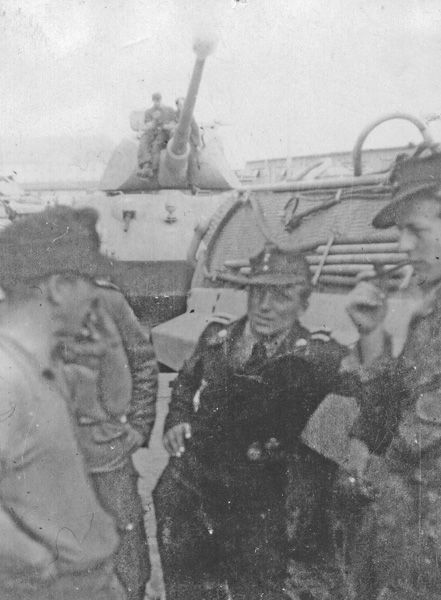
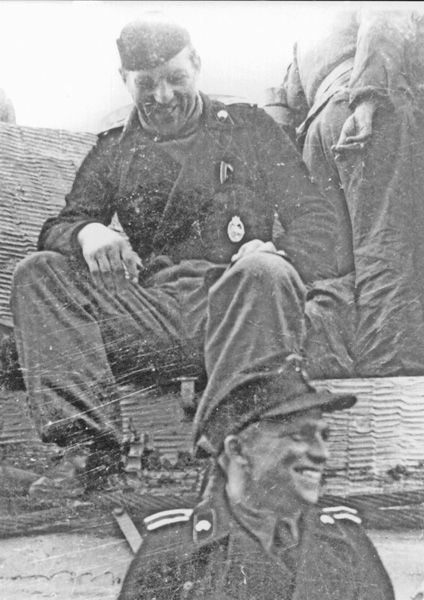
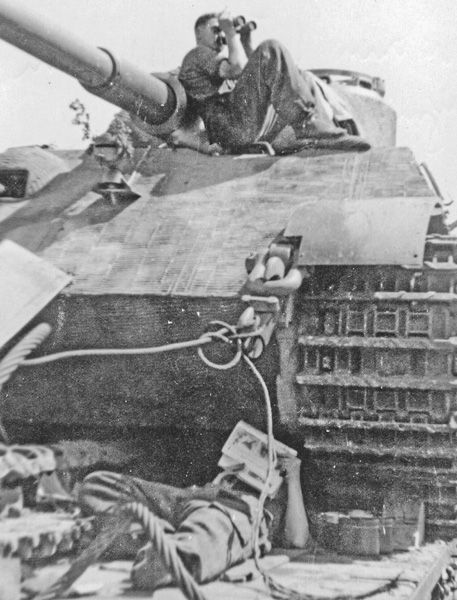
The last image shows a tank crew still in a relaxed mode during the rail movement. There is an air guard posted next to the main gun, but the driver has time to read a newspaper. All of that would soon change. It was more than three weeks later before the battalion arrived in Normandy. As the sketch map below demonstrates, this battalion also had to undergo an arduous road march that lasted for days.