
CHAPTER FIVE

From the hilltop at Con Thien, men of Mike Company, Third Battalion, Ninth Regiment, Third Marine Division watch U.S. airstrikes on enemy positions hidden within the supposedly neutral DMZ in the autumn of 1967. Beyond lies North Vietnam and the distant hills from which shells rained down on the Marines. “The NVA absorbed everything the Marines fired at them,” the journalist John Laurence wrote, “and kept coming back. No one was winning. Both sides were sacrificing their best young men.”
A SOLID FOUNDATION OF MUTUAL RESPECT
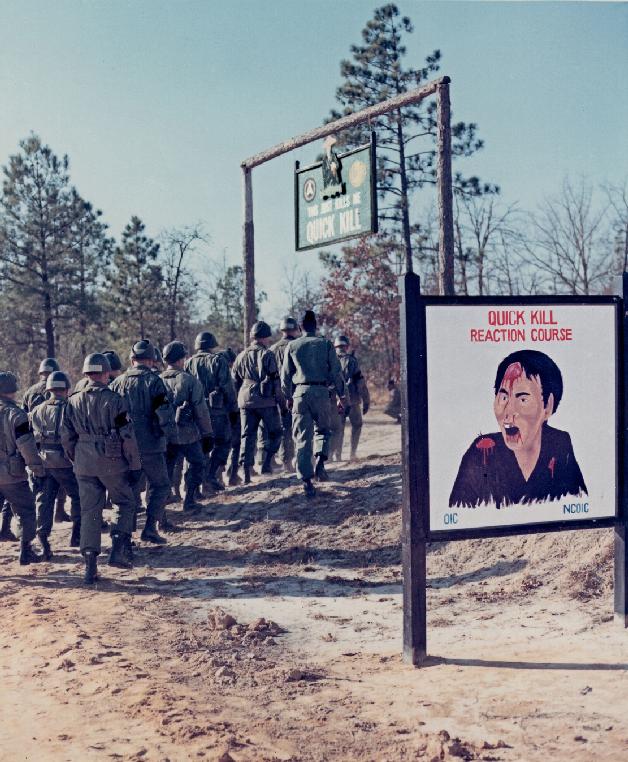
Army basic trainees head for the Quick Kill Reaction Course at Fort Bragg, North Carolina. “I want to go to Vietnam,” they chanted in cadence as they marched. “I want to kill a Viet Cong.” Sergeants led them down a trail lined with concealed trip wires, simulated booby traps, and pop-up silhouettes of the caricatured enemy at which they were to shoot with BB guns shaped like M16s.
BY THE SUMMER OF 1967, almost half a million American military personnel were already in South Vietnam, and tens of thousands more would soon be on their way. Along with boots and uniforms and duffel bags and all the other paraphernalia of war, each man was issued a little book, published by the Department of Defense, called A Pocket Guide to Vietnam. It was a sort of mini manual, offering a handful of facts about Vietnamese life and culture, and outlining how U.S. military personnel were supposed to behave in South Vietnam.
“The growing American commitment in Vietnam makes it ever more important for us to maintain the good relations that exist between Americans and the Vietnamese,” it said. “Wherever you go, remember that Vietnam is a land of dignity and reserve. Your good manners, thoughtfulness, and restrained behavior will be appreciated by the Vietnamese. You will benefit, as will the country you represent, in terms of the job you are there to do and in terms of friendship built on a solid foundation of mutual respect.”
The book set forth “nine simple rules” to follow:
•Remember we are special guests here; we make no demands and seek no special treatment.
•Join with the people! Understand their life, use phrases from their language, and honor their customs and laws.
•Treat women with politeness and respect.
•Make personal friends among the soldiers and common people.
•Always give the Vietnamese the right of way.
•Be alert to security and ready to react with your military skill.
•Don’t attract attention by loud, rude, or unusual behavior.
•Avoid separating yourself from the people by a display of wealth or privilege.
•Above all else you are members of the U.S. military forces on a difficult mission, responsible for all your official and personal actions. Reflect honor upon yourself and the United States of America.
Many years later, Bruns Grayson, an ex–Army captain who had served in Vietnam, was asked to write the introduction for a reprint of the book. He still admired its earnest tone, but questioned how much impact it could ever have had on “the behavior of the average American soldier—about twenty years old, not well educated…very often on his first trip away from the United States. I don’t know what the Vietnamese equivalent of ‘overpaid, oversexed, and over here’ was, but…such a phrase would have described almost all of us. We were curious, scared, open, friendly, and preoccupied with how much time we had left before we could go home. We were no more loutish and noisy than any similar collection of young innocents would be, but certainly no less.”
Some new arrivals did their best to follow the guidebook’s suggestions—and many of those who worked at pacification in the countryside or served as advisers to the South Vietnamese forces did master at least the rudiments of the Vietnamese language, came to understand Vietnamese customs, and made lasting friendships among the people alongside whom they worked. But for many men, both those about to face combat and the far larger number who would provide combat soldiers with support, the training they had received back home combined with the sheer foreignness of Vietnam itself soon erased the memory of many of the guidebook’s admonitions.
In training, troops were encouraged to call the Vietnamese “gooks”—a term first used by U.S. Marines for the people of Haiti and Nicaragua during the American occupation of those nations, and then applied to the Asian enemy in Korea. “They taught you that you were going to be fighting gooks,” an Army medic recalled. “That was part of the song you sang as you jogged down the road. As you went through bayonet training you were stabbing gooks. You were not talking about Vietnamese. Vietnamese might be people, but gooks are close to being animals.”
There were other contemptuous names for Vietnamese as well, including “slopes,” first employed during the Korean War, and “dinks,” a word apparently coined in Vietnam itself. Troops learned to call Vietnamese homes “hooches”—a corruption of the Japanese word for dwellings that GIs had learned during the battle for Okinawa in World War II—and to refer to older Vietnamese women as “mama sans,” the name GIs used for women who ran whorehouses in occupied Japan.
Virtually nothing was done to teach new soldiers about the people against whom—or for whom—they had been asked to fight. Instead, “the Army just gave you the opinion that all Vietnamese were bad,” an Army infantryman remembered. “I never heard anything about a friendly Vietnamese.” “I went to fight for America, not for the Vietnamese,” Marine John Musgrave recalled. “I never thought about them as anything other than my future enemy. I didn’t know anything about the country. So to say that I went over there uninformed would be an understatement. I didn’t know anything about the Vietnamese, and I didn’t care.”
First impressions of Vietnam did little to alter preconceptions formed in training. Everything seemed strange. City streets were crowded and chaotic. There were unfamiliar smells—exotic cooking odors combined with the reek of raw sewage. The roads along which newcomers were driven to their bases were lined with makeshift shacks in which people seemed to live in a kind of squalor never encountered at home. Small children played in the dust half naked. Rural families shared their quarters with livestock. People relieved themselves in the open. Rice paddies turned out to be fertilized with human feces. “I didn’t think, ‘Boy, I’m going to get over here and win this war for these people,’ ” one infantryman recalled. “It was more a reaction of ‘Boy! I wouldn’t want to live here.’ ”
Furthermore, many newcomers expected to find the South Vietnamese grateful for their presence and instead were often met with indifference or fear or open hostility toward the new foreigners, who reminded many of them of the hated French. A poll taken among urban South Vietnamese later in the war found that most saw the Americans as “drunkards, haughty, licentious,…indifferent to accidents for which they were responsible.”
General William Westmoreland shifted thousands of American troops to bases as far from Saigon as was practicable in order to reduce the likelihood of what he called “incidents” between Americans and Vietnamese. He succeeded in doing that, but one result was that most of the troops confined to the bases came to know Vietnamese only as translators, cooks, maids, interpreters, bar girls, or prostitutes. Meanwhile, grunts in the field often found it impossible to separate friends from enemies. “Charlie, VC, gook,” one soldier remembered being taught. “If he had slant eyes he also had an AK-47. If it was a woman, she would have a grenade stuck up under her dress someplace.”
“My time in Vietnam,” recalled one infantryman, “is the memory of ignorance. I didn’t know the language. I knew nothing about the village community. I knew nothing about the aims of the people—whether they were for the war or against the war.”
Ignorance and fear alienated a good many American soldiers from the people they were supposed to be defending. Sometimes, so did simple adolescent boredom.

Contact of a different kind: A U.S. Marine tries to get to know some village children.

Marines with nothing better to do while away an afternoon using a sawhorse to destroy a Buddhist temple.
In the summer of 1967, Marine Lance Corporal Bill Ehrhart’s outfit was conducting operations in an area called the Horse Shoe in Quang Nai Province: “We were sweeping a company-sized search-and-clear operation. (They used to call those operations ‘search and destroy,’ but they changed the name to ‘search and clear’ because ‘search and destroy’ sounded a little too harsh.) At one point the column got held up for some reason. We’re stopped for a fair amount of time and there’s this little Buddhist temple there. Very small. One room. Had an altar with a vase on it for burning joss sticks. They’d been doing repairs to the roof so there was a sawhorse there. We pick this up and we take turns using the sawhorse as a battering ram and we just start knocking in the sides of the temple about waist height until we’ve knocked in enough of these concrete walls that the whole damn structure collapses. Just because we were bored. We’re a bunch of teenage kids. It’s not much different from wrecking the sandcastle at the beach. Okay, we’re Marines. We’re fighters. We’ve got these guns. But we’re still a bunch of kids and we were bored. It was stinking hot; we’re going nowhere. And we’re just looking to pass the time. The temple’s there, so let’s wreck it. I wrecked that temple for no reason at all. I took a little vase that they used for holding the joss sticks. I brought that vase home with me. Forty-four years later I still have it. I’ve kept it all these years to remind myself of what I’m capable of.”
HUBRIS
IN THE SUMMER OF 1967, Le Duan was in trouble. His aggressive strategy, aimed at destroying the Saigon regime before the Americans could intervene on its behalf, had actually accelerated that intervention. The war in the South had stalled ever since, with high casualties and little progress. American bombing of the North had not shaken his people’s resolve to resist, but it had disrupted their lives and destroyed much of the infrastructure the communist regime had painstakingly built since 1954. Two of the North’s most revered figures, Ho Chi Minh and General Giap, opposed the kind of large-scale war championed by Le Duan and urged caution and a return to protracted guerrilla warfare. Meanwhile, Hanoi’s communist patrons, now more antagonists than allies, offered diametrically opposed counsel: Moscow, supplier of the antiaircraft batteries and heavy weapons without which continuing the war would be impossible, urged Hanoi to seek a negotiated settlement, while Beijing, which controlled the logistics of delivering those weapons and was providing hundreds of thousands of support troops, wanted North Vietnam to hold out for victory no matter how long it took.
To silence his critics and break the stalemate, Le Duan began to promote a new and far riskier version of the plan for victory he had first outlined in 1964. He had called then for mounting a “General Offensive, General Uprising,” only after a series of “big battles” decimated the ARVN. That had not happened, but he was now determined to launch it anyway.
It would come in two phases. First, Main Force North Vietnamese and NLF units would combine forces to make simultaneous coordinated attacks on scores of South Vietnamese cities and towns and military bases.
That offensive, Le Duan believed, would ignite the second phase, when Le Duan expected South Vietnamese civilians to rise up—just as Ho Chi Minh’s call for the Viet Minh and its sympathizers to revolt against a return to French rule had been answered in August of 1945. “We believed the cities were oppressed by the Americans and South Vietnamese, so the people there were ready to rise up,” the writer and ex-soldier Nguyen Ngoc recalled. “We were told the cities were like pregnant fish, filled with eggs. We just needed to tickle the fish a little, and all the eggs would pour out.”

The people of a village in the coastal Thanh Liem district of North Vietnam turn out to cheer local boys on their way to join the army. “Morale among the young recruits was high,” the photographer recalled. “Those who were accepted brought honor to their families.”
These twin blows were meant to “finish off” the enemy, destroy the Saigon regime, and so horrify the American people that they would demand that their sons be withdrawn from Vietnam. Washington would then have no choice but to sue for peace and negotiate a settlement favorable to Hanoi.
If the first two phases failed, Hanoi planned further attacks, but Le Duan was so confident of initial victory that he ordered new police uniforms made for the day when the communists took over southern cities.
“We talk about our own hubris,” said the historian James Willbanks, who served as an adviser in Vietnam later in the war. “But there’s some hubris on their side as well. And once they had convinced themselves that this was going to be a great success, it’s what some wags have called drinking their own bathwater. They decided it’s going to be a victory even though there are people saying, ‘Hey, this is not a great idea.’ These people are essentially charged with ‘subjectivism’ and told to shut up and keep rolling.”
Le Duan ruthlessly neutralized those who dared oppose his plan. Over the next few months, he undertook a massive purge remembered in Vietnam as the “Revisionist Anti-Party Affair.” Hundreds of people suspected of having doubts about the upcoming offensive—journalists, students, even highly decorated heroes of the French war—were denounced as “revisionists,” spies, “pro-Soviet traitors.” Some were locked away in the old French prison that the Vietnamese called Hoa Lo, or “Fiery Furnace,” and American POWs called the “Hanoi Hilton.”
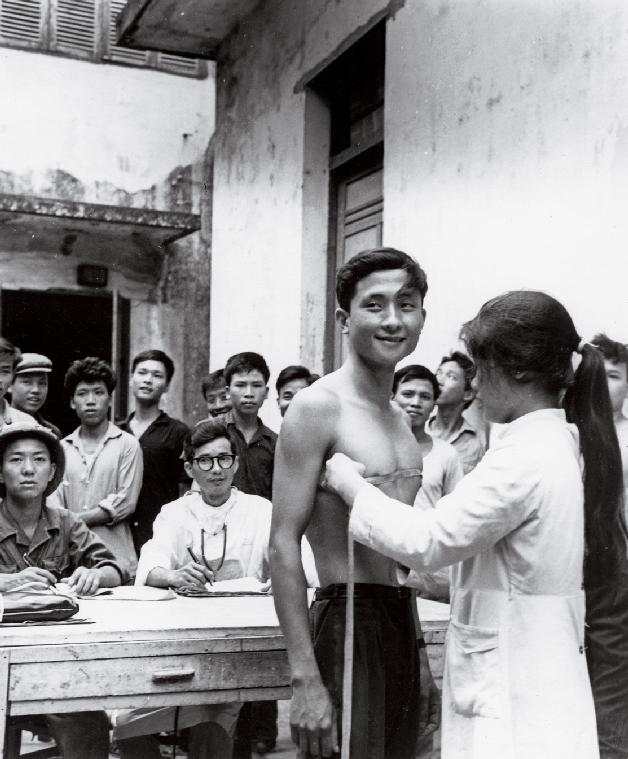
Medical staff examines a future soldier at a Haiphong recruiting station in the summer of 1967. “Nowadays,” said a North Vietnamese sergeant who defected to the South that year, “many young men lie about their age, making themselves older, so that they can be accepted into the army. The morale of the young men in the North is very high. Many seventeen-year-olds volunteered and, when refused, came home crying.”
General Giap was alleged to be in poor health and went to Hungary for medical treatment in mid-July—and then was encouraged to stay there. While he was gone, soldiers on his staff were arrested. So was Ho Chi Minh’s former secretary. Ho himself was sent to China for medical treatment in September.
The date for the offensive was still to be determined, but by late summer, hundreds, then thousands, of North Vietnamese regulars in civilian clothes had begun slipping southward to join the tens of thousands of NLF and North Vietnamese troops already in place. “Suddenly we were ordered to recall our soldiers from the battlefield,” recalled Colonel Ho Huu Lan, who had been fighting U.S. Marines just below the DMZ. “We were supplied with more weapons, ammunition, food, rice, salt, and dried fish, even sugar and condensed milk. We were told we were going to the southern front for a long period of time. We were very excited. We had the feeling that this time we would bring the war to an end.”
Nguyen Van Hoang was studying art in Haiphong that summer when an American bomb killed his fiancée. “Immediately afterwards,” he remembered, “I decided that I had to go south to fight. At the time…I thought that the Liberation Army was riding the crest of a wave. If I didn’t join up right away I’d miss my chance to take revenge. I reasoned that the Americans must be bombing the North in retaliation for their defeat in the South. I thought the NLF was on the verge of winning the decisive battle and that they would take Saigon in the very near future. I desperately wanted to go and kill a couple of Americans to relieve the bitterness I felt.” When an uncle who was a highly placed cadre took him aside to warn him that the war in the South represented “a colossal sacrifice of troops,” that if he insisted on signing up he was likely to die “a meaningless death,” he paid no attention.
“The farewell ceremonies I saw in my village were really en-thusiastic affairs, organized by the communists,” remembered the journalist Huy Duc, who was a boy then, living in his village in Ha Tinh Province. “The soldiers were so excited to go to the South to fight. My eldest brother shouted with happiness when he got the results of his physical exam and was accepted into the army. There were young men in my village who didn’t weigh enough, so they put rocks in their pockets to increase their weight. No one was sad, no one thought about the fact that they might not return, about the tragedy that might befall them.
JUST A GIRL
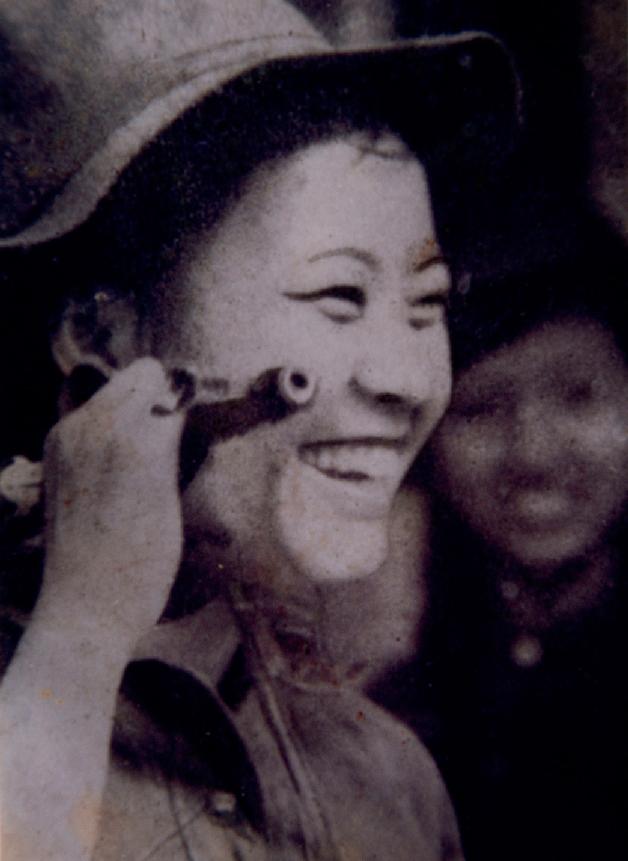
Mrs. Nguyen Thi Hoa
“I was fired up, excited at the thought that maybe we would at last be liberated,” Mrs. Nguyen Thi Hoa remembered, when, in the late fall of 1967, word filtered down to her that the long-awaited General Offensive, General Uprising was soon to begin. She was just nineteen but she’d already been a revolutionary for several years. Her village, Vong Tang, was just three miles from Hue. During the day, it seemed to be under the control of the Saigon government. ARVN troops camped nearby and were sometimes stationed within the village itself. But once the sun went down each day, Hoa and five other girls retrieved their snugly wrapped weapons from the duck pond in which they kept them hidden, so they could guard visiting cadre and drill in preparation for the revolt they had been assured was only weeks away.
Secrecy was everything; Hoa knew the names of just three of her superiors. Not even her mother knew what she was doing. She traveled to the city daily to sell the straw conical hats she and her friends wove, but also to gather intelligence. “I learned the positions of the puppet troops—ARVN, American, Korean—where they went, where they were stationed,” she remembered. She was small, soft-spoken, always dressed in an ao dai. “I would pretend to be very weak,” she said, “so that the Saigon soldiers would say, ‘Oh, she’s just a girl.’ ”
THE DEAD MARINE ZONE

South Vietnam, divided into four U.S. tactical zones
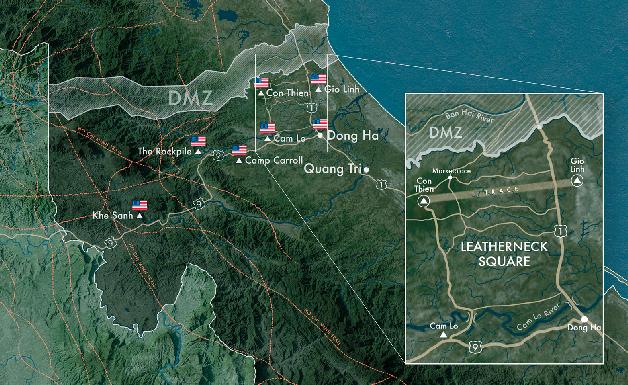
U.S. Marine outposts in the northernmost section of I Corps, just below the DMZ, and (inset) the area called “Leatherneck Square,” where thousands of U.S. Marines were stationed and more than 1,400 died
EARLY IN THE WAR, an American general had marveled at the complexity of the conflict in which he found himself. The NLF and the North Vietnamese seemed to be carrying on “a different kind of war in each of South Vietnam’s forty-four provinces,” he said. One province might endure ceaseless warfare, both large scale and small, while the province next door remained apparently at peace.
MACV had divided South Vietnam into four tactical zones. By the summer of 1967, Americans were fighting in all of them.
In IV Corps, Army and Navy forces patrolled the rivers and canals and marshes of the Mekong Delta, searching for the elusive enemy.
In III Corps, the Army continued to sweep the Iron Triangle, the NLF sanctuary near Saigon that was supposed to have been permanently denied to the enemy by big American operations earlier in the year.
In II Corps, a series of bloody battles in the Central Highlands around Dak To would temporarily drive North Vietnamese troops back into Cambodia and Laos.
But the central focus of the fighting would soon be in I Corps—made up of the five northernmost provinces of South Vietnam—where the U.S. Marines had taken the lead.
More than two and a half million people lived there, all but 2 percent of them within the narrow rice-growing river valleys along the South China Sea. The Marines initially wanted to focus on those lowland areas, and, working with the local South Vietnamese Popular Force, to eradicate the guerrillas there and provide security to the people, village by village, hamlet by hamlet, methodically choking off the rice and supplies and extorted taxes the NLF needed to keep fighting. The vast, largely empty highlands that stretched westward all the way to Laos, the Marines argued, could safely be left to the enemy. “The real war is among the people,” said Marine Lieutenant General Victor Krulak, “and not among the mountains.”
But General Westmoreland worried that leaving large swaths of territory in enemy hands could fatally undermine Saigon’s legitimacy, and he feared that thousands of North Vietnamese army regulars were planning to seize the two northernmost provinces. Finding, fixing, and destroying the North Vietnamese remained his principal goal. He insisted the Third Marine Division move inland to meet that challenge, establish a base at Dong Ha, and man strongpoints at Gio Linh, Con Thien, Cam Lo, Camp Carroll, the Rockpile, and Khe Sanh, overlooking Route 9, the east-west highway that Westmoreland hoped would one day carry American and South Vietnamese troops across the border into Laos to cut off the flow of North Vietnamese men and supplies coming down the Ho Chi Minh Trail.
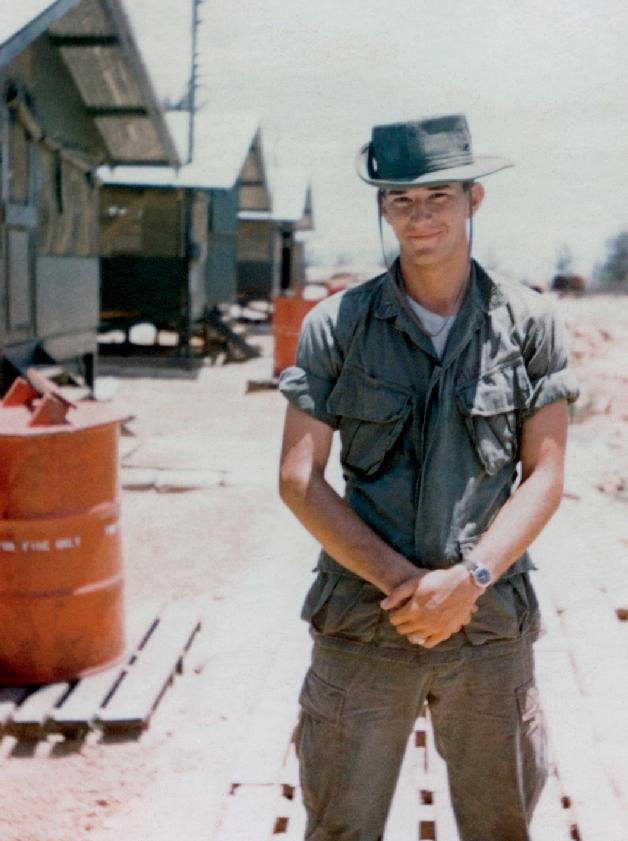
Private First Class John Musgrave, photographed near Danang before he asked to be sent north to I Corps because that was where the action was
Meanwhile, Secretary Robert McNamara, disappointed that American bombing had failed to stop traffic on the trail, hoped that an electronic barrier below the narrow DMZ might somehow do the job. It was an ambitious scheme—three to five billion dollars, five million fence posts, fifty thousand miles of barbed wire, thousands of mines, and sonic and seismic sensors meant to detect enemy movements—stretching from the coast all the way west to the Laos border. The initial section to be cleared by Marine bulldozers was the 6-mile-long, 218-yard-wide “Trace,” sewn with mines, barbed wire, and detection devices, which ran from Gio Linh to Con Thien. In addition, somewhere between thirteen thousand and eighteen thousand Vietnamese men, women, and children would have to be driven from their homes to create a vast free-fire zone.
The Marines who were ordered to construct and man the barrier that became known as “McNamara’s Line” thought it was madness. “With these bastards,” one officer said, “you’d have to build [the barrier] all the way to India, and it would take the whole Marine Corps and half the Army to guard it….Even then they’d probably burrow under it.” A North Vietnamese soldier named Le Van Cho confirmed their view: “It was nothing to us. Every night, we would go across it.”
Monitoring the border would tie down thousands of Marines and subject them to almost ceaseless combat. Between March 1967 and February 1969, 1,419 Americans—U.S. Marines and Navy corpsmen—would lose their lives within just four miles of Con Thien and inside the rough rectangle that came to be called “Leatherneck Square.” Nearly ten thousand more were wounded.
“For the Marines in northern I Corps in the Third Marine Division in the summer of 1967,” Private First Class John Musgrave, of Fairmont, Missouri, recalled, “we called the DMZ the ‘Dead Marine Zone,’ because we lost so many people up there.”
Musgrave could have missed the fighting along the DMZ altogether. He had initially been assigned to an MP battalion with the First Marine Division at Danang. While he was there, he found time to teach English in a village school and distribute books to the children provided by his church back home.
But his unit was a reinforced rifle platoon, and he soon found himself patrolling the countryside around the main Marine base. He came under fire for the first time when his patrol was ambushed at night. “They fired on us with automatic weapons. I got down and I didn’t get up. I was the automatic rifleman for the squad, and my squad leader had to come over and kick me and suggest to me that it would behoove me to get that rifle working. I was more afraid of him than I was of anybody else at that point, so I brought the rifle up and did my job—which meant I shot off twenty rounds into the dark. It was just a very brief contact. But it scared the living shit out of me. Later, I was to wish every ambush would be like that.”
Not long after that patrol, Musgrave found himself in another firefight. This time, his bullets found their mark. “I only killed one human being in Vietnam,” he remembered. “And that was the first man that I ever killed. I was sick with guilt about killing that guy and thinking, I’m going to have to do this for the next thirteen months. I’m going to go crazy. And then I saw a Marine step on a Bouncing Betty mine [designed to launch upward when triggered and explode at chest level], and that’s when I made my deal with the devil and I said, ‘I will never kill another human being as long as I’m in Vietnam. However, I will waste as many gooks as I can find. I’ll wax as many dinks as I can find. I’ll smoke as many zips as I can find. But I ain’t going to kill anybody.’ Turn the subject into an object. It’s Racism 101. And it turns out to be a very necessary tool when you have children fighting your wars, for them to stay sane doing their work.”

A Marine CH-53 Sea Stallion heavy-lift transport helicopter hovers above a smoke marker, preparing to drop a sling-load of ammunition and C-rations to the besieged men at Con Thien. The Marines were wholly dependent on resupply from the air. Medevac helicopters meant to carry away the wounded dared land only momentarily for fear of being hit by incoming shells.
Meanwhile, news of the bloody fighting along the DMZ was filtering down to him—his best buddy was stationed there—and in May when a recruiter from the Third Marines turned up asking for volunteers to replace men killed and wounded further north, Musgrave had stepped forward. “Part of it was I didn’t like operating around civilians around Danang. There were too many restrictions, you know. ‘Don’t fire until fired upon.’ That’s a really bad idea. I joined the Marine Corps to be in the varsity. And I felt like I wasn’t varsity unless I was up north fighting the NVA. I have never regretted that decision. There were times when we were under artillery fire, when I thought, ‘What were you thinking?’ But that’s where I had to be. I was a Marine rifleman. Here it is in a nutshell: if I lived to be sixty-three years old I didn’t want to look in the mirror some morning and have a guy looking back at me that hadn’t done everything for what he believed, who let somebody else do the harder part.”
Musgrave was assigned to Third Platoon Delta Company, First Battalion, Ninth Marines, Third Marine Division—“The fightingest Marines in Vietnam,” he said—and sent to Con Thien, a Marine strongpoint strung along the tops of three knolls two miles south of the DMZ and twelve miles from the coast. The easternmost anchor of the Marine outposts, raised just 518 feet above the surrounding flat terrain, it afforded the Marines unobstructed views in all four directions—eastward along the Trace for six miles to the Marine firebase at Gio Linh, southward ten miles to the I Corps logistical complex at Dong Ha, westward across the hills and ridges that stretched away toward the Truong Son range and harbored enemy artillery, and, finally, northward across the supposedly neutral DMZ that harbored still more, and on into North Vietnam itself. In Vietnamese, Con Thien means “Hill of Angels”; the U.S. Marines who endured life there came to call it “the Bull’s-Eye” and “the graveyard.”
A member of Musgrave’s new outfit remembered that for a full month no one bothered to learn the names of newcomers like him. They were all known as “FNGs”—“Fucking New Guys.” “Nobody counted, nobody was part of reality unless they’d stayed alive that long,” he remembered. “If they had…you could count on them to do their job.”
The unit had already suffered so many casualties in a series of bloody sweeps over roughly the same ground—Operation Prairie I, Prairie II, Prairie III, Prairie IV—that it was believed to be a hard-luck outfit. “If it could go wrong, it would go wrong,” a tanker who had carried their corpses from the battlefield remembered. “Wherever they went, they stepped into the shit.” The men of the First Battalion called themselves “Walking Death,” and “Death Dealers”; fellow Marines called them “Dying Delta.”
The North Vietnamese regulars they faced were small, wiry, tough, well armed, and determined. “My hatred for them was pure,” Musgrave recalled. “I hated them so much. And I was so scared of them. I was terrified of them. And the scareder I got the more I hated them. They didn’t have a thirteen-month tour like we did. They fought from the time they were old enough to pick up a rifle until they were dead. Every major contact I remember with the NVA was initiated by them ambushing us. They wouldn’t hit us unless they outnumbered us. And we were fighting in their yard. They knew the ground; we didn’t. They were just really good.”
The enemy mirrored Musgrave’s emotions. “When we and the Americans faced one another,” North Vietnamese Colonel Ho Huu Lan recalled, “they were determined to kill us and we were determined to kill as many of them as possible. Sympathy and hatred were interwoven, but in a battle the hatred was dominant.”
The North Vietnamese were armed with Soviet-made, seemingly indestructible AK-47s. The Marines had to fight with newly issued M16 rifles that had for a time a potentially fatal design flaw: they needed constant cleaning and often jammed in the middle of firefights. “Their rifles worked; ours didn’t,” Musgrave said. “The M16 was a piece of shit. You can’t throw your bullets at the enemy and have them be effective. That rifle malfunctioned on us repeatedly.”
The tropical heat was intense and relentless, Musgrave re-called, and the fighting was close in and deadly. “The enemy knew if they would pop the ambush close and then get amongst us, we would hesitate to call in air on ourselves. Firefights like that we called ‘brawls.’ They were very intimate. And they were very deadly. And they were absolutely terrifying.” On one early patrol, Musgrave watched an American A-4 Skyhawk swoop down to drop napalm on enemy troops hidden behind a hedge-row. He could hear their AK-47s firing at the plane until the instant they were engulfed in flames. “If the enemy is willing to die like that,” he thought, “this is going to be one very long war.”
The Marines were spread too thin to hold any of the territory they fought so hard to take. Again and again, they were sent out from one stronghold or another along the DMZ, looking for enemy soldiers. Again and again, they found them—often hidden in the same thickly grown hedgerows and irrigation ditches or concealed in the same bunkers and tunnels and spider holes from which the same Marines had driven them days or weeks or months before.

Under enemy fire, a Marine helps a wounded comrade to safety during Operation Prairie IV, somewhere in Leatherneck Square, May 13, 1967.
“The disillusionment for me began when I was going back to fight at places we’d already fought before,” Musgrave recalled. “We had fought, captured, and then left them, and the NVA came right back. You don’t like getting wounded in places you’ve already been before. War is a real estate business. We’re supposed to take real estate away from the enemy and then deny the enemy access to that real estate.”
On the morning of July 2, the First Battalion launched Operation Buffalo, a sweep of an area between the Trace and the southern edge of the DMZ, less than a mile and a quarter northeast of Con Thien. They had swept the same terrain just a few days earlier. Bravo Company moved along a narrow dusty cart track walled with three-foot hedgerows near a crossroads the Marines called “the Marketplace.” At about nine fifteen, the North Vietnamese opened fire from three sides. Thirty mortar rounds fell among the Americans within three minutes. A single shell killed the company commander, two platoon leaders, the radio operator, and the forward observer. Then the enemy used flamethrowers to set the brush and dry elephant grass on either side of the road on fire and shot the Marines as they tried to flee the flames.
Bravo Company was virtually annihilated in what came to be called the Marketplace Massacre. The men of Alpha Company, sent to rescue the survivors of Bravo Company, were themselves soon pinned down in the open. “The Americans were not very shrewd,” Colonel Ho Huu Lan remembered. “One soldier would be killed, and another one would run up to carry away his body, so many of them were shot. If they had attacked us first so we would have to retreat and then gone out to collect their wounded or dead, they would have taken fewer casualties.”
At about ten thirty that morning, John Musgrave’s platoon, escorted by four tanks, set out from Con Thien to do what they could for their fellow Marines. As they tried to clear and defend a landing zone so that the wounded could be evacuated, eleven men were hit by enemy artillery. So were several of the already wounded.
It was one of the worst days the Marine Corps endured in Vietnam: 51 dead and 166 wounded were carried off the battlefield under fire. Thirty-four more dead had to be left behind—and when Marines fought their way back two days later to retrieve their bodies, they found that a number had died because their M16s had jammed as the enemy closed in. All of the wounded had been executed, shot in the face or back of the head at close range. Some bodies had been booby-trapped, others hideously mutilated.
In the immediate aftermath, at least, the savagery of combat intensified. “Marine Amphibious Force headquarters was so desperate to get North Vietnamese prisoners that they offered us three-day in-country R&R if we’d bring a prisoner in,” Musgrave remembered. “ ‘Good luck,’ we said. ‘Don’t you know what we’re doing up here? Do you know who we’re fighting? You think we’re going to take somebody prisoner that’s mutilating our wounded? You really think we’re going to do that?’ I want to make this clear. We did not torture prisoners. And we did not mutilate them. But to be a prisoner you had to make it to the rear. If an enemy soldier fell into our hands he was just one sorry fucker. I don’t know how to explain it that it would make sense to anyone who wasn’t there.”
By the time the two-week operation ended, headquarters would claim that the Marines had killed 1,290 enemy troops. Musgrave and other Marines in the field were not so sure. “We were supposed to determine victory by the yardstick of the body count—which we called ‘counting meat.’ The unit got rewarded not for how much property you took but how much meat it could stack. We knew it was no way to win a war. If we sent in a body count of fifteen to the headquarters for the Marine Corps in Vietnam, it would turn into twenty or thirty and by the time it got to MACV in Saigon it would turn into fifty or sixty. We’d see an article in the Stars and Stripes about a battle we were in that said we’d killed a lot more people than we ever saw. We’d just go, ‘What the fuck? This is bullshit.’ It wasn’t that we didn’t do enough for you? If you guys think this is so easy, come out here and get that extra meat. We’re doing the best we can here. This is a dirty job.”
I DON’T WANT A WOMAN SEEING ME DIE
Her nickname in Vietnam was “Sam,” because, as one soldier told her early in her stint as a freelance war correspondent, her real name—Jurate Kazickas—was too hard to pronounce. She had escaped with her parents from Lithuania just before Soviet troops rolled in during World War II, worked after college at a Catholic mission in Kenya and as a researcher for Look magazine in New York, and then resolved to go to Vietnam and try to cover the war. When no one would hire her—she was just twenty-four, had never published a word, and covering battle was still considered mostly men’s business—she won $500 on the TV game show Password, used it to buy a one-way ticket, and set out for Vietnam, hoping to provide copy for a handful of relatively small publications.
Some women reporters stuck to human interest stories, but from the first Kazickas was determined to cover combat. It wasn’t easy. Many commanders disliked the idea of women in the field. They were a distraction, couldn’t keep up, would have to be protected, they said. “But women reporters in Vietnam did just what men did,” Kazickas and a fellow journalist wrote. “We were killed, wounded, shot at and captured by the enemy. We jumped out of planes, slept in foxholes, went on patrol, humped through the boonies, looked out for land mines, and wondered how we could ever try to put it all in words. Could we really make them see, feel, and understand?”
The Army placed few restrictions on her—though General Westmoreland tried for a time to bar female reporters from remaining in the field overnight—but the Marines insisted on providing her with an escort wherever she went. On one early patrol close to the Cambodian border she easily outwalked the overweight desk clerk who had been sent to accompany her, and when the exhausted man suffered a groin injury and had to be evacuated by helicopter she was furious to find herself obliged to go with him.
Her “first en-counter with war at its most obscene,” she remembered, came at Con Thien in early July 1967, as John Musgrave’s unit gathered the dead after the Marketplace Massacre. “What shook me to the core was the devastating sight of so many dead Marines who had been lying in the sun for three days—their bodies bloated, their faces black as if charred by fire.” “It’s getting so bad, I’m afraid to make friends anymore,” one corporal told her. “I talk to a guy one minute, the next thing they bring him back in a poncho.”
That November, during the jungle fighting around Dak To, she would spend a terrifying day pinned down by enemy snipers and photographing men of the 173rd Airborne as they fought back. When an enemy rocket exploded in the midst of the clearing, wounding so many Americans the medics could not deal with them all, she put her camera and notebook aside and went to work with gauze and bandages trying to do what she could to help them. When she got back to Saigon a TV correspondent taunted her. “Well, well, we heard you were playing Florence Nightingale at Dak To.” She never regretted it for a moment.

Jurate Kazickas tries to comfort a Marine wounded near Con Thien.
“I don’t want a woman seeing me die,” one wounded soldier told her. “War is a man’s business.” She understood: many of the young soldiers with whom she spoke believed they were in Vietnam so that their women and children would never have to experience war in their own country. “But,” she said, “they were also saying, ‘I don’t want you to see me scared, I don’t want you to see me cry the way I cry. I don’t want you to see me bleed the way I bleed. And I don’t want you to see me kill the way I like to kill.’ ”
A LOT OF DEATH AND CRAZINESS

Marine Private Roger Harris, proud son of Boston’s predominantly black neighborhood, Roxbury
PRIVATE ROGER HARRIS of Roxbury, Massachusetts, had joined the Marines in part, he said, because he wanted to be “a gladiator,” a killer of his country’s enemies. But once he got to Vietnam and was plunged into combat in Leatherneck Square he was rattled, at least at first. “You go over there with one mind-set,” he recalled, “and then you adapt. You adapt to the atrocities of war. You adapt to killing and dying. After a while it doesn’t bother you. Well, it doesn’t bother you as much. When I first arrived in Vietnam, there were some interesting things that happened and I questioned some of the Marines. I was made to realize that this is war, and this is what we do. And after a while you embrace that. This is war. This is what we do.”
On the morning of July 28, fourteen days after Operation Buffalo ended and John Musgrave’s badly mangled First Battalion of the Third Marines was pulled back to Camp Carroll to rest and recover, Harris and the Second Battalion moved out of Con Thien, across the Trace, and into the southern half of the DMZ itself. Operation Kingfisher was intended to be a “spoiling attack,” meant to get at the North Vietnamese and disrupt any plans they might have to cross into Quang Tri Province.

Marine survivors of Operation Kingfisher return to Con Thien following the dirt track called Route 606 that had led them into the DMZ and disaster two days earlier.
The column, reinforced by five tanks, three armored personnel carriers, and three massive M50 multiple-cannon antitank vehicles, was forced to stay close to Route 606, a rough cart track that led north toward the Ben Hai River, because the jungle on either side of the road was especially dense.
The heat was intense, well above 100 degrees. At first, everything was quiet. The Marines camped for the night in and around an abandoned hamlet and prepared to continue along the road the next morning as it looped eastward and back out of the DMZ. But planners had failed to see that the concrete bridge over an otherwise impassable stream was too narrow and too weak to carry armored vehicles. The Marines had no choice but to violate a cardinal rule of infantry tactics—turn around and try to go back the way they had come.
The enemy was waiting for them. The two lead platoons had gone just a little more than 100 yards when they set off a 250-pound bomb hidden beneath the road during the night. Several Marines were killed. Parts of them hung in the trees beneath which their fellow Marines now had to advance.
Farther down the road, combat engineers stopped the column to explode a second hidden bomb. At that moment, enemy soldiers concealed in bunkers and spider holes along both sides of the road began shooting. “That’s when everything broke out,” Harris recalled. “Massive ambushes. A lot of death and craziness.”
The Marines were forced to run a bloody one-thousand-yard gauntlet of mortars, machine gun bullets, and rocket-propelled grenades. Some men who sought cover off the road landed on punji stakes (sharpened bamboo spears smeared with feces to ensure infection) and booby traps planted there under cover of darkness. “There’s an old saying among Marines,” one survivor remembered. “They never retreat. They just advance in the opposite direction. Bullshit! We were retreating, getting the hell out of there!”
A tank was set on fire. A grenade smashed its way through an APC. Three crewmen trying to man the guns on their antitank vehicles were killed. Infantrymen found themselves trying to protect the cumbersome armored vehicles that were supposed to be protecting them. American planes dropped napalm: one Marine would never forget what he called the exposed enemy’s “cry of horror” as they saw the silver napalm tanks tumble toward them.
The column broke into separate sections, each fighting to keep from being cut off from the others. Roger Harris’s G Company held up the rear, hounded by enemy soldiers on all sides. He and his comrades killed at least two dozen enemy troops before the fighting ended, and the Marines staggered back out of the DMZ alongside the battered armored vehicles heaped with dead and wounded Americans.
The Second Battalion suffered 214 casualties—23 dead, 191 wounded and evacuated, 45 suffering from heatstroke. Thirty-two dead North Vietnamese were left on the battlefield but Marine commanders estimated they had killed another 175.
Harris mourned the loss of his friends. “It wasn’t a good day for the Marines,” he said. But he also remembered the ferocity of the enemy. “I have the utmost respect for the North Vietnamese army soldier. When you see someone jump out and confront a tank, with a big fifty-caliber machine gun on it and a ninety-millimeter cannon on it—that says something about him. They traveled for weeks just eating rice and drinking water. They were incredible soldiers.”
THE SCARIEST THING
IN AUGUST, John Musgrave’s squad was in the Ba Long Valley, dug in on a hilltop, guarding an outpost that relayed radio messages back to headquarters from Special Forces probing the jungle in Laos. “That was like getting a death sentence,” he recalled. “Because that’s just three Marines out there with a radio at night. That’s the scariest thing I did. You’re listening for the enemy. And they call you on the radio every hour, ‘Delta, Lima, Papa, 3, Bravo, Delta, Lima, Papa, 3, Bravo, this is Delta 3. Delta, Lima, Papa.’ (Delta company, listening post, Third Platoon, second squad, was three Bravo.)
“ ‘If your sit rep is Alpha Sierra, key your handset twice.’ (If your situation report is all secure, break squelch twice on the handset.)
“And if it’s not all secure, they think you’re asleep, so they keep asking you until it finally dawns on them that maybe there’s somebody too close for you to say anything. So then they say, ‘If your sit rep is negative, Alpha Sierra, key your handset once,’ and you damn near squeeze the handle off, because they’re so close you can hear them whispering to one another.
“That’s real scary stuff. I’m scared of the dark, still. I’ve still got a nightlight. When my kids were growing up, that’s when they really found out that Daddy had been in a war, when they said, ‘Well, why do we need to outgrow our nightlights? Daddy’s still got one.’ ”
A few weeks after his terrifying nights on the hilltop, Musgrave’s squad was encamped south of Cam Lo, providing security for a reconnaissance team. He had just climbed out of his fighting hole when the North Vietnamese opened fire and hurled grenades in among the men. He was hit by shrapnel and knocked senseless. Risking his own life, Navy corpsman George Shade left his fighting hole, ran out, and carried Musgrave back to safety. When he regained consciousness, he was temporarily deafened and terrified that he had been seriously hit. He never forgot the care with which Shade calmed him down or the skill with which he tended to the wounds in his arm and hand.
A STEP FORWARD
LIKE LE DUAN, Lyndon Johnson found himself in trouble during the summer of 1967. He had always maintained that the United States was “rich enough and strong enough” simultaneously to fight both the Vietnam War and the War on Poverty. That no longer seemed to be true. The steadily climbing cost of the war had sparked worrisome inflation. To offset it, Johnson proposed a 10 percent income tax surtax. Before conservatives in Congress would approve it, they forced him to accept cuts in the antipoverty programs that meant the most to him. Two of the most important domestic achievements of his administration—the Civil Rights Act of 1964 and the Voting Rights Act of 1965—had brought a measure of true democracy to his country, but they had not materially affected the fundamental conditions of African American life. During that spring and summer, 159 cities and towns saw violent uprisings against the glacial pace of change. At least 67 people died. And a backlash had simultaneously begun to grow among white blue-collar workers who felt the pace of societal change somehow was too rapid, that they were being passed by.

A Saigon vendor sells fruit beneath an election poster proclaiming “The Government of Nguyen Cao Ky Is the Government of the Poor,” in July 1967. The poster was soon removed—along with hundreds like it—when Ky’s fellow generals forced him to withdraw from South Vietnam’s presidential race in favor of his bitter rival, Nguyen Van Thieu.
Meanwhile, talks in June between Johnson and Soviet premier Alexei Kosygin that at first seemed to suggest Hanoi might be prepared to negotiate if Johnson stopped bombing the North had come to nothing. A Gallup poll completed in July showed that for the first time a majority of Americans—52 percent—disapproved of the president’s handling of the Vietnam War. The same poll revealed that 41 percent believed that American troops should never have been sent to Vietnam in the first place and, still worse from the administration’s point of view, 56 percent thought the allies were either stalemated or actually losing the war.

A young mother casts her first vote for president of South Vietnam, Bien Hoa Province, September 3, 1967. At the right is one of the U.S. observers sent by President Johnson to assess the election’s fairness. One of them, Governor Richard J. Hughes of New Jersey, dismissed the idea that the vote had been rigged: “We could all possibly have been bamboozled, but it would have taken a minimum of twenty-five thousand character actors and about eleven thousand stagehands to put on the production we have seen.”
Trying to rebuild public confidence, Johnson called a press conference on July 13. “We are generally pleased with the progress we have made militarily,” he assured reporters. “We are very sure that we are on the right track.” General Westmoreland was on hand so the president could ask him to dismiss what he called this “stalemate creature.” “The statement that we are in a stalemate is complete fiction,” the general said. “It is completely unrealistic. During the past year tremendous progress has been made.”
Three weeks later, the president publicly ended the nine-week internal debate over how to respond to the latest troop request made by the Joint Chiefs of Staff. They had hoped for 200,000 men and had urged the president to call up the Reserves to provide some of them. He agreed to send only 45,000 to 50,000 troops, which would bring the total to just over 525,000 by mid-1968. The Reserves were to remain at home, for fear their deployment would spur more criticism of the war.
The administration was at least outwardly united in its optimism. General Harold K. Johnson, Army chief of staff, was asked if this latest increase in troops might also be the last. He said he thought so: “This should be, with circumstances substantially as they are now, adequate to provide a degree of momentum that will see us through to a solution in Vietnam.”
Then, on August 7, 1967, just four days after the president revealed how many fresh forces would soon be on the way, a front-page story in The New York Times called into question every optimistic assumption about the war the administration and the military had expressed. Headlined “Vietnam: The Signs of Stalemate,” it was reported and written by R. W. Apple, the widely respected chief of the newspaper’s Saigon bureau. Almost 13,000 Americans had now died, Apple wrote. Nearly 75,000 had been wounded. The war was costing $2 billion a month. Within a year, there would be more than half a million Americans in country. “And yet,” Apple wrote, “in the opinion of most disinterested observers, the war is not going well. Victory is not close at hand. It may be beyond reach.” He continued,
Stalemate is a fighting word in Washington. President Johnson rejects it as a description of the situation in Vietnam. But it is the word used by almost all Americans here except the top officials, to characterize what is happening. They use the word for many reasons:
—Because the Americans and their allies, having killed by their own count 200,000 enemy troops, now confront the largest enemy force they have ever faced, 297,000 men, again by their own count.
—Because the enemy has progressed from captured rifles and skimpy supplies to rockets, artillery, heavy mortars, a family of automatic weapons, flamethrowers and antibiotic drugs—brought into South Vietnam despite unchallenged U.S. airpower.
—Because 1.2 million allied troops have been able to secure only a fraction of a country less than one and a half times the size of New York state….
—And above all, because if the North Vietnamese and U.S. troops were magically whisked away, the South Vietnamese regime would almost certainly crumble within months, so little have the root problems been touched.
It is true, as General Westmoreland has often said, that the United States has built an awesome logistical empire in Vietnam, that the enemy seldom wins a major battle, that more highways are open than before, that U.S. bombers have severely hampered Hanoi’s war effort, that the Viet Cong are suffering.
But the enemy continues to fight with tenacity, imagination and courage, and no one knows when he will stop.
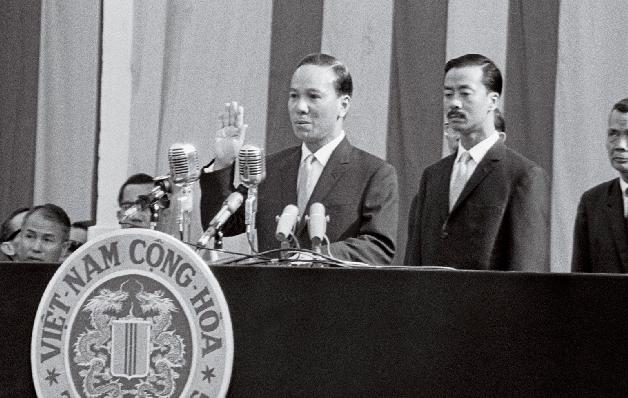
Nguyen Van Thieu takes the oath of office as South Vietnam’s president; Vice President Nguyen Cao Ky reluctantly stands in the background. The most serious problem facing the new Saigon government, The New Yorker’s Robert Shaplen wrote, “is that of conflicting personalities. The two men are almost completely different in character and behavior. Thieu is withdrawn, suspicious, and highly cautious….Ky has always been gregarious, incautious, and flamboyant, with a political style entirely in keeping with his career as a pilot.”
Apple reported that many officers considered General Westmoreland delusional when he talked of soon being able to turn the struggle over to the South Vietnamese. “Every time Westy makes a speech about how good the South Vietnam army is,” a general told him, “I want to ask why he keeps calling for more Americans. His need for reinforcements is a measure of our failure with the Vietnamese.” ARVN troops were “tough, willing and courageous,” Apple wrote, but still poorly led by a “corps of young officers, often incompetent and more often corrupt.” The government was incompetent and corrupt, too. “The problem isn’t the North Vietnamese army,” an out-of-favor Saigon politician told him. “It’s the South Vietnamese government.”
The story made Johnson livid. He called Barry Zorthian, the embassy public affairs official in Saigon, and told him that Apple was clearly a “communist” and should be thrown out of Vietnam. Zorthian was not to so much as speak to Apple again. America was at war; American reporters needed to “get on the team.”
Johnson’s ire was exacerbated because Apple’s story appeared just as a long-delayed presidential election campaign was getting under way in South Vietnam. From the moment in 1963 when the United States raised no objection to the generals who overthrew and then murdered South Vietnam’s first president Ngo Dinh Diem, many in Washington had worried about the legitimacy of the Saigon government American troops were being asked to defend. The Buddhist uprising that had threatened to topple Prime Minister Nguyen Cao Ky in 1966 had forced him to promise at least tentative moves toward democracy—election of a national assembly, a new constitution, and elections for president and vice president. Despite communist intimidation, 81 percent of South Vietnam’s registered voters had turned out in September of that year to vote for the assembly, which then drew up a new constitution and scheduled the presidential election for September 3, 1967. “When they have that election,” Johnson told a reporter, “that’s when South Vietnam stops crawling and begins to walk—when they get a democratic government.”
It seemed to the White House that real progress toward at least the appearance of democratic rule was finally being made. Ky assumed he would run for president. Washington pledged official neutrality, but behind the scenes it believed he and the military junta that appeared to support him were most likely to provide the stability South Vietnam needed. Ten civilians signed up to run against him. Ky saw to it that anyone who advocated peace was barred from the ballot, including two potentially serious rivals, General Duong Van “Big” Minh and An Truong Thanh, a former member of Ky’s cabinet, both of whom now favored opening talks with Hanoi.
Then things seemed to go off the rails. General Nguyen Van Thieu suddenly announced his candidacy. Shrewd, politically skilled, and seven years older than Ky, he was popular among his fellow soldiers, many of whom found his rival’s boastful swagger hard to tolerate. At a smoke-filled meeting of fifty high-ranking officers, Thieu outmaneuvered his opponent. He would be the junta’s candidate for president. Ky had to settle for being his vice presidential running mate.
To strengthen Saigon’s hand as election day approached, Johnson decided to increase pressure on the North. The Joint Chiefs were eager to do that too. They had already urged him to mine North Vietnam’s harbors, permit large numbers of allied troops to cross the Laos and Cambodia borders in search of the enemy, and authorize new bombing targets. Johnson felt that border crossing and the mining of harbors still carried too great a risk of Chinese or Soviet intervention. But he eagerly expanded the target list around Hanoi and Haiphong. “Our strategy, as I see it,” he told his national security team, “is that we destroy all we can without involving China and Russia by September 1st [two days before election day]. The [American] people will not stay with us if we do not [destroy] all we can, so let’s find the least dangerous and most productive targets.”
During the final week of the campaign, the communists did everything they could to intimidate potential voters. They mortared Hue and shelled Can Tho, briefly took over the provincial capital of Hoi An, dynamited bridges to keep voters from village polls, and stopped the show in four movie theaters in the Chinese Cholon district of Saigon to warn audiences not to vote. In a single day, some four hundred South Vietnamese are thought to have been killed from one end of South Vietnam to the other.
Roughly a third of all South Vietnamese lived in areas controlled by the NLF and thus were unable to vote. Many Buddhists, still angry at the treatment they had received from the Saigon government, boycotted the polls. Still, more than 83 percent of South Vietnam’s registered voters went to vote.
Thieu and Ky won, but their margin was just 35 percent, well short of the majority for which Washington had hoped. Truong Dinh Dzu, a civilian lawyer who had revealed himself as an advocate of peace negotiations after the campaign began, came in second, with 17 percent, and in Saigon and other urban areas Thieu and Ky lost to another civilian candidate, former premier Tran Van Huong. The winners’ strength turned out to lie in the countryside, where military commanders quietly controlled much of the vote. One American reporter described the election in some rural areas as “Chicago politics, with circumspection.” As soon as the results were in, Thieu had his nearest rival, Dzu, clapped in jail, along with some twenty other prominent South Vietnamese who had dared express doubts about continuation of the war.
Nonetheless, the State Department declared the election an important “step forward,” and in a television address, President Johnson used it as further evidence that “the grip of the Viet Cong on the people is being broken.”
But it was soon clear that neither the election of a new president in Saigon, the accelerated bombing of the North, nor the behind-the-scenes offers made by Johnson to stop it was having any discernible effect on the men who ran North Vietnam.
TIME IN THE BARREL
IN THE LATE SUMMER and early fall of 1967, North Vietnamese and NLF forces made a series of coordinated attacks on American outposts below the DMZ and along the Cambodian border that became known as the “Border Battles.”
Con Thien would be the first. In early September, North Vietnamese ground troops tried and failed again to take the outposts. Beaten back by Marines, they stepped up their shelling, beginning a relentless two-month siege. In one nine-day period, three thousand mortar, artillery, and rocket rounds landed among the huddled Marines.

A Marine at Khe Sanh tries to outrun an incoming 152mm shell. He had been loading Marine dead onto a helicopter when the enemy zeroed in on the landing zone. “I cringe as each [shell] hits and explodes,” one trapped Marine wrote. “They are striking the ground around this hole. It is almost as though the enemy are looking for me.”
Roger Harris and the Second Battalion, recovered and rebuilt since the Operation Kingfisher disaster, returned to Con Thien on September 10, just in time to suffer the consequences. “The most terrifying thing was being under siege by rockets,” he remembered. “There’s nothing you can do. You just listen to the sounds of the rockets coming over. You just pray that they don’t land on you. And there’s always one in each barrage that’s louder than the others. You know it’s coming. It just screams. It gets louder and louder and louder and then it hits, maybe ten yards away. I’ve never been as afraid as I was then. That’s why I’m not afraid of anything now.”
“Marines who survived at Con Thien developed senses as acute as wild animals,’ ” remembered the CBS correspondent John Laurence, who spent a terrifying few days there during the siege. “They had extraordinary sensitivity to sound; their hearing warned them, like deer, when an NVA shell was closing in. New guys and journalists didn’t have it. We’d hear the scream of the shell and the explosions almost simultaneously. Veterans at Con Thien picked up the faint pop of a round leaving its tube many miles away, tracked it moving through the air, and knew before it crashed roughly how close it was going to hit. Sometimes they got the warning from a slight compression of air in their ears, a tiny change in atmospheric pressure, a signal on the wind.”
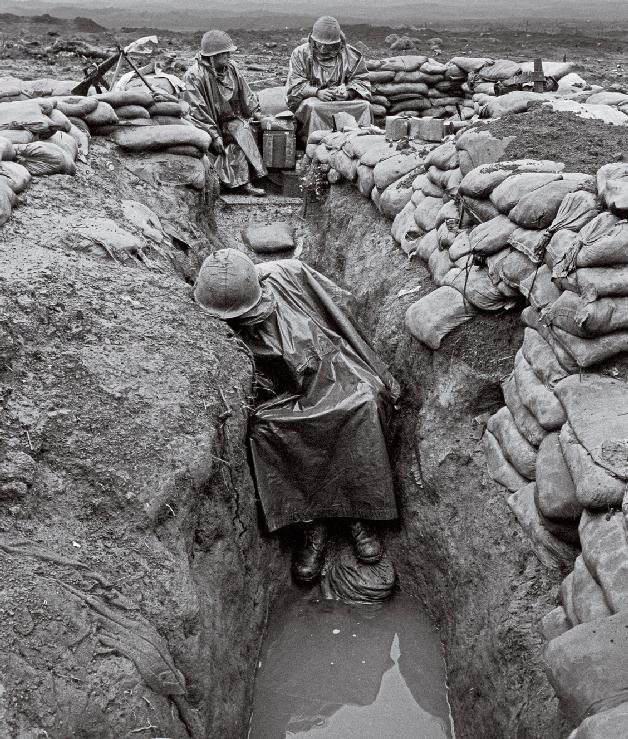
An exhausted Marine catches a few moments of sleep in his water-filled trench at Con Thien. “Our holes would fill with water,” a Marine machine gunner named Jack Hartzel recalled. “We’d have to bail them out four or five times a day. We also had immersion foot and your feet would bleed and hurt like hell. Then there was the damned mud! You walked in it, you sat in it, you slept in it, and you even ate it. There was just no escaping it.”
After one barrage ended, Laurence recalled, he heard sobbing. He left the hole in which he’d huddled and made his way to the side of a Marine lying motionless out in the open, wounded in the leg by shrapnel. “ ‘Hey man, don’t cry,’ I said, surprised at the words coming out of my mouth. ‘You’re a Marine!’ The wounded kid stopped crying, and looked at me with an expression of genuine pity that anyone, even this strange dude in the area, could say something so ridiculously lame….‘He’s not scared,’ [another] Marine said. ‘He’s cryin’ cause it’s his third wound. He’s gotta go back to the rear. And he can’t come back now, with three wounds. He’s cryin’ cause he’s got to leave all his buddies here.’ ”
In retaliation, the American high command had unleashed Operation Neutralize—forty-nine straight days of coordinated pummeling of North Vietnamese positions by B-52 bombers and tactical aircraft, naval guns fired from warships offshore, and Marine and Army artillery. Before it was over, some two thousand enemy troops were said to have been killed.
The monsoon added to the men’s misery, week after week of rain—seventeen inches in a single day—that filled foxholes and trenches, ruined supplies, caused painful trench foot, and turned Con Thien into a sea of red mud. The constant explosions—shells coming in, shells going out, bombs dropping on the nearby enemy—deafened some men and drove others mad.
“Almost every hour there’d be a barrage,” Roger Harris remembered. “And at the end of the barrage, somebody always got caught outside their holes.
“Then, you had to police up the bodies. You’ve got to try to remember whose hole this was, you know. If you find dog-tags, that’s great. But many times you find nothing. People get blown to bits, literally blown to bits. There’s a crater. It’s raining. So now it’s a big puddle of blood. And there’s pieces of bodies. But you can’t identify any of the bodies. So you have to try to remember whose position was this? You find a boot with a leg in it. So is the leg white or black? So who was the white Marine that was here? Who was the black? So then you try to remember and you tag it and put that in the green bag. And that’s what goes back, you know, as ‘Marine Lance Corporal so and so.’ And sometimes you’re not even sure because the body has literally been blown to bits and the only thing that’s left is a foot or a piece of an arm. Those kinds of things, they stay in your mind. They’re haunting. They’re haunting.”

Sitting out the rain. The monsoon’s single saving grace was that the thick fog that accompanied it and kept Marine helicopters grounded also kept the enemy’s forward observers, huddled within the DMZ, from calling in accurate fire.
For Harris, it went on for nearly a month. At some point during the siege, the ingenious men in the communications bunker managed to patch together a telephone connection so the men could speak briefly with their families back home. When Harris’s turn came, he told his mother that she shouldn’t believe the upbeat stories about Con Thien that were appearing on television and in the newspapers. “ ‘Because we’re losing the war,’ I said. ‘You’ll probably never see me again because we’re the most northern outpost the Marines have. We can literally look right into North Vietnam. We can see the sparks when the guns fire on us.’ And I said, ‘Everybody in my unit is dying and I probably won’t be coming back.’ Ma said, ‘No, you’re coming back.’ She said. ‘I talk to God every day, and you’re special. You’re coming back.’ And I said, ‘Ma, everybody’s mother thinks they’re special. I’m putting pieces of special people in bags.’ And she said, ‘No, you’re coming back.’ She tried to joke about it. And I was feeling that my mother’s in denial. She just doesn’t want to face the fact that her only son is going to die in Vietnam. And so I said, ‘Ma, this isn’t a joke.’ I said, ‘Everybody’s dying over here.’ And she said, ‘You’re not going to die. You’re not going to die.’ And the last thing she said to me was, ‘God has a plan for you.’ And I said, ‘Yeah, right.’ And I hung up.”

Changing of the guard: Amid the muddy chaos of Con Thien, the First Battalion, Ninth Marines, replaces the Second Battalion, October 7, 1967. “The most noticeable first impression of Con Thien is mud,” one man recalled, “and a unique smell of mud, human waste, and decomposing flesh—not overwhelming, but there all the time….One cannot go very far without seeing (and smelling) various small body parts.”
Harris and the Second Battalion were finally relieved on October 7, replaced by John Musgrave’s First Battalion. The rains did not let up. “Mud is everywhere, covering everything,” Musgrave wrote home to his mother and father. “It ranges from toe-deep to waist-deep….I’m living in a hole about 4½ foot deep and 5 feet wide….It’s just a little wider than shoulder-width, but with my flak jacket and fighting gear on, which we never take off, it’s a pretty tight fit. I can think of other places I’d rather live. What bugs me is my walls aren’t big enough to hang things on. I wish I was home in my own room instead of this one.”
“I sat in water,” Musgrave recalled. “I slept in water. I ate in water, because our holes were full. A flooded foxhole can drown a wounded man. The mud was real sticky and it could just grab onto you and pull your boots off. It’s hard to run in that stuff. And running, when you’re at a place where they’re firing heavy artillery at you, is pretty important.”
The peak of the siege had passed by the time Musgrave returned to Con Thien, but shells still fell every day. “Time at Con Thien was ‘Time in the Barrel,’ ” he remembered. “We were the fish; they had the shotguns; they stuck it in the barrel and blasted away. They were going to hit something every shot. Because Con Thien was such a small area, they couldn’t miss. We were getting newspaper articles in the mail from our families and we were being called ‘the Alamo.’ Hey, we knew what the Alamo was. We knew what happened there!”
On October 13, just a week after his unit replaced Harris’s, it was Musgrave’s turn to get hit a second time. He was ordered to help unload supplies from helicopters dropping into the Con Thien landing zone—a duty the men hated because the enemy could be counted on to step up their artillery fire whenever a helicopter appeared. Musgrave heard a shell coming in and tried to run but was slowed down by the mud and the heavy cans of water he was carrying. Shrapnel hit him in both legs. George Shade, the Navy corpsman who had tended his wounds a few weeks earlier, patched him up again.
Far worse was to come that evening. “We had a clear night,” Musgrave recalled. “Big moon—what my dad said was called a ‘bomber’s moon’ in World War II. It was around eight thirty. That was what one of the guys told me later, because his watch stopped. Two Marine Phantoms bombed my platoon. We thought it was MiGs—because who would be stupid enough to bomb Con Thien? They walked the bombs right through our area. One of them, a five-hundred-pound bomb, hit our command post bunker and blew away the wire in front of our position. It blew my rifle out of my hands. All the mines went up. So did the trip flares. The dirt fell and fell and fell until I got up on my hands and knees on the bottom of my hole because I was afraid I was going to be buried. Dirt just kept falling on us. In the midst of this chaos we’re trying to find out who’s standing around. How many guys are left? And you’re trying to figure out how many guys were in the bunker. The bunker was now just a big hole with twelve-by-twelve beams coming out of it.”
Musgrave and his buddies worked feverishly to dig men out of the earth before they suffocated. He heard a familiar voice screaming from somewhere inside the bunker. “I couldn’t make myself go in there,” he recalled. “I just ran out of guts. The person in the bunker that I was closest to that we lost was the corpsman who ran from his well-protected position to my little hole to treat me back in August, ‘Doc’ Shade. I liked him a lot. He never let us down. To be killed by our own jets after he’d been through Operation Buffalo and other operations, it wasn’t right.” The military kept secret the fact that U.S. bombs had killed Musgrave’s buddies; parents were told that their sons had died from fragmentation wounds from enemy artillery.
A few days after the bombing, Musgrave wrote home to tell his father what had happened. He’d never be able to forgive the errant American pilots, he said. “I’ll never cheer another airstrike again, even though it’s against the gooks. I know what they’re going through and I don’t wish it on anybody. When I see one now all I do is shudder and say a simple prayer: ‘God have mercy on us all and bring this war to an end.’ ” He continued:
Every Marine that’s left in Delta Co., 3rd platoon, says much the same prayer also….
Don’t worry because God is with me.
Your Loving Son,
John
SHUT IT DOWN
AS RAIN AND ENEMY SHELLS continued to fall among Con Thien’s filthy, exhausted defenders, the men still somehow found time to pass around a copy of the October issue of Playboy. It was “obviously very important to us,” Musgrave remembered. “There was an article on Haight-Ashbury with pictures of girls running around without their tops, you know, free love. They were ‘hippies,’ it said—and we thought it was pronounced ‘hip-peye’ because it had two ps. Hey, I’m going home and these hippy girls don’t wear no clothes. And they’ll go to bed with anybody. Even I could score!”
During that summer, the Haight-Ashbury neighborhood in San Francisco had been the center of what became known as the “Summer of Love.” Thousands of young people from all over the country had congregated there, eager to join the new and growing California counterculture—its music, its ubiquitous drugs, and the bright promise of promiscuity. It seemed to be a rebellion against everything, and its impact would soon be felt throughout the antiwar movement.
As the war had escalated, so had the frustration of those Americans actively opposed to it. “There was a major demonstration either in New York or in Washington every fall and every spring,” remembered Bill Zimmerman, by then an assistant professor of psychology at Brooklyn College, and when yet another giant rally in Washington was planned for October 21, he and many others wanted to do something “more militant than simply stand around and make speeches opposing the war, which is what these demonstrations had become.” One of the organizers, the longtime antiwar activist David Dellinger, put it best. The time was long overdue, he said, for a shift “from protest to resistance.” Since the Pentagon represented “the murder of people throughout the world,” the Yippie leader Jerry Rubin said, “the only thing to do with [it] is shut it down.”
The October 21 march was also meant to be the culmination of a national “End the Draft” week that had seen a protestor burn herself alive on the steps of the Federal Courthouse in Los Angeles; the public burning of draft cards in Boston; students tear-gassed, beaten, and arrested while trying to close down induction centers in Oakland, Chicago, Madison, and Brooklyn; and antiwar protests from Tokyo to Tel Aviv to London, where three thousand antiwar demonstrators stormed the U.S. embassy.

Ranks of nervous MPs stand ready to defend the Pentagon against antiwar demonstrators, October 21, 1967. They weren’t sure what to expect. March organizers had promised to blend “Gandhi and guerrilla”: “We will fill the hallways and block the entrances,” they said. “This confrontation will be massive, flexible, surprising.”
At noon on Saturday the 21st, tens of thousands of protestors gathered at the reflecting pool between the Washington Monument and the Lincoln Memorial. Crowd estimates ranged wildly from 50,000 to 100,000. Earlier antiwar demonstrators had been decorous, by and large, mostly older men and women.
This time there was “only a sprinkling of Americans past the age of thirty,” The New York Times reported, and they were “shaggier” than their predecessors. The “sweet smell of marijuana”—still novel to older reporters—seemed to be everywhere. Three giant NLF flags flew above the crowd, and vendors did a brisk business selling miniature versions of them for a dollar each. There were angry chants—“Hey, hey, LBJ, how many kids did you kill today?,” and no less angry placards: “War Is Good Business; Invest Your Son,” “No Viet Cong Ever Called Me a Nigger,” “Where Is Oswald Now That We Need Him?”
Peter, Paul, and Mary sang a new song by Phil Ochs, “I Declare the War Is Over.” Dr. Spock assured the crowd that America’s enemy was not North Vietnam. It was “Lyndon Johnson,” he said, “whom we elected as a peace candidate in 1964, who betrayed us within three months, [and] has stubbornly led us deeper and deeper into a bloody quagmire.”
David Dellinger and Jerry Rubin helped lead roughly half the demonstrators across the Arlington Memorial Bridge toward the north parking lot of the Pentagon. “We marched unimpeded toward what we saw as the enemy,” Bill Zimmerman remembered. “To us, the Pentagon was the brain of an evil monster, and we burned with the need to confront it. Nevertheless, we had no idea what to do when we got to the building. Most of us intended to simply stand in front of it in silent protest and defiance. A few were determined to get inside and ransack it. Others wanted to deface its outer walls. The more whimsical spoke of ‘levitating’ the building and ‘exorcising’ the evil spirits inside.”
The squat, sprawling building was protected by concentric rings of U.S. marshals and military MPs with truncheons, two lines of temporary wire fencing, and some 2,500 soldiers carrying rifles—without live ammunition, at McNamara’s orders—but with sheathed bayonets. Large numbers of protestors simply sat down in front of the marshals and refused to move. While loudspeakers blared “Demons out! Demons out!,” hippies chanted incantations meant somehow magically to lift the Pentagon off the ground. Shouts of “Sieg Heil” alternated with choruses of “America the Beautiful.” Some demonstrators urinated on the Pentagon walls; others made love in full view of the Pentagon’s defenders. Some hurled bottles at the soldiers; still others placed flowers in the barrels of their rifles.

Protestors face sheathed bayonets. “You are our brothers,” one demonstrator shouted to the soldiers. “We want you to come home to us. You don’t belong to them, the generals who are going crazy up there in the top part of the Pentagon because we’re talking to you.”
“It was the first time that antiwar demonstrators had confronted active-duty military personnel,” Zimmerman remembered. “We didn’t consider them the enemy. We considered them victims of the war. But we began to see our own government as the enemy.” He joined others intent upon ripping down the fences. Some thirty demonstrators managed to make it through one of the doors, only to be beaten back with clubs and tear gas.
“Inside the Pentagon,” Leslie Gelb recalled, “the secretaries who were working in my area were frightened by what these protestors might do. They thought they were going to come into the building and rape them. It was a sense of revolution.” Robert McNamara, watching from his third-floor office, was anxious too. “Of course I was scared: an uncontrolled mob is a frightening thing,” he said.
Six hundred and eighty-two people were eventually arrested. Forty-seven people were hurt—demonstrators, soldiers, and U.S. marshals. The press was generally scornful of the march. U.S. News & World Report charged that it had been “cranked up in Hanoi.” On NBC television, David Brinkley called it “a coarse, vulgar episode by people more interested in exhibitionistic displays than any redress of grievances.” The Washington Post dismissed it as “an intercollegiate jamboree….They came and they confronted and by the end of the day everyone was fulfilled and nothing changed. The war goes on.”
To many men like John Musgrave, caught up in unimaginable violence and cut off completely from their peers back home, antiwar demonstrations like the Pentagon march were simply inexplicable. “The only information I had about the peace movement came from Stars and Stripes,” Musgrave recalled. “That wasn’t a real objective newspaper. So I hated them before I ever knew anything about them. They were against what we were doing. They were calling us some pretty terrible things. We couldn’t begin to understand. What were they thinking? This was America. You don’t turn your backs on your warriors. We grew up watching the World War II movies and the newsreels and the way people reacted then. That’s what we expected. That’s what we wanted. That’s what we thought we’d earned.”
For his part, President Johnson was convinced that Ho Chi Minh himself, in collusion with Moscow and Beijing, had somehow directed the demonstration. He instructed the CIA to come up with the evidence—and was furious when it found none. Secretary of State Dean Rusk claimed they just hadn’t looked hard enough—and then told the press, “We haven’t made public the extent of our knowledge of subversion” for fear of setting loose “a new McCarthyism.”
Several days after the Pentagon march, Johnson shared his fears with his Republican predecessor Dwight Eisenhower on the telephone. “We just had hell [with] these college students,” he said. “I’ve had [FBI chief J. Edgar] Hoover in after them….They marched here, and we arrested 600 of them, and we gave 29 of them pretty tough times. We found most of them really were mentally diseased. Hoover’s taken 256 that turned in supposedly their draft cards….So you’re dealing with mental problems,…I think that we talk too damn much about civil liberties and constitutional rights of the individual and not enough about the rights of the masses.”
The ex-president offered sympathy. Whenever people criticized Johnson to him, he said, he told them he’d “been in the same position of responsibility. I might’ve done some things differently but that’s a question of judgment….We have freely elected [our] people and we’ve got to stand behind them.”
Johnson thanked him for his support. “I think your government’s in trouble, general,” he said. “I think it’s—I don’t want to say this—but I think we’re in more danger from these left-wing influences now than we’ve ever been in the thirty-seven years I’ve been here. And they’re working in my party from within.”

Allard Lowenstein, caricatured by David Levine. “He had what other people…in the antiwar movement did not,” a peace campaigner remembered, “which was a sense of political strategy. There were a lot of activists who didn’t see beyond the semi-annual mobilizations. Allard was not only extremely articulate about [how the administration was] lying to you…but he [also] had an idea of how to stop it.”
What Johnson had in mind was the fledgling “Dump Johnson Movement,” led by Allard Lowenstein, a thirty-eight-year-old attorney from New York who hoped to end the war by replacing the president who was waging it. A onetime student leader who had worked against segregation in Mississippi and apartheid in South Africa, Lowenstein shared the antiwar fervor of the protestors, but he believed the most effective way to end the fighting was to work within the political system, not outside it.
He had traveled the country all year in search of someone willing to challenge the president in the upcoming Democratic primaries. He asked Senator Robert F. Kennedy of New York, who had begun to separate himself from the Johnson administration over the war. He asked Lieutenant General James Gavin. He asked Senator George McGovern. They all turned him down. Unseating a president still seemed a hopeless cause.
Lowenstein vowed to keep looking.
OUR BEST INTERESTS
Eva Jefferson was the daughter of an Air Force officer and grew up overseas, on military bases—in “desegregated settings,” she remembered, though “I was usually the only little black girl in the class. If you look at my class pictures I look like the little chocolate chip in the vanilla ice cream. I was always a good student. I remember people saying, ‘Oh, you speak so well.’ The unstated part was, ‘for a black girl,’ probably a ‘Negro girl’ or ‘colored girl’ at that point. I was a Girl Scout. I was on the debate team. I played the organ in choir. I babysat. I was just your little wholesome little ‘Negress.’ Didn’t cause trouble. I was just wholesome beyond belief.”
Eva’s father served a year in Vietnam, overseeing MPs at Tan Son Nhut and Cam Ranh Bay, and returned home convinced that the United States had no business being there. But when his daughter entered Northwestern University in the Chicago suburb of Evanston in September 1967, race, not Vietnam, became uppermost in her mind. “My first roommate was a white woman from California,” she remembered. “Big bushy hair, very friendly. Then another woman, a blond woman, came in. Nothing against blondes, but I just remember her being very blond and Nordic looking. Anyway, she came in, took one look at me, left, spent the night in a hotel, and then got a single down the hall. So that was my welcome to Northwestern.”
The Vietnam War still seemed very far away. “Northwestern called itself ‘the Harvard of the Midwest,’ ” Jefferson remembered. “It was a school that had extraordinary wealth. And the war was not really an issue there yet. I still supported the war. The notion of even questioning the war was nothing that ever entered my consciousness. I found it so odd that some of my college classmates were questioning the war. It was like, ‘Well, no, the president has our best interests at heart. He, of course, would only prosecute a war that made sense.’ And I think most of America still felt that way.”

Eva Jefferson (third row, center) and primary school classmates at the Chateauroux-Déols U.S. Air Force base, France
Meanwhile, at the University of Nebraska, Jack Todd also supported the war. In fact, he had felt so strongly about it in 1966 that he had signed up for Marine officer training. “I went into the Marine Corps thinking this was all I wanted to do. My goal was to be a platoon commander in Vietnam.”
But as time went by and the war went on, Todd and many of his fellow students began to change their minds. “All young people go through changes,” he remembered. “But we were going through astronomical changes at a rapid rate. All the music, the culture, everything that we listened to, everything that we thought was transforming—and the core of it all was Vietnam, Vietnam, Vietnam. It just kept going in the background. First, it was kind of like a background noise, and then it got to be the elephant in the room. And then it was the elephant sitting on your head, and we couldn’t escape it.”
When Todd attended Officer Training School at Camp Upshur in Quantico, Virginia, doubts about the war followed him there, too. “I guess the emotional things that were happening on the ground, the photographs that we saw, the television news images, and the fact that there was no discernible progress started to eat away at what we thought. Napalm really bothered a lot of people. The fact that babies were being hit with napalm—even if it was one child who died that way—was enough to galvanize a lot of the feeling on the campus. In the summer of ’67, I was at Camp Upshur, you know, wanting to go kill Vietnamese people. And by October, I was completely against the war.”

Jack Todd (right) and a high school friend
THERE ARE NO FRIENDLIES
FOR NINE MONTHS, Private Dennis Stout served as a line soldier with Company B of the First Battalion, 327th Infantry, 101st Airborne. He was wounded three times, twice by bullets and a third time in June 1967, when a mortar round hit an ammunition dump at Buc Pho. He was treated for concussion and temporary deafness at a medical station. While he was recuperating, someone among his superiors learned that he’d wanted to be a freelance writer before entering the service, and made him public information officer, tasked with writing up and photographing the men in the field for the battalion newspaper, The Diplomat and the Warrior.
As long as he turned in two stories a week, he was free to accompany any unit he liked. Not long after he was back on his feet, the men of one company he covered captured a teenage Vietnamese girl. They interrogated her, then everyone in the platoon except for himself, the medic, and one other man—some twenty men in all—raped her repeatedly over a two-day period. Afterward, she was murdered. Later, Stout would report what he said he had witnessed to the battalion sergeant major, who told him things like that happened in war and that he should forget about it. He then told the chaplain, who went with him to confront the sergeant major again. Stout remembered that “the sergeant major told the chaplain to stick to religion, sent him away, and then told me to keep quiet, that I did not have to return from the next operation.”
Meanwhile, Stout often chose to cover the activities of a unique commando platoon called “Tiger Force” because, he remembered, “that’s where the action was”—small hand-picked teams, capable of remaining in the jungle for weeks at a time, fast moving and deadly, intended to “out-guerrilla the guerrillas.” In a little under two years, Tiger Force had fought in six different provinces, repeatedly suffering heavy losses. Some at MACV had worried that such a freewheeling outfit, operating on its own, would be difficult to control. But General Westmoreland and commanders in the field admired Tiger Force for its reliable ferocity.
In the summer of 1967, Tiger Force was sent into the fertile Song Ve Valley. Stout went with them. The entire population had already been herded from their homes and crowded into a refugee camp. But some had come back to resume the farming they had always done. Tiger Force was ordered to stop them. The valley had officially been declared a free-fire zone—and its officers were to take that literally. “There are no friendlies,” one team leader told his men. “Shoot anything that moves.”
They sometimes did. Not long after joining the company, Stout and several soldiers spotted two men in North Vietnamese uniforms running toward them down a hill. They were waving leaflets and shouting, “No shoot, GI!, No shoot, GI!” They appeared to be unarmed. Two U.S. soldiers raised their M16s and opened fire. The men fell dead.
“It happened so fast,” Stout recalled. “They just shot them. I couldn’t believe it.” Another soldier, disgusted, asked his sergeant to explain what had happened. The sergeant reiterated that the valley was a “damn free-fire zone, and you don’t question that.”
Stout left Vietnam at the summer’s end. But Tiger Force continued to work its deadly way across the valley. Among the scores of unarmed victims were two blind brothers; an elderly Buddhist monk; women, children, and old people hiding in underground shelters; and three farmers whose only crime was trying to plant rice in the paddy their family had farmed for generations. All were reported as “VC.” When two soldiers dared to complain to their superiors about what the other men were doing, they were transferred out.
Years later, a rice farmer remembered how hard it had been to bury his friends and neighbors killed by Tiger Force. “We couldn’t even have meals because of the smell. I couldn’t breathe air sometimes. There were so many villagers who died, we couldn’t bury them one by one. We had to bury them all in one grave.”
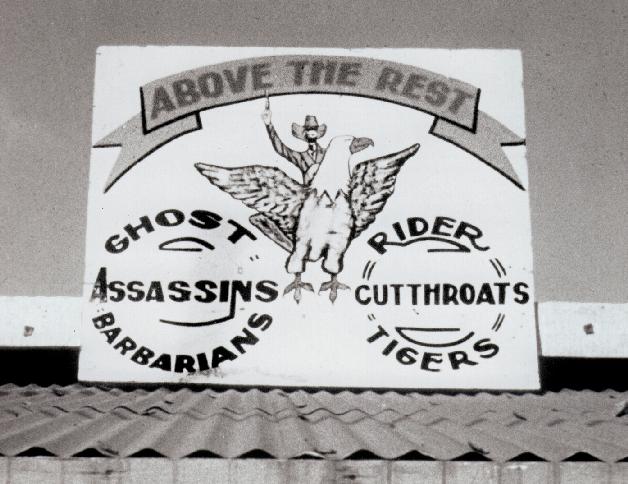
The hand-lettered sign ordered up in September 1967 for Tiger Force’s headquarters near Duc Pho in Quang Ngai by a new battalion commander, Lieutenant Colonel Gerald Morse, set the tone for its activities. “Above the Rest” was the First Battalion’s motto, but the cowboy on the winged horse, symbolizing his radio alias, “Ghost Rider,” and the alarming names for the force’s constituent parts were all Morse’s creations.
In August the First Battalion got a new commander: Lieutenant Colonel Gerald Morse. He was thirty-eight, a decorated veteran of combat in Korea, whose enthusiasm for killing seemed to match his new command. His radio moniker was “Ghost Rider.” After bloody combat between elements of the 101st Airborne and North Vietnamese regulars as part of Operation Wheeler, Tiger Force was about to be sent into Quang Nam Province in the Central Highlands with orders to find and destroy every remaining vestige of the enemy—base camps, supply depots, sympathetic villages. At some point along the way, Morse radioed the battalion, “You’re the 327th Infantry. We want 327 kills.”
The mission was already under way in early October when Private Rion Causey, a medic from Perry, Georgia, joined Tiger Force. He was excited. “I had an uncle that stormed the beach on D-Day,” he remembered, “and I had always dreamed that I could do something like that.”
It was quickly clear that this was to be nothing like D-Day. Tiger Force had recently been caught in a series of ambushes. Five men were killed, and the survivors vowed vengeance. “Everybody was bloodthirsty,” Causey remembered, “saying, We’re going to get them back. We’re going to even the score.” But he still had no idea what that would mean. “A decision had been made by Ghost Rider and by the captain in charge of Tiger Force,” Causey quickly learned, “that in the interest of removing anyone who might grow rice for the NVA, we were to kill all the males between the age of approximately sixteen and sixty.
“It was my first experience of combat. This was getting late into the operation, so as we flared out into a village we were surprised to find seven men. We rounded these people up. And we called back to the captain, Captain [Harold] McGaha, and said, ‘Well, what are we supposed to do with these people?’ And so the CO called back to battalion headquarters and said, ‘Well, we have seven all at one time. What are we supposed to do with them?’ And the word came back, ‘Field expediency. Deal with them as you’re supposed to.’ So we lined the people up against the wall and several of the people in the squad immediately opened fire and killed all seven.”
Causey could not bring himself to fire. He was surprised later to read in Stars and Stripes that only three men had been killed, that weapons had been found proving that they had been Viet Cong, and that Tiger Force was to be commended for the action. That was not what he had witnessed.
“I think when mothers send their sons off to war they anticipate that there’ll be officers who have a sense of dignity, that have a sense of responsibility, of morality,” Causey remembered. “If you’ve lost your best friend and you want revenge, it’s the officers who should say, ‘No, you can’t do that. And if you do it, there are consequences.’ But when the officers—and in this case it included the platoon leader and the battalion commander—are telling you that this is what you’re supposed to do, then it gets completely out of hand. There was a young man, the same age I was, who joined Tiger Force the same time I did. And I was surprised about three weeks into the operation, when we came into a small hooch area, that he came running up to the front saying, ‘It’s my turn. It’s my turn!’ And I knew then that things had just completely gotten out of hand. It was his turn to execute the people.”

The men of Tiger Force photographed at the end of Operation Wheeler. Long after the war, a sergeant refused to answer directly if he had ordered the rounding up and execution of unarmed civilians. “But if I gave the order to kill those people,” he said, “it was to keep my men alive. You don’t have to worry about the dead. You know what I mean? Those farmers were farmers by day and VC at night.” Medic Rion Causey kneels, fourth from left.
Tiger Force moved on. “If I walked into a village and everyone wasn’t lying prostrate on the ground,” one team leader remembered, “I shot those standing up. If they didn’t understand fear, I taught it to them….The way to live is to kill because you don’t have to worry about anyone who is dead.” In one eleven-day period, Tiger Force claimed to have killed forty-nine “VC,” most of them allegedly shot while “running from a hut.” Not a single weapon was captured from any of them, yet no one questioned the unit’s claims or looked into its tactics. At least one member of Tiger Force wore a necklace of dried human ears, cut from the heads of men he had killed.
One afternoon, Causey remembered, a patrol came upon a young man who was found to be carrying separation papers from the ARVN. They were unsure at first what should be done even with someone who clearly had been allied with the Americans. Causey was sitting nearby when a member of the company slipped up behind the man with a knife. The CO had given him permission to “take care of this person,” Causey recalled, and so “right in front of everyone in the platoon,” he seized the man from behind and slit his throat, sawing back and forth until his victim stopped kicking.
In November, Tiger Force fulfilled their battalion commander’s grisly quota—327 dead. No one knows how many more people they killed while in the field—or how many of those killed were unarmed civilians.
Years later, thanks in part to a sergeant named Gary Coy, whose conscience would not allow him to remain silent about what he had heard Tiger Force had done, an Army investigation would find probable cause to try eighteen members of the unit for murder or assault. But no charges were ever brought—“nothing beneficial or constructive could result [from] prosecution at this time,” said the Army brief—and six men, including an officer, were allowed quietly to resign. The official records were buried in the archives.
“I’m sure Ghost Rider thought that he was doing a good job of fighting the war,” Causey remembered. “But what he didn’t realize was what he was doing to the people that were doing it. It absolutely made every one of them a victim too. At the time, it may seem like a normal reaction to simply go out and shoot someone. You don’t have time to think about it. You’re trying to stay alive. But when you get home, either then or ten years, fifteen, twenty years later, it comes back. You can’t get away from it. The death and the fact that you were there and watching, it just comes back, it comes back, it comes back. And people like Ghost Rider, Colonel Morse, should know what they did.”
“They should have all gone to jail,” James Willbanks said. “They were guilty of murder. Period. At the same time, I felt as if that incident, which was an aberration, not the norm, tarred all veterans. There are hundreds of thousands of veterans who went and did their duty as honorably as they possibly could, and they’re tarred with the same brush.”
“One of the things that I learned in the war is that we’re not the top species on the planet because we’re nice,” concluded Karl Marlantes, who would later serve as a Marine first lieutenant in Vietnam. “We are a very aggressive species. It is in us. People talk a lot about how the military turns kids into killing machines. But I’ll always argue that it’s just finishing school. What we do as a civilization is that we learn to inhibit and rope in these aggressive tendencies. But in war we have to recognize them. I worry about a whole country that doesn’t recognize that. Think how many times we get ourselves in scrapes as a nation because we’re always the good guys. Sometimes I think if we thought we weren’t always the good guys, we might actually get into fewer wars.”
TRIAGE
THROUGHOUT THE EARLY FALL, monsoon rains had continued to make life miserable for John Musgrave and the other Marines huddled together at Con Thien. But by November, the worst of the shelling had finally ended and some battered North Vietnamese units had withdrawn northward. MACV credited the American airstrikes, artillery, and Navy shelling with driving them away. Actually, most were pulled back in order to ready themselves for the major offensive, now less than three months away.

John Musgrave’s wallet calendar, given to him by his father’s insurance agent for him to carry in Vietnam. “I marked off each of the days religiously,” he remembered, “and then in October, we went up to Con Thien again and I just stopped marking the days off because I thought: This is pointless. I’m not going to go home. I’m not going to make it home. You know, what’s the point? So I just quit marking them off.”
Still, the North Vietnamese had not all disappeared, and before dawn on November 7, two companies of Musgrave’s outfit were sent half a mile into the countryside northwest of the base to conduct yet another sweep. Calling upon his own disjointed memories and what eyewitnesses told him later, Musgrave painfully reconstructed what happened next: “We got into an area that was old hedgerows grown over with jungle. Very difficult to see very far. In the clear area, three NVA showed themselves and started spraying thirty rounds out of their AKs and then booking. The company commander himself said, ‘I want their bodies. Bring me their bodies.’ Everything’s about body count, right? We said, ‘Man, this is as old as Custer. These guys are showing themselves to draw us into an ambush. Lieutenant, don’t do this, you know. Please, these guys are bait.’ But the skipper says, ‘We’ve got to go. We’ve got to go.’
“And we went. I can’t tell you a whole lot about the ambush. I was one of the first people to be shot. One round put me down. And my grenadier was down. From the first day in boot camp you learn that Marines don’t leave their dead—and they never, never leave their wounded. And that’s why I’m alive today.
“I was lying on my face when the first guy came for me. He reached down and stuck his arms under my shoulders and lifted me up and the machine gun was maybe nine feet—ten feet at the most—away from me. This is a very intimate ambush. It’s a brawl. He fired a burst into my chest that blew me out of the Marine’s arms and then he was shot. Another very brave young Marine—an eighteen-year-old from Louisiana, his first firefight—had seen what happened and still came for me. He reached for me, and he was shot, I think in the forearm. He was lying beside me. I’ve got a hole through my chest big enough to stick your fist through, and I’m dying and I know it. And I heard this horrible screaming going on, and I was trying to figure out who was screaming like that because it sounded so—and then I realized it was me.
“When they began to drag us out, they were being pursued by the North Vietnamese and they would drop us and lay on top of us. They knew we were both dying. The grenadier had been shot in the right side of his chest. They knew we were both dead. But we were still alive. So they weren’t going to leave us. They would die before they left us. They covered us with their bodies and fired back at the NVA and then they’d jump up and drag us a little farther and then drop us and lie back on top of us. I kept telling them to leave me. And I meant it, I meant it. But all of a sudden I got scared that they might really leave me.
“I was triaged three times. The senior corpsman said, ‘He’s either shot through the heart or the lungs. There’s nothing I can do for him.’ He just turned away. I went, ‘Well, okay.’
“Then a helicopter came in. They threw me into the bird. The corpsman on the bird straddled me, stood over me and looked down at me, and then looked up at the door gunner and said, ‘Get him out of the way.’ Because he couldn’t work on me. I was a dead man.

Recuperating from his wounds in an Army hospital at Phu Bai, Musgrave receives his Purple Heart from General Bruno Hochmuth, commanding officer of the Third Marine Division, and General Tru Vuong, commanding officer of the Eleventh ARVN Division. General Hochmuth would die in a helicopter explosion the following year, the first general officer and the first and only Marine Corps division commander to be killed during the war.
“They flew me to Delta Med at Dong Ha. And I thought, Okay, I made it this far. But then this doctor comes over and looks at me and I’m conscious. I’m lucid. He checks a couple of things. I’ve got this huge hole in me. He looks me right in the eye and he says, ‘What’s your religion, Marine?’ And I said, ‘Well, I’m a Protestant.’ He says, “Get a chaplain over here, I can’t help this man.” And then he walked away.
“Another surgeon walks by, and he looked at me, and I was raised always to be nice to people so when he looked at me I smiled at him and nodded. And he said, ‘Why isn’t somebody helping this man?’ And inside I’m going, ‘Yeah, why isn’t somebody helping this man?’
“When they put me to sleep, I thought, ‘Boy, this is really it.’ You know. It was kind of ‘Okay, God. Into your hands I deliver my spirit.’ I thought that was it. So when I woke up in the surgical care intensive care ward, which was a Quonset hut, I thought, ‘Holy mackerel.’ I just couldn’t believe it.”
THE THIRD CIRCLE OF HELL
ALL THROUGH THE FALL OF 1967, the North Vietnamese and NLF forces continued their series of “Border Battles.”
The siege of Con Thien was followed by an assault on the ARVN base at Song Be. The South Vietnamese outpost adjacent to the provincial capital of Loc Ninh was next. There, large units of North Vietnamese and NLF regulars mounted a coordinated attack—and then fought for five days to hold on to the ground they’d gained, something they had never done before. American commanders were puzzled. Later, North Vietnamese commanders claimed they’d been practicing for the urban warfare they knew lay ahead.
Then, in early November, reports reached MACV that five North Vietnamese regiments and one NLF battalion—some seven thousand men in all—had again begun massing in the Central Highlands around the U.S. Special Forces camp at Dak To.
Among the North Vietnamese regulars was Colonel Nguyen Thanh Son, a political officer who had been so eager to fight that he, too, had filled his pockets with rocks to pass his physical. “Our commanders’ strategy was to lure American troops up there to fight,” he remembered, “so we could deplete and destroy them in the Central Highlands.”
As the NVA deployed their troops, Westmoreland sent his to Dak To—exactly what the enemy wanted him to do. Operation MacArthur was named for General Douglas MacArthur, the hero of the Pacific War—who had once warned President Kennedy that American boys should never be asked to fight in the jungles of Southeast Asia.
Among the Americans were the men of the elite 173rd Airborne—Westmoreland’s “Fire Brigade.” First Lieutenant Matthew Harrison was now with Alpha Company of the Second Battalion, the same rifle company that had been ambushed and so badly shattered back in June on the slopes of Hill 1338, just fourteen miles to the east. “We all knew in a general sense that we wouldn’t be brought back if there wasn’t something big going on,” Harrison recalled. “You just knew the area was crawling with North Vietnamese and that they were there not to avoid contact with us, but to have contact with us. This wasn’t like the Viet Cong, where if you could find them, you could kill them. Our problem wasn’t finding them, our problem was what to do with them once you found them.”
The fighting had begun in early November. By the time Harrison’s oufit reached its firebase, U.S. troops—supported by artillery and airpower—had driven the North Vietnamese off two mountains.
But the 174th NVA Regiment was still waiting for the Americans. Nguyen Thanh Son and his men were already dug in on Hill 875, the high ground he and his superiors knew the Americans would want to command. “We got there a month earlier,” Son recalled. “The men were puzzled and asked, ‘The forest is so peaceful and beautiful. Why are we here?’ We told them, ‘Keep working, they’ll come.’ ” The North Vietnamese were hidden within a network of fortified trenches and bunkers heavily reinforced with thick teak logs and ten feet of earth, all linked by tunnels.
On Sunday morning, November 19, 1967, Alpha, Charlie, and Delta Companies were ordered to take Hill 875. Matt Harrison had an infected shrapnel wound in one hand from an earlier fight and was not permitted to accompany his men, but he anxiously followed their progress over the radio.
Heavy artillery and flights of F-100s blasted the hillside ahead of the Americans, meant to knock out enemy positions before the paratroopers ever got within range. “The top of Hill 875 was bald, there were no trees left,” Son remembered. “The Americans destroyed them all. But while the bombs and shells fell, we were safe in our bunkers.”
The three companies began moving warily up the slope—Charlie and Delta in the lead, Alpha bringing up the rear, following the “two up and one back” assault tactic that had worked well in the mostly open European terrain during World Wars I and II but was unsuited to the dense triple-canopy jungles of the Central Highlands. The point men found leaflets in English scattered among the splintered trees. They urged every American soldier to sit down, hold his weapon over his head, and surrender. “You will not be shot,” they promised.
Eventually, the paratroopers stepped warily into a clearing littered with fallen trees from the morning’s bombardment and only a little over three hundred yards from the summit. “As they were scrambling up the hill, we held our fire,” Son remembered. “They made it just five meters from our trenches. When we could see their faces, we yelled, ‘Open fire!’ ”
Several men fell. The others ran to the right and left and stumbled into minefields. The rest fell back. Thousands of automatic weapon rounds ripped through the air. Chinese-made grenades came rolling and bumping down the slopes. The Americans sought what cover they could find behind fallen trees. Some scrabbled at the earth with their helmets, trying to dig fighting holes.

Using shattered trees for cover, paratroopers of the 173rd Infantry Division struggle up the slope of Hill 875 in the face of fire from enemy bunkers. “The Americans made a mistake when deciding to come to that hill, which didn’t have any military and economic value,” North Vietnamese Colonel Nguyen Thanh Son told an American interviewer after the war. “We tried to lure you to the hill, and we succeeded. You came. Your first assault was unsuccessful. Why did you carry out the following assaults?”
Charlie and Delta Companies were pinned down and being torn to pieces.
Meanwhile, near the foot of the hill, other North Vietnamese troops surprised Alpha Company from behind. They were first spotted moving up through the trees by a private from the Bronx named Carlos Lozada. As the men of his company scrambled up the slope, dragging their wounded with them, Lozada provided what cover he could, firing his M60 machine gun from his hip—until a bullet hit him in the head. He would be awarded a posthumous Medal of Honor.
“By early afternoon,” Harrison remembered, “the three companies had basically been decapitated. The company commanders were dead; most of the officers and most of the NCOs were dead.” The survivors from all three companies clustered in the clearing and did their best to set up a defensive circle. At its center was an aid station where officers and NCOs were bunched up, surrounded by wounded men.

After four straight days of combat, exhausted men of the 173rd slump atop an abandoned North Vietnamese bunker on the summit of Hill 875, Thanksgiving Day, November 23, 1967.
Enemy mortars and snipers hidden in the trees took a steady toll. The huddled men called in artillery and air support. U.S. artillery routinely hit within fifty feet of them—and sometimes closer. “The napalm engulfed our trenches and burned like a dragon,” Son recalled. “Most of our position was completely burned out. I was burned myself. My face, nose, hands, and feet were on fire. I became a torch. I was running around. My soldiers threw dirt on me to smother the flames.”
American bombs and napalm continued to pound enemy positions until it grew almost too dark to see.
A full moon rose.
Then, at 6:58, an American fighter bomber roared in from the northeast—the opposite direction from which earlier air support had come.
Two five-hundred-pound bombs fell from beneath its wings. One landed among the hidden enemy troops.
But the other fell directly onto the American aid station. In a fraction of a second, forty-two men were blown apart. Forty-five more were hideously wounded. A badly hit lieutenant from Alpha Company named Tom Remington crawled among the corpses and the screaming, moaning wounded men until he found a working radio. “No more fucking planes,” he shouted into it. “You’re killing us up here.”
The fighting and the horror on the hillside continued all the next day—some of the most furious combat since the Ia Drang Valley battles two years earlier. The men ran out of water. The ammunition supply ran dangerously low. Helicopters that tried to ferry in supplies were shot down.
Matt Harrison was not able to chopper in to take command of what was left of Alpha Company until late that afternoon. Snipers were still picking off Americans. North Vietnamese mortar crews crouched so close the men could hear rounds leaving the tubes. “Just after I got in there,” Harrison remembered, he came across “one of my platoon leaders—a great young lieutenant named Tom Remington. Despite the fact he’d already been shot twice he’d kept pushing on and was shot twice more. He was lying there beside the trail when I got in. And he just croaked at me, ‘Matt, do you have some water? My canteen’s been dry for two days.’ I gave Tom some water and moved on.
“It was chaos—collections of guys who had tunneled and dug down behind trees. It was not a real defensive position. And these were guys who had gone without water in that heat for two days, had gone with very limited resupply of food and ammunition. And almost every one of them was wounded. And all around were bodies. Guys who had been shot and blown up. It was the third circle of hell.
“Once we got the situation stabilized I was determined I was going to find every one of my guys. Nobody was going to be left behind. There were guys that I never found because they had essentially been completely blown apart. I had a copy of the company roster in my pocket. I found the living guys quickly. I would find the dead guys and check them off on my roster. I remember there was one really good sergeant. I couldn’t find him and I couldn’t find him. And finally I found a pair of legs. He was still wearing his fatigue pants. I pulled the wallet out from his pocket, so I knew that that was my NCO. The rest of him had been pulverized. There were two or three guys I was just never able to find a body for.”
On Thursday, two fresh battalions of the 173rd finally made it to the top of the hill for which so many had died. But the night before, the surviving North Vietnamese troops had slipped down the other side and disappeared into Cambodia and Laos.
Harrison remembered that “the powers that be decided it would be important to our morale for us to be in on the taking of the top of the hill. I had twenty-six guys left out of a company that started out at a hundred and forty, and all twenty-six had been wounded.” He and those of his men who were still mobile dutifully dragged themselves up the slope. Reporters and camera crews descended on the battlefield. A reporter asked a survivor what had happened. “What the fuck do you think happened?” the paratrooper answered. “We got shot to pieces. Make that ‘little pieces.’ ” One hundred and seven Americans had died taking Hill 875; another 282 were wounded. Ten more were missing. The number of North Vietnamese casualties is unknown, but their losses are thought to have been staggering.
Harrison and his exhausted men spent no more than half an hour on the hilltop, “just trying to gather ourselves,” he remembered, before they were helicoptered to the top of yet another hill.
It was Thanksgiving. Chinook helicopters clattered down out of the sky, carrying huge containers of hot turkey and mashed potatoes and cranberry sauce so that the 173rd could have their Thanksgiving dinner. As they ate, a TV news crew set up for a holiday spot, using them as a backdrop. “I was really angry,” Matt Harrison recalled. “It was as though we were entertainers.”
Back in June, Harrison had lost two West Point classmates on Hill 1338. He lost two more on Hill 875. Of the eight with whom he had served in the Second Battalion, four were now dead and two had been wounded. “To take tops of mountains in a triple-canopy jungle along the Cambodian-Laotian border accomplished nothing of any importance,” he remembered. “The battle for Hill 875 was a microcosm of what we were doing and what went wrong in Vietnam. There was no reason to take that hill. And I doubt that there’s been an American on Hill 875 since November 23. We accomplished nothing.”
POOLAW
At Fort Still, Oklahoma, on November 17, 1967, friends and family of a fallen soldier gather for a funeral—one of five military funerals held there that month. First Sergeant Pascal Cleatus Poolaw Sr. had been killed as he tried to drag one of his wounded men off the battlefield near the village of Loc Ninh.
He was a remarkable soldier, and was awarded forty-two medals, including one Silver Star in World War II, two more in Korea, and a fourth, posthumously, for his gallantry in Vietnam. He was also a Kiowa. He and three of his sons were among the 42,000 Native Americans who would serve in Vietnam, the highest per capita service rate of any ethnic group in the United States. Sergeant Poolaw’s widow spoke at the ceremony. “He has followed the trail of the great chiefs,” she said. “His people hold him in honor and highest esteem. He has given his life for the people and the country he loved so much.”

Kiowa dance, held at Carnegie, Oklahoma, in honor of Sergeant Poolaw upon his return from the Korean War in 1952

Sergeant Poolaw’s funeral at Fort Sill. His widow is at the left, next to her three sons.
THE END BEGINS TO COME INTO VIEW
IN THE WEEKS leading up to the battle on Hill 875, fearful that public support for a prolonged war was slipping away, the Johnson administration had been waging what one national security advisor called a “multimedia public-relations campaign…to persuade the American public that the war was being won.” In a July cable to the Joint Chiefs, General Westmoreland had proposed a coordinated administration-wide effort to persuade Americans that all the talk of “stalemate” was nonsense, that the United States was winning the war. It should all be organized quietly, he wrote, “to avoid charges that the military establishment is conducting an organized propaganda campaign, either overt or covert.”
Robert McNamara did not take part. Instead, he sent the president another eyes-only memorandum. To the public, the defense secretary was so closely identified with the Vietnam conflict that it was sometimes called “McNamara’s War.” But he himself had grown increasingly disillusioned with it—so disillusioned and so anguished that the president and others within the administration feared he might collapse, might even kill himself.
McNamara made the strongest case he could. “Continuation of our present course of action in Southeast Asia would be dangerous, costly in lives, and unsatisfactory to the American people,” he wrote in a cover note to the memorandum. There was no longer any reason to believe that the prolonged “infliction of grievous casualties, or the heavy punishment of air bombardment, will suffice to break the will of the North Vietnamese and Viet Cong,” he told the president. Instead, he said, the United States should cap troop levels, curtail ground operations to lessen the damage being done to South Vietnam, and declare a “unilateral and indefinite halt to the bombing of North Vietnam in order to bring about negotiation.”
Johnson never responded. McNamara had already angered him by testifying before a Senate committee that, in his view, no bombing that had already taken place nor any he could foresee in the future would “significantly reduce the…flow of men and materiel to the South.” Later that month—and without giving McNamara advance warning—the president would announce that his defense secretary was leaving the administration on March 1, 1968, to become head of the World Bank. Robert Kennedy, a friend and former colleague of McNamara’s, rushed to his office and urged him to make public his opposition to continuing the war and go out “with a hell of a bang.” McNamara would not do it. Although he had harbored doubts about the conflict since the first U.S. Marines landed in Vietnam in 1965, he would keep silent about those doubts for thirty-one years. His successor as defense secretary would be Clark Clifford, a prominent Washington lawyer and trusted counselor to Democratic presidents, whom Johnson assumed would be more supportive of the war.
Meanwhile, Johnson had asked the Wise Men to reconvene at the White House to assess the war and how it was being waged. After two days of discussion, they concluded that the ground war was still worthwhile, that the bombing of the North should be continued, that there was no point in calling for peace talks since the communists would never seriously negotiate, and that under no circumstances should the United States withdraw. In order to rally greater support for the war, they urged the administration to find “ways of guiding the press” to hopeful conclusions about prospects for victory.
The president started the ball rolling, ordering the embassy in Saigon to discover and publicize “sound evidence of progress,” and it dutifully fell in line, again praising the recent elections, claiming that security in the countryside was improving, that ARVN morale was on the rise.

General Westmoreland reports to the White House, April 27, 1967. Left to right: Special Assistant for National Security Affairs Walt Rostow; Westmoreland; Under Secretary of State Nicholas Katzenbach; Secretary of State Dean Rusk; President Johnson; Deputy Secretary of Defense Cyrus Vance; and Chairman of the Joint Chiefs of Staff General Earle G. Wheeler.
Vice President Humphrey was dispatched to the Today show to assure viewers that “we are beginning to win this struggle. We are on the offensive. Territory is being gained. We are making steady progress.”
On the CBS Sunday morning program Face the Nation, Ambassador Bunker employed a metaphor first used thirteen years earlier by the French commander in Vietnam, not long before France’s great defeat at Dien Bien Phu.
ELLSWORTH BUNKER: I think we’re now beginning to see light at the end of the tunnel.
BERT QUINT: Mr. Ambassador, you talk about light at the end of the tunnel. How long is this tunnel?
BUNKER: Well, I don’t think that you can put it into any particular time frame.
General Westmoreland himself was summoned home again to assure the National Press Club that the enemy was now “unable to mount a major offensive….I am absolutely certain that whereas in 1965 the enemy was winning, today he is certainly losing….A new phase is now starting. We have reached an important point when the end begins to come into view.” The recent battles around Dak To—including the struggle for Hill 875—constituted the “beginning of a great defeat for the enemy.” He also told reporters that the impressive body counts his commanders reported were “very, very conservative”; the figures probably represented, he said, “50 percent or even less of the enemy that has been killed.”
As if to prove it, MACV released a new and surprisingly low estimate of enemy forces to show how much damage the United States had done to them. It was only two-thirds of the total suggested by the CIA, in part because, after a bitter and prolonged debate behind the scenes, General Westmoreland had chosen to exclude from it the part-time guerrillas—farmers, old men, women, even children—who helped place mines, grenades, and booby traps that accounted for many American casualties.
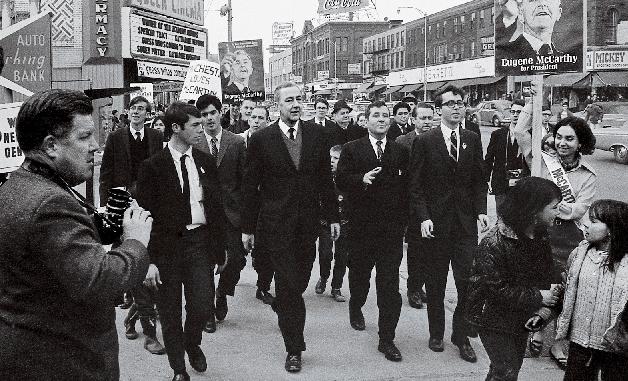
Minnesota senator Eugene McCarthy (center) and some of the well-dressed student followers who got “clean for Gene” campaign in downtown Manchester during the New Hampshire primary. “We’re involved in what has become a major war,” McCarthy told the voters. “The fact is there’s no economic justification…for the continuation of the war. There certainly is no diplomatic justification for it. It’s not militarily defensible, as we can see in the evidence being presented to us every day. And in my judgment, it has long since passed the point [at] which it can be morally justified.”
Robert Komer, the head of CORDS, chimed in too. All trends in pacification were “significantly upward,” he said: two-thirds of South Vietnam’s people now lived in “secure” areas; there’d been a bountiful rice harvest; the growing number of tractors at work in the fields and motor scooters plying the roads were evidence that life in the countryside was steadily improving.
For the moment, the administration’s PR offensive seemed to succeed. A Harris poll taken that winter showed that the American people, by a margin of 63 percent to 37 percent, now favored escalating the war rather than limiting it; the previous summer a majority had preferred deescalation. Lou Harris thought there were three reasons for the change: the tactics of the antiwar movement; the failure of the war’s opponents to offer a persuasive alternative; and the optimistic reassurance offered by Humphrey, Bunker, Westmoreland, Komer, and others.
Meanwhile, Allard Lowenstein’s yearlong search for a Democratic challenger to the president had finally succeeded. On November 30, 1967, Minnesota senator Eugene McCarthy announced that he would enter the New Hampshire Democratic primary and try to unseat the president of his own party. “There are some things that are just so wrong you have to take a stand,” McCarthy said, “no matter what.”
LIVING IS THE DIFFICULT THING
CAPTAIN HAL KUSHNER was twenty-six years old and married when he arrived in Vietnam that fall, the father of a three-year-old girl with another baby on the way. A recent graduate of medical school, he had volunteered to serve as a flight surgeon with the First Squadron, Ninth Cavalry—the “tip of the spear” for the First Air Cavalry.
Every few days, he tape-recorded his impressions for his family back home. Kushner complained about living conditions at Landing Zone Two Bits, in the center of the Bong Son Plain, worried he hadn’t been adequately trained to carry out the investigation of aviation accidents that was part of his new job, wished he was allowed to tend to the most seriously wounded men who were helicoptered out to bigger hospitals in the rear—and was initially appalled by the people whose independence he believed he was helping to defend. “Went downtown today—they call it a town—to get a haircut. The town consists of a bunch of filthy hovels. Just couldn’t believe how the people live. These little kids running around begging, and they’re about the same age as Toni-Jean. It just makes me want to vomit. Everything is dirty, filthy. There’s no sewage. There’s no sanitation. There’s nothing. People defecate right in the middle of the street. It’s just very, very depressing….

Captain Hal Kushner before setting out for Vietnam
“I don’t know if the country’s worth saving or not. I’m sure that if we do anything for them it’ll have to be long range. I mean a hundred to a hundred and fifty years because apparently the French didn’t do anything with them when they were here. And it’s really going to take at least two or three generations to raise their standards and their levels of intelligence, their understanding of sanitation and preventive medicine and politics and everything up to an acceptable American standard, if we want to help this country.”
On November 30, the same day Eugene McCarthy an-nounced that he was going to challenge the sitting president, Kushner flew to the air base at Chu Lai to deliver a lecture on the dangers of night flying. Afterward, he planned to head right back to his outfit. He never got there. “We had terrible weather that night. I asked the aircraft commander, Major Steve Porcella, who was from Massachusetts, if I could make a call to my family on the MARS station. There were people waiting in line. You had to wait in line for an hour or so and then you could talk for two minutes. He said, ‘No. We can’t. We have to get the airplane back.’ I said, ‘The weather is so bad.’ There was wind and rain. ‘Why don’t we wait out the weather and go back in the morning,’ Steve said. ‘Our mission is not so important. But we have to get the airplane back for operations tomorrow.’ I’ll never forget the dedication of that very brave young officer.
“It was dark and rainy and windy. Aboard were Major Porcella and myself, Warrant Officer Gifford Bedworth from Connecticut, the co-pilot, and the crew chief, who was a Sergeant McKee, whom I didn’t know well. As we were flying, I saw that we had drifted west of Highway 1 because I could see trucks. I knew that was wrong. So Steve called Duc Pho on the radio and he said, ‘I think we’re lost.’ ”
The helicopter slammed into a jungle-covered mountainside.
“The next thing I knew I was hanging upside down in a burning helicopter. I remember yelling, ‘Is anyone alive? Is anyone alive?’ I heard some groaning and I couldn’t tell where it was from. At first, I couldn’t unbuckle my seatbelt because I couldn’t move my left arm. When I managed to unbuckle myself I fell out of the helicopter and almost broke my neck. I didn’t realize that I’d been hanging upside down. I was completely disoriented.
“In the firelight I could see that Porcella was dead, jammed up against the console. He was kind of crushed. I just jumped away from the helicopter and it didn’t explode but it just went shwoosh and burned up. There was an M60 machine gun on the helicopter and the rounds were cooking off and it was exploding. One or several of the rounds went through my left shoulder. I could feel that. And I knew that my face had been cut and I knew that I had broken some teeth. I ran my tongue over my teeth.
“From the ground, I saw Warrant Officer Bedworth, who was still in his seat. The whole seat had come through the chin bubble of the aircraft. He had a broken tibia and fibula. The bones were sticking through the nylon of his jungle boot. He was conscious. And he was hurt very badly. Very brave. I took some branches and splinted his legs with his Army belt.
“So I just sat there with Warrant Officer Bedworth. I assessed my own wounds. I had some burns on my buttocks and burns on my back. I had a broken left wrist; a broken collarbone; and a bullet wound in my shoulder from the cooked-off rounds. I had lost seven teeth. I had no glasses. We had no first aid kit; no flares; no nothing. Everything had burned up in the airplane. We had no food or water.

Hal Kushner visits a village near Landing Zone Two Bits.
“That was the situation. So the rule is you wait with the aircraft until you get rescued. We waited one day. We waited two days. And poor Bedworth was in pain. On the morning of the third day he died, he just slipped away. It was very, very sad.
“I had to decide whether or not to stay with the helicopter. I had no idea whether it was going to keep raining. I had no idea where the enemy was. I thought that my best choice was to leave the aircraft and try to go down the mountain. So I used my Army belt to tie my left arm to my body. (That’s the way you treat a fractured collarbone.) And I tried to make my way down the mountain.”
It took Kushner four hours to stagger down the slope. When he finally reached level ground he looked back up—and saw two American helicopters hovering above the crash site. Their pilots did not see him. He was too exhausted and in too much pain to scramble back up the slope in hopes of catching their eye. “I just didn’t think I could make it. So I kept going. I saw this peasant working in a rice paddy. And he saw me. I had captain’s bars and a caduceus, the medical symbol, on my collar. And he said, ‘Dai uy bac si. Dai uy bac si.’ ‘Captain, doctor.’ He took me about another mile to a little hooch, and he sat me down on the front of it and he brought out a can of condensed milk and a plastic C ration spoon. It was the first thing I had had to eat but rainwater for three days. I opened the can and it was just the best stuff I’ve ever eaten in my whole life.
“Then, I heard another person say, ‘Dai uy bac si. Dai uy bac si.’ There was a squad of Viet Cong. The squad leader said, ‘Surrender, no kill,’ and he put his arms up. And I put my right arm up. The left one was still tied to my side. I think he was more nervous than I was, and he shot me with an M2 carbine, right where the M60 had shot me. It went right through my neck and came out the back. It just knocked me over. They went through my wallet and the squadron leader took my Geneva Convention Card, which was white with a red cross. He tore it up and he said in English, ‘No POW. Criminal. Criminal.’
“I thought that I would receive different treatment because I’d seen all these war movies where doctors had hospitals and treated their own patients and had instruments and got Red Cross packages. My father had given me a medallion before I left—a Star of David on one side and St. Christopher’s medal on the other. The squad leader tore that off and he took my dogtags and my watch. I had a wedding ring and he tried to take that too. I fought for the wedding ring. He made a motion like he was going to cut my finger off if I didn’t give it to him. But he finally let me keep it.
“So then they took my boots and we started marching. I was weak and I was sick and I was hurting and I was burned. It was bad. And they took me to this little village. The squad leader told me that the American airplanes had bombed this village, and there’d been many people killed there. The people came out and they tied me to a big block of wood, like a door. And this kid, a teenager, beat me with a bamboo stick.
“We stayed that night in that village. They fed me. And then we walked for a month, almost always at night. I was barefoot and my feet were just lacerated. I had maggots infesting my wounds. I had a fever. I was really sick. We kept going always higher in the mountains. I was weak and I asked to stop a lot. And most of the time they didn’t let me stop. I didn’t think I could possibly survive, I just didn’t think I could. And I didn’t care.”
Hal Kushner and his captors kept walking deeper and deeper into the Central Highlands, moving at night so as not to be spotted from the air. Once, he was taken to what he took to be a hospital. “It was just a series of caves but there were a lot of wounded lying around in hammocks. This female nurse came out and inspected my wounds. She laid me down and she gave me this bamboo stick to bite on. Then she took a rifle-cleaning rod and she heated it up in a fire until it was red hot. I was watching this and I was thinking, ‘Oh my God. What are they going to do with this?’ I didn’t know whether they were going to blind me with it or what. She put it through my wound, through and through. And it really hurt. It really, really, really hurt. And then she put Mercurochrome on the wound. And she gave me an aspirin tablet. I thought, ‘What else can they do to me?’ And I was to find out.”
Kushner spent the daylight hours at a series of way stations, a day’s march apart. “We stopped at this one place and this old man came out and he took my fatigue jacket. And I thought he wanted it. I kind of resisted him taking it. But he just pulled it away from me. And he went over and he washed it in the river and dried it. He dried it over a fire. And he brought it back to me. It was such an act of kindness that I get emotional thinking about it because it was just an island of kindness in this sea of cruelty.”
At another way station, Kushner met a North Vietnamese army officer who spoke English. “He had a little reel-to-reel battery-powered tape recorder. And he asked me to record a message to my family to let them know that I was safe. He said I could do that if I would make a statement against the war. And I told him with great bravado that I would rather die than make a statement against my country. And he said to me, ‘You will find dying is very easy. Living is the difficult thing.’ And those were probably the most profound words I had ever heard in my whole life, although I didn’t realize it at the time.”
Kushner and his captors kept going. It was raining heavily now. The jungle paths were slippery, the rocky hillsides so steep Kushner had to be pulled along by a rope. Finally, he was led up another hill and saw the outline of several huts hidden among some trees. At first, he thought it was another way station. But it turned out to be Prison Camp One, the first of six camps hidden in the Central Highlands of South Vietnam that he would survive over the course of the next five years.
“I expected to see a camp, to see Stalag 17, to see Hogan’s Heroes—barbed wire, searchlights, guards up in guard towers, a camp commander, Red Cross packages, maybe a hospital where I could see some prisoners. What I saw was a little clearing by a little muddy creek, a group of hooches, and four of the worst-looking Americans I have ever seen in my life. Their hair was matted. Their teeth were black. They had no shoes. The guards tore the rank off my uniform. They said that there would be no rank structure in this camp. Everybody is equal. I was not a doctor. I was the latrine orderly.”
WE’RE NOT GOING TO SHIMMY
AT YEAR’S END, public opinion polls delivered a distinctly mixed message for the White House: while most Americans still disapproved of the president’s handling of the war, more than 60 percent favored further escalation over reducing America’s effort.
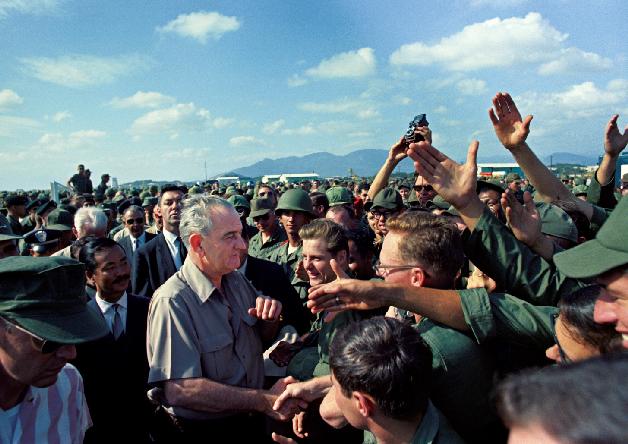
President Johnson surrounded by U.S. military personnel at Cam Ranh Bay, December 23, 1967. Behind him is Vice President Ky. “Please know that we are with you,” Johnson told his listeners. “We are for you. We will be there until the end.”
In December, President Johnson flew to Australia to attend memorial services for Prime Minister Harold Holt, who had won Johnson’s personal loyalty by supporting the American effort in Vietnam when his countrymen were deeply divided about the war in which their sons were dying alongside American boys. President Thieu attended the services too, and Johnson took the occasion to urge him to begin informal talks with representatives of the NLF, hoping that it might somehow be persuaded to separate itself from Hanoi. Thieu publicly refused; so long as they were intent on toppling his government, he said, he would never sit down with them.
On his way home, Johnson stopped over at Cam Ranh Bay. “The enemy is not beaten,” he told thousands of servicemen gathered to hear him, “but he knows that he has met his master in the field….We’re not going to yield. And we’re not going to shimmy.” He also surprised General Westmoreland with the Distinguished Service Medal and credited him with having brought South Vietnam “from the valleys and depths of dependence to the cliffs and heights where we know now that the enemy can never win.”
With nearly half a million troops in Vietnam—and despite the deaths of more than 11,363 Americans during the year—Westmoreland remained convinced that he was grinding the enemy down. The recent Border Battles had all been American triumphs, he argued, since thousands of enemy troops had been killed. Now it was time, he said, for an “all-out offensive on all fronts”—political, military, economic, and psychological. But the enemy was just a month away from launching an all-out offensive of its own.