
Introduction
This book in the popular Images of War series covers the deeds of the Waffen-SS from its inception in the 1930s to war in the Low Countries, France, the Balkans, Yugoslavia, Greece, Italy and finally on the Western Front in 1944; and to the defence of the bombed and blasted ruins of the Reich during the last weeks and months of the war in 1945. This is a comprehensive illustrated study of the Waffen-SS in action and features action photographs of such famous divisions as the Leibstandarte Adolf Hitler, Das Reich, Totenkopf and a number of rare shots of the Polizei Division in action in all theatres of operations.
About the Author
Ian Baxter is a military historian who specializes in German twentieth-century military history. He has written more than forty books including ‘Wolf’: Hitler’s Wartime Headquarters, Poland – The Eighteen-Day Victory March, Panzers In North Africa, The Ardennes Offensive, The Western Campaign, The 12th SS.Panzer-Division Hitlerjugend, The Waffen-SS on the Western Front, The Waffen-SS on the Eastern Front, The Red Army At Stalingrad, Elite German Forces of World War II, Armoured Warfare, German Tanks of War, Blitzkrieg, Panzer-Divisions At War, Hitler’s Panzers, Panzer Markings of World War Two, German Armoured Vehicles of World War Two, German Guns of the Third Reich and most recently The Last Two Years of the Waffen-SS At War, SS of Treblinka, Höss – creator of Auschwitz, Auschwitz Death Camp, Battle of the Baltics, Battle for the Reich, Last Years of the German Army and Concentration Camp Guards. He has also written over 100 articles including ‘Last Days of Hitler’, ‘Wolf’s Lair’, ‘Story of the V1 and V2 Rocket Programme’, ‘Secret Aircraft of World War Two’, ‘Rommel At Tobruk’, ‘Hitler’s War with his Generals’, ‘Secret British Plans to Assassinate Hitler’, ‘SS At Arnhem’, ‘Hitlerjugend’, ‘Battle Of Caen 1944’, ‘Gebirgsjager at War’, ‘Panzer Crews’, ‘Hitlerjugend Guerrillas’, ‘Last Battles in the East’, ‘Battle of Berlin’, ‘Destruction of Busse’s Ninth Army’ and many more. He has reviewed numerous military studies for publication and supplied thousands of photographs and important documents to various publishers and film production companies worldwide.
Chapter One
Between 1933 and 1939 the power of the SS grew considerably with thousands of men being recruited into the new ideological elite armed formation under the command of Heinrich Himmler. All early recruits were expected to meet very stringent criteria. Every volunteer had to be fit, have excellent racial criteria and produce a certificate of good behaviour from the police. During their tough training programme new recruits were indoctrinated with an almost fanatical determination to fight for the Fuhrer, even if it meant risking life and limb on the battlefield. Each recruit then left, displaying blind allegiance and joined one of the newly-created armed SS divisions where he would obey every order, even if it meant shooting prisoners and committing atrocities against civilians.
The initial training was carried out in various depots outside each SS Verfügungstruppe (SS Replacement Troop) regiment’s home town. The training programme was very tough and demanding. Out on the rifle ranges the recruits became used to their weapons, and once familiar they were taught infantry assault techniques that included charging at sandbags with fixed bayonets. Every instructor placed great emphasis on aggression on the battlefield, with an ardent determination to win at all costs. It was believed that this kind of training enhanced every recruit and instilled in them the drive to overcome their enemy through fighting skill and sustained physical endurance. Every candidate was pushed to the limits of tolerance. They were constantly sent on long marches with or without their kit, in order to develop stamina and endurance.
At least three times a week the trainees had to endure formal lectures covering policies of the Nazi Party, which included a very in-depth indoctrination in SS philosophy. The men were all ordered to follow Heinrich Himmler’s demand for blind and absolute obedience and learnt to treat those who were against the Reich with fanatical hatred. This included Jews, gypsies, homosexuals, the political Left and any other groups deemed to be inferior beings. By perpetually drilling the recruits to hate, they were able to infuse them with pitiless contempt and to not think twice about meting out severe punishments. The training in Nazi ideology was relentless. Not only did they learn about enemies of the state but were also indoctrinated into SS philosophy regarding racial superiority. These ideological teachings were aimed at producing men who ardently believed in the new Aryan Order. Regularly they had to attend lectures ful of anti-Semitism. On the bulletin boards inside the SS barracks and canteen there were often copies of the racist newspaper Der Stürmer. Such propaganda material was routinely circulated in order to ferment hatred and violence. As a result many of the new recruits became easily susceptible to anti-Semitic doctrine, especially the younger men.
In this manner, the SS was filled with men fully indoctrinated into fighting for their Fuhrer, regardless of their own fate. With anti-Semitism ingrained in their minds, every candidate would be willing to obey any order, even those involving the killing of prisoners and atrocities against civilians. Such was the strength of feeling manufactured against those who did not conform to the Aryan ideal.
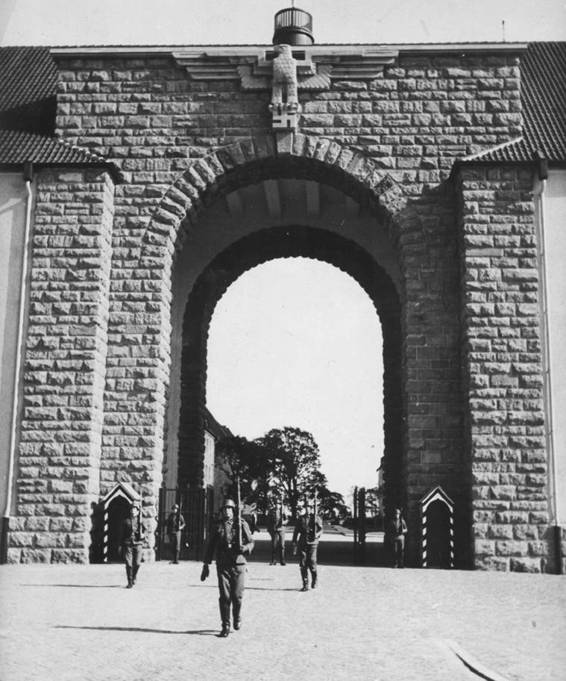
At an SS training barracks in 1939. These troops are from the newly-created regiment known as Germania. In October 1939 the Deutschland, Germania and Der Führer regiments were organized into the SS-Verfügungs Division. These would soon form part of the infamous Das Reich Division.
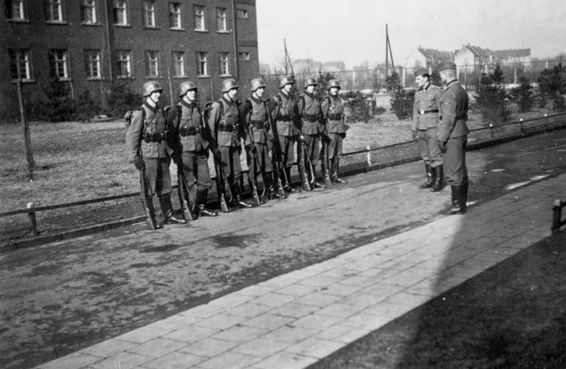
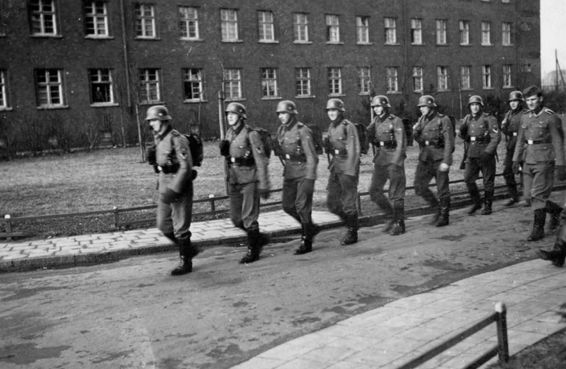

Three photographs at an unidentified barracks: these SS troops are training, during which every trainee was pushed to the very limits of his endurance. These men were constantly sent on long foot marches with or without full kit, in order to develop stamina and endurance.
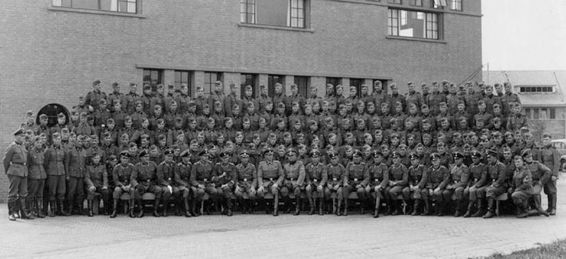
A group photograph of the SS at a training barracks with their commanding officers. In the early stages of SS recruitment every new volunteer had to conform to excellent racial features and produce a certificate of good behaviour from the police. Although the recruitment programme for the volunteers was very selective, the training was equally tough.
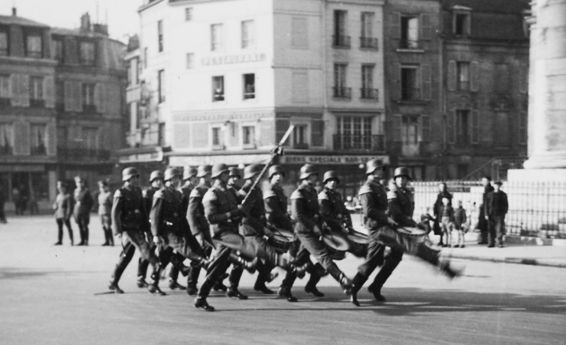
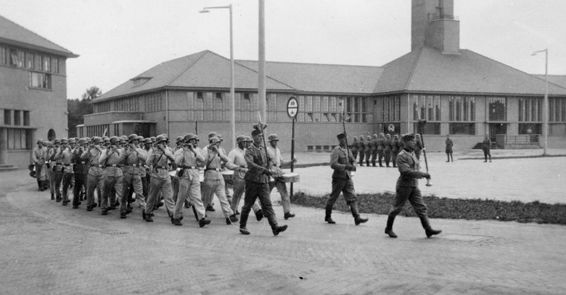
Two photographs showing an SS military procession: one shows them playing while at their home station in Germany; in the other the troops can be seen in a town. As a walking-out dress this uniform proved to be impressive when on parade but was not practical for field use or other utility purposes. Note the grey-white cotton drill uniform being worn by the soldiers at the barracks. This was produced in the summer of 1933 for training purposes for the Heer and later the Waffen-SS as well.

A photograph taken in the winter of 1939 showing the commanding officer inspecting the men of the SS Totenkopf (Death’s Head) Division. This division was formed in October 1939, initially from concentration camp guards of the 1st (Oberbayern), 2nd (Brandenburg) and 3rd (Thuringen) Standarten regiments of the SS-Totenkopfverbände and soldiers from the SS-Heimwehr Danzig. The division was commanded by the fanatical SS-Obergruppenführer Theodor Eicke and prior to it achieving division status, the formation was known as Kampfgruppe (battle group) Eicke.
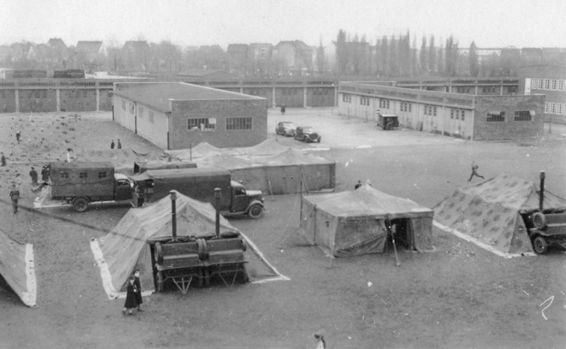
A photograph showing an SS Totenkopf barracks. The period of enlistment in the original Totenkopf was initially four years. However, by 1938 this had trebled to twelve years. Before joining, all recruits served as conscripts in the armed services. Although this was intended to give them basic military training, not all recruits were very happy undergoing another spell of military service once they had completed their national service. It was not until May 1939 that Hitler finally directed that serving in the Totenkopf would count as compulsory military service.
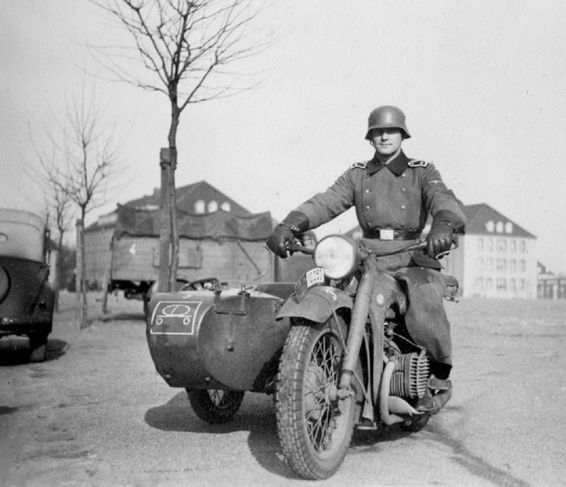
A motorcyclist with his motorcycle combination. Initially motorcyclists were often part of a reconnaissance battalion that comprised a battalion staff, motorcycle company and heavy company. However, as the war continued many of the motorcyclists were used for dispatch purposes to various sections of the front and because motorcycles were regarded as versatile machines it enabled them to move swiftly across terrain with important information. The marking on the sidecar denotes a Commissariat unit – in this specific case, that of a motorized bakery unit.

Members of the Totenkopf during training with their commanding officer. The officer wears the standard army greatcoat and field cap with the infamous death’s head badge that soon symbolized the Totenkopf Division on the battlefield of both Western and Eastern Fronts.
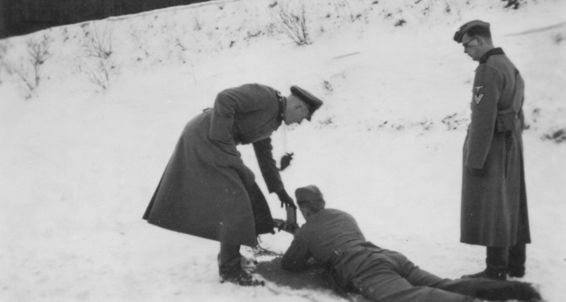
A Totenkopf commanding officer checks the magazine of one of his trainees as he is put through firing practice in the snow. The weapon is the ancestor of the British BREN gun, the ex-Czechoslovakian Army ZB vz 26 or 30 light machine gun, which all fell into German hands with the annexation of Bohemia-Moravia. The ZB vz 26 and ZB vz 30 were both very expensive to produce but gave good service; they are extremely difficult to differentiate externally.
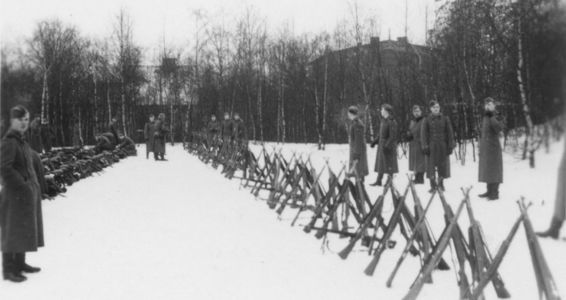
A group of Totenkopf troops at a concentration camp. Most of these soldiers were initially taken from the concentration camp system and then recruited into the Waffen-SS for military service. By the time these men fought on the battlefield most were already physiologically hardened and imbued with fanatical hatred, both against political opponents of the Reich and those regarded as racially impure. These men were ideal candidates to wreak often terrible crimes both on and off the battlefield.
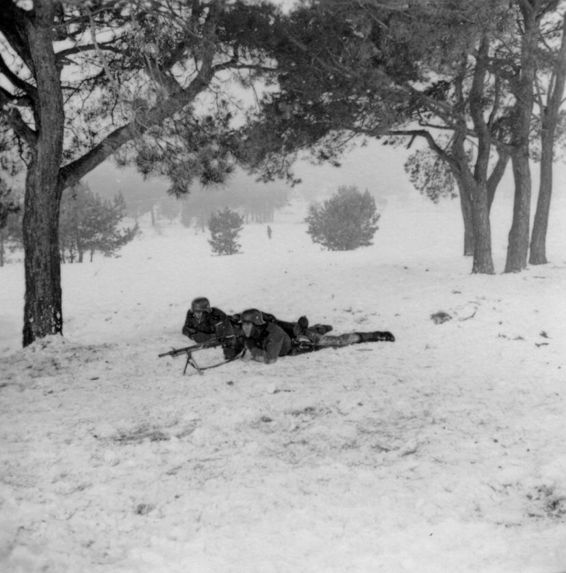
A Totenkopf machine-gun crew in the snow during a training exercise. Once these men were familiar with their weapons they were taught infantry assault techniques that included charging positions with live ammunition. The SS were taught that ‘the only form of defence on the battlefield is to attack’. Such aggressive training led to inevitable fatalities but the SS were firm believers in the ‘train hard, fight easy’ school of thought. The training also made the average SS man much more inclined to lay down his life for the Fuhrer.

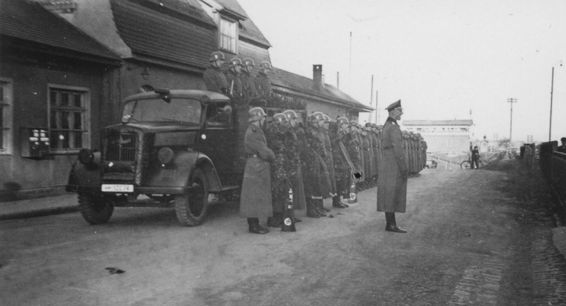
The following sequence of photographs shows a full military ceremony in honour of a Totenkopf soldier who had been fatally injured. The national flag has been draped over the coffin and the soldier’s M1935 steel helmet displaying the SS insignia on the side has been placed in traditional style on top of the coffin as a mark of respect.
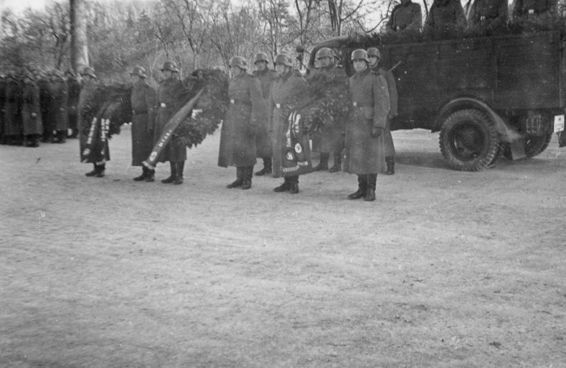
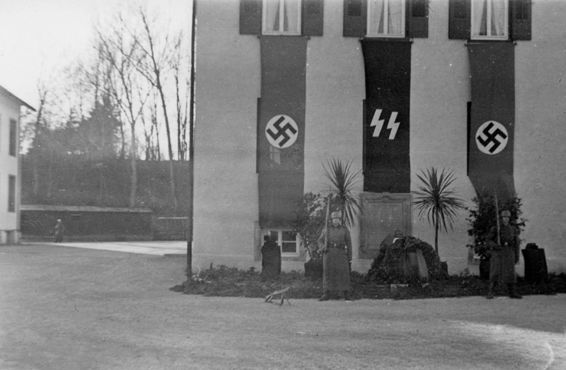
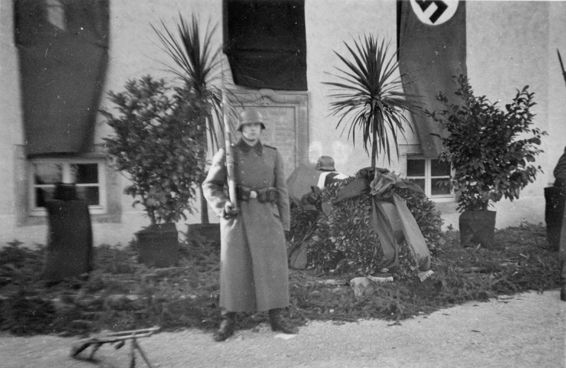
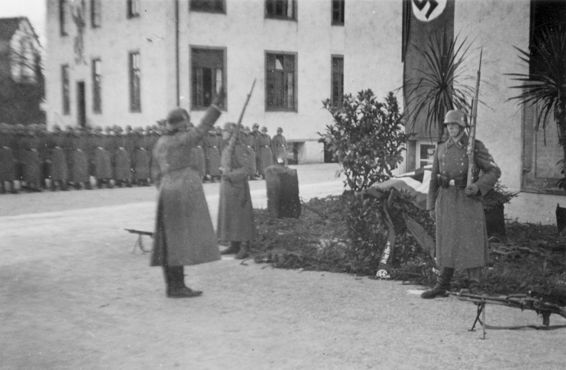
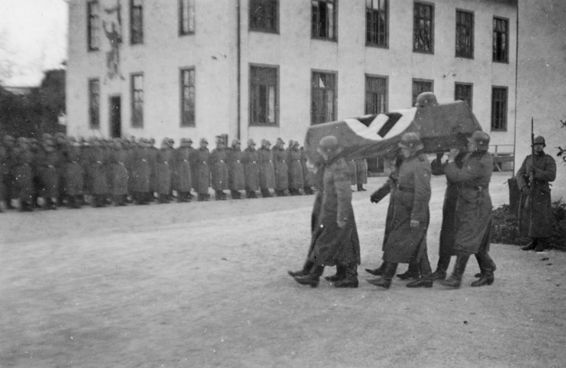
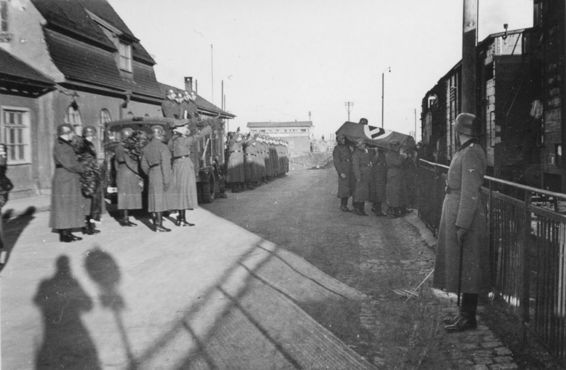
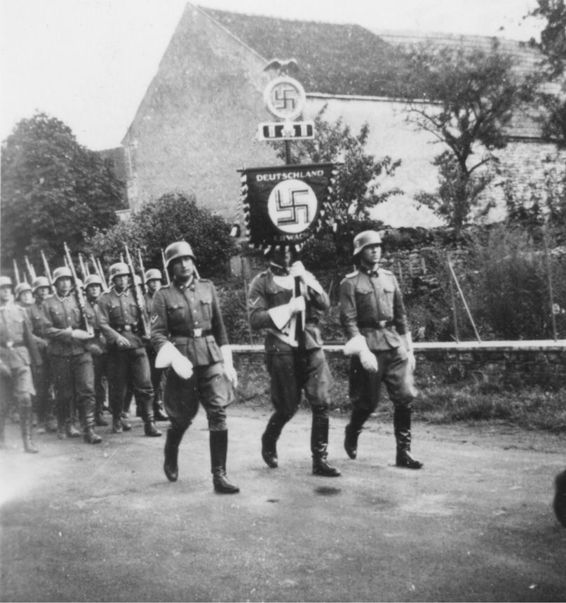
An honour guard of the Totenkopf follows the field banner standard during a march from their barracks. To many of the SS men the field banner had an almost religious significance. Each banner was ‘consecrated’ by Hitler himself at the Reichsparteitage (Reich party convention days) in Nuremberg where it was brought into contact with the Blutfahne (Blood Banner), the flag stained with the blood of Nazi ‘martyrs’ killed during the Munich Putsch of 1923.
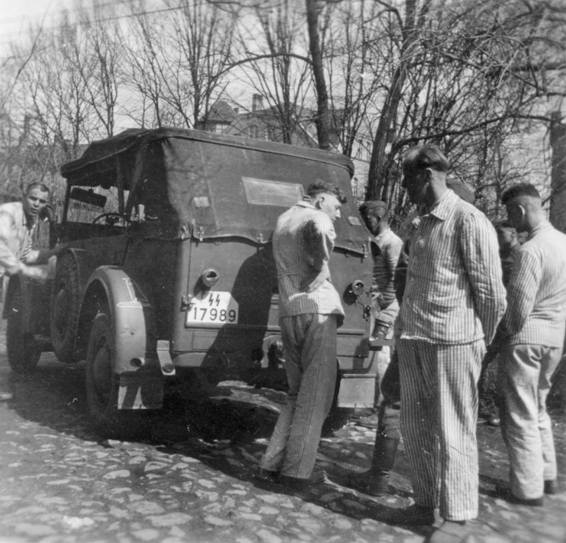
At a training barracks these SS men in their striped cotton drill training clothes are seen with a light Horch crosscountry vehicle. Note the number plate on the rear with the SS insignia emblazoned above the five-digit number.
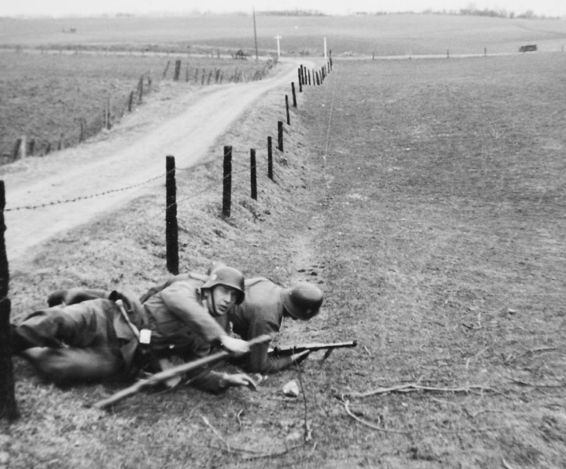
During a training exercise, two Totenkopf troops: one armed with the standard 98K carbine bolt-action rifle and the other with the new machine pistol (MP38). These men in training regarded their role in the SS as unlike that of their Heer counterparts. Their blind faith in Adolf Hitler enabled them to go into combat with fanatical allegiance to the Fuhrer and with the ability to face the prospect of almost certain.
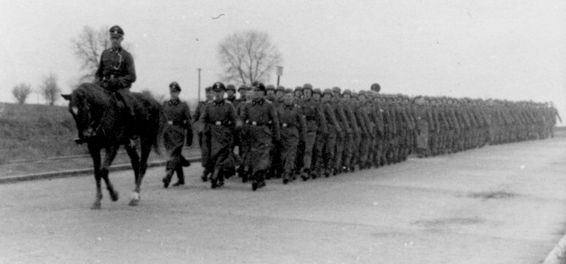
Totenkopf troops on a march from their barracks with their commanding officer leading them on horseback. The training of these men was designed to create a perfect political fighting machine and proved a great attraction to the men who joined. They ardently believed that stretching themselves both physically and mentally marked them as true Nordic Germans, complete and proven men of Hitler’s military elite.
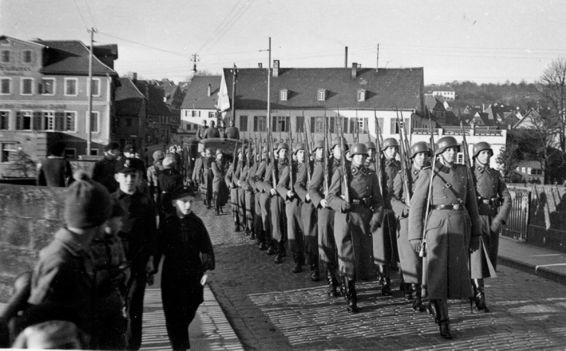
A Totenkopf unit on the march through a German town from a training barracks. Young children, some of whom are dressed in the Hitlerjugend uniform, watch this military spectacle. All of the Totenkopf troops are dressed in the inadequately insulated Heer greatcoat which would be standard issue until the end of 1941 when these men nearly froze to death in the depths of a Russian winter.

A portrait photograph of a young SS soldier, probably from the Leibstandarte SS. He wears the M1935 steel helmet with the SS insignia on the right-hand side. The SS rune is sewn onto his tunic.
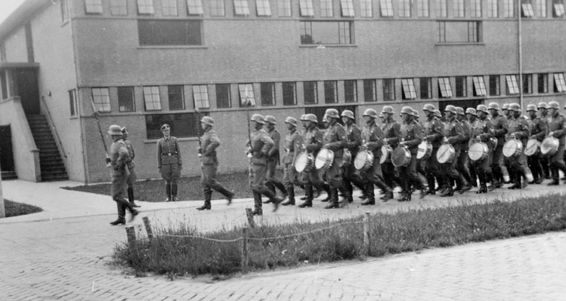
A military band of the Leibstandarte can be seen playing during a training procession at a barracks.

Totenkopf troops practising with the MG34 machine gun in a heavy role. The MG34 would soon prove an invaluable weapon to the SS, both in a defensive and offensive role. This machine gun would be used extensively throughout the war and would become a much feared and revered weapon.
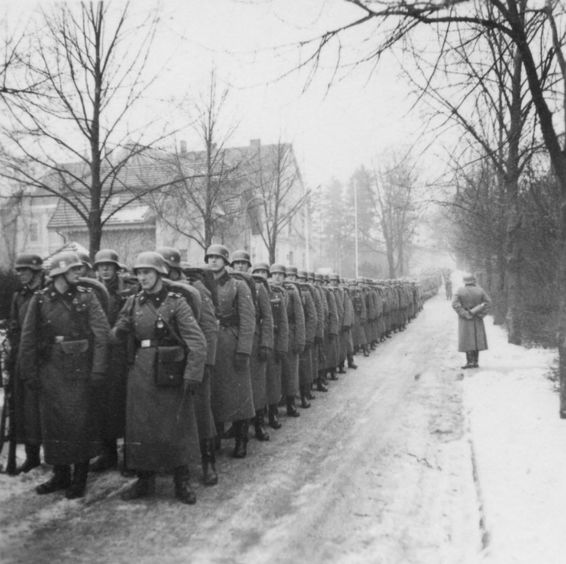
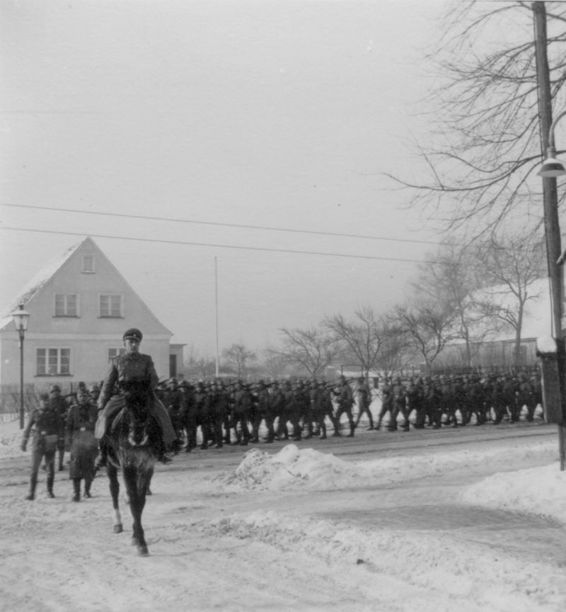
This and the following two photographs show troops of the Totenkopf marching during the winter. Their commanding officers can be seen accompanying the march. Commanders strove at length to teach their men that they were part of a closed order with its own rules and regulations. The men soon understood the meaning of obedience, honesty and dedication to duty. From the very first day they were recruited into the SS and put into training, they were told that they were part of a military elite totally separate from their Heer counterparts.

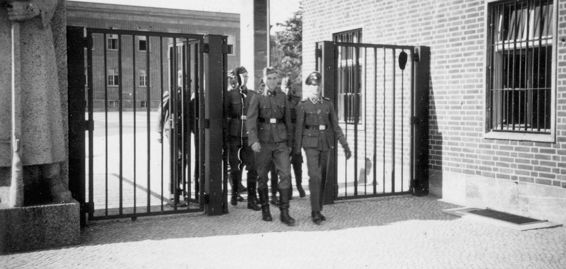
SS troops walking through iron gates to their barracks, accompanied by their commanding officer. There was a considerable difference between the attitudes of the SS and the rest of the armed services. While the Wehrmacht were to fight initially along the old military lines, the SS looked upon their service with a brutal attitude that knew no bounds. In many ways these troops found brutality to be the norm and often expressed this in the harsh and murderous activities against the Jews and anybody else regarded as hostile to their beliefs.

SS troops at a training ground during a passing-out ceremony bearing their oath to the Fuhrer. Showing blind allegiance each soldier knew he was expected to step up and join one of the newly-created armed SS divisions where he would obey every order, even if it meant shooting prisoners and committing atrocities against civilians.