
Chapter Three
On the eve of the Allied invasion of France, four of the ten German armoured divisions in France and Belgium were Waffen-SS. They consisted of the Ist SS.Panzer-Division Leibstandarte Adolf Hitler, 2nd SS.Panzer-Division Das Reich, 12th SS.Panzer-Division Hitlerjugend and the 17th SS.Panzergrenadier-Division Götz von Berlichingen named after a medieval hero fitted with an artificial iron hand. Even by this late period German intelligence could not confirm with any degree of accuracy where the main Allied invasion would take place. As a consequence the bulk of the Waffen-SS divisions were not located in the Normandy sector under the command of the 7th Army. The Leibstandarte was lying in the area of Bruges in Belgium where it had been resting since the spring of 1944 and had become part of the high command strategic reserve and was, therefore, under Hitler’s direct control. Das Reich was still in the Toulouse area where the level of partisan operations had increased. The new Hitlerjugend Division had been transported by rail from Belgium and was moved close to its expected area of action between the lower Seine and Orne rivers, while the Götz von Berlichingen Division was stationed in Thouars in France.
The Hitlerjugend Division was the nearest of all the four Waffen-SS divisions to the actual Allied landing-point. On paper the division had over 20,000 soldiers deployed for action in Normandy. Although it was short of a number of armoured vehicles, the troops were well-equipped and armed. After nine months of intensive combat training their spirits were high and they were looking at the coming action with confidence. It was probably the best-trained and demonstrably effective unit in Normandy – on either side.
When the Hitlerjugend was eventually released to meet the Allied invasion on 6 June, the division was constantly strafed by fighters which disrupted the cohesion of many of the marching columns. By the following morning on 7 June, exhausted from more than a day’s constant marching, the bulk of the Hitlerjugend had moved into the area north of Caen. By this time reports had confirmed that the enemy had managed to break through some parts of the coastal defences and push his attack inland.
Within hours, fighting against the Allied forces was finally unleashed. From their hideouts and freshly-dug trenches the youths crashed into action, opening up a ferocious barrage of fire on British and Canadian positions. Although the continuous attack from the air disrupted the grenadiers’ assault, the teenagers of the 12th SS fought on. Many of the Allied soldiers were shocked at seeing teenagers in SS uniforms. It was their first encounter with the Hitlerjugend generation. For months prior to the invasion of Normandy the Allies had ridiculed the Hitlerjugend as the ‘baby-division’ but to the soldiers who fought against the 12th SS, this was far from being a division of badly-trained teenagers. It was an elite unit that instilled fear and, at the same time, fought a battle that inspired even its enemies.
Over the next few days as the battle of Normandy intensified, the Hitlerjugend came under even heavier attacks. Still this did not discourage the grenadiers from being driven from their bombed and blasted positions, for they had been given orders to hold the enemy at all costs and prevent them from penetrating their lines and breaking through to the ancient city of Caen.
During the evening of 9 June the Panzer-Lehr-Division moved into line alongside the 12th SS after driving miles to the front from Chartres. The following day the 21st Panzer Division also moved up and helped the other two divisions to form the principal shield around Caen, with motley other ad hoc units that had retreated from the coastal sector. Over the following days and weeks the Hitlerjugend, Lehr Division and the 21st Panzer carried on fighting stubbornly in and around the city of Caen which was slowly being reduced to rubble.
By the morning of 26 June, the British finally unleashed a large-scale attack on Caen code-named Operation Epsom. During the day’s fighting at least fifty enemy tanks were knocked out by the Panzers and PaK guns alone. However, the Panzer-grenadiers took a heavy battering and in some areas a number of battalions were totally wiped out along with their commanders. Over the next few days the Allies continued to strike out, smashing into the 12th SS lines and causing massive damage to their positions. In the days leading up to July the British, endeavouring to expand their bridgehead, became increasingly incensed by the conduct of the Hitlerjugend Division, who fought so tenaciously when its cause was so clearly lost. This dogged determination had managed to finally blunt the Epsom operation, which consequently prevented it from acquiring the high plain south of Caen. In spite of this success the division was badly depleted and its survivors exhausted. Most of the German forces around the city were in desperate need of being replenished.
On 5 July, news reached Army Group B that Hitler contemplated having the Hitlerjugend relieved. However, three days later the SS divisions were once again fighting another battle for Caen, code-named by the Allies as Operation Goodwood. Once again these ‘boys’ were the core of the defence and fought out the battle in the ruins around Caen with an aura of being indestructible, even though their ranks had been greatly depleted after weeks of continued defence. As the battle reached its peak, Hitler ordered the city to be held at all costs. However, with no more reserves left and ammunition rapidly running out, the Hitler youth were withdrawn and instructed to take on a new defensive position in the rear.
By 11 July the Hitlerjugend was relieved by the Leibstandarte Adolf Hitler Division which took command of two units that remained in action. For nearly a week the Leibstandarte battled in the Caen region in a desperate attempt to stem the advancing Allies. During the battle SS grenadiers fought a desperate close-quarter action that saw both sides sustaining terrible casualties. Although Operation Goodwood would be soon called off, both the British and Canadians continued keeping seven of the remaining nine Panzer divisions occupied in the Caen sector.
Six divisions of the American First and Third armies had meanwhile moved south on the western side of the Cherbourg peninsula. The only German armoured divisions in their path were the 2nd SS.Panzer-Division Das Reich and the 17th SS.Panzer-grenadier-Division Götz von Berlichingen. Das Reich Division had journeyed from Toulouse in the south of France and had been seriously delayed reaching the Normandy sector by partisan activity and the constant aerial attacks. The convoys of the division had been unable to carry out daylight movement and had crawled northwards through the darkness. All the Panzer divisions that arrived in the Normandy sector were in such bad shape that they needed days to regroup before going into action. German wireless signals were continuously filled with Panzer commanders requesting fuel, transportation, new routings and other important matériel needed to sustain their drive. Das Reich Division was no exception. It arrived exhausted in the rear areas of the battlefront between 15 and 30 June, nearly three weeks behind schedule, and was not inserted into the Normandy campaign until 10 July, by which time it had already suffered heavy losses. Despite its severe mauling by Allied bombing, the division was far from beaten.
All over the Normandy sector the Waffen-SS divisions continued desperately to try to keep the Allies in check. The Normandy countryside had created conditions that favoured the SS grenadiers. Clusters of trees, tall hedges, ditches and lack of roads frustrated the Allied armoured units seeking to destroy enemy tanks in open areas. Aided by this terrain the SS were able to defend positions for longer than the Allies expected possible, and as a result incurred huge casualties. Frequently the Allies watched their irrepressible foe come under a furious crescendo of mortar and shellfire and still they held their ground to the grim death. However, the savage Allied air attacks and naval bombardments gradually began to grind down the German defences. Movement was almost impossible by daylight and any vehicles that travelled during the day were attacked and destroyed.
By the end of the first week of August both the Heer and Waffen-SS divisions were fighting for survival. Corps and divisions remained in action on paper but were becoming a collection of small battles, shrinking down to battalion size. A catastrophe now threatened the whole area as the Americans began to break out and the Normandy campaign became mobile. To save the German forces in Normandy from being completely encircled and destroyed, a series of rapid withdrawals was undertaken through the Falaise-Argentan gap. On 16 August German forces continued retreating and crossed the River Orne. The Hitlerjugend Division desperately fought to keep the gap open. The bulk of the German armour, however, that had become trapped inside the pocket at Falaise fought a desperate battle to escape the impending slaughter. By 21 August the terrible fighting in what became famously known as the Battle of the Falaise Pocket drew to a catastrophic conclusion. The Waffen-SS had been dealt a heavy blow.
The Normandy campaign had been very costly for the Waffen-SS, with many of its elite units being annihilated. The Leibstandarte had suffered almost total destruction. Das Reich had some 450 men and fifteen tanks remaining; the Hohenstaufen had 460 men and some twenty-five tanks that had survived the slaughter. The 10th SS.Panzer-Division Frundsberg lost all of its tanks and artillery, while the Hitlerjugend had only 300 men remaining and no artillery.
Following the complete German defeat in France, remnants of their forces withdrew for rest and refitting. The Leibstandarte was withdrawn to Aachen; Das Reich limped back to the Schnee Eifel area; the Hitlerjugend was pulled out and sent back east of Maas in Belgium; and Götz von Berlichingen was moved to Metz. The Hohenstaufen and Frundsberg divisions were withdrawn to lick their wounds in a quiet backwater in Holland. It was a town called Arnhem.
With the huge losses inflicted on the Waffen-SS, the campaign in the West had proved, as had the battles in the East, that they could only delay the enemy, not defeat them.
Within months of the Normandy campaign the Waffen-SS would once again be ready and refitted for action. However, it was not to be another delaying action. This time the SS troops were to go over to the attack in a bold and daring offensive through the Ardennes region. This was to be known as the Fuhrer’s last gamble in the West.
By the summer of 1944 the Waffen-SS along with its Heer counterpart had come close to being completely annihilated on the Western Front. However, within months it had miraculously undergone recovery. Many of the divisions that had been battered in Normandy and then smashed to pieces in the Falaise Pocket and in the subsequent retreat across France were now rebuilt. New divisions had been raised or others brought in for refitting in Germany or on the Eastern Front. On paper it seemed that there was still hope but in reality many German units still seriously lacked transport and the appropriate numbers of officers and non-commissioned officers. A great number of units had barely half their proper requirement of the major items of equipment.
However, in spite of the shortages, in September 1944 just two months following the Normandy campaign Hitler decided to launch a great winter counter-attack in the West. The attack he envisaged would be through the Ardennes – the scene of his great 1940 victory – to capture the town of Antwerp. Fog, night and snow would be on his side. With Antwerp in German hands, he predicted the British and Americans would have no port from which to escape and this time the enemy would not be allowed to escape.
Here in the Ardennes a substantial number of divisions was assigned to the area, including four crack Waffen-SS: 1st SS.Leibstandarte Adolf Hitler, 2nd SS. Das Reich, 9th SS.Hohenstaufen and 12th SS.Hitlerjugend. These SS divisions were larger than the regular Heer Panzer divisions and totalled a ground strength between 16,000 and 20,000 soldiers, with three-battalion Panzergrenadier regiments, a slightly larger artillery regiment that included a battalion of Nebelwerfer and a Sturmgeschütz Abteilung with twenty or thirty assault guns. The SS also had a higher allotment of motor vehicles. However, they were still below their assigned strength for officers and non-commissioned officers, mostly because of the terrible losses sustained in Normandy.
The equipment used by the SS armoured formations in the Ardennes was generally excellent, although by this late period of the war it was still in short supply. The forces committed to the battle zone contained a number of independent selfpropelled anti-tank and heavy tank battalions and several assault gun brigades, which were battalion-size formations. There were four Schwere Panzerjager battalions, nominally equipped with a mix of Jagdpanthers, Panzerjager IVs, and Sturmgeschütz. IIIs. The Schwere Panzer battalions contained the famous Tiger heavy tanks. Three of these units were committed in the Ardennes and the 501.SS was attached to the Leibstandarte. The lead element of the 501.SS Schwere Panzer Abteilung was commanded by the veteran armoured ace SS Obersturmbannfuhrer Joachim Peiper, commander of the 1st SS.Panzer-Regiment.
For the attack in the Ardennes, the Waffen-SS was assigned for action with the 6th Panzer-Army, which was to deliver the decisive blow. It was commanded by Oberstgruppenführer Josef Sepp Dietrich, who had fought brilliantly on the Eastern Front and commanded the I.SS.Panzer-Korps comprising the 1st and 12th SS.Panzer divisions in the Normandy campaign. The 6th Panzer-Army contained all the four SS.Panzer divisions and was given the task of tearing huge holes in the American lines between the Losheim Gap and Monschau.
To the south of the 6th Panzer Army’s sector lay General Hasso von Manteuffel’s 5th Panzer Army and General Erich Brandenberger’s 7th Army, which was the southernmost of the three armies committed to the offensive. Altogether the five Panzer and Panzergrenadier divisions and thirteen infantry-type divisions consisting of Fallschirmjager and Volksgrenadier troops were to be unleashed through the Belgium and Luxembourg countryside. The code-name for this historic offensive was Wacht am Rhein (Watch on the Rhine), and it was unleashed during the early morning of 16 December 1944.
The attack was opened up by 2,000 light, medium and heavy guns, howitzers and Nebelwerfer which poured fire and destruction onto enemy positions. Shell after shell thundered into American strongpoints. In the north 6th Panzer Army inflicted the heaviest barrage of fire. At least 657 guns and howitzers of various calibre and 340 Nebelwerfer were directed on American positions between Hofen and the Losheim Gap. For almost an hour without interruption shells screamed over the heads of the waiting German infantry. Abruptly the bombardment ended, leaving a stunned silence for a few moments. Then beneath the pines and camouflage netting, thousands of German soldiers began their ‘historic offensive’.
The Volksgrenadiers, many going into battle for the first time, were excited at thethought of fighting an offensive that their Fuhrer had said would drive the invaders from their homeland and win them the greatest victory since Dunkirk. The Volksgrenadiers were closely followed by the tanks and elite Waffen-SS Panzer divisions. The spearhead of the 6th Panzer Army was to be formed by I.SS.Panzer-Korps which had been tasked with smashing through American lines between Hollerath and Krewinkel and driving through to the Liege-Huy sector with the Hitlerjugend on the right flank and the Leibstandarte on the left. The I.SS.Panzer-Korps was given a particularly powerful Kampfgruppen, which was led by Obersturmbannfuhrer Joachim Peiper and his powerful Tiger tanks.
The attack by Peiper went well. By 19 December his Tigers had reached Stoumont, where a vicious two-hour battle raged with the Americans trying at all costs to hold the town. When the town could no longer be held the Americans quickly retreated but Peiper’s tanks pursued them for a few miles out of the town before eight of their own tanks were brought to a flaming halt at an American roadblock.
In spite of the successful German advance through the Ardennes, the Allies were now beginning to recover from the initial surprise and resistance was stiffening day by day. By 22 December the Americans began stemming the German drive. Coupled with the lack of fuel and constant congestion on the narrow roads, many German units were brought to a standstill. The fuel shortages were so bad that on 23 December Peiper’s Kampfgruppe destroyed their vehicles and his remaining 1,000 men set out on foot for the German lines. The remnants of the Kampfgruppe then linked up with the Leibstandarte just before dawn on Christmas Day.
Along the entire front German soldiers were becoming increasingly exhausted. Even the Waffen-SS had become worn down. For days and nights in the wet and cold, they had pushed westwards towards a promised victory. Originally nourished by their early success and the apparent lack of resistance, their forces began to wither as shortages of rations, lack of sleep and the constant shelling and bombing from aerial attacks drained their energy. With the SS armoured spearheads bedevilled by broken lines of communication and lack of fuel, the Ardennes offensive began to grind to a halt less than two weeks after it was unleashed.
In a drastic attempt to assist the failing drive to the River Meuse, additional troops were thrown in to launch a new offensive in Alsace where the Americans had drained their forces in order to send reinforcements north into the Ardennes. The codename was Nordwind and it was launched in earnest on New Year’s Day with eight divisions spearheaded by an SS Korps consisting of the 17th SS.Panzergrenadier-Division Götz von Berlichingen and the 36th Volksgrenadier-Division. At first the offensive went relatively well but heavy resistance soon forced the Germans back. The subsequent commitment of the 10th SS.Panzer-Division Frundsberg and the 6th SS.Gebirgs-Division Nord failed to alter the situation in the area.
In the Ardennes the Leibstandarte, Hohenstaufen and Hitlerjugend divisions were heavily embroiled in fierce fighting around the town of Bastogne. The German capture of the town was not a symbolic one. It was essential to the successful development of their offensive through Belgium. Around the smouldering town the Waffen-SS fought with great energy and determination. Both sides incurred huge losses but still the Americans were resolute in defending the town and preventing the enemy from gaining entry.
During the first days of January 1945 the weather became even more appalling, with temperatures falling to around zero. Fighting through fog, sleet and deep snow caused discouragement and pessimism to spread on both sides and even the crack SS divisions began to falter. Around Bastogne the Germans were eventually forced onto the defensive and driven back. Nearly 12,000 German troops were killed attempting to capture Bastogne and 900 Americans died defending it, with another 3,000 killed outside the perimeter. From the pulverizing effects of ground and aerial attacks, the Germans had left behind 450 tanks and armoured vehicles.
The defeat outside Bastogne was yet another major blow to the German command and marked the turning-point of the offensive. All across their battered front fighting had become harder and resistance was difficult to overcome. Troops constantly found themselves beating the enemy only at terrible cost, only to find a few miles further on that fresh, well-armed American forces were waiting for them.
With so many Allied troops being deployed in the Ardennes, Hitler was slowly forced to realize how dangerous the war in the West had become. On 8 January, with more than 100,000 Germans dead on the battlefield, the Fuhrer grudgingly ordered the remnants of the forward units to fall back to a line running south from Dochamps in the Samrée-Baraque de Fraiture area to Longchamps, 5 miles north of Bastogne. Even more significant were orders for the mighty elite SS Panzer divisions to go over to the defensive. The 6th SS.Panzer-Army was withdrawn into reserve under Hitler’s personal command and he also called back remnants of his foremost fighting machine – the Leibstandarte – from the Bastogne area. Panzers coming off the assembly lines were diverted from the Ardennes back to the Eastern Front and there were no more propaganda broadcasts in Germany about the ‘historic offensive’.
By 24 January all four Waffen-SS divisions that were initially committed to the Ardennes campaign were withdrawn and ordered to Hungary in a drastic attempt to throw the Red Army back across the Danube and to relieve the capital, Budapest. As for the remaining forces in the Ardennes sector they were withdrawn and the remaining units were back over the Rhine by 10 February, preparing to fight the last battle of the Reich.
By early February 1945 German forces in the West were slowly being driven back. Along the defensive front remaining German divisions with handfuls of anti-tank and artillery guns were strung out along the front lines and were almost totally unprotected. Along whole areas of the front the once-proud Panzer divisions had been reduced to skeletal formations on a stricken field. They were now not only vastly outnumbered but seriously lacking in fuel supplies, lubricants and ammunition. When parts of the front caved in, armoured formations were often forced to destroy their equipment so that nothing was left for the conquering enemy. The Germans no longer had the manpower, war plant or transportation to accomplish a proper buildup of forces.
Despite the enemy’s overwhelming superiority, German forces prepared their defensive positions along the German frontier and dug in. Many soldiers, especially those fighting in the ranks of the Waffen-SS, decided that their fate would be met out on the battlefield. However, much of the German forces that were thrown together to defend the Reich and protect the route into Germany were manned by inexperienced training units. Some soldiers were so young that in their rations they had sweets instead of tobacco. All of them were ordered to stand and fight and not to abandon their positions. Terrified at the prospect of retreating, which would warrant almost certain execution, many reluctantly opted to bury themselves deep into a foxhole or bunker. Here they hoped the western Allies would give them a chance to surrender, instead of burning them alive with flame-throwers or blowing them to pieces by hand grenade.
Although many SS soldiers were aware that the war was at its end, many still retained intense unit pride which often assured they would do their duty to the bloody end. By April 1945 the SS divisions in the West were virtually non-existent. What names remained were shadows, their ranks partially filled with a motley collection of men from the Heer, Luftwaffe, Volkssturm and Hitlerjugend. However, unlike their SS counterparts, they were not fighting with fanaticism in the name of their beloved Fuhrer; they were compelled to fight on the battlefield for survival.
Many of the SS saw their end on the battlefield, fighting for the last strongholds. Towns and villages often saw SS troops dug-in and defending their positions to the last round. Even in front of Berlin, the last bastion of defence in the Reich, these fanatical soldiers fought on with massive losses.
As fighting soldiers, it was never doubted in the eyes of the Anglo-American forces that the SS were an elite band of men who fought with skill, courage and effectiveness. However, in captivity it was clear that many were arrogant, fanatical and unrepentant regarding the terrible acts of cruelty and barbarism that they had committed both on and off the battlefield.

An SS soldier on a road somewhere in Italy. He is standing in front of a light Horch cross-country vehicle and is holding a tortoise. It was in August 1943 that Hitler ordered the transfer of his elite SS Panzer Corps from the Eastern Front to Italy following the Italian capitulation in July. This type of sudden shift became characteristic of the employment of the crack SS divisions during the second half of the war, as Hitler used them as a ‘fire brigade’ to reinforce trouble spots. Note the lettering on the rear of the vehicle ‘Abstand 30m’ (spacing 30 metres) to ensure that vehicles did not bunch together in convoy, and the white paint applied to enhance visibility for night time driving.

A portrait photograph showing a young SS soldier on the left and his friend who has joined the ranks of Rommel’s Afrika Korps. By 1943 it became apparent that the southern theatre of operations both in North Africa and Italy was collapsing. Rommel had lost his grip in the desert in May 1943 and Italy had surrendered to the Allies later in September 1943. This undoubtedly put incredible stress on the German arsenal and vital men and equipment required to prop up the Eastern Front were now being hastily shifted to the south.

Moroccan prisoners being led away under the watchful eye of an SS soldier during heavy fighting in southern Italy. It was the 4th Tabor of Moroccan Goums that fought in the Sicilian campaign, landing at Licata on 14 July 1943 and attached to the US Seventh Army. It was in May 1944 that three Goumier groupes, under the name Corps de Montagne, were the vanguard of the French Expeditionary Corps attacked through the Aurunci Mountains during Operation Diadem. It was here that many losses were inflicted on the Allies. The Moroccans fought very well but in a number of places were cut off by German forces and captured. The Moroccans were probably the most effective troops in the Allied armies deployed in Italy, especially in mountainous terrain.

At an SS command post in Italy and a commanding officer hands a piece of paper to a motorcycle dispatch rider. Italy’s mountain spine provided the Waffen-SS with many opportunities for a good defence. Throughout the Italian campaign the Germans took advantage of this natural asset by incorporating Panther tank turrets and huge concrete emplacements into their defensive lines, which stretched across the Italian landscape.

SS FlaK-gunners guard the water’s edge against aerial attack. As the Allied air force started to inflict heavy casualties by 1944, the Luftwaffe, Heer and Waffen-SS divisions became well-equipped with 2cm FlaK 38 guns. This gun had a practical rate of fire of 120 rounds per minute with a maximum horizontal range of 4,800 metres, which was particularly effective against both ground and aerial targets. Thousands of these FlaK guns were used in the defence of Italy in a desperate attempt to delay the Allied onslaught. However, like so much of the German armour employed on all fronts, they were too few or too dispersed to make any significant impact on the main enemy operations which were already capturing or encircling many of the key towns and cities.

A photograph taken while a 8.8cm FlaK gun is being readied to fire its projectile against an enemy target.

The crew of a 7.5cm le.IG18 during a fire-fight as they engage the enemy with their gun. Although the gun was one of the first post-First World War weapons to be issued to the Heer and Waffen-SS, it remained in service on all fronts until the end of the war. A typical infantry regiment controlled three infantry battalions, an infantry gun company with six 7.5cm I.IG18 and two 15cm s.IG33 guns, and an anti-tank company initially equipped with twelve 3.7cm PaK 36 guns, but started to be replaced in first-line units with the 5cm PaK 38 in late 1940 and this in turn by the 7.5cm PaK 40 from November 1941.

A photograph taken during operations in Italy showing the Waffen-SS with their VW Type 166 Schwimmwagen (literally floating/swimming vehicle) amphibious four-wheel-drive off-roaders. These vehicles were used extensively in Italy where rivers and streams were a common obstacle.

Two commanders dressed in the summer camouflage smocks survey a map in their Volkswagen Schwimmwagen. This vehicle was an amphibious car used extensively by both the Heer and the Waffen-SS during the war. The nearest man is decorated with the Ritterkreuz (Knight’s Cross).

An interesting photograph showing a column of 166 Schwimmwagen amphibious vehicles halted in an Italian town. The terrain in Italy for vehicle movement was often hindered by steep ravines, mountains and many rivers. These vehicles were very versatile and were used extensively during operations against military and countering the growing resistance groups.
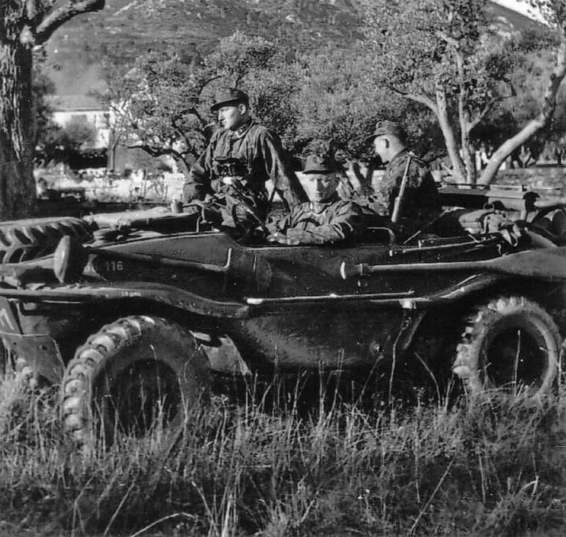
A VW Typ 166 Schwimmwagen halted in a field during summer operations in Italy. By this period the Waffen-SS and their Heer and Luftwaffe counterparts were slowly being driven northward by strong and determined Allied forces.

A photograph showing a typical mortar crew in action. A mortar crew usually consisted of at least three members: the gunner controlling the deflection and elevation of the weapon; the assistant gunner loading the round at the command of the gunner; and the ammunition man preparing and handing over ammunition to the assistant gunner. The weapon illustrated was probably the best mortar of the war, captured from the Soviets and used by the Germans on the Eastern, Western and Southern Fronts the 12cm Granatwerfer 378(r), which was the German designation for these captured Soviet mortars. The weapon consisted of a circular base plate, the tube and the supporting bipod, weighing 628kg in action, with the base-plate alone weighing 282-284.93kg. Because of its excessive weight, a two-wheeled axle was utilized, enabling the mortar to be towed into action, the whole assembly weighing a hefty 559.89kg. The axle could then be quickly removed before firing. In German service the captured Soviet weapon and an improved German version (the schwerer 12cm Granatwerfer 42) fired the German-made Wurfgranate 42 round, filled with 3.1kg of high explosive.

A number of vehicles parked alongside a road somewhere in Italy. Note the divisional insignia of the SS Leibstandarte Division painted on the rear of the vehicle. When some of the elite divisions were transferred to Italy they played little part in the conventional war. Instead they were involved in the guerrilla campaign. The Leibstandarte, for instance, was given the task of guarding several vital road and rail junctions in the area of Trento-Verona. After several weeks the division was moved to the Parma-Reggio area. During this period the Leibstandarte was involved in several skirmishes with partisans, their actions leaving an indelible markon the Italian population. The SS were very brutal and mass killings were quite common. Note the ‘Abstand 30m’ lettering on the nearest vehicle and the white lines painted on the two nearest vehicles to aid visibility during night time driving.
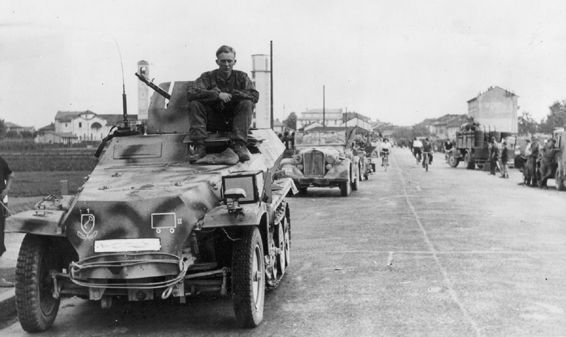
An SS soldier belonging to the Leibstandarte sits on his Sd.Kfz.250 Alt light reconnaissance halftrack which is armed with the MG42 machine gun and protected by a splinter shield.

In a field and SS troops are taking cover before moving forward. Note the machine-gunner armed with the MG34 machine gun complete with fifty-round basket drum magazine.

Coastal defence troops guarding the French coastline in 1944. A soldier armed with Kar98k bolt-action rifle and M24 stick grenade can be seen on duty. Many, but not all, coastal troops would be no match for the Allied invasion forces. Within hours of the attack many of the coastal forces would be dead or captured. It would be in the rear areas where elite SS divisions would be deployed to try to stabilize the threat from an inland Allied attack.
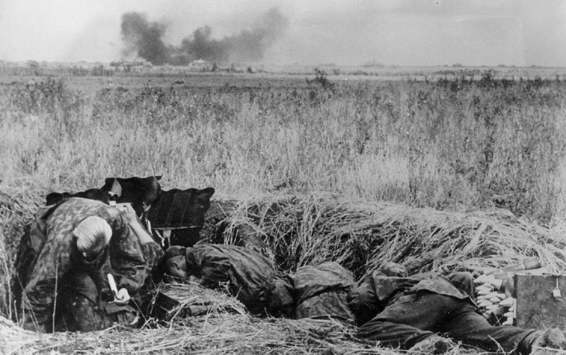
In June 1944 SS Hitlerjugend in a Normandy field armed with the 7.5cm le IG18 light infantry artillery piece. This particular weapon was used in direct infantry support. The gun was very versatile in combat and the crew often aggressively positioned it, which usually meant the piece was regularly exposed on the battlefield. The Hitlerjugend Division was the nearest of all the four Waffen-SS divisions to the actual Allied landing-point. On paper the division had over 20,000 soldiers deployed for action in Normandy. Although it was short of a number of armoured vehicles, the troops were well-equipped and armed. After nine months of intensive combat training their spirits were high and they were viewing the coming action with confidence.
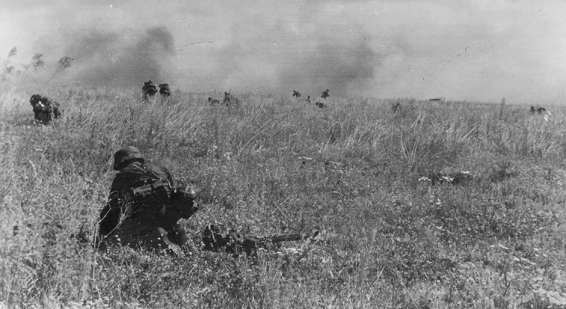
SS troops move forward into action. From their hideouts and freshly-dug trenches the Hitlerjugend went into action against British and Canadian positions. Although the continuous attack from the air disrupted the grenadiers’ assault, the 12th SS fought on.

A Tiger tank belonging to the 101st schwere Panzer Abteilung moving along a road in Normandy in late June or early July 1944. The unit markings were sometimes applied to the other side of the hull front. The vehicle is a midproduction specimen with rubber-tyred and interleaved road wheels. The division had been transferred to Normandy where it was part of the 1 SS Panzer-Korps which comprised the 101 SS Heavy Panzer Battalion, Hitlerjugend, 17th SS Panzergrenadier Division Götz von Berlichingen and the Panzer Lehr Division. Initially the Leibstandarte was deployed along the shores of the River Seine to counter any possible landing in the Pas de Calais. However, after the Allies had landed in Normandy the first units did not arrive in the Normandy sector until the night of 27-28 June. It took a further week until the entire division was regrouped for action, losing valuable time to counter the increasing Allied threat.

Two Panther tanks, probably belonging to the Lehr Division, parked in a Normandy village prior to their orders to the front. Note how much foliage has been attached to the tanks in order to try to break up their distinctive shape from the air. By this period of the war travelling by road during daylight hours was perilous for any tank crews. Consequently, much of the movement by road and rail was undertaken by the Germans at night to avoid high daylight movement losses.

A Panther tank somewhere in Normandy has been abandoned by its crew and blown up to deny its use to the enemy during a fire-fight in a village. Between June and July 1944 there were initially only two Panther-equipped Panzer regiments on the Western Front, with a total of 156 Panthers between them. From June through August 1944 an additional seven Panther regiments were sent into France, reaching their maximum strength of 432 in a status report dated 30 July 1944.
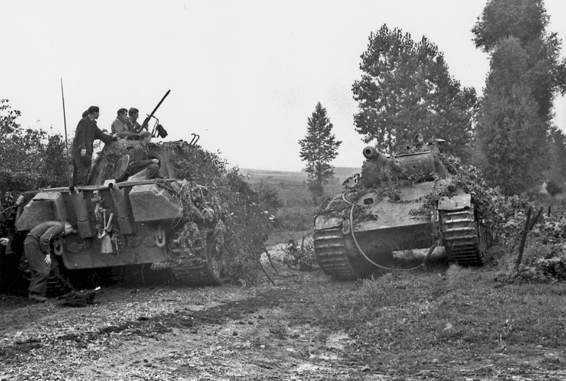
Two Panthers can be seen on the Western Front probably between June and August 1944. The towing cables suggest that the vehicle on the left has broken down or has become stuck, and is awaiting a tow from the other Panther Ausf.G. During the campaign in Normandy Panther crews found that although the Panther could deliver a lethal punch to the enemy, as a tank it was poorly suited to hedgerow terrain because of its width. The long gun barrel and width of the tank too often reduced manoeuvrability in village and forest fighting. As a direct result of this, many were knocked out of action.

An SS troop on motorcycles advances along a French road bound for the front. The smiles on the men’s faces do not depict the seriousness of the situation. Many were told by their commanding officers that the Allies would bleed to death along the shores of France and there would be no immediate threat of them gaining any significant ground.
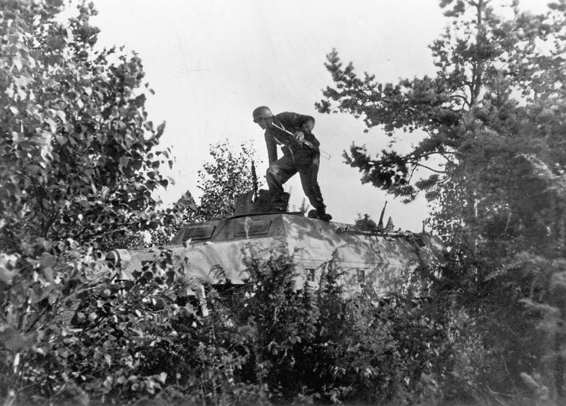
An SS soldier, probably a group leader, is about to jump off the Sd.Kfz.251 Ausf.D halftrack armed with his MP38/40 machine pistol. The halftrack is armed with an MG42 machine gun complete with splinter shield for local defence.
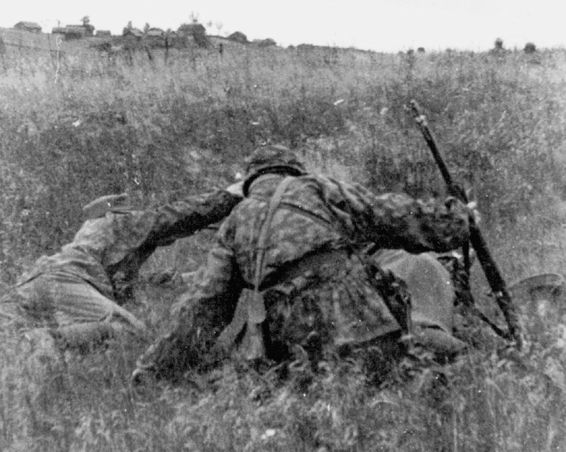
SS troops in a field during action against an enemy target. All over the Normandy sector the Waffen-SS divisions continued desperately to try to keep the Allies in check. The countryside here had created conditions that favoured the SS grenadiers. Clusters of trees, tall hedges, ditches and lack of roads frustrated the Allied armoured units seeking to destroy enemy tanks in open areas. Aided by this terrain the SS were able to defend positions longer than the Allies expected possible, and as a result the latter incurred huge casualties.

One of the most vital elements to sustain an army on the front lines was supply. Here in this photograph is a column of supply trucks destined for the front. However, with almost total Allied dominance from the air, movement was almost impossible by daylight and vehicles that travelled during the day were often attacked and destroyed. The tight vehicle spacing, which would be dangerous near the front, suggests that the photo was taken well to the rear and where strong AA defences were present.

A MG42 machine gun mounted on a sustained fire mount during operations in northern France in June or July 1944. Despite the adverse situation in which the German soldier was placed during the summer of 1944, he was still strong and determined to fight with courage and skill. However, by this period of the war both the Heer and Waffen-SS soldiers lacked sufficient reconnaissance and the necessary support of tanks and heavy weapons to ensure any long-term success.
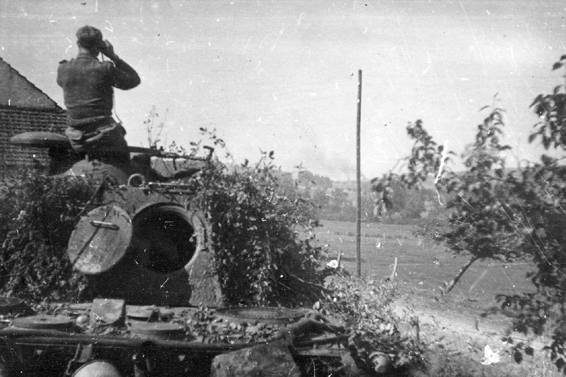
A Panther commander surveys the terrain ahead through his binoculars, trying to establish the location of his enemy before proceeding forward into action. Note the foliage attached to the vehicle in order to help conceal it along the hedges and trees of Normandy.

SS troops move forward into action. Here the premier divisions did what they could in France to hold the Allies in check. The Waffen-SS fought alongside well-seasoned Heer and Luftwaffe divisions which gave them considerable support on the front lines. However, the German forces suffered huge casualties. Consequently, in order to make good these losses, many of the exhausted and depleted divisions had conscriptions of old men and low-grade troops. The method of recruitment generally produced very poor results. Not only was the number of recruits simply insufficient but the supply of good quality replacements into the German army was also beginning to show signs of strain and exhaustion. In the Panzerwaffe too many of the replacement crews did not have sufficient time for proper training and as a result losses soared. Lack of fuel and insufficient spare parts coupled with the lack of trained crews all played a major part in reducing the effectiveness of the German arsenal on the Western Front.

SS troops can be seen here making their way back to a MG42 machine-gun position with the weapon on a heavy mount for sustained fire. By the time the Allies launched their attack on the shores of northern France the German forces were ill-prepared for any type of large-scale offensive. The infantry’s defensive positions required an efficient and regular supply of ammunition and the support of neighbouring units in order to hold their ground. Without this support the German forces were doomed. Commanders in the field were fully aware of the significant problems and difficulties imposed by committing badly-equipped soldiers to defend the depleted lines of defence. However, in the end, they had no other choice but to order their troops to fight with whatever they had at their disposal. The elite formations of the Waffen-SS had been removed from the Eastern Front in order to counter the threat in France. While many of the premier divisions fought well, delaying the Allied advance, they had in fact seriously weakened the forces available to hold the Russian Front and removed men and equipment that were desperately needed to prop up the disintegrating lines.
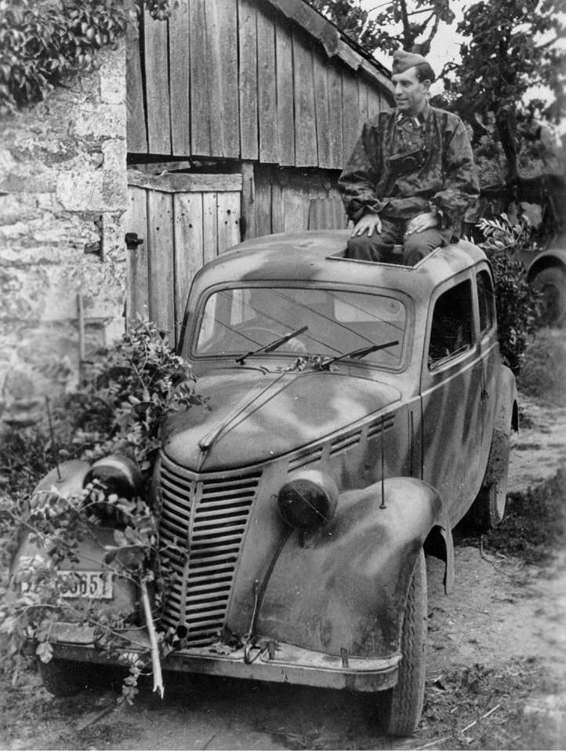
An SS soldier poses for the camera while sitting on the roof of a civilian vehicle that has been requisitioned for operational duties in the Waffen-SS. The photo shows a NSU-Fiat 1100 A (or perhaps the longer-wheelbase L model), an Italian design produced from 1939-1948, which was imported into pre-war Germany in limited numbers and then built under licence there. Note the blacked-out headlights and the SS licence plate.
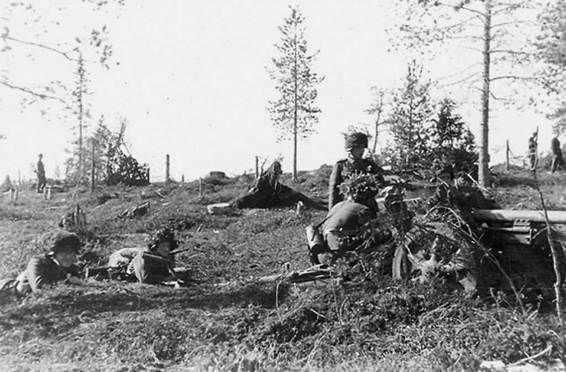
A familiar sight by 1944, here troops can be seen with their 5cm PaK 38. Even by 1944 the PaK 38 was still widely used by the Heer.

An SS 8.8cm FlaK 36 gun complete with Schutzchild (protective shield) in action against an enemy target. This FlaK gun was widely used as an anti-tank gun in which role it was formidable. On the battlefield it proved a very versatile weapon and continued being used in a dual role until the end of the war.
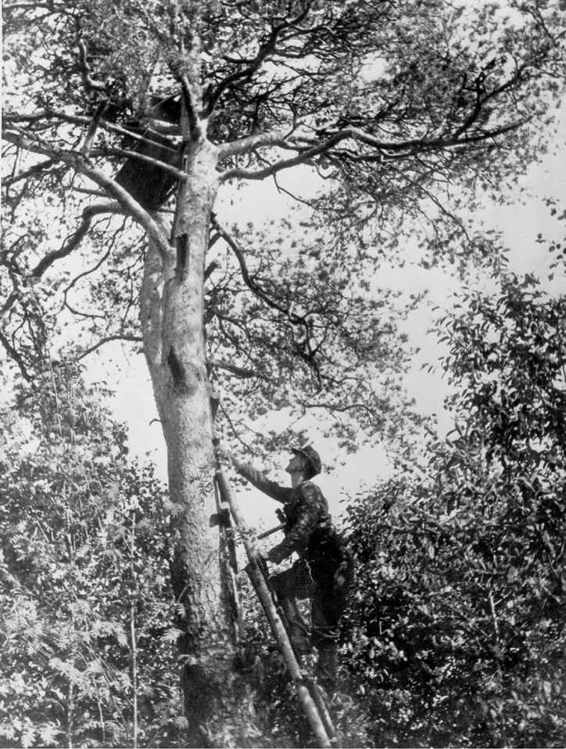
An SS trooper can be seen climbing up a tree to what appears to be an observation post set high up. Observation posts were key in determining the whereabouts and location of the enemy. Once located, the observer would relay the message via a field phone to the forward command post where the message would be forwarded to the commander in the field.

A well-concealed Sd.Kfz.250 Alt light halftrack during operations in northern France in the summer of 1944. During the day armoured vehicles were often halted and camouflaged until required to go into action. Movement was limited at all times.
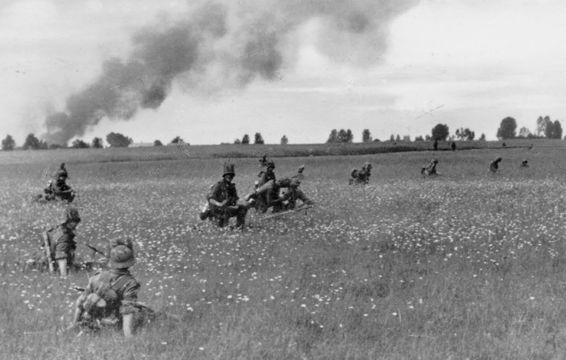
SS troops advance through a field towards the battlefront. All across the front lines hundreds of defensive positions had been carefully selected, camouflaged and well-prepared for close-quarter combat. The Waffen-SS were determined at all costs to defend Normandy, even if it meant fighting to the death themselves.
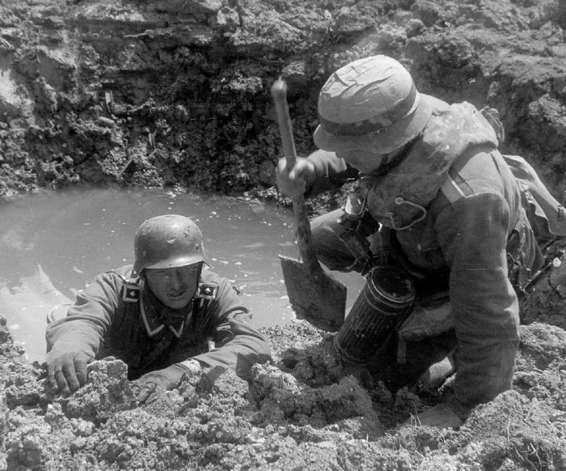
Waffen-SS men climb out of what appears to be an old bomb crater.

Waffen-SS troops advance through undergrowth. The leading soldier appears to be holding an M24 stick grenade, while his comrade who probably is a troop leader is armed with an MP38/40 machine pistol.

A 7.5cm PaK 40 anti-tank crew belonging to the 12th SS Panzer Division Hitlerjugend during a fire-fight against an enemy target. By 1944, in addition to anti-tank weapons, a typical SS Panzer-Division was also authorized eighty towed and forty selfpropelled 2cm guns and twelve heavy 8.8cm FlaK pieces. Less well-equipped grenadier and Gebirgsjäger divisions had eighteen towed and twelve self-propelled 2cm guns. These troops fought a desperate battle of attrition to hold on to their position around the town of Caen. However, following weeks of fighting and high losses in men and equipment the troops were forced from their positions and continued a defensive rearguard action, still fighting as they withdrew eastwards.

A Waffen-SS soldier surveys the area through a pair of binoculars in the Normandy sector. Along many parts of the front the Germans fought with fanatical resistance and held in a number of places. However, it came with a high price in men and materials. In spite of this the German soldier was still capable of meeting the highest standards, fighting courageously with self-sacrifice against considerable numerical superiority.

SS troops, probably at an observation post, are seen here with their Horch cross-country vehicle which has straw applied over it to help conceal it behind the stacked hay somewhere in the Normandy sector. Note the observer standing on the haystack with his 6 × 30 Sf.14Z scissor periscope observing the enemy. Forward observers were normally assigned to artillery batteries to establish observation posts among front-line infantry units. Their line of communication was often paramount in relaying important battlefield data.

SS troops take cover from the incessant enemy aerial attacks that plagued the front lines in northern France.

A bicycle unit halted on a dirt track. Much of their kit has been attached to the bicycle. In the last year of the war the bicycle was one form of transportation that was utilized by both Heer and Waffen-SS troops due to the severe shortage of fuel.
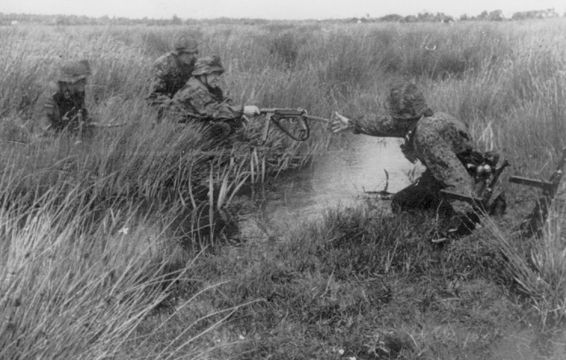

Two photographs taken in sequence showing Waffen-SS troops in marshy ground. They are armed with the MP40 machine pistol. By this period of the war the MP38/40 sub-machine gun was manufactured in great numbers and issued to squad leaders, senior NCOs and front-line officers. It was regarded as one of the most effective submachine guns ever produced and used extensively within the ranks of both Heer and Waffen-SS regiments.
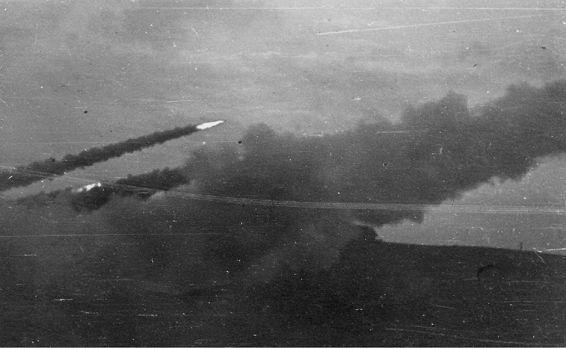

Two photographs showing the moment when 15cm Nebelwerfer 41s are fired in a defensive action against enemy positions. This deadly weapon fired 2.5kg shells from a six-tube mounted rocket-launcher. The projectiles could fire to a maximum range of 7,000 metres. When fired the projectiles screamed through the air causing the enemy to become unnerved by the noise. These fearsome weapons that caused extensive carnage to the enemy lines served in independent army rocket-launcher battalions and in regiments and brigades. The distinctive and long smoke trails helped the enemy pin-point the mortar positions for retaliation (assisted by special mortar detection radars) so that after firing it was essential to change the position of the Nebelwerfer batteries.

During operations in northern France, here SS troops are on the march. The almost total destruction of the Waffen-SS the campaign in the West had proved, as had the battles in the East, that the German forces could only delay the enemy rather than defeat him. Note the dismantled mortar equipment being carried.
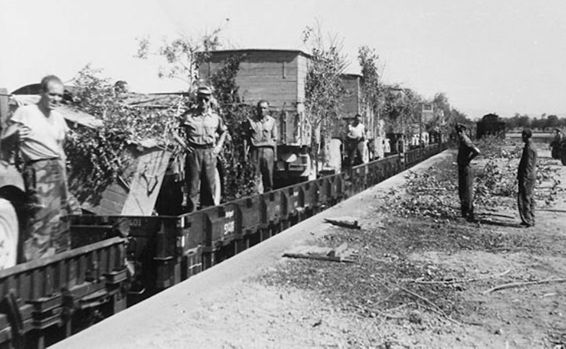
SS troops preparing to leave a platform with supply trucks and other equipment on special railway flatbeds destined for the front. Foliage has been applied to all the vehicles and equipment in an attempt to break up the distinctive shapes and minimize the possibility of aerial attack while stationary.

Two SS soldiers pose for the camera as they prepare to board the train with the rest of their unit. A gun can be seen on the special flat car. Although travelling by train was regarded as perilous, especially during the last months of the war, it was still often the quickest method of moving men and equipment from one part of the battlefront to another.

Panther Ausf.G tanks have been chocked and ready for transportation to the front. Between 1944 and 1945 some 4,185 Panthers were produced. However, with such great demands put on these machines to fill the front lines on both the Western and Eastern Fronts, high losses were inevitable. Yet, in spite of the losses Panther crews continued to put up a formidable defence against the advancing enemy.

A column of Pz.Kfw.IV and StuG.IV assault guns halted on a road on the Western Front. From 1943 until the end of the war the assault guns were slowly absorbed into the Panzer units, Panzer and Panzergrenadier divisions of the Heer and Waffen-SS. Despite the StuG’s proven tank-killing potential and its service on the battlefield both in offensive and defensive roles, the increased use of the StuG as an anti-tank weapon from 1942 onwards steadily deprived the infantry of the fire support for which the assault gun was originally intended.
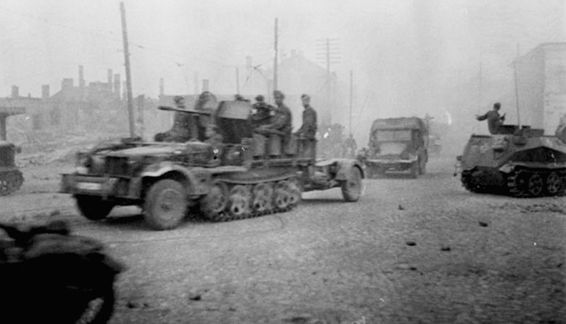
A 2cm FlaK 38 gun mounted on the back of a Sd.Kfz.10/4 1-ton halftrack during summer operations in 1944. The sides of the vehicle are in the upright position. When the sides were down it allowed extra space on board the halftrack for the FlaK crew to manoeuvre easily. Note the Sd.Ah.51 trailer attached to the field containing ammunition. This weapon was usually served by eight men (four single 2cm FlaK guns would need a total of twenty-four men) on a single mount to give a combined cycle rate of fire of 1,800 rounds per minute. These lighter-calibre guns were much respected by Allied air-crews and were also devastating against light vehicles as well as soldiers caught out in the open. Such guns also armed a variety of vehicles on self-propelled mounts. Behind the Sd.Kfz.10/4 is a Krupp Protze 6 × 4 le gl LKw L2H43 1-ton light truck, and on the right is an Sd.Kfz.250 Alt light reconnaissance halftrack with what appears to be additional improvised side or roof protection on the upper hull sides.

One of the most important elements in maintaining vehicles on the front lines were the mobile maintenance units. Here in this photograph is one such unit that maintained many of the vehicles on the Western Front in 1944.

SS soldiers during a lull in the fighting can be seen next to an infantry support truck. By the summer of 1944 the Waffen-SS along with its Heer counterpart had come close to being completely annihilated on the Western Front. However, within months it had miraculously undergone recovery. Many of the divisions that had been battered in Normandy and then severely mauled in the Falaise Pocket and the subsequent retreat across France were now rebuilt.

A Waffen-SS FlaK crew during defensive operations on the Western Front during the early winter of 1945. This 2cm FlaK 30 gun had a practical rate of fire of 120 rounds per minute with a maximum horizontal range of 4,800 metres, which was particularly effective against both ground and aerial targets. A number of these mounted FlaK guns were used in the defence of the Rhine and Elbe in a desperate attempt to help delay the Allied onslaught. However, like so much of the German armour employed for defence, they were too few or dispersed to make any significant impact on the main enemy troops which were already capturing or encircling many of the key towns and cities.

A heavy machine-gun position. By late 1944 new German divisions had been raised or brought in for refitting in Germany or on the Eastern Front. On paper it seemed that there was still hope but in reality many German units still seriously lacked transport and the appropriate numbers of officers and non-commissioned officers. A great many units had barely half their proper allocation of the major items of equipment.

Waffen-SS troops pause during a lull in the fighting. In spite of the constant setbacks that plagued the front, the SS remained an irrepressible foe.

Two well-camouflaged SS soldiers armed with the lethal Panzerschreck (armour or tank terror), the popular name given by the troops to this weapon. The official name for it was the Racketenpanzerbüchse, or rocket tank rifle, abbreviated to RPzB. It was an 8.8.cm reusable anti-tank rocket-launcher developed during the latter half of the war. Another popular nickname was Ofenrohr or ‘stove pipe’.

Waffen-SS troops can be seen inside a forest. Following the complete German defeat in France, remnants of the SS forces withdrew for rest and refitting. During their withdrawal many of the units spent time resting in the forests during the dangerous daylight hours when air attacks were likely and continuing their withdrawal at night.
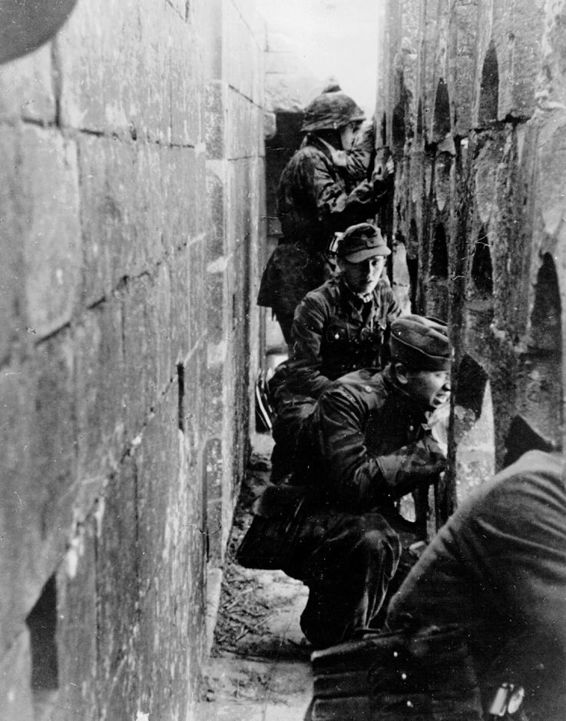
As they withdraw across Western Europe SS troops take cover during a heavy exchange of fire.

A column of StuG.III Ausf.Gs making their way forward in the snow. On board is a mixture of Heer and Waffen-SS grenadiers clad in their winter whites. Panzergrenadiers were considered elite front-line units and were known for their performance at the front. Often they would advance into battle with assault guns and other armoured vehicles which offered them armour protection and mobility until they were close enough to attack enemy positions on foot.

SS troops wearing their winter whites and whitewashed steel helmets rest before continuing their march in the snow.

Waffen-SS troops in a forest pause in operations for some well-earned respite and warm food. An HF 12 small kitchen wagon can be seen next to other stationary vehicles. These mobile kitchens could also operate on the move, cooking stews, soups and coffee. The limber carried utensils and equipment. The troops nicknamed these kitchen wagons ‘goulash cannons’. Many of the mobile kitchens were towed by animals but by 1944 were also seen pulled by an assorted range of vehicles.

Grenadiers hitch a lift on board a column of whitewashed StuG.III Ausf.Gs led by a StuH. The StuH has an application of Zimmerit anti-magnetic mine paste applied over the armour plating. By late 1944 the anti-tank battalion was more or less motorized and consisted of an anti-tank company equipped with Jagdpanzer IVs, Hetzers or StuGs which were organized into three platoons of four vehicles and an HQ section of two vehicles, a motorized anti-tank company of twelve 7.5cm PaK 40 guns and a motorized FlaK company equipped with twelve 2cm or 3.7cm FlaK guns.
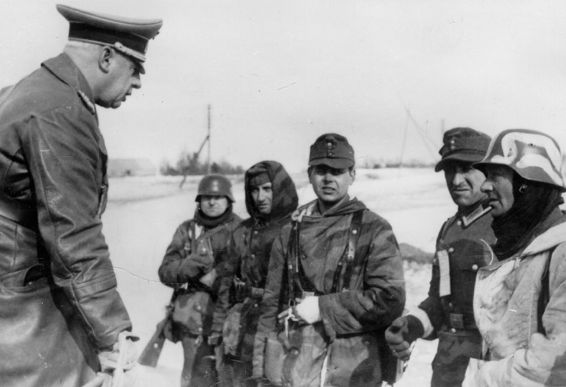
Field Marshal Model conferring with his men in late 1944/early 1945. In August 1944 Model was made commander-in-chief of Army Group B and OB West. Many of the commanders in the field as well as the soldiers looked upon Model as the Fuhrer’s troubleshooter. He had been the commander who had first introduced in early 1944 the ‘Shield and Sword’ policy on the Eastern Front, which stated that retreats were forbidden unless they paved the way for a counterstroke later. Out on the battlefield Model was not only energetic, courageous and innovative but was friendly and popular with his enlisted men. Although these were critical days for the German forces on the Western Front, Model was still determined to try to improve the situation by opening up the pockets, pulling the troops out and withdrawing them in order to build new defensive lines. Out on the battlefield the condition of the troops varied considerably. While some parts of the front were manned by demoralized troops, others were heavily defended with a formidable force. It was these demoralized troops at the front that Model wanted to infuse the front-line commanders with courage and determination to hold and not give an inch to both them and the enemy.

A photograph taken next to a VW Typ 82 Kübelwagen (bucket or tub vehicle) showing American prisoners being led away during operations in the Ardennes in December 1944.

In the snow in late 1944 or early 1945: a 2cm SS FlaK 38 crew during defensive operations. During the war these formidable weapons were found in SS mechanized FlaK battalions. German divisions also had additional anti-aircraft platoons and companies in their Panzergrenadier, Panzer and artillery regiments. However, by 1945 they were badly depleted with low stocks of ammunition.
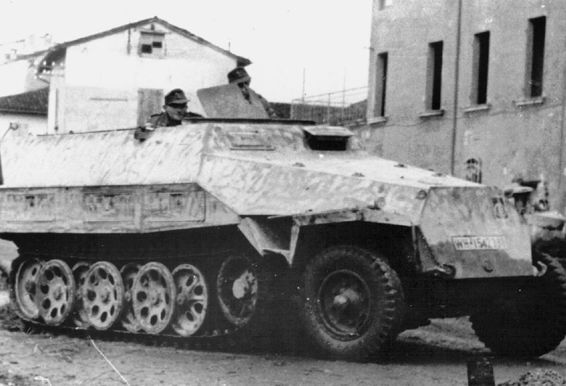
In support is a Wehrmacht Sd.Kfz.251 Ausf.D halftrack advancing through a town. These vehicles were used extensively during the latter half of the war by both the Heer and Waffen-SS to transport Panzergrenadiers to the forward edge of the battlefield. Despite being lightly-armoured, they could maintain a relatively modest speed and manoeuvre across country and keep up with the fast-moving spearheads.

With enemy aircraft now ruling the skies many German divisions had increased their anti-aircraft battalions with each of them containing two or even three heavy batteries. This photograph shows an 8.8cm FlaK 36 gun complete with Schützchild. In various sectors of the front some units barely had enough Panzers to oppose enemy armour and called upon FlaK battalions to halt the Allied attacks. During this later period many FlaK guns came to be assigned dual purposes, which involved adding an anti-tank role to their operational duties.
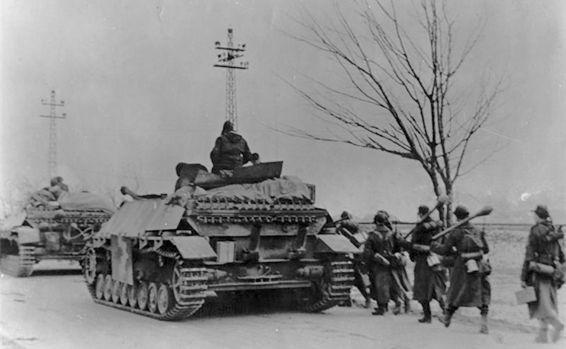
Grenadiers armed with the deadly Panzerfaust (‘tank fist’) march along a road under the protection of a Jagdpanzer IV. With the drastic need for new armoured fighting vehicles, more second-generation tank destroyers were built. One such vehicle that came off the production line in 1944 was the Jagdpanzer IV. This vehicle, built on the chassis of a Pz.Kpfw.IV weighed 28.5 tons. The vehicle was equal to any enemy tanks thanks to its potent 7.5cm gun. The Jagdpanzer saw extensive service during the last months of the war and with its reliability and well-sloped thick frontal armour it became a highly efficient fighting vehicle.
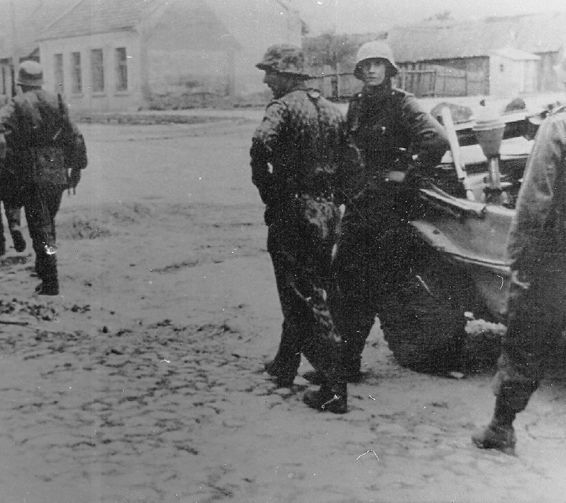
SS soldiers with their Volkswagen Type 166 Schwimmwagen. The Type 166 was the most numerous mass-produced amphibious car in history. Note the Panzerfaust anti-tank projectors inside the vehicle. This recoilless projector consisted of a small, disposable preloaded launch tube firing a high-explosive anti-tank warhead, operated by a single soldier. The Panzerfaust remained in service in various versions until the end of the war. The weapon had warnings written in large red letters on the upper rear end of the tube, warning the user of the back-blast. After firing the tube was discarded, making the Panzerfaust the first disposable anti-tank weapon.

A close-up view of two King Tiger tank men taken in Budapest in 1945. Note the Zimmerit anti-magnetic mine paste on the turret. For additional armoured protection track links have been attached to the side of the turret. The mounting of spare track links would reassure a superstitious crew that the protection had been enhanced, but tests showed that at certain strike angles this improvised armour actually weakened the protection by causing shot traps.

SS troops hitch a lift on board a Pz.Kpfw.IV Ausf.H or J. The Pz.Kpfw.IV became the most common Panzer in the Panzerwaffe and remained in production throughout the war. Originally designed as an infantry support tank, it soon proved to be so diverse and effective that it earned a unique offensive and defensive role on the battlefield.


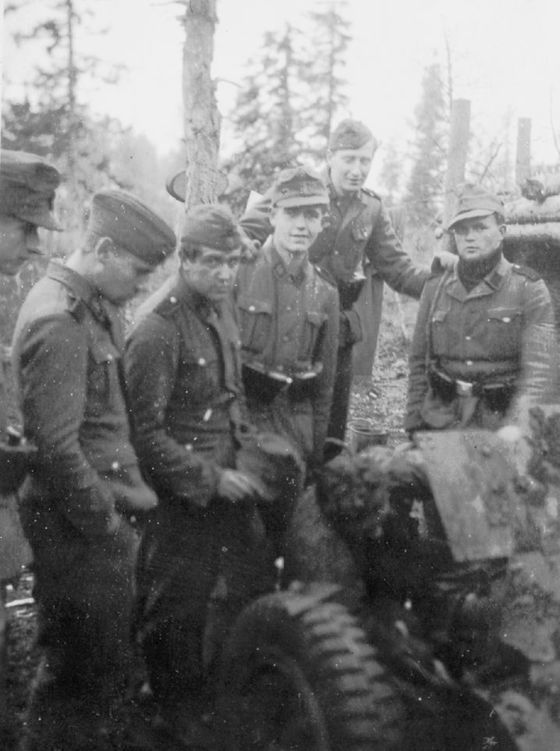
A series of photographs taken of Waffen-SS troops inside a forest during defensive action on the Western Front. A typical strongpoint deployed along the front contained a series of MG34 and MG42 machine guns on light and heavy mountings, an anti-tank rifle company or battalion, a sapper platoon that was equipped with a host of various explosives, infantry guns, an anti-tank artillery company with a number of antitank guns, and occasionally a self-propelled gun. If and when available there might also be Pz.Kpfw.IVs, Tigers, Panther tanks and a number of StuG.III assault guns, all of which were scraped together. This front-line defensive belt became a killing zone where every possible anti-tank weapon and artillery piece would be used to ambush Allied tanks. While an enemy tank was subjected to a storm of fire within the kill zone, special engineer mobile detachments equipped with anti-personnel and anti-tank mines would quickly deploy and erect new obstacles, just in case other tanks managed to escape the zone. Despite the weakened lines of defence when the Allies attacked, they were met by very strong resistance in a number of areas. Note the extreme youth of some of the soldiers.
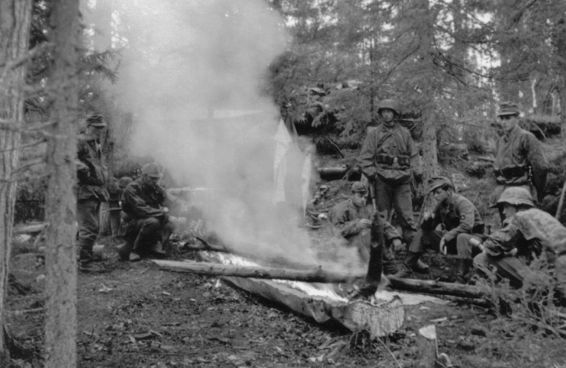

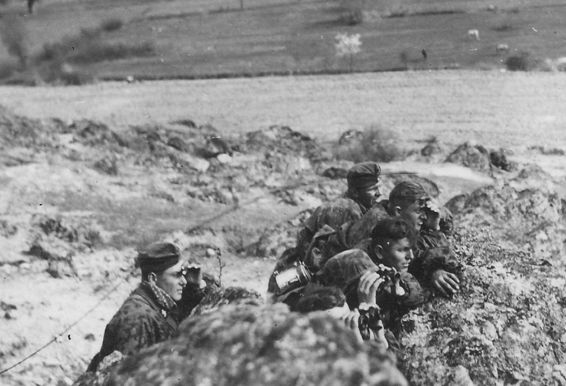
SS troops survey the terrain ahead. The bulk of the weapons and equipment used by the Waffen-SS throughout the war was more or less identical to that used by the Heer. A number of small arms, particularly those of foreign origin, saw considerable use in the units of the Waffen-SS due to the Heer’s initial reluctance to supply sufficient quantities of German-produced hardware to Himmler’s elite force.
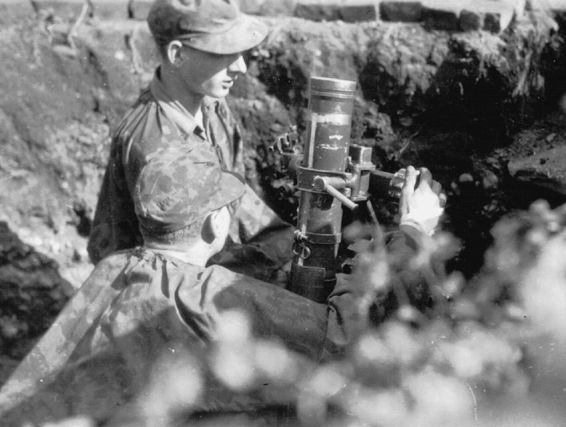
A Waffen-SS 8cm mortar crew preparing to fire one of the weapon’s projectiles. Although the SS were slowly being driven further east by overwhelming enemy superiority, they were still fighting with fanatical determination on the battlefield.

A photo taken at the moment a captured (possibly Czech, French or Soviet) heavy artillery piece is fired at an enemy target. Note the gunner plugging his ears. Late-production models such as this one had pressed steel wheels with solid rubber tyres and air brakes for motor towing. While these old howitzers were heavy and impractical for moving quickly to another position, they were used by both the Waffen-SS and Heer in offensive and defensive roles successfully until the end of the war.

A well-concealed SS grenadier inside his foxhole armed with the standard infantryman’s bolt-action Kar 98k rifle and an M24 stick grenade.
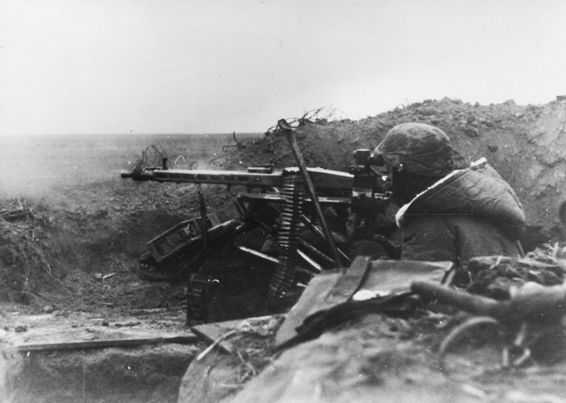
A photograph showing an SS MG42 machine gun on a heavy sustained fire mount. In open terrain the MG42 heavy weapons squad would use their sustained fire mount to protect the flanks of the advancing rifle companies. However, in built-up areas the crews often had to operate forward with the rifle platoons and in light machine-gun roles with bipods only, but they were still sometimes able to take advantage of the situation and revert back to heavy machine-gun role.

SS troops tuck into their rations during a lull in the fighting. They appear to be sharing soup from one bowl. The troops were issued a march ration of sausage, cheese, dried bread, coffee and sugar in paper bags. However, during the last months of the war almost all rations had been exhausted and many troops had to rely on scavenging for what they could find, either from dead comrades, civilians or captured stocks.
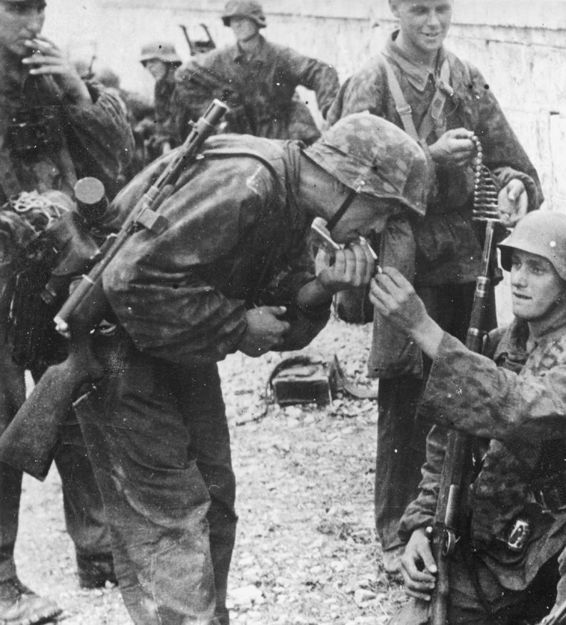
SS troops pause in battle and have a cigarette before resuming operations. This photograph appears to have been taken in the last year of the war in the Balkans. Note the Waffen-SS soldier receiving a cigarette: he is armed with a Bergmann 9mm MP28 machine pistol. The Waffen-SS used a huge variety of weaponry, everything from small arms to heavy tanks. However, even these crack troops were curtailed by never-ending shortages and were supplied with various weapons and equipment in order to sustain them on the battlefield long enough to drive back the growing enemy forces. During the last two years of the war the Waffen-SS supplemented the finest hardware the German armaments industry could produce with whatever could be scraped together from German-made or captured stocks, in the same way that the Heer and the usually badly-equipped Volkssturm also had to make do as best they could.
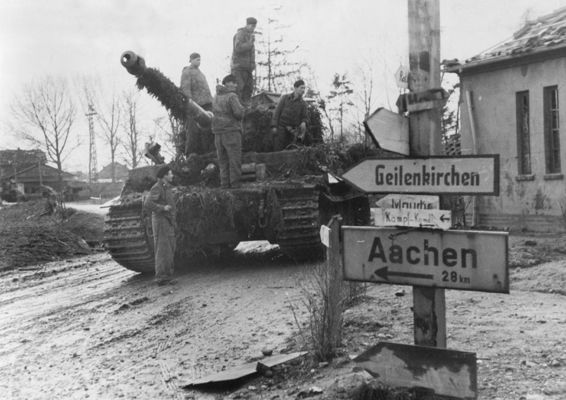
A Tiger tank operating during the last weeks of the war. This tank served on both the Western and Eastern Fronts and with its potent firepower and thick armour it initially proved more than a match for any tanks fielded by the enemy. However, the introduction of more potent Allied tanks, especially the Soviet IS heavy tank series, ended its era of relative invincibility, which many crewmen often learned the hard way by remaining over-confidently aggressive. However, by this period of the war desperation had filled the ranks as the Tiger dwindled in numbers. As with other Panzer units, the once-vaunted Tigers continued to fight on until they were destroyed or they simply ran out of fuel.