
CHAPTER 14
(OCTOBER 1944)
 U.S. 7TH FLEET
VICINITY SURIGAO STRAIT
NEAR THE PHILIPPINE ISLANDS
15 OCTOBER 1944
The carnage in the Palau Islands did little to alter the short-term war plans for either the U.S. or Japan. Both sides were now locked into a bloody fight to the finish. For Tokyo there was only one choice: inflict as many casualties as possible on the Americans in hopes that the bloodletting might cause FDR to accept something less than unconditional surrender. It was a battle plan of utter desperation.
In Washington, the costly battles for Tarawa and Saipan had already tempered any pretense of euphoria. Now, the Peleliu casualty figures were cause for the Joint Chiefs to contemplate the long-range consequences of invading the Home Islands. To the small handful who were aware of its potential, Peleliu was a good reason to consider the as yet untested atomic bomb as a preferable alternative to assaulting the emperor’s native soil.
But all that was well into the future. In the near term, no one was prepared to suggest that MacArthur revise his plans for returning to the Philippines. Even before the fighting was done on Peleliu, Nimitz began shifting his subs, carriers, and surface forces south from the central Pacific to support the invasion of Leyte.
In preparation for the operation, code-named King Two, American bombers struck Imperial air and naval bases on Formosa and Luzon repeatedly in order to minimize the effectiveness of any counter-attack against MacArthur’s invasion forces. By 11 October, when the ships of the 3rd Amphibious Force were ordered to sortie from the Admiralty Islands, the Japanese had lost air superiority over much of the southern Philippines. Two days later, the 7th Amphibious Force deployed from bases MacArthur had seized on the north coast of New Guinea.
On 15 October, the two amphibious forces rendezvoused with the rest of the 3rd and 7th Fleets, just east of Leyte, at the north end of the Surigao Strait. The combined 738-ship armada included eight large aircraft carriers, twenty-four small carriers, a dozen battleships, two dozen cruisers, and 141 destroyers—making it the most powerful naval force ever assembled.
Among those engaged in this extraordinary endeavor were some of the most famous names in the history of the U.S. Navy: Admiral “Bull” Halsey, commanding an abbreviated 3rd Fleet aboard the battleship New Jersey; Admiral Marc Mitscher, on the carrier USS Lexington; Rear Admirals Frederick Sherman, Ralph Davison, and Gerald Bogan; and Vice Admiral John S. McCain, the grandfather of Senator John McCain.
Vice Admiral Thomas Kinkaid, commander of the 7th Fleet, was also designated as the overall commander of the invasion operation. MacArthur, deployed aboard the cruiser Nashville, was little more than a passenger until he got ashore—as he clearly intended to do as soon as possible. Halsey’s 3rd Fleet, though not under Kinkaid’s operational control, was nonetheless assigned the mission of providing cover for Kinkaid’s 7th Fleet and the landings by the amphibious forces. It was a command arrangement that would come to haunt the invaders.
 HQ 6TH RANGERS ASSAULT
SULUAN AND DINAGAT ISLANDS
PHILIPPINE ISLANDS
18 OCTOBER 1944
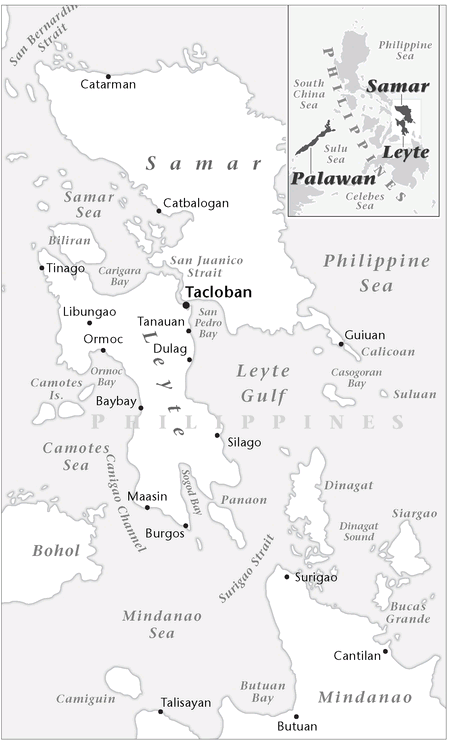
Though D-Day for the invasion of Leyte had been set by the Joint Chiefs for 20 October, operations ashore actually commenced on 17 October when the 6th U.S. Army Ranger Battalion, commanded by Lieutenant Colonel Henry “Hank” Mucci, charged ashore on the islands of Suluan and Dinagat. Their mission: destroy the Japanese radar and communications facilities and anti-shipping artillery on the tiny spots of land that provided natural obstacles off Leyte’s landing beaches.
Supported by carrier air strikes and naval gunfire, Mucci’s 500 Rangers made short work of the Japanese garrisons on both islands. On Dinagat, in a fashion reminiscent of Peleliu, the enemy had installed heavy artillery that could roll out of caves and fire at the approaching U.S. Navy ships. The guns were spiked in short order and despite lingering Japanese resistance, the Rangers set up beacons to guide the ships of the main landing force to their beaches. After securing the islands, the Rangers planted an American flag—the first to fly in the Philippines since Japan had taken the islands from the United States almost three years earlier.
 ABOARD USS NASHVILLE
LEYTE GULF
PHILIPPINE ISLANDS
20 OCTOBER 1944
For the next forty-eight hours after Mucci’s rangers seized the two little sentinel islands off Leyte, the landing beaches were pounded by the 7th Fleet’s battleships. Carrier aircraft bombed and strafed the beaches. Employing lessons learned from the assaults on the Marianas and Palau Islands, naval gunfire spotters in small aircraft overhead and aboard close-in destroyers and LCIs adjusted the fire of the battleships and cruisers until they were sure that every known target ashore had been hit at least four times.
But the Americans weren’t the only ones who had learned lessons at Peleliu. The Japanese didn’t bother to return fire on the U.S. battleships and cruisers—they were too far out at sea. Instead, the surprised defenders hunkered down in their holes waiting for softer targets—the landing craft ferrying MacArthur’s troops from ship to shore.
Despite a Philippine occupation force that numbered more than 270,000, the Japanese troops ashore, led by General Tomoyuki Yamashita, were woefully unprepared for MacArthur’s invasion. On Leyte, the 16,000 men of the Imperial Army’s 16th Division were short on supplies, ammunition, and fuel. American carrier aircraft had bombed their air force practically out of existence. And U.S. Navy submarines, operating from bases in New Guinea, New Britain, and the Marianas, were sinking Japanese merchant ships and crude oil carriers faster than they could be replaced.
Early on the morning of 20 October, MacArthur and Kinkaid agreed that the landing beaches had been sufficiently “prepared.” When MacArthur was told that the headquarters of the 16th Division had likely been destroyed, he is said to have remarked, “Good, that’s the outfit that did the dirty work on Bataan.” Shortly before dawn on 20 October, Kinkaid gave the order: “Land the landing force.”
The assault, led by the 96th and 24th Infantry Divisions, began after sunrise as the final fires from hundreds of heavy guns swept the beaches and more than 1,000 carrier aircraft crowded the skies. Well before noon, soldiers of the 96th Infantry Division had captured Hill 120, a key D-Day objective. On the other side of the waterfront town of Tanuan, the 24th Infantry Division moved smartly inland. Then, a little after noon, a Navy landing craft motored to within a few feet of the beach. It let down its ramp, and with bullets snapping through the air a few hundred meters away, General Douglas MacArthur strode through the shallow water to the shore. The old general had kept his promise: He had returned.
Once ashore, MacArthur headed to the 24th Infantry Division’s command post. From there he broadcast a message to the Filipino people and to listeners in America: “This is the voice of freedom. People of the Philippines, I have returned.” After informing them that Filipino president Sergio Osmeña, Manuel Quezon’s successor, had returned with him, he concluded with “Let no heart be faint.”
One of those who was there for this remarkable moment was twenty-two-year-old First Lieutenant Paul Austin from Ft. Worth, Texas, the commander of F Company, 2nd Battalion, 34th Infantry, 24th Infantry Division.

FIRST LIEUTENANT PAUL AUSTIN,
US ARMY
F Co, 2nd Bt, 34th Inf, 24th Inf Div
Northeast Coast of Leyte
21 October 1944

We were taken out to the transports, and more than 400 ships left New Guinea, headed for the Philippines. That last night aboard the ship, it was unusually quiet. There was some letter writing going on, some rifle cleaning. It was a serious time in our lives.
It was about six o’clock that morning when they dropped anchor. And then there was a loud explosion. The ship just trembled. We all looked at each other, and felt maybe we had been torpedoed. But someone said, “No, that’s the beach bombardment beginning.” Our battleships were firing with sixteen-inch shells.
About 9:15, we went over the side, down the cargo net, and into the boats. I was in the second wave. I could see Japanese artillery shells hitting the water, exploding, around the first wave, then around the second wave. I looked over to the left, and two LCIs had been hit and were on fire. I heard a loud explosion behind me, and I looked around. The boat that had been behind me wasn’t there. All I could see was three or four helmets floating upside down in the water. About thirty men in the boat were killed within a split second.
Then I heard a loud voice to my left. He said, “Let’s get off this beach! Follow me!”
General MacArthur came in the same area we did. He brought with him the president of the Philippines, Osmeña. When MacArthur waded ashore right behind our battalion, the word went just like wildfire. “MacArthur has landed!” kept going through the ranks. Everybody knew who he was, and it was uplifting.
We had heard that phrase “I shall return” over and over. It was kind of a motto, something for us to look forward to.
A tank came roaring up from the beach right after we got fifty yards inland. The tank rolled right on through F Company, up to K Company, and the battalion commander stepped over and started talking to the crew on the tank-infantry phone, giving the gunner the targets. Anything that looked like it could conceal an enemy soldier, he put a 75 mm shell in. He literally blasted his way through that jungle.
When they quit firing that tank, he turned and said to our battalion, “All right, you can go through now.” When we got to a little town, we surrounded it and dug in. I went down the line out and told the men, “Dig’em deep. You will get hit tonight for sure.” And they did. At dark we got in those foxholes, and didn’t come out until daylight. If you did, you were fair game for the Japanese, and you’d get shot.
About one o’clock that morning, a mortar shell exploded about twenty feet behind my foxhole. I felt like they used that one shell as a signal to begin their attack. Right after that, all hell broke loose. As it turned out, two of our platoons were caught in a banzai attack, and they hit G Company something awful. It was a full Jap battalion; two companies hit that roadblock, and they held it for two hours. The third Jap company swung out across this field in front of F Company and started coming toward us.
They began to lay a murderous fire on us. They knew exactly where we were. After about fifteen minutes, the bullets were coming over our foxhole so thick and fast that I had the distinct fear that if I stuck a finger up, it would be cut off. There was just a constant popping as the bullets came whizzing by.
After a bit, there was a steady roar of our M1s, a machine gun, and about four Browning automatic rifles.
The toughest part, personally, was lying on the ground in a dark jungle, where you can’t see your hand before your face, and there was a man about six feet away from us who had been shot through the stomach. But we couldn’t do anything for him. We’re five or six miles from the road, it’s pitch black, and we had no chance in the world to get him out. We did have a medic with us, and he was doing all he could for him. But the man woke up about every hour and called for his mother. That’s hard.
I had about 180 guys in my rifle company when we landed on Leyte. When we left, there were fifty-five men left. But I think of it this way. If we hadn’t done what we did, today it wouldn’t be the United States of America. We’d be speaking Japanese west of the Mississippi River, and across the river they’d be speaking German.
That’s what could have happened, and would have happened, if millions of us hadn’t put on uniforms and decided it wasn’t going to happen.
 JAPANESE FIRST STRIKING FORCE
IMPERIAL NAVAL BASE
BRUNEI, BORNEO
21 OCTOBER 1944
The Japanese army may not have been prepared for MacArthur’s return to the Philippines, but the Imperial Navy was as ready as it could be given the shortages Japan was experiencing from the U.S. Navy’s round-the-clock submarine attacks. Word of the Leyte landings was passed quickly and from Tokyo, Admiral Soemu Toyoda quickly put his Sho One plan into effect. Sho is the Japanese word for victory, and Toyoda intended to be victorious.
The Imperial Navy’s Sho One plan was a last-ditch effort to engage the U.S. Navy in a decisive battle. Within hours of learning about the landings on Leyte, most of the remaining ships in the First Striking Force were under way, steaming toward the Philippines from their base in Brunei, on the island of Borneo. Admiral Soemu Toyoda had a complicated plan—but one goal: to engage and destroy a U.S. fleet that outnumbered him almost three to one.
Toyoda hoped to lure the American 3rd Fleet away from the invasion beaches and get it into a position where the Japanese could trap it and inflict mortal damage to the ships and men.
Knowing he was outnumbered—particularly in aircraft—Toyoda believed that his more experienced commanders could somehow prevail. His subordinates shared that belief in the Sho One plan, themselves, and their ships.
Admiral Takeo Kurita, aboard the heavy cruiser Atago, commanded the Japanese First Attack Force, consisting of five battleships—the Kongo, Haruna, and the “super battleships” Nagato, Yamato, and Musashi—nine other heavy cruisers, and thirteen destroyers. The three “supers” were the largest battleships ever built and the Yamato boasted eighteen-inch guns.
Admiral Jisaburo Ozawa, who had been humiliated at the “Great Marianas Turkey Shoot,” led the Northern Force of carriers. Though Ozawa’s primary mission was to act as a decoy for Halsey, he was placed in overall tactical command of the operation. A third Japanese naval task force called the Southern Force was split into two separate units, SF-1 and SF-2. Admiral Shoji Nishimura’s battleships, cruisers, and destroyers were designated SF-1, and Admiral Kiyohide Shima led a similar surface action force called SF-2. They, along with Kurita’s force, intended to enter the Leyte Gulf from opposite sides—Kurita from the north and Nishimura and Shima from the south—in an effort to box in the Americans. Admiral Toyoda calculated that if he could catch the Americans in this “pincer movement” he could trap, destroy, and sink the American ships.
And, like so many other Japanese naval operations, Toyoda’s plan relied on deception. He hoped to use Ozawa’s task force as a decoy to get Halsey’s 3rd Fleet to leave the area around Leyte and go after Ozawa’s carriers. Toyoda and Ozawa gambled that, if tempted with nailing four Japanese aircraft carriers, Halsey would leave his station at the east entrance to the San Bernardino Strait and go after the really “big fish.”
If all worked as planned, then Ozawa would engage the 3rd Fleet while the other Japanese task forces moved in and decimated the landing forces and the covering ships of the 7th Fleet. Then, in withdrawal, Kurita’s force could come to Ozawa’s assistance in a decisive battle to destroy or at least severely cripple the U.S. 3rd Fleet. At least, that was the plan.

 JAPANESE CENTER FORCE
PALAWAN PASSAGE ENCOUNTER
PHILIPPINE ISLANDS
23 OCTOBER 1944
Before dawn on 23 October, Toyoda’s battle plan was coming to fruition. Kurita’s First Attack Force, which sortied from Brunei, Borneo, was steaming parallel to Palawan Island toward the American invasion beaches. Nishimura’s SF-1, which left the same anchorage, was taking a more easterly route toward Leyte. Meanwhile, Shima’s battleships and cruisers were racing at flank speed south from Japan and Okinawa.
Admiral Takeo Kurita

At Leyte, the Americans, busy offloading supplies for MacArthur’s troops, were blissfully unaware of the pending battle. Then, at 0630 on 23 October, two American submarines, the USS Darter and USS Dace, observed Kurita’s First Attack Force racing north off the west coast of Palawan Island. The Darter was able to torpedo the Atago, which sank twenty minutes later. The Dace torpedoed the Maya, causing it to sink just moments after the Atago. The Dace also seriously damaged the Takao, but somehow she was able to withdraw and make her way back to Brunei for repairs. After his flagship sank, the destroyer Kishinami rescued Admiral Kurita, who transferred his flag to the Yamato and continued on course toward the now-alerted Americans at Leyte. Despite his losses, Kurita made it clear that he expected all remaining ships from his First Attack Force to press on to the San Bernardino Straits.
 BATTLE OF THE SIBUYAN SEA
ABOARD 3RD FLEET FLAGSHIP
VICINITY OF LUZON ISLAND
24 OCTOBER 1944
1740 HOURS LOCAL
By dawn on the morning of 24 October, American recon planes, ignorant of Shima’s onrushing fleet, were searching without success for Kurita’s First Attack Force and Ozawa’s carriers.
At about 0800, U.S. Navy scout planes located Kurita’s battleships in the Sibuyan Sea, heading for the San Bernardino Strait. The ever-aggressive Halsey wasted no time ordering his 3rd Fleet carriers—now designated as Task Force 38—to launch an air strike. Admiral Frederick Sherman was the first to respond, launching his carrier planes off the USS Princeton to engage Kurita’s battleships in the Sibuyan Sea. Meanwhile, his ships and carrier aircraft fended off Japanese bombers from Clark and Nichols Fields. The American carriers and their escorts threw up a furious anti-aircraft barrage. It wasn’t enough.
At 0935, a single shore-based “Judy,” launched from Clark Field, managed to penetrate the Hellcats and anti-aircraft fire and drop one bomb on the flight deck of the Princeton. The bomb started fires that raged out of control, causing a huge explosion in the carrier’s torpedo storage deck. This explosion also damaged the cruiser Birmingham, which had come alongside to help fight fires and transfer wounded. Princeton went to the bottom less than an hour later.
Meanwhile, Navy carrier pilots from Bogan’s, Davidson’s, and Halsey’s carriers were taking their revenge. Navy dive-bombers and torpedo planes put nineteen holes in the battleship Musashi, eventually sending her down—carrying more than 1,000 Japanese sailors to the bottom with her. With all of his battleships damaged by at least one bomb or torpedo hit, Kuirita broke away and headed west to get out of range of the American planes.
Halsey’s 3rd Fleet aircraft had launched some 260 sorties against the Japanese ships, losing only eighteen planes that day, though casualties aboard the Princeton and Birmingham were heavy. Briefed by his pilots, Halsey believed that the entire Japanese fleet had suffered heavy casualties, and that Kurita was withdrawing to Brunei.
 USS NEW JERSEY
OFF CAPE ENGAÑO, LUZON
PHILIPPINE ISLANDS
24 OCTOBER 1944
2000 HOURS LOCAL
Meanwhile, still hoping to get Halsey’s attention, Ozawa’s decoy force had launched all its planes to the south during the Battle of the Sibuyan Sea to attack the 3rd Fleet, leaving no aircraft to cover the Northern Force carriers. Ozawa desperately wanted the decoy plan to work. Unless he could draw Halsey’s ships north, Kurita’s First Attack Force would be unable to get through the San Bernardino Strait in sufficient time to engage the Japanese Southern Force before it could wreak havoc on Leyte.
Ozawa’s decoy mission was a disaster for his pilots. Before the Battle of the Sibuyan Sea, Ozawa had 116 aircraft. By late afternoon of 24 October, when one of Halsey’s scout planes finally spotted black smoke spewing intentionally from Ozawa’s carriers, he had just twenty-nine remaining.
Halsey jumped at the bait. He ordered his 3rd Fleet to give chase—with the goal of launching a dawn attack on the Japanese flattops. That’s when things began to unravel for the Americans.
As he sped north, Halsey thought that the 7th Fleet transports and their escorts at Leyte faced no serious threats because he’d accepted the exaggerated reports of his returning pilots that Kurita’s force had been compelled to retire and head back to Brunei. This faulty information led him to presume that Kinkaid no longer needed the 3rd Fleet’s covering force. The hard-charging “Bull” was wrong.
Kurita had turned toward Brunei, but then he reversed course and headed back east toward the San Bernardino Straits. At 2000 on 24 October, as he sped northward, Halsey was heading away, just as Ozawa and Kurita intended.
Halsey radioed Admirals Nimitz and Kinkaid with the message: “I AM PROCEEDING NORTH WITH THREE TASK GROUPS TO ATTACK ENEMY CARRIER FORCE AT DAWN.”
 BATTLE OF SURIGAO STRAIT
7TH FLEET FLAGSHIP COMMAND
VICINITY OF LEYTE GULF
24 OCTOBER 1944
2020 HOURS LOCAL
Earlier that day, Halsey had sent a message indicating that he was going to create a new task force group by pulling ships from the other groups. This new force, to be called Task Force 34, was to consist of four battleships, six cruisers, and fourteen destroyers. Halsey had said that it would be used “to engage the enemy decisively at long ranges.”
Admirals Nimitz and Kinkaid had each received Halsey’s earlier radio message, but neither had any idea that creating Task Force 34 meant Halsey was not going to provide a covering force for the 7th Fleet’s amphibious force, which still had 110,000 troops and 250,000 tons of ammunition, fuel, rations, and other supplies still to be put ashore.
When Nimitz and Kinkaid received Halsey’s message at 2000 about heading north with three groups, they each assumed that he would use Task Force 34 to guard the San Bernardino Strait against Kurita’s return and would be taking his only three carrier task groups to engage Ozawa’s fleet.
As long as the 7th Fleet commanders were able to provide cover from their own ships in the south, and there was no interference from Kurita’s Center Force or Ozawa’s Northern Force, there was no need to worry. They could handle the Southern Force, and no one replied, questioning Halsey’s order.
For his part, Halsey believed his intentions were clear. He said, “I am proceeding north,” and had earlier reported that he would be with Task Force 34. No one questioned the fact that he was going north, nor did they think to inquire who was left to guard the San Bernardino Strait.
When the news came that afternoon about Kurita’s losses and apparent withdrawal, Halsey changed his mind about creating Task Force 34. He reasoned that with Kurita so weakened and in retreat, Kinkaid could handle any other problems the Japanese navy might pose. So Halsey steamed north, to engage Ozawa, leaving no U.S. force to guard the San Bernardino Strait or provide cover for Kinkaid’s 7th Fleet.
On the night of 24 October, believing that Halsey’s Task Force 34 was guarding the San Bernardino Strait and the northern waters, Kinkaid concentrated on the south. He assigned Rear Admiral Jesse Oldendorf to “plug up” the Surigao Strait between Dinagat Island (taken by the 6th Ranger Battalion almost a week earlier) and the southern tip of Leyte Island. It would be the logical sea entrance for an attack by the Japanese Southern Force.
Kinkaid relied on more than logic, however. He’d received reports earlier in the day that the Southern Force had been sighted in the Sulu Sea—due west and opposite the invasion’s landing beaches. By having Oldendorf cover the southern entrance to the Surigao Strait, and with Task Force 34 supposedly covering the waters north of the landing site, the U.S. invasion of Leyte could continue until completed without interference by the Japanese. All Kinkaid had to do was keep the Japanese Southern Force from getting through. Kinkaid and Oldendorf both reasoned that Task Force 34 would surely take care of Kurita’s Center Force if and when it returned.
At 1900 hours on 24 October, Nishimura was already at the southern end of Surigao Strait and sailing north toward the American transports. At 2230, one of Oldendorf’s thirty-nine torpedo boats sighted Nishimura’s force in the strait and radioed its presence to Oldendorf and Kinkaid.
At fifteen minutes past midnight on 25 October, another U.S. torpedo boat encountered Nishimura’s force and launched its torpedoes. Others joined in the fray; altogether they launched thirty-four torpedoes during the three-hour attack, but scored only one hit. Emboldened, Nishimura charged in. He thought he had somehow successfully maneuvered through the gauntlet of American torpedo boats on both sides of his line of ships.
But then Nishimura’s luck ran out. He was confronted by Oldendorf’s main force, positioned at the top of the strait. Waiting for the Japanese ships were six U.S. Navy battleships, four heavy cruisers, four light cruisers, and twenty-one destroyers. Oldendorf had positioned his ships to trap the Japanese force. It was a traditional old-fashioned naval battle, with extensive use of big guns and torpedoes.
At exactly 0300, Oldendorf’s twenty-one destroyers caught the enemy from both sides near the southern tip of Leyte. The gauntlet began to close as Nishimura’s ships moved closer to the transports.
In less than an hour Nishimura was confronted first by the destroyers, then by Oldendorf’s cruisers and battleships, which proceeded to unleash their big guns. The brutal shelling took a terrible toll.
By the time the engagement was over, the U.S. 7th Fleet had put every one of Nishimura’s ships out of commission. He and his crew perished when the Americans sank his flagship, the battleship Yamashiro.
Meanwhile Admiral Shima, with his half of the Southern Force, had entered the bottom end of the Surigao Strait. He’d arrived just in time to see the results of Oldendorf’s awful destruction of Nishimura’s flotilla.
Shima’s flagship, Nachi, collided with the retreating and blazing Mogami of Nishimura’s force, and Nachi was damaged in the incident. U.S. torpedo boats had already attacked Shima’s force on the way in, knocking one of his light cruisers out of formation. Now Shima had a paltry force of three cruisers and four destroyers, and he could see that they didn’t stand a chance. His ships made a quick U-turn and headed back to the safety of the Mindanao Sea.
As the battle of the Surigao Strait developed, Lieutenant (jg) Jim Halloway, a twenty-two-year-old gunnery officer from Charleston, South Carolina, was aboard the destroyer Bennion. Through his binoculars, he could see the approaching enemy vessels.

LIEUTENANT (JG) JAMES HALLOWAY, USN
Aboard USS Bennion
Surigao Strait
24 October 1944
0004 Hours Local

I remember thinking at the time, “That looks just like a Japanese battleship!” We’d gotten reports from submarines that had seen this group coming into Surigao Strait. They first reported a battleship, then a second, and a third. Then they submerged and came up and reported, “Now we see a cruiser.”
Their battleships turned out to be the Fuso, which had nine fourteen-inch guns, and each projectile is as tall as I am. That’s a big hunk of explosive. And the Yamashiro had nine or maybe twelve sixteen-inch guns. The Yamashiro was followed by the Mogami. She was very heavily armed with eight-inch guns, torpedo tubes, and six-inch guns. And I think there were four or five destroyers with torpedoes. We had, in our group, nine destroyers that would be taking on this group as they came through.
The Japanese were coming in a column. And we were coming down on their bow. Our destroyers were at 300-foot intervals, and we were making thirty-two knots.
I was standing up with the binoculars. And there it was, clearly a Japanese battleship. At that point-blank range, we were given our target from the squadron commander of the destroyers. He said, “Your division will attack the second ship, the Yamashiro.”
We could see two battleships now. And we cranked the director around, put the crosshairs right on the second battleship, and lowered the crosshairs to the waterline. I told the people in the plotting room, tracking Yamashiro by radar, to get her course and speed.
We received the orders to make the run in. That’s when we increased speed to thirty-two knots, made smoke, and headed for our launch point for the best torpedo shot, 1,000 yards from the Yamashiro.
It sort of gave us comfort when our battleships started firing, six in a row, with their tracers. Looking through the lens, I could see them impacting on both the Fuso and the Yamashiro. Guns were being torn off and the superstructure began to collapse, and fires started. But the Japanese guns didn’t slow down a bit.
One torpedo would not sink it. It would take three or four. We could launch ten, but were told to only launch five—our division would launch fifteen—so there would be fifteen torpedoes going against the Yamashiro.
We fired a spread to take care of the ship’s maneuvering area. That way, between three and six torpedoes hit Yamashiro. And then she’s in trouble.
We could also see where the projectiles from our ship were striking the Japanese ships. When one of those large armor-piercing shells hits, the first thing that happens is that the whole area of the armor where the shell hits turns pink. I guess it’s just all that energy being dissipated, and then comes the explosion. It was quite a Fourth of July show because when it hit, the shell exploded, and then it set off ready ammunition topside, and that would also explode, and it was a pretty wild scene.
We were sent south again to sink the rest of the Japanese ships that were trying to escape. As we went again into the strait, it was really a scene out of Dante’s Inferno. The seas were covered with oil, there was wreckage all over the place, and there were Japanese sailors hanging onto the wreckage as we went by.
That’s when Bennion encountered the Asagumo, a Japanese destroyer about five miles away. It looked like it was badly hit and was limping away. But the commander of the 7th Fleet ordered us to destroy it.
”One of our destroyers, the Grant, was badly shot up and dead in the water, but she was able to get steam up and get under way again. I think Grant lost something like sixty people.
Early in the melee, just as we were beginning to withdraw, we saw a large shape on our starboard side. It started firing toward the Grant. We were only about 2,000 yards away but the cruiser hadn’t seen us—it was shooting over us. The plotting room said, “We have her course and speed, and she looks like she’s in a turn.” The captain said, “Fire five torpedoes!” So we swung the tubes out, ready to fire, hit the switch, and away they went. We sank the cruiser Asagumo.
We listened to the TBS, the VHF radio to “talk between ships.” Normally, it wouldn’t range that far, but we were getting some skip distance and we heard this voice say, “This is Taffy 2. I’m under fire by some sixteen-inch guns, and two battleships and three cruisers are bearing down on me.”
Here we’d just finished this night action, and thought we’d destroyed the Japanese threat to the Leyte beachhead. Now, suddenly we find that aircraft carriers providing our air cover are under attack from Japanese surface ships in the vicinity.
I went from the elation of great victory to a feeling of, “This can’t be happening.” It was a tremendous reversal for all of us.
The only advantage we had was that, for a while, the Japanese ships were firing armor-piercing shells and they went in one side of the carrier and out the other before exploding. But then the Japanese caught on and began using 2,000-pound bombs.
 TASK UNIT TAFFY 3
BATTLE OFF SAMAR ISLAND
25 OCTOBER 1944
0815 HOURS LOCAL
Admiral Oldendorf’s destroyers, cruisers, and battleships had set a trap for the Japanese Southern Force and it had worked. The crossing of the “T”—a classic maneuver taught at naval schools for centuries—had caught Admiral Nishimura off guard. His flagship, the Yamashiro, was sunk, taking its skipper to the bottom of the bloody, oily, fiery waters of the Surigao Strait.
For Oldendorf and his men, victory had been complete. But Halsey’s move north was having devastating consequences. Admiral Kurita, having changed his mind about retreating, entered the San Bernardino Strait just after midnight and was surprised that the 3rd Fleet was nowhere in the vicinity. Four hours later, Kurita’s ships slid unnoticed through the strait and headed south to Leyte Gulf.
Kurita planned to reposition his ships from a search and patrol night formation to the circle formation used for anti-aircraft defense. It was just about the time that the Battle of Surigao Strait was ending to his south. At 0415 Admiral Kinkaid radioed Halsey and asked about Task Force 34, inquiring whether it was still guarding San Bernardino Strait. Halsey didn’t get the message until two and a half hours later.
At about 0720, Oldendorf recalled his ships from the Surigao Strait, and about that time, Halsey—a few hundred miles north of Leyte Gulf—was composing a radio message in response to Kinkaid’s earlier query. This message should have informed Kinkaid that Task Force 34 had not been deployed and was not guarding the San Bernardino Strait. Instead, it merely informed the 7th Fleet commander that Task Force 38 was heading north in its entirety.
Ten minutes later, Oldendorf received an urgent radio message from an carrier escort with one of the 7th Fleet’s task units. The 7th Fleet had eighteen carrier escorts, divided into three task units of six small carriers each, code-named “Taffy” 1, 2, and 3.
Task Units Taffy 1 and 2 were 120 miles out from Leyte on submarine and anti-aircraft patrol. Taffy 3’s commander, Admiral Clifton Sprague, had launched twelve fighters and six planes of an anti-submarine patrol just after 0600 to provide cover for the ships in Leyte Gulf, to combat air patrol over the invasion beachhead, and to execute ground attacks on the enemy troops on Leyte. The Taffy task units and their aircraft weren’t trained, or even equipped, to fight an enemy fleet.
Then, just after dawn on 25 October, Kurita’s Center Force off Samar Island surprised the carrier escorts of Taffy 3. About 0700, a recon plane from Taffy 3 located the Japanese ships but Kurita reacted first, ordering a “general attack.”
Kurita’s order meant that each Japanese skipper would initiate independent action. When the shells from Kurita’s battleships and cruisers began splashing in the ocean near his carriers, Sprague sent Kinkaid an urgent radio message that they were under heavy attack from Kurita’s fleet, and that their own small force was no match for the Japanese. Sprague asked for immediate help from Task Force 34, which he assumed to be nearby, or from the rest of the 3rd Fleet somewhere north of his position.
The terrible news that the enemy fleet was already halfway into Leyte Gulf was passed up the line. The entire Leyte invasion operation was now in jeopardy.
When Halsey finally replied to Kinkaid’s earlier radio inquiry, Kurita’s big guns were already shelling the small escort carriers of Taffy 3. Admiral Sprague radioed that he was under fire from four battleships, eight heavy cruisers, and eight destroyers. All of his carriers were well within range of the big Japanese guns and the enemy ships were all out of range of his much smaller five-inch guns.
Suddenly, Sprague saw an avenue of delay, if not delivery: a bank of fog and rain. He ordered his carriers and destroyer escorts to enter the nearby rainsquall. It bought them about fifteen minutes of cover. As Sprague lay hidden, both he and Kinkaid were wondering what had happened. Where was Halsey’s Task Force 34? Where was the rest of the 3rd Fleet?
Once the rainsquall no longer protected them from visual contact, Admiral Sprague knew he couldn’t outrun or outgun the Japanese battlewagons or cruisers. Having already sent all his planes out on patrol, and desperate to save his carriers, at 0715 Sprague ordered his three escorts, USS Hoel, USS Heermann, and USS Johnston, to counter-attack the Japanese formation.
If the carriers were going to survive, the little destroyers were going to have to go up against battleships and cruisers four times their size, many with fourteen- to eighteen-inch guns. It was like a dog chasing a truck—the entire Taffy task unit was smaller than the Yamamoto.
The destroyer’s confrontation with Kurita’s powerful First Attack Force seemed like a suicide mission. Yet Sprague’s order was carried out with extraordinary courage and determination. The gamble paid off and most of the carriers survived the first and only encounter between carriers and surface combatants.
Thirty-five minutes into the lopsided fight, Sprague sent his only remaining surface combatants, little destroyer escorts, to engage the battleship Yamamoto, Kurita’s flagship. After several exchanges, the Yamamoto fled to escape the American torpedoes. For the rest of the naval skirmish, Kurita remained off-balance and was unable to get back into action.
During the battle between Kurita’s Center Force battleships and Sprague’s Taffy units, Lieutenant Tom Stevenson, a twenty-two-year-old communications officer, had a ringside seat on the deck of one of Taffy 3’s destroyer escorts, the USS Samuel B. Roberts.

LIEUTENANT THOMAS (TOM)
STEVENSON, USN
Aboard USS Samuel B. Roberts
25 October 1944
As the communications officer and a deck officer, I stood eight hours of deck watch a day and decoded all the messages that came in. We were aboard the smallest of the major war vessels and I would have to prepare the messages for the appropriate officers on the ship and supervise the general operations of the radio room and the signal apparatus.
Taffy 3 screened for anti-submarine and for anti-aircraft purposes.
Planes were taking off from the carriers of Taffy 3 and were supposed to put up combat air patrol to protect the ships from air attack, and to launch strikes at the beach every morning at dawn to support the troops with bombing and strafing.
The planes would come back and re-arm, go back, and make a second strike during the day, and sometimes a third strike. Meanwhile, we’d keep a combat air patrol of six fighters above our own formation to try to ward off any attacking Japanese planes.
At night the radio for TBS signal skips, and you can hear it sometimes many miles away. So I heard the reports of the Battle of Surigao Strait during the night. We were aware that we had won a terrific victory.
Suddenly, the “general quarters” alarm rang for everybody to report to their battle stations. The Japanese ships had spotted us. We could only see the tops of the masts of the Yamato, the Kongo, and big battleships. They were over fourteen miles away. We didn’t know they were coming after us until they opened fire.
Evidently, they were on their way to Leyte Gulf, where the troop transports were. They just stumbled on us.
Well, against the battleships, there was no defense because they were so far away and their guns could reach us, while we couldn’t even shoot a quarter of the way at them. So our only defense was to lay smoke around the carriers
As they closed on us, we had hoped that we’d be able to fire on them, but it took a long time before they came within range. Then we could use our five-inch guns, which we did. But our main weapons to really cause some damage were our torpedoes. But unfortunately the destroyer escorts only carried three each, whereas the destroyers had ten. So as things got worse, the admiral ordered the “small boys” to form up for a torpedo attack. The “small boys” were the destroyers, and the “small, small boys” were the destroyer escorts.
The destroyers were the Hoel, the Johnston, and the Heermann. We saw the Hoel and the Johnston form up for a torpedo attack, but the Heermann had not yet shown up, so we just fell in behind the Johnston and the Hoel.
We saw the Johnston starting to get hit pretty badly. We were able to go all the way in to fire at about 6,000 yards. We were tracking a heavy cruiser. I don’t know whether it was the Tone or the Chikuma, but we felt that we made a hit.
I was up on the signal bridge when we saw the Johnston the last time. She was really shot up, but she was still firing and still steaming along pretty well. But all of a sudden she got into the smoke and I never saw her again.
The captain came on the squawk box and indicated that our chances of surviving were not great, but we were going to do a lot of damage to the enemy. John McClair and I were good friends, so we were up on deck together, and we shook hands and said good luck to each other.
The first real hit that I could feel was when a cruiser shell went through the main deck and through the side of the CIC where we were and into the fire room, below the bridge structure.
It was a panic, because everything went out and you could hardly breathe. Everyone ran to get out. I had a talker’s helmet and a voice megaphone in front of me. I had a hard job getting them to get out, so I got out there a little late myself. Thank God that I did, because as I looked down on the main deck I saw a lot of bodies strewn around.
First thing I had to do was to go back down into the radio room where the decoding machine was and get the decoding wheels and throw them overboard.
Then I was supposed to blow up the ECM, which was a top-secret coding machine. I didn’t put the hand grenade in the side of it, as I was supposed to do, because I was afraid I’d set it off too soon and kill myself. One of the enlisted men had a submachine gun, and he shot the thing up for me. It was just as good a job as having the hand grenade do it, I guess.
There was a safe right outside my room with the secret documents and all the invasion plans. They were all in weighted bags, and we each got several bags and threw them overboard.
The last one I threw overboard didn’t sink. I’d failed to put weights inside it. The captain said, “You’d better get that bag.” So I retrieved the bag and took it with me.
They taught us in communication school that if you didn’t destroy the electric coding machine and the wheels, you’d better go down with the ship, because you would be court-martialed and be in more trouble than if you died.
Then I decided to go up on the bridge. It was crowded up there because everybody had gathered there.
I went back to the signal bridge, right behind the navigating bridge. And then a big explosion hit aft, and the blast came forward and knocked us all down. The signal bag caught on fire from the shrapnel. But the ship was still steaming, although they only had one fire room and two engines running.
But then another big explosion struck aft on the port side, and with that, everything went out. The ship just stopped, a big hole in the side from the last explosion. After that there was no power and nothing much you could do.
The air ejection for the guns had failed and the aft gun exploded. A powder bag “cooked off” in the breech of the gun because there was no air-cooling coming through. So that gun was finished. And the forward five-inch gun had run out of ammunition.
The captain decided to carry out the destruction drill and abandon ship. That’s when we started to get off. I knew if I got off that ship alive that I was going to live.
A group attached themselves to scaffolding that floated off the deck. I swam out to them, maybe 400 yards away, and tried to persuade them to get off that thing, and join us where we had a floater net.
We had some water and malted milk tablets. They had nothing. We thought that they’d be better with us, and we thought as a larger group we’d be noticed. But they didn’t want to leave. They insisted on staying on that scaffolding. We took one man who was badly burned back to our group, but the rest of them refused to get off. They were never found. We learned later that they had been attacked by sharks. There were about sixteen of them.
In the beginning, everybody was delighted just to be alive, and thinking that we’d get picked up right away. Shortly after the ship sank, a plane came over us. He buzzed us two or three times, and then wiggled his wings to signal us. We felt sure that we were going to be rescued then.
Unfortunately he couldn’t land on his carrier, and eventually landed in Tacloban where the airfield was semi-operational. By then he’d forgotten the exact coordinates of where we were. Evidently he was struggling to find a place to land and had nothing to write with.
As the second night approached, things really deteriorated, and it was every man for himself. We really started to lose hope, and didn’t see any way we were going to be picked up. I thought, “I’d better make peace with the Almighty.”
The oil slick helped us though. It kept the sharks away from us. We had shark scares, but that heavy oil, almost like tar, kept the sharks away and it coated you from the sun. We were right on the equator, and during the day the sun is brutal.
Well, we were about on our last legs, and then we saw these small vessels on the horizon, coming towards us. We were sure they were Japanese. But they were LCIs: American patrol craft. But they had their guns trained on us, because we looked like Japanese to them. We were screaming, “We’re Americans, we’re Americans!” That’s when they turned their bullhorn on and asked about the World Series. Fortunately somebody knew who won.
So it was like a madhouse. They had to pull us out of the water. But it was great joy, I’ll tell you.
I think that we prevented the Japanese from taking over the Gulf and isolating the troops ashore. If that had happened, I think the invasion would have been a flop. I mean, eventually it would have taken place, but I think that Taffy 3 kept things going so that the invasion was kept right on schedule.

The battle against Kurita’s Center Force lasted more than two hours. During that time the aircraft from all three Taffy units arrived on the scene to help out. Some of them had already spent their munitions on land-based targets, but although they had no bombs or ammunition for their guns, they still dove and swooped menacingly at the Japanese ships. It was an effective feint that caused the ships to swerve and retreat in evasive maneuvers.
Some of the planes still had armaments and were able to inflict mayhem on the enemy ships, bombing and strafing them with great success. The Taffy units’ planes sank three Japanese heavy cruisers and damaged a number of other ships.
By the time the two-hour battle was over at 0945, the Hoel and Johnston and the destroyer escort Samuel B. Roberts had been sunk by gunfire from the Japanese ships. And though at least one torpedo struck one of the Japanese ships, the Japanese finally succeeded in hitting the American carrier escort Gambier Bay. Hammered by enemy gunfire, the little carrier became dead in the water, and finally sank at 0907. And then, just minutes later, the little carrier escort St. Lo was struck four times in the first organized kamikaze attack of the war.
At 0925 one of the sailors aboard Sprague’s flagship yelled, “They’re getting away!” Unexpectedly, Kurita ordered his ships to break off action against the Americans and retire to the north. The destroyer escort torpedo attacks on the Yamamoto had effectively slowed Kurita’s flagship, and it trailed sluggishly behind the other ships. Finally, it was so far back that Kurita couldn’t plan a strategy. He was still confused, thinking that the little Taffy units were Halsey’s Task Force 38.
Admiral Sprague was incredulous. Kurita’s cruisers and destroyers—poised to destroy the American ships—turned and headed back out to the open ocean.
The sinking of the Gambier Bay carrier escort affected Lieutenant Dick Roby, a twenty-four-year-old pilot of Taffy 3. He’d flown cover for the 20 October landings at Leyte and had taken part in the Battle of Surigao Strait and other action of that week. He was assigned to a different mission when his Taffy unit came under attack.

LIEUTENANT RICHARD ROBY, USN
Battle of Leyte
25 October 1944

My plane was a Grumman FM2 built by General Motors, the successor to the original F4F. It had a single-row, nine-cylinder, 1,350 horsepower engine.
We’d provide combat air patrol either over the ships or over the island, and we’d also escort the bombers on bombing missions.
On 21, 22, and 23 October I led eight planes to predawn combat air patrol over the Tacloban airstrip on Leyte Island. On 24 October, I had been relieved at about 7:20 in the morning and started back to the ships. All of a sudden they said, “Hold up, we’ve got Japanese bombers coming in!”
When they radioed me that these planes were coming in, I was about probably 10,000 or 11,000 feet, and they were a little below me, so it was easy to pick up speed and go down and make a run.
I made what they call a semi-high side run and I shot the right wing off the first one. Then I pulled up and shot another one. I went after the third one and chased him from about 6,000 feet down to sea level. I got two plus a probable that day.
On the morning of 25 October they woke me up about one o’clock in the morning and we started loading five torpedoes.
We were going to go chase the survivors of the Battle of Surigao Strait, which was fought the night before south of Leyte. So they expected us to go down there and bomb the second group. The battleships and cruisers had started after them, too. But then they cancelled us.
Approximately ten minutes to seven the word came out that the Japanese fleet was twenty-five miles away. So Sykes, Dugan, a fellow named Rocky Phillips, and I got off. We were vectored northwest to take on two destroyers that were approximately twenty-five miles from the task force. We were over a thin overcast at about 2,000 feet, and they didn’t have any radar fire control and didn’t see us coming. And interestingly enough, you can sink a destroyer with .50-caliber machine guns, because every round we had was an armor-piercing round. In every three rounds, one was armor-piercing, one an armor-piercing tracer, and one an armor-piercing incendiary.
When the four of us went down in our first run, they didn’t start to shoot at us until we were recovering because they couldn’t see us coming. All four of us made two runs.
But when I came back up on top, I was above this 2,000-foot layer of clouds, and I couldn’t find anybody. Not a soul. I knew where the Japanese fleet was supposed to be so, I headed in that general direction.
I ran into Fowler, the skipper of VC-5. He had about five torpedo bombers and a whole bunch of fighters. He was going to fly right by them; he didn’t see them. I finally got his attention and indicated, “They’re over that way.”
He then turned and we went over. I probably had 1,000 rounds of ammunition left, maybe 1,200, in my four guns. I made a lot of runs after I didn’t have any more ammunition, because if I’d see one of our torpedo bombers, and he had his bomb bay doors open, I’d fly in front of him to give him cover—drawing fire to me rather than to him.
On a combat ship, you know the destroyer is armed, but they’ve got basically no armor. So, our fifties go right through them. But, on the cruisers and battleships, you’re talking armor. They’ve also got a lot of guns on the flight decks. So you aim for those. By the time that day was over we had sunk three cruisers.
 USS NEW JERSEY
BATTLE OF CAPE ENGAÑO
25 OCTOBER 1944
0845 HOURS LOCAL
Halsey’s race to the north wasn’t a total waste. Though he had taken the bait and left his station to chase after Ozawa’s flattops, he did manage to catch the Northern Force early in the morning of 25 October. At 0540, his dawn patrol found the Japanese carriers and their escorts about 200 miles east of Cape Engaño, on the northern coast of Luzon.
The first American aircraft appeared over Ozawa’s fleet shortly after 0710. The Japanese admiral had no intention of trying to wage a serious battle against waves of American dive- and torpedo-bombers. But, in hopes of delaying Halsey as long as possible, he sent up his last twenty-nine fighters. In a matter of minutes they were all downed.
While the futile aerial battle was being waged, Ozawa, unaware that Kurita’s badly battered First Attack Force had retired, desperately tried to summon help. There was no help available. The land-based Japanese air armada on Luzon had been all but destroyed in four full days of aerial combat with the U.S. Navy pilots.
At 0820, just as Halsey’s pilots were lining up to make their first dive-bomb and torpedo runs on Ozawa’s now undefended carriers, he received a message from Kinkaid informing that Kurita was at that moment engaging the Taffy carrier escorts. The crusty admiral was stunned. But before he could act, his pilots were engaging Ozawa’s carriers.
They first clobbered the Japanese aircraft carrier Chitose with bombs and torpedoes and then went after the destroyer Akatsuki, which exploded and sank. Next, they hit two more carriers, the Zuiho and the Zuikaku—Ozawa’s flagship. Then, at about 0900, shortly after Zuiho was struck by an American torpedo, damaging her rudder, Halsey received another urgent message from Kinkaid: “OUR CVES BEING ATTACKED BY 4 BBS PLUS 8 CRUISERS AND OTHERS STOP REQUEST LEE COVER LEYTE AT TOP SPEED STOP REQUEST FAST CARRIERS MAKE IMMEDIATE STRIKE.”
Halsey, preoccupied with the battle against Ozawa, replied to Kinkaid’s plea for help with a position report for TF 38 reasoning that Kinkaid, once he knew their location, would know that it was impossible to come to Sprague’s aid in time.
Kinkaid replied with a message he didn’t even bother to put into code. In plain English, he asked, “WHERE IS LEE? SEND LEE.” But Admiral Lee was with Halsey, doing battle with the Japanese Northern Force.
By now Halsey’s second wave of American attack aircraft were attacking the carrier Chiyoda. It was dispatched later in the day by the guns of closing American ships. The Japanese cruiser Tama was also struck and later sank.
About 1000, there was a lull in the one-sided battle and Ozawa decided to move his flag to the Oyodo, a light cruiser. He knew that staying with Zuikaku was dangerous as well as pointless. His flagship aircraft carrier was already a main target of the persistent 3rd Fleet aircraft. His intuition was correct: Moments after he moved over to the Oyodo, two more carriers were sunk—the Zuiho and Zuikaku.
But the aircraft of the 3rd Fleet couldn’t do it all. Some of the remaining Japanese ships were heavily armored, and American bombs seemed to bounce off their decks. Two Japanese battleships—the Ise and Hyuga— became the targets of the U.S. Navy’s big guns.
In the heat of battle, Halsey continued to ignore Kinkaid’s requests for help, not viewing it as his responsibility—he’d already advised the 7th Fleet that he was exercising his prerogative of going after the Northern Force.
At 1000 hours, Halsey received a message from Admiral Nimitz in Hawaii, who had been monitoring the two different battles taking place around the Philippine Islands. Anxious to know the answer to Kinkaid’s question regarding the whereabouts of Lee’s Task Force 34, he sent a dispatch to Halsey: “WHERE IS REPEAT WHERE IS TASK FORCE 34 RR THE WORLD WONDERS.”
The message delivered to Halsey contained the usual “nonsense” padding at the front and back of the actual message. These short, frivolous phrases were intended to confuse enemy code specialists. The radio operator aboard the New Jersey removed the one at the front of the message, but left in the phrase following the double consonants, which indicated where the padding started. So, the message delivered to Halsey contained the added words of padding: “THE WORLD WONDERS.”
Halsey interpreted it as a harsh rebuke—with the “REPEAT” intended for great emphasis and “THE WORLD WONDERS” intended as sarcasm. He was infuriated. To comply with Kinkaid’s request for help meant that he’d have to break off his attack on Ozawa and let him get away rather than finishing him off right there.
But Halsey also sensed that Nimitz was alarmed about the fate of Kinkaid’s Fleet and was convinced that the 3rd Fleet battleships ought to be in action off Samar with Sprague. So just before 1100, Halsey ordered Admiral Lee’s Task Force 34 and Rear Admiral Bogan’s carrier group to withdraw from the attack on Ozawa’s force and race south to provide support for Sprague.
Four hours into the battle, Halsey’s Task Force 38 turned away. The only capital ships Ozawa had left were the six battleships that Halsey wanted to destroy. But now, to the Japanese admiral’s surprise, the attackers were turning around and retiring.
Ironically, if the 3rd Fleet had stayed to protect the San Bernardino Strait, Halsey would have had the great battle he’d wished for and Kurita wouldn’t have done nearly the damage to Sprague’s ships. Or, if he’d have stayed in the area east of Cape Engaño, the Northern Force might well have come farther south and Halsey would have been able to finish off Ozawa’s fleet. Either one of the two actions would have been the great victory he sought. He got neither.
 HQ PACIFIC FLEET COMMAND
PEARL HARBOR, HAWAII
28 OCTOBER 1944
Despite Halsey’s decision to chase the decoy Ozawa had set for him, the four-day Battle of Leyte Gulf was a profound American victory. In the largest naval engagement in history, the Japanese lost almost half their naval forces in the Philippine waters—twenty-eight of sixty-four ships—including four aircraft carriers, three battleships, six heavy cruisers, four light cruisers, and eleven destroyers. More than 10,500 Japanese sailors and airmen were also killed.
The Americans lost just six ships, including two escort aircraft carriers, a heavy cruiser, two destroyers, and a destroyer escort.
When it was all over on 27 October, the Imperial Navy was all but finished. It would never again be able to mount a significant challenge to the U.S. fleet.
 HQ 24TH INFANTRY DIVISION
BREAKNECK RIDGE AT ORMOC, LEYTE
PHILIPPINE ISLANDS
26 DECEMBER 1944
The sea battles of Leyte Gulf lasted four days. Taking Leyte, the steppingstone to the rest of the Philippines, would take four more months. It had begun with a “feasibility raid” against the Philippines by carrier aircraft in September, followed by the decisive sea battles in the surrounding waters. It continued on the ground as foot soldiers pushed across Leyte. In early November, the Japanese were able to get 13,000 reinforcements and hold the American soldiers at bay.
The ten days of brutal combat on Leyte that took place between 7 and 17 November turned out to be some of the bloodiest of the entire war. Soldiers from the 24th Infantry Division had to use rifles, machine guns, hand grenades, satchel charges, and flame-throwers on entrenched enemy emplacements. At a hill dubbed “Breakneck Ridge,” the troops of the 24th Infantry Division had to fight for every inch of ground. When the fighting there was over, some 2,000 Japanese soldiers were dead but the Americans had progressed only a mile closer to their objective.
A few weeks later, in desperation, more than 1,000 Japanese troops carried out a banzai charge on three captured American airfields. It was a nightmare of automatic weapons, swords, and grenades. Japanese infiltrators destroyed a dozen American aircraft, burned down buildings, and caused heavy American casualties in a forward hospital. However, by early December nearly all of the enemy soldiers had been killed and the island of Leyte was finally secured by U.S. troops.
The invasion of Leyte cost the Japanese more than 70,000 lives. But more than 15,500 Americans were killed or wounded trying to ensure that General Douglas MacArthur kept his promise to return to the Philippines.