
Early Mesopotamia and Egypt were the heartlands of the great river valley economic, social and political systems that produced the earliest advanced civilizations in world history. From the military perspective, these two river valleys both witnessed the development of intimately intertwined militant religion and kingship, manifesting their warlike ideologies by the creation of martial art and inscriptions. Though warfare in the Near East had been going on for centuries, it is with the first written and artistic records of Egypt and Mesopotamia that true military history begins. This chapter will examine the rise of the military states in Mesopotamia. These developments should be compared with comparable contemporary events in Early Dynastic and Old Kingdom Egypt (see Chapters Twelve and Thirteen).
The following chart (Table 2.1) shows the major periods of Early Mesopotamian history. The exact dates for the division between the different phases and subphases of the Early Dynastic period are interpreted differently by different scholars (compare with AI 502–3 and C1/2:998–1001).
|
Table 2.1 The major periods of Early Mesopotamian history |
|
|
Late Uruk |
3500–3000 |
|
Jamdat Nasr |
3000–2900 |
|
Early Dynastic I |
2900–2650 |
|
Early Dynastic II |
2650–2550 |
|
Early Dynastic IIIA |
2550–2400 |
|
Early Dynastic IIIB |
2400–2300 |
The Late Uruk (Pre-Dynastic) period {3500–3100}1
A number of developments in the Late Uruk period collectively formed the catalyst which caused Mesopotamian civilization to definitively cross the military threshold. These included the urban revolution, an increase in the size and amount of monumental building leading to fortifications, the development of ideological art, much of it with military themes, and the rise of social stratification with domination by martial kings and elites. The formulation of a complex administrative organization, capable of collecting and dispersing surpluses and running a city-state, laid the foundation for kings capable of mobilizing armies in the thousands of men and keeping them in the field for months. The invention of proto-writing (from mnemonic accounting devices), which occurred in Uruk around 3400, was a key component of the new bureaucratic state (PAE 58–67; EA 5:3528). In addition to allowing an expanded and more efficient bureaucracy, writing would eventually permit the state ideology, both religious and military, to be recorded and preserved, thus creating military history.
The city-states of the Late Uruk and subsequent periods were both quantitatively and qualitatively different from the towns of the Neolithic period. The shift of agriculture from the rain-fed lands around Mesopotamia into the river valleys had a significant impact on population growth. As irrigation developed in the river valleys agricultural productivity and surpluses expanded, in part because of higher productivity per acre and in part because of multiple crops per year in the hot climates of Mesopotamia. At the same time the rivers allowed the easy collection and transportation of these surpluses into one central location. The combination of irrigation and river transport meant that cities were no longer dependent solely on the land immediately surrounding the city, but could collect surpluses from tracts of land all up and down the river system. The overall impact was to allow the possibility of having cities many times larger than had been possible during the Neolithic period, creating the first city-states.
An examination of city size during the urban revolution gives a sense of the overall growth of population. In the late Ubaid period {4500–4000} there were very few settlements as large as ten hectares, which could have held a maximum population of around 2000. By the Early Uruk period {4000–3500}, Uruk (Warka, Erech, Unu)2 encompassed 70 hectares, two other cities were 50 hectares, and a final two 30 hectares each (M = CAM 58–9). The population in these cities might have ranged from 7000 to 20,000. By the Late Uruk period {3500–4000} Uruk had reached more than 200 hectares in area, and was the greatest city of the age, with a population as high as 40,000 to 50,000 – twenty times greater than the largest towns of the Neolithic period. Cities of this size could probably field armies of several thousand men, and perhaps up to 5000 with maximum effort, compared to the dozens or hundreds of men who composed earlier Neolithic tribal armies. We must also note that the great cities that were developing in the Late Uruk had a number of villages and small towns as satellites, which were politically integrated into the city-state and which supplied some of their surplus resources to the central city. However, as the great cities continued to grow in size, the number of smaller villages began to decrease rapidly; presumably their populations migrated into the large centers. Part of the reason for this might have been the greater security inside the great cities, pointing to increasing warfare in the region.
These new cities were ruled by a hierarchy of priests and kings with the majority of wealth and power in their hands, though they were always dependent on town councils for making major decisions. They organized a central hierarchical government overseeing a stratified society. A large percentage of the people of the new Mesopotamian city-states were no longer directly engaged in agriculture designed to produced the food to be consumed by their own families. Rather, they increasingly entered non-food-producing occupations such as priests, scribes, craftsmen and merchants. The development of economic specialization gave rise to military specialists, who would develop into military professionals, elites, and ultimately martial aristocracies. Monarchical rule was not absolute, requiring advice and consent by the city council of elders. None the less, the new kings of Mesopotamia had far more military resources at hand than any earlier rulers. One of the primary functions of these new kings (lugal: “big man”) was that of warlord, to protect and expand the power of the city-state.3
The centralization of power in the hands of allied royal and priestly classes was associated with the emergence of a divinely mandated martial ideology. Using their new wealth and surplus resources, the kings and priests embarked on a flamboyant program of monumental building of immense temples, palaces and city fortifications. The most lavish building projects were temples, such as the great Eanna (“House of Heaven”) temple complex at Uruk (CAM 61–3). None the less, massive monumental fortifications were also built, such as the great mud-brick wall of Uruk, built around 3000, which had a circumference of six miles; its ruins can still be seen 5000 years later. By the Early Dynastic period all Mesopotamian cities were fortified with such huge mud-brick walls.
During this period a royal ideology of divine kingship developed in which the king was chosen by the gods as his representative on earth; this could sometimes encompass the idea of the king as son of god, or as a god incarnate (EM 260–74). When the king acted as warlord, he was acting under the express command of the gods as revealed through divination and oracles. The gods themselves were the ultimate arbiters of war. It is probably not unimportant that the patron goddess of Uruk – where we first see evidence of this new ideology – was Inanna (“Lady of Heaven”, the Akkadian Ishtar), patroness of love and war. In the absence of early written texts – all proto-writing of the Late Uruk period is administrative – the development of an ideology of martial kingship can only be seen in the new styles of martial art.
The “Priest-King”4
The earliest Mesopotamian art was largely ornamental and often abstract. This type of art continued throughout the Late Uruk period, during which we also find the first ideologically-rich martial art, from both sculpture and cylinder seals. The use of cylinder seals in Mesopotamia dates back to the fourth millennium. They were made from small two-to-five centimeter long cylinders of stone, similar to large oblong beads, which were rolled on wet clay as a type of seal to show ownership, rather like a medieval signet ring. The art on cylinder seals is often called glyptic art, which provides us with a number of important martial scenes as sources for military history. Originally designed simply as a stamp to indicate identity and ownership, they rapidly developed into an extraordinarily sophisticated and elegant art form, like gem-cutting and cameos in medieval and Renaissance Europe.5
A problem with interpreting glyptic art for the military historian is that much of it focuses on mythological and religious themes, creating a methodological question concerning the reliability of the weapons depicted: are the weapons and combat techniques authentic to the contemporary age, or are they stylized representations of archaic weapons in contemporary retellings of ancient myths. An analogous problem might be if an archaeologist were to insist that twenty-first-century warriors used swords in combat because he found depictions in twenty-first-century Christian churches and religious art of the archangel Michael wielding a sword. Thus, if a Middle Bronze cylinder seal shows a god wielding a mace in a mythological scene, we cannot be certain that the mace was actually used in real combat during the Middle Bronze Age, since the scene may be a stylized anachronistic representation which originated centuries earlier, with the god becoming iconographically standardized as wielding a mace in subsequent art. Another problem with glyptic art is that many of the cylinder seals are quite small, measuring only one or two inches. Although many of the scenes depicted are of extraordinary detail and quality, many others are quite abstract, and it is often difficult to interpret the details of weapons.
Most art of early Mesopotamia was religious in nature, and presumably Late Uruk martial art was also fundamentally religious in purpose. None the less, the glorification of the martial deeds of the gods, legendary heroes, or kings clearly points to a fundamental martial ideology as a significant indicator that Mesopotamia had crossed the military threshold by the mid-fourth millennium. This new martial art is exemplified by the emergence of the “Priest-king”, an iconographically stylized figure of a tall bearded man wearing a kilt or long robe, a flat round cap, with his shoulder-length hair in a bun. The image of the Priest-king appears in Uruk, as well as Susa II iconography in Elam. There are a number of different scenes:
· Hunting: armed with a bow, hunting either lions (AFC 22) or bulls (AFC 23);
· Armed with a bow and a long, mace-like weapon resting on his shoulder (PAE 68/3);
· Two siege scenes: both show the Priest-king armed with a bow, shooting enemies while besieging a city. The first shows prisoners with arrows protruding from their legs fleeing from the Priest-king. The city is represented by a wall and a large palace or temple behind it. The building has three curved horn-like lines coming from its side which have been interpreted as either actual architectural features or a divine aura around a temple; they could also, on the other hand, represent flames coming from the burning of the besieged citadel, palace, or temple. This scene could represent an attack on an enemy city, or perhaps the ritual slaughter of captured prisoners before the temple of the gods (AFC 24; PAE 68/1, 70; FI §743). The second shows a number of bound prisoners around the city, with one man on the ramparts and another falling from the ramparts; this is clearly a siege scene, but the building lacks the horns/flames (PAE 68/2). These represent the earliest depictions of sieges in history;
· Boat scene: the Priest-king sits in a large boat holding a mace in one hand and rope in the other to which are tied two kneeling bound prisoners. This points to the military use of boats by at least the late fourth millennium;
· Execution of prisoners: two different scenes show the king armed with a six-foot-long broad-headed thrusting spear, held point downward, overseeing the torture or execution of bound prisoners (#1 = AFC 23; AAM §L–3; #2 = PAE 68/5);
· Ritual activities (AFC 25, §8; AAM §L1–2): making offerings at a temple (AFC §9).
The Priest-king, armed variously with spear, mace, and bow, is thus shown in a whole sequence of martial activities, including hunting, fighting enemies, assaulting fortified cities, transporting captives by boat, and torturing or executing bound prisoners.
The problem of interpreting the Priest-king is one of context: is he intended to represent a god or a mythical figure? Does each image represent the same great conqueror king? Or is it a stylized figure representing a number of different kings, each of whom is depicted in the same way? The kings of Egypt were always shown in stylistically similar images, and it is generally impossible to tell which king is represented without an inscription. Does each scene represent a separate discrete historical event, or are they idealized depictions? Does the distribution of the Priest-king iconography represent the zone of political domination of a single state, or is it merely that the Priest-king iconographic style was copied in several different politically independent regions? Unfortunately, in the absence of historical texts from this period, it is impossible to answer these questions with certainty.
A military maximalist interpretation of the Priest-king would argue that the art depicts the real military activities of one or more actual kings who extended Uruk's military power into southern Mesopotamia. The appearance of the Priest-king iconography in Elam represents the extension of Uruk military power into that region as well. All of this may be part of what is called the “Uruk expansion” (see pp. 40–42). Minimally, the Priest-king iconography demonstrates that martial kingship was ideologically highly developed in Uruk by the late fourth millennium; Mesopotamia had clearly crossed the military threshold.
Other Late Uruk martial art {3500–3000}
Not all martial art of the Late Uruk period was specifically associated with the figure of the Priest-king, although the themes were precisely parallel. Hunting was a major martial theme in Late Uruk art. The most famous is the Uruk lion hunt, showing the Priest-king with a bow and another man with a spear battling four lions.6 A similar scene shows the king with a bow followed by a servant with quiver and arrows; the king is hunting bulls and an onager (AFC 23; AAM §A–4; FI §683). Another cylinder seal shows a man with a bow hunting an antelope (AAM §A–2). Hunting scenes do not necessarily point to warfare, but they do show a desire to emphasize royal prowess with weapons; the theme of the martial hunter-king endures in the Near East through the Sassanid period7 and into Islamic times.
The importance of the bow in Late Uruk Mesopotamia is emphasized in two other cylinder seals. One shows the king at target practice with a bow, shooting a boar target mounted on a pole (FI §682). Another shows an early arms factory making bows and bronze daggers, and perhaps javelins as well (FI §742). Individual combat is depicted showing a man grappling with another and stabbing him with a short javelin or dagger (AFC §22). A siege scene shows defenders on the city ramparts throwing stones at attackers who appear to be torturing or executing a prisoner (FI §748). Other scenes also show the beating or execution of bound prisoners (FI §746); another shows kneeling bound prisoners attacked by vultures or perhaps mythic winged creatures (FI §887). The marshaling of troops or vassal clans in preparation for battle or in victory celebrations may be depicted in a scene showing men with banners with large balls on top, seated before an enthroned figure (FI §15).
The “Uruk Expansion” {3500–3000}8
The Late Uruk period also witnessed a phenomenon known as the Uruk Expansion, which is characterized archaeologically by the spread of a similar style of material culture of pottery, bowls, clay tablets, and cylinder seals from Sumer (southern Mesopotamia) to far beyond its original core zone; during this period Uruk-style material culture spreads to northern Mesopotamia, Syria and western Iran. The cause of this expansion seems to have been largely economic. Mesopotamia has few natural resources besides clay, reeds, and grain. The massive population growth and high demand for prestige and luxury products by the new emerging Sumerian elites created an extensive search outside the Mesopotamian valley for metal (initially copper, then tin, lead, silver, and gold; ME 143–76), stone (for building, and semi-precious stones like lapis lazuli for ornamentation; ME 177–216), and building timber. The Uruk expansion occurred during most of the Late Uruk period, but rapidly declined by the thirty-first century. Some Sumerian centers, like Habuba Kabira in Syria, were simply abandoned. In others, like Susa, Sumerian cultural influence also declined rapidly.
The Uruk expansion took three forms. First, and most intense, new colonies were founded and occupied, largely by Sumerians. Second, Sumerian merchants and craftsmen, and perhaps other colonists as well, took up residence in already existing indigenous towns in northern Mesopotamia, Syria and Elam, bringing with them Sumerian technology, culture, and other social practices. Third, many cities on the highland fringes were regularly visited by Sumerians or were indirectly influenced by secondary exchanges. The spread of Sumerian influence and colonies seems to have developed along major trade routes to high-demand resource areas. The demand for natural resources in exchange for luxury and prestige items from Sumer created a shared interest between Sumerian merchants and peoples in the resource rich zones. The major Uruk Expansion trade routes included (HE1 14–18; M = CAM 64–5):
1. Elam, with Susa as a major colonial center;
2. NW Iran, with Godin Tepe as center on the Lapis Lazuli (and later Tin) Road to Afghanistan;
3. The Tigris route via Nineveh and Tepe Gawra;
4. North to Tell Brak in the Khabur triangle for copper, gold, and silver from Anatolia;
5. The Euphrates route to Tell Habuba in Syria for cedars, other timber, and metals;
6. The Euphrates route, with extensions southwest to Egypt via Canaan or the Mediterranean Sea; Sumerian-style motifs have been found on some Predynastic Egyptian artifacts, though the precise implications of these connections are disputed;
7. Persian Gulf route to Bahrain and Oman.
The intensity of trade and Sumerian influence varied in each of these areas, with the greatest evidence for direct Sumerian colonization being around Habuba Kabira in Syria and in Susa in Elam.
From the perspective of military history the important question is what role, if any, did military conquest play in the Uruk expansion. The essential question is whether the expansion of Sumerian cultural influences and material culture can be explained in purely social and economic terms, or do we need to posit a military component? The evidence is insufficient for a certain answer. It seems that a military component is not absolutely necessary, but the evidence fits more nicely together if we assume that Sumerian armies were involved to some degree in the Uruk expansion. It seems likely that warfare was a component in the expansion, but that the phenomenon was not primarily military in nature. This is reflected most clearly in the fact that some of the Sumerian colonies were strongly fortified; Habuba Kabira in Syria is the most striking example, with three-meter-thick mud-brick walls with numerous projecting square towers and strongly fortified gates (AS 190–7). Sumerian military occupation of Susa and other parts of Elam is also a possibility, but there are also arguments against this (PAE 52–69). Some have argued that the Sumerian military system was not yet logistically advanced enough to conquer Susa. But the distance from Uruk to Susa is only about 160 miles, requiring a campaign of only 10–14 days. Susa could also have been approached by the Karkheh river. Contemporary Egyptian armies found operations of this sort completely feasible (see Chapter Twelve). The artistic sources mentioned above demonstrate that militarism was a fundamental part of Sumerian kingship at this time, making it likely that international relations between Sumerian kings and outside peoples would have had a strong military edge to them; this was certainly the case a few centuries later.
Unfortunately, in the absence of written texts, all of this remains speculative. The problem of interpreting both the military significance of the Priest-king iconography and the military significance of the Uruk expansion are examples of the difficulty of doing military history in the absence of texts.
Legends of the Uruk period
We have no historical texts for the Uruk period. On the other hand, later Sumerian legendary recollections may reflect some of the historical situation in the Uruk age. The most important historical tradition is the Sumerian King-list.9 The precise significance and meaning of the King-list for fourth-millennium history is uncertain. It was clearly composed in its final form in the Isin-Larsa period (see Chapter Six) as a propaganda tool for the legitimization of the kings of Isin. The text can be divided into three phases: the antediluvian kings who ruled before the “great flood” (KS 328; C1/2: 107–8), a group of protohistoric kings (KS 328–329), a few of whom can be confirmed by other inscriptions, and the historic kings, whose names are also known from other sources (KS 329–40). The antediluvian kings have reigns of tens of thousands of years; after the flood the protohistoric rulers reign for hundreds of years, while the historic rulers have ordinary human reigns seemingly based on actual chronological information.
From the military perspective, a number of things are important to note. First, kingship “descends from heaven” (KS 328); it is a divinely ordained institution. Second, kingship is bestowed by the gods on a certain city, and can be taken away from that city as well. Thus “kingship”, or perhaps what we would call the hegemony of Sumer, is transferred from city to city by the gods. The mechanism by which kingship is transferred is warfare. The King-list repeatedly uses standardized formulae to describe shifts in the balance of power in Sumer: “city-X was defeated [in war]” or “city-X was abandoned [by the gods]” or “city-X was smitten with weapons” after which “its kingship was carried off to city-Y”. Thus, when the gods granted victory in battle, they were revealing whom they had chosen to be the new hegemon of Sumer.
The Sumerian King-list mentions a great flood, but when this was thought to have occurred relative to our modern chronological system cannot be determined. But two things are clear about kingship in antediluvian times. First, kingship passed between five different cities before the flood; each city in succession lost its hegemony when it was “abandoned” by the gods, and the “kingship was carried off” to another city. In military terms I take this to imply that Sumerian myths and legends remember that warfare and power struggles among Sumerian city-states occurred in the mythic antediluvian times, which historically are probably recollections of the fourth millennium. Second, after the great flood, kingship was re-established by the gods and given to the rulers of the city of Kish, at which time we move from legend into the very beginning of the proto-historical period.
 Map 2 Bronze Age Mesopotamia and Syria
Early Dynastic I {2900–2650}10
The end of the Uruk expansion occurred in the protohistoric period. The precise causes are uncertain, but a shift in the balance of power in Sumer itself, and increasing military conflict between rival Sumerian city-states, may have been contributing factors, perhaps related to the legendary establishment of hegemonic kingship at the city-state of Kish (EM 28–32; KS 328).
A number of characteristics of Early Dynastic Mesopotamia must be emphasized. One problem with Early Dynastic military history is that we do not have firm regnal years for most of the kings. We can generally tell the relative order of kings for a number of cities, and we can often determine synchronisms – that a certain king of one city was a contemporary of the king of another. But we do not know the length of reigns for almost any kings other than some of those mentioned in the Sumerian King-list, which is extremely unreliable for the Early Dynastic period. This means we can place the kings in order and determine if they were early or late in a given century, but, for the most part, we cannot give precise regnal years. In the following discussion I will give dates for most kings, but it should be emphasized that these are quite speculative and should be used only as broad chronological indicators.
Politically Sumer in the Early Dynastic period was divided into a number of separate and feuding independent city-states engaged in complex patterns of cooperation, alliance, conflict, and war.11 During much of the Early Dynastic period there was endemic warfare between these city-states, rather like classical Greece. The scale of this warfare was in many ways rather limited. Umma and Lagash, whose ongoing feud is the best documented (RH), are only about twenty-five miles apart. The entire area encompassed by the vast majority of Early Dynastic military sources is only 300 miles across. The greatest distance of a known military campaign in the Early Dynastic period, a conflict between Kish and Elam (PI 35), amounted to a distance of no more than 160 miles. Most military operations occurred within a few days’ march of the home city.
There was a great deal of cultural, linguistic, and religious unity among the Sumerians, despite their political disunity. We are provided with only a highly stylized legendary account of the history of this period in the King-list, which seems to suggest a succession of city-states. In fact, synchronisms from other contemporary records indicate that many of the dynasties mentioned in the King-list clearly overlap rather than being sequential. It appears that, whatever else was occurring in power politics in Mesopotamia, only one king was able to claim the title of “king of Kish” at a time. This did not mean he ruled all of Mesopotamia, but that he was the first among equals; I will describe this ruler as the hegemon, and his rule as hegemony. This hegemony also seems to have ben associated with religious responsibilities of maintaining the Tummal temple of the god Ninlil at Nippur (KS 46–9). An inscription describing which kings undertook repairs of that shrine broadly matches the patterns of Sumerian hegemonic kingship as described in the King-list.
To properly contextualize the Sumerian martial inscriptions of the Early Dynastic period, it must be remembered that the fundamental purpose of Sumerian inscriptions was to commemorate dedications and gifts to the gods. Most of the inscriptions are almost always associated with giving gifts of land, precious things, or temple buildings to the gods. The inscriptional evidence does not permit us to write a complete military history of Early Dynastic Sumer; rather we are given numerous snapshots of individual conflicts and military incidents. None the less, we have enough data to give us a good sense of warfare in the Early Dynastic Age.
Kish {c. 3100–2700?} (EA 3:298–300; DANE 171)
According to Sumerian legend, the period scholars now call Early Dynastic I was dominated by the hegemony of the kings of Kish (KS 328). Throughout the Sumerian period the title “king of Kish” (lugal Kish) meant hegemon of Sumer, and every warlord claiming universal domination of Mesopotamia adopted “king of Kish” as one of his titles (PI 37, 40, 102). We cannot know for certain the precise period of the hegemony of Kish. The King-list itself gives each of the rulers reigns of hundreds of years, and the dynasty as a whole a duration of 24,510 years. The last two rulers on the Kish king-list, Enmebaragesi and his son Agga (EM 28–32; KS 238; PI 18) are known from other records to have been contemporaries of Gilgamesh, king of Uruk, who dates to around 2700 (DANE 128–9). If we assume that each of the twenty-three kings of Kish were historical figures, however mythically remembered, who ruled for an average of around twenty years each, the entire period of Kish hegemony in Sumer would have lasted somewhat over 400 years. Since the dynasty's hegemony ended around 2700 under the last king, Agga, this would place the beginning of the Kish dynasty around 3100. Of course, such numbers are very rough and can only give us the broadest sense of chronology.
Militarily, little is known of the period of Kish, which has left scant inscriptions or martial art – only a fragment of two warriors and an image of a bound prisoner of war (AFC 89–92). Excavations of royal tombs from Kish show the use of metal weapons and the burial of several early war-carts (EA 3:298; see pp. 132–41). From the persistence of the title “king of Kish” as the rough equivalent of “emperor” in later Mesopotamia, we can assume their hegemony was substantial for at least part of the period. A few of their rulers have left us brief military hints. Etana, the eleventh from the end of the dynasty {c. 2900}, was said to have “made firm all the lands” (KS 328), which may refer to some type of political hegemony but could equally be a ritual or religious phenomenon – he is also said to have “ascend[ed] into heaven” (KS 328; C1/2:109–10), reflecting the connection of Sumerian kingship with the gods. The later legend of Etana gives a more detailed account of this (MFM 189–202). The legend records the founding of the city by the gods, and their primordial preparation for its defense:
The Sebitti [seven warrior gods] barred the gates [of Kish] against armies.
[The Anunnaki gods] barred them against [other] settled peoples.
The Igigi [gods] would patrol the city. (MFM 190)
Enmebaragesi {c. 2700} (PI 18; C1/2:110) is said to have “plundered the weapons of the land of Elam” (KS 328; PAE 87) some 160 miles to the east. This is the first textual reference to war between Sumer and the neighboring Elam, indicating the logistical reach of Sumerian armies of the period. Enmebaragesi was succeeded by his son Agga, under whom “Kish was defeated [in battle by Gilgamesh of Uruk], and its kingship was carried off to [the temple] Eanna [in the city of Uruk]” (KS 328).
Gilgamesh and the rise of Uruk {c. 2780–2560}
The shift of hegemony in Sumer from Kish to Uruk illustrates a problem in Sumerian legendary historiography. Later Sumerian tradition is unequivocal in attributing Uruk's rise to hegemony to Gilgamesh (EOG 143–8), but the King-list gives five kings ruling before Gilgamesh (KS 328–9); presumably Gilgamesh's predecessors before the rise of Uruk to hegemony. The dynasty begins four generations before Gilgamesh with “Meskiaggasher, son of [the god] Utu” {c. 2780–2760} who “entered the sea and ascended the mountains” (KS 328–9). If this deed is historical rather than mythical, it may imply that Meskiaggasher was perhaps the first known Sumerian king to take to the sea in war, and raided into the Zagros mountains for timber, metal, or stone.
Three of the early legendary kings of Uruk became epic heroes, perhaps because of early development of a heroic court poetry centered on martial deeds in Uruk. However that may be, Enmerkar {c. 2760–2740} and his son Lugalbanda {2740–2720} were attributed in Sumerian legend with an invasion and siege of Aratta, a mythical and wealthy land to the north-east of Mesopotamia, the source of tin and lapis lazuli.12 It is generally thought that Aratta was in central or eastern Iran, or perhaps Afghanistan (ME 12–4). We need not suppose that Enmerkar and Lugalbanda actually campaigned to Afghanistan, but rather than Meskiaggasher's “ascent to the mountains” and Enmerkar's siege of Aratta probably reflect legendary recollections of Early Dynastic campaigns into the Zagros highlands in western Iran to secure the immediate source of lapis lazuli and tin, rather than their original source in Afghanistan.
The greatest warrior-king of early Uruk, however, was Gilgamesh {c. 2700–2680}, who was destined to become the premier epic hero of the Near East, and whose tales were told and retold for the next two-and-a-half millennia (EOG). The military aspects of the Gilgamesh epic are discussed elsewhere, since they probably reflect warfare in the age of their actual composition rather than in the time of the historic Gilgamesh (see pp. 126–8). It is quite certain that Gilgamesh was a historical ruler, but it is difficult to disentangle the epic-hero from the historic king. He is attributed with building the massive ten-kilometer circuit of walls around Uruk (CAM 60; EA 5:294–8; C 1/2:110–12). Like his predecessors, Gilgamesh the epic hero is also a wanderer in search of cedarwood from Lebanon (EOG).
The most historical part of the epic tradition of Gilgamesh may be the tale of the defeat of Agga (Akka), the last of the hegemonic kings of Kish.13 Agga sent envoys to Uruk demanding that Gilgamesh submit to Kish and pay tribute. Gilgamesh convened the “assembly of his city's elders” for a consultation. Gilgamesh proposed, “let us not submit to the house of Kish, let us wage war!” But the elders demurred and refused to give their consent. Ignoring the will of the city council, Gilgamesh instead “placed his trust in the [war] goddess Inanna, took no notice of what his city's elders said”, going directly to the “assembly of the city's young men” of military age, who supported the call for war:
You are their king and their warrior!
O crusher of heads [with a mace in battle],
Prince beloved of [the god] An
When he [Agga king of Kish] arrives why be afraid?
The army [of Kish] is small
And a rabble [of untrained troops] at the rear,
Its men will not withstand us! (EOG 145–6)
With the young warriors of the city aroused, Gilgamesh prepared for war:
Now make ready the equipment and arms of battle,
Let weapons of war return to your grasp!
Let them create terror and a dread aura,
So when he [Agga of Kish] arrives fear of me overwhelms him,
So his good sense is confounded and his judgment undone! (EOG 146)
Agga is quick to respond to this challenge to the Hegemony of Kish. “It was not five days, it was not ten days, [when] Enmebaragesi's son Agga [king of Kish] laid siege to Uruk” (EOG 146). Gilgamesh sends one of his “royal bodyguard” to negotiate, but he is captured and beaten by Agga, whereupon:
Gilgamesh climbed up on the wall [of Uruk]
His dread aura overwhelmed those [too] old and [too] young [to fight]
But put weapons of war in the hands of Uruk's young men.
At the door of the city gate they stood [marshaled] in the roadway,
Enkidu [Gilgamesh's companion] went forth from the city gate
[leading the army of Uruk into battle against Agga].
Gilgamesh raised his head on the rampart.…
A myriad [of the enemy] did fall [to defeat]
A myriad [of Uruk] did rise [to victory]
A myriad did thereby roll [dead] in the dust,
He [Gilgamesh] cut down the horns of the [royal] boat [of Agga]
In the midst of his army he took prisoner Agga, king of Kish. (EOG 147–8)
With Agga as prisoner, Gilgamesh proceeded to negotiate from a position of power. Agga finally agreed that “Uruk, the smithy of the gods, its great rampart, a cloudbank resting on the earth, is given into your charge” (EOG 149); in other words Uruk became independent of Kishite vassalage. In return Gilgamesh set Agga free. This account is interesting in reflecting the fact that the king did not have absolute power, but had to consult the city councils before making war. The old men of the council of elders cautioned against war, while the council of the young warriors carried the day for war.
The predominance of Uruk in Sumer was said to have continued for perhaps a century {c. 2680–2560}, but no military details are known for the subsequent rulers. The period of Uruk hegemony corresponds roughly with what archaeologists call the Early Dynastic II period {2650–2550}. By the end of the first dynasty of Uruk, their hegemony was rapidly passing to the city of Ur.
The First Dynasty of Ur, and the royal tombs {c. 2560–2450}14
According to the King-list, the city of Ur came to hegemony in Sumer after the first Dynasty of Uruk. Royal inscriptions of this period provide little information of military matters beyond mere mentions of the names of kings, which none the less have the merit of confirming the basic historicity of the Sumerian King-list, at least for this period (PI 97–101; KS 329).
From the perspective of the military historian, the spectacular treasures from the royal tombs of Ur include a number of artifacts of the greatest importance. The cemetery of Ur contained hundreds of tombs, of which sixteen are called “Royal Tombs” because of the richness of their content and because of human sacrifices buried with the kings and queens, presumably to accompany them into the afterlife. The absence of inscriptions makes it impossible to know for certain who was buried in the tombs, but a tentative list has been reconstructed (AFC 96). The tombs thus cannot be precisely dated, but are generally placed in late Early Dynastic II through early Early Dynastic IIIA, around 2550–2450.
A number of weapons and other military artifacts have been preserved in the royal tombs of Ur, which generally reflect precisely the weapons depicted on contemporary martial art. The weapons include: copper daggers (RTU §147–8); a stunning ceremonial dagger in gold (AFC §54; RTU §146; AM §xv; AW 1:140–1); spike-like javelins (RTU 162, §140; AW 1:134); broad-headed spears (RTU 162, §141–2); and socketed axeheads (AW 1:136–7; RTU §149–51); no archery equipment was found in the tombs. There were also weapons found in ordinary tombs in the Ur cemeteries: a preliminary count included 58 spears, 171 daggers and 309 axes.15 If these numbers are proportional to the actual use of weapons it may give an impression of the troop-types of Sumerian armies.
Body army was likewise absent, but the oldest known copper helmets were found still on the skulls of sacrificed bodyguards sent to accompany their kings in the afterlife (AFC §56; AW 1:49). The beautiful golden helmet-crown of Mekalamdug {c. 2510} (AM §xvi; AANE §45; FA 83) could have been worn by the king in battle, but it would have afforded little protection; it is somewhat similar to the helmet worn by Eanatum (AM 66), but I suspect the battle version was in bronze. There were apparently no metal helmets found in the non-royal graves, which probably indicates that most helmets were leather. Only elite soldiers and royal guards had metal helmets. Some art from the royal tombs also display martial themes, such as symbolic lions, representing the triumphant king, trampling prostrate enemies (AFC §57; RTU §13). A bodyguard in a sheepskin robe with an axe attends the king at a banquet (RTU §17). Bronze daggers are also common weapons in the art (AFC §58; RTU 74, §21).
The “Standard of Ur”16
The most important artistic source for military history from the royal tombs is the famous Standard of Ur, a box inlaid with shell and lapis lazuli depicting a scene of victorious warfare of the king of Ur. It was discovered in tomb PG 779, which is associated with Ur-Pabilsag, who died around 2550 (AFC 96–7). The martial side of the box is divided into three panels, depicting different phases of combat. I believe it should be read from the bottom to the top. In the bottom panel four Sumerian war-carts charge across a battlefield strewn with enemy corpses. These war-carts are described in detail later (see Chapter Five). Each war-cart is pulled by four equids, and has a driver and a warrior, who wields either a javelin or an axe. The middle panel shows a line of eight infantrymen on the left side, and another half a dozen collecting enemy prisoners on the right. The eight are all dressed the same and carry the same weapons. The men wear sheepskin kilts, and have long capes running from their shoulders to their ankles. The capes are fastened at the neck and open at the front, leaving the arms free for combat. The capes are polka-dotted, which some have interpreted as leopard skins, but are more likely simply colorful designs. Each wears a leather cap or metal helmet fastened under the chin, perhaps similar to the helmets found in the royal tombs (AFC §56). Each of the men is armed with a medium-size thrusting spear, held underhand. The right half of the middle panel shows the soldiers of Ur rounding up prisoners. All of them have been wounded and have several gashes with flowing blood. Some of the Ur soldiers have collected booty in their arms and are brandishing knives or clubs as they herd the prisoners.
On the top panel the prisoners are brought before the king on the right side, naked and bleeding from their wounds. King Ur-Pabilsag stands in the center of the panel, reviewing the prisoners. Behind the king are three soldiers, each armed with spears and axes. In the rear is the royal chariot, held by the axe-armed driver. The elite warriors and charioteers all seem to be dressed in sheepskin or fringed leather kilts and wear sheepskin cloaks over one shoulder. The common soldiers wear the polka-dotted capes; both classes have the same caps or helmets.
As I interpret it the Standard of Ur depicts the aftermath of a victorious battle rather than the actual combat. The chariots race across the field, pursuing the fleeing foe and trampling the dead. The middle panel shows the infantry following the chariots collecting the booty and wounded enemy as prisoners. The final panel shows the triumph celebration where the booty and prisoners are brought before the king. The Standard shows two classes of Sumerian warriors, charioteers and infantry; there is no sign of archers and none of the corpses or wounded have any missiles protruding from them. The four weapons depicted are javelins (only thrown by charioteers), medium-size thrusting spears, and axes or daggers for close combat. We are not shown, however, how the enemy was defeated. Was there a phase of missile exchange? Was there an infantry melee? Did the chariots charge, drive by throwing javelins, or only pursue an enemy already broken by the infantry? Despite these unanswered questions, the Standard of Ur is a striking piece of martial art, both for its depiction of war-carts, arms and armor, and for its evocation of the martial spirit of the Sumerian kings.
A lesser known, but equally important Ur war-scene comes from a cylinder seal, which I believe depicts a Sumerian army on the march, with infantry, war-carts, dogs, pack animals, and boats.17 The scene shows two parallel panels, one on the river and one on land, which I interpret to show an army on campaign with part marching on the bank of the river, accompanied by other troops and supplies on boats in the river. The upper panel shows a boat with a seated royal figure being paddled by another man. On shore is a soldier with a long lance who accompanies a donkey bearing a load of supplies. The bottom panel shows the army on land accompanying the fleet on the river, with a two-wheeled war-cart ridden by a man with an axe (?) pulled by long-eared equids. The chariot is followed by a dog and three soldiers, one with an axe and two with long spears.
Although we know little of the actual military history of the First Dynasty of Ur, the royal tombs provide crucial examples of weapons and martial art, giving us invaluable insights into the Sumerian military system.
Early Dynastic IIIA {2550–2400} and IIIB {2400–2250}
With the beginning of Early Dynastic III, we enter our best-documented period for military history before the rise of the Akkadian empire of Sargon. We are especially fortunate to have a series of martial inscriptions from the kings of Lagash. Around 2500 we have vague records of a Mesilim who claimed the title “king of Kish” and who is remembered in later inscriptions as arbitrating a boundary dispute between Lagash and Umma (PI 40), an apparent reflection of his position of overlord. However, little is known of his military activities (KS 53).18
The warrior-kings of Lagash {2495–2345}19
Early Dynastic IIIA could be called the age of the warlords of Lagash, who provide us with our richest sources of both military narratives and martial art of the Early Dynastic Age. Interestingly, Lagash is nowhere mentioned in the Sumerian Kinglist, an oversight which is generally thought to reflect a propaganda statement by the kings of early Middle Bronze Isin about the illegitimacy of the kings of Lagash. The rise to hegemony of Lagash in Mesopotamia begins with the victories of Urnanshe.
Urnanshe of Lagash {c. 2495–2475}
The first Mesopotamian king for whom we have a detailed contemporary account of warfare is Urnanshe of Lagash, who fought against both Umma and Ur. The background to this war relates to an ongoing struggle between Umma and Lagash over control of agricultural land, diversion of irrigation water through building canals and dams, and failure to share the agricultural produce from certain shared tracts of land (RH 22–3; PI 54–5).
[Urnanshe, king] of Lagash, went to war against the leader of Ur and the leader of Umma: [Urnanshe] the leader of Lagash defeated the leader of Ur. He captured Mu[…] the admiral, captured Amabaragesi and Kishibgal the officers, captured Papursag, son of U'u, captured […] the officer, he made a burial mound [for the war dead]. He [then] defeated the leader of Umma. He captured Lupad and Bilala the officers, captured Pabilgaltuk ruler of Umma, captured Urtulsag the officer, captured Hursagshemah the quartermaster-general, and he made a burial mound [for the war dead].
(PI 25)
Urnanshe's inscription contains the first textual reference we have to the Mesopotamian custom of building burial mounds for the war dead at the site of a victory. We also have an iconographic representation of this in the famous Stele of Vultures, where the dead are shown placed in a pile by the victors while people carried baskets of earth to bury the corpses (AAM §121; see p. 55). When a Mesopotamian king claimed to have “raised a mound” after a battle it indicated that he was victorious, because his troops were in possession of the battlefield and therefore buried the war dead. Urnanshe emphasized his capture of important enemy officers, including the king of Umma, Pabilgaltuk. We do not know the fate of these captives; in later texts they are often tortured or executed, but are also often returned to their thrones as vassals of the victorious king. In addition to his military victories, Urnanshe also “built the walls of Lagash” (PI 25, 28–9), a defensive action emphasizing the military threat of his age.
Some of the inscriptions of Lagash mention overseas voyages through the Persian Gulf to Dilmun (modern Bahrain; DANE 45; EA 1:266–8) for timber and stone for temple building (PI 23, 24, 28–30). Although not explicitly military ventures, these voyages indicate that seagoing vessels were capable of sailing the Persian Gulf during this period, and this maritime technology would lay the foundation for the eventual naval conquests of the Akkadians in the Persian Gulf (see pp. 80–1, 84).
Urnanshe was succeeded by his son Akurgal {c. 2475–2455}, about whom we have no military information (PI 33), and then by his grandson Eanatum, the greatest warlord of Early Dynastic Mesopotamia.
Eanatum I (Eannatum) {c. 2455–2425}20
According to Sumerian martial ideology, kings did not win victory in battle by their own strength and wisdom, but by the gift of the gods. Eanatum is no exception.
Eanatum, king of Lagash, granted strength by [the high god] Enlil, nourished with special milk by [the mother goddess] Ninhursag, given a fine name by [the war goddess] Inana, granted wisdom by [the god of wisdom] Enki, chosen in her heart by [the divination goddess] Nanshe the powerful mistress, who subjugates foreign lands for [the war god] Ningirsu [patron god of Lagash] … beloved spouse of [the war goddess] Inana.
(PI 37)
Not only was Eanatum granted these special gifts by the gods, he was in fact the son of god on earth. According to one of Eanatum's inscriptions, the war god Ningirsu, “warrior [and son] of [the high god] Enlil”, “implanted [his] semen for Eanatum in the womb” of Eanatum's mother. Thus, the hero-king was not a mere man, but a demi-god, son of the war god, destined to fulfill the gods’ commands and restore the proper divine order in Sumer through victorious battle. When Eanatum finally matured, “Ningirsu, with great joy, gave him the kingship of Lagash” (PI 34).
Lagash had been engaged in an ongoing struggle with Umma over disputed agricultural land between the two cities for a generation or two. Attempted arbitration ultimately failed, leading to renewed hostilities (RH 22–4). Eanatum's first campaign was against his nearest rival, the city-state of Umma under their king Enakale.21 The great war between Lagash and Umma is recorded in the longest and most detailed battle narrative of the Early Dynastic period. According to Eanatum, the king of Umma “acted haughtily” and broke the divinely established order by usurping the “Gu'edena”, an agricultural region between Umma and Lagash. Eanatum observed the city of Umma making military preparations to seize and retain control of this disputed agricultural land.
Eanatum, who has strength [in war] … declared: “Now then, O Enemy [king of Umma]!” [He] proclaimed for evermore: “The ruler of Umma – where is he recruiting [soldiers for the war]? With [other] men [foreign mercenaries?] … he is able to exploit the [agricultural region] Gu'edena, the beloved field of Ningirsu. May he [the war god Ningirsu] strike him down!”
(PI 34; cf. PI 55)
This warlike provocation of seizing land from Lagash would have justified military action by Eanatum, but the king was further compelled to battle by an oracular dream.
Eanatum who lies sleeping – [his] be[loved] master [the war god Ningirsu] approaches his head [in an oracular dream, and says:] “Kish itself [the sacred city of divine kingship] must abandon Umma.… The sun-[god] will shine at your right [in battle], and a [crown?] will be affixed to your forehead. O Eanatum, you will slay [the enemy from Umma] there. [The burial mound with] their myriad corpses will reach the base of heaven. In Umma […] the people of his [king Enakale's] own city will rise up against him and he will be killed within Umma itself [during the rebellion of his own people].’
(PI 34)
Enakale, king of Umma, was not merely the enemy of Lagash, but the enemy of the gods, who prophesied his defeat in battle. Eanatum does not go to war for plunder or personal glory, but at the express command of the gods.
The description of most of the beginning of the battle is unfortunately broken, but the narrative picks up again in mid-combat. “He [king Eanatum] fought with him [king Enakale]. A person shot an arrow at Eanatum. He was shot through by the arrow and had difficulty moving. He cried out in the face of it” (PI 34). This text shows both the use of archery in Sumerian warfare – which is unclear in the art of the period – and the fact that the kings fought in personal combat.
The next part of the text is again broken, but it is obvious that, despite his serious wound, Eanatum leads the army of Lagash to victory. After the victory, a treaty is made, in which Enakale of Umma is forced to cede land to Lagash
Eanatum, the man of just commands, measured off the boundary with the leader of Umma, left [some land] under Umma's control, and erected a monument on that spot [of the victory].… He defeated Umma and made twenty burial mounds for [the battle dead, indicating very high casualties in the war, or perhaps a number of different encounters].… Eanatum restored to [the god] Ningirsu's control his beloved field, the Gu'edena…. Eanatum erected a [victory] monument in the grand temple of Ningirsu.
(PI 34–5)
The defeated Enakale of Umma is thereafter forced to swear a peace oath.
Eanatum gave the great battle net of [the supreme god] Enlil to [Enakale] the leader of Umma and made him swear to him by it. The leader of Umma swore to Eanatum: “By the life of Enlil, king of heaven and Earth! I may exploit the field of Ningirsu as a[n interest-bearing] loan.… Forever and evermore, I shall not transgress the territory of [Lagash, the city of the god] Ningirsu! I shall not shift the [course of] its irrigation channels and canals! I shall not smash its [boundary] monuments! Whenever I do transgress, may the great battle net of Enlil, king of heaven and earth, by which I have sworn, descend upon Umma!” Eanatum was very clever indeed! He made up the eyes of two doves with kohl, and anointed their heads with cedar [resin]. He released them to [the high god] Enlil, king of heaven and earth [as an offering].
(PI 35)
Doubting the sincerity of this oath taken under extreme duress, Eanatum forced Enakale to repeat the exact same oath by five additional gods (PI 35–7). As we shall see, Eanatum's distrust was justified. Some time after the initial victory, the oath was broken just as Eanatum had feared: “the leader of Umma smashed the [boundary and victory] monument” that Eanatum had set up after his victory, and occupied the disputed lands. The war god Ningirsu again “gave the order to Eanatum [to go to war], and he destroyed [the city of] Umma” (PI 39–40).
With its rival Umma subjugated, Lagash was now one of the most powerful states in Sumer, but was yet by no means predominant. In subsequent years he launched a whole series of campaigns throughout Mesopotamia. In his first campaigns he “defeated Elam and Subartu [northern Mesopotamia], mountainous lands of timber and treasure … he defeated Susa [the capital of Elam]” (PI 37), and “defeated the ruler of Urua, who stood with the standard [of the god of the city] in the vanguard [of the battle line]” (PI 43), another indication of Sumerian kings fighting in the front ranks. Thereafter he turned to subdue the rival city-states of Sumer.
He defeated Uruk, he defeated Ur, he defeated Kiutu. He sacked Uruaz and killed its ruler. He sacked Mishime and destroyed Arua. All the foreign [non-Sumerian] lands trembled before Eanatum, the nominee of Ningirsu. Because the king of Akshak [a city near Baghdad] attacked, Eanatum … beat back Zuzu, king of Akshak … and destroyed [Akshak].
(PI 41–2, 43)
His initial victories over these city-states established his pre-eminence in Sumer, so that “to Eanatum, ruler of Lagash, Inana [the war goddess], because she loved him so, gave him the kingship of Kish”, meaning official status as hegemon over Sumer (PI 41). Thereafter,
Elam trembled before Eanatum, he drove the Elamite back to his own land. Kish trembled before Eanatum; he drove the king of Akshak back to his own land.
(PI 42)
Eanatum's new status as hegemon, however, was not entirely secure. Realizing they could not defeat him individually, his defeated rivals began to form coalitions against him:
He defeated [a coalition of the kings of] Elam, Subartu and Urua at the [battle of the] Asuhur [canal]. He defeated [a coalition of the kings] of Kish, Akshak and Mari at the Antasura of Ningirsu.
(PI 42)
By the time of his death Eanatum was supreme in southern Mesopotamia, and hegemon of Sumer, but his defeated enemies chafed under the domination of Lagash, and grasped the first opportunity to rebel under Eanatum's successor and brother, Enanatum I (see pp. 60–1).
The Stele of the Vultures22
Eanatum's great victory over Umma, which left twenty burial mounds of enemy dead and launched Eanatum on his career towards domination of Sumer, was celebrated in the famous “Stele of the Vultures”, which could perhaps be better entitled “The Victory of Ningirsu through Eanatum”. This stele is perhaps the greatest surviving piece of Early or Middle Bronze martial art from ancient Mesopotamia, and merits detailed attention.
The stele is unfortunately broken and fragmentary, but the overall sense is clear. The entire stele shows the victories of Eanatum, but each side shows a different sphere, the celestial and the terrestrial. The divine side, probably the more significant from the Sumerian perspective, is divided into two panels. The upper panel shows the bearded and powerful war god Ningirsu, father of Eanatum and divine patron of the city of Lagash. Ningirsu holds his mace in his right hand, and holds the “great battle net” of Enlil in his left hand – surmounted by an emblem of the mythical Sumerian lion-headed eagle Anzu (also called Imdugud, GDS 107–8; AAM §117; AM §70a) – by which the defeated king of Umma was forced to swear an oath that, if he broke the treaty, “the great battle net of Enlil … [will] descend upon Umma” (AM §67; PI 35), precisely as depicted in the stele. The soldiers of Umma are caught in the net, and the head of one – presumably the king of Umma who is trying to escape – is being crushed by the mace of Ningirsu (AM §67, 69). Behind Ningirsu, and about half the size of the god, stands a figure in a feathered crown holding a battle standard crested with Anzu (AAM §118). This is probably Ninhursag, mother and councilor to Ningirsu. The standard, possibly an actual bronze standard of Lagash (PI 43), is Anzu, precisely the same emblematic creature on Ningirsu's battle net. When the standard is carried into battle it thus represents the presence of Ningirsu going into battle beside the king – a motif mentioned in numerous Mesopotamian inscriptions.
The lower register is quite fragmentary, but clearly shows the edge of a chariot on the left, and the top of the head of Ninhursag facing the chariot on the right (AAM §118). This type of chariot of the gods was led in processions at the temple of Ningirsu at Lagash, where the king Eanatum greets the god and shares the booty of the victory with him. It is possible that the chariot and Anzu standard were actually brought into battle as a sign of the divine presence of Ningirsu, rather like the biblical Ark of the Covenant (Judges 5.20; Joshua 6; 1 Samuel 4–6); hence the emphasis given by Eanatum on his later capture of the standard of the enemy king of the city of Urua (PI 41, 43). The overall meaning of the celestial side of the stele is that Ningirsu grants victory in battle to his son and earthly representative, Eanatum, king of Lagash.
The other terrestrial side of the stele shows the earthly results of Ningirsu's divine intervention on behalf of Eanatum (AFC 190). This side is divided into four panels, which are probably intended to be read chronologically from top to bottom. It must be emphasized that the panel does not show the army of Lagash in actual combat, but at the moment of victory. In the top panel the sky is filled with vultures – from which the stele gets its name – who fly off with the severed arms and heads of the dead soldiers of the defeated army of Umma (AM §120). Beneath the hovering vultures, on the right side of the panel, the victorious army of Eanatum marches gloriously over the corpses of their fallen enemy (AM §66). King Eanatum leads the army wearing a thick sheepskin kilt and long sheepskin robe on his left shoulder and a helmet similar to the golden helmet of Mekalamdug from the Royal Tombs of Ur (see p. 48). He is armed with what is sometimes called a sickle-sword, but what may be a scepter or club (see pp. 66–71). Behind him his troops are marshaled in a very interesting formation, which is sometimes described as a phalanx (AM §68). The soldiers are beardless, with long hair flowing down to their shoulders. They all wear helmets, which might be of copper similar to those found in the royal tombs of Ur (AFC §56; AW 1:49). One text mentions the delivery of a copper/bronze helmet and spearhead, implying that the two go together as a warrior's equipment (PI 71). However, it may be that only the elite bodyguards, like those buried in the royal tombs, had metal helmets, the rest making due with leather caps.
The front of the formation is protected by four large body-length shields – only the heads and feet of the soldiers are visible. The shields are rectangular – about one and a half meters tall and a meter wide; each has six round, evenly spaced disks. It is impossible to tell what the shields are made from, but a contemporary body shield from Mari (AFC §99) is made of long reeds bound together with leather straps and a large handle two-thirds of the way up. By analogy it is likely that the Lagash shield were made of reeds and covered with leather. It appears that every soldier did not have his own shield. Rather, only the front rank of the formation carried the shield in both hands, forming a solid shield wall. This is apparent from two characteristics. First, between each shield we see six spears thrust forward, and each spear is held by two hands, which means the men in the rear ranks cannot hold a shield. A second feature which points to most soldiers being shieldless is that in the second panel, discussed below, none of the soldiers have shields, nor do those in the Standard of Ur (AFC 98–9). Thus, the overall formation is seven men deep. The front man carries a shield, probably with both hands for ease of maneuverability and bearing the weight. The rest of the men in the following six ranks thrust their spears between the shields.
The right half of the first panel is generally ignored, but is important for understanding the scene. The army of Lagash is trampling the dead on the left portion of the top panel, while on the right the diminutive and chaotic soldiers of Umma – some fallen, some tumbling, some standing – flee in terror (AFC 190).
Only the upper left portion of the second panel has survived (AAM §119; AM §66). On the right Eanatum, in precisely the same dress as on panel one, rides his war-cart into battle. In his right hand he holds a sickle-sword (or club or mace) and in his left hand he holds a long lance which he is thrusting out against the enemy over the heads of his donkeys (see p. 55). Most of the war-cart and the equids pulling it is missing, but from its size it is clearly a four-wheeled vehicle, and essentially the same in structure as the war-carts found in the Standard of Ur, though rendered in more detail (see pp. 49–50); the javelin quiver contains eight javelins and an axe. Behind Eanatum stands his driver, who is mostly effaced by damage to the stele; his arm by Eanatum's hip is holding an axe (or a javelin?). Behind Eanatum marches the infantry of Lagash. They are dressed in sheepskin kilts, with some type of sash (leather or colored cloth?) over their left shoulders. They wear precisely the same helmets as the soldiers in the first panel, and are armed with spears and narrow-bladed socketed axes, some of which have been found by archaeologists (RTU §151; AW 1:136–7). They seem to be marching in fairly ordered ranks.
Several questions of interpretation arise here. First, are the infantry in panel two the same as those in panel one, but in a different phase of the battle? Or are they an entirely different tactical unit, performing a different function? One interpretation suggests that they represent the same troops in different phases of the battle. In defensive positions, or when advancing slowly, the Sumerian infantry remained behind the large body-shields. When attacking, however, they abandoned the shields, which were too bulky to use at a run, and charged forward without them. The other interpretation maintains that some of the infantry fought without the shields, and were assigned to tactically support the war-carts at a run. According to this interpretation, the heavy infantry fought from behind their shield wall throughout the entire battle, while different units of light, shieldless infantry supported the war-carts. Another question derives from the placing of Eanatum relative to the infantry. In both the first and second panels, Eanatum precedes his army into battle. Does this represent actual tactical practice, or is it a symbolic representation of the king as leader of the army? Most importantly, did the war-carts generally precede the infantry into battle? In other words, did war-carts charge against enemy formations supported by infantry, or did the infantry defeat other infantry while the war-carts supported with javelins, or pursued fleeing enemies. Unfortunately, the evidence from Early Dynastic Sumer is insufficient to answer these questions with certainty.
Of the third panel, only a triangular fragment of the center-left survives, showing the aftermath of the battle (AAM §121). The left shows a burial mound: the dead of Umma – and perhaps the casualties of Lagash as well – are stacked in a mound, while workers bring baskets full of dirt to bury them. This is the burial mound whose “myriad corpses will reach to the base of heaven” (PI 34) as prophesied in Eanatum's dream. The right side of this fragment shows the rich bounty from the reconquest of the field of Gu'edena, the result of Eanatum's victory. In the far right corner we see the feet of Eanatum, supervising the scene. At his feet a cow lies bound to a stake, which is probably either to be sacrificed to the gods, or will be eaten by the troops. The message of this panel is also clear. The result of war is death to the enemies of the god Ningirsu and his beloved city of Lagash, and prosperity and bounty for the people of Lagash.
Only the barest sliver of the fourth panel remains, but it provides enough information to reconstruct some of the scene. In the far left of the panel we see a hand grasping the end of a long lance in precisely the same way that Eanatum grasps the end of his lance from his chariot in the second panel. I suggest that the fourth panel showed another chariot scene parallel to that in the second panel, or perhaps the king standing and using his lance. The precise length of the lance is difficult to tell, but by comparing its proportional length to the size of Eanatum in the surviving figures, the lance would seem to be three to three-and-a-half meters long. All of this implies that, in addition to using javelins from the war-carts, the Sumerians also used long lances, which the chariot warrior would thrust over the backs of the equids against the enemy. On the far right of the fourth panel we see the tops of four heads, three facing to the right. Only the tops of their heads are visible, and they are set very close together. They seem to be wearing helmets similar to those worn by the soldiers of Lagash in the first and second panels. It may be that they are part of the advancing army of Lagash, but no weapons are visible above their heads (as they should be by analogy to panel two). Furthermore, Eanatum is always shown on the stele preceding his army, never following it. I suggest they are probably enemy soldiers who have turned to flee from the irresistible onslaught of Eanatum's chariot.
The fourth figure, who is taller and slightly larger than the others, faces left, about to be stabbed in the face by Eanatum's lance. He seems to be raising his hand to ward off the blow. This figure probably represents the enemy leader, at the moment of his defeat by Eanatum. A fragment of the inscription by this head reads “king of Kish” (PI 37). This may simply be a phrase from a longer part of the now lost inscription, but some have speculated that this refers to the name of the man who is being attacked by Eanatum – Eanatum himself is likewise identified in a superscription on the stele (PI 37). In other words, the fourth panel may show Eanatum's victory over the king of Kish. This makes some sense in the context of the inscriptions, since, as Eanatum's oracular dream prophesies, “Kish itself must abandon Umma, and, being angry, cannot support it [Umma]” (PI 34), implying that Kish was an ally of Umma in the war. This scene would thus represent the aftermath of the original victory over Umma in which the “king of Kish” is likewise overthrown, paving the way for Eanatum to take that title of hegemony in Sumer, as he ultimately does (PI 42).
Ironically the Stele of the Vultures may not be a representation of the actual battle, but rather of the oracular dream in which Ningirsu ordered Eanatum to go to war with Umma and promised him victory.
Most of the elements of Eanatum's dream are depicted in the stele. On the celestial side we see the appearance of the God Ningirsu holding his enemies trapped in the great battle net. On the other side we see the defeat of the army of Umma and the huge burial mound reaching to the height of heaven. In the small upper fragment of the lowest panel we see a figure about to be skewered by Eanatum's lance, who is possibly identified in the inscription as the “king of Kish” (PI 37), whom the oracular dream promises “must abandon Umma” and “cannot support Umma”. The stele thus nicely illustrates how oracular dreams, divine intervention, and actual combat were all inextricably intertwined in Sumerian warfare.
Other artistic sources
Additional Early Dynastic martial art supplements the more famous Standard of Ur and Stele of the Vultures. Most of the martial art of the Early Dynastic period often does not have sufficient chronological context to be attributed to a specific ruler or dynasty. All of the art exhibits similar styles and themes. These sources are important to help us avoid interpreting Sumerian martial art based only on the artistically most famous and most frequently reproduced items – in other words, generalizing from limited examples. Some very fragmentary figures from Kish (AFC §48–9) show close parallels with similar scenes from contemporary Mari and Ebla (see pp. 241–8), which allows us to fill in some conceptual gaps.
In scenes of close-grappling melee combat, either with humans, animals, or mythic monsters, the preferred melee weapons include the mace (FI §79), short thrusting spear (or javelin) held overhand (FI §61, §78, §942), the axe, and the dagger, held either overhand (FI §83, §758; AAM §46) or underhand (FI §837). In one scene a warrior has grabbed his enemy by the hair and is thrusting his dagger into his neck (FI §837). Wrestling and boxing are also depicted as sports (AM §46; AANE §437; AAM §48). The bow is occasionally shown (FI §758, §933; ME 110; AFC §99), indicating its use in this period even though absent from the Standard of Ur and the Stele of the Vultures. Several scenes also show javelins used from boats for hunting (FI §695–7; FI §934); presumably they would have been used in river warfare as well (AMM §44).
A number of Early Dynastic maceheads were dedicated as temple offerings, indicating the continued use of that weapon.23 One example has four carved lion-heads projecting out of the sides of the mace (AAM §38), which may be related to lion-headed maces which kings said they dedicated to the gods.24 The mace was possibly considered the premier royal weapon of the Sumerians. From Gudea's dynasty at Lagash alone we have twenty-nine surviving votive maceheads (E3/1:225–6 for catalog list). Based on archaeological evidence alone, we would conclude that the stone mace was the major weapon of the Sumerians. However, these maces may reflect the continuation of traditional ritual use of the mace – rather like a royal scepter (AM §65) – rather than its use it combat. The priority of the mace in ritual did not necessarily translate into its priority in combat, where it seems to have largely been replaced by the axe, as found in the artistic and textual sources. In the Stele of the Vultures the god Ningirsu still wields a mace, while all humans on the terrestrial battlefield use axes (AM §66–7; cf. SDA 169). This emphasizes that caution needs to be used when trying to reconstruct combat weapon-use from archaeological evidence alone. What gets preserved in the archaeological evidence is often based not on what weapons were used in combat, but on what weapons were used in rituals, in temple dedications, or in tombs.
Enanatum I {c. 2425–2405}25
Upon the death of Eanatum he was succeeded by his brother Enanatum I. Urluma, king of Umma, the son of Enakale who had been humiliated in the wars with Lagash, took the opportunity afforded by the succession to attempt to regain the disputed land:
Urluma, ruler of Umma, recruited foreigners [as mercenaries]26 and transgressed the boundary channel of [the god] Ningirsu, [saying]: “Antasura is mine! I shall exploit its produce!” [The god Ningirsu] spoke angrily [through a prophetic oracle]: “Urluma … has marched on my very own field. He must not do violence against Enanatum, my mighty male!’ Enanatum beat back Urluma.
(PI 47–8)
Urluma's rebellion against the hegemony of Lagash was apparently not the only one, for a later inscription informs us that the gods “granted kingship of Lagash to Enanatum, put all foreign lands [Elam, northern Mesopotamia] in his control, and set the rebellious lands [of Sumer] at his feet” (PI 51). Thus, though the details are not known, it appears that Enanatum faced a serious rebellion upon his succession; he claims to have retained control over Sumer, but if so, it was quite tenuous.
Enmetena {c. 2405–2385} (PI 54–68)
Some of Enanatum's claims may have been propagandistic hyperbole (RH 30–1), for the war between Umma and Lagash continued. The conflict erupted over the failure of Umma to pay the grain tribute that had been established by earlier treaties:
When, because of [Umma's failure to deliver] that barley, he [Enanatum I] sent envoys to him [Urluma], having them say to him, “You must deliver my barley!” Urluma spoke haughtily with him: “[The] Antasura [agricultural zone] is mine, it is my territory!” he said. He levied the Ummaites and foreign [mercenaries] were dispatched there. At the [battle of the] Ugiga-field, the beloved field of [the god] Ningirsu, Ningirsu destroyed the Ummaite army.
(PI 77)
More details are provided in the inscription of Enmetena, son and successor to Enanatum I:
Enanatum, [father of Enmetena and] ruler of Lagash, fought with him [Urluma of Umma] in the Ugiga-field, the field of Ningirsu. Enmetena, beloved son of Enanatum, [commanding the army of Lagash], defeated him [Urluma]. He [Urluma] had abandoned sixty teams of asses on the bank of the Lumagirnunta-canal, and left the bones of their personnel strewn over the plain. He [Enmetena] made burial mounds in five places there for them.
(PI 55, 77)
This inscription has a number of interesting features. It states that Enanatum fought with Urluma, but does not mention a victory. Rather, his son Enmetena is said to have defeated Urluma. This can be understood in one of two ways. Either Enanatum fought Urluma and was defeated, after which Enmetena took revenge, or that Enanatum declared the war but was too old to fight, and the actual battle was fought by his son Enmetena (RH 29–30). Whatever the actual events, this incident reminds us of an important characteristic of ancient Near Eastern inscriptions. A king never writes an inscription or raises a monument in which he admits defeat.27 Since, due to the vagaries of archaeological preservation and discovery, we lack inscriptions from Umma's side of this war, the conflict appears at first glance to be nothing more than an endless succession of brilliant victories by Lagash orchestrated by the god Ningirsu. The reality was obviously quite different, hinted at by the fact that Enanatum is said to have fought Urluma, but not to have defeated him. The other interesting item in this inscription is the mention of the capture of ”sixty teams of asses”, meaning, presumably, sixty teams for war-carts. The implications of this for Sumerian war-cart warfare are discussed in Chapter Five.
In the aftermath of the battle, Urluma escaped. The army of Lagash followed the fleeing king to the walls of Umma, where Enmetena “sent [envoys to Umma, saying]: ‘Be it known that [Umma] will be completely destroyed! Surrender!’ ” (PI 85). Urluma apparently refused to surrender and was overthrown and killed in a coup. He was replaced by Il, a priest of the temple at Zabala, who usurped the throne. Umma apparently made peace thereafter, but the underlying conflict over the disputed agricultural and water rights continued, with Enmetena prevailing (PI 55). Most of Enmetena's other inscriptions deal with temple building or other ritual activities. He does mention that he “built a fortress along the Sala-[canal] in the Gu'edena [agricultural zone], and named it ‘Building-that-Surveys-the-Plain’ for him. He built a wall for the Girsu ferry terminal” (PI 67). These were watch-towers and provincial fortifications designed to observe and protect against troops or raiders from Umma.
Enmetena's control over other parts of Sumer was likewise weakened. A building report mentions that
He [Enmetena] cancelled [labor and tribute?] obligations for the citizens of Uruk, Larsa and Patibira. He restored [the first] to [the goddess] Inana's control at Uruk, he restored [the second] to [the god] Utu's control at Larsa, and he restored [the third] to [the god] Lugalemush's control at the Emush [temple in Patibira].
(RH 31)
The obvious import of this inscription is that there were certain obligations of labor or resources that these city-states had been required to make, but that Enmetena “restored” them to the city-states. The implication here is that his hegemony over these city-states was lost, at least to some degree. This is confirmed by another text which states that “Enmetena ruler of Lagash and Lugalkiginedudu, ruler of Uruk, established brotherhood” (RH 31). “Brotherhood” here implies peaceful relations, but more specifically, independent equal kings called themselves “brothers”. Whereas his uncle Eanatum had “defeated Uruk” (PI 41–2) and established hegemony over the city, Uruk is now regarded as a fully independent equal of Lagash, whose obligations of labor and tribute were “restored”. This may hint at the initial military victory by Uruk which laid the foundation for the rise of that city to predominance under subsequent rulers (see pp. 63–6). Thus, under Enmetena, the hegemony of Lagash which had been established by Eanatum was beginning to be undermined.
En-entarzi {c. 2367–2350}
Unfortunately we know almost nothing of the military history of Lagash during the next forty years {c. 2385–2343}.28 The vague indications we have point to the decreasing military might of Lagash. There is a brief account that during the reign of En-entarzi {c. 2373–2360} 600 Elamites raided the land of Lagash, but they were intercepted and captured by local troops.
Luenna, the sanga [temple administrator], fought with 600 Elamites who were carrying off booty from Lagash to Elam. He defeated the Elamites and [took] 560 Elamites [prisoner].… They are in Eninmar. He [Luenna] recovered five vessels of pure silver, twenty […] five royal garments, and fifteen hides. (KS 331)
Such raids and counter-raids were probably not uncommon in Early Dynastic Sumer, but records of such events have rarely survived. The fact that this raid was dealt with by the local commander probably points to a military system in Lagash that was still relatively strong. On the other hand, the fact that the raid occurred at all, and that there is no record of a retaliatory attack by Lagash against Elam, probably points to the declining prestige and overall military strength of Lagash during these decades.
Uru'inimgina (Urukagina) {c. 2343–2335}29
The growing weakness of Lagash is emphasized by the fact that its last king of this period, Uru'inimgina, was a usurper: “Ningirsu … granted the kingship of Lagash to Uru'inimgina, selecting him from among the myriad people; [Uru'inimgina] replaced the customs of former times” (PI 71); this implies that there was a period of social anarchy at the time (PI 74–5). The disorders and weakness of Lagash increased the threat of outside intervention, causing Uru'inimgina to “[re]build the wall of [the city of] Girsu” (PI 70). But this was a case of too little too late. The year names30 on several tablets mention sieges of Lagash by “the leader of Uruk” in the fourth {2340} and sixth years {2338} of Uru'inimgina (RH 34), for a new great warlord had arisen who in one terrible day would erase the century-and-a-half of domination of Lagash over Umma.
The Second and Third Dynasties of Uruk {2410–2316}
The power vacuum created by the declining military strength of Lagash in the twenty-fourth century was filled by Uruk, ruled by the epic hero Gilgamesh three hundred years earlier. Lugalkiginedudu (Lugalkinishedudu) {c. 2410–2390} seems to have initiated the revival of fortunes for Uruk by becoming king of both Uruk and nearby Ur. It is not clear if he took Ur by force, but the impression from the text points to some type of diplomatic union of the states (PI 101–3): “[The god] An, king of all lands, and [goddess] Inana, queen of [the temple] Eana, Lugalkiginedudu, king of Kish – when Inana combined lordship with kingship for Lugalkiginedudu, he exercised lordship in Uruk and kingship in Ur” (PI 102). In this text he also claims the title “king of Kish”, which the kings of Lagash had ceased using. If not pure hyperbole, this probably implies some type of hegemony in Sumer for Uruk.
We have no military records for the next two kings of Uruk, Lugalkisalsi {c. 2390–2375} (PI 103–4) and Urzage {c. 2375–2360} (PI 104). However, they retained the dual monarchy of Uruk and Ur (PI 103), and Urzage, at least, continued his claim to be “king of Kish” (PI 104), pointing to ongoing predominance of Uruk during the early twenty-fourth century. The fourth king of Uruk, Enshakushana {c. 2360–2340} (PI 104–6) spread Uruk hegemony into northern Sumer with a campaign against Kish and Anshak.
For [the god] Enlil, [divine] king of all lands, Enshakushana, lord of Sumer and king of the nation [of the Sumerians] – when the gods commanded him, he sacked Kish and captured Enbi'ishtar, king of Kish. [He defeated] the leader of Akshak and the leader of Kish, having sacked their cities […] [He] dedicated the statues [of the gods of Akshak and Kish], their precious metals and lapis lazuli, their timber and treasure to [the god] Enlil at Nippur.
(PI 105)
According to this inscription, Enshakushana conquered Kish and Akshak (near Baghdad) in northern Sumer; his offerings at the temple of Nippur implied some type of alliance or suzerainty over that city as well. Taken as a whole, control of Ur, Uruk, Nippur, Kish, and Akshak gave Enshakushana power over western, central and northern Sumer. This left only Lagash in the south-east still outside of the domination of Uruk. Lagash became the target of the last and greatest of the warlords of Uruk, Lugalzagesi.
Lugalzagesi (Lugalzaggissi) {2340–2316}31
Lugalzagesi was the son of king U'u of Umma, and great-grandson of Il, who had usurped the throne from Urluma after his disastrous defeat at the battle of the Ugiga-field (see p. 62). Before becoming king of Umma, Lugalzagesi had been an important priest of Nisaba, patron goddess of Umma (PI 94). His relationship to the city of Uruk is somewhat mysterious; he claims he was “brought up by Ningirim the mistress of Uruk” (PI 94), perhaps implying an intimate relationship with the city from his youth. It is probable that he became king of Uruk through marriage or some type of peaceful acquisition, rather than by war (RH 34). In his major royal inscription he lists “king of Uruk” (PI 94) as his first title, and he is called king of Uruk, not Umma, in the Sumerian King-list (KS 330). This would imply that the sieges by the “king of Uruk” against Lagash and Girsu mentioned in several year names were undertaken by Lugalzagesi himself, and are the same events as the sieges described in the Uru'inimgina inscription. By combining the city-state of Ur with the kingdom of Uruk, which had conquered most of Sumer under the previous kings, Lugalzagesi was master of all Sumer except the old dual city-state of Lagash-Girsu, to which he turned his attention.
The initial attacks by Lugalzagesi against Lagash were unsuccessful. A fragmentary inscription describes these initial campaigns. “He [Lugalzagesi] besieged Girsu [the second major city of the kingdom of Lagash]. Uru'inimgina battled him and [drove him off] at [Girsu's] wall. […] He [Lugalzagesi] returned to his city [Umma], but came a second time [to attack Girsu]” (PI 78). The year names also mention at least three failed sieges against Lagash by the “king of Uruk”, presumably Lugalzagesi (RH 34).
Although the details are not known, around 2335 Lugalzagesi inflicted a crushing defeat against Lagash, in which he sacked and destroyed the city. We have a poetic lament by a priest of Lagash who witnessed the final destruction of his city.
[Lugalzagesi] the leader of Umma set fire to the Ekibira [temple]. He set fire to the Antasura [temple] and bundled off its precious metals and lapis-lazuli. He plundered the palace of Tirash, he plundered the Abzubanda [temple], he plundered the chapels of [the gods] Enlil and Utu. He plundered the Ahush [temple] and carried off its precious metals and lapis-lazuli.
(PI 78–9)
The account goes on in this vein, describing the desecration and plundering of another dozen shrines. The priest-scribe making this account was in a sense creating a judicial record of the crimes and sacrilege of Lugalzagesi, and ends his account with a prayer and curse:
The leader of Umma [Lugalzagesi], having sacked Lagash, has committed a sin against Ningirsu. The hand which he [Lugalzagesi] has raised against him [Ningirsu] will be cut off! It is not [because of] a sin of Uru'inimgina, king of Girsu [that Lagash was sacked] ! May Nisaba, the god of Lugalzagesi, ruler of Umma, make him [Lugalzagesi] bear the sin [for plundering the temples of the gods]!
[PI 79]
In a sense this bitter prayer was answered, for Lugalzagesi would eventually himself be defeated and overthrown by Sargon of Akkad; if the scribe who wrote this curse lived to see that day he undoubtedly rejoiced and praised his gods.
But the day of retribution was not to come for another twenty years, which were filled with triumph upon triumph for Lugalzagesi. Using the plunder and slaves from the sack of Lagash, Lugalzagesi was able to muster an even stronger army for a series of campaigns over the next two decades. If he was not already king of Uruk in 2335, he became such within the next few years and seems to have moved his capital there, using “king of Uruk” as his principle title.
Having thus conquered the last independent city-state of Sumer, Lugalzagesi claimed the title of high king of Kish.
When [the high god] Enlil, [divine] king of all the lands, gave to Lugalzagesi the kingship of the nation [of Sumer], [Enlil] directed all the eyes [of the other rulers of the] land [of Sumer] toward him [Lugalzagesi, in obedience], put all the lands at his feet [in submission], from east to west made them subject to him.
(PI 94)
Here we see that, in typical Sumerian fashion, it is the gods who decided to grant Lugalzagesi supreme kingship in Sumer. Later in the inscription Lugalzagesi lists the Sumerian cities that “rejoice” under his kingship. It presumably lists his conquests or vassal states, and includes Uruk, Ur, Larsa, Umma, Zabala, Kidingir, and Nippur (PI 94). Lagash and Girsu, though conquered by Lugalzagesi, are notably absent from the list – perhaps there was little rejoicing in those devastated cities.
With Sumer fully secure, Lugalzagesi turned his attention to the Semitic-speaking lands to the north, campaigning along both the Tigris and Euphrates rivers:
Then, from the Lower Sea [Persian Gulf], along the Tigris and Euphrates to the Upper [Mediterranean] Sea, he [the god Enlil] put their routes in good order for [Lugalzagesi's armies to march, and for communication and trade]. From east to west Enlil permitted him no rival; under him the lands rested contentedly, the people made merry, and the suzerains of [the various vassal city-states of] Sumer, and the rulers of other lands [along the Tigris and Euphrates] conceded sovereignty to him [Lugalzagesi] at Uruk.
(PI 94)
Some scholars doubt the historicity of Lugalzagesi's conquests outside of Sumer, attributing the inscription to royal hyperbole. It is true that there is little confirming evidence for his conquests, although the city of Mari was sacked twice during this period, which could be attributed to campaigns by Lugalzagesi and later by Sargon (CAH 1/2:331). On the other hand, there is nothing inherently improbable about Lugalzagesi being able to campaign up the Tigris and Euphrates. After all, Sargon and his successors would do the same a few decades later. Mesopotamian armies of this time had the capacity to campaign over distances of several hundred miles. The lack of confirming evidence is probably due to the fact that Lugalzagesi was overthrown by Sargon shortly after his Tigris and Euphrates campaigns, leaving him no time to consolidate these fresh conquests. In a sense Lugalzagesi's campaigns of the unification of Sumer paved the way for the rise of Sargon. By undermining the independent military strength of each individual Sumerian city-state, Lugalzagesi made it possible for Sargon to take all of Sumer by one great military victory – the defeat of Lugalzagesi himself, as will be chronicled in the next chapter.
The sickle-sword32
Yadin, followed by many subsequent scholars, believed that the so-called “sicklesword” originated in Mesopotamia in the twenty-fourth century. I see several phases of development of this weapon, with the classic sickle-sword emerging only in the Middle Bronze Age. The earliest evidence we have of a possible sickle-sword-style weapon comes from Early Dynastic Mesopotamia {2900–2300} (MW 1:143). An Early Dynastic fragment of sculpture from Telloh shows a man with a sickle-like weapon on his shoulder (AM §44a; AW 1:136; see Figure 2a). This weapon was also known in Early Dynastic Syria, where a cylinder seal depicts a man slaying a lion and a bull with a javelin wielded overhand in his right hand and a sickle-shaped weapon in his left hand (FI §78). There are two questions about these weapons: are they made from copper/bronze or wood? Do they have a cutting edge or were they used as clubs? There is insufficient evidence give us a certain answer. As discussed below, I suspect that these Early Dynastic weapons represent fighting clubs, essentially the same as the similar weapons found in Egypt (AW 1:158–9, 166–7; see p. 426).
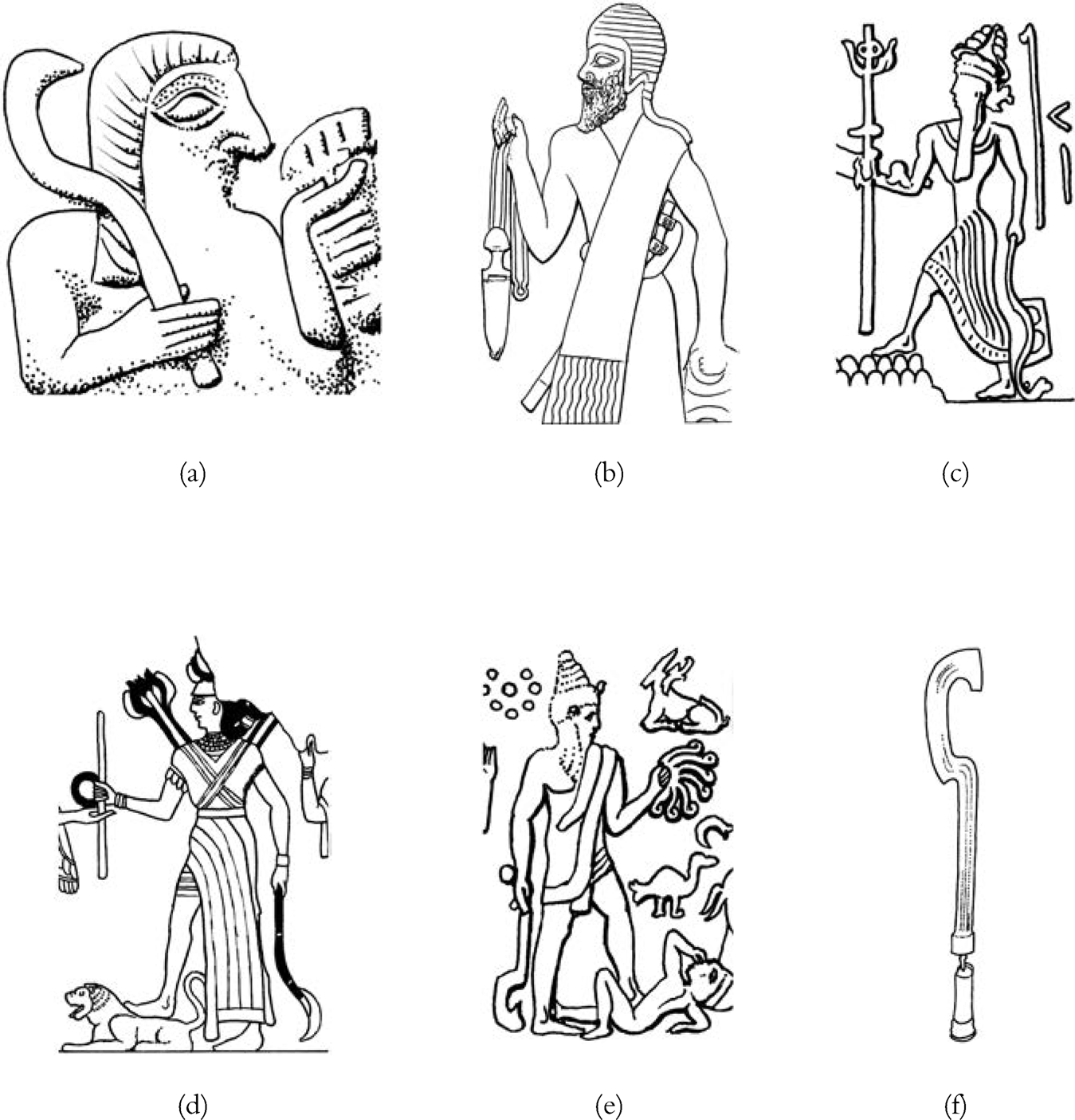 Figure 2 Early and Middle Bronze Age weapons (drawings by Michael Lyon)
The next example of a possible Early Dynastic sickle-sword comes from the famous “Stele of Vultures” of king Eanatum of Lagash {c. 2440 (see Figure 1)}.33 Here, however, the ambiguities are only increased. King Eanatum is shown in two different scenes holding the same curved sickle-like object. In the top scene the upper portion of the object is missing, while in the bottom scene the upper portion is partially defaced. The main oddity of this weapon is that it is clearly shown as being composed of (at least) three separate parallel pieces. A first glance this feature might seem to be ribbing on the metal, as is found in some depictions of daggers. But the object seems to be bound together in at least two places with thin ropes. Since copper/bronze objects were invariably cast as a single piece, it seems unlikely that the artist was trying to depict a metal sickle-sword, or at least not of the classical type found in the Middle Bronze period. None of the other soldiers in this scene are carrying this type of object. While it is possible that this object was a sickle-sword, there is clearly ambiguity here. It may, in fact, be a scepter rather than a weapon; an image of an enthroned deity from the Early Dynastic period shows the god holding both a mace and a curved club-like object in his left hand, which broadly resemble the proposed early sickle swords (AM §65; cf. FI 821). Another possibility is that Eanatum's weapon is actually a whip used to goad the equids in the chariot, such as is clearly depicted in several chariot scenes;34 the most clear comparison is to an Old Babylonian scene (WV §31).
 Figure 1 The “Stele of the Vultures”, king Eanatum of Lagash, Sumer {c. 2440} Source: Louvre AO 50; drawing by Michael Lyon.
The case against Eanatum's weapon being a sickle-sword is bolstered by the fact that the type of object held by Eanatum disappears during the subsequent Akkadian and Ur III periods {2300–2000}. If this object is the ancestor of the classic Middle Bronze sickle-sword, why does it disappear during the Akkadian period? Instead, the Akkadian sickle-sword-like weapon is clearly a type of axe. The haft and the blade of the Akkadian weapon would be about 60–75 cm long, judging by its proportion to the body – when the tip is resting on the ground the edge of the handle reaches to about the lower hip (FI §540, §781; see Figure 2c–e). The haft is completely straight until the last foot or so, which has a slight curve to it. A broad rectangular axe blade is fastened to the upper curved part of the haft; the wooden haft sometimes extends beyond the upper edge of the axe blade (FI §567, §781). The rectangular axe-blade seems to be epsilon-shaped (FI §781; see Figure 2b–c).
· Warrior with throwing or fighting stick, similar in form to later “sickle swords” {c. 3000} (Relief from Telloh; Louvre AO 2350); see AM §44a.
· Akkadian stele of warrior carrying a sheathed dagger on a belt in his right hand; an Akkadian war-axe showing the shape of the head and rivets is sheathed in his belt, partially obscured by a sash {23C}; (Iraq Museum 59205) see AM §119.
· Uruk: Neo-Sumerian god with war-axe in age of Shulgi {21C} (British Museum, 116719); see FI §781.
· Mari: The goddess Ishtar holding a curved axe in her left hand; colored mural from the Palace of Zimri-Lim, “The Investiture of the king by Ishtar” {18C} (Louvre); see SDA §346.
· Cylinder seal from Mari showing a god carrying a classic “sickle-sword” standing on a prostrate enemy {18C} (Louvre AO 21988); see FI §191.
· Classic “sickle-sword” from Abydos, Egypt {19C} (Museum of the Oriental Institute, Chicago); see AW 1:172b.
· Narrow-bladed “chisel” axe from Ras Shamra, Syria (Louvre); see MW 2:276, §418.
· Middle Kingdom Egyptian semi-circular axe; see EWW §23c.
· Middle Kingdom Egyptian broad-bladed axe (British Musuem); see AW 1:154.
· Middle Bronze Age broad-bladed dagger from Tel Rehov, Israel; see MW 2:434, §628.
· Broad spearhead from Serrin, Syria (Oxford, Ashmolean Museum); see MW 2:315, §47.
· Spiked javelin head from Khirbet el-Krimil, Israel (Jerusalem, Hebrew Union College); see MW 2:336, §156.
In a badly damaged relief of Sargon in a victory procession, he is followed by several attendants carrying what seem to be this type of “sickle-axe”.35 The clearest example of this weapon comes from a fragment of an Akkadian relief from Nasriyeh showing courtiers bringing tribute. In the upper-right-hand portion of this relief a soldier escorting prisoners is carrying a clearly depicted version of this axe (ME 108). In the lower-left section another man holds a sheathed bronze dagger in one hand, and a vase in the other. Inside his belt is a rectangular sickle-axe, about 75 cm long in proportion to his body (AAM 137; see Figure 2b). The sickle-axe is partially obscured by a sash, but enough of the top remains to show that the upper portion of the haft is partially curved and the haft extends beyond the top of the blade, just as in the other examples. Another clear example can be found in the twentieth-century relief of Anubanini in Iran (ME 20; PAE 319). The axehead is riveted to the metal bands which encircle the haft. I will call this weapon the “rectangular sickle-axe”. I believe what occurred is that during the Akkadian period a rectangular axe blade was bolted to the curved scepter-club of the Early Dynastic period, representing the first step in the evolution towards the classic sickle-sword.
At around 2000 the form of the Akkadian-style rectangular sickle-axe splits into two different forms of the weapon: the Babylonian curved sickle-axe, and the classic sickle-sword. The Babylonian version probably originated as a shift in the form of the axe blade from the original Akkadian rectangular blade to a semi-circular curved version of the sickle-axe found on Neo-Sumerian and early Old Babylonian cylinder seals (AW 1:150; AAM §138; FI §167, §772). The difference is subtle, but noticeable, and is transitional to the Babylonian curved sickle-axe. The Babylonian-style “curved sickle-axe” is held in precisely the same way in precisely the same ritual contexts as the Akkadian “rectangular sickle-axe”. In some of the depictions it is possible to see that the blade of the curved sickle-axe is quite clearly a separate object from the wooden haft – they are not a single piece of cast bronze (SDA §383, 384; FI §538). The best examples of this come from the remarkable murals at the palace of Zimri-Lim in Mari {c. 1765 (Figure 2d)}. Here the war-goddess Ishtar holds a sickle-axe in her hand; the painting shows the curved wooden haft in one color, to which is attached a different colored crescent-shaped axe blade, on the top of the haft (SDA 279; AW 1:172). Overall the weapon has the distinctive curve of the Old Babylonian sickle-axe. Another mural from the palace shows the war-goddess with three hafted weapons in a quiver on her back – a mace, an axe, and a curved sickle-axe, again with distinctive colors for the haft and blade (SDA 282–3).36
The other line of development from the Akkadian rectangular sickle-axe leads to the classic Middle Bronze sickle-sword, found in both art and archaeology.37 A very clear cylinder seal from Mari {1765} shows the new-style sickle-sword with precisely the features of the surviving archaeological examples of the classic sicklesword, but depicted in the same ritual context of the earlier Akkadian sickle-axe (FI §191; Figure 2e). Ritually speaking, in depictions of royal and divine iconography, the weapon was the same, even though the actual form of the weapon had gone through several transformations. In the classic sickle-sword the blade is actually rectangular (like the Akkadian sickle-axe). Essentially someone seems to have taken the Akkadian rectangular sickle-axe, and cast the entire thing in bronze, haft and blade, while retaining the original axe-like form. As with the Akkadian rectangular sickle-axe and the Babylonian curved sickle-axe, the sharp blade of the weapon occupies only the upper third, betraying its origin from the axehead.
From surviving archaeological examples we can see that the classic sickle-sword kept the distinctive quasi-rectangular form of the blade which was modeled after the Akkadian rectangular sickle-axe. Thus the Akkadian sickle-axe diverged into two different forms in the Middle Bronze Age: the curved sickle-axe, and the classic sickle-sword. The curved sickle-axe continued the original curvature of the haft, but kept the wooden haft and metal blade of the original. It seems likely that the sickle-“sword” is actually a version of the axe, where the original wooden haft and metal blade are combined together and cast in a single piece. This would have served to decrease breakage both of the haft and of the joint between haft and blade. The weapon also invariably appears only in royal and ritual contexts in both artistic and archaeological evidence. It is quite probably an elite or royal weapon (MW 1:170–1).
During the Middle Bronze Age the new sickle-sword spread rapidly throughout the Near East, appearing in Elam, Syria, Canaan, and eventually Egypt.38 Egypt seems to have been the last region to acquire the weapon. It doesn't appear in Middle Kingdom Egyptian art, making it likely that the weapon was initially acquired by Egyptians through trade or plunder from Canaan. There is mention of thirty-three “scimitars” – literally “reaping implements” (ECI 79 n49) – taken as plunder in Syria during the reign of Amenemhet II {1929–1895}. Presumably these are versions of the sickle-swords found in the royal tombs of Byblos in Syria and Shechem in Canaan during this period. The weapon does not seem to have been manufactured in Egypt until the New Kingdom, when it frequently appears in a modified form as the Egypt khopesh (hpš), or scimitar, where the haft of the weapon is reduced to about one third and the blade extended to two thirds (AW 1:206–7; FP 51).
Warfare in Early Dynastic Elam {2900–2334}39
Although ethnically distinct and speaking their own language, the Elamites had in many ways been integrated economically and culturally with Sumer during the Uruk expansion of the late fourth millennium. These bonds remained strong throughout the Early Dynastic period, during which we also have our first records of warfare between Elam and Sumer. In the Susa III phase of Elamite history {3100–2700}, the early cultural predominance of Uruk expansion-style material culture is replaced by pottery and art styles derived from the eastern highlands of Fars and Luristan. Some speculate that this might be associated with the movement of nomadic highlanders into Elam, perhaps associated with “Awan”, a name in Sumerian records for northern Elam (PAE 88–9, 97–8).
An Elamite kingdom, with its capital at Susa and encompassing south-western Iran, flourished during the Early Dynastic or Proto-Elamite period (PAE 71–84; EA 5:106–10). The precise boundaries and nature of this state are uncertain. Cultural influence from Elam, including pottery styles and proto-Elamite tablets, are found throughout much of south-western and central Iran, indicating widespread cultural influence and merchant activity. In some ways, the Elamites became the suppliers for overland trade to Sumer for lapis lazuli, tin, and other Iranian products. How much political or military influence Elam might have exerted in other parts of Iran is unknown.
Militarily, all we know of Elam during the Early Dynastic period derives from incidental references in Sumerian texts. The Sumerian King-list states that “Ur was defeated in battle and its kingship carried off to Awan” (KS 329) – either a city-state in Elam or an alternate Sumerian name for the region as a whole. Its location in the King-list would place the event in late Early Dynastic II, perhaps around 2550. Assuming there is some historicity to this claim, it would imply a major Elamite invasion of Sumer – perhaps Awan highlanders – which may have resulted in the vassalage of one or more Sumerian city-states to the Elamites (PAE 88). Shortly thereafter, perhaps 2525, Enna'il, King of Kish, claims to have “vanquished Elam”, probably ending this vassalage (PI 21).
The major recorded wars of earliest Elamite history are with Eanatum of Lagash, who mentions campaigns in Elam a number of times in his inscriptions (PI 37, 41–44; PAE 89). Lagash, on the south-east edge of the Mesopotamian flood-plain, was the closest Sumerian city-state to Elam, and had the most frequent economic relations with it (PAE 91). Eanatum claims to have defeated Elam, “the mountainous land of timber and treasure” (PI 37), and “made burial mounds” in it (PI 41). The details are elusive, but economic texts from Lagash in subsequent decades show extensive trade in grain, spices, wood, and silver (PAE 91). It is possible that Lagash exercised some type of suzerainty over Elam during the late twenty-fifth century. Arrowheads, daggers, and a four-wheeled chariot were discovered in excavations at Susa dating to roughly this time (PAE 95), indicating the movement of Sumerian war-cart technology into the region by the twenty-fifth century. With the decline of Lagash military power beginning around 2400, the Elamites became independent again, and took to raiding their former suzerains. A text from about 2360 describes a raid by 600 Elamites into Lagash (KS 331). It was undoubtedly only one of many. Thereafter we have no military information on Elam until the invasion of Sargon of Akkad and his successors in the late twenty-fourth century.