

Kfz 82 Kubelwagen captured by Polish resistance fighters, August 1944, in Warsaw. (Leandoer & Ekholm archive)
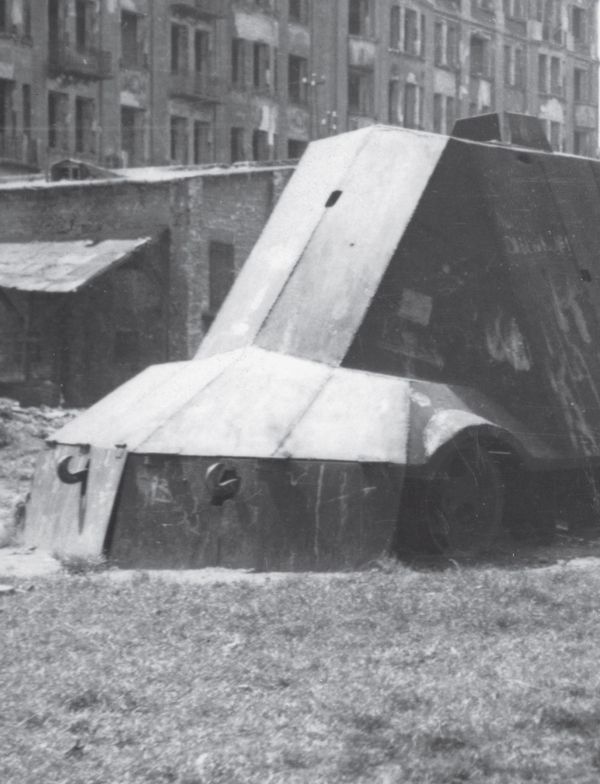
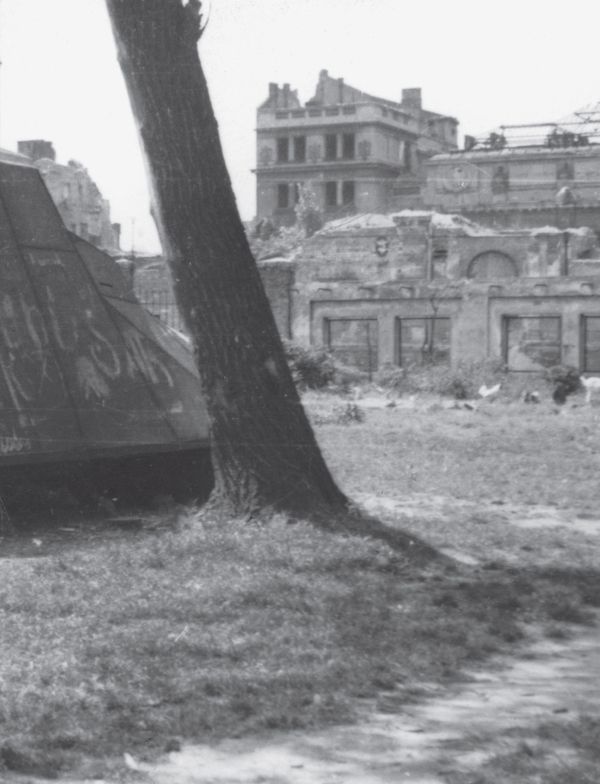
“Kubus” after the war.
Part 1
A note from the publisher
The book you are holding in your hand is the second in our series focused on operations during WWII. Our series differs from the English Osprey series in that we not only describe the relevant military forces and equipment, but also the men behind the machines and the conditions these soldiers faced at the front. Our publications are also broader in content and larger in their format and number of pages. And importantly, the graphic material presented in this series is wholly unique.
What might be regarded as bothersome about this book are the various military designations and numbers used to identify German vehicles. Therefore, throughout the text of this book we have chosen to minimise this potential problem for the reader by referring to a German vehicle and/or weapon system by its most frequently used name. This is very often the name of an animal, a nickname, or letters or numbers and/or some combination thereof. All names are explained in an appended glossary.
We have even appended a fact-supplement where every weapon system and vehicle is described in more detail.
We use the British military ranking system when possible and the German system when there is no British equivalent; as for example, with the ranking system of the Waffen-SS. In addition, all military units are printed in cursive style in order to make them more apparent to the reader.
We have retained the Polish geographical names with a few exceptions made for the sake of clarity. This is clearly reflected on the four maps provided at the end of the book.
In addition, where it has not been possible to confirm the exact Polish name for a location, a generic term has been used.
Enjoy this fascinating reading experience!
LEANDOER & EKHOLM PUBLISHERS

A German air-defence position near Warsaw airport, August 1944. The gun is the renowned Flak 88.

One of four bridges over the river Vistula in Warsaw. Capturing these bridges proved to be a very tough challenge for the insurgents as they were heavily defended by the Germans.
Chapter 1
The largest German armoured units in Poland’s capital city on August 1, 1944, were the 1st and 2nd companies from Panzer-Abseiling 743., stationed at Plac Saski and Plac Teatralny. Each these units consisted of fourteen armoured anti-tank guns, model Jagdpanzer 38(t) Hetzer – from here on out, to be called a Jagpanzer or Hetzer, as they are correctly referred to – and quite likely a few armoured vehicle assault guns, model Sturmgeschutz 40 Sd Kfz 142/1 Ausf., henceforth, referred to here simply as the StuG 40, within units of the 2nd company.
Within the so-called Police District, the head of the SS and its police army (SS und Polizeiführer) in Warsaw, SS-Standarten-führer, Paul Otto Geibel, had command over a tank platoon comprised of four to five Italian tanks, models M13/40 and M14/41, to be referred to in the future as the PzKpfw 736 (i).
In a “so called” Kraftfahrpark (motor pool repair facility) at Fort Bema in the district of Wola, there were several other armoured cars and armoured transportation vehicles which had been repaired. Cars and other vehicles were also repaired on a continuous basis at the Kraftfahrpark on Ulica Gniewkowska (Ulica: Street/ Avenue in English).
On August 1, the off-loading of tanks belonging to the II Fallschirm-Panzer-Regiment “Hermann Göring” commenced in Wola (Ulrychów) and Boernerowo. These were directed towards the front outside Siedlce, Minsk and Wolomin, as well as the front outside Magnuszew, east of Warsaw. On July 31, five model PzKpfw VI Tiger Ausf. E tanks were off-loaded, after having been repaired and sent from Germany, as reinforcement to the 3rd SS-Panzer-Division “Totenkopf ”. The Tigers were driven by factory personnel along the streets of Ulica 22 Listopada, Ulica Targowa, Ulica Zielieniecka, Ulica 3 Maja, Aleje Jerozolimske, Ulica Chaubinskiego, Aleje Niepodleglości (Ulica Topolowa) and Ulica Rakowiecka to the SS-Staufernkasern (SS-garrison) located on Ulica Rakowiecka 4. In addition, the garrison already had some tanks that had been repaired there. Von Krannhals, (Hans Von Krannhals, Der Warschauer Aufstand 1944, Frankfurt am Main 1964, p.242) reports that there were 11 vehicles at the SS-Staufernkasern: five Tiger tanks, a Panther tank-PzKpfw V, four PzKpfw IV tanks, and a self-propelled Sturmpanzer IV Brummbär asssault gun. All were repaired vehicles from other units, among them, the 3rd SS-Panzer-Division “Totenkopf ” as well as the 5th SS-Panzer-Division “Wiking”.
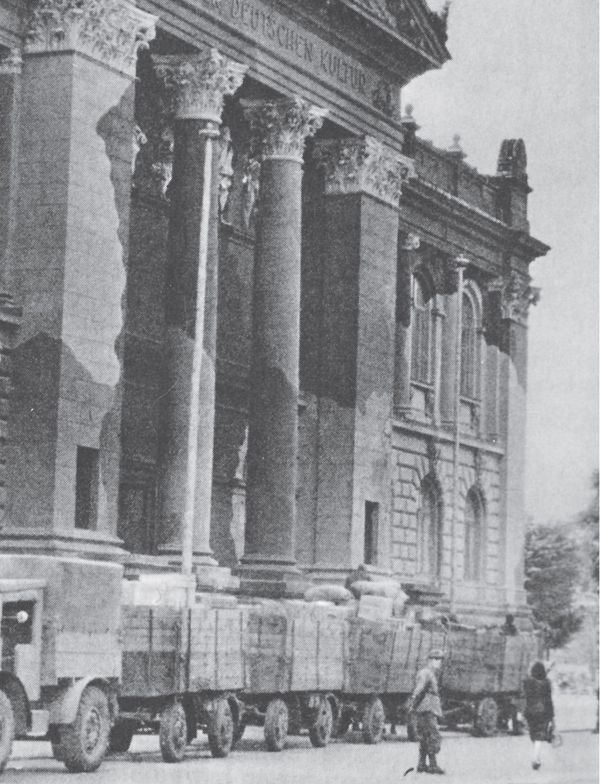
At the end of July 1944, the German administration in Warsaw evacuated staff and, in this case, valuable Polish artworks. The Russians were closing in in the city which had panicked the Germans. The photograph shows German trucks loaded with Polish art to be transported to Germany. The location is the Zacheta Art Museum on Malachowski Square.
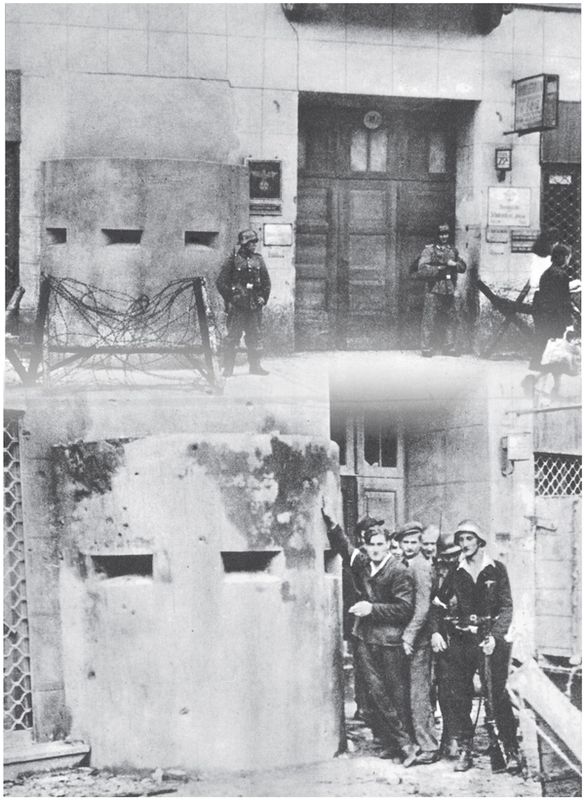
This photograph shows the “Nordwache” police station on Chlodna Street before and after insurgents had stormed it on 3 August 1944. All important official buildings had their defences strengthened with, for example, bunkers or more barbed-wire, after the 1943 uprising.
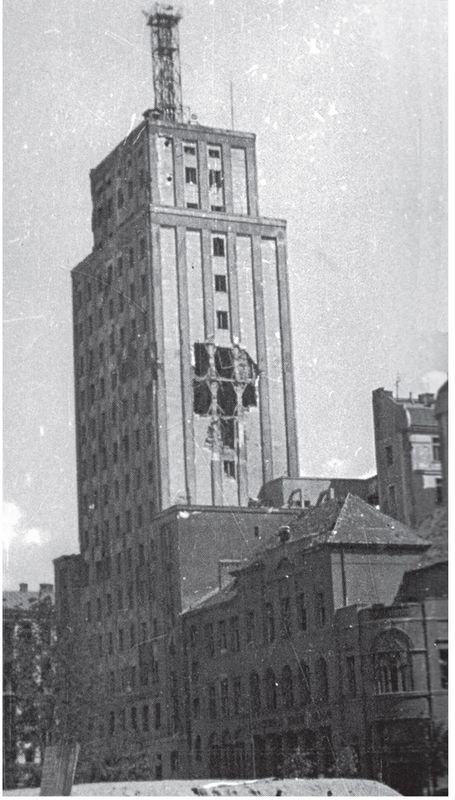
The Prudential insurance company head office before a Karl Gerät 040 and its rockets had been unleashed on it.
Mention should also be made of certain other armoured vehicles, for example, those with the SA’s headquarters in Ulica Krucza, and the anti-aircraft artillery’s tractors at Pole Mokotowskie and at the air field in Okęcie. In addition to these, account should be taken of the tanks moving east through Warsaw towards the front. For example, the PzKpfw IVs which were sent to reinforce the 3rd SS-Panzer-Regiment “Totenkopf” and then sent to an elementary school at Ulica Mieszka I in the city district of Targówek. These tanks could, at any time, be “recalled” to the city and sent in against the resistance fighters. In addition, the German commander could also direct frontline forces to Warsaw, but the situation at the front was such that this safeguard was not taken at the beginning.
Near the dinner-hour of August 1, a StuG 40 under the command of Lt. Jg Kannert from Fallschirm-Panzer-Division “Herman Göring” found itself in the city district of Praga. This vehicle, as it happened, had been sent to the FAMO-Warschaus factory in Ursus outside Warsaw for repairs. In the vicinity of Most Kierbedzia (the Kierbedzia Bridge), soldiers from an infantry unit informed Kannert that the Uprising had broken out. Kannert was transporting a wounded colleague, Lt. Jg Hoffman, and therefore decided to make his way through Warsaw. Despite taking hostile fire, Kannert rolled across the bridge towards the city’s centre along the Ulica Mowy Zjazd. Ulica Senatorska was cordoned off by a barricade and so he swung left and came to Plac Pilsudskiego (Pilsud’s Square), or “Adolf Hitler Platz” as the Germans named it, where the garrison’s regiment was quartered. The wounded Hoffman was taken to the hospital. At the garrison, the crew was also provided with additional equipment and ordered to fire upon on the insurgents’ positions. The gun-loader fired with a submachinegun while Kannert used “the artillery” – i.e. a Panzerfaust that had been assigned to him, and with which he demolished the Polish positions (Ulica Krakowskie Przedmieście). On August 2, a StuG 40 was dispatched to attack the Polish emplacements on Theatre Square. A shell exploded while being fired, which destroyed the main gun’s barrel. The crew, nevertheless, continued to fire on the Polish positions in the municipal building with a machinegun, which was the only weapon at hand. The following day the crew was ordered to retrieve a tank from the Kraftfahrpark in Praga. They got over the Kierbiedz Bridge and through Praga without difficulty. There, the crew came upon a PzKpfw II Ausf. II tank that, for some unknown reason, had been abandoned. A tow line was attached and the StuG 40 proceeded to tow the tank back the way they had come. While crossing the Wisła, these German armoured vehicles came under fire from insurgents shooting from Stare Miasto (The Old City). The PzKpfw II was carelessly driven and collided with its “recovery vehicle” which caused the tow line to break. After once again securing a tow line, the German armoured vehicles resumed their journey.
A PzKpfw IV ausf G belonging to 3.SS-Panzer-Division “Totenkopf” outside the Waffen-SS barracks in Warsaw, 31 July 1944.

A BA-10 Russian armoured car. It was used by the German police units in the Warsaw area.

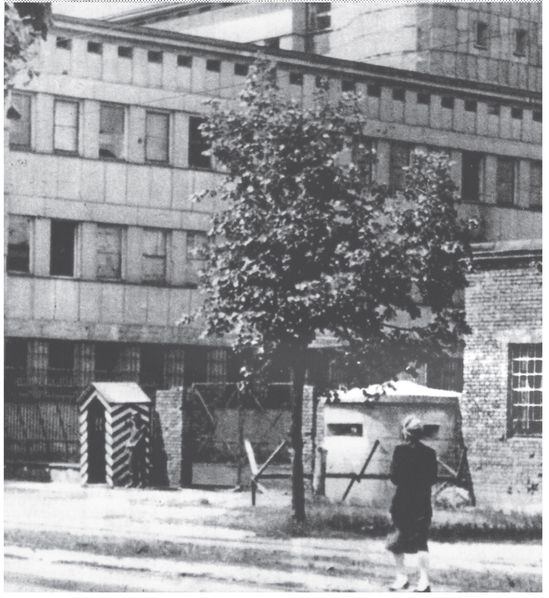
The Waffen-SS barracks in Warsaw.
Despite the damage to its barrel, Kannert’s vehicle was used in battle and attacked the area around Plac Napoleona (Napoleon Square). On August 5, Kannert received orders to cross the Kierbiedz Bridge to a tank repair-shop in the town of Modlin, outside Warsaw. The odyssey which Kannert’s crew underwent illustrates the point that there may well have been more armoured vehicles in Warsaw than those officially recorded.
The German air-defence barracks in Warsaw, 31 July 1944.


A Hetzer belonging to Panzerjäger-Abteilung 743 outside of Warsaw in summer 1944. The unit was in the process of being equipped with brand new Hetzer vehicles.
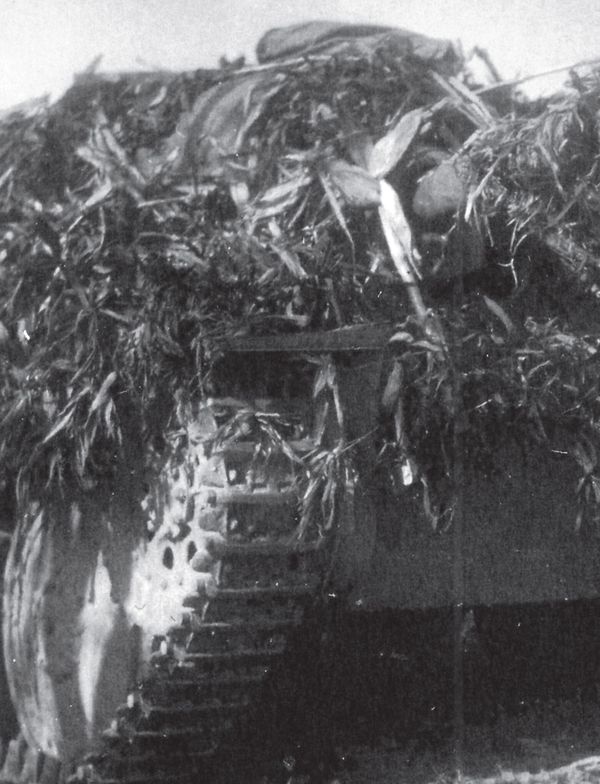
A Hetzer belonging to Panzerjäger-Abteilung 743 outside of Warsaw in summer 1944. The unit was in the process of being equipped with brand new Hetzer vehicles.

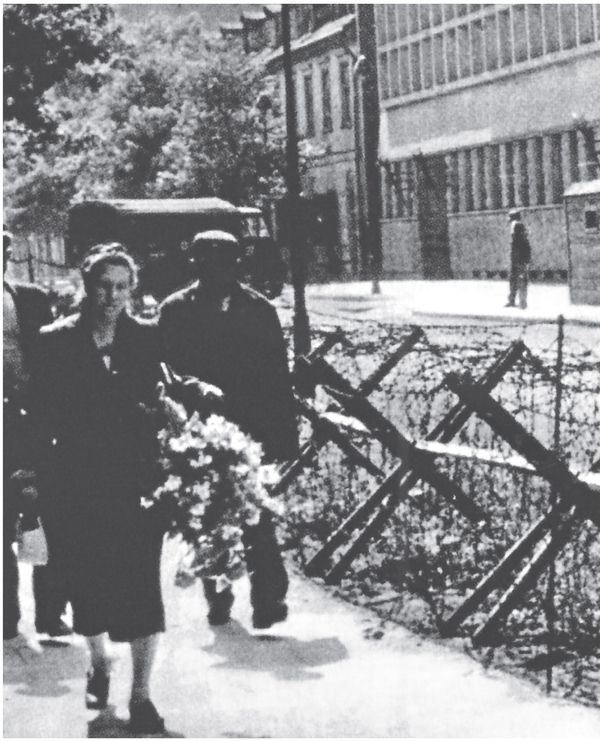

An administration building in Warsaw. After the attack on SS-Brigade-führer Kutschera in February 1944, defences for administrative buildings were notably increased. Note the distance between the barbed-wire and the actual building. This arrangement was repeated around many of the insurgent’s possible targets, ensuring that most of the attempted stormings ended in failure.

Members of RONA brigade march into Warsaw. Their fighting ability was quite low, but they compensated for this by massacring civilians instead. Even the Waffen-SS found their methods abhorrent.