
Until moving to Shropshire from my native Laugharne some years ago, I had no interest in the happenings of the Great War, as my only knowledge of any ancestors who had served was of my grandfather and great uncle during the Second World War. Shift working left me with plenty of spare time to fill, so I began carrying out some research on my family tree. After struggling to find out about my paternal grandfather’s side of the family, I discovered that his father, David Thomas John, a coal miner, from Halfpenny Furze, near Laugharne, had run away to Australia in 1913 after he had been forced to marry his then pregnant girlfriend. My grandfather was born around the same time that David disappeared, and his mother later remarried; as a result the true story of my great grandfather was never relayed to my generation. David’s younger brother, John James John, also a coal miner, was due to join him in Australia, but when war broke out it left the two brothers on opposite sides of the globe, with David working as a miner in the Bulli Colliery, New South Wales.
Whether it was a sense of patriotism or desperation will never be known, but David enlisted at Randwick and became one of the original members of the newly formed 4th Battalion, Australian Imperial Force (AIF). His brother John volunteered for service with the Pembroke Yeomanry. Neither man would live to see the end of the war, although they did meet briefly in Egypt in 1916. David would survive the infamous campaign in Gallipoli, taking part in the famous Battle of Lone Pine, and later fought in the successful Australian assault on Pozières during the Somme battles. He was killed while leading a reconnaissance patrol at Mouquet Farm on 18 August 1916. John served throughout the Pembroke Yeomanry’s campaign in Egypt and Palestine, then embarked with the 24th Welsh for France in May 1918, only to be killed during the Battle of Épehy on 18 September 1918. The two brothers and close friends, lie just thirty miles apart on French soil.
Because of this discovery, and the immense pride I feel about having these two men as my immediate ancestors, I started on the road to researching their battalions. While halfway through writing a book on the history of the 4th Battalion AIF, I was disappointed to discover that an Australian author, Colonel Ron Austin, had beaten me to it, and was about to publish his own book. A cheeky telephone from me to Ron led to the exchange of my research and material on the battalion, and resulted in a few paragraphs of his book being written about the death of 244 Lance Corporal David Thomas John. His death, along with a photograph of him, was printed in the book The Fighting Fourth, so my intention of getting my great grandfather commemorated in print was realised.
The next project of mine culminated in the publication of my first book, Carmarthen Pals, a history of another local unit, the 15th (Service) Battalion, Welsh Regiment. While writing A Township in Mourning, which I self published, I was told of the existence of a photograph of my mother’s uncle, Harry Allen, a Whitland man. Harry was killed while serving with the 15thWelsh at Mametz Wood. While researching his story, enough material was found to complete the book, which I dedicated to Harry.
With Carmarthen Pals published, I was commissioned by Pen & Sword to write another book, which would be part of their 2014 Great War Centenary list, entitled Carmarthen in the Great War, which chronicles how the war affected the county of Carmarthenshire, and was published on 1 June 2014. With that completed, I embarked upon this book, in order to commemorate my great uncle, John James John, who was killed in action at Gillemont Farm, during the battle of Épehy. For this reason this book is being written both in his memory and in memory of the other men of the former Pembroke and Glamorgan Yeomanry battalions who fought and died after being amalgamated into the newly created 24th Battalion, Welsh Regiment.
The Welsh Regiment was originally raised from the merging of two of the old Regiments of Foot, the 41st and the 69th. The 41stRegiment of Foot was raised on 1 March, 1719 by Colonel Edmund Fielding, and consisted of a core nucleus of Outpatients from the Chelsea Military Hospital (Chelsea Pensioners). It moved to Portsmouth as garrison troops, enabling existing units to be able to serve overseas. This led to the early regimental nickname of the ‘Invalids’, a somewhat unfortunate name that proved hard to shake off.
On 11 December 1787 the 41st Foot became a Line Regiment of the British Army. It saw active service for some years throughout the Americas, and also against the French at Quebec. In 1815 the 41st moved to France, seeing service in the campaign against Napoleon under Lord Wellesley, and through the remainder of the nineteenth century fought in wars throughout the Empire: in Burma, Afghanistan, India and the Crimean Wars. In 1857 the Regiment moved to Jamaica on garrison duties, and after a three year spell there returned to Britain. The Regiment was renamed after the Cardwell Reforms in 1881, and became the Welch Regiment. Two Battalions were formed, the 1st Battalion from the 41st Foot and the 2nd Battalion from the 69th.
The 69th Regiment of Foot was originally raised on 20 September 1756 as a second battalion of the 24thFoot. It spent the early years of its life at sea with the Royal Navy, and during the next 123 years of its history served throughout the British Empire, until being turned into the 2nd Battalion the Welch (sic) Regiment under the Cardwell Reforms.
The 1st Battalion began this next stage of their life in South Africa, where they saw service against the Zulus, before moving to Egypt in 1886. After seeing action there the Regiment spent time on garrison duty back in Britain before embarking again for South Africa, where it fought throughout both of the Anglo-Boer Wars. In July 1904 it returned home but was back on the borders of the Empire at the outbreak of the Great War, stationed at Chakrata, India.
The 2nd Battalion meanwhile had spent most of its time in the years before the war on garrison duty in Britain. From 1892 to 1906 it was in India, before moving to South Africa and then to Pembroke Dock. In August 1914 the 2nd Battalion was sent to France as part of the 1st Division of the British Expeditionary Force, and remained on the Western Front for the remainder of the war, gaining for Wales its first Victoria Cross of the war, when the actions of Lance Corporal William Fuller of Laugharne, during the rescue of his captain, Mark Haggard, under heavy German machine-gun fire during the fighting at Chivy-sur-Aisne, led to his being awarded this most sought after of gallantry awards.
In the meantime the British army was rapidly expanding and gearing up for war. Territorial battalions were called up, and the first of the Territorial Welsh battalions, the 1/6thWelsh, arrived on the Western Front in October 1914.
The Welsh Regiment expanded rapidly throughout August of that year. The 2nd Battalion was in France, the 1st was on its way back from India, and the Territorial battalions, the 1/4th (Carmarthenshire), the 1/5th (Glamorgan), the 1/6th (Glamorgan), the 1/7th (Cyclists) and the Pembroke and Glamorgan Yeomanry Battalions (which were later to become affiliated to the Welsh Regiment as its 24th Battalion) had mobilised ready for war.
As well as these regular and territorial units, Service, or war-time only, Battalions were raised throughout the recruiting grounds of South Wales during the opening months of the Great War. These Battalions were the 8th(Pioneers), 9th(Service), 10th(1stRhondda), 11th (Cardiff City), 12th (Reserve), 13th (2nd Rhondda), 14th (Swansea City), 15th (Carmarthenshire), 16th (Cardiff City), 17th (Glamorgan), 18th (2nd Glamorgan), 19th (Glamorgan Pioneers), 20th (3rd Rhondda), 21st (Reserve), 22nd (Reserve), and 23rd (Reserve) Battalions. As well as these, the Territorial battalions often had Reserve battalions attached; for example the front-line unit of the 4th Welsh was the 1st/4th Battalion. The reserve battalion was the 2nd/4th.
This book is written to commemorate the achievements of one of these magnificent battalions of the Welsh Regiment, the 24th(Pembroke and Glamorgan Yeomanry) Battalion, the Welsh Regiment, and in memory of my great uncle, John James John.
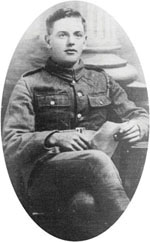
This book is dedicated to Private John James John (320374), of Laugharne. Killed near Gillemont Farm on 21 September 1918.