
CHAPTER 8
ANY ACCOUNT OF THE Battle of Britain must note from the outset the strange nature of the encounter. Consider these points:
• There is no agreement on when the battle started or when it ended.
• For most of the battle a maximum of 50 per cent of the Luftwaffe engaged a maximum of 40 per cent of Fighter Command and usually the numbers were much smaller than that.
• Although almost all the action was in south-east England, for the entire battle 25 per cent of Fighter Command’s single-engine fighters were in Scotland.
• Neither side knew the strength of the other. Nor did they establish with any accuracy what damage they were inflicting on each other.
• The Germans had no overall plan to defeat the RAF.
• For any given day of the battle, it is not known with any certainty the number of German aircraft over Britain, nor is it known exactly how many British planes were sent against them.
We will return to many of these matters as the battle is described.
In 1940 the air defence of Great Britain depended on two factors. The first was the performance of two types of single-engine fighters, the Hurricane and the Spitfire, and the skill of the pilots who flew them. The aircraft were outstanding and the pilots who survived their first encounters showed increasing skill as the battle progressed. However, it is doubtful whether Fighter Command could have prevailed had it not been for the second factor. Britain possessed the most sophisticated air-defence weapons system in the world. There were three keys to this system – the gathering of information about incoming raids, the rapid dissemination of this intelligence to the fighting squadrons, and the direction of those squadrons onto the enemy aircraft.
Intelligence of raids was gathered from two sources – radio waves and human observation. In 1935 R. W. Watson-Watt discovered that aircraft passing through radio waves interrupted them and produced a ‘blip’ on a small cathode-ray screen. This blip could be read with sufficient accuracy to obtain a rough idea of the distance of the aircraft from the screen.1 In further developments, the direction and the height of the incoming aircraft could be determined, although these measurements were very crude in the initial period.
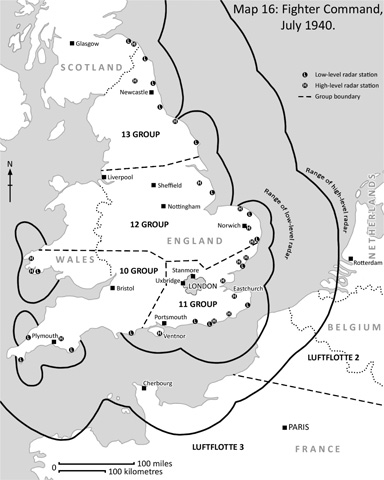
The practical application of radar began in 1936 when a series of stations (called Chain Home) was built around the British coast. The stations consisted of eight lattice towers standing from 250 to 350 feet high. They looked out to sea and gave the stations a range of 70 to 140 miles (Map 16).2 At the beginning of the Battle of Britain there were 34 Chain Home stations between Scapa Flow and Pembrokeshire in Wales. To account for low-flying aircraft, a second series of stations called Chain Home Low was constructed along the same stretch of coastline.3
The radar stations worked thus. The staff continually scanned the small screens (approximately 5 × 3 inches) for blips that indicated incoming aircraft. After allowing for friendly aircraft that were equipped with an electronic identification device (pip-squeak), they conveyed the information by buried cable to Fighter Command headquarters at Bentley Priory.4
The radar chain pointed out to sea where there were no hills and valleys to interrupt the radar signal. Once the raiders had crossed the coast, the Observer Corps would plot their course. This corps consisted of 30,000 men grouped in small dugouts that dotted the country. They were equipped with an aircraft identification chart, binoculars and a telephone. They would telephone information regarding type of aircraft, numbers and course to Bentley Priory or to the nearest Group or Sector airfield.
So Bentley Priory received a huge volume of plots from the Observers and from the radar chain. On the suggestion of Sir Keith Park in his capacity as Dowding’s Senior Air Staff Officer (SASO), all these plots were sent to a special operations room to be sorted out or ‘filtered’.5 This was necessary because different radar stations and Observer Corps posts might be plotting the same raid, and the filter room attempted to remove any duplication and sort the plots into discrete raids. It was only ‘filtered’ information that was sent to the central operations room and displayed.
This display consisted of a huge horizontal gridded map of the United Kingdom. Each raid was assigned a number and a tentative strength, both of which were written on small wooden blocks. The blocks were then placed on the map and pushed across it by members of the Women’s Auxiliary Air Force (WAAFs) armed with long croupier-like poles as further information came in. The blocks were also colour coded against a large clock divided into coloured five-minute segments so that it could be seen at a glance when the plot had last been updated.6
In a gallery above the map sat a group of men who made decisions based on the plot. The most important was of course Dowding, but it was his Senior Controller who made most of the operational decisions including what plot references would be sent to each of the headquarters of the four fighter Groups into which Britain was divided. Alongside the Senior Controller sat the heads of Anti-Aircraft Command and Balloon Command so that AA batteries and barrage balloon concentrations could also be warned of raiders.
When the plot information reached Group headquarters the first operational decisions were taken, because in Dowding’s decentralised system it was the Group that dispatched fighters against particular raids. When Group HQ received the intelligence they would plot it on a gridded map of their own area in the same way that it had been first put on the large map at Fighter Command HQ. The Senior Group Controller would then decide which squadrons from their main or ‘Sector’ airfields would be most appropriate to intercept the raid. In selecting these squadrons Group HQ was aided by a large display called a Tote Board on the wall of its operation room. This board indicated by a series of coloured lights the state of readiness of the squadrons or whether they had already been dispatched for battle.
Once he had received the signal from Group, the Sector airfield commander would ‘scramble’ a squadron or squadrons from his airfield or dispatch a force from one of the satellite airfields attached to his sector. Once aloft the fighter force would be directed or ‘vectored’ onto the incoming raid by the Sector Controller. ‘Tally-ho’ was the signal from the squadron commander that his aircraft had made contact with the enemy.
The whole system was designed for rapid response to emerging and ever-changing situations. Fighter Command HQ aimed to update plots to Groups every minute and Groups aimed for the same order of speed to Sectors. Once a squadron had been selected to scramble it took several minutes (reduced to 90 seconds later in the battle) to get it airborne. Ideally, then, from the first plot being received at Bentley Priory to ‘squadron airborne’ would take less than five minutes. In practice, with inexperienced plotters and controllers, it often took longer than that, but as an Me 109 could cross the Channel in two or three minutes, speed was of the essence.
This system had many advantages but undoubtedly the most important was the reduction in the number of standing patrols that had to be flown by Fighter Command. These patrols could consume valuable fuel, tire pilots, and produce wear and tear on the planes without necessarily finding the enemy or bringing them to battle. In 1940 most British squadrons were only dispatched to meet significant threats.
In many accounts the system is described as a near perfect air-defence arrangement. However, despite its relative sophistication it did have some imperfections. The radar chain was a very recent innovation and more stations were being added as the battle commenced. Many of its operators were new to the job and their estimates of the height of a raid or the numbers of aircraft it contained could be wildly inaccurate. Moreover, a large number of hostile aircraft could clutter the small screens aggregating the blips to such an extent as to make the size of a raid a matter of guesswork. At the beginning of the Battle of Britain one to three aircraft could be estimated accurately, four to nine with some degree of accuracy, and 10 and above only very approximately according to the skill of the operator.7 The estimates of the operators improved as experience was gained but it remained something of a matter of chance until the end of the battle.
Estimates of the height of incoming aircraft were even more inexact than those of numbers. Operators consistently underestimated height, which often led to the intercepting fighters being jumped by their opponents.
The Observer Corps also had its difficulties. In the early days there were many mistakes in aircraft identification and there was the perennial problem of cloud, a common phenomenon over southern England at any time of year. Cloud could also muffle the sound of an enemy formation and allow it to reach its target undetected.
The system had one surprising vulnerability. Sector operations rooms were situated on the airfields in relatively flimsy wooden or brick buildings.8 It should have been obvious to Fighter Command that at some point in the battle the airfields would be prime targets for the Luftwaffe and that if the sector operations rooms were destroyed a vital link in the intelligence chain would be gone. The obvious solution was to fortify these rooms or put them underground, or to locate them away from airfields where they could still operate quite satisfactorily. Indeed, at the height of the battle some Sector airfields were forced into this expediency without a serious loss of efficiency.
A comment is necessary on the organisation of Groups and Sectors into which Fighter Command was divided. The north of England and Scotland were defended by 13 Group with its headquarters near Newcastle. It had six Sector airfields and guarded the north-east, Scottish industrial zones and Scapa Flow, the base of the Home Fleet. To its south was 12 Group with its headquarters near Nottingham. It too had six Sector airfields, which were placed to defend the industrial Midlands and East Anglia. In the south-west was the newest and smallest of the Groups, No. 10. It had just three Sector airfields (to become four when Middle Wallop was transferred to it once the battle started) and covered the West Country, South Wales, and was always on call to defend such vital targets as Southampton (where the Supermarine works were located) and the ports of Portland and Portsmouth. Its headquarters was at Box, 10 miles east of Bristol.
The most important of all the Groups was No. 11, under the command of Air Vice Marshal Park, which covered south-east England and was closest to the enemy squadrons based in the Pas de Calais. It had seven Sector airfields. It protected the most likely invasion area from Harwich to Portsmouth. Above all, it defended London, which was surrounded by a great circle of Sector airfields – Kenley, Biggin Hill, Hornchurch, North Weald and Northolt. Its headquarters was at Uxbridge (Map 16).
Of the Group commanders, Air Vice Marshal Saul of 13 Group had a reputation as a thorough trainer and an efficient and capable officer. In the west Air Vice Marshal Brand was also thought to be thoroughly professional. His ability to work easily with Park in the neighbouring 11 Group was one of the features of the battle. In contrast was the inability of the commander of 12 Group, Air Vice Marshal Trafford Leigh Mallory, to work easily with Park. Indeed, as the Battle of Britain wore on, his disagreements with Park gained him a certain notoriety. Whether that reputation was deserved or not will be investigated later.
Air Vice Marshal Park was the key figure in the Battle of Britain. His was the strongest Group, in the most dangerous place and guarding the most important targets. On most days of the battle, 11 Group fought the overwhelming number of combats. It was on Park’s judgement that Dowding relied about which squadrons to dispatch and when. It is not an overstatement of the case to say that if these judgements had been poor, the battle might have been lost. Park was born in New Zealand. He tried his hand as a sailor but when the First World War broke out he joined an artillery regiment and fought at Gallipoli. After Gallipoli he transferred to the British Army and served at the Somme, where he was wounded. As he recovered in England, he decided to join the Royal Flying Corps. In 1917 he was promoted to command a squadron. By the time of the Armistice he had shot down five enemy aircraft and been awarded the Military Cross and the Croix de Guerre. In the interwar period he graduated from the RAF Staff College and was Senior Air Staff Officer to Dowding. When war broke out Dowding appointed him to command 11 Group, which, as we have noted, saw much action in France and Flanders. Park demonstrated his ability for optimising limited resources during the evacuation at Dunkirk.
Park was a complex man. He neither drank nor smoked, had few personal friends, and his memoranda and instructions could be blunt to the point of rudeness. Yet he was popular with his pilots whom he visited regularly in his own Hurricane. At the same time he shunned publicity and this remoteness prevented him from becoming a household name.9
We have already encountered Dowding as an implacable opponent of dispatching fighters to what he considered a lost cause in France. He had been the head of Fighter Command since 1936 and was on the brink of retirement when war commenced in 1939, and again faced retirement on the eve of the Battle of Britain. He had flown in the First World War and was then sent home to improve training standards. In the interwar years he had served in Iraq, been Director of Training and a member of the Air Council for Supply and Research. He was among the first to grasp the operational implications of radar and oversaw the growth and development of the British fighter defensive system. In the end this was identified so closely with him that it became known as the ‘Dowding System’.
Dowding was an intensely private man, with few friends and no small talk. He could be difficult and opinionated and by 1940 had alienated almost all his superiors on the Air Council. In addition, he failed to mediate the conflicts between the Group Commanders Park and Leigh Mallory, most importantly the dispute over the merits of large versus small fighter formations. Ultimately, the situation was resolved, not by Dowding, but by the practicalities of the situation. He had, however, defenders in powerful places including Beaverbrook, the Minister for Aircraft Production, and Winston Churchill.
On the German side, the most outstanding fact was their almost total ignorance of the defensive system just described and which Hitler required them to defeat. In the pre-war period German blimps had observed and photographed the radar towers, and as German scientists were working on radar themselves they had a reasonable idea of what they were. However, they had no understanding of the importance of the radar chain for rapidly disseminating intelligence on raids to the British squadrons. The radar towers, which were anyway difficult to bomb, never became a priority target for the Luftwaffe and were never systematically attacked.
The Germans did know that the enemy squadrons were controlled by radio from the ground. However, they considered this a negative for the RAF as they thought it tied squadrons to very specific areas and thereby hampered their mobility.
The Germans did not understand the relationship between Fighter Command HQ, the Groups and the Sectors. The location of Fighter Command headquarters at Bentley Priory was quite unknown to them, as were the locations of the Group headquarters. As for the vital Sector airfields, apart from recognising that locations such as Biggin Hill, Kenley and others were important fighter bases and therefore worthy of attention, they failed to grasp their role as receivers and disseminators of raid intelligence. As a result they were unaware of the function or even the existence of the control rooms. This intelligence failure explains why there was no systematic attempt to destroy these rooms and to ensure that they remained destroyed.
Even the function of many airfields in Britain remained a mystery to the Luftwaffe. When they attacked an airfield they were often unsure about whether it was part of Fighter Command or whether it belonged to Bomber Command or Coastal Command. As it happened, the airfield that received most attacks during the Battle of Britain belonged to Coastal Command and formed no part of the system the Germans were aiming to destroy.
Lack of intelligence was not the Germans’ only problem. There was a huge gap in their communications arrangements. Once aircraft were aloft, ground control could not speak to the pilots because of a lack of ground-to-air radio. This meant that once orders were given, a raid could not be recalled or redirected.
Were the men in command of the Luftwaffe of a type and flexibility of mind to overcome these formidable disadvantages? The answer is no. Goering had little grasp of detail nor the enquiring mind to probe for any weaknesses that his force might possess. Anyway, a considerable amount of his energy was devoted not to developing a coherent strategy against Britain but to maintaining his position in the Nazi hierarchy, a perennial problem for many of those who led the country. Moreover, Goering’s relatively easy victories against the Poles and the French seemed to confirm that his air force was invincible. The air battles over Dunkirk, which saw the introduction of the Spitfire, might have provided valuable lessons, but there is no evidence that Goering was paying attention.
Nor was Goering good at appointing competent subordinates. General Udet of the production department actually thought that the Spitfire and Hurricane were poor-quality machines. His head of Intelligence, Major Josef Schmid, spoke no foreign languages, had never flown, and while identifying Britain as Germany’s ‘most dangerous enemy’, had no quality target information about the British defensive system, overlooked the importance of the radar chain, and rated the Spitfire as little better than the Me 110 fighter bomber.10
Under Goering were the commanders of the three Luftflotte that were to operate against Britain. The leader of Luftflotte 5, which was based in Norway, was Generaloberst Hans-Jürgen Stumpff. He was to play a minor role in the battle and his one contribution will be discussed in due course.
More important were the commanders of the Luftflotte based in the Low Countries and France. In command of Luftflotte 2 was General Kesselring. In the interwar period he had been involved in the establishment and growth of the Luftwaffe, and was influential in selecting the Me 109 as its principal fighter. However, Kesselring had no battle experience and if he had a view of the role of air power it was that it should operate in tactical support of the army. This was of course not the role it needed to play against Britain. Despite his rather high post-war reputation, there is little to suggest that Kesselring thought deeply or incisively about the task before him. In the absence of clear direction from above he had an opportunity to impose a strategy on the Battle of Britain, but he conspicuously failed to do so. There is much evidence that he thought the unprecedented numbers of aircraft in his hands could accomplish anything. That they had an unprecedented task to perform never seems to have occurred to him. The traits he was to develop as an army commander later in the war, namely fixity of purpose and the relentless pursuit of an objective, were not evident in his conduct during the battle in the skies.
Hugo Sperrle, in charge of the smaller Luftflotte 3, lacked Kesselring’s charm (or any charm at all for that matter) but had the advantage of being a professional airman with experience in Spain with the Condor Legion. As will become apparent, his ideas on how to win the battle differed from Kesselring’s, thus preventing the Luftflotte commanders from presenting a united front to Goering. How these ideas fared will be discussed later.
The organisation of the Luftwaffe differed little from the RAF. Under the Luftflotte was the Geschwader (Group), which had three Gruppen (wings), which in turn had 3 Staffelen (squadrons). Bombers and fighters were ordered in the same way. Most Me 109s and the dive-bombers were in Kesselring’s Luftflotte 2 and were arrayed near the Channel coast because of their short range. Bombers were placed further back and it was usually the manoeuvring of these aircraft to assemble into attack formations that was first picked up by the British radar chain.
The aircraft available to each side have often been described and only features that affected the battle will be mentioned here. The only single-engine German fighter to participate in the battle was the Me 109. It had a maximum speed of about 350 mph, which put it on a par with the Spitfire but gave it at least a 30 mph advantage over the Hurricane. It was equipped with 2 x 20mm cannon in its wings and two machine guns that fired through the propeller. This weaponry gave it a greater punch than the 8 x .303 machine guns of the British fighters but required greater accuracy to score a hit. The engine was fuel injected, which meant that the plane could climb faster than its British equivalents and could dive in the sure knowledge that it would not cut out – something that could not be said about the carburettor-supplied British engine. The Me 109 had some disadvantages. It was difficult to fly and with its narrow undercarriage had more crashes on takeoff and landing than either the Spitfire or the Hurricane. More importantly, both of its British opponents could turn inside it, often a matter of life and death in a dogfight. Another factor that greatly hampered the effectiveness of the aircraft in the Battle of Britain was its short range. Its cruising range was just over 400 miles with no combat allowance. In practice, combat limited its range to London and only gave it a few minutes over the city before it had to turn for home. An oversight in this regard was the German failure to consider fitting the fighter with drop tanks to increase its range.
Mention has been made of the British fighters, the Hawker Hurricane and the Supermarine Spitfire. It only needs to be added that the wood and cloth construction of the Hurricane made it difficult to shoot down, while its sturdy build made it a more stable gun platform than the Spitfire or the Me 109. Both the Hurricane and Spitfire also had a short range (the Spitfire’s was 575 miles non-combat flying), but this was less of a factor because in the main they were operating over home territory. The Spitfire was probably the better fighter, but two-thirds of the planes that took part in the Battle of Britain were Hurricanes.
The only other British fighters to take part in the battle were the Blenheim and the Defiant. Both were obsolete and sitting ducks for the Me 109. It is a wonder that any at all survived combat.
Most German bombers came from an earlier era than the fighters. Of the two main German types, the Dornier 17 had been flying since 1934 and the Heinkel 111 since 1935. These planes only averaged around 250 mph and carried relatively light bomb loads – between 1,750 and 4,000lbs These characteristics were no great disadvantage when used in close support of the army, but British fighters could easily catch them and their bombs could not penetrate hardened military targets – as against civil buildings. Nevertheless, both bombers could withstand a great deal of punishment from .303 bullets before being brought down.
The newest German bomber was the Junkers 88. It could carry up to 5,000lbs of bombs at 285 mph. However, it was under-gunned, having just three machine guns compared with four for the Dornier and Heinkel. It was difficult to fly and much prone to accident at takeoff and landing.
Much was expected but little delivered by two other aircraft in the Luftwaffe. The twin-engine Me 110 was a fighter-bomber that proved to be too light to deliver a substantial bomb load and too heavy to be an effective fighter. Originally it had been designed to escort bombers but soon required a fighter escort of its own. It was a liability during the Battle of Britain and was withdrawn at the end of August.
The other aircraft with a high reputation at the beginning of the battle was the JU 87 dive-bomber (the Stuka). This aircraft had terrorised the Poles, the French and British troops at various times during the battle in the west and civilian columns trekking away from the fighting. It was the most accurate of the German bombers but only carried a 1,100lb bomb load and had a maximum speed of just 230 mph. It had no rear firing guns and was very vulnerable to first-class fighters as it pulled out of a dive when its speed might drop to 110 mph. As the Germans were about to find out, the Stuka could not survive against Hurricanes or Spitfires.11
Overall, then, the Luftwaffe’s aircraft were ill equipped to fight the Battle of Britain. Its bombers carried very light bomb loads and were too slow. Its fighter-bomber and dive-bomber were not fit for purpose. Its single-engine fighter was first class but lacked range. These planes did not amount to a strategic air force or anything like it.
The Germans did possess one advantage at the beginning of the Battle of Britain. This was the experience of many of their pilots, gained in combat in Spain, Poland and in the west. However, the losses inflicted by the Allies in 1939, although often overlooked, were considerable. Many Luftwaffe pilots would therefore fly for the first time against Britain.
On the other side, British fighter pilots possessed limited experience. Some of them had combat experience in the west, but there they had fought at a tremendous disadvantage in trying to support a retreating army from ever shifting airfields. To a great extent they would learn on the job between July and October 1940 – or they would not survive.
What of numbers? On 13 July (near enough to the British date for the commencement of the battle) the Germans possessed:12
|
Table 2: German Aircraft, July 1940. |
|||
|
Type |
Total |
Serviceable |
|
|
Number |
Per cent |
||
|
S E Fighters (Me 109) |
1,077 |
899 |
83 |
|
T E Fighters (Me 110) |
382 |
280 |
73 |
|
Bombers |
1,347 |
943 |
70 |
|
Dive-bombers |
436 |
340 |
78 |
|
Totals |
3,242 |
2,462 |
76 |
Not all these aircraft would have been available against Britain. During the battle approximately 10 per cent of the single-engine fighters and between 10 and 20 per cent of the twin-engine fighters would have been held back to defend Germany.13
The German figures look impressive but on analysis reveal some weaknesses. On the reasonable assumption that it would take more than one fighter to protect a bomber, on any given day the Germans would only be able to offer protection to a small fraction of their bomber force. At the rate of two fighters to one bomber, if the Luftwaffe could field, say, 700 serviceable fighters, this would have limited the number of bombers the Germans could have deployed on a single raid to 300 – that is, only around 30 per cent of their available force. And the fact is that on most days the number of single-engine fighters available to the Luftwaffe was fewer than 700. In this way the limited availability of Me 109s constrained the bombing capacity of the Germans throughout the daytime offensive.
For Britain, only figures for fighters will be given because only they could oppose the assault of the Luftwaffe; and only serviceable fighters are given because as the Luftwaffe could strike at any time, only those could take to the sky immediately. The figures for 8 July are as follows:14
|
Table 3: British Fighters, July 1940. |
|
|
Type |
Serviceable |
|
Hurricanes |
469 |
|
Spitfires |
283 |
|
Total |
752 |
In addition, there were about 100 serviceable Blenheims and Defiants available, but as will be seen there is good reason to discount these aircraft.15 For practical purposes then, Britain had 750 serviceable fighters to oppose 2,500 serviceable German planes of all types. Fighter Command was outnumbered by 3.5 to 1.
What did the opposing sides know of each other’s strength? On the German side Major Josef (Beppo) Schmid, the Chief of Intelligence for the Luftwaffe, produced a report on the RAF on 16 July 1940. This report contained many errors, but as far as numbers were concerned Schmid was not that wide of the mark in his estimate of 675 serviceable frontline fighters. However, he did underestimate British serviceability rates.16
The RAF’s estimates of Luftwaffe strength were much wider of the mark. The Air Intelligence (AI) section of the Air Ministry estimated in June 1940 that the total German frontline strength was 5,000 aircraft, of which 2,500 were bombers.17 These figures were only accurate if reconnaissance, ground attack and transport aircraft were included. The actual figures, including these types, was in fact 5,005 on 8 June.18 Yet if these largely non-strategic types of aircraft were eliminated, the AI section of the Air Ministry’s estimate was far too high. In particular they overestimated the number of bombers possessed by the Germans by about 100 per cent.
The Air Ministry figures were soon questioned. Professor Lindemann, Churchill’s scientific adviser, had been subjecting the figures to careful scrutiny and comparing them with the emerging order of battle that was being built up for the Luftwaffe from the Enigma decrypts. These indicated that in the case of bombers the Germans possessed no more than 1,250, which was remarkably close to the mark.19 These new estimates were sent to the Air Ministry as coming from ‘an apparently sure’ source.20 However, there is some doubt whether the air staff or Dowding (if he saw them) believed Lindemann’s estimates, because in August 1940 the air staff produced a paper that estimated the German bomber force at 2,000 – a paper which Dowding did see.21 The serviceability rate of this force was estimated at 80 per cent, which gave the Luftwaffe 1,600 serviceable bombers when the true figure was 876.22
Why the air chiefs chose to ignore Lindemann’s estimates is a mystery. Perhaps they were unaware of his source and regarded him as a rank amateur, meddling in areas where he had no expertise. And the higher figures would have suited Dowding’s cautious cast of mind. Whatever the reason, it seems that the head of Fighter Command and his superiors thought they were fighting a battle against double the numbers of German bombers that the Luftwaffe actually possessed.
There were some other factors that would affect the Battle of Britain. It is clear that the British had one obvious advantage. They would be fighting over home soil. They could therefore recover damaged aircraft and pilots who managed to parachute out of disintegrating planes and who might therefore fight another day. Damaged German planes and pilots and crew who bailed out would be a dead loss. This factor is particularly noticeable in pilot strengths for single-engine fighters. Despite some bad moments the British figures rose from about 1,200 at the beginning of the battle to 1,800 at the end. At the same time the German figures dropped from 850 to 650.23
Fighting over home soil also gave the British an advantage in aircraft maintenance. The British had a sophisticated series of Aircraft Storage Units in reasonable proximity to their fighter airfields. In France and Belgium the Germans were not as well placed. In 1940 many workshops were located in Germany, meaning damaged aircraft had to be transported back by road or rail, repaired, and then flown back. The Luftwaffe maintenance organisation was quite efficient but this process took time and meant that for the entire battle the serviceability rates were much lower than the British.24 Between July and December 1940 British serviceability rates remained virtually constant at 90 per cent, while the rates for the Luftwaffe fell from 80 per cent in July to 70 per cent in December.25
The Germans had two advantages. As the aggressors, they could choose their targets. The radar chain would give warning of their approach but the British could never be sure where the bombers would proceed once they crossed the coast. Especially baffling was a common German tactic of splitting into small groups and attacking multiple targets.
The other German advantage is a cause for some surprise. The Luftwaffe had developed an efficient sea-rescue service for pilots who ditched or bailed out in the Channel. German pilots were equipped with flares to attract a small group of Heinkel 59 rescue planes. On the other side the British had nothing. Their pilots had to rely on sharp-eyed observers along the coast who might alert nearby ships. For a maritime nation this was an important and surprising omission.