
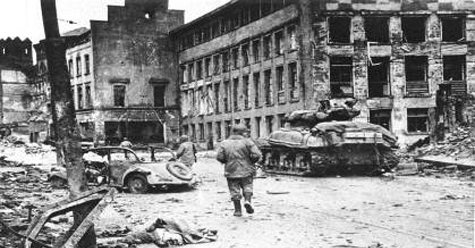
American troops in bomb-damaged Cologne, March 1945
Bundesarchiv Bild 146-1971-053-63
In 1939, Hermann Goring, head of the Luftwaffe, had boasted, ‘If bombs drop on Germany, my name is Meyer.’ Early RAF bombing missions, however, were considered too dangerous by day and too ineffective by night. On 30 May 1942, Arthur ‘Bomber’ Harris, appointed commander of Bomber Command in February 1942, organized the destruction of Cologne, using no less than a thousand bombers in a determined act of terror against civilians. German war production suffered, but German anti-aircraft guns and the vulnerability of British planes resulted in high casualty rates for the RAF.
In January 1943, Harris joined forces with his American counterpart, Carl ‘Tooey’ Spaatz, in a renewed initiative in bombing Germany. The RAF bombed cities by night, a policy of ‘de-housing’, its express purpose to target and demoralize the civilian population (despite evidence during the Blitz that rather than demoralizing, bombing only hardened resolve); while the USAAF bombed industrial and military targets by day. Hamburg was razed in July 1943 by incendiary bombs causing firestorms that engulfed the city, melting cellars, and killing 50,000 people. Numerous other cities were also targeted. But with only one in four aircrew surviving their allocated thirty missions, the attacks were halted. Allied pilots who survived being shot down in Germany were often lynched by the local civilians. The German population called for retaliation, but with Goring’s diminishing air power engaged on the Eastern Front, the Luftwaffe lacked the resources to respond.
On 13 February 1945, Bomber Harris sent his planes over Dresden, one hundred miles south of Berlin and brimming with refugees fleeing the Soviets sixty miles away to the east. Dwarfing the devastation caused in the Blitz four years earlier, Dresden, with only minimal anti-aircraft guns, was obliterated, with ten times the number of bombs dropped and ten times the number of casualties during the whole of the Blitz, and almost double the casualties suffered by the atomic bomb over Hiroshima. Churchill questioned Harris’ methods of ‘bombing German cities simply for the sake of increasing the terror’.