
The capitulation of Germany had no effect on Japan’s determination to carry on the fight despite their severe losses. One by one, the Japanese lost their Pacific islands as the Americans homed in on the Japanese mainland in a protracted war of attrition. The Japanese fought to the last for each of these islands, preferring death, even by suicide, to surrender. The erosive but ultimately successful fight for the small but strategically important islands of Iwo Jima and Okinawa (both would be used as bases for the air offensive on Japan) is etched onto the American consciousness.

The US triumph over the Japanese on the Pacific island of Iwo Jima, March 1945
In Burma, Japan’s attempt to take the British bases on the Indian border, such as Kohima, failed and General Slim’s army of British and Indian troops advanced against the retreating Japanese forces. The Burma Road – supplying the Chinese – was reopened in January 1945 and Rangoon was liberated on 3 May. In the Philippines, the Americans defeated the Japanese navy at the Battle of Leyte Gulf in October 1944, soon followed by the successful recapture of the country, with Manila falling on 23 February 1945. American submarines could now thwart supplies to the Japanese mainland, exacerbating the crisis in Japan.
From the end of 1944, American planes were bombing Tokyo and other cities at will. The American navy had ripped the core out of the Japanese navy, while the Japanese air force, by and large spent, was reduced to the use of aerial suicide attacks, or kamikaze, on American ships. Meanwhile, the American naval blockade was having a telling effect on the Japanese supply of food and materials. Defeat was inevitable, but when presented with the opportunity to surrender at the Potsdam Conference in July 1945, and threatened with ‘complete and utter destruction‘, Japan refused.
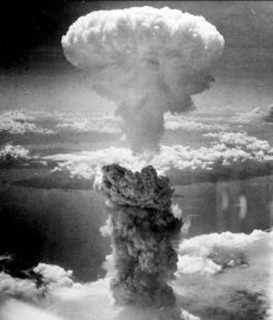
Atomic bombing of Nagasaki on 9 August 1945
Faced with a protracted war in the Far East, the Allies took decisive action – on the morning of 6 August, the American plane, Enola Gay, dropped an atomic bomb, ‘Little Boy’, named after Roosevelt, on the city of Hiroshima. The effects were devastating. Two days later, on 8 August, the Soviet Union declared war on Japan, as Stalin had promised at Yalta, but still the Japanese refused to surrender. Three days after Hiroshima, the Americans dropped ‘Fat Man’, named after Churchill, on Nagasaki. This ‘new, most cruel bomb,’ as Emperor Hirohito called it, finally gave the Japanese the means to surrender without losing honour. The formal surrender took place in Tokyo Bay on board an American battleship on 2 September 1945 – six years and a day after Germany’s invasion of Poland.
The Second World War was over.