
19
The ever-decreasing American leverage added to the strategic uncertainty as the 2014 elections approached with a peace process nowhere in sight, the Taliban resilient, and the Afghan government continually plagued with corruption and predation. Russia, China, and Central Asian governments began hedging their bets by increasing their contacts with the Taliban. These factors eroded confidence in Kabul and persuaded Karzai to take an increasingly aggressive anti-American policy.
Karzai eventually permitted BSA negotiations to resume. While American and Afghan officials worked out an agreement, Karzai called for a Loya Jirga to examine and recommend approval or disapproval of the text. The deal was then to be sent to parliament for approval before being signed by Karzai. The timing coincided with the release of William Dalrymple’s book Return of a King, which discussed the sad reign of Afghan king Shah Shuja—the last Popalzai ruler before Karzai—who was considered a British puppet and was overthrown shortly after the disastrous British retreat from Kabul in 1842.1 Already sensitive to being considered an American puppet, Karzai wanted to distribute the political risk of signing a BSA as widely as possible.
The support from the assembled delegates in favor of the BSA was overwhelming. Karzai, however, took to the podium and urged members against it.2 He waved the assurance letter Obama sent him regarding the BSA, recalling the earlier assurance letter about the Taliban office, and explained how US promises could not be trusted.3 Karzai ultimately refused to sign the agreement—he had more to gain by standing up to the United States. The document would not be approved until October 2014, after the new Afghan administration had come to power, and just two months before the United States was to end its combat mission. Neither Ashraf Ghani (the new president) nor Abdullah Abdullah (in the newly created office of chief executive), signed the agreement. They delegated that task to an unelected official, National Security Advisor Hanif Atmar.
As the end of the US combat mission loomed closer, discussions within the Obama administration began to center on ways to try to recover the US Army’s Sergeant Bowe Bergdahl—the only American soldier in Taliban captivity. With the ongoing counterterrorism missions in Afghanistan and Pakistan, the United States was unwilling to refocus more resources to find him. I supported the idea of the detainee exchange, provided the Taliban agreed to the travel ban and that the deal was linked to a broader peace process.
The Israelis, hardly fussy when it comes to dealing with militant groups, traded over 1,000 prisoners for Gilad Shalit in 2011, a soldier held by Hamas since 2006.4 The five Taliban detainees, after more than a decade in GTMO, would probably prefer to live with their families in Doha rather than try to assume a battlefield leadership role.5 Besides, the Taliban had capable people in those roles already and probably did not want these five competing for senior leader jobs.
The Taliban wanted them out of GTMO, which was leverage the Obama administration could use for a higher return. The Qataris valued their diplomatic role in the Gulf and wanted good relations with the United States.6 They had every reason to uphold their end of the agreement, which we had negotiated in 2011 and 2012.
By May 2014, the Taliban finally caved on the travel ban, enabling the Qataris to sign the agreement and opening the door for the detainee transfers. Secretary of Defense Chuck Hagel had the political courage to approve the transfers and sign the certification letter.
Bergdahl was repatriated in an impressive battlefield link-up between the Haqqani network of the Taliban and US special operations forces on June 4, 2014. Some congressional members and pundits cried foul, saying that the effort was damaging to US interests.7 As of December 2020, all five exchangees had remained quietly in Doha, following the rules we negotiated with the Qataris. The exchange, however, was not linked to any peace process.8
Had US and Afghan officials examined the issue dispassionately, they could have arrived at some conclusions about the Taliban. First, the exchange showed that the political commission in Doha represents the Taliban leadership. The transaction had to be communicated from the Qataris to the political commission, then to the Taliban senior leadership in Pakistan, and then to the Haqqani network who was holding Bergdahl. The link-up of hostile forces in a combat zone to conduct a prisoner handover like this one was complex and high risk, and the Taliban political commission made it possible. Second, it helped answer a lingering question about the relationship between the Haqqanis and the Taliban senior leadership. Despite public statements from Sirajuddin Haqqani that he was Taliban, some US intelligence agencies and commands have persisted in believing they were separate.9 The exchange showed that the Haqqanis were responsive to Taliban senior leader orders. Although several of their top leaders were in custody, including a son of Jalaluddin Haqqani, the Haqqanis did not demand that their detainees be part of the exchange.10 Third, it showed the political commission could make commitments on behalf of the senior leadership and follow through. These points suggest the political commission should be considered a legitimate conduit for talks. The US officials ignored or dismissed those facts until August 2018, when senior American military leaders pressed again for exploratory discussions.
The uncertainty over the bilateral security agreement, meanwhile, likely prompted more aggressive hedging strategies by key actors in Afghanistan and the region. Businesses were even more reluctant to invest in Afghanistan. The capital flight continued to be a problem. Real estate prices plummeted. Kleptocratic behavior became more aggressive as officials sought to extract all they could and tuck it away overseas in case things fell apart.11 The worth of the Afghan currency plummeted. On August 1, 2013, the afghani had traded at 53 to the dollar. Two years later, it was trading at 64 to the dollar—a 21 percent decline. Figure 7 shows the post-2013 decline in optimism among Afghan respondents.
The situation may have created even greater incentives for electoral fraud in both the Ghani and Abdullah camps.12 Ghani’s vote tallied higher than Abdullah’s. The latter refused to accept the results and tensions mounted. The impasse over the election results heightened the risk of political violence as Abdullah supporters, such as the powerful Balkh governor Atta Mohammad Noor, threatened civil war.13 Carter Malkasian, an Afghanistan expert and a former senior political advisor to ISAF commander General Joseph Dunford (2013–2014), notes that these problems were occurring anyway due to the drawdown of international forces.14 Nonetheless, the anxieties surrounding the BSA intensified the toxic environment of 2014 and increased American frustration and fatigue.
After months of wrangling, the disputed 2014 presidential election to replace Hamid Karzai resulted in a US-brokered Government of National Unity consisting of two rival camps. The new government was led by President Ashraf Ghani and by Abdullah Abdullah, who accepted the newly created position of chief executive. The provisions of the deal included, within two years, electoral reform before parliamentary elections scheduled for 2015, district council elections, and a constitutional Loya Jirga to consider, among other issues, whether to institutionalize a prime minister position.15 The lingering animosities and competing visions of government guaranteed gridlock and made progress on these sensitive issues virtually impossible. Having rebuffed the BSA, Karzai positioned himself as a political figure of significant stature and has been agitating against the new government since he stepped down from power.16
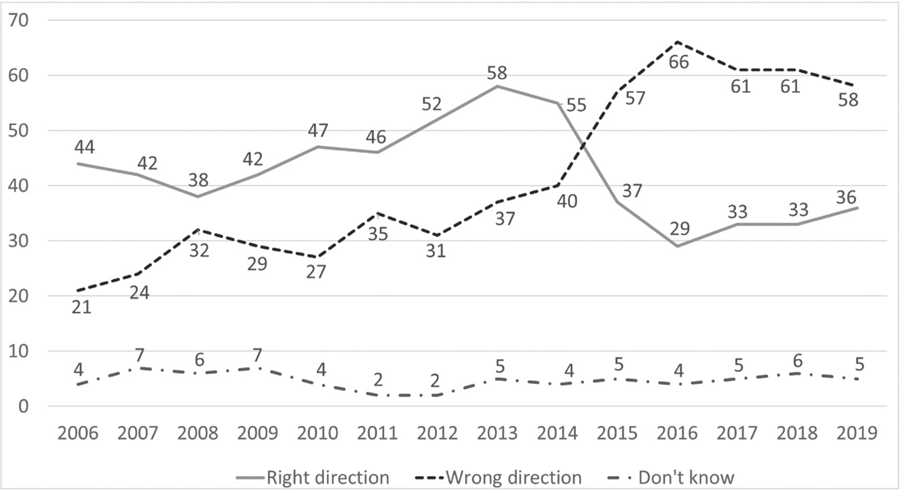
Figure 7. National Mood in Afghanistan
Question: “Overall, based on your own experience, do you think things in Afghanistan today are going in the right direction, or do you think they are going in the wrong direction?”
Source: Afghanistan in 2019: A Survey of the Afghan People, The Asia Foundation, 2019, 17; reprinted with permission.
The Afghan government continued its refusal to engage the Taliban political office, insisting instead that the Pakistanis deliver the Taliban to the table. Afghan president Ashraf Ghani, in the face of stiff political opposition, began efforts toward a rapprochement with Pakistan, which even included agreements on intelligence sharing.17 To show their bona fides, the Pakistanis delivered three unempowered Taliban interlocutors to talks in Muree, Pakistan, in 2015.18 The Taliban political commission, however, dismissed the talks and noted that they were the only Taliban entity authorized to participate in them.19 The announcement of Mullah Omar’s death two years earlier scuttled the meeting anyway. The Quadrilateral Coordination Group Process (Afghanistan, Pakistan, US, China) atrophied out of existence by 2016.20
Professor Paolo Cotta-Ramusino, the secretary general of Pugwash, an international organization, had maintained contact with the Taliban political commission and believed that private talks with them and former US officials could help restart a peace process. He recruited Ambassador Robin Raphel and me to join him in Doha for an informal conversation. After several meetings in which the Taliban members expressed a desire for talks so that Afghanistan could avoid becoming “another Syria,” the group took the extraordinary step of writing an open letter to the American people asking for discussions to find ways to end the conflict. We conveyed our follow-up discussions to senior American and Afghan officials. President Ghani and the top NATO commander in Afghanistan, General John “Mick” Nicholson, bravely offered a cease-fire during the 2018 Eid al-Fitr holiday.
Top American military leaders and former Defense senior leaders encouraged President Trump to appoint Zalmay Khalilzad as US special envoy to resume talks with the Taliban. After nearly 18 months of negotiations, the United States and Taliban concluded an agreement in which the former agreed to withdraw all foreign troops within 14 months (by April 30, 2021), and the latter agreed to prevent al Qaeda and other terrorist groups from threatening the United States from Afghan soil. Both parties agreed to make efforts toward a peace process that included the Afghan government, provided the latter releases up to 5,000 Taliban prisoners.
The agreement was probably the best the United States could get at that time, given the state of the conflict. It is far less than what the Taliban wanted in 2012 to begin talks with the Afghan government.
President Trump, eager to end so-called endless wars, put his support behind the talks (including an ill-advised invitation for the Taliban to come to Camp David, which the latter rejected). The United States and the Afghan government missed opportunities in 2001, 2003, 2004, and 2012 when their leverage was far higher, and had to settle for what they got in the February 2020 agreement.
According to Statista, a data harvesting website, 581 American service members died from 2012 to 2019 in support of Operation Enduring Freedom.21
Conclusion to Part IV
Bargaining asymmetries undermined the prospects for reconciliation in Afghanistan. President Obama’s decision on December 1, 2009, to announce both a surge of forces and a timeline for withdrawal limited American leverage. The Taliban aimed to gain concessions that improved its legitimacy while coaxing the United States to complete its withdrawal, but the insurgents were not interested in negotiating an end to the conflict at that time. As the drawdown continued, American bargaining power declined further. By March 2012, the Taliban postponed talks with the United States. The persistent and increasingly specific withdrawal announcements likely doomed any hopes of a peace process before the withdrawal of American troops. The Pentagon continued to receive a level of White House scrutiny about military operations that diplomats never underwent regarding reconciliation, regional diplomacy, and the 2014 elections. The number of meetings about those matters were comparatively few and far between.1
Bureaucratic frictions, lack of vision, poor coordination, inadequate strategic empathy, and sloppy execution damaged reconciliation. The lack of agreed conceptual frameworks for war termination inhibited clear communication and consensus-building within the US government, making the status quo harder to change.2 The five strategic lines of effort became unprioritized silos. Individual actions in one, like the abortive opening of the Taliban political office, created setbacks in others. In the end, reconciliation further poisoned the relationship with Karzai, undermined American credibility in Afghanistan and the region, and heightened political uncertainty and instability as Afghanistan approached the 2014 elections and the end of the international combat mission. None of these problems were inevitable, nor were they easily preventable.
The lack of a coordinated strategy with the Afghan government increased the risk that sensitive issues such as reconciliation would become friction points. These problems exacerbated the prisoner’s dilemma—each party recognized the benefits of cooperation toward peace. Still, no one trusted the others enough to take any risk to bring it about. Risk aversion and mutual suspicions created further obstacles. These issues made a credible reconciliation strategy even more necessary. The US government, however, proved incapable of delivering one.
In Iraq, Bush changed strategy when advisers affirmed his beliefs in the importance of success, presented facts on how the current approach was failing, and offered an alternative path to achieve his goals. That never occurred for Obama on Afghanistan, in part because his definition of success centered on ending the US role in the war rather than achieving specific security and stability outcomes. Withdrawal timelines became rigid. Defense and State failed to offer alternatives that might have addressed Obama’s concerns about open-ended commitments, even though the status quo risked leaving Afghanistan on its own to deal with an industrial-scale insurgency that was still allied with al Qaeda. After foregoing opportunities for a peace process in 2001, 2003–2004, and 2010–2012 when America and the Afghan government had very high negotiating leverage and the Taliban had few conditions, the United States found itself in February 2020 accepting the Taliban’s demands for a 14-month withdrawal timeline in exchange for the latter’s assurances that they would not allow terrorists to use Afghan soil to foment attacks.