
22
With decisive victory clearly out of reach, the United States’ approach by 2004 drifted toward transition-and-withdraw. It was not a change of strategy; the Bush administration was lowering the bar of success as they sought a way out.1 Bremer passed control to the IIG’s Prime Minister Ayad Allawi on June 28; the CPA disbanded, and so did Combined Joint Task Force-7.
A new civil-military country team provided an opportunity to look at the situation with a fresh set of eyes. John Negroponte became the chief of mission at the new American embassy, and General George Casey took command of Multi-National Force—Iraq. They signed a Joint Mission Statement to reduce the civil-military rift between Bremer and Sánchez. They also established a team to assess the conflict and suggest a way forward.2
The preeminent threat, the new plan stated, was Sunni insurgents and members of the former regime—“Sunni Arab Rejectionists” and “Former Regime Elements.” The goal for the coalition was not to defeat the insurgents, but to “reduce the insurgency to levels that can be contained by ISF [Iraqi security forces], and that progressively allow Iraqis to take charge of their own security.”3 President Bush described it succinctly in a June 28 speech at Fort Bragg, “As the Iraqis stand up, we will stand down.”4 The essence of the plan was to build and train Iraqi security forces, hand over control to them, and draw down the US presence.5
The rules for the January 30 election, however, entrenched Sunni resistance. In the run-up, Iraqi and American officials considered whether to divide Iraq into multiple voting districts or to treat it as a single national district. Sunni Arab candidates would win seats in predominantly Sunni Arab areas such as Anbar province.6 In the single-district alternative, the Shi’a and Kurdish parties would have a significant advantage due to their sheer numbers and the probability that insecurity and insurgency would suppress the Sunni vote.
The decision to treat Iraq as a single national district was part of a UN-brokered compromise to appease Sistani’s demands for elections in 2004. This poll was to elect the Iraqi National Assembly, which would form the Iraqi Transitional Government (ITG). Former CPA official Meghan O’Sullivan argues that treating Iraq as a single voting district was the only realistic way to pull off elections within this timeline.7 The decision reinforced Sunni Arab marginalization and undermined the election’s legitimacy.
Many Sunni Arab leaders called for a boycott of the election; others were probably too scared to vote due to threats made by Zarqawi and other insurgents.8 In Anbar, the turnout was only 2 percent.9 Violence on polling day was high, but 58 percent of eligible voters reportedly participated.10 Allegations of rigging included ballot stuffing, voter intimidation, fraudulent voter registration, vote buying, and importation of non-Iraqi Kurds to cast votes for Kurdish parties.11 The United Iraqi Alliance, a coalition of non-Sadrist Shi’a religious parties, came in first. The Kurdish parties were second; Allawi’s Shi’a-Sunni coalition secured only 25 seats. For the 275-member parliament, Sunnis tallied only 8 percent of the representation—less than half their proportion of the population.12
After post-election jockeying by the parties to form a government, Ibrahim al-Jaafari finally secured the prime minister post. He was not an influential national figure backed by a militia, so he posed little threat to Iraq’s Shi’a strongmen. Bayan Jabr from SCIRI gained the powerful Interior Ministry. He acted swiftly to intensify de-Ba’athification and remove Sunnis from leadership positions.13 Sectarian violence, including atrocities, rose.14 Iran, meanwhile, continued its influence campaign with the new Iraqi government (reportedly giving millions of dollars to Jaafari in advance of the election) while enhancing its lethal support to Shi’a militias that were fighting the coalition and engaging in sectarian cleansing.15
Shi’a and Kurdish advantages in parliament gave them control in drafting the constitution, which would be approved or rejected in an October 2005 referendum. In advance of the vote, Sistani explained to US officials his preference for votes to be counted by province instead of treating the whole country as a single district. The former, he argued, would reduce fraud from inflating the number of Kurdish seats in parliament and could increase Sunni representation.16 A new electoral law created electoral districts instead of treating Iraq as a single national district.17 This time the Sunni Arab leaders encouraged participation, because two-thirds of voters in three of Iraq’s 18 provinces could defeat the measure.18 Voters approved the constitution, although Sunni Arabs alleged that election rigging repressed Sunni turnout and inflated Shi’a and Kurdish votes in Diyala, Salah ad-Din, and Ninewa.19
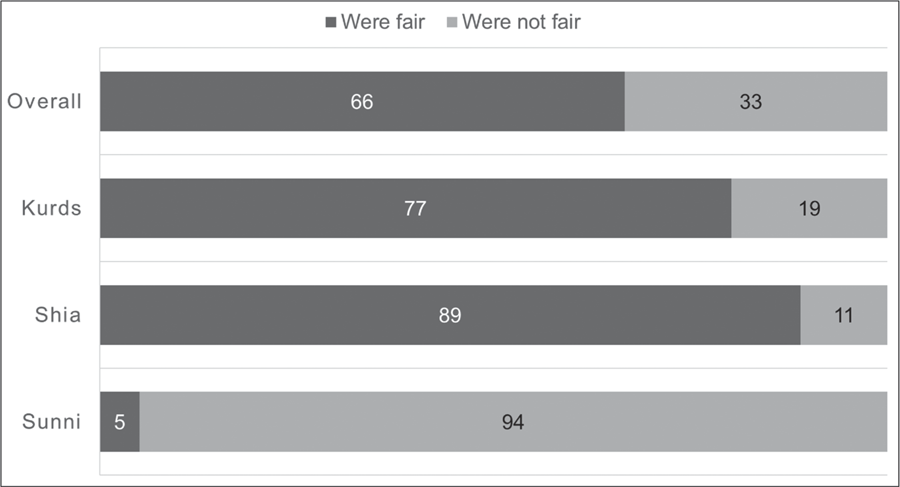
Figure 8. Perceived Fairness of 2005 Elections
Question: “Do you think that recent parliamentary elections were or were not free and fair?” Chart shows percentages.
Source: Based on data from WorldPublicOpinion.org, “What the Iraqi Public Wants,” a WorldPublicOpinion.org Poll conducted by the Program on International Policy Attitudes, January 31, 2006, 7.
The final milestone was the parliamentary elections set for December 2005 to form a permanent Iraqi government. Concerns about electoral fraud, however, increased as the polling approached, including allegations of ballot stuffing, intimidation, fraudulent registration, and vote buying.20 The de-Ba’athification commission removed 90 Sunni Arab candidates from eligibility.21 After the polling, Sunni Arab and secular party leaders protested the massive fraud by the government and Shi’a and Kurdish parties.22 Sunni Arab leaders complained to Khalilzad that their constituency was “under siege” from the terrorists, the government, and the coalition.23 Violence reportedly increased, particularly around Baghdad.24 Reflecting on the historic 2005 elections series, Allawi complained that the polls undercut rather than advanced democracy in Iraq.25 Survey data draws a similar picture.
WorldPublicOpinion.org, together with the Program on International Policy Attitudes, conducted opinion surveys in Iraq entitled “What the Iraqi Public Wants.” Their January 2006 edition asked about the fairness of the December 2005 elections (see figure 8) and the legitimacy of the new government (see figure 9). Both showed a clear sectarian divide. Eighty-four percent of Shi’a and 76 percent of Kurds considered the country to be going in the right direction, but only 6 percent of Sunnis agreed.26
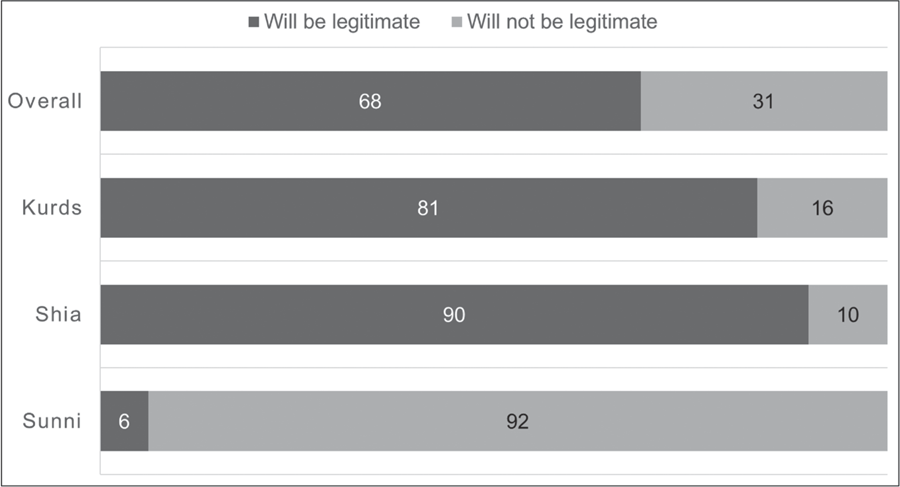
Figure 9. Future Government Legitimacy
Question: “Do you think that the government to be established by the newly-elected parliament will or will not be the legitimate representative of the Iraq people?” Chart shows percentages.
Source: Based on data from WorldPublicOpinion.org, “What the Iraqi Public Wants,” a WorldPublicOpinion.org poll conducted by the Program on International Policy Attitudes, January 31, 2006, 7.
Nouri Kamal al-Maliki, a relatively low-profile figure with a deep sectarian past, finally emerged as the prime minister.27 Maliki used Iraqi forces and JAM to continue Sunni Arab repression.28 A Sunni Arab leader told US officials that “The extrajudicial practices of Shi’a police in Anbar province fueled the insurgency.”29 When US officials presented Maliki with evidence of sectarian atrocities at the hands of these forces, he reportedly replied that things were worse under Saddam.30 Saudi Arabia’s King Abdullah complained to the US ambassador to Iraq, Zalmay Khalilzad, that the United States had given Iraq to Iran as a “gift on a golden platter.”31
Polling data collected by the Defense Intelligence Agency showed that confidence in Iraqi security forces was dwindling among Sunni Arabs while support for armed resistance was increasing.32 Attacks rose from 200 per week in January 2004 to more than 1,000 per week in July 2006. They would nearly double again to 1,800 per week in July 2007.33 A sectarian civil war was well underway, with atrocities on both sides of the Sunni-Shi’a divide.34 The Sunni insurgency had become sustainable, enjoying local popular and external support. The Maliki government exploited American forces and Jaish al-Mahdi to consolidate Shi’a power and exact retribution for decades of abuse at the hands of Saddam. Despite these shocking levels of violence, General Casey and Secretary of Defense Rumsfeld began canceling deployment orders for units scheduled to go to Iraq. They remained convinced that the United States had to draw down to win.35 As US officials measured progress using milestones, they ignored evidence that the overall situation was spinning out of control. With a growing Sunni insurgency and Shi’a militancy and a government of dubious legitimacy in the eyes of many Iraqis, the conditions were emerging for a counterinsurgency loss.
Conclusion to Part V
Why did this toxic combination arise of an insurgency with tangible support and a host nation government unable to win the battle of legitimacy in contested and insurgent-controlled areas? Existing explanations focus on the lack of Phase IV planning, inadequate troop presence to maintain security, and poor politico-military integration.1 These problems contributed to a more significant cause: a failure to develop a strategy resilient to the competitive, interactive, and often violent nature of politics in post-conflict societies. America deployed a well-trained and sophisticated military force, highly experienced diplomats, and extensive civilian expertise. By 2006, US forces were losing to a poorly trained, equipped, and resourced insurgency, as Iraqi elites manipulated American officials, thus creating a downward spiral into more violence and damaged legitimacy.
The Bush administration failed to consider war termination in its policy and strategy. They fixated on the military campaign, implicitly assumed a decisive military victory, ignored warnings about probable post-Saddam risks, and thus heightened the likelihood of quagmire. The administration failed to develop a strategy that integrated all elements of national power toward a favorable and durable outcome and that was resilient enough to adapt to emerging risks. The military campaign plan was sufficient to defeat a poorly trained and incompetently led Iraqi Army, but too rigid to adapt to the dynamic aftermath. Despite ample warnings from the intelligence community and a wide array of experts about the risks of post-regime instability, the Bush administration clung to the optimistic assumptions underpinning the campaign plan.2 Wolfowitz’s testimony on February 27, just weeks before the invasion, dismissing the need for stabilization forces suggests the Bush administration never seriously contemplated the risks.3 The Department of Defense and the Bush administration fell victim to what Nobel Prize winner Daniel Kahneman called the planning fallacy—the tendency to underestimate the costs and overestimate the benefits of future actions. They were not alone. If State had grave concerns about the prospects for success, Powell could have recommended an interagency war game to Bush. As a former chairman of the Joint Chiefs, he was aware of the utility of this tool to expose problems. The failure to understand the difference between strategy and plans had significant consequences.
The CPA developed on the fly and implemented a milestone-centric plan that viewed post-war security and reconstruction as an engineering task. The approach, so deeply ingrained in US civilian and military officials, was unquestioned. Iraqi elites exploited each milestone. The Sunni Arab sense of alienation grew, as the coalition military and Iraqi government were perceived to be adding repression to political exclusion. As more Sunni Arabs fought back, Shi’a leaders pressed their advantage. Higher troop levels in 2003 might have delayed the onset of the insurgency. Still, they could not have ensured government legitimacy or convinced Sunni Arabs to accept what they perceived to be a state of oppression.
Rebalancing of political power to reflect Iraqi demographics was bound to reduce Sunni Arab influence and enhance Shi’a and Kurdish influence, so the Bush administration, CPA, and military should have taken extra care to address Sunni Arab concerns. The United States, however, was unprepared for the intense scrimmage for power among Iraqi elites.4 De-Ba’athification and disbanding the Iraqi Army had disproportionately large effects on Sunni Arabs. Excessive military efforts in the Sunni Triangle, torture, and abuse fueled resentment. Together, they stoked armed resistance and a belief that there was no place in the new Iraq for Sunni Arabs.5 These policies and actions were encouraged and amplified by Shi’a leaders eager to consolidate power and avenge years of humiliation and abuse. American officials lacked the strategic empathy to discern these traps. A strategy that was adaptable to the likely scrimmage for power, score-settling, and potential for sectarianism would have put the United States in a much better position to succeed. “Bush, Cheney, Rumsfeld, and Tommy Franks spent most of their time and energy on the least demanding task—defeating Saddam’s weakened conventional forces—and the least amount of time on the most demanding—rehabilitation and security for the new Iraq.”6
The administration’s governing strategy document assumed that the political, military, and economic elements of its strategy were “integrated and mutually reinforcing,”7 but each track operated on an internal logic and trajectory. Military and civilian officials worked hard in their silos, doing their best in a dynamic environment. The main problems of security, governance, development, and political inclusion, however, were interconnected and spiraled downward.8
No one in Iraq had the authority, responsibility, and accountability, however, to ensure these efforts worked in concert toward achieving a successful outcome. The White House and National Security Council were in no position to run a limited war full time when they had responsibilities across the globe, domestic policy to manage, and departments to run. In the absence of full-time governance of American and coalition efforts on the ground, political and military activities unwittingly self-synchronized to empower a highly sectarian Iraqi government and heighten Sunni resistance. The result by 2006 was a sustainable insurgency fighting against the coalition and an increasingly predatory Iraqi government that showed little interest in earning Sunni Arab support.