
Crafts underwent a long evolution during the Early Minoan, an incubation that prepared the way for major developments in the Middle Minoan temples and towns. We have, for example, the potter’s workshop at Fournou Korifi, the carpenter’s toolkit found at Khamaizi and the three almost identical dog-handled schist jars; these instances show a significant degree of craft specialization in the Early Minoan (Branigan 1983).
Most of the evidence we find for full-time craftsmen nevertheless comes from the temples of the Middle and Late Minoan periods, so we should see the main period of craft industries as belonging to an urban society and in particular to the temples within that urban society. There were lapidaries in the temple workshops at Knossos, Mallia and Phaistos, bronze-smiths at Phaistos, seal carvers at Knossos, ivory carvers at Zakro. Craft specialization is often subsidized at the redistribution centre in a chiefdom society, so we should expect to see crafts flourishing in the temple culture of bronze age Crete: we should also expect to see craftsmen gathering in the temples, where the agricultural surpluses and imports were collected and redistributed. From the economic and organizational standpoint, it was very natural for the craftsmen to have become concentrated in workshops in the temples.
At the same time, there were craftsmen working outside the temples. For example, ivory carvers and stone vase makers worked in premises along the Royal Road in Knossos. Whether these craftsmen were independent or worked under the aegis of the temple, which was close at hand, is hard to judge.
Certainly there were part-time specialists operating in settlements like Palaikastro which had no temple, so it was possible for them to work geographically separate from the temple centres. But even there it is hard to be sure that there was no ultimate control from the temples. We know from the temple archives at Knossos that the geographical reach of the administrators was exceptional, so it is possible that ivory carvers in Palaikastro were employed and controlled by the Zakro priests.
Concentrations of workshops, such as those along the Knossos Royal Road, in the East Wing of the Knossos Labyrinth, and in the Northern Quarter of Gournia, suggest another possibility - that there were guilds of craft workers. The evidence so far gathered is very inadequate, so we could not be sure, but there does seem to be some tendency to concentrate. Guilds could be the answer, or alternatively some form of temple control: either way, the tablets imply a minutely ordered society.
Makers of stone vases
In the manufacture of stone vases, the Minoans displayed enormous patience, as well as very high levels of confidence and skill. It was a craft that evolved into an art form, as they attempted more and more ambitious shapes in a widening range of materials. Perhaps the most extraordinary creation was a libation vessel in the form of a shell, yet made out of a block of hard and brittle obsidian. The great majority of the vessels made were simpler. The first stage in making a stone vase was to rough out its external shape: then the interior was hollowed out by a combination of drilling and chiselling. Sometimes a ring of holes was made and the core knocked out, and sometimes a larger solid drill was used instead. The drill might be made of wood or bronze, using sand or emery, imported from Naxos, as an abrasive. The exterior of the vase was then finished and both surfaces, inside and out, were ground smooth with a stone.
The initial idea of making vases out of solid stone was probably a foreign import. Egyptian stone vases reached Crete before the bronze age began; the Cretan industry, which had started as early as 2500 bc, nevertheless post-dated the arrival of these foreign vases. To begin with, the Cretan vases were made out of chlorite or chlorite schist, but the vase makers soon branched out into other materials, favouring especially the relatively soft and easily worked serpentine which can be found in various parts of central and eastern Crete.
By the time the first temples were built, in 1900 bc, craftsmen had the confidence to attempt harder stones which had more attractive colours and textures, such as mottled breccias and orange stalactite. The technique had developed to such an extent by the New Temple Period, beginning in 1700 BC, that vases were being made out of obsidian and rock crystal: for example, the beautiful crystal rhyton from Zakro.
Perhaps the commonest stone vessels were those that were compact in form, like birds’ nests, but more ambitious forms were attempted even from the beginning, such as the circular pot-lids with handles in the form of a reclining dog, made, apparently in some numbers, at Mochlos in around 2500 bc. Very large numbers of stone vases were deposited as grave goods in the early communal tombs of the Mesara plain; there were some fine examples deposited in early tombs at Mochlos too. Often the earliest jars and vases were decorated with hatched incised triangles and spirals in relief, in much the same style as the cosmetic jars made in the Cyclades: probably the designs were copied from Cycladic models.
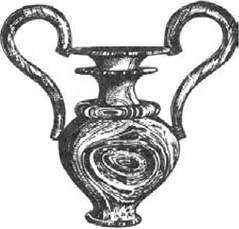 Figure 26 A stone vase from the temple at Zakro
Although some of the designs and the technique of vase making were borrowed from abroad, the Minoans developed the technique in a quite extraordinary way. By the time of the first temples, the making of stone vases had become widespread, with the production of buckets, jars, bowls and lamps designed to be used both in the house and the temple. It was in this first temple period that the Minoan vase makers began to tackle hard exotic stones, like the rosso antico from the Greek mainland and the white-speckled obsidian from Yiali near Karpathos in the Dodecanese. A typical stone vase maker’s workshop from this period has been identified at Mallia.
It was in the period after 1700 BC that the stone vase makers’ art reached unparalleled heights. The dark, blue-black serpentine which had been popular before was still used a great deal, but now new materials were tried out as well - alabaster, gypsum, limestone, marble and breccia - and some extremely hard rocks like porphyry. A plain black obsidian which the Minoan craftsmen tried may have come from the Qiftlik area of Cappadocia. The green speckled Spartan basalt used at Knossos came from the south Peloponnese; a store-room in the East Wing of the Knossos Labyrinth held a supply of Spartan basalt blocks at the time of the temple’s abandonment in 1380 bc. Some relatively soft Egyptian alabaster was imported and at least forty vases were made from it by Minoan craftsmen. Occasionally, Minoan vase makers took Egyptian vases and adapted them, often painstakingly and with great ingenuity, to suit the tastes of their Minoan masters and mistresses. One, that was eventually exported to Mycenae, had been turned upside down, transforming its mouth into a pedestal base, and its original base had been sawn off and replaced with a moulded rim of gilded bronze; then a pair of wooden handles and a spout were added, completing the transformation of the Egyptian vessel into a Minoan jar.
The relief-picture offering vases or rhytons were probably the most remarkable of the vase makers’ creations. They were designed for ritual use and some of them were coated in gold leaf. The Harvester, Boxer, and Chieftain Vases and the Peak Sanctuary Rhyton are all made of a close-grained black steatite and decorated with highly detailed reliefs showing ritual scenes (Figure 56).
By the end of the New Temple Period, the art of making vases out of stone had become a very specialized and rare craft. It had become purely a temple art. The final chapter of the vase makers’ story is shrouded in mystery. The art seems to have died out in Crete altogether, yet mysteriously reappeared in Mycenae in the thirteenth century bc; Sinclair Hood (1978) has suggested that after the conquest of Minoan Crete by Myceneans, the finest craftsmen may have been taken by force to the mainland and made to work for new masters.
Workers in metal
The existence of metal vases and bowls can be inferred from pottery objects which imitate metal models, sometimes even to the extent of having fake rivets and fake chain-links added. The direct survival of the metal originals has been patchy, but there is evidence of a fairly large-scale metal-working industry in Minoan Crete, producing copper and bronze vessels. A hoard of 153 silver cups and one gold cup found at Tod in Upper Egypt may have come originally from Minoan workshops; the vessels appear to be Middle Minoan IB work, which was produced in Crete between 2000 and 1900 bc, and were found in an Egyptian deposit which has been dated fairly precisely to about 1920 bc. The Tod cups were apparently offered as tribute from a Syrian king, perhaps the king of Byblos, which implies that there were complex and long-distance exchanges of goods in the twentieth century bc. Another metal object of Minoan origin, a spouted jug dating from 1850 bc, was found among the grave goods of a prince of Byblos.
Certainly by the year 2000 bc, the tables of the Cretan rulers shone and glittered with drinking cups of gold and silver and, even in the century before the first temples were raised, those rulers were wearing elegant gold ornaments, not imported, but produced by Minoan craft workers.
By 1500 bc, the metal workers of Crete were producing a large range of cooking and storage utensils, including some large cauldrons made by riveting together several bronze sheets: some fine examples were found at Tylissos. Sheet bronze was also used for making armour. Hammered or cast, bronze could be made into tools: single-edged knives for cutting meat, razors, axes, adzes, axe-adzes, double-axes, double-adzes, chisels, sickles, hammers and saws. Throughout the Minoan period, Cretan craftsmen went on making stone axes and maces. Sometimes the workmanship in these archaic stone artefacts was very fine, and it is possible that they were used as insignia of rank, in much the same way as stone maces in the Wessex Culture in southern England; if so, it is curious that the same obsolete tool became associated with rank in two cultures that were geographically so widely separated.
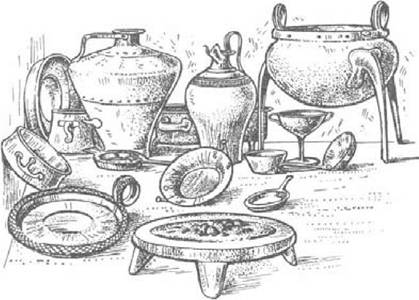
Figure 27 Bronze objects from a tomb at Zafer Papoura, Knossos. The tripod in the foreground is a portable hearth or offering table made of plaster
Copper was found in Crete itself, especially in the Asterousi mountains bordering the Mesara plain, and some may have come from Chrysokamino, near the coast east of Pachyammos, but the demand for metal artefacts is likely to have been high enough for imports of copper to be necessary. The most likely foreign source is Cyprus. The bronze was cast in standard ingots that were about 0.9 metres long with inward-curving sides that made them easier to carry on the shoulder, as shown on one of the contemporary Egyptian tomb paintings depicting Minoan emissaries.
Gold was reserved for making ornaments, jewellery (pins, rings and bracelets) and decorative inlays of various kinds. Some of the stone vases were partially coated with gold leaf. Sometimes the ivory figurines of deities and bull-leapers were given details such as loincloths in gold. The overall effect of, for example, a group of elaborately dressed and bejewelled priestesses conducting a rite with carved and gilded cult objects against a background of inlaid furniture, brightly painted pillars and multi-coloured frescoes must have been one of dazzling opulence.
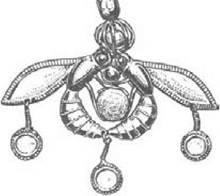 Figure 28 The Bee or Wasp Pendant from Mallia
The temple goldsmiths at Mallia seem to have been outstanding. The celebrated Wasp Pendant (Figure 28) came from a rich burial at Mallia, and it is generally believed that at least some of the Aigina Treasure - found at Aigina, but of unknown provenance - came from Mallia too. The naturegod pendant found at Aigina looks very much like Middle Minoan III work, dating from about 1600 bc; it may have been robbed from the Chrysolakkos tomb at Mallia in antiquity. The large building to the west of the Mallia temple yielded a gold-handled dagger with cut-out designs on its hilt, while the temple itself yielded some magnificent long swords: one of them had a pommel covered in gold sheet modelled to depict an acrobat (Figure 29). The swords may have been ceremonial, or they may have been used in an acrobatic ritual sword dance. The gold used by the Minoan smiths to make all these fine objects was imported from the Egyptian gold mines in Sinai, from the Arabian desert and from Anatolia.
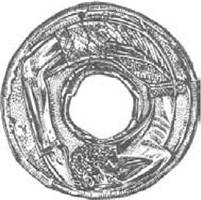 Figure 29 Acrobat on a gold sword hilt from the temple at Mallia. Made in about 1550-1500 BC
The gold cups found in a burial at Vaphio near Sparta on the Greek mainland were probably made by Cretan craftsmen, although Sinclair Hood (1978, p. 167) takes the rather odd position that one of the cups is of Mycenean origin, one of Minoan origin. There are slight stylistic differences in the execution of the relief work, and it may be that one cup is an exotic, a Minoan import, and the other was made by a Mycenean craftsman to make a pair; on balance, I think it more likely that both are Minoan (Figure 51).
A set of silver vessels was found in the Silver Vessels Sanctuary (Evans’ South House) at Knossos, but relatively few vases made of precious metals have been found in Crete. This seems to be because temple, villa and tomb sites have been plundered - mainly in antiquity - rather than because of any original dearth. It is possible that a high-status tomb may yet be found entirely intact and that many gold and silver objects remain to be discovered by excavation. Nicolas Platon (1968, pp. 167-8) mentions the remarkable technique, perfected by the Minoan metal workers, by which superbly decorated daggers were produced. The technique, known as damascening, involved the addition of inlays of threads of silver and gold to bronze blades and hilts, and set off by patches or pools of black enamel; the designs depicted hunting scenes (Figure 10). Many artefacts decorated in this way have been found in royal tombs on the mainland. Platon is convinced that the echnique came from Crete; if that is so, it is likely that at least some damascened daggers await discovery at Minoan sites on Crete.
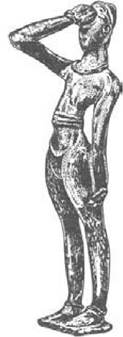 Figure 30 Bronze worshipper from Tylissos
The bronze workers, in addition to making weapons, tools and utensils, were also producing figurines as votive offerings. Typically, the figurines which they made are 20 centimetres high and depict worshippers in attitudes of adoration, or reclining goats, or cattle. They were cast in solid bronze, apparently by the cire perdue method. The original model was made in wax; it was then encased in a clay mould and molten metal poured in through the feet; the hot metal melted the wax and displaced it, filling the mould. The metal filling the pouring hole was usually left untrimmed after it had cooled, so that many of the figurines have a peg under their bases: even the best figures - and some of them (see Figures 2 and 30 ) are very fine - may seem rather unfinished to modern eyes. The rough, bubbly surface often seen is possibly due to a shortage of tin in the alloy, which meant that the metal did not flow well. Even allowing for this, the surface was left just as it came out of the mould. The explanation may be that the figurines were not intended for use as ornaments but were votives to be left in shrines: they had a symbolic, not an aesthetic, role to play. Many were recovered from dark caves and rock crevices where they were not intended to be seen by mortal eyes.
Makers of faience
The manufacture of faience objects was another highly specialized craft closely associated with temple worship; many of these objects have a religious significance and were probably made for cult use. The Minoans may have learnt the art of making faience, a glaze technique, from the Egyptians in about 2000 bc. The glaze consisted of a core of crushed quartz grains coated with glass, usually tinted blue or green by adding small amounts of copper compounds; the result was a richly glazed finish. At first, the technique was used for relatively simple objects, such as pendants and beads, but later it was applied to vases, statuettes and plaques.
The most outstanding collection of faience from the Minoan period is the one that was found in the Temple Repositories in the West Wing at Knossos, where cult vases, plaques, and the famous Snake Goddess statuettes were all treated in this way. The miniature faience robes are almost certainly votives standing for full-sized ceremonial robes that were offered to a goddess, either to dress an idol or to dress a priestess for a ceremony in which she somehow became the goddess. In the classical period and earlier it was quite common for statues of goddesses to be annually reinvested with robes. In Book 6 of the Iliad, we are told of an embroidered robe carried by a procession of old women to the Trojan Athena. At Athens itself, around the summer solstice, the image of Athena Polis was veiled, taken down, disrobed and washed, before being ceremonially reclothed in a new robe specially woven by the arrhephoroi. A similar rite seems to have taken place at the Temple of Artemis at Ephesus. The faience robes tell us that something similar happened in the Knossos Labyrinth too.
The Minoan faience artists achieved very high levels of technical ability. Quite how independent they were of other craftsmen, particularly in the temples, is impossible to judge, but the fact that many objects - and especially the cult objects - required the shared expertise of several different crafts implies collaboration. Potters, faience artists, pot painters, clay figurine makers, stone carvers and the priesthood probably worked closely together, sharing ideas that would glorify their deities.
Shell and ivory workers
In the New Temple Period (1700-1470 bc), inlays made of shell were applied to wooden chests and other furniture. Often only broken fragments of these inlays survive, and nothing of the item of furniture to which they were attached, so it is difficult to visualize the original effect or even the extent of the shell decoration. A plaque from Agios Onoufrios near Phaistos shows the head of a man with moustache and beard. A rectangular plaque from the Phaistos temple shows, in relief, four animal-headed figures in long robes with tasselled belts; it was originally fixed to a curving surface, probably of wood, by means of nails at the four corners (Figure 49). An irregularly shaped plaque from the Throne Sanctuary at Knossos shows a sheathed dagger hanging from a decorative belt.
The shell used for this decorative work was probably the oyster-like Spondylus gaederopus, which is native to the Aegean. The Minoans did not invent the technique of carving shell: it was used earlier, in the Cyclades, for making figurines and bracelets.
The craft of the ivory carvers has attracted more attention. Some of the early ivory seals made on Crete seem to have been strongly influenced by Syrian originals, which suggests that the craft may have been introduced from Syria. Ivory was used, like shell, to decorate wooden boxes and other pieces of furniture. Probably the most spectacular example of this is the large gaming or divination board found in the East Wing of the Knossos Labyrinth: it was covered with plaques of ivory, plated with gold and further decorated with plaques of crystal backed with silver or blue paste. The wooden box to which all these fittings were fixed probably contained the gaming pieces, which were as likely as not also made of ivory. The early temple at Phaistos yielded some small ivory pieces carved in the shape of a bull’s leg and a lion’s head: the lion’s mane was coated in gold.
The temples seem to have had their own ivory carvers, but it is known that ivory carving also went on at Palaikastro, where there was no temple. Some finished ivory plaques were found there, as well as a piece of unworked tusk. Generally, though, ivory seems to have been concentrated in and near the temples. At Zakro, there were ivories shaped like double-axes. In the Silver Vessels Sanctuary at Knossos there was an ivory of a griffin biting a bull’s leg.
During the period of the later temples, there was a remarkable output of large ivory figurines at Knossos. The most celebrated of these is the Boston Goddess, a highly detailed representation of the Snake Goddess with details picked out in gold. Some of the figures represent bull-leapers. They have tiny holes drilled in their heads for the insertion of twisted pairs of goldplated bronze wire to represent tresses of waving hair. They probably had gold loincloths too. It is possible that the bull-leaping figurines belonged to a cult model showing a tableau of bull-leaping. Some at least of the Knossos ivory figurines were made in the workshop beside the Royal Road. The carefully assembled figures, some of them 40 centimetres high when complete, exploited the same colour and texture contrasts between polished gold and carved and polished ivory that were achieved in the large chryselephantine (literally ‘gold and ivory’) statues of classical Greece.
Some of the smaller ivory pieces are just as impressive as displays of technical skill and aesthetic control. A small cylindrical ivory box found at Katsamba, and dating to 1450-1400 bc, shows a group of men attempting to capture a bull in a wild landscape.
After the (assumed) conquest of Crete by the Myceneans, large quantities of Minoan artworks may have been transported to the mainland. The light, portable ivories would have been particularly attractive as loot. There is some doubt about the provenance of the fine ivory sculpture found at Mycenae, depicting two goddesses and a small boy-god. It was found in a Late Helladic IIIA context, dating to 1400-1300 bc, yet it seems to be of Minoan workmanship or inspiration; it may well have been brought to the mainland by proud Mycenean conquerors as booty.
Sculptors of statues
The Minoans made large numbers of statuettes in clay, faience, ivory and bronze, but no large-scale stone reliefs and no large statues in any materials have survived. It may be argued from the evidence that the Minoans did not make large statues. Whilst this is possible, it would be odd; the plaster relief frescoes, such as the one at Knossos depicting a temple attendant leading a large beast, show that the Minoans were interested in large-scale modelled representations of people, bulls and mythological animals. The Minoans had the skill to make life-sized statues in stone or wood - or even ivory - if they chose: the elaborately carved stone vases and fragments of high quality frieze work in carved stone show this very clearly. The Minoans also had diplomatic and trading contacts with Egypt, where stone carvers were making representational bas-reliefs and larger-than-life-sized statues.
Both the models and the technical skills were available, so it would be strange if no large statues were attempted. It is possible that some were made but later destroyed or stolen. Ironically, the more striking and distinctive objects are, the more likely it is that they will have been stolen and therefore absent from the archaeological record. Lord Elgin found (and took) two fragments of carved slabs showing reliefs of bulls at Mycenae. They may have come from the inner chamber of the tholos tomb known as the Treasury of Atreus. The subject matter suggests Minoan Crete, but more to the point is the material of which the carving is made: it is gypsum, which is not found near Mycenae, but is found on Crete and was used extensively by the Knossians for embellishing their temple. It is thus possible that, just as we are suggesting for some of the other finds at Mycenae, it was taken from Knossos: if so, the implication is that other pieces of statuary and relief carving from Minoan Knossos were also removed - by some Mycenean equivalent of Lord Elgin, perhaps.
Some carved stone heads rather less than half life-size have been found in Crete, for example the Middle Minoan II head (1900-1700 bc) which was found at Monastiriako Kefali. The absence of trunks or limbs to go with the heads implies that they were mounted on clay or wooden bodies which have subsequently disintegrated, probably simple wooden xoana. Other evidence, such as the votive faience robes mentioned earlier, tells us that elaborate dresses were offered to deities and it is probable that statues of deities were clothed in these. If so, the timber structure need have been little more than the simplest type of tailor’s dummy. Evidence of clay feet found at the Anemospilia and Mallia temples suggests that the robes were floor length or nearly so, with the feet fitted loosely under the hem. These goddesses were very simple, and may have been armless, like the earliest wooden idols on mainland Greece.
Some bronze and clay fittings imply that there were at least two large statues on Minoan Crete, i.e. life-size or larger. One stood in the Great Goddess Sanctuary in the East Wing of the Knossos Labyrinth: bronze curls from its head were found in the cellars. The other was enshrined at the Mount Juktas peak sanctuary not far away to the south. Hood has suggested that the statue at Knossos may have looked like the snake goddess shown in faience in the Temple Repositories. This is possible, though a simpler rendering without raised arms is more likely. The statues were probably made of cypress wood; it was commented in later times that this was the most suitable material for cult images because it was so long-lasting (Pausanias, VIII; Theophrastus, Historia Plantarum, V).
Seal makers
The locks the Minoans fitted to their doors were little more than wooden bolts with pegs to hold them in place. They were fairly clumsy devices and only offered security from one side: anyone could unlock them from the other side. The seals which the Minoans devised were a simple way of ensuring security. A loop of string or even thread securing a door or a wooden chest could be ‘locked’ with a lump of clay stamped with the owner’s personal seal. The seal might be broken, the string might be cut - but not without the owner discovering later that his privacy had been invaded.
The designs carved on the sealstones were very varied. They often showed scenes from Minoan mythology or religious symbols, which gave the sealing the extra dimension of defence by superstition. Frescoes show that the seals were worn on string or leather thongs looped round the owner’s neck or wrist. As such, they functioned as portable signature stamps, identity tags, and possibly even as credit cards. The magico-religious content of many of the seal images makes it likely that their owners treated them as amulets as well. How far down the social scale the possession of seals extended is not known, but the carrying of personal identification tags is exactly what we would expect of such a minutely organized society.
Seals were manufactured at many settlements, both towns and villages. Halffinished seals were even found at the early settlement of Fournou Korifi. There must have been concentrations of seal makers at the great temple centres, serving the larger populations of the towns.
Some seals are cylindrical, and in the earliest period, from 2500 BC onwards, the designs were carved on the flat end, not on the curve as in Syrian and Mesopotamian seals. After some examples of these foreign seals were imported to crete in the Middle Minoan, some cylinder seals of the eastern type were tried out by Cretan craftsmen, but the standard seal shape in the Early Minoan period was a simple button shape: a very short cylinder with convex ends. This later evolved into a thin lens, with designs on one or both faces. Other shapes were used too, such as cones, prisms, stamps, and even animals and birds.
In the Late Minoan period (after 1600 bc) carved stone seals were replaced to an extent by metal signet rings. These seem to have been designed to be worn on the finger, although the oval design-disc was so big as to be unwieldy; possibly they were normally worn on a string round the neck, or simply reserved for a leisured elite. The signet rings were probably the prerogative of the rich, as they were often made of gold or silver. They were engraved with elaborate scenes of myth and ritual and consequently provide us with valuable information about the Minoans’ religious beliefs (see Chapter 6).
Most of the seals were nevertheless made of bone, ivory, steatite, banded agate, or orange carnelian. By the mid-point of the Minoan civilization’s development, the seal makers had some quite sophisticated tools at their disposal: cutting wheels, fast-twirling drills and gravers of bronze. They also had magnifying glasses to help them with the extraordinarily fine detail which they worked into the seal images:
some lenses were found in a Middle Minoan tomb at Knossos. In fact, many of these images could only have been created with the aid of magnifying glasses. They must have been used by the painter of the bull depicted on the flat side of a crystal plaque found at Knossos. Since the seal carvers needed both hands free for their work, the lenses may have been mounted in some way, either on stands on the work-bench or on something like spectacle frames.
In the New Temple Period, from 1700 BC onwards, the seal carvers achieved their finest work. Designs incorporating fish, birds, bulls, people, gods, goddesses, schematized buildings of various kinds, ships, and elaborate ritual scenes were carved into an astonishing range of materials: ivory, bone, agate, carnelian, haematite, jasper, chalcedony, lapis lazuli and even rock crystal, amethyst and obsidian. The images on the seals reached new heights of sophistication. Before, the individual elements of the design were simply placed side by side. Now, they were combined and synthesized on aesthetic principles which apparently did not always depend on the content of the subject matter, although it is difficult to be certain in an area such as this. What we certainly can see is a tendency towards synthesis and dynamic development, a typical feature of Minoan civilization.
During the Post-Temple Period (1380-1000 bc) the art of seal cutting gradually declined. Invention flagged and a handful of traditional designs was repeated over and over again. Waterfowl and stylized papyrus flowers recur, as do simplified outlines of chariots. The carving had by this time become careless and clumsy. Limbs were often not properly joined with bodies and the long necks and rigidity of attitudes recall the shapes of the clay idols of the period. The art of the Minoan seal cutters, like other aspects of the culture, was falling gradually into decay.
Scribes
It is possible to see the development of Minoan civilization encapsulated in the developments of the urban centres, and the administrative control of the whole territory’s economy was central to that urban development. Unfortunately, the exact location of the territorial boundaries is not known, but it is possible to make statistically based estimates of their approximate positions (Figure 23). It is reasonable to assume that the territory governed from Knossos, for instance, extended eastwards for roughly half the distance between Knossos and Mallia and southwards for roughly half the distance between Knossos and Phaistos. Problems arise when we come to consider the smaller centres, such as Arkhanes; could they have had territories which were on the same footing as those of the major temple-centres? On the whole, it seems unlikely that Knossos’ territory extended only half-way to Arkhanes, only 8 kilometres to the south of Knossos. Clearly, devising a political map of Minoan Crete is fraught with problems.
The administration of each territory was finely tuned and certain aspects of it were recorded on clay tablets at the urban centres. The scribes were an important group of people: there were at least seventy of them working at Knossos in 1380 bc, to judge from the number of scribal hands identified in the clay tablets. In the heyday of the temples, the scribes used at least two linear scripts, and the evolution and interpretation of those scripts are matters of continuing controversy among scholars.
The potters of the Early Minoan period were already occasionally putting signlike marks on certain clay vessels. From their shapes, these marks seem to have been a form of writing.
By about 2100 bc, a new kind of script had appeared. It consisted of sub-realistic images of, for instance, a fish, a leg, or a double-axe. Combinations of these hieroglyphs were carved on sealstones. Evans called it a ‘pictographic’ script, and its origin is still uncertain. Some of the signs resemble symbols from a Mesopotamian script predating cuneiform, which suggests that the script was imported from the east. On the other hand, most of the signs are peculiar to Crete and that argues for a local origin. The overlaps between the Cretan script and other scripts, such as the hieroglyphic scripts of Cyprus and the Hittite lands of Anatolia, may suggest an alternative possibility, that they all evolved from a common ancestor, a now-lost script perhaps originating in Syria. Alternatively, it may yet emerge that the similarities simply represent marginal additions and that the Cretan script was essentially a native creation after all. Curiously, seals with these signs were still being made at the end of the Middle Minoan, around 1600 bc, and were entombed in buildings destroyed in 1470 bc, well after the appearance and general adoption of both Linear A and Linear B scripts. It may be that the old pictographic signs acquired a special magic power associated with the remote past.
Evans listed 135 hieroglyphic signs; although the total is actually rather greater than this, there are still not enough for the system to have been a purely ideographic one, with one sign for each idea. Equally, there are too many for them to have been purely phonetic or syllabic. Therefore, as Professor Alexiou has said (undated, p. 124), the system must be some sort of half-way house, with some of the signs qualifying the meanings of others. Further difficulties arise because it is by no means clear what objects the signs are intended to represent, but even if it were, decipherment would still be a very long way off.
To judge from the pottery found with it, the famous Phaistos Disc dates to about 1700 bc. It carries a double spiral statement composed of pictograms imprinted on the clay with 45 possibly wooden but more likely metal stamps. The signs at first sight seem to be completely different from those of other scripts found in Minoan Crete, and they are often for this reason said to be an import: the disc itself is sometimes explained away as a foreign curiosity. Yet there are some related inscriptions which seem to be Minoan in origin. There are inscriptions which are presented in spiral form, such as that on a gold ring from Mavro Spilio. There are comparable signs too, cut into an offering table at Mallia and engraved on a bronze axe left as a votive offering in the sacred cave of Arkalochori.
It may be that the script on the Phaistos Disc represents a chance survival of a script developed for some special, possibly religious purpose. Probably there were other scripts too, scripts of which no trace has survived. We have to remember that in many cases it was, ironically, only accidental hardening by destructive fires that preserved caches of clay tablets as samples of the Minoan scripts.
Some groups of signs on the Phaistos Disc are repeated; these may be refrains, suggesting a song or hymn, or they may simply be recurring words. It may represent a list of deities, a list of soldiers, or a discussion by a Hittite king of the building of the temple at Phaistos: all these suggestions have been put forward, though none of them has convinced even a quorum of scholars. Colin McEvedy has even proposed (1989) that the Phaistos Disc is a modern fake, a more successful Aegean equivalent of the Piltdown hoax, but this seems unlikely in view of the recurrence of some of the symbols on other Minoan artefacts. For the time being, the Phaistos Disc remains an unsolved mystery.
Between the eighteenth and fifteenth centuries bc, i.e. at the time when the Phaistos Disc was made, the Linear A script was in general use on Minoan Crete. This was, in John Chadwick’s (1976) opinion, another native Minoan script. It was used for keeping accounts and also for dedicatory inscriptions. Some of the contents of the Linear A inscriptions are accessible, because some of the signs were borrowed, together with their meanings, for inclusion in the later Linear B script. Linear B is generally agreed to be an early form of Greek, but Linear A was a different language, which has so far evaded identification.
Tablets in Linear A have been found at Knossos, Mallia, Phaistos, Agia Triadha, Tylissos, Palaikastro, Arkhanes, Zakro, and what seems to be the site of the temple archive chamber at Khania. The script consists of about 70 characters. So far, too few inscriptions in Linear A have been recovered for translation to be possible. Nevertheless, by applying phonetic values known to be valid for the Linear B script, a number of interpretations have been attempted. Some say that Linear A is related to the Phoenician and Palestinian languages, and that the texts contain lists of people and quantities of produce; but it would be premature to assume this. Most probably the Linear A inscriptions are in the pre-Hellenic language of the Minoans, which may well have been related to languages spoken in south-west Anatolia, such as Luvian or Hittite. Short Linear A inscriptions are found on tables of offering and ritual vases, and the word A-sa-sa-ra, conjectured to be the name of a goddess, recurs in these ritual inscriptions at Palaikastro, Knossos, Arkhanes and Psychro (Alexiou, undated, pp. 127-9; Palmer 1961, pp. 235-6).
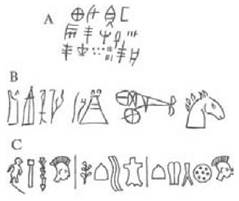 Figure 31 Three Minoan scripts: A: Linear A. B: Linear B. C: Phaistos Disc script
Relatively few Linear A inscriptions have survived, but the situation with Linear B is very different. At Knossos alone fragments of over 3000 Linear B tablets were recovered - nearly ten times the total number of Linear A inscriptions so far recorded. Tablets with the Linear B script have been found at the mainland city sites of Pylos, Mycenae, Tiryns and Thebes, as well as at Knossos, Khania (Kydonia) and elsewhere on Crete. Sinclair Hood (1971, p. 113) suggests that Linear B was developed at Knossos during the period following the ‘1450’ disaster. Both the script and the language are the same at Cretan and mainland sites and there is general agreement that the language is an early kind of Greek. Some scholars are uneasy about this interpretation because the sign-groups give only approximations of words and can therefore be made into several different words: the sign-group ‘po-lo’, for example, can be made to mean as many as eight different Greek words. Another problem arises from the form of the inscriptions; most are lists of short, terse statements - objects, numbers and dedicatees - and many of the words are proper names, so it is possible to make false interpretations without the errors becoming apparent subsequently, as they would in a longer and more connected text.
It nevertheless seems likely, since increasing numbers of tablets make sense when interpreted as a form of Greek, that Michael Ventris was right. It is to be hoped that a longer, sequential text will eventually be discovered: a piece of poetry or prose would test the hypothesis conclusively.
There are tantalizing hints in the archaeological record that the Minoans may have written longer, non-bureaucratic texts on parchment. It is known that they used ink - there are clay cups with ink inscriptions inside them - and it would have been natural to use that ink for cursive writing on a material such as parchment or papyrus. In addition, some of the clay sealings have traces of vegetable matter adhering to them, implying that they were attached, possibly as signatures, to documents written on some perishable material. There is also the supportive evidence of a later Greek tradition that skins had at one time been used as writing paper. Unfortunately, as far as is known, no written parchments have survived from the Minoan civilization, and it may be that the finest Minoan thoughts were never committed to writing. It is believed that the whole of Homer may have been passed on by oral tradition for several generations before being written down in the ninth century bc. If this seems unlikely, it is recorded that, in January and February 1887, a Croatian minstrel recited from memory a series of lays amounting to twice the combined length of the Iliad and the Odyssey (Thomson 1949, p. 529).
Potters
Minoan potters produced an astonishing variety of wares. One of the earliest Minoan pottery styles, dating to 2700 bc, was a type called Pirgos ware, named after a site on the coast to the north-east of Knossos. Typically, this ware had a pattern burnish on a red, grey or light brown surface, and it was applied to goblets with tall narrow stems or conical pedestal bases. Pirgos ware bears a closer relationship with late neolithic wares made on the Greek mainland and in the Cyclades than with any Cretan forerunners, and the style may have been imported (Figure 32A).
Soon to follow were pots with simple linear designs in black, brown, or red on a pale yellowish background. These Early Minoan II vessels were made around 2500 BC and are known as Agios Onoufrios ware after a site near Phaistos. At about the same time, two new styles appeared. One was a range of curious vases shaped like birds and animals, amongst which we might include the Myrtos Goddess vase. The other was Vasiliki ware; this marked the end of the pattern burnish technique and the beginning of a new finish, a reddish-brown wash deliberately applied unevenly in order to simulate the mottled texture of the stone vases that were at that time so fashionable in eastern Crete (Figure 32C). The Vasiliki ware included some peculiar long-spouted ‘teapots’ and jugs: the spouts have distinctive upturned sides and a curious joint or articulation before they join the main body of the vessel.
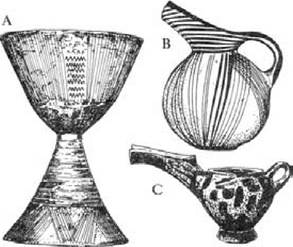 Figure 32 Early pottery styles. A: Pirgos ware. B: Agios Onoufrios ware. C: Vasiliki ware
As the development of the towns continued apace in the phase immediately before the building of the first great temples, there were crucial developments in the potters’ craft. They started to use the fast wheel, which enabled them to create new and far more refined shapes with thinner walls. They also began firing in built kilns rather than in open fires, which ensured a more even and consistent firing, and more predictable results (Alexiou, undated). Many of the shapes that had been developed in the Early Minoan nevertheless continued in use, especially the one-handled cup and the jar with a short spout on its shoulder, bridged by the rim. The growth of the towns meant that the urban potteries had to produce large quantities of plain ware for ordinary everyday use, such as cooking pots, storage jars of all sizes and lamps. The decorated ware was given a black lustrous surface with spiral patterns in white, purple, orange and red: some of the patterns were elaborate, clever and confidently executed, showing a sophisticated understanding of the difficulties of designing for a curved surface. This polychrome type of design seems to have been invented at Knossos, where it was fashionable for some time before it was adopted generally in the east of Crete. Perhaps the spiral designs originated in the ‘Bandkeramik’ of the Danube basin and arrived in Crete by way of the Cyclades, where stone pyxides were made with spiral ornaments; but Stylianos Alexiou thinks it more likely that the spiral came from the Middle East, where it was used in gold wire jewellery from an early date.
It was during the Middle Minoan II period, when the first large temples were raised, that the greatest developments in pottery took place. The gathering and concentration of craft workers into the temples seems to have stimulated technical advances of many kinds. The Kamares ware consisted of polychrome-decorated thin-walled vessels. The fine cups with their eggshell thin fabric imitated metal originals. Beautifully made and beautifully decorated, Kamares vessels are of a quality and refinement never again to be achieved in the Aegean world. But it was a relatively short-lived style: by Middle Minoan III, beginning in 1700 bc, the potters had stopped making it. Since this was also a period of great affluence, it can only be assumed that the wealthy customers who commissioned the Kamares cups - aristocrats and priestesses among them - could now afford cups of precious metal instead.
There was also, around 1600 bc, a striking new development in pottery style, with marine reliefs added to some vases at Knossos and Phaistos, reliefs depicting shells, crabs, seaweed, rocks and dolphins. By 1500 BC another decorative style, the tortoise shell ripple, had appeared. The potters decorated cups with closely set vertical stripes, painting them on a wet slip, deliberately causing the edges to blur. They may have intended, as with the earlier Kamares pottery, to imitate metal originals: in this case the shimmering surfaces of metal flutes.
The temples fell and were rebuilt after 1470 bc. The potters of the new temples produced yet more new styles. Now designs were recognizably drawn from nature, but stylized in such a way that they formed bold patterns. There were distinctive Floral and Marine styles and some of the vessels decorated in this way were very fine indeed (Figure 33). Even so, most of the pottery made in Crete at this time, including Knossos itself, was rather carelessly decorated. Ajug from Palaikastro, for example, is bold and effective, but casually executed.
Peter Warren (1975, p. 42) has suggested that the Marine Style vases were all made at Knossos, in a single workshop. Some of the earliest examples of Floral Style vessels also came from Knossos; they are gracefully shaped vases decorated with stylized but recognizable white lilies and recalling the famous Lily Fresco from Amnisos. Perhaps the finest and technically most assured essay in the Floral Style, though, is the ewer found at Phaistos, which is completely covered with grey-green sprays of olive leaves. Vases in the Marine Style, including rhytons, bridge-spouted jugs and three-handled amphoras, are decorated with triton shells, argonauts, octopuses, starfish, rocks and seaweed - all of them treated in a free and fluid way. The most perfect example of the Marine Style is the pot from Gournia with an octopus sprawling all over its surface.
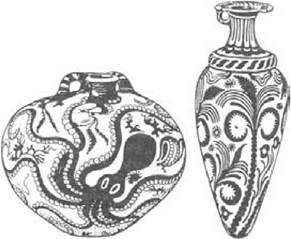 Figure 33 Marine (left) and Floral (right) Style vases
In the Late Temple period, when Knossos dominated most of Crete, the temple potters worked in a different spirit, producing more formal, symmetrical and grandiose work. The so-called ‘Palace Style’ amphoras were at first made and used only at Knossos itself, which strongly suggests that they were made for the use of the ruling elite. Sinclair Hood (1971, p. 45; 1978, p. 41) sees at this time many signs of mainland influence; new forms were introduced to Crete from the Greek mainland, including stemmed goblets decorated in the Ephyrean style. In this late period, some of the traditional motifs used in Minoan pottery decoration became stiff, straight and symmetrical; the papyrus and even the octopus were organized into symmetrical shapes. Subject matter draws widely on marine motifs, as well as vegetation, helmets (Figure 7B), shields, double-axes and, for the first time, birds. The earlier vitality and sense of powerful movement disappeared from Minoan pottery. It was replaced instead by a restrained, disciplined formality that seems foreign to the Minoan spirit, but it was nevertheless hieratic, powerful and rich, and it continued into the PostTemple Period (Late Minoan IIIA, dating to 1400-1300 bc).
At every stage in the development of the Minoan culture, the potters - and especially those working in the temple-precincts - were producing work to please their patrons. The seemingly kaleidoscopic changes of fashion in pottery shapes and decorative styles must reflect significant changes in their patrons’ tastes and preoccupations. It is for this reason that the work of the potters is of such interest, in giving us an insight into shifts in taste and, possibly, shifts in the power base too. Yet all the time we have to remember the inherent, native dynamism of Minoan culture; all the way through there are changes, experiments, alternations between abstraction and naturalism; all the way through, Minoan art is freely ranging, ever searching for new forms of expression.
In the fourteenth century bc, the decorative motifs became more schematic. The octopus tentacles, sometimes reduced to six or four in number, were made disproportionately long: the papyrus flowers became degenerate. For the first time birds became a common motif. In the thirteenth century, the technical quality of the fabric was uniformly good, a well-fired reddish-brown colour, but the gradual impoverishment of the designs continued: the octopus was simplified to a wavy line encircling a vase. This was the time when the Mycenean influence over the Aegean world was at its peak. Finally, in the twelfth century bc, the Granary Style appeared - a very meagre type of decoration in horizontal bands - and the Close Style, in which the designs were hemmed in by dense fringes, bands, and multiple borders; the purely decorative aspect makes it difficult to identify the motifs. The octopus on a pot from the Diktaian Cave has twelve tentacles and is scarcely recognizable.
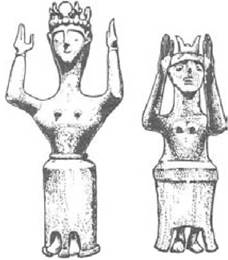 Figure 34 Clay goddesses from the late refuge settlement of Karfi
The style of the clay figurines of goddesses also changed, and there is a startling contrast between the tense and dramatic naturalism of the Snake Goddess figurine the Temple Repositories at Knossos and the rigid and simplified idol from the Late Dove Goddess Sanctuary in the East Wing of the Labyrinth. The late idol’s skirt was reduced to a simple cylinder, crudely painted with a black on white slip, and the raised hands exaggerated in size to emphasize the hieratic gesture. In the following phase, as in the very late idols from Karfi (Figure 34), the necks became grotesquely long, the faces harsh and ugly, with curious detachable feet peeping out through an opening in the cylindrical skirt; these figurines show, more than any other single artefact, the signs of decadence. In the mountain-top refuge of Karfi, a few straggling survivors tried to keep the Minoan way of life going, but it had fallen into lifeless stereotypes. It had run its course.
Style and the urban craft worker
At the civilization’s zenith, the Minoan towns gathered together craft workers with widely varying skills and enabled them to learn from one another. There are all kinds of art objects which display collaboration between different sorts of craftsmen. The ivory inlays that decorated wooden furnishings, for example, show that the ivory carvers were working in close collaboration with the joiners. Physical closeness in the temple workshops may have stimulated friendly rivalry to produce ever-finer works and thus stimulated technical and artistic development.
Enough has survived for us to be able to trace the developing skills and aspirations of some groups of craft workers, but we can be sure that there were many crafts and other activities in the city of Knossos which have left no archaeological trace. Very little, for instance, has survived of the carpenter’s or joiner’s craft. The stone chair in the Throne Sanctuary at Knossos seems to imitate a wooden precursor; the frescoes show folding wooden stools with cushions, such as were used in ancient Egypt; there is indirect evidence, in inlay work and bronze hinges, of storage chests, cabinets and chairs; presumably there were also low wooden beds of the same type inferred from a cast discovered at Akrotiri on Thera. The larnaxes or burial chests were apparently imitations in clay of wooden chests. A wooden lid carved with a winged griffin and a deer in a rocky landscape was found at Saqqara in Egypt; Sinclair Hood (1978, pp. 115-16) suggests that it may be the work of a Minoan wood carver working in 1450-1400 bc, perhaps as a captive in Mycenae: if so, it is a rare survival of Minoan wood carving.
The craft workers reached levels of technical skill and artistry so high that some of their works rank among the finest ever produced in Europe. The purely aesthetic value of their work is easy to appreciate. It is instantly appealing because of the Minoans’ delight in grace, movement and natural forms - in short, their delight in life. Sometimes it is difficult to penetrate beyond aesthetic appreciation. The purpose of some of the objects crafted is difficult to understand because many of the finest had a religious significance. Sealstones and frescoes often depict cult scenes; stone vessels were often intended for cult use; the finest faience figurines were idols; the metal and clay figurines and miniature double-axes were intended as offerings to deities; the recurring marine motif on the pottery and in frescoes may have had a cult association with the worship of Poseidon.
But the purely secular products of the workshops were often made with comparable skill and sensitivity. During most of the long development of the civilization, there was an overt delight in the natural world and its forms. Usually there was a vitality apparently drawn from nature itself. Even this, though, can be seen as a facet of the Minoans’ religious orientation. Their world-view was essentially animatistic: every living thing and every outwardly inanimate thing too was a part of the living cosmos, and therefore imbued with something of the divine spirit.
The craft workers loved complicated and attractive patterns and looked constantly for new ways of elaborating old motifs, like the papyrus, and for new sources of artistic inspiration. Often their work appears to depict the fleeting moment. The dog-handled pot-lids from Mochlos, for example, seem to show a particular dog relaxing on a particular afternoon in the hot bronze age sunshine; the crowds in the miniature frescoes seem alive with the excitement of the spectacle they are witnessing, and seem to have been caught mid-shout; the hoopoes in the Pilgrim Hostel fresco seem at first glance to have fallen from the pages of some bronze age edition of Audubon.
But this immediacy is deceptive. When we look closely at the plants and animals depicted on frescoes and vases, many of them are not really very lifelike. Often the species is elusive. The monkeys are blue and all the facial profiles in the fresco crowds are identical; the human beings depicted were, with a few very noteworthy exceptions, not shown as individuals. In this sense, much of the artwork is as abstract, generalized and impersonal as that of the ancient Egyptians. What gives it the illusion of immediacy and modernity is the sense of movement and vitality, and the spontaneity of the individual craft workers. They were, one senses, hot-blooded creators, these citizens of the Minoan towns.