
In 1700 bc, the first temples were destroyed, possibly by earthquakes. The destruction of the temples and the towns round them led directly to a rebuilding programme. It is principally the ruins of the New Temple and Late Temple Periods that we see at Minoan sites today.
In the New Temple Period, the towns remained important foci for large areas. The temples in their turn were elaborated and apparently enlarged: their importance in relation to the towns and the rural hinterlands continued to be at least as great, if not greater. In general, the patterns established in the First Temple Period were maintained. The plans of the towns, for instance, continued to follow the irregular plans established before 1700, but they were extended. Most of the towns were on or near the coast and they exploited their site advantages, capitalizing on their access to sea routes and on the fertile soils of their hinterlands.
Palaikastro in eastern Crete typifies dozens of small Minoan towns. It covered at least 22,000 square metres and possibly twice that area, consisting of rather irregular blocks of houses separated by cobbled streets. The ground-floor rooms were used for storage, cooking and other work: from them stairways rose to the living and sleeping quarters upstairs. Pseira, located on an island close to the north coast, was a similar sort of town - a town without an identifiable temple.
Knossos, Mallia and Zakro belong to a second type of Minoan town: one where the settlement surrounds and is dominated by an important temple. Adjacent to the temple there were further important buildings, some perhaps houses, others perhaps sanctuaries. At Phaistos, Gournia and Myrtos Pyrgos, these intermediate buildings seem to have been absent: instead, a temple or equivalent large building stood on a hill summit, dominating a town quarter of small houses.
The architecture of the great Minoan temples is too large and complex a subject to deal with here, and a discussion of the temples’ religious function is reserved for Chapter 6 below. Here, the focus is on the temples’ place in the growth of the towns.
At Mallia, the Central Court existed in the First Temple Period, with rooms ranged at least along its western side; as at Phaistos and Knossos, the new temple was apparently preceded by an earlier one on the same site. But the Mallia site (Plates 10 and 11) may prove to be more complicated than this, in view of the fairly recent discovery made to the west of the ‘Second Temple’ site; there was a large building, at least 1,700 square metres in area, with at least 60 rooms and open light-wells or courts, although no great courtyard, the distinctive feature which typifies the Minoan temple. The large early building dates to the First, or Old, Temple Period and is the best-preserved building of that age so far found in Crete. What its function was and what relationship it bore to the building-complex which then stood on the site of the later temple has yet to be established.
The Phaistos temple rivals the Knossos temple in splendour; although it is smaller and seems, to judge from the remains, to have been decorated less lavishly, it has a spectacular location on a precipitous hilltop offering views across the Mesara Plain to the east and south-east and to Mount Ida in the north. It has many features in common with the Knossos Labyrinth. It was rebuilt in about 1700 bc, although to a significantly different plan and at a higher level, so that the lower wall-courses of the earlier temple and its west faqade are still visible on the west side, now that the site has been excavated to the earlier courtyard level. The West Court has a paved entry from the north, but by way of steps down rather than a ramp up. There are two flights of broad steps at right angles to each other, descending to the paved courtyard: the arrangement is reminiscent of the Theatral Area at Knossos, though at Phaistos it is located in the north-east corner of the West Court. There are corridor-like storerooms in the West Wing, though not as extensive as those at Knossos. There is a bench-lined sanctuary opening out of the west side of the Central Court, but without a throne and without an antechamber or en suite lustral basin. A major suite of chambers with pier-and-door partitions, colonnades and light-wells comparable to the so-called ‘royal apartments’ at Knossos is located in the northern sector, not in the East Wing: it has a lustral area attached to it. There is also a workshop area.
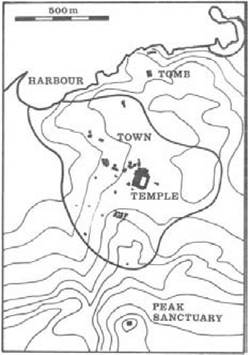 Figure 24 Mallia. The solid line marks the approximate boundary of the built-up area. The Chrysolakkos tomb seems to have been situated on the outskirts of the town, just like the cemeteries at Knossos. Mallia’s peak sanctuary, on the low hill of Prophitis Ilias, is one of the lowest in Crete
The architectural parallels are numerous and striking enough for us to assume that the large buildings at Phaistos and Knossos had a similar function. If the Knossos Labyrinth was a temple-complex, then so too was the large building at Phaistos. The differences between the two buildings seem to be mainly differences of style and emphasis, not differences of overall purpose. There is, for instance, a showy and large-scale entrance to the Phaistos temple at the north-west corner; at the equivalent point in the Knossos Labyrinth there seems to have been no entrance at all, in spite of the arguments of Arthur Evans and James Walter Graham (see Castleden 1989, pp. 12 and 189). There was also a straight and direct access route by way of a corridor in the middle of the West Wing, whereas at Knossos there was a long and circuitous route by way of the Procession Corridor, which doubles back on itself before arriving at the southern end of the Central Court; the Phaistos entrance seems closer in spirit to the more direct west-east access corridor of the Knossos First Temple. It seems as if the Central Court at Phaistos was rather more public than that at Knossos.
Although it is smaller, Phaistos has an additional court, the Peristyle Court, to the north of the Central Court: there seems to have been no comparable courtyard at Knossos. A peculiarity of Phaistos is its two sets of ‘royal apartments’, one in the northern sector, one in the East Wing. The existence of the two suites argues strongly against the royal apartment interpretation. The idea that the northern suite was used in summer and the eastern in winter does not convince. A significant difference between Phaistos and Knossos arises because virtually the whole of the first temple at Phaistos was replaced when the site was redeveloped after the 1700 BC destruction: only the Central Court remained. As a result, the new temple was built to a single coordinated design, and the site levelled and terraced to allow it to extend over a wider area of the hill summit. It is hard to disentangle the building sequence at Knossos, but the final layout seems not to be the result of a single overall plan, but to have grown by accretion and piecemeal development.
The temple at Knossos was, so far as we know, the most ambitious building the Minoans attempted. The overall plan, extending about 140 metres from north to south and the same from east to west, is roughly square; the outer walls have extensions and indents that imply design from the centre outwards. The clean outline of the rectangular Central Court was established first and the sanctuary suites aggregated round it. The Knossos Labyrinth (Castleden 1989) gives a detailed account of the temple’s design and function. The completed building, as it stood in about 1400 BC, was a sprawling maze of chambers and corridors developed in different places to heights of two, three, or four storeys.
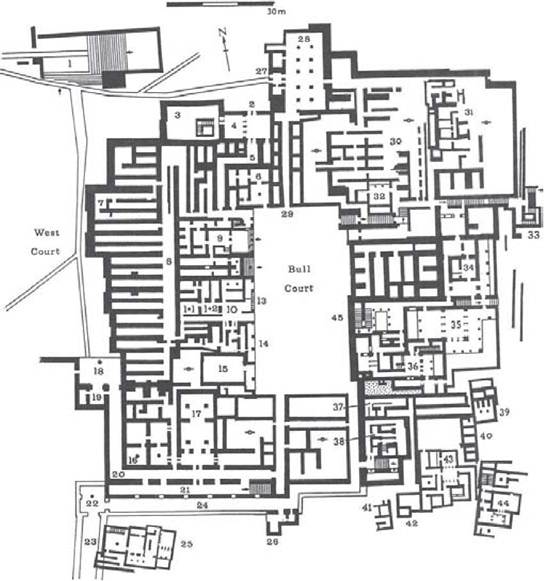
Figure 25 The Minoan Temple at Knossos: a reconstruction of the ‘ground-floor’ plan. 1 - Theatral Area, 2 - North-West Portico, 3 - Initiation Area, with adyton, 4 - Induction Hall and Vestibule, 5 - North-West Entrance Passage, 6 - Lotus Lamp Sanctuary, 7 - West Store-Rooms, 8 - Lower West Wing Corridor, 9 - Throne Sanctuary, 10 - Snake Goddess Sanctuary, 11 - West Pillar Crypt, 12 - East Pillar Crypt, 13 - Tripartite Shrine, 14 - Colonnade of the Priestesses, 15 - Destroyed Sanctuary, 16 - Columnar Shrines, 17 - Cupbearer Sanctuary, 18 - West Porch/Entrance, 19 - West Porch Shrine, 20 - Procession Corridor, 21 - South Terrace, 22 - South-West Porch/Entrance, 23 - Stepped Portico or paved ramp, 24 - South Corridor (at lower level), 25 - Silver Vessels Sanctuary, 26 - South Porch/Entrance, 27 - North Entrance, 28 - South Pillar Hall, 29 - North Entrance Passage, 30 - Service Quarter, 31 - North-East Kamares Pottery Store, 32 - North-East Sanctuary, 33 - East Entrance, 34 - Temple Workshops, 35 - Double-Axe Sanctuary, 36 - Dolphin Sanctuary, 37 - Triton Shell Sanctuary, 38 - Late Dove Goddess Sanctuary, 39 - Monolithic Pillar Crypt, 40 - Pre-Temple buildings, 41 - House or Shrine of the Sacrificed Oxen, 42 - House or Shrine of the Fallen Blocks, 43 - Chancel Screen Sanctuary, 44 - South-East Sanctuary, 45 - Grand Staircase. Arrows on staircase indicate ‘down’ direction, asterisks indicate temple repositories, and stippling indicates tell material not quarried away at this level. The winged circle indicates that the site was too badly damaged at the time of excavation for reconstruction to be more than tentative
One of the most striking features of the Knossos Labyrinth was the richness of its decorations and ritual equipment. The interior walls were covered with elaborate frescoes depicting scenes from mythology and ritual, scenes of bull-leaping, processions of tribute-bearers and religious emblems, all designed to emphasize the building’s religious dedication and to sign the function of individual rooms.
In the Procession Fresco, the fabrics worn by the Minoans were pain-stakingly covered with grids, apparently marked into the soft plaster with taut string; the resulting grid lines were used by the fresco painters to construct detailed textile patterns (Figure 6). Some of the patterns shown are so elaborate that it seems doubtful that they were woven: some may have been printed with blocks, while others may have been produced by a mixed-medium method, combining printing, embroidery, and applique work. Fragmentary and damaged though they are, the Knossos frescoes have yielded a vast amount of information about the world of the Minoans. One miniature fresco fragment shows a woman, perhaps a priestess, leaning on a balustrade rail; behind her is a net hanging across a window. Perhaps nets were hung over windows and doorways in the temples to keep out birds, and possibly dragonflies and locusts.
The cult equipment of the Knossos Labyrinth was also very elaborate, and it demonstrates the extraordinarily high quality of Minoan craftsmanship; all kinds of vessel were used for offerings and ritual, made of pottery, stone, and faience.
The temples were much more than centres of worship. The tribute that poured into the temple store-rooms, dedicated variously to deities and sanctuaries, had to be recorded and redistributed. The clay tablets of the Knossos temple archive record such large quantities of produce that it seems as if the temple was at the very centre of the organization of the Minoan economy. As I have argued elsewhere (1989, pp. 169-71), the temple functioned rather like a great medieval abbey, drawing and reallocating large revenues from the surrounding area and thereby developing into a major centre of wealth and power.
Some of the pottery found in the temple at Knossos says that it is ‘royal’, but this may mean no more than ‘state’ or ‘official’ or even that the pottery was made by state potters (Haskell 1983). The king is but rarely mentioned even in the archive tablets, where the preoccupation is with lists of offerings and the deities and sanctuaries to which they were dedicated. The implication is that the king was housed elsewhere. There were doubtless all kinds of subtly poised relationships between the royal household and administration on the one hand and the temple priesthood and its administration on the other. It may be that some of the produce offered to the temple for the gods and goddesses was discreetly diverted to the royal household; it may also be, as with many later monarchies, that the royal authority depended on the religious establishment for validation.
The Labyrinth dominates our thinking about Knossos, but it must not be forgotten that the temple was surrounded by a Minoan city, most of which remains unexcavated. Some of it has been disturbed by later developments: the site of the Early Iron Age, classical and Hellenistic city of Knossos overlaps with that of the Minoan city (Hood and Smyth 1981) - but nevertheless much remains to be excavated. The best-known part of the Minoan city is the so-called ‘Royal Road’ which runs from the Theatral Area at the north-west corner of the temple towards the Bull’s Head Sanctuary (or ‘Little Palace’) 200 metres away to the west-north-west (Plate 12). The road is typical of the Minoan roads of Knossos. There is a central lane 1.4 metres wide, which is made of two lines of large rectangular stone slabs. On each side there are slightly lower and narrower lanes made of smaller unshaped stones. Quite how these three lanes were deployed in Minoan times is not certain, though the differences in level imply that the central lane was kept dry in wet weather by draining to the side lanes. A similar lane design is apparent in the short section of curving roadway which has survived at the Minoan village of Tylissos, just to the west of House c (Figure 13 and Plate 13). At Tylissos there are also ‘sleeping policemen’ - slabs crossing the entire roadway and rising some 3 centimetres above its general surface level - but their function is not clear. Was their purpose to debar wheeled vehicles from a congested part of the village, or to slow down and reduce the destructive effects of runoff during torrential rainstorms?
The Royal Road passed through what seems to have been a densely built-up area of the Minoan city. To one side were houses, including the House of the Frescoes, and workshops. The Late Minoan debris of an ivory carver’s workshop was found to have been destroyed by fire. On the other side were more houses and a large building tentatively identified as an armoury or arsenal. After running dead straight for about 160 metres, the Royal Road reaches the modern road from Heraklion. At this point the Minoan road reaches a crossroads; the Royal Road continues (underground now) westwards past the south fronts of the Bull’s Head Sanctuary and Unexplored Mansion and past more Minoan houses, including the House of the Sacrificed Children, discovered by Peter Warren in 1979. The northern fork, branching off the Royal Road, runs along the east front of the Bull’s Head Sanctuary. The road leading south from the crossroads seems to have followed the course of the modern road and may have led to the south-west corner of the Labyrinth’s West Court, where a part of an access road has been exposed.
The Knossian roads were laid out in straight sections, but without any overall geometric plan. Curiously, the contrasting paved/cobbled texture of the road surface continues into open courtyard areas round the temple. In the Theatral Area and the West Court, raised linear pathways of well-made slabs pass through open areas of irregular cobbling, and show us clearly the main lines of movement through these courtyards: they emphasize the North Entrance and West Porch of the temple as important destinations.
From the Labyrinth’s south-west entrance a paved ramp, now eroded beyond recognition, led down to a bridge over the Vlychia stream; on the south side this was supported on a finely built stone viaduct, which carried the road on south-eastwards along the north front of the Pilgrim Hostel and then southwards between yet more Minoan houses. On the southern edge of the Minoan city, the road passed through a cemetery: the Temple Tomb was the principal building in this area.
Immediately to the north of the temple stood several substantial buildings: the North-East House, North House, North Pillar Hall and Balustrade Sanctuary (or ‘Royal Villa’). Further off in that direction, on the site of the modern village of Makroteichos, there were Minoan houses and traces of Minoan houses have been found as far north as Palaiomilo, some 600 metres north of the temple precinct: beyond this area was the northern cemetery of Zafer Papoura. The archaeological evidence is necessarily very incomplete, but it suggests that the temple was at the centre of a town whose built-up area was approximately 1,200 metres from north to south and 800 metres from east to west.
At Zakro, both temple and town have been excavated. The temple is easily identifiable by its long, rectangular Central Court, in this case oriented north-northeast to south-south-west. A large room at its northern end was a kitchen and there was probably a refectory above it, on the first floor. The West Wing contained chambers which Sinclair Hood (1971, p. 66) interprets as state apartments, although they might better be interpreted as sanctuaries; the chambers behind are admitted, by their excavator, Nicolas Platon (1971, p. 257), to be ritual in nature. A collection of cult equipment came from one room and an archive tablet collection from another. From the upper floor of the West Wing came bronze tools, bronze ingots and elephant tusks. It is not clear whether there were actually craft workshops in the West Wing at Zakro but, if so, it seems to be a significant departure from the pattern observed at the other temples, where the votive workshops were in the east, as at Knossos, or north-east, as at Phaistos.
The East Wing rooms have been interpreted by Platon and Hood as royal living quarters, like those at Knossos; a lustral basin is represented as a bathroom connected with these. Nevertheless, there is every reason to see the lustral basin, originally embellished with unequivocally religious frescoes, as a special chthonic shrine. The East Wings of both Knossos and Zakro make better sense interpreted as sanctuaries (see Castleden 1989, pp. 48-51, 90-2).
Steps in the south-east corner of the Central Court led down into a well which was used, at least in the temple’s final days, for offerings: there were many small clay vases, one of which still had olives in it when excavated. The alleged royal suite opened onto a colonnade to east and west: that to the east led to a square courtyard with a circular spring chamber in it. A rectangular spring chamber nearby seems to have been accessible only from outside the temple. These may have been used for normal, secular water supply, or they may have had some cult use.
The visible temple remains at Zakro seem to belong entirely to the New Temple Period. Its site was evidently occupied beforehand - the outer walls near the main entrance in the eastern corner extend across the remains of earlier houses - but it is not yet known whether a temple stood there. As at Knossos and Mallia, the temple grew up symbiotically with its adjacent town, but at Zakro we can see the whole urban structure. A paved road ascends the gentle gradient from the east, leading from the now-drowned site of the Minoan harbour, through the lower town to the main gate of the temple. This gate must have been a conspicuous structure, since its footings project some 8 metres from the eastern corner of the temple. Curiously, the Zakro temple is oriented with its corners, not its sides, facing the cardinal compass points: in this respect, it is reminiscent of the early ‘proto-temple’ at Vasiliki.
The paved road continues westwards past the main temple gate and connects with the road network of the upper town. Another road leads away at right angles to it, in front of the temple gate, and ascends the hillside. A large area of the town has been excavated and left continuously exposed, stretching some 80 metres along the slope and 40 metres up it. The layout is very similar to that of Gournia, with narrow cobbled alleys weaving irregularly among blocks of houses, many of which had rather small chambers, cellars perhaps, on the ground floor. Where it differs significantly from Gournia is in being situated in the bottom of a steep-sided valley instead of on a low hill; in a sense, the Zakro site is the mirror image of that of Gournia. The Gournia temple crowns a hill summit, with a commanding view of the Mediterranean. The Zakro temple lies in the lowest part of the valley, frequently halfsubmerged by the rising water-table, and threatened by further sea-level rises.