
Fishing was one of the major activities for Minoans living on the coast, but there is as yet no evidence for the way in which they organized their fishing. The rich variety of marine motifs on the frescoes and in pottery design implies that the Minoans felt a deep familiarity and empathy with marine life. A gold ornament found in the Knossos Labyrinth seems to represent the Cretan skaros or parrot wrasse, which is now quite rare in Cretan waters but still highly regarded as a dish (Figure 36c). There are gemstones which show the skaros too. One, a cornelian intaglio, shows the fish on its own among seaweed. Another, a chalcedony intaglio, shows a muscular fisherman proudly holding a skaros in one hand and an octopus in the other (Figure 35). Sealstones and a Minoan fresco at Phylakopi show flying fish, and the use of the octopus as a decorative pottery motif is well known.
The remains of fish are rare, as we would expect, although Evans’ excavators found fish vertebrae in a cooking pot at Knossos. Some wellmade metal fish-hooks were found at Gournia (Figure 36B), together with a lead sinker for a fishing line and some stones which could have been used for weighting nets. These finds suggest at least two methods of fishing, with line and net, and there may have been others. A peculiar bronze double-headed spear found at Agios Onoufrios near Phaistos has been interpreted as a fish spear. This may have been used in conjunction with a net, or on its own from an open boat.
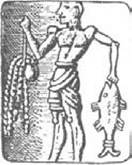 Figure 35 Fisherman carrying an octopus and a skaros fish
Tuna are sometimes landed when they try to swim through holes in fishing nets and get their teeth caught in the mesh; once trapped in this way, they can be dragged on to the beach with the net. Ann Guest-Papamanoli (1983) suggests that the design on a Kamares vase at Phaistos shows this fishing method. Tuna were once caught in large numbers in spring and autumn in the Mediterranean and it may be that the Minoans organized large-scale tuna fishing in a similar way.
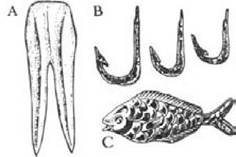 Figure 36 Fishing. A: bronze fish-spear found at Agios Onoufrios. B: metal fish hooks from the near-coastal town of Gournia. C: small gold bead in the form of a fish, from Knossos
The octopus was a popular and recurring artistic motif, which suggests that it too was fished; the chalcedony intaglio mentioned above confirms that this was so. The octopus may have been speared by torchlight at night, just as it is today. Sponge-fishing may also have gone on from the ports, though there is no direct evidence of it. Certainly the sponges would have been useful; they could have been used as a filling for cushions and mattresses, and as a protective padding inside boots and helmets. Evans thought the Minoans used sponges for painting, and felt he could detect that the plastered walls of the early temple at Knossos were decorated with sponges dipped in paint.