
The vessels that sailed in and out of the Minoan harbours, whether bayhopping round the Cretan coast or bound for far-distant ports, were generally rather small. Usually, they had a single mast stepped amidships and were rigged with a single square sail. Often they were equipped with fixed oars as well. No recognizable remains of Minoan ships have yet been identified on the sea-bed, but they are frequently represented on seals.
The earlier ships had high stems to breast the waves and low sterns: the keel projected from the stern, apparently to make the ship run straighter, although this feature was dispensed with later. There were other variations too: some ships had low prows and high sterns, whilst others were high at both ends. The large steersman’s oar, which must always have been located at the stern, is the only clear indication of the vessel’s orientation.
Many of the Minoan sailing ships were probably small enough to drag out of the water on to a beach, but some seem to have been very large. One ship is shown with a row of fifteen oars along one side. A standard vessel in the later Greek period was the pentekonter, the fifty-oar ship, thought by Bury (1951) to have come into use in the eighth century bc, and it may be that the seal showing a vessel with thirty oars was intended to represent the Minoan forerunner of this Greek type of warship.
Curiously, the Phaeacians, the legendary people in the Odyssey who sound like the Minoans in so many ways, were described as the kings of sea-craft; they were also credited with sailing galleys with fifty oars, in other words, larger ships than Bury credits the Homeric Greeks with possessing.
The Greek warships were designed for speed, and built longer and narrower than cargo vessels. A Pylian warship of the twelfth century BC is shown on a vase painting to have high ‘castles’ at each end connected by a raised gangway along the centre. Above its ram are two bowsprits and a large flag or model in the form of a fish. This sort of vessel could well have existed four centuries earlier in the Aegean. From the admittedly fairly simplified drawings on the Cretan seals, it looks as if the Minoans were in fact building this type of vessel by about 1600 bc. That being so, it is also likely that they were building it for the same military purpose. Thucydides credited the Minoan kings with organizing the first naval fleet, and it is possible that the Minoans did indeed have a squadron of specially designed and equipped warships that were ahead of their time.
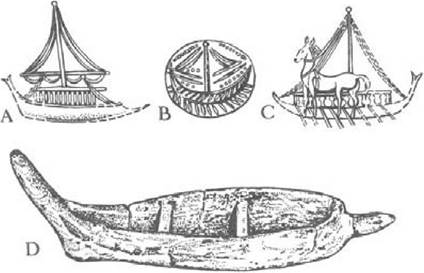
Figure 37 Minoan ships. A: ship with raised central deck or cabin and a furled sail. B: similarly rigged ship, but with oars as well. C: ship with raised central deck or cabin and oars; the superimposed horse is hard to explain. D: clay model of a boat with a high prow, projecting keel and seats for oarsmen
The sleek warships contrasted with the stubbier lines of the freighters, but there were other vessels as well. A Minoan fresco from Akrotiri on Thera shows a different sort of ship again, with a lightly-built superstructure amidships covered by an awning and offering some shelter from showers and the beating sun to varying numbers of seated passengers. There was a special, elaborately canopied seat high on the stern, which we may suppose was intended for the ship’s captain, and a row of twenty oarsmen on each side of the ship. These rich passenger vessels, if that is what they are, have a high prow and a relatively low stern; a carved representation of a leopard or lioness stretches and peers out over the stern. The Theran ships vary in size: the smaller ones are shown with no mast and only five oarsmen on each side, the larger ones with twenty or more oarsmen. Some were elaborately decorated, with painted designs on their hulls, garlanded canopies, ‘figureheads’ in the form of leopards or lionesses and ensigns in the form of large flowers. There is no reason to suppose that these beautifully caparisoned vessels were in use only round the coast of Thera; they were probably not intended for long voyages on the open sea, but we can imagine that very similar passenger ships plied round the coasts of Crete, gliding elegantly from bay to bay.