
In Greece, the tradition was well established by the fifth century BC that Minos, king of Crete, had ruled the Aegean Sea and its islands.
The earliest ruler known to have possessed a fleet was Minos. He made himself master of the Greek waters and subjugated the Cyclades by expelling the Carians and establishing his sons in control of the new settlements founded in their place; and naturally, for the safer conveyance of his revenues, he did all he could to suppress piracy.
(Thucydides, I)
Archaeology seems to support the idea of widespread Minoan trading contacts and a significant number of thorough-going Minoan colonies. The distribution of the place-name ‘Minoa’ in the Aegean and in the eastern and central Mediterranean also seems to imply Minoan colonies. The name makes some sense as an enduring survival of bronze age Cretan influence, but we must not lose sight of the fact that it was Evans who gave the Minoan civilization its name and not the Minoans: they almost certainly called themselves something completely different. If, however, the bronze age Cretan king and trader-in-chief was known by the title ‘minos’, it is possible that the king’s colonies were named ‘Minoa’ after him.
There were important trading links between Crete and its neighbours in the neolithic and early bronze age. During the First Temple Period, between 1900 and 1700 bc, the Minoans were exporting their distinctive pottery and stone vessels to Egypt and the Near East as well as to islands in the Aegean, but there was a massive expansion of trade after the temples were rebuilt. The main thrust of colonial development seems to have followed in the wake of this major rebuilding programme, in the period between 1650 and 1500 bc.
The colonial development manifested itself in three ways: the spread of Minoan artistic and cultural influences, the diffusion of exported Minoan products, and the establishment of Minoan settlements beyond the Cretan shores. Naturally, there has been controversy concerning the status of these Minoan settlements, but they are identifiable by their coastal location, irregular street plan, Minoan style of architecture, Minoan burial customs, Minoan shapes worked in local pottery wares (and thus not imported from Crete), and Minoan religious ritual.
There is a short but significant list of Aegean settlements which fulfil the requirements. Kastri on Kythera seems to have been one of the earliest, if not the first, Minoan colony, and it was set up well before 2000 bc. There were Triandha on Rhodes, and Iasos and Miletus on the Anatolian coast; there was a tradition that the original colonists of Miletus came from Milatos, a Minoan settlement just east of Mallia. Naxos and Karpathos are thought to have had Minoan colonies too, and a very strong Minoan influence is seen at Agia Eirene on Kea: perhaps it was an existing town that was taken over by Minoan traders and administrators. It is probable that Phylakopi on the island of Melos was similarly adopted, and not actually founded, by Minoans. These changes seem to have occurred about a hundred years after the Cretan temples were rebuilt; then, quite suddenly, in about 1600 bc, all the pottery at Phylakopi was Minoan in style.
One of the most remarkable colonies was the one closest to Knossos, Akrotiri on the island of Thera. Spyridon Marinatos emphasized the Cycladic features of the settlement there, but many of the finds are more typically Minoan: the house plans are not dissimilar to those at Tylissos, with typically Minoan pier-and-door partitions, lustral areas, and Minoan pottery forms in local ware. Akrotiri was built in about 1550 BC (Late Minoan IA) and is likely to have been a Minoan foundation. It developed its own distinctively ‘Theran’ artistic spirit, which was a development from the Minoan, while remaining in close and continual contact with Crete. The frescoes, for example, show many elements that are borrowed from Minoan Crete, but handled in a way that turns them into distinctively Theran compositions.
We can speculate from the handful of known Minoan colonies that there were probably several more, possibly on the mainland of Greece itself. The status of Mycenae at this time was almost certainly politically independent of the Minoans, but culturally and artistically Mycenae was strongly influenced by them. Possibly the idea of the tholos tomb was exported to Mycenae from Crete. The Minoans were, in a very real sense, the Americans of the bronze age Aegean, exporting style and tone as much as products.
The Minoans exported lead figurines to Kambos, bronze figurines to Agia Eirene and Phylakopi, gold cups to Sparta, and swords to Mycenae. Rich gold, silver and bronze vessels and decorative ostrich eggs with faience mountings - shades of Faberge - were exported to Mycenae and Thera. But above all the Minoans exported large quantities of decorative, painted, and distinctively shaped pottery - the finest pottery in the civilized world - all over the Aegean region. The densest concentrations of Minoan produce were found in the Aegean islands, Argolis, Messenia and the Dodecanese. It is thought that some of the grave goods found in the shaft graves at Mycenae were Minoan imports. Significant levels of trading went on outside this inner area, and scattered finds of Minoan products have been made as far west as the Lipari Islands off the coast of Italy, as far north as Troy (stone lamps), and as far east as Egypt and Syria, where Minoan vases made of precious metal have been found.
Some raw materials and perishable commodities such as food and cloth were probably exported as well. At Knossos, several different kinds of textile or garment were stored and doubtless some were exported; the tablets describe them variously as ‘with wedge pattern’, ‘with white fringes’, and ‘of better quality’ (Driessen and Macdonald 1984). Sinclair Hood (1971) suggests that woollen cloth and timber were sent to Egypt in exchange for linen or papyrus. The Minoans were capable of producing a large surplus of olive oil which could have been exported; some of the oil filling the store-rooms of the Knossos Labyrinth at the time of the 1380 BC fire may have been awaiting export. There were probably invisible exports too: exports of technical skill and artistry, exports of medicine and magic. The Egyptians valued magic and we know that the Cretans of the classical period had acquired a legendary reputation as seers and astrologers (Castleden 1989, p. 127).
Counterbalancing the outflow of products and services was a large range of imports. The Minoans seem to have been self-sufficient in terms of basic needs, which must have put them in a position of trading strength, but they relied on imports for supplies of exotic raw materials for the manufacture of luxury goods. There was a port called Minoa on the south-west coast of Sicily which may have been a Crete-controlled trading station. Quite what the Minoans wanted from the west is not known. Their interest may have been in Sardinian copper or Etruscan tin; the Minoans needed tin to make bronze, and the sources of their raw materials are unknown. The tin may have come from Etruria, Bohemia, Spain, or even Britain. Britain may also have been the trade-source of the small amount of amber found in Crete. A gold-mounted disc of amber found at Knossos may have come from the Wessex culture of southern England.
But the Minoans traded far more with their neighbours on the Aegean islands and coastlands close at hand. They imported via Kythera two fine ornamental stones, Spartan basalt and rosso antico, from Lakonia on the Greek mainland. They had contact with the Argolid cities too, although it is not clear from the archaeological evidence what, if anything, they imported from them: possibly the relationship was mainly a political or diplomatic one, or possibly - following the later Greek legends - the imports were archaeologically invisible, taking the form of slaves or tribute-children. The Minoans probably sent wine or olive oil to Mycenae; numbers of stirrup-jars made in or near Kydonia have been found at Mycenae and Tiryns, as well as Thebes, implying a regular export trade from Crete (Catling 1980). There seem to have been relatively few trading links with Attica, which is surprising, although a scatter of finds at Thorikos suggests that the Minoans may have been interested in the silver ores there; if so, the island of Kea could have been used as a trading station for their transfer to Crete.
Naxos supplied Crete with emery, which was needed for drilling and polishing the stone bowls and vases. Yiali in the Dodecanese supplied Crete with the white-speckled obsidian wanted for the fabric of the bowls; possibly the obsidian came by way of Triandha as a trading station. From Anatolia, Minoan traders brought black obsidian, possibly tin and exotic sealstones: from Cyprus, probably copper. From Syria, they brought back lapis lazuli originating ultimately in Afghanistan, as well as ivory and Babylonian sealstones. From Egypt came veined white alabaster, amethyst, carnelian, and possibly the eggs and plumes of ostriches.
It was from Egypt, too, that the Minoans imported a limited range of manufactured goods; the fact that nearly all the imports of manufactured goods were Egyptian reflects the Minoans’ admiration for Egyptian culture: possibly it was the only culture they regarded as the equal of their own. Scarabs, beads, pendants, and ivories found their way to the Minoan temple sites. An ivory furniture inlay showing a sphinx at Mallia is thought to have come from Egypt, as are two ivory figurines of boys found at Palaikastro. Archaeological evidence from Egypt confirms that there were political or cultural links between Egypt, mainland Greece and Minoan Crete at the close of the Late Temple Period, 1470-1380 bc. At the base of one of the statues in the funeral temple of Amenhotep III (died 1369 bc) at Thebes, there is an inscription which includes a list of nine place-names. Four belong to the kingdom of Pylos: the important town of Pa-ki-ja-ne, and the districts of Na-pe-re-wa, Me-za-na, and Wa-e-ro. One belongs to Kythera, which lies on the trading route from Pylos to Crete. The remaining four were places in Crete: Knossos, Amnisos, Lyktos, and Dikte (Nixon 1968).
In the early days of Minoan studies, this widespread network of trading links was seen as evidence of a powerful Minoan navy, a wholesale conquest by sea and political subjugation of the tributary lands. It is clear that this was not necessarily the case. Certainly at the beginning of the New Temple Period, about 1700-1600 bc, there was a major economic and possibly demographic expansion on Crete which supplied the thrust outwards; Minoan colony settlements were set up in a band right across the southern Aegean from Kythera to Iasos. Further off, the Minoans established or developed trading relationships with communities in Messenia, Lakonia, and Argolis on the Greek mainland, as well as Cyprus and Egypt: in these areas, there is no firm evidence that they founded colonies. Then there was an outer fringe area, an area of occasional and perhaps very infrequent trading contacts, including Syria and possibly Palestine in the east, Miletus, Didyma, Iasos, Knidos and Troy in Anatolia, Attica and Delphi on the Greek mainland and Sicily-Lipari in the west. How much further west the Minoan merchantmen sailed remains a matter for speculation: possibly as far as southern Britain.
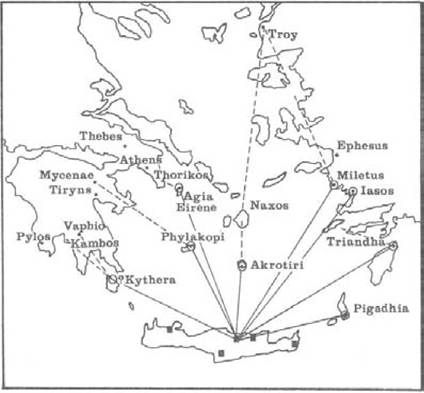
Figure 38 The Minoan trading empire. Main urban temple centres on Crete shown as black rectangles, and known colonies or trading stations are ringed. Implied primary trading links with Crete are shown as solid lines. Probable secondary trading links, between Minoan colonies and non-Minoan towns, are shown in dashed lines. Trade routes passing outside the Aegean region are not shown
The development of this ‘trading empire’ should be seen as directly associated with the development of the Minoan civilization on Crete. The Minoans had advanced technically and artistically far beyond any of their neighbours. It was natural that their products should be in great demand. The trading empire was, in large measure, demanded by the Aegean world rather than imposed upon it. Population growth on Crete may have played its part in giving an impetus to the foundation of the colonies. Calculations of Mallia’s food requirements (see Chapter 4) show a significantly large shortfall in wheat. Possibly this shortfall was met by grain production on the Lasithi Plain, but if Lasithi was not tributary to Mallia, the city would have had to look overseas for grain, ‘buy’ it from neighbouring territories, or go hungry. There are some indications that the population of Crete was rising significantly around 1550-1500 BC (Late Minoan IA), with new settlements appearing in previously unpopulated areas such as the Zou valley to the south of Sitia and the south coast between Arvi and Myrtos, where at least five new settlements were founded in Late Minoan I. Meanwhile, the old established centres had expanded greatly. The recent survey of the Knossos area (Hood and Smyth 1981) shows that the occupation area there had, by Late Minoan I, increased over ten times, albeit over a 1,000-year period since the Early Minoan.
The push of rising population levels and increasing economic production capacity combined with the pull of widespread demand for products are enough to explain the rapid growth of the trading empire between 1700 and 1500 bc. The only real mystery is the precise mechanism by which the inner band of Minoan colonies was established. Were the Minoan colonists welcomed and supported by the native Kytherans when they founded Kastri? Still more to the point, were they welcomed by the Melians when they took over the existing settlement at Phylakopi? Or was the colonial thrust resented and opposed? It may be that the foundation of the chain of trading posts had to be established by force, but it is probably only in this very limited sense that the Minoans imposed their will on the Aegean world outside Crete.
Sinclair Hood (1982) nevertheless gives us a salutory reminder that the Minoans lived in a world where might was right, where Egyptian rulers boasted of their subjugation of foreigners, of the cities and territories they had sacked and laid waste, and where Hittite kings boasted of holding their lands ‘with a strong arm’, and of capturing the idols of their enemies. The Hittite king Hattusili I, who ruled from about 1650 BC onwards, described his own march on northern Syria in these terms:
Like a lion, the Great King crossed the river Pura and overcame the city of Hassu like a lion with his paw. He heaped dust upon it and filled Hattusa (his own capital) with its possessions. Of silver and gold there was neither beginning nor end. And their gods I brought up to the Sun-goddess of Arinna.
(Lehmann 1977, p. 191)
It was a ferociously aggressive world, and the Minoans lived successfully and competitively within it. There is no reason to suppose that they were very different from their neighbours in their attitude to military aggression. We nevertheless only need to postulate the forcible imposition of that inner band of Minoan trading settlements - not the whole trading empire.
We can, moreover, be fairly sure that these contacts with other communities had effects which went far beyond the Minoans’ original intentions. It seems that many of the communities trading with Minoan Crete caught something of the flavour of its culture, whether material or spiritual, and developed it in their own way. Nicolas Platon (1968, p.51) suggests that it was contact with the Minoan civilization which led to the development of the Phoenician civilization in the Levant. The Philistine culture too, developing further south on the coast of Palestine, may have roots in the Minoan trading empire; Bury (1951) mentions that an ancient name for Gaza was Minoa, which implies that it too was once a Minoan trading station.
Precisely how the Minoan merchants carried on their trade is uncertain. Money did not exist in the Minoan scheme of things. It has been assumed that goods and services were traded by exchange, although relative values would have been complicated and difficult to agree. Sinclair Hood (1971, p. 125) proposes that goods were paid for with an agreed weight of gold or silver. That bronze scale pans and lead weights were found as grave goods indicates that they were perhaps regarded as in some way central to life. John Chadwick (1976, p. 157) agrees that transactions would have been easier if prices were agreed in terms of a base-commodity - whether gold or silver or something else - but there seems to be no evidence of this in the archive tablets. Some tablets used the word ‘o-no’, thought to be ‘wonos’ ( = price), with a commodity and then followed with an amount of some other commodity, such as olive oil or wool. This implies, if not a transaction, at least an evaluation of some produce. But there is no need to suppose that the ways of the Minoan traders were simple, straightforward, or even efficient. The tablets reveal the Minoans as lovers of minutely recorded detail; their labyrinthine architecture reveals a love of complexity and puzzles. It may be that the Minoans enjoyed the social and diplomatic aspects of long-drawn-out negotiations over the price of a cargo with Egyptian, Cypriot, or Troj an merchants. That love of haggling is still there in the Mediterranean economy, and maybe it began with the Minoan traders.