
Occasionally, as in the Kamilari model just mentioned and the two women on the Kalyvia ring, the celebrants are naked, but this seems to have been exceptional. More often, religious ceremonies required special clothes.
The Agia Triadha sarcophagus shows men and women involved in a funerary rite; some of them have an animal skin wrapped round as a skirt. It falls straight from the waist and the hem is rounded, but with what looks like a short tail at the back. The men and women who wear this garment are naked above the waist. The untreated, untrimmed, unadorned sheepskin was probably the first human garment and may therefore have been associated in the Minoan mind with the distant and primeval past. Interestingly, the draped xoanon representing the deity on the Agia Triadha sarcophagus is apparently wearing a full-length sheepskin robe; this may be to emphasize his antiquity or his rustic origins (Figure 47).
Other figures participating in the same religious ceremony wear a cloth robe covering both upper and lower parts of the body and falling straight down without folds or flounces to the ankles. This robe has a triple-striped band on the shoulder and a similar band running down the side under each arm: another band decorated the hem. The robe could be in various colours - blue, orange, white - and might be held at the waist by a belt or cord.
Another and very peculiar sacral garment was the cuirass. This is the dress worn by the priest on the Harvesters’ Vase. It covers the upper part of the body and consists of bands of semicircular scales all pointing upwards, ending at the lower edge in a belt from which hangs a broad piece of pleated cloth. The garment is so peculiar that we might dismiss it as a quirk of the rhyton carver’s imagination, but for the fact that it features again on a seal impression from Agia Triadha, where the rhyton also originated. It is by no means certain what this garment is. The only way the scale effect could have been achieved is with layers of shaped leather or metal: either would have made the garment extremely heavy and unwieldy. It also seems unconnected with any military use. The scales suggest the scales of a fish rather than armour; was the priest perhaps a priest of Poteidan? The lower half of the Harvesters’ Vase priest is broken off, so we have no way of knowing how his lower half was clothed, but the seal impression shows that underneath the pleated skirt the man was wearing the sacral hide garment. The overall effect is visually complicated and inelegant, and could only be explained by recourse to arcane ritual references, which at this distance of time we have little hope of tracing.
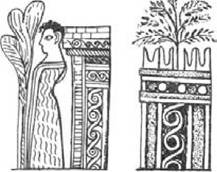 Figure 47 Two images of sacred trees on the Agia Triadha sarcophagus. Left: a tree beside a xoanon of a deity and a shrine. Right: a tree in a walled sacred enclosure
The priestesses wore a double garment. It consisted of the straight robe mentioned above, with an elaborate flounced and layered over-skirt tied on at the waist. The detailed structure is detectable from the Theran frescoes (Marinatos 1984). The bodice of the robe has a deep cleavage plunging to the navel. The belt tying the skirt on drew the bodice edges in round the breasts (if they were to be exposed) and presumably lent them some support from the sides and from below. The striped and layered skirt was open at the front to reveal the braid-decorated robe beneath. The overall effect, with headdress, necklaces, bracelets, rings and so on, must have been barbarically opulent. When numbers of priestesses dressed in this way and danced themselves to a pitch of religious ecstasy, the sight must have inspired awe among the beholders. It is easy to identify with the excited crowd of onlookers in the miniature frescoes.
It was the priestesses who dominated religious ceremonies. In the iconography, they far outnumber the priests and male attendants, and it may be significant that on Side A of the Agia Triadha larnax the lyre player is a male dressed in a priestess’s robe. This suggests that there was a subordinate caste of priests who were transvestite, who became nominal priestesses in the service of the deity: they were probably eunuchs. Perhaps as a result of Syrian influence, companies of eunuch priests may have inhabited the Minoan temples; in a later period, it is known that eunuch priests served Cybele and Attis in Anatolia. In the Minoan temples, it was usually the priestesses who conducted the ceremonies, performed the sacred dances and occupied the most important spectator seats for major rituals. In both the Sacred Dance and the Grandstand Frescoes, the priestesses are shown seated in places of honour, centrally, prominently and with a clear view of the ceremonies being conducted before them.
Among other functions, priestesses probably chanted prayers and invocations to the deities. In open-air ceremonies, they apparently used a triton shell to amplify and distort their voices. There is a seal from the Idaian Cave showing a priestess holding a triton shell to her lips as she stands on a step in front of an altar decked with sacral horns and sacred boughs (title illustration, Chapter 2). The triton shell was used right through into modern times in Crete by rural postmen and shepherds, both as a megaphone and as a horn. Probably it served the same functions in the hands of the Minoan priestesses. Triton shells are frequently found in shrines, and with the narrow end cut away to make a mouthpiece.
Votive offerings include elaborately decorated model robes representing the sacred vestments worn by priestesses when they conjured up the goddesses they served. By putting on special clothes and performing certain rituals, a priestess might be transformed into an epiphany of the goddess. It is probable that Minoan citizens offered real robes to the temple for this purpose: some may have been woven in the temple itself, given that loom-weights were found in the cellars of the East Wing of the Labyrinth. Probably the finest of these garments were used to adorn wooden cult images of the goddess. There were many ways of inducing the deities to reside in the shrines and temples. A recently proposed reconstruction of the Procession Fresco from the Knossos Labyrinth (Hagg and Marinatos 1987) shows one of the leaders of the procession presenting a fringed garment, presumably the ritual overskirt, to the priestess who is about to become the goddess. This clever and inventive suggestion makes sense of the otherwise inexplicable presence of a fringe hanging in the air between the two figures.
Above all, the Minoans wanted to see their gods. Somehow, the deities had to be made to appear before the worshippers, and this appearance might take many different forms. Gods and goddesses could appear in the form of boulders, trees, birds, snakes, or pillars, but we can be sure that an appearance in human form had the greatest emotional impact. The later Artemis of Ephesus was confidently expected to show herself in specially designed windows of appearance placed high in the temple’s pediment. Probably a priestess took on the role of Artemis and became the epiphany of the goddess. This type of ritual was already a very ancient custom by the time the famous Temple of Artemis was built, around 600 bc; it had been a common practice in Anatolia, Syria, Mesopotamia and Egypt (Trell 1988). Nanno Marinatos (1984) has argued persuasively that windows of appearance were used in Minoan rites at Akrotiri on Thera, so it is very likely indeed that they were used in Crete itself. The architects who designed the Temple of Artemis at Ephesus were, moreover, Knossians; Khersifron and his son Metagenis grew up within sight of the Knossos Labyrinth’s crumbling walls. It is likely that there were windows of appearance located on the first floors of the Minoan temples, overlooking both West and Central Courts.