
Dancing, as we have already seen, formed an integral part of the ceremonies that led up to an epiphany. The priestesses’ complete abandonment to the dance, as depicted in some of the ring images, shows that they were using dance, just as the dervishes were to use it much later, to induce a state of religious ecstasy. It is known that Dionysos was worshipped at Pylos shortly after the Minoan period on Crete and it is possible that his orgiastic cult was preceded by a Minoan proto-Dionysian cult.
Beer or wine may have been used to help produce the euphoric state. Drugs may have played a part too. Poppy-growing started early in Anatolia and certainly spread to Crete during the Minoan period. There is a Minoan seal showing a goddess holding three poppy seed-heads. The famous late figurine of a goddess found in a small rural shrine at Gazi wears a diadem embellished with three carefully depicted poppy seed-heads, and they have been cut as if for the extraction of opium. This figurine, aptly nicknamed ‘The Poppy Goddess’, dates from about 1350 BC and makes a clear connection between the manifestation of the deity and the taking of opium. Whilst the orgiastic dancers may have been stimulated by alcohol, it is likely that opium was used to heighten the states of meditation during long vigils and bout of prayer, the curious seclusions which the ancients called ‘incubation’. These opium-induced trances may have produced states of awareness and revelation which explain some of the fantastic imagery of Minoan religious art, and which may even go some way towards explaining the extraordinary architectural achievements of the temple-builders.
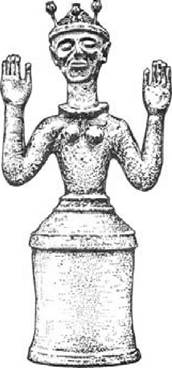 Figure 48 The Poppy Goddess
Thomas de Quincey paid a very revealing tribute to the power of opium in his Confessions of an English Opium Eater (1821). First he was at pains to deny opium’s power to intoxicate, asserting that the drug produced a static, ‘chronic pleasure’ lasting perhaps ten hours. Then he invoked opium directly, leaving no doubt as to the limitless power which the drug-user feels he has been given:
Thou buildest upon the bosom of darkness, out of the fantastic imagery of the brain, cities and temples, beyond the art of Phidias and Praxiteles - beyond the splendour of Babylon and Hekatompylos [Egyptian Thebes, one of the sources of opium]: and from the anarchy of dreaming sleep, callest into sunny light the faces of long-buried beauties.
But the opium-taking habit led de Quincey on to far less pleasant and exhilarating experiences, and we are justified in assuming that the Minoans too suffered the adverse effects of opium. This is, at least, one way of explaining an otherwise very peculiar aspect of Minoan religion - the daemons. Some of these daemons are shown as followers, guardians and attendants of deities and sacred objects; others are fantastic composite monsters which seem to be spontaneous creations of the unconscious mind.
There is a dog-headed creature that recurs in several images. Evans sees it as an adaptation of the Egyptian dog-ape, possibly developing from the monkey frescoes in the Knossos Labyrinth; the monkey was not native to crete and the animal may have been taken for a monster and so given an impulse to the creation of other monsters. A tablet from Phaistos shows an orderly but sinister procession of four daemons, each with its left arm hanging down and its right arm raised, holding a staff (Figure 49). One has a dog’s head, another a boar’s head, a third a bull’s head and the fourth a bird’s head. Possibly they are priests or temple attendants wearing animal masks: the Minoan religion had certainly not developed so far that such things were incongruous. Nilsson (1949) points out that the Phaistos daemons are similar to daemons shown on Babylonian and Assyrian amulets, believing that the Minoan daemons were simply copies of these foreign monsters.
There are nevertheless many images which seem to be spontaneous Minoan creations - strange and haunting images like the one on a sealstone depicting a daemon carrying two animal carcases on a pole. Is he a deity bearing off animals that have been sacrificed to him? Another shows a large and lordly daemon with a wasp-tail, standing between two human attendants. Another shows the converse, a humanoid god standing between two daemons: he is mastering them by grasping their tongues.
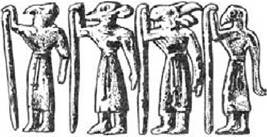 Figure 49 Procession of animal-headed daemons
The daemons are closely linked with religious cult activity. It seems that they are not gods exactly, but made of the same stuff as gods. Sometimes they stand in for a deity, haunting the sacred places and occupying a position midway between gods and men. Perhaps the Minoans regarded them as fearful intermediaries - essential but frightening go-betweens. In this sense, they may have occupied the same position in the Minoan religious system as angels and demons in the Christian belief-system in medieval Europe.
The Minoan religion was itself in transition, and we can see the humanoid deities as more evolved than the daemons, who were older nature-spirits. The daemons roamed the forests and mountain sides, lurked in the caves and rock crevices, fostering nature under the supervision and ordinance of the evolved gods and goddesses.
We should not treat the daemons as foreign implants, yet they do nevertheless have what Nilsson describes as an ‘antithetic’ quality compared with the rest of the Minoan pantheon. The opium-taking may well be all that is needed to explain this. De Quincey wrote that habitual opium-taking reawakened the childhood capacity that we all recognize and remember, for conjuring up monsters in the dark. It was ‘a power of painting, as it were, upon the darkness, all sorts of phantoms. . . . At night when I lay awake in bed, vast processions passed along in mournful pomp; friezes of neverending stories . . .’ This nightmare of processing phantoms reminds us of the procession of daemons from Phaistos, which could have been seen in the sort of opium trance de Quincey described. De Quincey reported that these endless processions produced in him feelings of deep melancholy and gloom. He was not merely frightened: he became profoundly and suicidally despondent. It may be this kind of experience that led some Minoans to submit willingly to sacrifice.
A belief in daemons or evil spirits led on naturally to a need for exorcists; exorcism, it is reasonable to assume, became one of the priestly functions. The Minoan priests and priestesses became so expert in this art that they became famous for it throughout the Aegean world. An exorcism relating to a disease, and allegedly written in the tongue of the Keftiu, survives in an Egyptian papyrus of the fourteenth century BC (Alexiou, undated, p. 108). No doubt there were formulae for getting rid of evil spirits, and it may be that the mysterious painted symbols written inside two cups from Knossos are spells of this kind.