
The care which bereaved Minoans sometimes lavished on their dead suggests a belief in the afterlife, and the idea of an Elysium, a pleasant Heaven awaiting people at the end of their earthly lives, is thought to have been a Minoan creation. It is not known whether the Minoans had any concept of reward or retribution in the afterlife, though they seem to have believed that the human soul survived death. The butterfly, a common motif in Minoan art, is thought to symbolize the soul (Alexiou, undated, p. 121). The fact that the butterfly is engraved on circular gold weights from a tomb at Mycenae may indicate that, at least in the Mycenean period, there was a belief in the weighing of souls to determine their fate after death. Bronze scale-pans have been found in Late Minoan tombs in Crete itself.
Since most burials have been robbed, archaeology rarely gives us the sort of fine detail about the Minoans that we would like to have. The Agia Triadha sarcophagus is invaluable in showing us the funeral ceremonies that were offered for some important person around 1400 bc. They consisted of an elaborate sequence of libations poured into a large vessel on an altar between two double-axes mounted on painted pyramidal bases; grave-goods were dedicated to the sheepskin-draped statue of a god in front of another altar; offerings of food and drink were dedicated at a third altar set up in front of a sacred tree shrine; music was played and an ox and two goats were sacrificed.
The Early Minoan burials were mainly in collective tombs, each one a family grave that continued in use over several generations. A small settlement might have just one tomb: Knossos was ringed by such tombs. Nearly all the burials were inhumation burials. The isolated cremations found in the Ailias cemetery on the eastern fringes of Knossos and dating to around 1600 BC may be the graves of foreigners from Anatolia, where cremation burials were the norm. More usually, the body was bound up in a folded position, with the knees under the chin. Then it was simply laid on the floor of the tomb, or forced into a large storage jar which was laid on its side in the tomb; a third alternative, which became more popular with time, was to place the trussed corpse in a clay box or larnax.
The earlier collective tombs were cut, like artificial caves, out of the soft limestone. They had no particular design, often had several connecting chambers, and continued in use right through to the Late Minoan period. A large rock-cut tomb dating to 16001500 BC has been excavated at Katsamba; its grave-goods included pottery cups, engraved seals (one imported from Syria), and inlaid gold rings.
In some parts of Crete the rock was too hard to carve in this way, so caves or built tombs were used instead. At Mochlos, there were some rectangular tombs which belonged to wealthy families. In the Mesara Plain the built tombs were usually circular. A classic example of these is the Kamilari tomb near Phaistos, which was built around 2000 BC and was in use for several hundred years. Its massive cyclopean ring of masonry still stands to a height of 3 metres. Perhaps it was never roofed: if so, it must have had a very high corbelled vault, either in stone or in mudbrick. On the whole, the evidence points to these Mesara round tombs having been roofed; the surviving wall stumps are very thick and have faces that slope inwards, and there are sometimes fallen wall blocks in the interior, suggesting a collapsed beehive vault. Vaults with a ground-level diameter of 9 metres or so, such as the one at Platanos (Figure 53C), were certainly technically feasible; they must have been imposing structures in their original state.
The Mesara tombs often had annexes as overspill ossuaries and cult rooms built onto them. The Apesokari tomb (Figure 53B) had burials in the corbelled circular chamber and in some of the outer chambers: it also had a rectangular cult room. In the vestibule was a niche with a small bench-altar to support a piece of stalactite as an idol. Outside the tomb entrance was a larger, rectangular altar which may have been used for sacrificial offerings. The vaulted tombs at Lebena, or Lendas, on the south coast have a similar layout to those in the Mesara Plain, with a round main chamber and rectangular cult rooms adjoining.
There has always been a tendency to build houses for the dead to resemble houses for the living. The curious thing about the Minoans is that they were, in Mesara at least, building round tombs and rectangular houses: the rooms were rectangular even in the neolithic period. It may be that the round tombs are a reference back to a very ancient and primitive type of house, long-since abandoned except for tomb architecture, or they may be an exotic, a design imported from a foreign land where both tombs and houses were round. In favour of the latter explanation is the sudden appearance of the Cretan round tomb in about 3000 bc: they are not known in Crete before that time. It may be, then, that the idea of the circular tombs was brought in by the immigrants who arrived in Crete from Anatolia at the beginning of the bronze age.
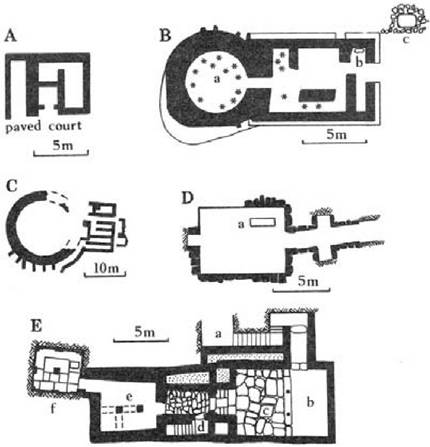
Figure 53 Minoan tomb plans. A: a built tomb at Mochlos. B: a built tomb at Apesokari. a = burials, b = altar in niche, c = altar outside. C: large circular tomb with rectangular cult rooms adjoining, at Platanos in the Mesara Plain. D: the Royal Tomb at Isopata. a = grave pit. E: the Temple Tomb at Knossos. a = winding rock-cut entrance passage, b = portico, c = open, paved courtyard, d = covered lobby and staircase up to shrine on first floor, e = built pillar crypt later subdivided with walls to make an ossuary, f = rock-cut tomb chamber, lined with gypsum slabs, with late grave-pit in north-east corner
At the beautiful ridge-top site of Phourni, above the Minoan town of Arkhanes, there is an extraordinary Minoan mortuary-complex which seems to have been in use continuously from 2500 to 1250 BC (Plate 19). It is still not fully excavated, but it has already emerged as one of the richest and most extensive prehistoric cemeteries in the Aegean. It has several circular tholos tombs, of which one, ‘E’, dates to the PreTemple Period, 2500-2000 bc.
But of all the tombs so far uncovered at Phourni, Tholos ‘A’, which is located well to the north of the two main mortuary houses, is the most spectacular. It dates from about 1390 bc, just a few years before the fall of the Labyrinth on the plain below. It consists of an 8-metre-diameter beehive tomb, with a large square capstone still in place, and a 20-metre-long entrance passage on the east side; it is like a simpler, trial-run version of the great tholos tombs at Mycenae, and it may well be that the Mycenean tholos tombs originated as a Minoan idea (Plate 20).
Phourni’s Tholos ‘A’ had its main chamber robbed in antiquity, but in 1965 the side chamber yielded the first untouched high-status burial of Minoan Crete. Among the grave goods were 140 pieces of gold jewellery, which had originally adorned the corpse of an important woman, who may have been a queen or a high priestess. With the great lady’s body were the remains of a sacrificed bull and horse. Near this tomb are several large rectangular mortuary-complexes, consisting of many small rectangular chambers, and these seem to have evolved as family tombs for the Minoan township of Arkhanes, whose distant successor Phourni still overlooks (Plate 19).
The Temple Tomb on the southern edge of Minoan Knossos is a tomb like no other in Crete (Figure 53E). The tomb chamber is a relatively small square chamber cut out of the living rock of the Gypsades hillside. Its walls and floor were sheathed in gypsum slabs, whilst its ceiling was painted blue and supported by a gypsum pillar. The original burials, placed there around 1550 bc, were unfortunately robbed in antiquity. All that was found in the tomb chamber when it was excavated was the apparently hasty, late burial in a pit under the floor of an old man and a child. Was the man the last Minoan king or the last Minoan high-priest of Knossos? The date of this burial, around 1380 bc, may be very significant, for it was then that the Labyrinth was virtually abandoned and the development of Minoan culture took a new direction. Sinclair Hood (1971, pp. 144-5) writes of the Temple Tomb as the only certain example of a Minoan royal tomb, but its status is so peculiar that we cannot be sure who was buried there, either at the beginning or at the close of its period of use.
The building attached to the front of the tomb chamber included another pillar crypt (later partitioned and turned into an ossuary), some cult rooms, a walled courtyard and a portico. The Temple Tomb was evidently a very special tomb, but its precise original function seems to be impossible to ascertain. It may, at the time when it was built, have been intended as a final resting-place for the priestesses of the Knossos Labyrinth, rather than, as is often assumed, for the Knossian kings.
Another allegedly ‘royal’ tomb is the Great Tomb at Chrysolakkos, which stands at the northern edge of the Minoan town of Mallia, a little inland from the cliffed headland, and it is thought to have served as a family vault for Mallia’s royal family in the New Temple Period (for instance, by Hood 1971, p. 145). This was a large rectangular building in the same tradition as the mortuary houses at Phourni, with a rabbit warren of small chambers inside and a colonnade along the east front; it differs from the Phourni mortuary houses in having been built all at once. The surviving lower courses of the outer wall are of smooth, beautifully cut and polished blocks of dense grey stone.
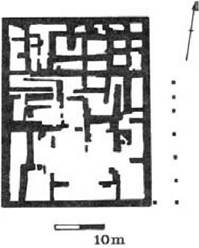 Figure 54 Plan of the Chrysolakkos tomb
It is obviously significant that many of the Minoan tomb entrances open towards the east; the Temple Tomb and the Tomb of the Lady of Arkhanes both face east, the direction from which the rising sun’s resuscitating rays shine. The east-facing Chrysolakkos colonnade probably had the same ritual significance. Unfortunately, the burials were thoroughly plundered for their precious grave-goods in antiquity, and we must be thankful that at least the Wasp or Bee Pendant survived the looting (Figure 28). The local name of the place, the Gold Pit, implies that a good deal of gold was robbed from the site before the French archaeologists started excavating it in the 1920s, and there is good reason to suppose that the so-called Aegina Treasure, which is now in the British Museum, originated here.
The ‘Royal Tomb’ at Isopata was a later rich tomb, post-dating the Thera eruption. The Isopata Tomb, dating to 1450-1400 bc, was an impressive chamber tomb with a large, corbelled, rectangular chamber and a high stone vault. It had a long entrance passage sloping down from the east. The Isopata Tomb was wrecked in 1941-2, during the Battle of Crete, by being turned into a gun emplacement by German soldiers, so drawing British shellfire upon it.
The collective burials continued, but the size of the tombs gradually diminished. By the time of the Thera eruption in 1470 bc, most of the burials were in small tombs holding at most four members of a family. Usually the burials were accompanied by some personal grave-goods, such as a seal-stone or a metal signet ring, but they were also usually robbed soon afterwards. In the Late Minoan period new styles of burial came in, the larnax burials. The larnax was a clay sarcophagus, often with panelled sides and gabled lids, and elaborately decorated all over with painted images. From their shapes, they were apparently copied from wooden originals, and it seems likely that the clay coffins are really copies in clay of wooden clothes-chests. Just occasionally, wooden chests were used as coffins, but only for very wealthy people. The Agia Triadha Sarcophagus is a superb example of a larnax, though made of stone coated in plaster. It is beautifully painted with scenes of the dead person’s funeral along the sides, and scenes of Elysium, or the way to Elysium, on the ends; smiling goddesses in plumed head-dresses ride along in a chariot drawn by a griffin on one end, and by a goat on the other, presumably ready to convey the human soul to Elysium, to live ever after with the gods. The Agia Triadha sarcophagus is a marvellous work of Minoan art; but it is also a positive and glowing affirmation of the Minoans’ beliefs concerning human mortality and the life after death.