
The activities of Early Minoan priestesses were focused on the peak and cave sanctuaries and the sacred enclosures, but after 2000 BC they focused increasingly on the temples. Relatively little is known of the first great temples, which were built between 2000 and 1900 BC and destroyed by earthquakes in 1700 bc, except that they stood on the same sites as the later temples. The foundations of the later temples largely obscure the plans of their predecessors but, from the patchy remains that have been investigated, the older temples seem to have been similar in style, scale and layout to the later temples, although they were perhaps slightly less complicated.
The ruins seen today are essentially those of the ‘second’ or ‘new’ temples, built in 1700 BC and destroyed in the Thera eruption of 1470 bc. Only one of them, the Labyrinth at Knossos, was restored and repaired so that it could continue to use after 1470, and it was more or less completely abandoned some ninety years later after a maj or fire. After that, the Minoans appear either to have lost interest in temple-worship, or to have restructured their economy in such a way that it could no longer sustain - or no longer needed - large temple-complexes.
The Labyrinth at Knossos is generally recognized to have been one of the greatest architectural achievements of the ancient world. Had its fabric endured with its frescoes undamaged for just a few centuries longer, it might well have been ranked as one of the world’s Seven Wonders. Its outline plan, as recovered by Sir Arthur Evans’ excavations, is a ragged square roughly 150 metres across, covering an area of about 20,000 square metres. The footings and parts of the walls of around 300 chambers have survived on the ground floor; the presence of several staircases implies the existence of upper storeys and, taking into account the destroyed upper floors as well, the original temple may have had a thousand chambers altogether. The Knossos Labyrinth was exceptional in its size and complexity, but there was a strong family likeness among the Minoan temples. The large buildings at Zakro, Mallia and Phaistos possess plans that have many features in common, though with significant variations; their designs may have been based loosely on that of Knossos or they may have evolved independently from a common set of functions. They are really not similar enough, either to each other or to Knossos, for us to assume that they were copied from the Knossos Labyrinth as a model.
The temples’ most distinctive common feature was the large rectangular Central Court oriented roughly, but not exactly, north-south and measuring about 45 by 23 metres. In The Knossos Labyrinth (Castleden 1989), the evidence is summarized for believing that it was in the Central Court that the bull-leaping ritual took place, a ceremony that was itself central to the Minoan belief-system. From the significant number of representations of bull-leaping on frescoes and sealstones, it is possible to reconstruct with some confidence the events that took place in the Bull Courts.
To begin with, it is important to recognize that the various images represent different stages of more than one acrobatic feat, and that in some instances there is an element of idealization. Teams of bull dancers were evidently involved and they rehearsed a repertoire of spectacular and dangerous-looking feats for the benefit of a host of onlookers: there is little doubt that the crowd of spectators shown in the Grandstand Fresco is watching a display of bull-leaping, and the Tripartite Shrine fixes the location as the Central Court of the temple. Some members of the team distracted the bull by turning somersaults on the paved court: while the beast’s attention was diverted, an acrobat might leap crosswise over its back. Other team members, the bull-grapplers, hurled themselves on to the bull’s horns to pad them with their own bodies and make the beast lower its head (Figure 50). While the bull’s head was low, the bull-leaper might dive between the horns to land, head and hands first, on the bull’s back: momentum carried him on over the bull’s tail, to land on his feet behind the bull. In a variation on this feat, the bull-leaper performed the ‘Diving Leap’ from a vantage point; the large, stepped stone block in the north-west corner of the Bull Court at Phaistos was probably used for this purpose, and there may have been similar free-standing vaulting blocks at Knossos and Mallia.
Some images, like the bronze statuette thought to have come from Rethymnon, show a bull-leaper landing upright on his feet on the bull’s back. To have reached this position, he must have somersaulted over the bull’s head. Gaining enough height and momentum for the somersault would have required the energy of a team of acrobats to propel him up and over the horns.
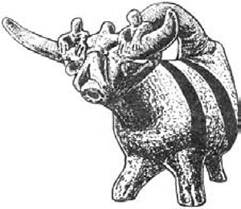 Figure 50 Bull-grapplers immobilize a bull
Acrobats are shown, independently of bull-leaping, on a number of Minoan artworks. A sealstone shows two acrobats performing handstands. A gold sword hilt from the temple at Mallia shows an acrobat performing a back somersault (Figure 29); perhaps, as Professor Alexiou suggests (undated, p. 49), in reality this feat was performed over the self-same sword planted in the ground, point upwards. Feats of this sort were probably performed as a preamble and as an accompaniment to the bull games. Whether the boxing and wrestling matches shown on the carved rhyton from Agia Triadha, a miniature fresco from Tylissos and certain sealings were part of the same or a different festival is not known: the way they are depicted suggests that they too had the quality of ritual struggle.
Controversy has always surrounded the Minoans’ bull-leaping exploits, and there are many who are sceptical that they ever took place. But the surviving works of art can be interpreted in such a way that credible acrobatic feats may be reconstructed. Certainly it is hard to believe that bull-leapers grasped the horns, and relied on the tossing movement to get them safely over the bull’s head. Although at first sight the Bull-Leaping Fresco found in the cellars of the Labyrinth’s East Wing seems in its present reconstruction to show, on the left, a bull-leaper waiting to be hoisted into the air, the figure is in fact a bull-grappler and represents a group of two, three or four grapplers whose job it was to pad the horns, keep the bull’s head low and the rest of its body still during the leap. It is the second figure, in the centre, who is the bull-leaper, the star performer. The third figure, on the right, represents another group of helpers waiting behind the bull to catch the leaper after the successful vault. If a single leaper had grasped the horns and hoped to be thrown neatly over the bull’s head, the chances of achieving a successful vault would have been very low. Bulls usually shake their heads erratically, lowering them vertically and twisting them sideways as they jerk them up to inflict the maximum injury. In this situation, Minoan bull-leapers could never have cleared the horns. The whole manoeuvre would have been far safer if the leaper did not touch the horns at all, by using either the ‘Diving Leap’ or the ‘Somersault Leap’ described above.
Feats as daring as those shown on the frescoes and sealstones are certainly possible and they probably were really performed, but it seems likely that they were carefully choreographed and presented to make them seem as dangerous as possible. The skill of the teams of acrobats, performing all manner of diversionary handstands and somersaults on the ground between the bull and the spectators, must have convinced those watching that they were seeing something infinitely more perilous and spectacular. No doubt the bull-leapers and their teams used the power of suggestion as well as enormous skill and dating to excite their audiences.
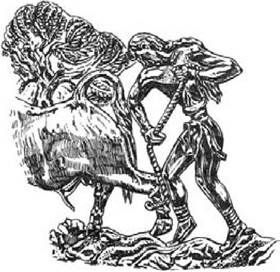 Figure 51 A man captures a wild bull
Parallels between Minoan bull-leaping and Spanish bull-fighting, for instance, should not deceive us into seeing bull-leaping as mere ‘theatre of cruelty’ entertainment. It was not a game, but a serious and central ritual in the Minoan belief-system. The bull was a manifestation of Poteidan, and dancing with the most powerful god in the Minoan pantheon was no light matter. Probably the bull dance expressed the interweaving of human and divine destinies; there were elements of collusion and elements of struggle with the deity. Probably the rite was an ordeal, one of many rites of passage that young Minoans, girls as well as boys, had to undergo in order to achieve higher status.
Many colonnades, staircases, doorways and corridors open on to the Central Courts and, if the bull dance really did take place there, they must have been protected in some way from the rampaging bulls. At Phaistos, there is evidence that doors closed off some of the openings. On the east side of the Bull Court at Mallia, there is evidence of a series of rails supported on stout wooden posts, and a door closing off the northern end of the colonnade. The Bull Court at Knossos is not well preserved, but it is possible that a fence of some kind ran round its edge; a fragment of fresco found in the Labyrinth shows a strongly made three-rail wooden fence with a priestess or attendant leaning on it, watching the spectacle.
Ranged along the western sides of the Bull Courts were suites of important cult chambers built in stone and mudbrick, and framed with horizontal and vertical timbering. The interiors were plastered and decorated with frescoes which developed a complex cycle of religious ideas. Mark Cameron (1987) came to believe, after studying these frescoes intensively, that the West Wing of the Knossos Labyrinth in particular was given over to a whole programme of initiation rites and ordeals.
There was usually at least one chamber in the New Temples with a gypsum bench along its walls. At Knossos, the two main chambers of the Throne Sanctuary and the principal chamber of the Snake Goddess Sanctuary had bench-altars; at Phaistos, there were two chambers with benches opening from the Central Court. There were also pillar crypts in the West Wing. Although the sacred character of the pillar crypts has been questioned, there is plenty of evidence that they too were cult structures. In a pillar crypt belonging to a building on the Gypsades Hill at Knossos, 200 small conical offering cups were found, still containing remains of vegetable matter. Under the floor of the pillar crypts in the West Wing at Knossos were deposited the ashes of animal sacrifices: the pillars above were incised repeatedly with the sacred doubleaxe symbol. The crypts were small, too small to have needed a central pillar to support the ceiling, so we can only presume that the pillar had a symbolic significance to the Minoans (Plate 18). Ferguson (1989, p. 5) mentions the idea that the pillar might have been a representation or reduction of a sacred tree. Certainly, instances of stone worship are not unknown in antiquity, and they may preserve a vestige of the even earlier belief-system of the megalith-builders. The Old Testament speaks of a stone raised by Jacob on the spot where he experienced a mystic vision; Jacob worshipped the stone and anointed it with oil. Similarly, liquid libations were offered to the pillars in the pillar crypts by the Minoans, to judge from the rectangular depressions in the floor beside many of them.
On the east side of the Central Court at Knossos and Phaistos, there were suites of chambers separated from each other by pier-and-door partitions. At Mallia, a similarly designed suite was located in the north-west corner of the temple.
At intervals round each temple there were adyta, sunken and secluded rectangular areas which are thought to have been used for important ceremonies (Marinatos 1984). Suites of store-rooms occupied a large area of the temple. They were used to store the very large volume of offerings and tribute that came in from the townspeople and from the people living in the surrounding countryside; administrating the inflow and redistribution of this temple tribute was a major function of the Minoan temple.
There were small sacristies and strongrooms for storing precious cult equipment; there were vestries where the priestesses put on their ceremonial dress in readiness for ritual, and refectories for the priests, priestesses, initiands and temple servants; there were service areas and kitchens. A detailed study of the Knossos Labyrinth (Castleden 1989) shows that its design resolves into a number of distinct functional areas; using this kind of analysis, it is possible to identify several separate sanctuary suites within the temple. It may be possible to analyse the plans of the other ancient Cretan temples in the same way.
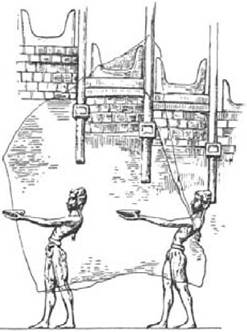 Figure 52 Procession at a temple
It seems that neither temple nor town was fortified, so it was possible for the temples to grow outwards from the nucleus of the Central Court virtually without restraint. The only restrictions to growth were the topography of the site and the West Fagade. Fronting the West Court, which was an important ceremonial area in its own right, the elaborately indented West F agade was a fixed backcloth for ritual. In front of it, large-scale and public religious festivals took place, bringing temple and town together. As Nanno Marinatos has perceptively argued (1987), the common architectural features of the West Courts at Knossos, Phaistos and Mallia imply a use for harvest festivals. In each West Court there were large cylindrical granaries, and the curious pattern of paved causeways suggests that the granaries, as well as the temple entrances, were focal points.
A notable feature of the temple was the unobtrusiveness of its entrances. Knossos had seven or eight entrances, all different in design, all more or less inconspicuous. The entrances led into passageways that followed more or less devious routes towards the Central Court; it may be that the twists and turns of these passages had some magico-religious significance.
To the casual eye, there is little sense of planning. All appears chaotic, yet comparisons among the temples reveals that, although complicated, their plans are ordered and carefully thought through. The Minoan architects clearly intended to produce an effect that was bewildering, impressive and disorienting. Their intention was to create a narrative experience for the pilgrim or initiand, an experience full of unsettling incident and surprise. It was one of the temple’s functions to produce these effects and they are part and parcel of the Minoan religious experience; the temple itself was in a very real sense an extreme expression of that experience. De Quincey’s opium dreams were full of daemonic pomp and circumstance: they also included architectural nightmares which paralleled Piranesi’s neurotic and obsessive drawings of complex, claustrophobic interiors. De Quincey frequently dreamt of a fantastically elaborate and labyrinthine building. The Minoans, under the influence of exactly the same drug, may well have had visions of a fantastic, maze-like building, and based the design for the Labyrinth on their visions. De Quincey’s dream was, on his own account, of a building vision described by Wordsworth in The Excursion, Book II:
The appearance, instantaneously disclosed,
Was of a mighty city - boldly say
A wilderness of building, sinking far
And self-withdrawn into a wondrous depth,
Far sinking into splendour - without end!
Fabric it seem’d of diamond, and of gold,
With alabaster domes, and silver spires,
And blazing terrace upon terrace, high
Uplifted; here serene pavilions bright
In avenues disposed; there towers begirt
With battlements that on their restless fronts
Bore stars.
Some such vision, provoked by religious ecstasy and zeal, stimulated by opium, may have lain behind the elaborate and dizzying designs of the Minoan temples.
As the temples increasingly absorbed the Minoans’ religious vitality, so the cults of the peak sanctuaries declined. They were still visited; sacrifice was still made; the deities were still honoured; but the real seat of religious power now lay in the temples. It was a natural enough development. Secular, economic power gravitated towards the lowlands and to the urban centres in particular. It was inevitable that spiritual power should devolve on the urban temples. Probably the priestesses systematically brought the peak sanctuaries and other rural shrines under their control, just as Solomon was to do a thousand years afterwards, building an urban temple and then extending his power over the high places.
When the temples were rebuilt in 1700 bc, the pottery style reflected a change of philosophy of some kind. The Marine Style, with its fish, seaweed, shell and octopus motifs, shows a concern for the abundance of life in the dark waters of the Mediterranean; implicitly, it invokes the god Poteidan or Poseidon, to whom the Knossos Labyrinth was dedicated (Castleden 1989, pp. 112-13, 138-9). The twilit subterranean chambers carried undertones of the cave sanctuaries. The Throne Sanctuary at Knossos was specifically designed to simulate the peak sanctuary environment. Gods and goddesses were lured to the towns. It was as if a diffuse religious power permeating the whole island was gathered and transferred from the mountains and hillsides to the temples and then, after the destructions of 1470 bc, to just one temple, at Knossos. After the virtual abandonment of the Knossos Labyrinth in 1380 bc, that power retreated underground, to the cave sanctuaries. It was in this late period, between 1380 and 1200 bc, that the cave cult really came into its own, acting as a night-safe for the whole fund of Minoan religious beliefs. From this cave cult sprang the peculiar, complicated, mixed-origin myth of the birth of Zeus Cretagenes, ‘Cretan-born Zeus’, as it was told by the Greeks in the fifth century bc.