
The idea of a Minoan personality is nonetheless strongly rooted. The artwork is so vivid, so immediate in its appeal that we may feel an instant affinity with the Minoans as people. As Maitland Edey (1975, p. 57) has said, we sense that if we could get one step closer we could get to know them. Our view of them is nevertheless largely the result of Sir Arthur Evans’ skilfully presented publicity for peace-, flower-and leisure-loving Minoan aesthetes. Although a great deal of new archaeological evidence has come to light since Evans’ time, and alternative visions have been proposed, for example by Hans Wunderlich (1975), it is to a very great extent Evans’ presentation of the Minoans that has prevailed, right down to the present day.
This firmly established twentieth-century tradition has it that the Minoans were talented, subtle, luxury-loving, worldly, sophisticated. They were sensitive, elegant and graceful; they loved refined and sumptuous decor, beautiful art objects and jewellery. They loved peace and the rule of law, detesting tyranny and warfare. They had no personal ambition, a trait inferred from the complete anonymity of artists, sculptors, rulers and military leaders: there were no boastful lists of great achievements or conquests, and no monumental portrait-statues of kings of the type found in Egypt. In fact, no individuals emerge at all. There is no Solomon, no Pericles, no Akhenaton, no Imhotep. From this it is argued that the Minoan culture was an anonymous one, where function within the hierarchy was all-important, personal identity nothing.
Henry Miller, voicing the conventional view in The Colossus of Maroussi (1980, pp. 123-4), saw the Minoans as splendidly sane, rich, peaceful and powerful, a clean, salubrious and joyful people: ‘the prevailing note is one of joy ’.
Above all, the Minoans have been seen as nature-lovers. They responded to all the various aspects of the natural world: plants, flowers and animals, birds, fish and landscape, sea, shells, rocks and seaweed. The princes and great ladies of the Minoan courts wandered languorously amid flowers, birds and butterflies in their royal gardens.
The Minoans were great admirers of the human body, as the classical Greeks were to be later, but the Minoans had their own distinctive ideals of physical beauty. They liked to see long, slender, graceful but muscular limbs, narrow waists and dark hair falling in long flowing ringlets - on both men and women. They liked to see broad shoulders and deep chests on men, and firm full breasts and full hips on women. Minoan women were elegant, graceful, poised, well-mannered and sexually alluring, with their breasts displayed and their lips and eyes accentuated by make-up. The men too were elegant and dressed in a way that was sexually provocative; the torso and thighs were exposed and the narrow waist and prominent codpiece were obvious focal points. Both men and women, as depicted in works of art, were consciously and self-confidently graceful, attractive and fashionable, in a way that looks startlingly modern.
Minoan art, in harmony with these characteristics, focuses on themes from nature - crocuses, sailing nautiluses, dolphins, octopuses, swallows, ibexes among them - rather than themes from contemporary events. There is no sense of history, of political events, of even the possibility of war in the frescoes, with the one exception of the miniature fresco fragments showing a band of men saluting their leader (Figure 55) by brandishing their spears - and even this may be a ceremonial rather than a military gesture. One of their most outstanding traits, the tradition has it, was their love of peace, the pax minoica spreading effortlessly as a result of pure and massive cultural superiority across the Aegean Sea. The Minoans’ strength at sea was so great that they had no need to fortify their Cretan cities at all: none of them had defensive walls.
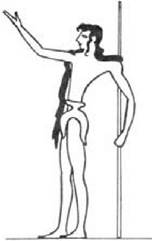 Figure 55 The leader of the people?
Jacquetta Hawkes (1968) has drawn attention to the essentially feminine quality of Minoan culture. Women did not necessarily dominate men socially and politically, nor were men effeminate; it is merely that feminine qualities - that is to say, qualities that, however irrationally and prejudicially, in the contemporary western world we would be more likely to associate with women than with men - were to the fore. We could cite as examples love of art and nature: love of miniatures, models and toys: love of jewellery, ornament and detailed decoration: love of peace: lack of interest in politics, self-aggrandisement and war. Jacquetta Hawkes develops her theme to the point where she argues that the personality of classical Greece was produced as a result of the fertilization of the feminine Cretan culture by the masculine Achaean, or Mycenean, culture of the Greek mainland. The marriage of the two mythologies produced the goddess Athena who, in her own person, combined the masculine qualities of a warlike goddess of victories and a goddess of intellectual strength and wisdom with the feminine qualities of the Minoan goddess, associated with weaving, wearing a long flowing gown, and acting as a dependable protectress and mother figure for the whole community.