
This traditional view of the Minoans has prevailed throughout the twentieth century. Nevertheless, we should examine the different elements within that orthodox view, to see how far the archaeological evidence supports them. Some may turn out to be well founded, others mere wish-fulfilment. First, let us look at the oft-repeated assertion that the Minoans were peaceable. It is one of their most attractive characteristics, and the more so because they were surrounded by warlike and very assertive neighbours - the Myceneans, Egyptians and Hittites that we know of, and there were probably many more besides.
The assumption that the Minoans were total pacifists is based mainly on the apparent lack of solid, built fortifications. Nevertheless, Lucia Nixon (1983) quotes Alexiou’s very significant list of Pre-Temple sites on Crete whose location seems to show an interest in defence: Pyrgos, Fournou Korifi, Vasiliki, Khamaizi, Kastri near Palaikastro, and Debla. Then, in the Old Temple Period, and dating to around 20001800 BC (Middle Minoan I-II), came Agia Photiou. This hilltop site overlooking the north coast of Crete was first developed as an open settlement, consisting of a rectangular building 18 by 27 metres and comprising 36 rooms. Almost at once it was destroyed - whether by the inhabitants themselves or by invaders is impossible to tell - and replaced by a circular building 7.5 metres in diameter. The hilltop was surrounded by a substantial circular wall which the excavator interprets as defensive in intention (Tsipopolou 1988). The similar mini-fortress settlement of Khamaizi lay to the west of Agia Photiou and would just have been visible from it. We may, in these two sites, be glimpsing part of a chain of coastal military bases which once ringed Minoan Crete and kept it secure.
In the Old and New Temple Periods, we could add Phaistos to the list of fortress sites, with its precipitous slopes defending it from sudden attack on three sides. Although the temples may not have been surrounded by fortress walls, there is every reason to suppose that they were secure. If we interpret the ‘palaces’ as temples, and therefore not necessarily the headquarters of the King or the Lawagetas, there is no reason to suppose that the buildings would have been regarded as a military target. Nevertheless, the temples were richly equipped with great ceremonial bronze double-axes, with cult objects in gold, lapis lazuli, and other precious materials, so they would have been well worth looting. Ransacking an enemy’s temple and stealing his cult idols was also an easy way of humiliating and demoralizing him. We know, for example, that the Hittite kings indulged in this tactic (Lehmann 1977, p. 191). For these reasons it would be surprising if the temples were left completely undefended. In fact, there are indications that the Knossos Labyrinth was made secure. There is clear evidence, in the form of pivot-holes in the floor at the West Porch at Knossos, that both the entrances into the Procession Corridor were equipped with substantial double doors. Tablets found in the West Wing of the Labyrinth record quantities of weapons; perhaps the entrances and various other strategic points round the temple were guarded by an armed security force.
There may alternatively, or additionally, have been psychological defences. Possibly the power of the temple priestesses was such that they could exact aweinspiring retribution from anyone committing sacrilege. Possibly there was an agreement, stated or tacit, that neighbouring Cretan states would not attack one another. Since warfare is clearly irrational, it may have occurred to the Minoans to make war taboo, at least among themselves. Taking this idea a step further, to the state of affairs that seems to have existed between 1470 and 1380 bc, an almost island-wide network of religious controls and economic interdependence centring on Knossos may have made any attack by a Cretan unlikely.
Nevertheless, there were some security measures at Knossos. Evans’ reconstruction of a section of the eastern facade of the Knossos Labyrinth as a high, windowless curtain wall is probably right. The West Court was bounded on its western side by a curving wall which may have been no more than a retaining wall to stabilize the tell material beneath the West Court terrace, but there are indications that the wall rose above the level of the West Court; there were clearly entrance gaps where roads passed through it, and those entrances may have had gates. The Labyrinth wall on the eastern side of the West Court, the West Fagade, had no windows on its ground floor, and this feature too would have made the building secure against attack.
There may be something in the traditional idea that the Minoans did not need to defend their cities on land because they were defending them at sea. We infer that there were war-galleys in the Minoan-Mycenean world (see Chapter 5), and we know that hundreds of rowers were called up to defend Pylos during the military crisis that led to its fall. No doubt there were coastguards stationed all along the Cretan shoreline, just as there were at Pylos, and seaborne enemies were dealt with before they ever reached the coast.
It is possible that Khamaizi, a small rounded structure on a north coast hilltop between Mochlos and Sitia, was one of these coastguard look-out stations. Other small, isolated, near-coastal buildings which are otherwise difficult to account for could have functioned in the same way, without necessarily being massively constructed or in any other conspicuous way defensive.
Nor were the Minoans weaponless. They deposited weapons as ritual offerings in cave sanctuaries and graves, and there is no reason to suppose that the weapons were not used for warfare. Men are often depicted, in figurines, for example, with daggers hanging from their belts, although this is likely to have been a simple precaution against robbery or personal attack. Other weapons were used in hunting; the Lion Hunt Dagger shows bows, spears and shields in a non-military context. Swords too could have been carried for self-defence or for hunting. Nevertheless, the whole panoply of weapons and military equipment was available to the Minoans - including body-armour and chariots - and it could have been used for warfare.
The threat from overseas must have been ever-present, given Crete’s situation. The threat at home, from neighbouring city-states, probably varied significantly through time: during the long Minoan period there must have been times of peace, times of tension and unrest, and times of war. Lucia Nixon (1983) suggests that Crete may have been torn by war during the Pre-Temple Period, but the building of the temples as power centres brought the phase of unrest to an end. Perhaps the establishment of well-defined urban centres, with firm control over their hinterlands and developing networks of trading and diplomatic relationships, led to a more harmonized political regime from 2000 BC onwards. Even so, as we saw in Chapter 2, the possibility that a subject territory or even a confederation of dissatisfied subject territories rose up against Knossos in 1380 BC is very real.
The various sporadic burnings and destructions of the temples and other, lesser Minoan centres are very difficult to evaluate. How can we tell, three-and-a-half thousand years on, whether a fire was started accidentally or deliberately? How can we tell, after that lapse of time, whether a fire, if deliberately started, was an isolated act of arson by a discontented slave, or part of an armed insurrection, or an onslaught by an invading Mycenean army? It is difficult to define an invasion in purely archaeological terms: hence our many difficulties in interpreting the later stages of the Minoan period on Crete. It is equally difficult to point to hard evidence of Minoan militarism, especially in the face of a well-established, or at any rate long-established, view that Minoans were non-aggressive. One feature of the culture which is impossible to overlook is the double-axe. Whatever it may have come to symbolize as a fullblown mystic symbol in temple iconography, the double-axe has the look of a weapon, a battle-axe.
It may be that a good deal of latent aggression was sublimated and controlled by religious rituals. A major distinguishing feature of the Nuba people of the Sudan is their lack of aggression. Their fighting is channelled into ritual wrestling matches which are the focus of their belief-system. The Minoans developed bull-leaping into a major, focal cult activity, and there were other violent, agonistic rites too, such as boxing and wrestling. Performing or watching blood sacrifices will also have released some of the aggression.
Identifying the Minoans as nature-lovers seems at first far less tendentious, far less controversial, yet, if it is an inaccurate reading of the evidence, it may seriously mislead us. Lucia Nixon (1983) argues that the use of nature motifs on frescoes and painted pottery is not really enough to justify characterizing a whole people as flower-lovers. It is a valid argument, and by substituting nineteenth-century Britons for bronze age Cretans we can see how misleading a line of thought Evans’ might be; the roses on their teacups and the ivy-covered trellises printed on their wallpaper would not blind us to the Victorians’ capacity to exploit child labour and commit acts of ruthless military aggression in India and Africa.
But the more important point is that the nature motifs in Minoan art are for the most part not merely decorative, as they are in nineteenth-century European art. The Minoans used nature motifs to conjure up the habitats of deities. This can be clearly seen in the decor of the Throne Sanctuary at Knossos, where a symbolic peak, the stone throne itself, was set in a wild landscape of fresco mountains; the griffin on the west wall was regularly depicted as the goddess’s heraldic attendant. The representation of plants and animals may often indicate a religious dedication or thought. The representations are, moreover, not very true to nature. The freedom with which many of the images are painted or carved is deceptive; the artist was not capturing the fleeting moment in the manner of a French impressionist, but rather conveying life and vitality to an idea of the thing depicted. It is an otherworld that we are being shown on the Minoan murals, with species of plants and animals that, in many cases, we have never seen in the everyday world. The dream-like, poeticized effect may be deliberate, part of the exotic thought-world which the Minoans inhabited.
The carefree image sometimes applied to Minoans may also be wide of the mark. The faces in the frescoes are often smiling; sometimes the heads are thrown up as if convulsed with laughter or song; yet the ecstasy of a major religious experience might have produced the same effect. Similarly, the scenes of dancing are unlikely to be scenes of secular recreation: from the contexts, they are much more likely to be ritual dances designed to produce an epiphany of a deity. In other words, in spite of the apparent diversity of the material, we are actually looking at one particular side of the Minoans’ lives, their experience of religious ecstasy. There was a darker side too, the shadowy initiation rites and ordeals; we can infer these (e.g. Marinatos 1984) even though we are rarely shown them.
That the Minoans were admirers of physical beauty in both men and women seems self-evident from their works of art. Often the figures pose in attitudes of exaggerated pride and nobility, such as the attendant bearing a rhyton in the Cupbearer Fresco at Knossos (Figure 57), the young Minoans and the so-called Priest-King from the Procession Fresco, the prince or older initiate on the Chieftain Cup (Figure 56), and the faience Snake Goddesses. The Minoans are often portrayed giving vent to extreme emotion, whether dancing ecstatically to greet a goddess as she approaches, or swelling with pride as they present offerings in the temple, or prostrated with grief over the god’s departure.
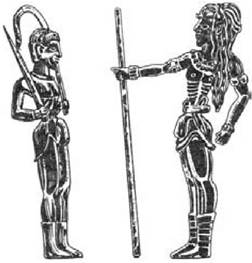
Figure 56 Two figures from the Chieftain Cup
It is impossible to tell from the evidence whether there was scope for individual ambition in Minoan Crete. It may be, as the traditional view has it, that personal ambition was unknown: certainly no evidence of it has survived. On the other hand, ambition and the pursuit of power may have existed, but simply went unrecorded. For the time being it remains an open question, yet it is surely significant that there are no portrait-frescoes or portrait-statues of any of the Minoan rulers, and no inscriptions boasting of power and conquest.
With the Minoans’ creativity and originality we are on surer ground. The wide range of distinctive artefacts which only the Minoans could have designed and made indicates an intensely dynamic and original culture. Some of the ideas may have been borrowed - the hieratic poses of the Procession Corridor, possibly from Egypt, the sacral bull horns, possibly from Anatolia - but the Minoans developed them in a way that was always recognizably Minoan. The sacral horns became stylized to the point where they could stand singly and function as a focus on an altar, or stand in rows to make an ornamental pinnacled parapet for a temple roof cornice. The ‘Egyptian’ poses of the figures were developed in a way that was less monumental, more animated and vital than the original, so that the figures seem to be about to come to life. It is, above all, this vigorous vitality and immediacy that gives Minoan works of art their distinctively Minoan flavour.
In the New Temple Period, Cretan artists achieved a mastery of equilibrium; the images of people, for instance, appear to be completely natural and yet those images are careful compromises between the objective reality and the concepts imposed upon it. There is an equilibrium here which verges on the classical, and yet conveys very different effects - of delicacy, suppleness and muscular tension, of energy, movement and youthfulness.
Sometimes we tend to be swept along by the free treatment which the artists gave to their subjects and, as a result, we overlook the beautifully fine detail which is also a characteristic of much of their work. Obviously the sealstones and signet rings by their very nature contain a great deal of fine detail, but it exists in large-scale designs too. Close inspection of the Procession Corridor and Cupbearer Frescoes reveals that the various different textile patterns of the young men’s kilts have been painted with great precision (Figures 6 and 57). Similarly, the geometrical, stepped outlines of the painted garden wall in the Villa of the Lilies at Amnisos contain detail that is not at all evident on first viewing: the main impression is of white lilies growing against a low, stepped, buff wall, with an exhilarating red background beyond. The wall’s cornice is indicated by no less than seven separate zones of ochre; some of them are, moreover, textured with a subtle and very carefully drawn criss-cross pattern that suggests a textile or basket-weave pattern. This eye for precise minute detail is what gives Minoan art its particular and uncanny sharpness.