
In spite of the abundance of artefacts, images and even inscriptions from the Cretan bronze age, it is still very difficult to reconstruct the society with any confidence.
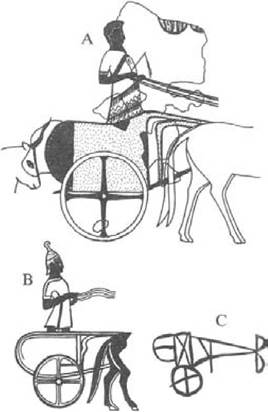 Figure 9 Chariots.
A: reconstruction from fresco fragments in the Knossos Labyrinth. B: fresco from Pylos showing winged chariot of common Minoan-Mycenean type. C: chariot symbol on a Linear B tablet from the Knossos Labyrinth
The Linear B tablets offer fleeting glimpses of deities, officials and bureaucrats from the fourteenth century. Since some of the officials’ titles have been found at Pylos on mainland Greece as well as at Knossos, it may be fair to assume provisionally that Minoan society had a rather similar structure to that of Pylos.
A few tablet references imply the existence of a king or Wanax at both Pylos and Knossos, but little more than this can be said. The adjective ‘royal’ is used of certain craftsmen - a royal fuller and a royal potter at Pylos - and even of certain textiles and pottery at Knossos. There is no mention of a king or of the adjective ‘royal’ at Mycenae at all. Sometimes the word ‘king’ was used for a deity such as Poseidon, so we cannot be sure, even where the word occurs, that a secular king existed. Evans and his supporters, identifying the large buildings at Knossos, Phaistos, Mallia and Zakro as royal palaces, took these as tacit evidence for the existence of powerful and grandiose dynastic kings. But if we interpret the palaces as temples and are unable to identify alternative sites for kings’ residences, the prima facie case for kings is significantly weakened.
However sparingly, the word ‘royal’ was nevertheless used at Knossos, so we should perhaps assume that there was a king of Knossos, even if he was a fairly shadowy, background figure dominated by the priesthood and by other officials. The great temple centres of Knossos, Phaistos, Mallia and Zakro were certainly major administrative, economic, and political centres and it is likely that each had its own ruler. The classical Greek tradition had it that Minos co-ruled Crete with his brothers Rhadamanthys and Sarpedon; King Minos became associated with Knossos, King Rhadamanthys with Phaistos and King Sarpedon with Mallia. It is likely that Middle Minoan Crete was a loose confederation of city-states, each with its own ruler and often with its own great temple-complex. After the destructions of 1470 bc, only the temple at Knossos was rebuilt, and this implies political as well as religious centralization in the New Temple Period; at this time, the power of Knossos seems to have extended across the whole of central Crete, with perhaps only the western and eastern extremities remaining independent of the Knossian rulers.
At Knossos, one tablet lists the names of men attached to two officials who are given the title qa-si-re-wi-ja. This may be the word ‘guasileus’, later to become the Homeric word ‘basileus’, an alternative title for a king. In Minoan-Mycenean times, the guasileus seems to have been a less exalted figure than a king, but still an important figure, perhaps a local chief. Tablet As 1516 from Knossos speaks of the Guasileus of a place ending in -ti-jo (possibly pa-i-ti-jo, Phaistos) and a retinue or an offering of twenty-three men. The tablet speaks of the Guasileus of Sitia (se-to-i-ja) and his retinue or offering of twelve or more men. Whether these chiefs were officials acting under a king or in effect kinglets in their own right is unclear. On the whole it looks as if they were local leaders, less important than the relatively small number of kings; each lesser centre, like Agii Theodhori, Kanli Kastelli, Arkhanes, and Pyrgos-Myrtos, probably had its own Guasileus.
It is at this point that we begin to notice some differences between the social hierarchies of Knossos and Pylos. Whilst the Guasileus at Knossos was an important figure, at Pylos he seems to have been little more than a foreman or supervisor. Conversely, an official called the ra-wa-ke-ja was regarded as a person of high status at Pylos, whereas at Knossos he was treated as merely the equal of the Guasileus (Hooker 1987). Clearly, we need to be cautious in drawing too close a parallel between the two social structures.
In the Early Minoan Period, to judge from burial practices, society was structured mainly round clans or extended families. It may be that as the urban centres evolved and became foci of wealth, certain families emerged as wealthier and more successful commercially than others and that the Guasileus emerged from these rich families. It would certainly make sense for progressive economic and social differentiation to result in the emergence of individual social leaders. The clans remained important right into the Old Temple Period, and this may have been partly thanks to the clan-focus supplied by the person of the Guasileus.
The most outstanding leader, though, was in a stratum above the Guasileus. He was the Lawagetas, literally ‘the leader of the people’. In later Greek, for instance in the Iliad, the word translated as ‘people’ often refers to ‘the people arrayed for battle’ or ‘the war host’, so some have understandably assumed that this Minoan-Mycenean title designates the commander of the army. But the tablets do not confirm this interpretation. There is nothing, apart from the much later connotation accruing to the word ‘people’, to connect the Lawagetas with the command of the army. He may have been the leader of the people in a political rather than a military sense, a kind of prime minister under the Wanax or possibly even a president, if the Wanax was a ceremonial figure-head with circumscribed powers. There is really too little evidence to go on, but what we have is compatible with a Wanax who was a monarch with very limited secular power, a constitutional monarch who formed a charismatic focus for public ceremony, and a Lawagetas who was the effective secular ruler.
At Pylos, the Lawagetas’ estates were significantly smaller than the king’s, though he had tradesmen attached or allocated to him. The title ‘Lawagetas’ is found at Knossos, but only on tablet fragments, so it is very difficult to find out anything about him. Chadwick (1976) thinks that tablet E1569 may give the size of his estate, which is comparable to that of his peer at Pylos. Lydia Baumbach (1983) believes that the broken tablet As 1516 may have been headed ‘Lawagetas of Knossos’: it gives a list of thirty-one men’s names, men who may have constituted the Lawagetas’ retinue.
In terms of land ownership, the Telestai were as important as the Lawagetas. There seem to have been several of these. At one time Chadwick thought they had a cult role, but he has come round to the view that they were simply men who owned large tracts of land and therefore had become politically powerful. But the telestes in later Greek times had associations with cult and ritual, so it may be wiser to assume provisionally that the Minoan and Mycenean telestai were also major religious leaders.
Another official who had a religious role of some kind was the Klawiphoros. This ‘key-bearer’, known from Pylos, was often and perhaps always a woman. In classical Greece, ‘key-holder’ was a synonym for priestess, so it may well have been that the Minoan and Mycenean key-bearers were also priestesses. Given the size and elaborateness of the Minoan temples and the very large number of cult objects produced, we should expect that priests, priestesses and other religious leaders were prominent in the social hierarchy.
Surrounding the Pylian Wanax was an important group of courtiers known as Hequetai (e-qe-ta in the tablets) or ‘Followers’. These noblemen presumably formed an entourage for the leader, providing him with support, security and company, and who probably also functioned as senior administrators and military commanders.
Followers also appear at Knossos, for example on a badly damaged tablet (tablet B 1055) which seems to list Knossian F ollowers; one F ollower came from Exos, according to tablet Am 821. But here too we must exercise caution in assuming that Knossian and Pylian Followers enjoyed equally high status. According to the tablets, the Followers at Pylos had slaves, special clothes and wheels, i.e. chariots, which implies either high status or a military role or both. The Knossian F ollowers, according to J. T. Hooker, had a supervisory role in, for example, textile production, which certainly implies a less exalted status. On the other hand, the distinction made in the tablets between ‘cloth for export’ and ‘cloth to do with the Followers’ could be interpreted differently: it may be that certain cloth was reserved for use in making garments for the aristocracy because of its high quality. Nevertheless, whatever conclusion we draw, it will have to be cautious and provisional.
It is not known how many Followers there were at Knossos or at any of the other centres on Crete; they may have formed an elite corps, a mobile fighting force, or each may have commanded a regiment. The Followers were probably town-based and Chadwick suggests that, as a group, they could have been a threat to the king’s (or leader’s) power; he further suggests that the second class of grandees, the rural landowners, acted as a check on them. Equally, the Followers may have acted on the king’s (or leader’s) behalf sometimes in counteracting any tendency for a Landholder to behave independently of the central administration.
Another group of rural officials, the Koreters or Governors, existed at Pylos, and may also have existed in Crete. It is not clear how the role of the Koreter differed from that of the Guasileus, but it may be that the Koreter was an official appointed by the central administration and allocated to a district, whereas the Guasileus emerged as it were dynastically out of the district’s clan system. The district Governors or Superintendents had deputies called, among other things, Prokoreters: the Minoans were great bureaucrats.
Of the great mass of ordinary people, little is known. The lower classes were, on the whole, not the concern of the tablet scribes; masons are mentioned in the Knossos tablets, but few other trades-people. Professor Willetts (1969) reflects that the society of classical Crete had three lower classes. There were free citizens, and then two classes of serfs, one with some rights, though not the right to possess arms, the other with no rights and these were the chattel slaves. This three-tiered lower class may have been inherited from the Minoans, although there is no reason to think so, except that Aristotle made a passing reference to the laws of Minos still being in force among Cretan serfs. Certainly some slaves at Knossos were bought and sold; the phrase ‘he bought’ crops up in four places in tablets listing men and women by name, which is strongly suggestive of slavery. ‘Women’ and their children are mentioned on the tablets too, without any reference to menfolk, implying slavery
and absent males. The male slaves were probably removed to work elsewhere, possibly to reduce slave solidarity, possibly to reduce morale, possibly to supply a workforce for the Minoan galleys. We know that Minoan ships were rowed as well as sailed (see Chapter 5) from the fresco evidence; we also know from the Pylos tablets that as many as 600 rowers were required for a fleet. The ‘women’ were probably on their own because their men were deployed at sea, as galley slaves.
At Knossos, a fragmentary fresco shows a white (i.e. Caucasian) officer exercising a troop of black soldiers at the double. The negroes are probably Nubian slaves given to the Minoans by the Egyptians in exchange for manufactured goods such as pottery and metalwork. At Pylos, slaves were listed in order to make calculations for rations. It seems that significant numbers of the Pylian slaves were servants of a deity and therefore not ordinary slaves at all. It may well be that at Phaistos, Mallia, Zakro and Knossos many slaves became temple servants - and probably considered themselves fortunate.
The very fragmentary evidence from Minoan Crete dating from around 1380 BC harmonizes well with the more complete social picture Chadwick has pieced together from mainland Pylos. What emerges is still indistinct, a suggestion of an extremely complex society with a shadowy, possibly powerless King as its figure-head and the ambiguous figure of the Lawagetas, the Leader of the People, at his side with a troupe of noble Followers; there were also the Telestai, possibly the religious leaders, and Klawiphoroi, the priestesses, controlling the all-important temples where wealth was gathered and redistributed. In the countryside, the Land-holders counterbalanced the urban-based power of the Followers, while the district Governor and his Deputy administrated the land for the King or Leader and the Guasileus satisfied the village clansmen’s need for a clan chief and a local identity. Probably the hold of kinship ties, the hold of the clan, diminished with time as new bonds, those of craft specialization, strengthened. The great mass of ordinary people went about their work, some ‘free’ (whatever that may have meant to a Minoan), some in servitude, and some chattel slaves.
The great public festivals, such as those shown on the Grandstand and Sacred Dance Frescoes at Knossos, played an important part in displaying and reinforcing the social hierarchy. Public ceremonies tend to have this function even in the modern world; a British Coronation, for example, parades, expounds, and confirms the fine detail of social stratification. In classical Greece there were many festivals. Some, such as the Thesmophoria, were exclusively female festivals; others, like the Gymnopaideia of Sparta, were exclusively male; some, like the Athenian Panathenaia, sought to involve the whole community. These were socially oriented festivals. There were also seasonally oriented festivals, which had the rather different role of harmonizing society with nature. It is reasonable, given the fresco evidence, to assume that the Minoans too had a range of festivals and religious ceremonies which contained these various emphases.
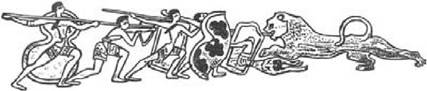 Figure 10 Design on the Lion Hunt Dagger
In the Theran Naval Festival Fresco, we can see the central, queenly figure of a priestess on a balcony with the sacral horns beside her. Below the town walls a procession of naked, uninitiated youths takes an animal to be sacrificed. Elsewhere there are men in kilts who, Marinatos (1984) believes, may be initiated young people of higher social rank; there are common towns-people in tunics, nobles in long robes and rustics in sheepskins. We do not need to believe that rural farm workers actually wore shaggy hide garments as they went about their work, or that boys normally went naked until their manhood initiation; the fresco artist was simply spelling out the concepts of social stratification and of social unification during the festival. Possibly the Theran artist was deliberately focusing on the appropriate dress for certain rituals. For instance, the priest in the harvest festival on the Harvesters Vase is wearing a symbolically bizarre garment; the boys stripped for their initiation rituals, such as boxing, tests of strength, and head-shaving. The girls had their own ritual which took place indoors, partly in a pier-and-door-partitioned room, partly in a sunken adyton. Possibly they had to draw blood, symbolizing the onset of menstruation. This is shown graphically by the wounded, bleeding girl sitting on a rock in Room 3 of Xeste 3 at Akrotiri; her blood sacrifice is shown again in a different way on the wall over the adyton, where sinister, blood-spattered sacral horns stand forbiddingly on top of a blood-spattered altar.
Individual and small-group initiations probably took place in the temples, where many small and medium-sized chambers were designed and equipped for specialized religious ceremonies. Mark Cameron (1987) made a paper reconstruction of the rooms, apparently on an upper floor of the Knossos Labyrinth, where the Sacred Communion (Camp Stool), Grandstand and Sacred Dance Frescoes were installed; the scale of these frescoes strongly implies that the chambers they decorated were small - perhaps 4 metres square - and therefore used by small groups of people. Both Mark Cameron and Nanno Marinatos (1984) have developed the very important idea that the decorative schemes sign the functions of whole suites of rooms, a crucial idea in establishing the function of the Knossos Labyrinth in particular as a major cult centre.
The mainly small-scale, private and intimate ceremonies of initiation undertaken in the temples enabled people to step as individuals and peer-groups from one social, spiritual and status class to another. The transition from childhood to adulthood was probably marked by a graded series of initiation rites. Gosta Saflund (1987) argues that the strong elements of an initiatory character detected in later Cretan society were probably a survival from the Minoan civilization. Possibly the image on the Chieftain Cup can be interpreted as a herd of boys - they seem to be covering themselves with animal hides - presenting themselves to an older, already-initiated youth on completion of their rite.
Strabo (x, 482) wrote of a later Cretan custom which may also have been a Minoan survival; Strabo himself said that it was ‘a tribal feature of great antiquity’. Youths promoted from the herd of boys were then obliged to marry. In other words, marriage too was a rite of passage controlled by the community. Saflund (1987) interprets the Sacred Dance Fresco as the culminating public festival in this initiation sequence, a pre-marriage rally of the promoted girls and boys; he argues, interestingly, that the ritual focus of the fresco is not missing, as received opinion has it, but inherent in the crowd of boys and girls itself. Cameron (1987) added the idea that the sacral knot was a marriage token. These are interesting speculations, but perhaps they read too much into the fragmentary fresco record.
The private, small-scale ceremonies took place within the framework of the larger, public ceremonies. In the Cretan towns, many of the private and public rites must have taken place at the great temples. The inner chambers and adyta of the temples were places where individual and small-group initiations and rites of passage were conducted. The Central and West Courts were places where the large public ceremonies took place. The Grandstand Fresco appears to show a crowd of spectators - Evans estimated 600 onlookers - gathered in the Central Court of the Knossos Labyrinth. The Sacred Dance Fresco appears from the design of the pavement to have been set in the West Court, either at Knossos or at a similarly designed temple. The temples were thus major foci, socially as well as spiritually.
Again and again, women are shown in dominant roles - in the Theran Naval Festival Fresco, and in the Knossos frescoes too. That priestesses were dominant in the temples cannot be doubted - the Grandstand and Sacred Dance Frescoes make their position very plain - and it is left for us to speculate on the possible role of women in society outside the temple. In state affairs, for instance, were women able to take their place as equals alongside men? Or perhaps even as their superiors? There is no hint in the tablets that women held important political positions, but we know that the picture they give is incomplete. The Klawiphoroi, the Key-bearers, were priestesses who may have held some secular position, but what that was and how important it was cannot be gauged. Nevertheless, it is tempting to see the powerless Wanax, with his mainly ceremonial role, living in the shadow of a Labyrinth run by powerful priestesses as an earthly parallel to the Minoan myth of a relatively insignificant male god, Velchanos, who was subordinate to a more powerful goddess.