
Minoan society grew out of a long period of indigenous cultural development. The neolithic levels under the Knossos Labyrinth are among the deepest in Europe, and contain the remains of many successive settlements. Those layers represent something approaching a 3,000-year-long neolithic preamble to the Minoan civilization. Then, shortly after 3000 bc, there was a rapid surge forwards into the bronze age. Traditionally, this is explained as a result of immigration - large numbers of new people arriving with new ideas - but now there is a tendency to explain change in terms of local native developments. There may have been small numbers of incomers to Crete at this time, as seems likely at all stages in Cretan prehistory, because of the island’s situation, but new ideas could have been introduced by social and cultural contact alone.
Ideas and goods arrived from the Cyclades and the practice of burying people in domed round tombs seems to have been imported from Anatolia (see Chapter 6). Sinclair Hood (1971, p. 49) likens Early Minoan Crete to America: with its fermenting mixture of ideas and traditions it was a prehistoric New World. Some of the Early Minoan II pottery (2600-2300 bc) is reminiscent of Syrian ware and the first Minoan seals, produced at this time, are also reminiscent of seals from Syria; these are pointers to trade with the Levant. The Pre-Temple Period of Minoan Crete gives us little evidence of its social and political life, but it is likely that society revolved mainly round the clan.
In 1930 bc, the Old Temple Period began with the building of the first huge labyrinth at Knossos. This was so distinctive a development that it is tempting to attribute it to invaders or migrants bringing in an exotic architectural idea from abroad. But there is no need to postulate invaders from Greece or Anatolia. The maze-like, multichambered temples - the so-called ‘palaces’ - had their native Cretan precursors. There was a cellular multi-room building, albeit much smaller, on the site of the Knossos Labyrinth itself, and a recognizable L-shaped predecessor for the temple plan, complete with central courtyard, was built at Vasiliki in 2600 bc. The big Minoan temples should be seen as resulting from a long period of indigenous development, increasing prosperity and increasingly centralized organization, in religion and in the economy.
The evidence of social and political development in the Old Temple Period (1930—1700 bc) is fragmentary, though it looks as if social classes based on rural or urban roles and divisions based on occupational specialization led to the development of a more stratified society than before. The bonds of the old clan system were beginning to loosen. The growth of towns at this time probably had much to do with the process, and we should see Minoan society developing towards something like the much later city-state system, although in Crete it looks as if the towns lived in relative harmony with each other.
Widespread physical damage brought the Old Temple Period to an end in 1700 bc. Both temple and city at Knossos suffered extensive damage, perhaps more than once. The temple at Phaistos was apparently damaged at the same time by an earthquake, then repaired, only to be destroyed by a catastrophic fire. The destruction at Phaistos was complete; the ruins of the old temple were levelled, the site was filled in and a new temple built on top of the rubble with a different plan. At Monastiraki, a small ‘palace’ or temple was destroyed by fire at the same time as Knossos and Phaistos. The destructions may not have occurred simultaneously all over Crete, and they may have been due to different causes: nevertheless, the Phaistos evidence apart, the effects of a large-scale earthquake seem sufficient to explain events.
Sinclair Hood (1971) believes that foreign settlers arrived in Crete in 1700 BC in the wake of the temple destructions. He rejects mainland Greeks in favour of Luvians from south-west Anatolia, a people with a language related to that of the Hittites further east. The Beycesultan palace, which may have been the headquarters of one of the Luvian rulers, could conceivably have served as a model for the New Temples on Crete, i.e. the temples built in and after 1700 bc. Arguing against this idea is the fact that the New Temples were very similar in concept and design to the Old Temples, so the use of Beycesultan as a model is unlikely. But arguing in support of a Luvian influx is the appearance of one of the Minoans’ distinctive forms of writing, the script known as Linear A. The later Linear B script has been interpreted as a primitive form of Greek. Linear A, which contributed some of its signs to Linear B, was nevertheless not Greek but some other language, yet to be identified. Leonard Palmer (1961) noticed a link between Linear A and the Luvian language, a link which may prove to be very significant. The last word in an inscription on an altar from the Diktaian Cave, using Michael Ventris’s values for the syllabic signs, reads ‘ja-sa-sa-ra’. This is fairly close to the Luvian title ‘Ashassarasmes’. In other Minoan Linear A examples, there is an extra suffix, ‘-me’, which brings the word form even closer to what we must assume was the Luvian original. Therefore, Palmer argues, the title guessed by Evans to be the name of the deity turns out to be the title of the Linear B goddess Potnia (‘Lady’) in the Luvian language, where it also means ‘Lady’. This certainly reinforces the general idea of significant cultural contact between the Minoans and the Arzawa Lands of south-west Anatolia during the Second Temple Period, though it does not necessarily mean that there was any large-scale immigration from Anatolia into Crete.
The rebuilding on a more lavish scale of the Knossos temple following the disaster was paralleled in Anatolia by the rebuilding of the war-devastated city of Hattusa by Tabarna, the Great King of the Hittites. It would be interesting to know whether diplomatic or trading relations existed between the Minoans and Hittites; both cultures were at their zenith at this time. In Egypt, the central power structure disintegrated as the Semitic Hyksos people invaded Egypt from the Near East. Some form of relationship was maintained between Hyksos Egypt and Minoan Crete: Hyksos artefacts have been found in the Knossos Labyrinth.
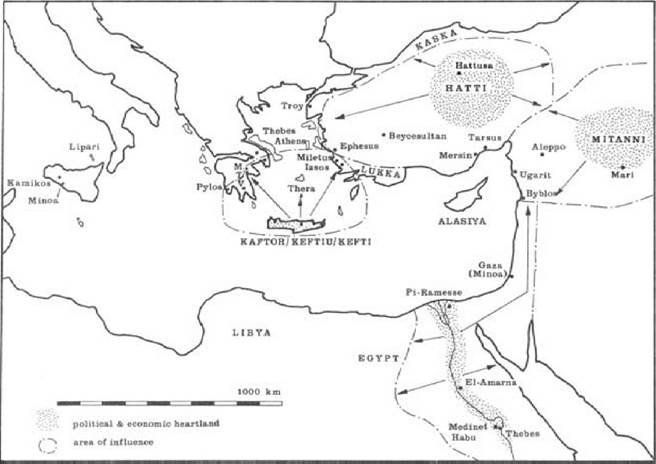
Figure 11 The Minoan world. The map shows the cultural heartlands of the Minoans and their neighbours in the middle of the second millennium BC (stippled), together with their areas of influence (arrows and dot-and-dash line). The Minoans’ activities were not confined to their ‘area of influence’ as defined on the map; there is archaeological evidence that they traded with Hatti, Mitanni and Egypt as well
The New Temple Period (1700-1470 bc) was to be the most exuberant phase of Minoan civilization, producing the most elaborate architecture, the finest frescoes and the most sophisticated and beautiful works of art. The population grew to a point where the island may actually have become overpopulated. The remedy then, as in later times, was to found overseas colonies (see Chapter 5). These colonies were established across the southern Aegean and some may even have been on the Greek mainland, which seems to have become strongly ‘ Minoanized’ at this time. There is every possibility that this process of Minoanization was mainly the result of consumer demand, because the Minoans were producing goods that were extremely attractive and of the highest quality. The legend of Theseus, the tribute-children and the Minotaur may suggest that there was a time, before the classical period, when Greek cities like Athens and Mycenae were tributary to Crete, but the legend may conceal a rather different folkmemory. It may have been a sore point with the classical Greeks that once there had been a time when they were culturally inferior to their neighbours on Crete; the Minoans’ cultural and therefore trading superiority may, to a proud race, have felt like political subjugation. It may have been this subjective and exaggerated view which found its way into the folklore.
There is more evidence of the Minoan social structure from the New Temple Period. Women emerged as dominant figures in ceremonial contexts, and society as a whole had become much more strongly stratified. Social classes were now more important than the clans as the towns came to dominate the organization of rural areas. The government may have been more or less theocratic, with priestesses and other religious officials occupying positions of importance. One peculiarity of Minoan society, even at this zenith stage, is that it shows no sign whatever of personal ambition. There are, in the archaeological record, no signs at all of boastful, self-aggrandizing rulers or viziers, which is a striking contrast to the situation that prevailed in contemporary Egypt or Anatolia.
The New Temple Period came to an abrupt end with the catastrophic Thera eruption of 1470 bc. The precise date is still a matter of controversy, but the most likely scenario is a long series of premonitory earthquakes and minor eruptions beginning in about 1500 BC and culminating in a caldera eruption of enormous violence in 1470 bc. Thera is 120 kilometres north of Crete, but maj or earthquakes with their epicentres on Thera would have caused significant damage to Knossos and other Minoan sites on Crete. The final eruption would have been experienced as a multiple disaster at the Minoan sites. The initial damage to walls and foundations by blast and earthquake was followed by a towering tsunami, or ‘tidal’ wave, which would have washed across the northern coastal lowlands, destroying the principal Minoan harbour towns of Katsamba, Amnisos, Agii Theodhori and possibly quays at Kytaiton, Kydonia and Mallia too. A link between the Thera eruption and events in Crete is very plausible; in ad 1650, volcanic activity on Thera was responsible for earthquakes and tsunamis in Crete, though on a much smaller scale than envisaged in the prehistoric eruption.
After the waters of the 1470 tsunami receded, a great cloud of white ash blown south-eastwards by the wind covered the whole of central and eastern Crete, blotting out the sun and then settling over the landscape; on the sea-bed 120 kilometres south-east of Thera it is still 78 centimetres thick. Knossos and Mallia were not directly downwind at the time of the eruption, but the ashfall there must have been 20-30 centimetres thick, and half that amount would have been enough to put the farmland out of production for several years and paralyse the Minoan economy.
The archaeological evidence is patchy, but the town of Palaikastro at the eastern end of Crete was apparently destroyed in about 1470 bc. Some houses were repaired, but others were so badly damaged that the new houses built on their ruined foundations had a completely different alignment. There is evidence of disaster at Zakro, Mochlos and Pseira, which were never rebuilt. Knossos was extensively damaged by earthquake in 1470 BC and also somewhat earlier, presumably in the long premonitory series of earthquakes.
The Thera eruption must have been an appalling experience for the Minoans. The massive earthquake, the blasting bull-roar of Thera exploding, the darkening skies, the tsunamis and the silent rain of white ash must have reduced them to terror and despair. The interruption to food production created an economic crisis. The unparalleled unleashing of the cosmic forces may have precipitated a religious crisis. The reduced importance of the peak sanctuaries in the period following the Thera eruption may reflect a loss of faith in the god Poseidon or in the ritual procedures designed to propitiate him.
There is evidence at Zakro of a large-scale ritual of appeasement in about 1470 bc; on a hill above the Minoan town a large deposit of Late Minoan I pottery was discovered in a votive pit. Similarly, at Niru Khani, in the large house or temple near the shore, a deposit of votive cups with pieces of volcanic pumice (apparently collected after the Thera eruption) was found secreted under the threshold of a shrine; possibly it was placed there as a re-foundation or reconsecration deposit after the building was repaired.
Some commentators, Sinclair Hood among them, place the Thera eruption earlier, towards the year 1500 bc, attributing the disastrous collapse of Minoan civilization several decades later to some other cause. It is nevertheless compatible with what we know of large-scale caldera eruptions to suppose that the Thera eruption was a long-drawn-out series of events beginning in 1500 and culminating in 1470; we therefore need not look for any external reasons for the serious weakening of the Minoan economy in the years immediately following 1470. Certainly there seems to have been a shift of cultural and political balances in the Aegean from this time on. Hood (1971, p. 58) sees war as the reason for the destruction and permanent abandonment of the eastern towns of Zakro, Pseira and Mochlos, but it seems reasonable to attribute these events to the Thera eruption.
After Thera, the Minoan economy was reconstructed, but it was not the same as before. Many sites were too badly damaged to rebuild. The Phaistos temple was reoccupied and a new residential building (sometimes called a Mycenean megaron) was raised at Agia Triadha. The Knossos Labyrinth was systematically repaired and redecorated and became the principal religious focus of Minoan Crete. The severe damage and the economic, political, and social crisis that followed directly from it accentuated a tendency towards centralization. Thera led directly to a focus on Knossos as a capital city, an administrative centre for the greater part of Crete, and a major cult centre.
Nicolas Platon (1968) and others believe that it was at this time that people from mainland Greece, often called ‘Myceneans’ for convenience, invaded a weakened and disoriented Crete, and succeeded in conquering it. It would have been relatively easy for them to do so at this time; we can imagine that a great many ships of the Minoan fleet, whether merchantmen or war galleys, were sunk either at sea or at anchor in the many harbours along the north coast; we can imagine also that the normal efficiency of Minoan bureaucracy and communications had broken down. Physically weakened by food shortages as well, the Minoans would have been easy prey to an envious neighbour who had been waiting for his opportunity to strike. Alternatively, Myceneans may have taken over peacefully at Knossos, perhaps as a result of a dynastic marriage between Cretan and mainland royal houses. Nevertheless, as I have argued elsewhere (1989, pp. 153-6), the case for a Mycenean take-over in Crete in 1470 has not been conclusively developed. It is an open question still, and we should not assume that Mycenean invaders were in control at Knossos as early as 1470.
The period which followed, the Late Temple Period (1470-1380 bc), was one of partial recovery, but to a rather formal, highly centralized and bureaucratic system with Knossos as the leading city of Crete. Later in Crete’s history, Knossos was to become the leading city again; the recorded chronicle of the classical period opens with the capture of the hill-top city of Lyttos by the Knossian army in 343 bc: in 250 bc, after a long power struggle, Knossos once again dominated the whole of Crete. In the Late Temple Period, many of the artistic influences seem to be Mycenean, and the implication is that the mainland culture had become the dominant one, even though it was still Cretan artists who executed much of the finest artwork and metalwork, on mainland sites as well as on Crete. The adoption of Linear B Greek as the scribal language has been taken by many as proof that the Greeks controlled Crete, but it may be that this reflects a preference for Greek as the Aegean lingua franca, the language of officialdom, administration and trade: it does not prove that Greeks ruled at Knossos.
1380 BC was a maj or turning-point for Minoan civilization. It was the date when the Knossos Labyrinth was devastated by fire and abandoned, never to be rebuilt, never to be repaired, never to be fully reoccupied. The fire may have been the result of an accident - perhaps an overturned hearth or lamp - but if so the temple would surely have been rebuilt, as it was after the 1700 and 1470 destructions. The 1380 fire seems to have been a deliberate act of arson. In fact this may have been the time when the Myceneans invaded. The so-called Palace of Kadmos at Thebes was sacked at the same time as the Knossos Labyrinth; we may see both as part of a process of expansion and domination by which thirteenth-century Mycenae appears to have become the capital of an empire extending across most of the Aegean.
There was no sign at Knossos that the fire had been associated with an earthquake - no heavy blocks of masonry were displaced, for instance, as they were in earlier destructions - so some human agency is likely to have been to blame. If not Mycenean soldiers - the likeliest scapegoats - then who else? As suggested earlier, Minoan Crete evolved towards a cellular structure of separate but closely harmonized city-states. It is quite possible that rivalries and disputes developed between them and it may well be that Knossos was sacked by some envious neighbour, perhaps even the people of Kydonia. Another possibility is that the city-states of the New Temple Period which had been assimilated into the greatly expanded Knossos territory of the Late Temple Period resented the hegemony of Knossos. It may be that the people of Phaistos and Mallia, for example, were discontented with their lot and rose up against Knossos. The New Temple phase, with five or more separate temple centres, was a period of relative autonomy; the Late Temple phase had become unacceptably over-centralized to the point of provoking insurrection. Invasion, war, or revolution? The evidence is very inconclusive as yet, so we must leave this, like so many other major ‘historic’ events in the prehistoric period, as an open question.
The three hundred years which followed the abandonment of the Knossos Labyrinth, the Post-Temple Period (1380-1100 bc), are among the least known of Minoan prehistory. There was a shift of emphasis, with many of the new settlements located inland and some of the old settlements abandoned. It was as if, with the rise of the Mycenean trading empire, the Minoans started to turn away from the sea, narrowing their horizons to the shores of their own island. At the same time the culture flourished, though without the large and spectacular range of artefacts produced in the great days of the temples. Homer tells us that King Idomeneus of Crete sent a fleet of 80 ships to join those of Nestor king of Pylos and Agamemnon king of Mycenae at the siege of Troy, which may have happened towards 1250 BC. This was an unsettled time in the Aegean when, it is believed, waves of Central European peoples invaded mainland Greece, threatening and destroying some of the established Mycenean centres.
Around 1200 BC many Minoan sites were burnt and abandoned. There were many changes, apparently produced by the arrival of refugees from Mycenae and the other mainland cities, which were invaded at this time. The Cretan culture continued to have some recognizably Minoan traits - the potters, for instance, continued to make bell-shaped idols of the goddesses with their hands upraised - but there were many changes under way as a result of repeated contacts with other cultures. It was a complex and gradual evolution away from the Minoan civilization of the temple periods and towards a more purely Greek culture. The Odyssey, written down in the eighth century BC, speaks with plausible accuracy of a Crete populated by several peoples speaking several languages. ‘There, one language mingles with another. In it are Achaeans, great-hearted native Eteocretans, Kydonians and Dorians in three tribes and noble Pelasgians. ’
The Pelasgians were a mysterious people, thought to have originated on the far shores of the Black Sea, filtering west and southwards into the Aegean. There is little archaeological evidence of them on Crete. Willetts (1969) says that ‘Larisa’ was one of their characteristic place-names. According to Strabo, Cretan Larisa was absorbed by Hierapytna (modern Ierapetra) and there was a tradition that Gortyn too had once been called Larisa; these may give us clues to the parts of Crete where the Pelasgians settled, although it is not known when they arrived or in what numbers.
Strabo, in his commentary on the above-quoted passage of Homer, says that it is reasonable to assume from other sources that the Eteocretans and Kydonians were native to Crete and the Dorians incomers. The Dorians occupied, amongst other areas, the extreme east of the island, east of the town of Praisos. The Praisians, with their temple of Diktaian Zeus and their ancient cults, were clearly native Cretans who had close connections with the old Minoan culture. They somehow kept their ancient and distinct language alive until the third century bc. Several inscriptions in this ‘Eteocretan’ language have survived, written using letters of the Greek alphabet; if these can be deciphered, we may gain access to at least one of the non-Greek ancient languages once spoken on Crete. Of the Achaeans, of course, much more is known. The Achaeans were the Myceneans - whether conquerors, settlers, or refugees.
The three tribes of Dorians were the people who came to Crete right at the end of the bronze age and, in effect, brought the Minoan period to its close. It was in about 1200 or 1150 BC that Hellenic tribes from the north-west (Dorians, Aetolians, Phocians, and Locrians), tribes who had until now stayed outside the Minoan-Mycenean sphere, surged south into Greece. Mycenae and Tiryns fell; Pylos had fallen already; a little later, the Dorians who had occupied the Peloponnese may have sailed to Crete to bring the now-decaying Cretan civilization to an end. According to Ivor Nixon (1968), the Dorian occupation of Crete may have come about in a different and more complex way, with a migration eastwards through Thrace into Phrygia, then southwards into Lydia and Caria in Anatolia before returning westwards by way of Rhodes and Crete to attack the Peloponnese from the sea. The final push through the south Aegean happened, Nixon believes, after an abortive attack on Egypt, the invasions by the ‘Peoples of the Sea’ recorded by the Egyptians in about 1190 bc. There is a tradition that the Philistines originated as Cretans; the Book of Jeremiah (47:4) says, ‘for the Lord will spoil the Philistines, the remnant of the country of Caphtor. ’ Caphtor was Crete. There is a close resemblance between Philistine pottery and that of Late Helladic IIIC pottery from Argolis and Attica, too. It is possible that a Cretan contingent joined the ‘Peoples of the Sea’ confederation to destroy the Hittite empire and invade Egypt. The Egyptians list the Philistines, as ‘Pulesati’, among the invaders. Defeated and falling back to the north in disarray, remnants of the Sea Peoples may well have resettled in south-west Palestine.
On Crete itself, only a few stragglers managed to keep the Minoan way of life going, and then only in remote mountain refuges such as Karfi, high up in Lasithi, only in a decadent form, and only for a short time. A dark, barbaric period enveloped the close of the Minoan age as a new culture slowly crystallized out of the long struggle for supremacy, the severe and martial civilization of the Dorian cities. Ovid writes of the Minoan age as a time lost in legend, full of wisdom and wealth, fantasy and romance, but he also infers a period of fear and waning power towards the end: ‘When Minos was in his prime, his very name had terrified great nations: but now he was weak and very much afraid of Miletus, the son of Deione and Apollo, for the latter was young and strong’ (Metamorphoses, 9).