
Chapter 13
The Romans saw themselves as a peasant people, and were proud of their rural origins. Agricultural literature, which flourished from the second century BC to the first century AD, and which propagated ties to the soil, was at the same time aimed at increasing production and profit. Agriculture was not only the basis of livelihood, but also of wealth, which was primarily manifested in landholding (Plin. epist. 3.19, 6.19).
Economic interests were also a factor in the expansion of the Roman Empire, which began to take over the entire Mediterranean region after the middle of the third century BC. Rome profited from the taxes of the provinces, and took over their landscapes, first by land surveying and parcelling, then also by intensified construction. North Africa supplied olives and cereals; Spain, wine and oil; Sicily and Egypt, cereals – the latter probably yielding two harvests a year. Under Augustus, 20 million modii – approximately 150,000 tons – of cereals were delivered to Rome each year (Aur. Vict. epit. Caes. 1.6). Despite these imports, however, scarcities were never impossible in the capital, so that Italic agriculture continued to be of great importance, despite a number of setbacks.1
Agriculture in Italy was very diverse. Farmed fields with crop rotation predominated (Varr. rust. 1.44.1–2; Verg. georg. 1.73ff.; Plin. nat. 18.49ff.); to some extent, the Romans had already initiated the later three-field system, although two-field rotation was still the most common method. A year of cultivation would hence be followed by a year lying fallow, during which time the field could be used by cattle for pasture. Various cereals and types of vegetable could be grown alternately. Use of fertiliser made more regular use possible, so that fallow years could be avoided. Animal dung, compost and ash were the available fertilisers (Varr. rust. 1.38.1ff.; Plin. nat. 17.42ff., 18.192ff.). According to Columella (2.1.1ff.) in the first century AD, soils should not age if fertilisers were used. If no fertiliser was used, half the fields were left unfarmed every other year, and had to be ploughed fairly often during this time (Verg. georg. 1.71–2; Colum. 2.9.15; Plin. nat. 18.176–7). Vergil, who recommended crop rotation and the use of fallow fields and of fertilisers, also mentioned burning off fields. At the same time, he connected human dominion over the earth, which he conveyed, with a respect for the divine (georg. 1.96ff.). The fact that overexploitation led to leaching out of the soils – the quality of which could be distinguished – had been recognised in principle (Colum. 1 praef. 1ff.).
Agriculture first of all served to provide the personal subsistence of the peasants, who moreover also depended on sales in the nearest town (Cat. agr. 7.1; Varr. rust. 1.16.3) or on exports further afield. Viniculture was the most profitable type of farming. Olives were also productive, and less work-intensive than cereals. Besides that, fruit and vegetables were raised, and bee-keeping and silviculture pursued; the woods could also be used for pig raising (Varr. rust. 2.4.20).2 The main animals were sheep, poultry and cattle. Goats too were common, but in the immediate surroundings of farmsteads they could destroy gardens and kill young trees (Verg. georg. 2.196; Plin. nat. 8.204). Nevertheless, animal husbandry was described as generally the most lucrative rural pursuit (Varr.rust. 2.1.11). In addition to pasturing, there were also various forms of transhumance, which had become established primarily in southern Italy since the second century BC. Varro kept his cattle herds in the Reatine Mountains in summer, and in Apulia in winter (Varr. rust. 2.2.9). Such migratory grazing practices remained common into late antiquity, but were never dominant.3
During the Second Punic War (218–201 BC) large areas of southern Italy had been devastated. These were then confiscated as Roman state land (ager publicus), and allocated for farming. At the same time the Roman conquests of the second century BCmeant an increased burden for the peasants and citizens, who had to absent themselves from their fields for overseas wars for long periods of time. Moreover, cheap cereals from the overseas provinces increasingly came onto the market. This made reorientation towards wine and olive production necessary, and also to pasturing, all of which required greater expense and effort, although that did not generally diminish the areas used for cereal cultivation.4 At the same time, the emergence of large estates was favoured; these were able to turn forest and grazing areas into farmland in areas distant from the coasts.
In this situation the tribunes Tiberius and Gaius Gracchus (in office 133 and 123/2 BC, respectively) proposed a reapportionment of the state land (ager publicus), according to which needy peasants were apparently to receive farms (Plut. Tib. Gracch. 8; App.civ. 1.7ff.) of up to 30 iugera (8 ha) (CIL I2 585, line 14). Although this was only a low average size, implementation of the land reform was largely blocked by the ruling classes.5 Vineyards and olive groves of 100–500 iugera spread in Latium and Campania.6 An ideal estate would be approximately 200–300 iugera (50–80 ha) in size, while the ever larger estates could cover as much as 90 sq. km; Pliny the Younger (AD 61/2–c. 114) was said to have owned a total of 35,000 iugera.7
M. Porcius Cato (234–149 BC), who wrote a work called On Agriculture, considered an estate with its accompanying buildings, equipment, plantations, cattle and staff as the greatest of possessions. A farmer should never buy rashly, and always consider all factors (agr. praef. 1.1ff.). His goal should be to pass on to his descendants more purchased than inherited land (Colum. 1 praef. 7, 10). The management of the estate was essentially carried out as follows. For his estate in Campania, which consisted of a number of separate parts, Cato had various administrators to whom he issued instructions. The operation was oriented towards the market and the money economy, and employed both craftsmen and day labourers. The estate contained various acreages: first, an olive plantation of 240 acres (c. 60 ha) with 5,000 trees, which yielded 30,000 bushels of olives, with an administrator (vilicus) and 11 slaves; second, a wine-growing estate of 100 acres (25 ha), with wine- and olive presses, as well as a granary with a threshing floor, run by another administrator and 16 slaves; between these facilities lay fertilised land with fodder grasses, where sheep and draught oxen were held between the harvest and the sowing, as well as in winter; third, there were the fields of cereals, cultivated by tenants; fourth, there was pastureland with grass and oak-woods, which was used for pasturing the herds of others in winter, part of which was located on state land.8
In Italy there were different basic types of estates (villae rusticae), with a residential house around which stables, lofts, storehouses and workshops were grouped. Often, the residential and work buildings were arranged around three sides of a peristyle court.9Columella, writing about agricultural operations in the first century AD, distinguished between the manor house (villa urbana), the work area with the farm labourers’ house (villa rustica), and the storage area, with crop storerooms (fructuaria). He recommended halfway up a hill as the site of the farmstead; villages had been built at such locations since the Neolithic period:
But as the nature of the farm and the method of its cultivation is a matter of importance, even so is the construction of the farmstead and the convenience of its arrangement … As to the qualities of a building site, I shall now speak in general terms. As a building which is begun should be situated in a healthful region, so too in the most healthful part of the region … Let there be sought, then, an atmosphere free from excesses of heat and cold; this is usually maintained halfway up a hill, because, not being in a hollow, it is not numbed with winter's frosts or baked with steaming heat in summer, and, not being perched on the top of a mountain, it is not fretted at every season of the year with every little breeze or rain. The best situation, then, is halfway up a slope, but on a little eminence, so that when a torrent formed by the rains at the summit pours around it the foundations will not be torn away.
(Colum. 1.4.6ff.; Loeb)
However, the term villa rustica also described the actual farming operation in a comprehensive sense. This form of operation was commonly adopted in the provinces, so that it also appeared north of the Alps. Here, we encounter villas modelled after the Italicvillae urbanae, but embodying a whole class of buildings outside the townships, located in the midst of the farmland. They had an enclosed courtyard area with a work section (pars rustica), run by an administrator (vilicus) and separated by a wall from the manor (pars urbana): see Fig. 12. Such a complex represented a whole economic and production centre, which, along with staff quarters and stables, also included workshops (brickworks, pottery, iron smelting). The villas themselves were in a Mediterranean style, patterned after the Italic villae urbanae. They often had a raised, richly furnished and elongated manor house with a columned hall in front and corner risalites (projecting building sections). Moreover, the heatable dwelling was equipped with bathing facilities, terraces, gardens and decorative water basins.
Fig. 12 Reconstruction drawing of a villa rustica in south-western Germany.
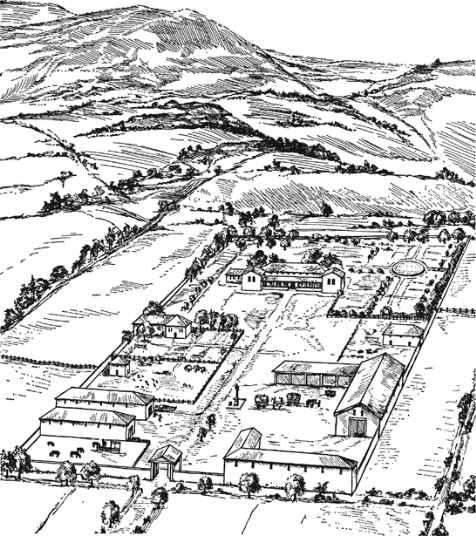
Cereal cultivation (wheat, spelt, barley) was central for agriculture in the provinces; it was accompanied by the growing of fruit and vegetables and by cattle pasturing. For the northern and eastern provinces, cattle were the predominant domesticated animals, and were accordingly bred further. In many areas of the empire, exogenous animals and plants were also introduced. In addition to the very common grapes and wheat, vegetables such as celery and red beets appeared in many places, as did orchards with apples, pears, cherries, plums and nuts – as has been ascertained in various areas, such as Switzerland and England.10
The acreages were considerable, and amounted to approximately 50–100 ha, or even 200 ha in the case of one villa in south-western Germany.11 Since a team of oxen could plough only approximately 0.25 ha (1 iugerum: Plin. nat. 18.9) a day, considerable investment in cattle had to be made. The villas were accordingly often located at the transition between damp pastures or remnants of forests in the lowlands and the dry fields in the hills. Much wood was needed for the rural operations and their maintenance, which was obtained by clearing the surrounding oak forests. Valuable humus was washed from the cleared grounds into the river valleys, which resulted in increased flooding and the creation of new damp meadows.12 The villas thus contributed significantly to the change in the landscape.
Towards the end of the third century AD, the sizes of large-scale farms increased in the Roman Empire once again. Large estates were managed mainly by leasing to small farmers (coloni). Thus, the colonate was increasingly transformed into a permanent, hereditary leasehold. These ties to the land served on the one hand to guarantee the tenants economic security and thus to avoid flight from the land. On the other, their purpose was to guarantee regular tax yields. Moreover, the coloni were often more profitable than slaves, whose numbers declined. At the same time, the institution of the patrocinium was increasingly common: for protection against tax agents, peasants turned to influential officials or landlords, who in return collected rents in cash or in kind. Peasants sometimes also surrendered their land to large landowners to escape from debts or taxes.13 Nevertheless, both free small peasant holdings and the slave economy remained in place to late antiquity. Owing to a labour shortage, however, fields were increasingly neglected and settlements abandoned, so that they were in many cases reconquered by nature.
1 Lepelley 1998, 36ff., 52ff.
2 Nenninger 2001, 41–2.
3 Flach 1990, 146, 303.
4 Jongmann 2003.
5 Molthagen 1973.
6 Dohr 1965, 151–2.
7 White 1970, 406; Pekáry 1979, 88.
8 Gummerus 1906, 15ff.; Schönberger 1980, 402–3.
9 Flach 1990, 215ff.
10 Flutsch et al. 2002, 34; cf. Chapter 22, n. 7, below.
11 Drexhage et al. 2002, 75.
12 Kuhnen and Riemer 1994, 79ff.
13 Pekáry 1979, 127–8.