
Chapter 14
The relationship of the Romans to the forest reflected their basic view of nature. On the one hand, the forest was a dark and dismal place, the haunt of wild animals and the questionable gods who held sway there (Plin. nat. 12.3; Sen. epist. 4.41.3). Silvanus, Pan/Faunus and the fauns reduced people to terror with their weird voices. The Romans often used adjectives such as ferus (wild), foedus (horrible), horridus, obscurus or occultus to describe the forests.1 The historian Tacitus (c. AD 55–120) described Germany as a country of terrible forests and dismal swamps (Germ. 5.1). The forests were seen as the primeval starting point of human life (Vitr. 2.1.1), and as the habitat of barbarians who were at a low stage of civilisation (Lucr. 5.948ff.). The forests were moreover a strategic challenge, particularly in Gaul, Germany and Britain, since the enemy there could withdraw into them and lay ambushes, as was done in the battle of Teutoburg Forest in AD 9. Hence, military advances into these areas necessarily involved the massive felling of trees (Caes. Gall. 3.28–9; Lucan. 3.394ff.).
On the other hand, the forest was a piece of nature's beauty (locus amoenus), a pleasant place to linger under shady trees. This could involve the public forest (silva), a protected grove (lucus) or, in particular, a private piece of woodland belonging to an estate (nemus). Here the forest might serve for relaxation and conversation during the hunt (Hor. epist. 1.4.4–5; Plin. epist. 1.6.2, 2.8.1, 5.6.7–8).
Pliny the Elder writes in his natural history (12.1–5):
The riches of earth's bounty were for a long time hidden, and the trees and forests were supposed to be the supreme gift bestowed by her on man. These first provided him with food, their foliage carpeted his cave and their bark served him for raiment; there are still races which practise this mode of life. This inspires us with ever greater and greater wonder that starting from these beginnings man has come to quarry the mountains for marbles, to go as far as China for raiment, and to explore the depths of the Red Sea for the pearl and the bowels of the earth for the emerald … Once upon a time trees were the temples of the deities, and in conformity with primitive ritual, simple country places even now dedicate a tree of exceptional height to a god; nor do we pay greater worship to images shining with gold and ivory than to the forests and to the very silences that they contain. The different kinds of trees are kept perpetually dedicated to their own divinities, for instance, the chestnut-oak to Jove, the bay to Apollo, the olive to Minerva, the myrtle to Venus, the poplar to Hercules; nay, more, we also believe that the Silvani and Fauns and various kinds of goddesses are, as it were, assigned to the forests from heaven, and as their own special divinities … We use a tree to furrow the seas and to bring the lands nearer together, we use a tree for building houses.
(Loeb)
Like Pliny (nat. 31.53), other authors too recognised that clear-cutting could lead to flooding. Vergil (georg. 1.481–3; Aen. 2.305–7) and Lucan (2.409–10) mention the raging Po and write of farmland washed away; Horace speaks of uprooted trees (carm. 3.29.33–41), and Ovid, of torrential brooks which threaten farmsteads (met. 8.552–5); Lucretius mentions forest fires caused by clearing, hunting, warfare and lightning (5.1241ff.) – though he describes it as progress when wild forests and groves in higher locations give way to cultivated trees (5.1370ff.). The geographer Strabo too (c. 64/3 BC to AD 23/6) still considered clearings to be an achievement of civilisation, along with mining (14.6.5).
Even if no further-reaching measures for the protection of forests are apparent here, wood was not simply freely available. Certain forests were indeed protected, because of various property rights and strategic considerations, for example in Macedonia (Liv. 45.29.14) and in Lebanon (CIL III 180; IGLSyr 5056, 5070, 5086). Moreover, reafforestation was already being carried out at an early date – for economic reasons (Theophr. hist. plant. 2.2.2ff.; Varr. rust. 1.6.5), to safeguard precious wood resources and economically valuable space in particular areas. Finally, the forests were an essential element of agriculture, and served as forest pastures; oak-woods in particular were used for pig raising (Varr. rust. 2.4.20). Moreover, the trees were the main source of wood (Plin.nat. 16.62) for construction and fuel, and for shipbuilding.
Although much wood for shipbuilding was available in Italy and Corsica (Theophr. hist. plant. 4.5.5, 5.8.13), timber, including pine, cypress and cedar from the Black Sea area and the Caucasus, had been imported since the late republican period (Verg.georg. 2.440–5; Hor. carm. 1.14.11–12). When Rome built its first navy during the First Punic War (264–241 BC), oaks and firs were transported on the Tiber from Etruria, Umbria and Latium for this purpose. The extensive recently conquered Sila Forest in Bruttium in Lucania (modern Basilicata in southern Italy) also provided much wood for shipbuilding and house construction (Dion. Hal. 20.15). The Romans also transported tree trunks by river to Rome from the thickly wooded area of Tyrrhenia in Etruria (Strab. 5.2.5).
The timber industry of course made clearing necessary, which in some places both impaired the appearance of the landscape and changed the soil. In the area around Rome, the deposited sediments increased tenfold as a result of new farmland being opened up in the second century BC.2 As mentioned above, increased sediment deposits in the river beds near the Gulf of Taranto in Lucania have been ascertained for the Graeco-Roman period.3 This intensified land and forest utilisation was ultimately also apparent in the provinces.
In Germany, forest cover consisted for the most part of mixed oak and beech deciduous forests, which were felled periodically throughout the period from 600 BC to AD 400. At Auerberg Mountain near Bernbeuren in the Allgäu region of southern Germany, it has been shown that in certain areas the Romans specifically felled firs,4 which were otherwise found largely in areas outside the limes (Fig. 11); apparently this political boundary generally coincided with the natural boundary between deciduous and coniferous forests.5 Württemberg in south-western Germany provides a particularly evident example of how clearing and forest pasturing over-exploited the forests.
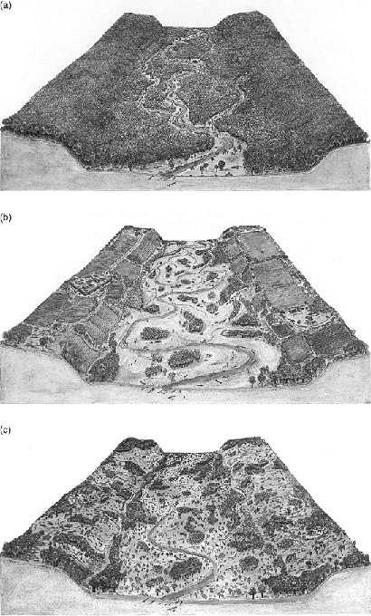
Using the growth rings of trees, it is possible to determine when they were felled. Such dendrochronological dating of floodplain oaks uprooted by the raging water and embedded in river gravel documents increased flooding for the Main–Danube area during the period from the first to the third centuries AD; it declined again during the fourth and fifth centuries. Tree pollen was reduced considerably by comparison with non-tree pollen (from grasses and herbs), which shows that forest areas had been reduced by comparison with cultivated areas. Oaks and firs could not regenerate fast enough, because of their long growth periods. The result was a thinning of the forests, and a general reduction in their area. This accelerated the surface run-off of the water, so that the topsoil of the fields was washed away and deposited in the river valleys as floodplain loam sediment. Flood beds and damp biotopes spread in the valleys. River courses shifted and valley floors were widened. Hillside sites, which were preferred for villae rusticae, were abandoned to erosion and achieved lower yields. However, with the decline in the Roman settlement in the fourth century AD, new floodplain forests grew back, and flooding became less common. The forest was able to recover despite the overexploitation, but the appearance of the landscape had changed inasmuch as the oaks had largely disappeared (Fig. 13).6
Fig. 13 Changes in wooded valley meadows due to Roman settlement in south-western Germany (pre-Roman times; Roman period; era of the Great Migration).
1 Nenninger 2001, 30–1.
2 Judson 1968.
3 Brückner 1986; cf. Chapter 1, n. 11, above.
4 Küster 1994.
5 Nenninger 2001, 102–3, 204.
6 B. Becker, ‘Raubbau am Wald’, in Kuhnen 1992, 36ff., 71ff.