
Chapter 15
The Romans had gardens in various forms, both in the cities and in the countryside. They are known to us primarily from Pompeii and Herculaneum near Naples, the cities destroyed in AD 79 by the eruption of Mount Vesuvius, where the volcanic material covered and preserved extensive finds. In Rome itself they are attested for the middle of the fifth century BC, inasmuch as the Law of the Twelve Tables made provision for the boundaries of neighbouring properties (Tab. 7.2): an olive or fig tree might be planted no nearer than 9 feet from the property line, and other trees no nearer than 5 feet (cf. Tab. 7.9a/b and 10; Plin. nat. 16.15). The garden formed a central economic base so that, at that time, a farmstead near Rome was not yet called a villa, but rather a hortus(garden) (Plin. nat. 19.50).
The kitchen and vegetable garden was the oldest form of Roman garden. It is attested since the fourth and third centuries BC, and was widespread in Pompeii up to the second century BC. In private homes one passed through the tablinum (picture room) of the atrium into a small vegetable garden (hortus). The garden was thus in the back part of the lot, and grew not only vegetables, but also fruit trees and some vines, as in the House of the Surgeon or the House of Sallust. Even smaller houses had at least a corner for herbs and flowers, which shows the general desire for green space. The peristyle garden had its origins in the peristyles (arcades) of Greek houses, which the Romans adopted in the late second century BC, and greened by means of artificial irrigation (House of Sallust, House of the Vettii, House of Polybius). These gardens were now no longer only kitchen gardens, but also decorative and pleasure gardens, for which the plural word horti was common, even if the Romans did not make the distinction until the height of the imperial era. If one or several porticos (columned halls or arcades) enclosed the garden, it was called a xystus, which often extended as a terrace in front of the longitudinal facade of a country house.1 The walled garden was called a viridarium (pleasure garden or park).
The Romans generally built deep, long gardens edged in by three walls. In the centre or on the main axis, there was often a fountain, basin, channel or pathway. The so-called House of Loreius Tiburtinus (in fact D. Octavius Quartio) in Pompeii has a central axis with nested frame motifs in the form of pavilion elements and pergolas, and a euripus – a lengthy irrigation channel (Figs. 14 and 15) – so that the view from the private chambers into the garden was directed by architectural aesthetics. In addition, the garden was furnished with sculptures, vases, garden furniture and fences of wickerwork between the beds. Often the landscape was continued as a painting at the rear of the garden, or inside the house, with garden and animal paintings. In the garden itself a tricliniummightalso be built under arbours (Casa del Bracciale d'Oro). Thus did the garden also serve as a venue for cultured conversation and social representation.
Fig. 14 House and garden of Loreius Tiburtinus in Pompeii.
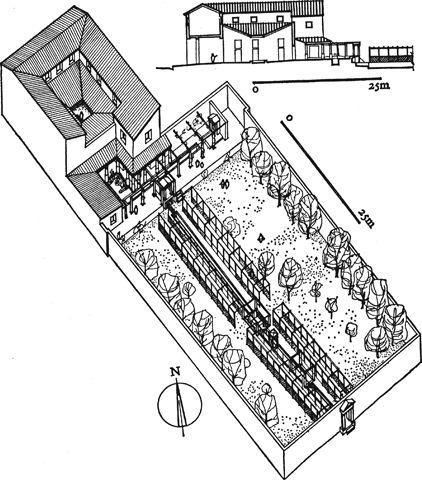
Fig. 15 House and garden of Loreius Tiburtinus in Pompeii.
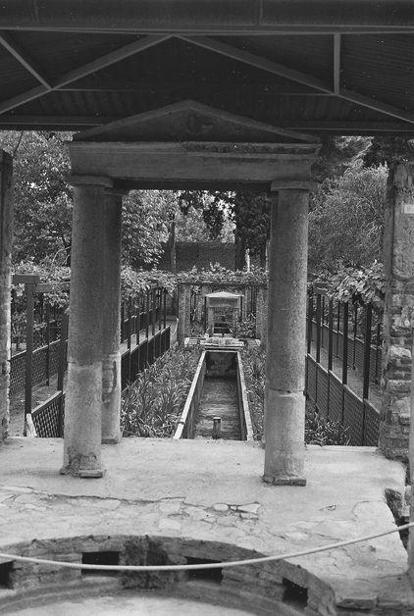
The Romans developed a rich and significant art of garden landscaping. The profession of garden landscaper (topiarius) is attested from the first century BC (Cic. ad Q. fr. 3.1.5: 54 BC; Plin. nat. 12.22). According to Pliny the Elder (nat. 12.13), the Roman C. Matius invented the art of clipping shrubbery during Augustus' reign. Moreover, gardens provided ever new inspiration for painters and poets. If Martial (first century AD) dreamed of the garden in the city (epigr. 12.57: rus in urbe), he thus projected nature into the city in verse form.
Horticulture was an important branch of agriculture in antiquity, and an element of self-sufficiency. The garden was described as ‘the peasant's second side of bacon’ (Cic. Cato 16.56). It provided an important contribution to the diet, and thus supplemented the cultivation of fields growing the staple food, cereals. Wine and olive oil, which were basic foodstuffs too, were also produced here, particularly in city gardens. Cato (agr. 9) in the second century BC mentions suburban gardens with fruit trees, grapes and olives; apples and pears were later joined by cherries, which were imported from the Black Sea in 74 BC (Plin. nat. 15.102), along with apricots from Armenia and peaches from Persia. Figs, too, were of great importance (Cat. agr. 10), and were cultivated in many varieties. Thus a great variety of exotic plants found their way into the gardens, along with the native plants.
Pliny the Elder starts his work on botany (Natural History, books 12–17) with a discussion of trees, distinguishing ‘exotic trees’ (12–13), ‘fruit trees’ (14–15), ‘forest trees’ (16) and ‘cultivated trees’ (17); book 18 then covers agriculture; book 19, garden plants; and books 20 to 27, medical remedies from plants. In book 19.51 the garden is described as the ‘farm of the poor man’, from which the people obtained its sustenance. Columella too, in books 10 and 11.3 of his treatise on agriculture, De Rustica, discusses horticulture in some detail. Pliny saw such vegetables as cabbage, lettuce, onions, cress, leeks, cucumbers, carrots and radishes, which could be eaten raw or preserved, as important for the food supply (nat. 19.57ff.). Other garden plants mentioned in the sources, and whose remains have been found in Pompeii, include many evergreens: ivy, boxwood, laurel, myrtle, cypress, acanthus, dwarf plantains, rosemary and oleander, as well as flowers – lilies, roses, chrysanthemums and violets – which brought some colour into the garden, but generally had a rather subordinate role; they are also shown on the fresco with the garden scene in the Casa del Bracciale d'Oro. The use of the plants is multifaceted, as Pliny points out. Plant finds have revealed culinary, medical and ornamental species: laurel and ivy served for wreaths, and oleander both for ornamentation and against snakebites.
Archaeobotanical finds (root holes, pollen, seeds etc.) attest to a mixture of trees, vines and vegetables for the gardens of Pompeii, where trees and vines could serve as shading. The House of Polybius had fig trees, fruit trees, an olive tree with a ladder, and rows of trees and hazelnut bushes along the garden wall. The house with the ship Europa had a commercially used fruit and vegetable garden with beds and pathways; 416 root holes and 28 clay jugs along the wall have been certified, together with vines, field beans, hazelnuts and figs. In the garden of the caupona (inn) of Euxinus, near the amphitheatre, there were 2 trees, 32 vines and a roofed triclinium, where the wine of the house was apparently also served.2
In Rome itself there were some seventy city and villa parks, in addition to the house gardens.3 Luxury villas (domus) contained the largest green spaces in the city, even if they were located mainly at the outskirts or in the surrounding hills (see Fig. 22below). The preference for luxurious estates in Rome apparently began in the first century BC with Lucullus and Pompey, the victors over the Hellenistic rulers of the east, and was continued by many such personalities as Sallust, Caesar, Maecenas and so on. Since the Roman gardens and parks were in private hands, they were accessible to the public only to a limited extent, for example, when rich patrons opened them up for their clients, or sponsored the establishment of such a park for the public (Porticus Pompeiana: Mart.epigr. 2.14.10). Caesar and Agrippa, Augustus’ son-in-law, friend and army commander, bequeathed their gardens to the people in their wills (Suet. Iul. 83; Dio 44.35.3, 54.29.4). Occasionally, Roman emperors and empresses took over private gardens and put up buildings in them for public entertainment, such as thermal springs or the so-called Naumachia on the right bank of the Tiber, a water basin designed for the performance of naval battles (Suet. Aug. 43). The imperial palaces and villas also had splendid gardens, both in Rome itself (the Domus Augustana with its hippodrome on the Palatine) and in Tivoli (the Villa Hadriana, early second century AD).
All in all, the gardens thus constituted an important contribution to the Roman food supply, and to recreation in the midst of the urban hustle and bustle. The parks and gardens brought a piece of nature into the city; city houses were equipped with gardens as a substitute for nature. Nero's Domus Aurea was the pinnacle in this respect: in the middle of Rome, it was patterned after a country or lakeside villa with a garden and a water facility, but it also drew criticism (Tac. ann. 15.42). And as we will see, these rural villas of the upper class, which obstructed lake shores and riverbanks in Italy with their gardens and parks, also became the target of a critique of opulence.
1 Gieré 1986, 107ff., 284ff.
2 Jashemski 1979, 172ff., 233ff.; 1998.
3 Grimal 1969, 107ff.; Frass 2006, 428ff.