
Chapter 17
The Romans had terms for breakfast, lunch and supper – ientaculum,prandium and cena – the first two of which were seen as only minor meals and were mainly eaten cold. In the morning, water with bread and cheese, and sometimes also eggs, olives, capers or milk and honey, would be taken. The midday meal too might be limited to a piece of bread with cheese or cold or smoked meat, vegetables and fruit, with water or wine as the main drink. The main meal was the evening cena, which was often celebrated in grand style by the upper classes, and to which its members invited one another. The wealthy had a room in their houses especially for this purpose, the triclinium, where men and women dined in recline, while the children sat. The order of the three slightly rising couch beds, each for three persons, was graded hierarchically; attendants served the meal.1
A complete cena included three parts. The appetiser (gustatio) was usually served cold, and consisted of salads, raw vegetables, eggs and fish or seafood. The main course included dishes of cooked vegetables and meat. The dessert (secunda mensa) contained pastries and fruits. The process of the evening meal was ritualised, with an initial offering of wine opening the feast. After the gustatio came a drink of honey wine (mulsum); following each course, the drinking bowls were filled with various other wines. After the main course, an offering was made to the lares, the tutelary gods of the house. Following the cena, a banquet would continue with a comissatio, a round of drinking with fixed customs, in which the drinking bowl was passed round for a variety of toasts. Such a banquet (convivium) could therefore last eight to ten hours, or until dawn, accompanied by many presentations, such as music, dance and games.2
The productive provinces exported more than cereals, wine and oil to Rome; other foods, including delicacies, were transported over long distances throughout the empire, so that various products came from specialised areas: particularly fish sauce (garum) from Spain, sausages from Gaul, spices from the East, lemons and pomegranates from Africa, dates from the oases, plums from Damascus and oysters from the North Sea. Wine, fish sauce and oil were transported in amphorae, which were then disposed of on a gigantic, ever growing – and stinking – mountain of shards on the bank of the Tiber south of Rome – today's Monte Testaccio. These food transports could thus certainly have damaging environmental effects, at least locally. All in all, this trade contributed to the spread of Mediterranean cuisine, even if regional traditions and preferences survived in the provinces.3
Water and wine were the chief beverages, although in some provinces, including Egypt, Spain and Gaul (Plin. nat. 22.164), beer, which was cheaper, and disdained in Rome, was preferred. It was seen as the drink of the poor, while wine from Italy was initially consumed only by the rich (Athen. 152c). In Egypt, beer was accepted, but was supplemented by wine, which was also increasingly exported to Rome.4
There were many different kinds of wine, from the first-class Falernian to the inferior Vatican and Marseillian; these were in some cases sweetened by thickened grape and fruit juice which had been boiled in lead vessels (Plin. nat. 14.68, 80, 130; Mart.epigr. 9.93, 10.36, 45). In that way, lead could enter the wine and have damaging health effects. Resin or pitch might also be added as preservatives, and the amphorae sealed. For drinking, the wine was sifted into a mixing jug, diluted with cold or warmed water, and finally poured into bowls. The problems caused by cutting wine were known (Plin. nat. 14.68, 130) but were never systematically addressed – as we will see below, too, in the case of lead in the water pipes.
The food of the common Romans was for the most part vegetarian. In Italy, emmer (triticum dicoccoides) was seen as one of the oldest foods (Plin. nat. 18.62, 83), but was increasingly being replaced by bread wheat (triticum aestivum).5 The typical food of the poor was dark, ground barley bread, or a mash (puls) of water, oil and barley; wheat, used for baking light bread, was better and more expensive. In addition, fruit and vegetables (cabbage, garlic, onions, beets), legumes (beans, lentils and pea mash, sometimes enriched with pork bacon), cheese (moretum: herb cheese), eggs and marinated fish were also consumed; meat was rare, since it was generally too expensive. Such simple food was, however, also seen as proof of cultivation and moderation; Seneca too supported it (epist. 2.17–18). Even Emperor Trajan (AD 98–117) held modest cenae, accompanied by refined performances and conversations (Plin. paneg. 49.5ff.).
Recipes were in circulation even in early imperial times. Around AD 400, they were compiled under the name Apicius into a diverse collection, De re coquinaria, which, unlike modern recipes, often contains only very rudimentary indications as to quantities. A basic difference from the modern diet is the lack of sugar and the low use of salt, which was largely obtained from the sea and used mainly as a preservative. Honey and fish sauce (garum) took their place. There were of course no potatoes, tomatoes or maize, and very little rice.
The calculation of portions and calories in the Roman diet depends particularly on information from the first half of the second century BC from Cato (agr. 56ff.), who gives us considerable figures: while an estate administrator was allocated 0.7 kg of wheat and 0.57 litres of wine per day, a working slave might be issued 1.6 kg of wheat bread and 0.72 litres of wine, which, together with the oil, would come to approximately 2,700 and 4,900 kcal, respectively. According to the historian Polybius (6.39), a soldier in the mid-second century BC would get approximately 35 litres or 27 kg of wheat a month, or 0.9 kg per day, which would mean approximately 2,990 kcal. Moreover, soldiers frequently received bacon, cheese, salt, vinegar and hardtack (Hist. Aug. Avid. 5.3). Late Roman papyri from Egypt give the daily ration of a soldier as three Roman pounds (969 g) of bread, two pounds (646 g) of meat or bacon, 1.1 litres of wine and 0.7 decilitres of oil.6
The situation in the capital, Rome, where Gaius Gracchus in 123/2 BC introduced food distribution and also built corn storage houses for this purpose, was quite different (Plut. C. Gracch. 6–7). In the first century BC the poorer citizens, the corn recipients, were issued approximately 44 litres of wheat a month, that is, little more than the workers and slaves as recommended by Cato (approximately 35–9 litres). W. M. Jongman calculates rations of 33 kg, based on a total quantity meant to supply 360,000 people; he also assumes somewhat optimistically that half of the caloric requirement of the Romans had already been covered just by the olive oil and wine.7 However, it is also necessary to take into account that the corn recipients had to feed their families with the allocated rations, and initially also had to pay a certain sum for them, amounting to several days’ earnings.8 Sallust accordingly called the allocation ‘prison rations’ (hist. 3.48.19). Moreover, Caesar and Augustus restricted the number of recipients to 150,000 and 200,000, respectively (Suet. Iul. 41; Dio 55.10.1), so that a major portion of the city, which now had over a million inhabitants, was cut off from the distribution; scarcity and malnutrition occasionally occurred.9
It is commonly held that the lower classes of urban society ate in taverns, which was not universally the case. Taverns generally had an L-shaped bar facing the street, which could be equipped with up to six dolia (large earthenware vessels) as food containers (Figs. 16 and 17). Remains of the ancient contents indicate pea soup in Pompeii, and vegetables and cereals in Herculaneum. Stoves could be built into the bar, or separately. On the sides were masonry steps or wall shelves on which drinking cups, glasses, dishes and vessels were kept. Such tavern units were sometimes combined with other rooms, and could then serve as inns (popinae, hospitia, stabula), or else they were only a part of a private house.10
Fig. 16 Tavern in the Thermopolium of the via di Diana in Ostia.
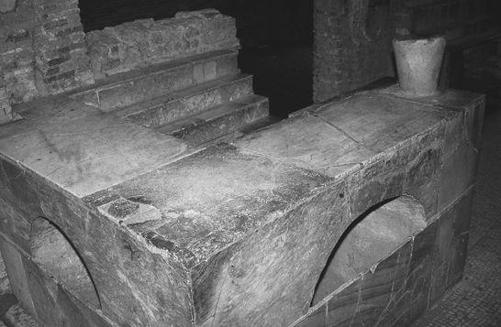
A popina is assumed to have encompassed at least three rooms: a kitchen, a dining room and a tavern unit. A hospitium additionally offered overnight accommodation, sometimes with a stabulum for wagons and horses in the backyard. Such taverns and inns have rarely been archaeologically substantiated in the provinces but are nevertheless attested, for example by gravestones with pub scenes in Augsburg and Regensburg. Written sources also indicate that hostels (mansiones) were available for travellers in the countryside, and were also used by the upper classes (Hor. sat. 1.5; Mart. epigr. 6.94).
Fig. 17 Thermopolium of the via di Diana in Ostia.
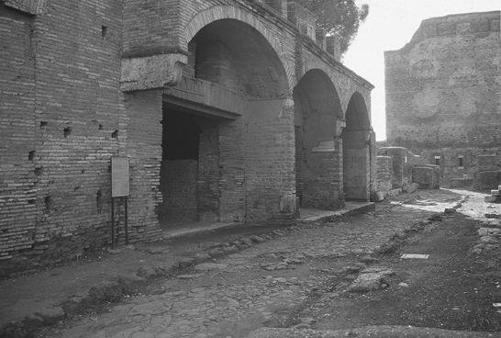
Overall, there was a broad range of restaurant facilities, which were in some cases also used by the wealthy; however, they could never replace the private banquet at home. On the other hand, it is questionable how many of the plebeians or members of the lower classes could afford a meal in a tavern; after all, at least those citizens in the capital who were entitled to a state allotment of cereals could process it themselves or have it baked into bread. In the countryside, the situation was different, inasmuch as the rural population was self-sufficient.
1 Holliger 1996, 5–6, 55ff.; Fellmeth 2001, 87ff.
2 Carcopino 1992, 360ff. (304ff. in 1939 edn).
3 Thüry 2004, 29.
4 André 1981, 177–8; Garnsey 1999, 118–19.
5 André 1981, 51–2; Garnsey 1999, 120.
6 Garnsey and Saller 1987, 89–90; Junkelmann 1997, 87.
7 Jongman 2007, 602ff.
8 von Ungern-Sternberg 1991.
9 Garnsey 1988, 218ff.; Robinson 1992, 151ff.
10 Kleberg 1966.