
Chapter 18
Fires in Rome
Fire had religious significance in Rome, and was used in ritualistic veneration. The Volcanalia festivities were held every August in honour of the god of fire, Volcanus. In Rome the qualities of Hestia, the Greek goddess of the hearth, were embodied in the Latin goddess Vesta, goddess of the state hearth. A round temple at the forum Romanum was consecrated to her, as the central place of the community. Here there was a hearth with the eternal fire, tended by the Vestal Virgins, who were in priestly service. The shrine was at the same time the state's storage house, and was under the protection of the Penates, whose religious image (palladium) was kept here. The six Vestal Virgins enjoyed great honours and privileges, since they embodied purity and thus enabled expiation. Since their virgin inviolability symbolised stored fertility, they were important for growth and fertility rites. Their supreme duty besides their virginity was the guardianship of the eternal fire, as an expression of community. If the fire was extinguished, they risked being flogged (Dion. Hal. 2.67).
For Rome there was also a rational, political aspect of fire, since it could be used as an instrument of power. As in the case of water, the sources primarily refer to the capital itself. In the course of the growth of the city, the danger of fire was addressed organisationally. This at the same time lent political authority to those involved in such activities, since fires had been frequent during the Roman republic. Numerous major conflagrations are reported, particularly toward the end of the republic: in 50 BC an enormous blaze destroyed numerous districts (fourteen vici), and the next year there was an earthquake accompanied by fires which destroyed many residential areas.1 It was the time that the old republican system was breaking apart; senatorial rule had proven incapable of addressing the problems facing Rome and its empire, and the ruling elite was engaged in constant internal strife. In this situation Caesar seized power with his army and began to reorganise the state, but was then murdered in 44 BC.
The danger of fire in the city of Rome was due mainly to the fact that wood was still the most widespread building material for simple housing. Problems were caused not only by hearths, but also by numerous open flames, such as candles, torches, oil lamps, and coal basins for heating and cooking. These threatened wooden ceilings and wooden partitions in the upper storeys, which were installed by profit-hungry landlords to create additional rental space, for in the narrow streets and high buildings the housing shortage was acute. The politician and financier M. Licinius Crassus (115–53 BC) had a gang of 500 construction workers and was also involved in real estate speculation. He would buy houses which were already on fire, or were located near a potential source of fire, and then build new, profitable tenement blocks on the vacant lots (Plut. Crass. 2.34).
During the republican period, there were no effective regulations for home building, nor did insurance or any firefighting or police forces exist. Fire prevention was inadequately handled by a fire watch of only a few people, the tresviri nocturni, who were responsible for public order at night, and a small gang of state slaves, who were completely ineffective in cases of major fires. For this reason neighbourly assistance was widespread, and private efforts required. M. Egnatius Rufus, who held the office of aedile in 22 or 21 BC, with responsibility for the supervision of streets, squares and markets, had in previous years assigned both his own and rented slaves to firefighting, and thus achieved great popularity. However, Augustus, who had taken power in 27 BC as the new ruler, accused him of conspiracy and had him killed (Vell. 2.91.3).
Augustus, Rome's first emperor, only gradually took measures against the danger of fires. First, in 23 BC, he set up a fire brigade, for which a few vigiles (‘guardians’) were drafted and subordinated to the aediles. This organisation was initially very rudimentary, and hence inefficient. In 7 BC, Rome was reorganised, with the city's four traditional regions being replaced by fourteen regions and some 265 vici; at this time, the firefighting force too was restructured. The small neighbourhoods were given a local autonomous administration under collegia consisting of four vicomagistri each, recruited from the lower classes of society, or from freedmen.2
After more major conflagrations, Augustus in AD 6 organised seven cohorts as a permanent fire brigade, with each cohort responsible for two of the fourteen urban regions. These paramilitary units, with a total of 7,000 freedmen, were directly under the command of a praefectus vigilum from the equestrian class, who was appointed by the emperor and directly responsible to him (Dio 52.24.6, 33.1, 55.26.4–5). This professional unit not only strengthened the city's firefighting capabilities: it also provided a permanent presence of law and order for the ruler at the neighbourhood level. There were seven barracks as guard houses at the city wall, and smaller guard-stations distributed throughout the city. These troops nevertheless had a largely preventive function, since they were powerless against a heavy fire. Here, Augustus’ construction regulations, which limited the height of houses to 70 feet (20.7 m), or about six or seven storeys, were little help, either (Strab. 5.3.7).
The best known fire in Rome broke out on the night of 18/19 July AD 64, and lasted for nine days. Emperor Nero (AD 54–68), who had been staying in Antium, hurried to Rome and initiated relief activities. The rumour nevertheless arose that he had ordered the fire set himself (Tac. ann. 15.38–44). Thereafter, blame for the disaster was laid upon the Christians, who were hated by the majority of the people, and who suffered severe punishments as a result. Only four of the fourteen regions had escaped the fire; three had been completely burned to the ground, while in seven more only a few houses remained. The building rubble was disposed of in the marshes of Ostia. The number of human victims is unknown; it must be assumed that several thousand died.
After the fire catastrophe of AD 64, the most comprehensive attempt was made to rebuild and modernise Rome's residential neighbourhoods (Tac. ann. 15.43). In place of the narrow, twisted lanes, Nero had more regular, broader streets built, with arcades in front of the houses. To prevent new fires, common walls of adjacent buildings and combustible materials were to be avoided; fire-proof building blocks were used, and fire-extinguishing equipment provided. Under Trajan, the height of buildings was still further limited, to only 60 feet (17.7 m) (Aur. Vict. epit. Caes. 13.13). These measures were, however, of only limited success, for the streets remained narrow and twisted. The fire hazard could never really be eliminated, so that fires occurred repeatedly.
The water supply and sewage system of Rome
The logistical problems of the city included water supply and sewage disposal. Rome's water supply was relatively good at an early date, even including a certain level of hygiene. Here the Romans used achievements which we have already observed among the Greeks. Originally, drinking water had been obtained from the Tiber and from wells; from the late fourth century BC it was supplied by means of ever longer and higher aqueducts.
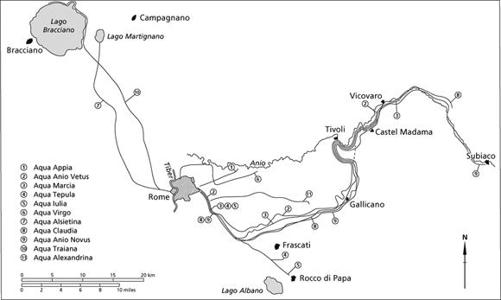
During the republic four such aqueducts were built: the aqua Appia (312 BC), the Anio Vetus (272 BC), the aqua Marcia (144–140 BC) and the aqua Tepula (126 BC), which brought in water from the Anio Valley, or, in the case of the aqua Tepula, from the Alban Hills (Fig. 18). The water arrived in the city by way of the surrounding hills, where it was stored in reservoirs known as castellae, and then distributed via clay and lead pipes to the lower-lying residential areas. Despite this flow-through system, the water was not wasted, but was intercepted repeatedly or fed into households and gardens. Initially, of course, very little overflow water was passed on to private households, for the goal was not the comprehensive supply of all houses, but rather the supply of public wells with drinking water.3
Fig. 18 Rome's aqueducts.
As early as the sixth century BC, the Roman Forum had been drained and the Cloaca Maxima built, a large central sewer which emptied into the Tiber. It was the most important sewer during the next centuries, and was continually expanded – in some parts, it is used to this day. By the first century BC an extensive system of sewage ditches existed, which, however, also brought with it a number of dangers. Problems included their stench in dry spells, the backup of the sewer system when the water of the Tiber was high (Plin. nat. 36.105) and the inadequate clearage of the sewage ditches of waste material. The ditches not only provided a cleaning function, but were also sources of gases of decomposition and pathogens which repeatedly caused epidemics.4 The only way to counteract this was with a massive flushing, which apparently also contributed to the improvement of air quality (Front. aqu. 88, 111).
In 312 BC the state assumed overall responsibility for the water supply, which was thus no longer a family problem, but a communal task. This was financed by war spoils, and managed by regular officials: the censors, who were chosen every five years and were responsible, among other things, for public procurement; the aediles; and in some cases special commissions. Unlike many other cities, Rome was no longer exclusively dependent on the generosity of individuals. The state built aqueducts and made water available to the public free of charge. Connections of private homes to the water system were seen as privileges for persons who had distinguished themselves, and apparently had to be approved by the people's assembly.5
By 126 BC, however, after the first four aqueducts were built, construction largely came to a standstill. No definite authority yet existed for the maintenance of the aqueducts; the traditional offices, the aediles and censors, were soon overwhelmed by the task. By the end of the republic, therefore, there was need for action, and Augustus, the first emperor, reacted accordingly. A new principle was now imposed: private persons paid for the maintenance of the water system, that is, it was paid for by private donations from the emperor or other members of the ruling class.
M. Vipsanius Agrippa, a friend of Augustus since their youth, who had led the victory over Anthony and Cleopatra at Actium in 31 BC and became Augustus’ son-in-law ten years later, took over responsibility for the water supply. He used his own funds to expand and maintain the water lines, a kind of propagandistic donation to the Roman plebeians. He may already have begun to do so when he served as praetor in 40 BC, but this was definitely the case when he assumed the position of aedile in 33 BC (Front. aqu. 9) – specifically for that purpose. New aqueducts, the aqua Iulia (33 BC, possibly started in 40 BC) and the aqua Virgo (21–19 BC) were built; the latter provided the water for the first public thermal baths on the Campus Martius. This considerably increased the amount of water being supplied to Rome.
Agrippa acted with senate approval, but at his own authority and expense. He assigned 240 of his own slaves to duty as so-called aquaria, and thus laid the foundations for a professional administration of the water supply; he also became the number two man in the state. At the same time, he probably introduced the system of standardised lead pipes (quinariae), which was used during the imperial era, and was a prerequisite for the comprehensive provision of water system connections for private residences (Front.aqu. 25ff.).6
After Agrippa's death in 12 BC, Augustus felt forced to take responsibility for the water supply personally. His goal was to underpin Agrippa's privately financed efforts by state action. Agrippa's slaves were therefore transferred to the state, and received the designation familia publica as public servants. Agrippa's regulations were published as an edict. Moreover, various senate resolutions passed in 11 BC, as well as the lex Quinctia of 9 BC, created a solid legal basis for the administration of the aqueducts (Front.aqu. 125ff.). The lex Quinctia stipulated the protection of the aqueducts and banned the theft of water. A cura aquarum was also established in 11 BC: the emperor appointed three distinguished men of the senatorial class (consulars, i.e., former consuls) for unlimited terms as curatores aquarum to run the water supply, and provided them with public employees. Their tasks included the preservation of the structures and staff supervision, approval procedure for private connections to the system, and the legal handling of disputes and offences (Front. aqu. 98ff.).
During the later part of Augustus’ reign, the aqua Alsietina and several other canals named ‘Augusta’ were built (Front. aqu. 11–12). The lines were in some places marked with stones (cippi) every 70 m, for better monitoring. The Alsietina, on the right bank of the Tiber, in the area of today's Trastevere, fed the Naumachia, the gigantic water basin for the performance of mock naval battles and similar entertainments (Front. aqu. 11). Overall, the quantity of water introduced into the capital more than doubled under Augustus. The first Roman emperor had successfully accomplished the smooth transfer of this public task to his personal responsibility, without offending the senate; a state function thus fell under the aegis of the emperor. Accordingly, private connections to the water system were no longer allocated by the people's assembly but by the emperor himself. Access to water was now granted by special permission from the emperor, as a beneficium, so that it was no longer merit, but rather imperial favour, that determined private advantage.7
The constantly recurring floods of the Tiber, which could inundate entire neighbourhoods of Rome and cause substantial damage, were also a problem. Caesar was said to have already made plans to dam and rechannel the Tiber extensively (Cic. Att. 13.33.1; Plut. Caes. 58.4). The Tiber bed had been cleaned under Augustus to achieve better drainage of the water masses and of the overflow channels (Suet. Aug. 30). In AD 15, after a severe flood, the emperor Tiberius, Augustus’ successor, appointed five curators to supervise the bed and banks of the Tiber (curatores alvei et riparum Tiberis), and two senators to draft a comprehensive regulation plan (Dio 57.14.7–8). This included the damming of tributaries: the Chiana (then known as the Clanis) was to be redirected from the Tiber into the Arno; the water of the Nera, too, was to be diverted; and the Veline Lake was to be dammed, instead of flowing into the Nera. However, the local residents feared inundations and also expressed religious concerns, so that the project was ultimately dropped (Tac. ann. 1.76, 79). The Tiber continued to cause great damage on its way to the sea (Plin. epist. 8.17).8
Thereafter, Emperor Claudius (AD 41–54) instituted the office of procurator aquarum (Front. aqu. 105) in Rome as a kind of executive alongside the commissioners of the cura aquarum. The staff was enlarged with 460 imperial slaves and freedmen (familia Caesaris: Front. aqu. 116), so that the water authority had the largest number of public employees (700). The number of aqueducts was again increased by two, the aqua Claudia and the Anio Novus (AD 38–52).
Emperor Nerva in AD 97 appointed Sextus Julius Frontinus as curator aquarum. He wrote the work De aquaeductu urbis Romae, which describes the aqueducts, the distribution of water and the applicable legal rules. The water quality of the various mains is also assessed (aqu. 89ff.), and the punishment for pollution mentioned (aqu. 97). Based on his account (aqu. 78), the daily capacity for the first century AD has been estimated at approximately 500,000–600,000 cu. m;9 together with the two last lines built, the aqua Traiana (AD 109–17) and the aqua Alexandrina (AD 226), it might even have reached 1 million cu. m, or approximately 500–600 or even 1,000 litres per head per day – approximately double or even four times today's capacity. However, this calculation took into account only the flow area, not the flow velocity. A more recent estimate by C. Bruun arrives at only 67 litres per day,10 so that no safe assessment can be made here.
Under Frontinus the aqueduct system had a total length of 423 km and included 247 reservoirs and 591 open water pools. One-sixth of the water went to the emperor, a third to homes and the rest to the public (Front. aqu. 78). The emperor not only decided upon the allocation to private persons, but also levied the charges; standardised lead pipes of various sizes connected homes to the distributor, and their dimensions served as a basis for calculating the water rates. The pipes (fistulae) were labelled by name and mainly belonged to senators, and also to equestrians and imperial freedmen.11 Disposal of sewage was provided by the underground sewer system, flushed by water from the aqueducts, which, however, simply shifted the problem of pollution from Rome to the lower reaches of the Tiber.
Hydraulic engineering, water poisoning and lead problems
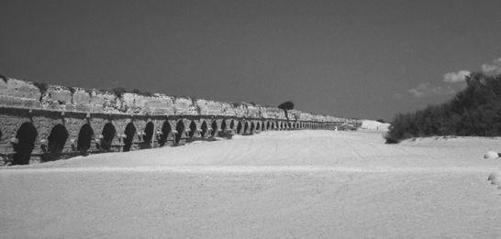
Outside Rome, too, important water mains were built during the Augustan period, including the aqueducts of Emerita Augusta (Mérida) and Tarragona in Spain, Pont du Gard in Gaul, the canals of Alexandria, and the water supply systems of Pompeii and of Caesarea in Judaea (Fig. 19). In addition to aqueducts and municipal distribution networks, the Romans in various areas around the Mediterranean built valley dams such as those familiar in Egypt and the Near East, one example being Emerita Augusta,12 and systems of canals, with which entire areas could be irrigated artificially, such as in the Po Valley (Strab. 4.6.7, 5.1.4; Plin. nat. 3.119). Lakes and marshes were also drained, for example the Veline Lake in the third century BC (Cic. Att. 4.15.5), the Fucine Lake under Claudius (Suet. Claud. 20; Tac. ann. 12.56) and Hadrian (Hist. Aug. Hadr. 22.12), the Po delta (Strab. 5.1.11; Plin. nat. 3.120–1), parts of Tuscany, and the Pontine marshes in Latium (Liv. epit. 46). Numerous canals and river regulation projects served navigation, including the Fossa Mariana in the Rhone delta, and the Fossa Drusiana between the Rhine and the Ijssel in the Netherlands, or else were built to protect settlements from flooding, as in the case of Glanum (Saint-Rémy-de-Provence, France).
Fig. 19 Herodian Roman aqueduct in Caesarea, Israel.
It was generally recommended to provide farm fields with drainage ditches and irrigation canals (Cat. agr. 155.1; Verg. georg. 1.106–10), for which there were precise legal stipulations (Dig. 8.3.1ff., 39.3.8ff., 43.20.1ff.). The property owners adjacent to water mains and bodies of waters were required to ensure that the water, a public asset, remained accessible to all, particularly for navigation and leased fishing. Any modifications that caused the water of a public stream to take a different course than it had in the previous summer were generally banned (Dig. 43.13.1ff.). On the other hand, hardly any measures were taken against water pollution by sewage.
Not only in Rome were sewage ditches an important factor for waste disposal. In Pompeii the high kerbstones and the ‘zebra crossings’ made of stone blocks show that, on the one hand, rain and sewage were drained away there and that, on the other, overflow water was fed through to clean the streets. Urban streets were provided with underground sewers to wash away excrement; however, these sewers never constituted a full-coverage network, and in some cities they did not exist at all, so that much waste was left in the streets (Strab. 14.1.37). In some places it has been observed that the waste in the streets was therefore periodically covered over with new layers of gravel, as in Augusta Raurica (Augst, Switzerland) and Coblenz, Germany.13
A number of places in the Roman world faced problems of water pollution and water poisoning due to the practice of waste disposal by way of water. Even in Hellenistic times there had been a case of mass poisoning of the Nile, with numerous deaths (Athen. 2.42a). Fish from dirty rivers were generally considered bad (Gal. alim. fac. 3.24[25], 28–9[29–30]). Pliny the Elder reported on a number of poisoned rivers (nat. 18.3), and his nephew Pliny the Younger wanted to have the Amastris (Amasra) River in Pontus-Bithynia covered over because of the danger of epidemics (epist. 10.98–9). Moreover, the numerous military camps in the Roman Empire seem to have regularly contaminated the water of their surroundings (Veg. mil. 3.2). Apparently, no measures to prevent such problems were taken.
Another threat to the people was the lead in the metal pipes, which polluted the drinking water. Such lead pipes existed as water supply mains in settlements throughout the Roman Empire; they were economically advantageous over clay pipes. While the harmful effects of lead pipes had been recognised early (Vitr. 8.6.10–11), the problem was never addressed systematically. Convenience, which particularly benefited the upper classes, the consumers of luxury goods, was not the only determining factor. It has to be taken into account, however, that the inside surface of lead pipes was often rapidly covered with a layer of calcium, so that the metal could no longer enter the drinking water. Moreover, Rome itself was supplied with hard water, which took up a very low level of contamination. Skeleton examinations from throughout the Roman Empire have yielded a wide range of different results with regard to lead poisoning, some considerably above, others far below, today's values.14 Thus, even if the lead caused health problems locally, it had no noticeable effect on the population as a whole.15
1 Kolb 1995, 286.
2 Robinson 1992, 105–6.
3 G. Garbrecht, ‘Wasserversorgungstechnik in römischer Zeit’, in Frontinus-Gesellschaft 1989, 32ff.
4 Robinson 1992, 112–13.
5 W. Eck, ‘Organisation und Administration der Wasserversorgung Roms’, in Frontinus-Gesellschaft 1989, 63–4.
6 Evans 1982.
7 Eck, ‘Organisation und Administration’, in Frontinus-Gesellschaft 1989, 66–7.
8 Aldrete 2007, 15.
9 Garbrecht 1984, 8.
10 Bruun 1991, 103.
11 Bruun 1991, 77ff.
12 Schnitter 1978, 1994.
13 Thüry 2001, 23ff.
14 Drasch 1982.
15 Weeber 1990, 171ff.