
Chapter 3
Agriculture formed the basis of the ancient economy, and initially served the purpose of self-sufficiency. Even the prosperous were, in their own view, not merchants or shopkeepers, but farmers and landowners. The ancient polis was, as Max Weber described it, a ‘warriors’ guild’, its citizen hence a soldier who equipped and provided for himself; the city did not embody a centre of production and commerce, but rather served ‘consumer interests’. For the citizens, agriculture represented the primary economic sector, so that no contradiction arose between town and countryside.
Ancient agriculture demonstrated great continuity: there was neither any revolutionary technological innovation in agriculture nor any mechanisation, only some improvements in the tools and the methods of cultivation. No large-scale enterprises came into being in the area of the skilled crafts, and mass production hardly emerged at all. In terms of forms of property and means of production, there were major differences in agriculture depending on location – ‘from the highly developed Egyptian channel and irrigation system to simple pasturing and hunting economies’.1
Even in early Greece, the most important products were cereals, grapes and olives, and beyond that legumes (field beans, lentils, peas) and fruit (pears, apples, figs). In addition, stockbreeding, primarily of sheep but also of cattle and goats, was practised, as were fishing and hunting, primarily of wild boar, deer and so on. Two-field rotation predominated, so that half the arable land lay fallow at any time, together with common pastureland. The Mediterranean climate, with high precipitation in winter and sunny summers, allowed for a wide range of crops. In early summer, field crops and fruit were harvested, followed in late summer by grapes and olives. During their fallow year, fields were repeatedly ploughed with an ox-drawn plough, and fertilised with animal dung. This was in short supply, since only draught animals were kept in stables. A common pastoral practice was transhumance, in which the herds were pastured in the valleys and plains in winter, and in the nearby mountain ranges in summer (Soph. Oid. T. 1133ff.).
Literary sources on Greek agriculture are scarce, and often provide only indirect indications. Hesiod of Boeotia (around 700 BC) in his poem Works and Days describes daily work and provides us with an agricultural calendar, but no real instructions on how to go about farming; in essence, it is a moral appeal for hard work on one's own farm. He recommends one or several slaves and draught animals, and his goals are autarky, freedom from debt, and a son as an heir (erg. 229ff., 375); on the other hand, he warns against engaging in commerce (618ff.).
Tyrtaeus of Sparta (second half of the seventh century BC) describes the subjugation of the neighbouring Messenians, who had to surrender half their harvest to their Spartan rulers (fr. 5D). This resulted in additional economic gains for the Spartans on their farmsteads in Laconia, which, however, also led to differences in relations of ownership. Accordingly, the lyricist Alcman around the same time describes the ordinary dishes of the people in Sparta (groats, pearl barley mush with honey, mash of legumes), shortages in the spring and the delicacies enjoyed by the rich – cake, pastries, apparently also meat from the hunt – so that, overall, fluctuating food supplies must be assumed.2
Around 600 BC, Athens had to contend with an agricultural crisis caused in part by population growth and overpopulation. The Attic countryside was largely in the hands of noble families; free labourers and a major portion of the former small peasants had become dependent upon them as debtors or serfs, and were thus in danger of falling into debt slavery. Leased farmland apparently cost a sixth of the yield surrendered to the lord of the manor, hence the term hektemoroi for ‘tenant’. In this situation, Solon was elected as a ‘conciliator’, and introduced many reform measures, including an export ban on all food products other than olive oil (Plut. Sol. 24.1), restrictions on the acquisition of land (Aristot. pol. 1266b 16), debt relief for the citizens (seisachtheia, ‘shaking off a burden’; Aristot. Ath. pol. 12.4; Poll. 7.151), the abolition of debt slavery (Aristot. Ath. pol. 6.1, 9.1; Plut. Sol. 15.2, 19.4), and a reform of weights and measures. This enabled an overall free development of the citizenry, and brought economic profits to a rising stratum of merchants.
Topographically, Greece is characterised by small-scale structures, with relatively little fertile ground between the mountains and hills. Attica had an area of approximately 2,500 sq. km (250,000 ha), and in the fifth and fourth centuries BC was home to 250,000 inhabitants, as noted, of whom some 50,000 lived in Athens. About 5.5 per cent of the cultivatable land, or 13,000 ha, was used for cereal cultivation.3 In 329/8 BC the Attic land produced approximately 27,000 medimnoi of wheat (approximately 1,000 tonnes) and 340,000 medimnoi of barley (approximately 11,400 tonnes; IG II2 1672), enough to feed approximately 50,000 to 60,000 people.4 In addition, at least 800,000 medimnoi (approximately 27,000 tonnes) of cereals were apparently imported every year during the fourth century BC, half of it from the Black Sea (Dem. 20.31ff.), with which at least another 130,000 people could be fed.5 The prerequisite for the imports was not only the metal and money economy which arose during the sixth century BC, but also the urbanisation and empire-building process in the Aegean area. The political control of the eastern Mediterranean and the Dardanelles proved to be vital, which is why the Delian League was founded under the leadership of Athens after 480 BC, when the Hellespont and Thrace were freed from Persian domination.
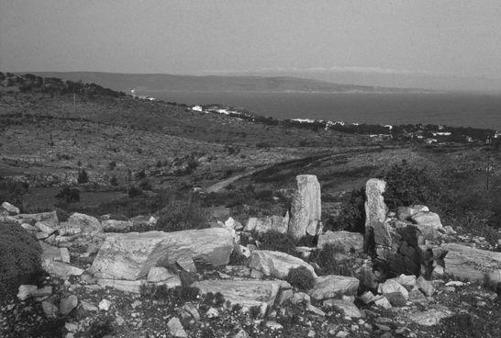
Archaeological surveys in the territory of Attica have yielded insights into the structure of rural farmsteads. The owner of the so-called Princess Farm of Agrileza (Fig. 3) was a certain Timesios, who was also known as the leaseholder of some silver mines and the owner of a second holding, the Cliff Farm, about a kilometre away, around the same time; he also acquired an additional farm from a debtor. Thus, Timesios owned almost the entire Agrileza Valley, where marble was quarried and metal mined.6 According to the investigations of H. Lohmann in the Charaka Valley, that area contained approximately 35–40 farms and a village-like settlement. The farmsteads were equipped with fortified towers, threshing places, terraces, graves and roadways. The towers served not only for defence, to guard against robbers, but also as living and storage space. A quarter of the farmsteads belonged to large-scale farmers, with approximately 25 ha each, and together accounted for 30–50 per cent of the acreage.7 The small peasants held only approximately a quarter of the area of the large farmers. The 2,000 richest Athenians held a quarter to a third of the cultivated land, and almost half of the farmland was in the possession or under the control of 10 per cent of the population.8 Oil and honey were the main agricultural products; mining played a rather minor role.
Fig. 3 Princess Farm, Agrileza Valley, Attica.
The fact that agriculture constituted the basis for a secure way of life was shown in connection with wars, such as the Peloponnesian War between Athens and Sparta, each supported by their respective allies (431–404 BC): Thucydides, from Athens (c. 460–400BC), reports that the Spartans systematically destroyed grain fields and orchards in Attica, with the intention of depriving the enemy of his source of food (Thuc. 2.79, 3.26, 6.94). However, such measures could not be successfully implemented everywhere, and hardly had any long-term effect, since the vines and olive trees were hard to destroy completely.9 Ultimately, Athens was cut off from its allies and food suppliers in the Aegean Sea, lost much of its strength and therefore finally had to capitulate to Sparta and its allies. Nevertheless, in later wars too, agricultural resources were repeatedly wilfully destroyed (Xen. hell. 4.5.10, 7.1, 5.2.39; Plut. Cleom. 26.1).
1 Pekáry 1979, 4.
2 Thommen 2003, 45ff.
3 Garnsey 1988, 101.
4 Garnsey 1988, 99.
5 Hopper 1979, 90.
6 Goette 1993, 167ff.
7 Lohmann 1985, 81.
8 L. Foxhall, ‘The Control of Attic Landscape’, in Wells 1992, 157.
9 Hanson 1998, 55ff.