
Chapter 4
The forest cover in the Mediterranean had already been subject to significant change during the centuries before the Greek settlement. Between 5000 and 3000 BC a shift occurred in south-eastern Europe (the Balkans), with cold treeless and wooded steppes and summer-green deciduous and coniferous forests being replaced by evergreen oak-woods. An investigation of the Argolis area of the Peloponnese reveals that it was covered before the Bronze Age (i.e., prior to 3500 BC) with thick deciduous forests of downy oak; in the Bronze Age (the third and second millennia BC), by sparser woods or macchia with evergreen holm oaks and pines; and starting around 900/800 BC, by olive and walnut trees.1 In addition to the hardwood deciduous trees, such as oak and olive, there were also such evergreen bushes as myrtle and oleander, and, particularly in higher locations, pine and cypress (Fig. 4). Cypresses grew especially in Crete, and cedars in Syria and Phoenicia, where they were primarily felled for shipbuilding (Theophr. hist. plant. 4.1.3, 5.7.1).
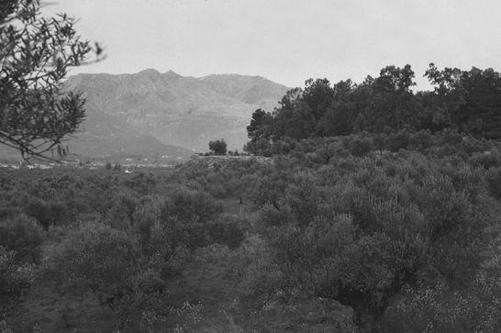
Fig. 4 Olive trees and forest cover near Sparta (Acropolis): view of the Taygetus Mountains with coniferous vegetation up to 1,700 m above sea level.
In ancient Greece the forests were already a source of energy and of building materials. The available literary information refers particularly to Athens. Attica experienced a rise in population during the seventh and sixth centuries BC, which resulted in increased clearing of the wooded slopes of the nearby Aegaleus and Hymettus Mountains (Figs. 5 and 6). More remote mountains, too, such as the Parnes, Kithairon and Pentelikon ranges, were also used to obtain wood supplies. The comic dramatist Aristophanes (c. 445–386 BC) in his play The Acharnians has charcoal burners from Acharnae appear as a choir, an indication of charcoal trade from the area of the Parnes, based on oak, maple or beech. In the Kithairon Mountains, there is a pass called Dryoskephalai (‘oak heads’, Hdt. 9.39), which indicates an old stand of oak. Thucydides (2.75) reports that at the end of the fifth century BC wood was felled on Kithairon. The Pentelikon Mountains, however, were primarily noted for quarrying of marble. On the plains there were, moreover, numerous olive plantations, which were legally protected (Dem. 43.71), but probably also scattered smaller clusters of oak, fir and elm.2 During the Peloponnesian War the destruction carried out by the Spartans in the Attic countryside probably rather affected the olive and fruit trees more than the actual woodland with building timber.3
Fig. 5 View from the Athenian Acropolis, above the Areopagus and the Agora, to the Aegaleus Mountains.
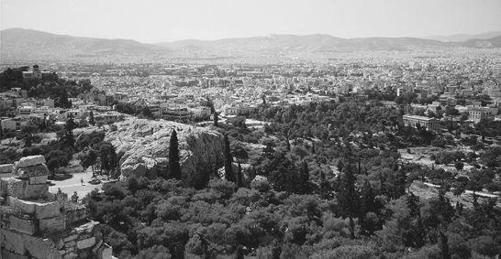
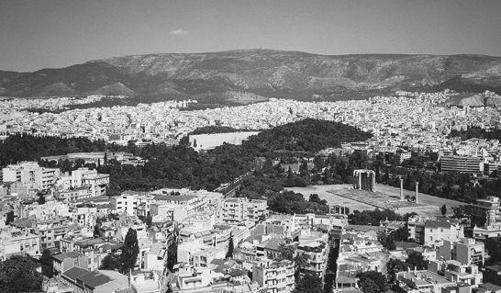
Fig. 6 View from the Athenian Acropolis and the Olympieion to the Hymettus Mountains.
However, wood was not used only for purposes of domestic construction and fuel, but also since the fifth century BC in large measure for mining and shipbuilding. The rise of Athens caused the demand for wood to increase considerably. Olive wood was used as firewood and for tools, but hardly for house- or shipbuilding. Wood was a scarce commodity, and had to be imported through the ports from nearby or even far-away areas, such as Piraeus, Eleusis, Corinth, Samos and Knidos (IG II2 1672).4 Especially for shipbuilding, Attica and neighbouring Euboea could meet only a small part of the demand for wood; the bulk was imported from the more productive forests of northern Macedonia and Thrace (Hdt. 5.23).
In 483/2 BC, in the context of the Persian Wars, a state navy was established in Athens with some 200 ships, which would have to be maintained and replaced in future as well. In this regard wooded Macedonia seemed the closest and most attractive solution for timber. Xenophon (c. 430–354 BC) has Jason of Pherai, the master of Thessaly (c. 380–370 BC), proclaim (hell. 6.1.11): ‘With Macedonia in our possession, the place from which the Athenians get their timber, we shall of course be able to construct far more ships than they’ (Loeb). Also important for the timber trade was the Attic colony of Amphipolis, at the mouth of the Strymon on the southern coast of Thrace. Thucydides (4.108) reports that in 424/3 BC, the town was taken by the Spartans: ‘The Athenians were greatly alarmed by the capture of Amphipolis. The chief reason was that the city was useful to them for the importation of timber for ship-building’ (Loeb).
In particular Theophrastus provides important information about timber for ships (hist. plant. 5.7.1):
Now silver-fir, fir and Syrian cedar are, generally speaking, useful for ship-building; for triremes and long ships are made of silver-fir, because of its lightness, and merchant ships of fir, because it does not decay; while some make triremes of it also because they are ill provided with silver-fir. The people of Syria and Phoenicia use Syrian cedar, since they cannot obtain much fir either; while the people of Cyprus use Aleppo pine (pitys), since their island provides this and it seems to be superior to their fir (peuke).
(Loeb)
Silver fir was most highly prized, because of its light weight; it could be found primarily in Macedonia, Thrace and Italy (Theophr. hist. plant. 4.5.5). The rulers Dionysius I and later Hieron II of Syracuse also obtained large quantities of wood for their extensive fleets in southern Italy and Sicily (Diod. 14.42.4–5; Athen. 5.206f, 208e–f), while Antigonos Monophthalmos of Asia Minor in 315 BC plundered Lebanon for this purpose (Diod. 19.58).
Forest utilisation and clearing were among the most conspicuous interventions in nature by the Greeks. Even in archaic times, it had already become apparent that this involved problems. Homer mentions torrential rivers which swept oak trees with them (Il. 11.492–5). The destructive effects of forest fires were also known since the earliest times (14.396–7, 20.490–1); however, with the exception of the fire on Sphacteria in 425 BC (Thuc. 3.98, 4.29–30, 34), they rarely appear in the literary tradition. Later, the negative effects of forest clearings on the landscape are primarily discussed by Plato (427–347 BC).
In his dialogue Critias, Plato imaginatively contrasts the primeval Athens of 9,000 years since with the contemporary condition, and discusses the phenomenon of deforestation and soil erosion (110c–112e). Human intervention, he notes, has eroded the earth, destroyed the habitats of animals, impaired the water balance and created a barren landscape. While this reflects contemporary clearing practices, it contains no historical analysis, and at the same time reveals an unbroken admiration for the beauty and fertility of the Attic countryside. Plato is writing not as a historian but as a philosopher, particularly about the ideal state, and at the same time criticising the monumental construction policies of the time, implemented by the Athenian politician Pericles (c. 490–429 BC). Even if the report displays aetiological aspects and has to be interpreted with caution, it nevertheless shows an awareness of environmental problems – which, however, gives rise neither to accusations nor to demands for a different kind of behaviour. Nor did any fundamental criticism of clear-cutting arise later, since clearing of land continued to be seen as part of the progress of civilisation. Nevertheless, the forest wardens mentioned by Aristotle (pol. 1321b 27–30, 1331b 14–16) are an indication that state controls were considered important in forestry, and that resources should be maintained; the Cypriot kings, too, were concerned about the protection of their trees (Theophr. hist. plant. 5.8.1). Obviously, even then there was the opinion that for long-term survival careful use of wood resources was necessary.
As can be seen from Plato, the damage to forests and to pastureland neither led to any immediate supply crisis, nor involved complete deforestation. Later replanting shows that intervention in the vegetation was not fundamentally irreversible. While J. V. Thirgood and J. D. Hughes have still assumed extensive deforestation,5 O. Rackham has pointed to the rapid regeneration of evergreen oak and Aleppo pine, so that these trees were not permanently destroyed.6 Moreover, natural scientists have come to assess the question of the regional differences in the flooding of riverbanks and the siltation of river mouths due to clear-cutting. Though there was human intervention, changes in forest cover also had natural causes. In many areas the barren condition of the landscape was caused by later natural or anthropogenic human changes, or even by clear-cutting during the nineteenth century.7 Moreover, the idea of extensive coniferous forests, especially in southern ancient Greece, is often a fallacy. Even then, macchia vegetation with pine and oak predominated (Macr. Sat. 7.5.9).
1 Jahns 1992.
2 Meiggs 1982, 191.
3 Nenninger 2001, 112.
4 Meiggs 1982, 433ff.
5 Thirgood 1981; Hughes 1994, 73ff., esp. 80ff.
6 Rackham 1990, 93–4.
7 Nenninger 2001, 202.