
Chapter 5
In the Near East and Egypt the most important gardens were located in the surroundings of the ruling dynasties, with the palace and the sacred site forming a unit. The so-called Hanging Gardens of Babylon of Semiramis, an Assyrian queen who lived around 800BC, were later included among the Seven Wonders of the Ancient World. These gardens have not been identified, but probably formed a terrace structure over dome-shaped substructures, such as those built under Nebuchadnezzar II during the first half of the sixth century BC.1 Moreover, Near Eastern rulers kept artificial animal-parks surrounded by walls, the so-called paradeisoi. They served for the royal hunts, which made the king, together with the god, the lord over nature, and which also recalled the Garden of Eden. Hellenistic rulers and Roman aristocrats would later be happy to continue with this tradition.
In the city states (poleis) which developed in Greece during the early part of the first millennium BC, the municipal centres left space for religious ceremonies and public meetings, but the residential areas had very little green space. Sacred gardens or public sacred groves were mainly located outside the actual housing areas. According to traditional belief, sacred beings dwelt in such places – be they gods, nymphs or heroes. A sacred grove (alsos) was generally a place in open natural surroundings with a cluster of trees, a brook, a field or a grotto. It was marked by a ritual figure and mostly enclosed by a wall, so that the designated plot was called a temenos. However, unlike the Near Eastern royal gardens, it remained accessible to all. Its fundamental features were its communal religious aspect and its untamed natural character, located at the transition to civilisation. Sacred groves were thus protected against uncontrolled intervention (Thuc. 3.70.4; Callim. hymn. 6.24–60). In Athens the sacred olive trees dedicated to Athena were generally protected from being felled or dug up (Lys. 7).
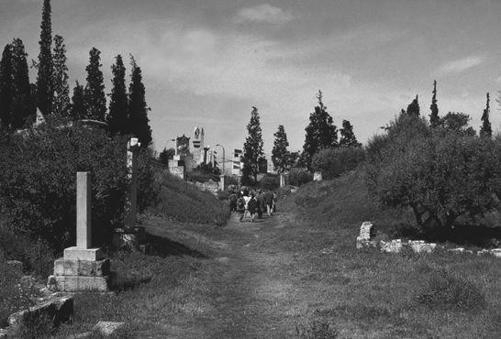
Moreover, private vegetable and fruit gardens (kepoi and orchatoi) are attested for the Greek poleis at an early date. Homer (Od. 7.112ff.) describes a garden surrounded by hedges for the palace of Alcinous, the ruler of Phaeacia, where everything flourished and there was no want; it included an orchard with apples, pears, figs and olives, a vineyard and a vegetable garden, so that it was designed and irrigated without decorative plants or flowers, purely for utility (Od. 7.129). Laertes too, the father of Odysseus, lived in seclusion and cared for his garden, where fruit and olive trees, grapes and vegetables grew (Od. 24.244ff., 340ff.). In the reality of the urban residential areas of the poleis, house gardens were relatively rare. Greek houses had a courtyard or a peristyle (arcade) without gardens. Gardens were often located at the city walls, or formed a green belt around the city, near the rivers.2 Here too were the garden-like graveyards, such as the Kerameikos in Athens (Fig. 7). The profession of gardener is attested as early as the fifth century BC (Athen. 9.372b–c; Theophr. hist. plant. 7.5.2). In this context Theophrastus lists a broad range of garden vegetables and seasoning plants.3
Fig. 7 Kerameikos cemetery in Athens.
In the Athens of the late classical and Hellenistic periods, new ‘philosophers’ gardens’ were created, which provided a landscaping enrichment of the city's surroundings. These included Plato's Academy, Aristotle's Lyceum and Epicurus’ Kepos – which can be translated as ‘garden’. Theophrastus, a pupil of Aristotle's, had a garden near the Lyceum; his works include a comprehensive botanical study (De causis plantarum; Diog. Laert. 5.46, 51ff.). These ‘gardens of learning’ were in private hands, and could, in connection with older public institutions, provide a philosophical and athletic education. They included an assemblage of parks, shrines and sports facilities, and such buildings as gymnasia and palaestras (courts for wrestling matches) as training areas, together with pathways, statues and sacred groves, such as for the Heros Akademos, or shrines such as for Apollo Lykeios. Theophrastus’ Lyceum also had an altar for the Muses.
In Hellenistic times the newly founded cities included many more park-like green spaces and groves, such as the Daphne in Antioch or the garden of the Museion in Alexandria (Strab. 17.1.8–10). The Paradeisos too was taken over by Hellenistic rulers, after Alexander the Great conquered the Near East from 334 BC and placed it under Macedonian rule (Plut. Demetr. 50). Also famous were the palace gardens established not only in Alexandria, but also in Syracuse under Hieron II. The urban dwellers thus not only experienced new splendour: they also were presented with nature in a new form, in a world of increasing urbanisation.
1 J.-C. Margueron, ‘Die Gärten im Vorderen Orient’, in Carroll-Spillecke 1998, 74ff.
2 Carroll-Spillecke 1989, 40ff.; 1998, 157ff.
3 Osborne 1992, 385.