
1
If you should wonder how many are the lands that Darius the King held, behold the sculpted figures who bear the throne, then you shall learn, then it shall become known to you that the spear of the Persian man has gone forth far. Then it shall become known to you that the Persian man has given battle far away from Persia.
Tomb of Darius I, Naqsh-i Rustam, (DNa §4, Figure 1.1)
Map 1.1 Achaemenid Persian Empire, with Major Routes. After Cambridge Ancient History, Vol. 4, Second Edition, 1988, map 1.
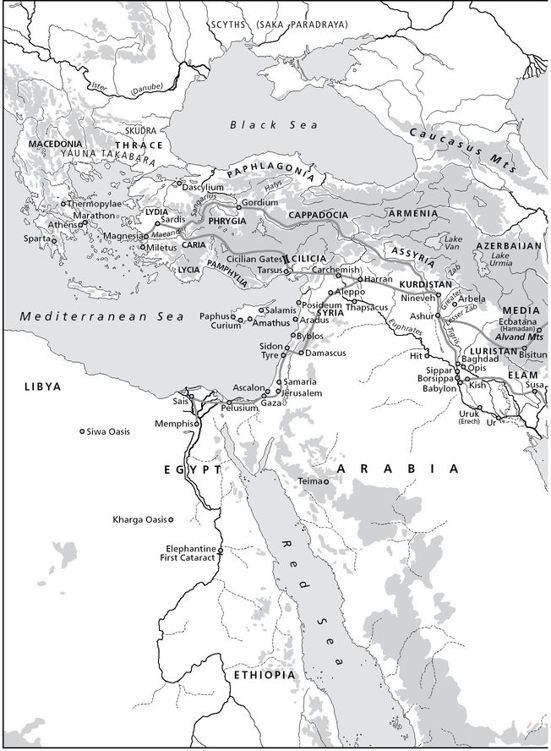

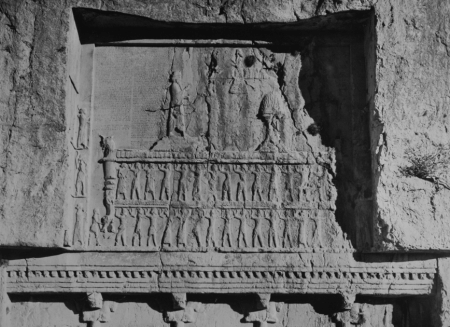
Figure 1.1 Tomb of Darius I, top register, Naqsh-i Rustam. Courtesy of the Oriental Institute of the University of Chicago.
Darius I (reigned 522–486 BCE) ruled the Achaemenid Persian Empire at the height of its territorial extent: from the Indus River to the Danube River and from the western edge of the Himalayas to the Sahara Desert. In its scope and durability, and in its ability to project and maintain its power, the Achaemenid Empire was unprecedented in world history. Its equal was not seen again until the height of the Roman Empire under Augustus and his successors in the first and second centuries CE.
The Achaemenid Empire retained its vitality for over two hundred years (550–330 BCE) and left a massive, if not always readily discernible, imprint on subsequent Near Eastern and European history. To the ancient Greeks, the Persian Empire was an object of fear and fascination: Persia served as the great “Other” from the Classical period onward. The Greeks framed the historical and cultural narratives of the West, and their perspective led to the development of many key East-West stereotypes that persist today.
The Physical Environment
Not surprisingly, an empire that encompassed so much territory (not less than 2 million square miles) included every sort of terrain.1 The central core of the Empire was southwestern Iran – ancient Parsa (Greek Persis), the geographic area synonymous with the name “Persia” that was subsequently applied to the entire country. Parsa, more specifically equivalent with modern Fars, is dominated by the southern part of the Zagros Mountains – a chain running northwest to southeast across western Iran – save for the coastal region along the Persian Gulf and the low-lying plains of Khuzistan, wherein is found the ancient city of Susa. Within the Zagros and its foothills, the scenery and vegetation differ markedly, and temperatures fluctuate between bitterly cold winters and scorching summers. Moving eastward beyond the Zagros one encounters the Iranian Plateau and the forbidding salt deserts of central Iran.
Despite this geographical variety, sufficient annual rainfall allowed agriculture without irrigation in much of Persia, as it did in many other parts of the Empire: northern Mesopotamia (modern Iraq), the Caspian Sea region and Turkey in the north and northwest, and Syro-Palestine (the Levant) to the west. Southern Mesopotamia, a critical component of the Empire, is a different story: irrigation had been necessary since (and indeed an impetus toward) urbanization in the fourth millennium. Other parts of the Empire, notably Egypt, also relied on irrigation. In Egypt, however, the Nile flooded and receded in harmony with the growing season. The Euphrates and Tigris in Mesopotamia flooded at the time of the harvest. A great deal more effort and resources were therefore devoted in Mesopotamia to controlling the flooding of these rivers via irrigation. Success in taming these rivers resulted in a rich agricultural-economy.
Ancient Near Eastern civilizations had been connected by trade for centuries. By the time of the Persian Empire an extensive network had been developed, the maintenance of which was a primary responsibility of the ruling authorities. The main routes ran between Fars (Persepolis) and Khuzistan (Susa) with roads branching in several directions: through Babylon and Mesopotamia northward across Anatolia (Turkey) to Sardis, the famous Royal Road described by Herodotus (see (pp. 111–113), and through the Median capital Ecbatana and eastward across northern Iran, the Great Khorasan Road (better-known as the Silk Road). Similar routes linked the Indus River valley, Egypt and Libya, and all the major centers even in far-flung regions of the Empire. In addition to the land routes, a number of well-traveled sea lanes from India to the Iranian coast and Mesopotamia were also used by the Persians. In the modern territory of Fars in southwestern Iran is the Kur River Basin, home to the Persian capitals of Pasargadae, founded by Cyrus the Great, and Persepolis, founded by Darius I. The remains at Persepolis, approximately 45 miles northeast of the modern city of Shiraz, offer the most eloquent and imposing testimony to the Persian King’s majesty (see pp. 141–145).
The term “Persian” in “Persian Empire” is generally understood to refer to the ethnicity of the ruling elite. The Empire itself encompassed scores of different ethnic groups, each with its own history and culture. Even a superficial accounting of these various groups offers a glimpse into the size and complexity of the Empire, but we possess limited evidence for how most people lived their daily lives. In northern Iran were the Medes, to whom much of Chapter 2 is devoted, and the north and east were home to several other Iranian groups as well: Parthians, Hyrcanians, and Areians, to name just a few. Many of these groups dwelled in what are now the countries of Kazakhstan, Turkmenistan, Uzbekistan, Afghanistan, Pakistan, and India. The fiercely independent Scythians, another Iranian group, dwelled along the northern and northeastern edges of the Empire, on the Eurasian steppes.
Mesopotamia, Syro-Palestine, the Levant, and Arabia were home to various Semitic peoples: Babylonians, Aramaeans, Jews, Phoenicians, and Arabs to name only those most prominent in the extant source material. The Empire encompassed northeastern Africa as well and included Egyptians, Libyans, Nubians, and Ethiopians. The Anatolian plateau and the Caucasus Mountains also contained a variety of peoples; the kingdom of Lydia based at Sardis, in western Turkey, was the main power in the sixth century before Cyrus. Finally, the Greeks of Ionia (western coastal Turkey) and even those of the European mainland figure prominently in this story as well – not least because their experience at the time of the so-called “Greek Miracle” (the Classical Period, c. 500–323 BCE) was shaped so profoundly by the Persian Empire’s impact.
Why “Achaemenid”?
The history of ancient Iran stretches back millennia. Before the advent of Islam in the seventh century CE, it included the histories of not only the Achaemenids but also their predecessors the Elamites and their successors the Seleucids, Parthians, and Sassanians. The Achaemenid Empire takes its name from Achaemenes, the eponymous founder of the dynasty. Specialists continue to debate the relationships and, even to some extent, the ethnic identity – counterintuitive as that may seem – of the early Achaemenid kings.2For Achaemenes, Darius I’s distant ancestor, there is no evidence earlier than Darius I’s testimony. Darius’ privileging of his Achaemenid descent is fundamental to understanding Persian royal ideology.
Cyrus the Great does not mention Achaemenes in his genealogy, and most modern scholars have rejected Darius’ implication that he and Cyrus shared descent from Achaemenes. Although the term “Achaemenid Empire” may be somewhat of a misnomer for the early Persian Empire, especially that period prior to Darius I, it is entrenched in the modern literature and will be used herein. The label also distinguishes the historical period in question and differentiates it from the succeeding Seleucid, Parthian, and Sassanian periods in ancient Iranian history. As the focus of this book is the Achaemenid period, to avoid excessive repetition, when the label “Persian” is used throughout it will be understood to refer to the Achaemenid period unless otherwise noted.
Sources
As is often noted, but bears repeating, ancient historians cannot choose their sources. The issue is not in deciding what sources to use but in assessing the usefulness and veracity of anything available. This does not mean that all sources are created equal, of course. Significant portions of this text are devoted to the problems of historical analysis engendered by the paucity of the sources as well as the tendentiousness of those that are available.
Most of the documentary evidence for the study of Achaemenid Persia – regardless of place or time of origin – was commissioned by the educated elite: members of the ruling class itself, the privileged among the conquered or peripheral regions, or the bureaucratic class of scribes. Economic and administrative documents, coupled with archaeological evidence, often provide vivid pictures of daily life, but these are sporadic and generally localized.3 A brief overview of the main sources follows, by way of an introduction to the variety of evidence available – as well as the problems associated with their use and interpretation for reconstructing Achaemenid history.
Archaeology
Archaeological research in the core areas of the Achaemenid Empire has been uneven. In recent decades, upheaval in the Middle East has periodically made excavation difficult, if not impossible. Several important cities in the ancient Near East have been continuously inhabited from antiquity into the modern period – for example, Hamadan in Iran (ancient Ecbatana), Erbil in Iraq (ancient Arbela), and Damascus in Syria – and excavation opportunities in these areas have been limited, regardless of any political considerations.
In Iran itself excavations have been focused in the western part of the country. In Fars, the Persian capitals of Pasargadae and Persepolis, the two most prominent Achaemenid sites, have received the most attention. The city of Susa in Khuzistan was important for centuries as an Elamite center; it became one of the Achaemenid capitals, the one most frequently referenced in the Greek sources. Recent excavations in the Mamasani district (Fars), in Georgia (east of the Black Sea in the Caucasus Mountains), and other places have provided additional insights into Achaemenid-period settlement as well as the influence and impact of the Empire on local populations. Some of the major cities in Mesopotamia, whose histories stretch back for two millennia or more before the Persian Empire, remained important through the Achaemenid period: Uruk, Ur, Nippur, Sippar, and most notably Babylon, to name only a few. Excavations have continued intermittently at these sites, by teams from various nations, since the nineteenth century.
Proper excavation is both meticulous and laborious, and publication of results may take many years. Excavation techniques have advanced since the nineteenth century, from what may generously be termed as mining operations for luxury goods, monuments, and inscriptions: the types of finds that would garner attention in museums. Modern excavations employ scientific, systematic approaches that are far more expensive and time-consuming, and involve analysis and consideration of every find in situ (i.e., where it was found in the ground, with context). They are replete with technology – computer mapping, ground-penetrating radar – the expense and complexity of which make necessary the formation of teams composed of various specialists. Museums worldwide display the fruits of these excavations, and their storage areas are often bursting with material not yet published or even studied. Researchers in the field often speak, only somewhat tongue-in-cheek, of excavating their own museums to find the as-yet unanalyzed piece of pottery, or the as-yet unread text, that may change perspectives on key problems in the field.
Written Sources
Until the late nineteenth century CE, knowledge of the Achaemenid Empire’s history was based almost entirely on Greek and biblical accounts. To the Greeks we are indebted for western notions of history-writing and historiography. The Persian Empire left an indelible impression on the early Greek historians who chronicled the era, and, through them, on their successors in the Roman period and beyond. Herodotus and Xenophon provide much of the narrative core of Achaemenid Persian history, for better or worse (a bit of each applies). As a function of the Greek source bias, our knowledge of the Empire disproportionately emphasizes the western and northwestern parts of it: western Anatolia (especially the coast, i.e., Greek Ionia) and the Aegean world. Eastern Iran and Central Asia were critical components of the Empire, as a number of references in the sources make clear, but particulars about Persian administration of these regions are scarce. Information about these areas is thus more spotty and speculative.
The Empire’s sheer, geographical scope is reflected in sources from several languages. The diversity of local traditions – oral and written – provides multiple perspectives, as well as frustrations, for study of the Persian Empire. Many of these traditions and the languages in which they were transmitted are poorly-understood, some are simply lost. The historian of the Persian Empire faces a herculean task to gather and sift this disparate evidence. A list of the main languages in which relevant source material is preserved is telling: Old Persian, Avestan, Elamite, Akkadian (the Babylonian dialect), Aramaic, Hebrew, Egyptian, Greek, Latin, and Phrygian. The nineteenth-century decipherments of Egyptian (hieroglyphic script) and Akkadian, Elamite, and Old Persian (cuneiform scripts) opened new vistas for Persian history that are still being explored today, especially for new perspectives on the Greek material that by necessity has formed the narrative base of much of Persian history.
The chronology of main events in Persian history is for the most part well-settled, but new discoveries frequently supplement, and sometimes change entirely, our understanding. Not surprisingly, specialists who study the Persian Empire are found in multiple disciplines: Ancient History, Archaeology, Classical Studies, Religious Studies, Indo-Iranian Linguistics, Assyriology, and Egyptology, among others.
The ancient Persians themselves wrote almost nothing – at least, nothing that has survived – in the way of narrative history. As with many ancient peoples, records of the past were kept alive through oral tradition. These “records” manifest themselves in the written sources in a number of compelling, but often puzzling, ways. It is easy to underestimate, or even ignore, how oral tradition has shaped the historical record, but where its imprint may be discerned and contextualized it is instructive.
Royal Inscriptions and Other Documentary Evidence
From the civilizations of Elam, Assyria, and Babylonia – the Achaemenid Persians’ imperial predecessors – we possess a variety of public and private records. The most common were royal inscriptions and administrative records. Terse chronicles record significant military or building activities of the kings. Not enough of these are extant, however, to enable writing a narrative account. Persian royal inscriptions relay the kings’ ideology, the image of their empire and their rule that they wished to project, and it is for these very reasons that they are among the most important sources for understanding the Empire. They are intentionally formulaic, grounded in the kings’ right to rule absolutely. This type of text situates the Achaemenid kings within a long continuum of Near Eastern history.
Careful analysis of these inscriptions reveals insights into individual king’s personalities and priorities. From Darius I onward, the inscriptions were frequently trilingual, inscribed in three languages, each in a different cuneiform script: Old Persian (an Indo-Iranian language), Elamite (linguistic affiliation uncertain), and Babylonian Akkadian (an eastern Semitic language). The choice of these three languages, and their linguistic variety, testifies to important aspects of royal ideology and tradition. Sometimes an inscription may have been written in other languages (e.g., Aramaic, Egyptian, Greek, or Phrygian), dependent upon location and audience. From Darius I’s reign onward, the royal inscriptions also became rather formulaic; nevertheless, slight differences in wording, emphasis, and occasionally content reveal significant details. Further, important cultural messages may be encoded in the trilingual inscriptions, based upon slight differences in the various versions of the same text; for example, the inclusion, exclusion, or modification of a key word or phrase in the different editions of the trilingual inscriptions may be telling.
A variety of administrative documents also exists. The most common are clay documents written in Elamite or Babylonian cuneiform and parchment documents in Aramaic, the latter in evidence from the utmost corners of the Empire: northwest Anatolia, southern Egypt, and Bactria. Type and content vary, from state archival material to records of private businessmen who contracted with the crown and private individuals. These documents typically reveal more about socioeconomic history than political history, yet thoughtful analysis offers insight into the political as well. They at times provide details about members of the extended royal family and other elites who oversaw a complex and centralized bureaucracy.
Particularly valuable for understanding the central bureaucracy is the important trove of Elamite documents found at Persepolis and dating to the late sixth and early fifth centuries. The Persepolis Treasury and Persepolis Fortification tablets (pp. 103–108) are also notable for the iconographic evidence: the wide variety of imagery preserved is still being tapped by art historians to assess the symbolism and culture of the Persian imperial bureaucracy. Similarly, several private and temple archives from Babylonia offer insights into the workings of the Empire in the provinces. Ongoing study of this vast and varied material continues to supplement and sometimes revise our knowledge of Persian history. Up until 2007 it was considered gospel that the Old Persian script had been used for royal inscriptions only. The discovery of an administrative document written in Old Persian – a document whose significance remains elusive – has forced us to reconsider what had been one of the most steadfast “truths” in Achaemenid historiography.4
Hebrew Bible
Several books in the Hebrew Bible contain important information about Persian administration and its concerns in the Levant. As with any source, the audience and aim of each must be considered. Many Persian kings are portrayed positively in these works, because they are set during the so-called Second Temple period in Jewish history, the era after the Babylonian Captivity in which Cyrus’ conquest of Babylon enabled a return of many Jewish exiles and a restoration of Jerusalem and the temple of Yahweh.
Greek/Classical Sources
Far and away the richest sources – in quantity, if not quality – for Persian history come from Greek and Roman writers. As noted above, the mainland Greeks lived in the shadow of the great Empire. Many other Greeks, in Ionia and the Black Sea region, were its subjects. There was no shortage of commercial and diplomatic exchange between these various Greeks – most of whom, it should be remembered, lived in independent city-states – and other subjects of the Persian Empire in the eastern Mediterranean as well as the Persian authorities themselves. Many Greeks, especially in the fourth century, served as mercenaries in the Persian army. Despite this frequent and varied contact, we cannot rely on Greek writers to present an unbiased view of Persian government, strategy, or culture.
The phenomenon of narrative, written history is traced to the Greeks and mainly to Herodotus, the so-called “Father of History,” who lived and wrote in the mid-fifth century BCE. Herodotus is by far the most important non-Persian source for this study, the main narrative source for the period preceding Cyrus the Great’s rise through the early reign of Xerxes. Herodotus was an Ionian Greek. He hailed from Halicarnassus, a city on the western coast of Turkey (Ionia) that was well-established as a nexus of west-east interaction; it was also subject to the Persian Empire. Well-read and well-traveled, Herodotus was in a position to offer significant insights into the scale and reach of the Empire, and yet as a Greek from the western frontier of the Empire, he was far-removed from the inner workings of the court and imperial bureaucracy. It is difficult, if not impossible, to trace where or from whom Herodotus gained his information. As with any source discussed herein, the modern historian must make informed choices about the reliability of the information presented.
The meaning of the word “history” (Greek historia), as Herodotus used it, was “observation” or “learning,” especially “learning by inquiry.” The task that Herodotus gave himself was not modest: to record the cataclysmic – note that this is from a Greek perspective – confrontation between Greeks and Persians, when the Persians invaded Greece in 480–479 BCE under the command of King Xerxes. This was a watershed moment in Greek and western history, and Greek intellectuals of that period and thereafter could not help but react to it and its impact. The invasion was, incidentally, far less significant for Persian history. But Xerxes’ expedition occupies perhaps one-third of Herodotus’ work. Much of the rest is devoted to developments that preceded Xerxes’ invasion and thus helps to explain how and why the expedition came to be.
Herodotus’ younger contemporaries Thucydides, Xenophon, and Ctesias also authored works helpful to the study of the Persians. The Athenian general Thucydides’ masterpiece chronicles the Peloponnesian War between Athens and Sparta and their respective allies. Thucydides periodically shows keen awareness of the Persians’ influential and important role in the war – in fact, it was Persian financial support that ultimately enabled the Spartan victory in 404 BCE – but his concern is not with Persia but rather with the Greeks themselves. His work is thus not as informative as we would wish for the Persian Empire.
The Athenian Xenophon, who lived at the turn of the fourth century, is known from a number of historical and philosophical works. The Hellenica, essentially a sequel to Thucydides’ history, provides the backbone of our historical narrative circa 411 to the middle of the fourth century. Xenophon also partook in an expedition of Greek mercenaries led by Cyrus the Younger, who attempted to overthrow his brother, King Artaxerxes II, in 401. That expedition failed, but Xenophon’s account of it and the Greek forces’ return (entitled Anabasis, usually translated as “the March Up Country”) is an important source for that turbulent period of Persian history. It likewise contains much of import for the historical geography of the ancient Near East. Xenophon’s Cyropaideia (“the Education of Cyrus”) is a quasi-historical novel and disquisition on leadership that reflects the Greek fascination with the founder of the Empire, Cyrus the Great. It adds little to our understanding of the history of the period but continues to be mined for social and cultural insights about the Persians.
Another Ionian Greek, Ctesias of Cnidus (a city on the southwestern coast of Anatolia), served as a doctor in the Persian court for over a decade early in the reign of Artaxerxes II, which makes him a rough contemporary of Xenophon. Only fragments and summaries of his Persica – a monumental work tracing the histories of Assyria, Media, and Persia to this time – have survived. This mostly-lost work was extremely influential in antiquity, but what remains is in many ways disappointing. As a historical text, defined by modern standards, it is lacking in accuracy and overemphasizes the sensational – surely part of the reason for its popularity. Ctesias’ reputation, despite his work’s influence, was less than positive, and this outlook has also colored how modern scholarship views his extant work. However, used judiciously, his work also offers many potential insights into Persian history, culture, and court life.
Later writers such as Diodorus Siculus (first century BCE) and Plutarch (c. 100 CE) contain information to fill gaps in the narrative history, though their accuracy and reliability must also be qualified. Other Greek writers, whose works survive only in fragments or quotations by other authors, also provide information on the Persians. Names such as Deinon and Ephorus (both fourth-century BCE writers) will occasionally be referenced herein. Likewise, tragedy, such as Aeschylus’ play The Persians; philosophy, oddments from Plato’s and Aristotle’s works; geography, such as Strabo’s work; and scraps from other genres also provide useful information, but with the same caveats as noted above. The so-called Alexander historians, those who traveled with Alexander the Great during his conquest of the Persian Empire in the 330s and 320s BCE, are also noteworthy. Their works have not survived directly but were tapped by later Roman writers such as Quintus Curtius Rufus (first century CE) and Arrian (second century CE).
Writing Achaemenid History: An Excursus on the Use of Greek Sources for Persian History
It is no accident that many Greek writers other than Herodotus were obsessed with the Persian Empire. Because of the Persian Empire’s enormous resources and reach, even the Greeks of the mainland had to consider its policies, as represented by the western satraps (governors). Most often, Greek views of the Empire were suspicious or downright hostile, colored by the stereotypical Greek denigration of “the Other” (non-Greeks), which made the Persians the prototypical barbarians. This is more than slightly ironic when one considers that the Achaemenid Persians were the rulers of a world empire, heirs to – and innovators within – Near Eastern political and cultural traditions that dated almost two thousand years before the Greeks developed writing. The Greek wordbarbaros was initially a label for non-Greeks – specifically those who did not speak the Greek language – and who were, because they were not Greek, inferior.5 If one could imagine a situation where no Greek sources were available, it is interesting to speculate how modern scholarship would interpret the Greeks as displayed at Persepolis or the tomb reliefs, from the Persian perspective alone: rustic barbarians with goofy hats?
An overview of the Persian Empire must rely on generalizations. Thorough, critical examination of each piece of evidence, with contextualization of its inherent problems, would move far beyond the scope of this book. There are many specialist books and articles that continue to grapple with the details of Persian history, some of which are cited in the footnotes and recommended readings. The reader is asked to keep in mind that the interpretations put forward here are no more than an introductory word. Every source that tells us something about Persian history, from all the various categories above, must be scrutinized for its accuracy, or when we lack supporting evidence – which is often the case – for its potential reliability.
An example from Herodotus may prove useful in this regard. He wrote his history, and notably read excerpts of it aloud to live audiences at Athens and elsewhere, in the late 430s and 420s BCE, a bitter and bloody period of Greek history in the initial stages of the Peloponnesian War. Herodotus invoked what in his view was clearly a better time: that time when much (but certainly not all) of the Greek world united against the overwhelming might of Xerxes’ invading army, and by so doing the Greek way of life, its values and its institutions, had prevailed against all odds.
As the so-called “Father of History,” he holds pride of place in the development of that discipline, but “history” to Herodotus and others held a different meaning than it does for us. Writing two generations after Xerxes’ invasion (in 480–479 BCE), Herodotus had access to eyewitnesses of the invasion, but for those periods that came before – the reigns of Cyrus, Cambyses, and Darius – he was reliant mainly on what his sources told him. As a public performer, Herodotus also knew the value of a good story and did not hesitate to tell one. Ultimately, then, the line between historical fact and hyperbole often seems blurred. It is this line that has preoccupied much of modern scholarship on Herodotus. He was not naïve, but he relayed the information given to him, often with a skeptical aside, and left it to his readers to decide. Some of his accounts of Persian customs seem bizarre and yet others echo, sometimes only faintly, important themes highlighted in the Persian kings’ own royal inscriptions. Regardless of the means of transmission, it is difficult to view this as a coincidence.
Herodotus was a product of his times, the great intellectual milieu of the fifth-century Greek world, and his work is replete with its elements, for example, interest in medicine, the ordering of the natural world, ethnography, and the relationship between human and the divine. His work is not a loose collection of random accounts and observations but contains a clearly-demonstrable pattern in its arrangement. This makes his history as much a literary achievement as a historical one, but it makes the modern historian’s task that much more complex. For example, Herodotus relates that, at a critical moment in Cyrus the Great’s expansionist campaigns, it is the defeated Croesus, once king of Lydia and subsequently Cyrus’ “wise advisor” (one of Herodotus’ favorite literary character-types), who counsels Cyrus to make the fateful move across the river Araxes to engage his enemy. This reminds the reader to consider that it was Croesus’ own hubris in crossing the river to engage the Persians that brought about his defeat by Cyrus (see pp. 39–42). Did this actually happen as Herodotus tells it? Did Croesus become, in truth, an advisor of Cyrus who, in this case, gave Cyrus bad advice as a “payback” for his own defeat? Or was this entire episode an embellishment on Herodotus’ part, to emphasize a literary motif? Or is the truth somewhere in the middle? It is these sorts of questions that must be considered time and again in examination of our sources for Achaemenid Persian history.