
2
Iranians into Iran
The Persians were one of many groups of Iranians, who were often demarcated by tribes.1 Based on assessment of archaeological evidence, scholars believe that Iranian migrations into western Iran may have begun as early as 1500 BCE. The kingdom of Elamwas dominant during that time in western Iran, and we have little firm information on the Persians until several centuries later. Archaeologists emphasize how difficult it is to equate specific types of evidence (e.g., a particular style of pot) with specific groups of people. We can only generalize about the earliest migrations of Iranians into the land that would ultimately bear their name. Even some of the most basic questions remain contentious among specialists, such as which route or routes the Persians took into and through Iran. For much of twentieth century, it was held that Iranian migration occurred mainly through the Caucasus Mountains, west of the Caspian Sea. More recently, new discoveries in conjunction with reassessment of old evidence have identified an eastern route as more likely.
Research in ancient Bactria – an area that encompassed modern northeastern Iran, northern Afghanistan, and parts of Turkmenistan and Uzbekistan – has uncovered remnants of an advanced, Bronze Age society that flourished in the centuries around 2000 BCE. Various sites in this area provide evidence of irrigation farming and monumental architecture, markers traditionally associated with early urbanization. As a whole, this area is called the Bactria-Margiana Archaeological Complex (BMAC) or the Oxus Civilization, for the Oxus River (the Amu Darya) that runs through the region. Margiana was the name of Bactria’s neighbor in ancient Iran. It is a matter of ongoing debate whether various Indo-Iranian groups were some of the original inhabitants of the BMAC; whether they simply passed through – over decades, if not centuries – on their way to the Indian subcontinent or to Iran; or whether they had nothing to do with any of it.2 The linguistic and cultural affiliation between the various Indo-Iranian groups is well-established, but specifics regarding their settlement in Iran remain obscure.
The Persians first appear in the written record of the ninth century BCE, from the reign of the Assyrian king Shalmaneser III (reigned 858–824 BCE). Shalmaneser III and his successors frequently raided territories in the central western Zagros Mountains northwest of the modern Mahidasht, home to Persians and various other Iranian groups. By the middle of the eighth century, the Assyrians had created a formal province of Parsua and controlled the area until Assyria’s fall in the late seventh century. Tracking the movements of the Iranians in this period seems a hopeless task; we have no sources from them and few references to them. Assyrian royal inscriptions and official correspondence refer to this region only in the context of military raids, receipt of tribute, or other administrative matters relating to the region’s government by Assyria.
The connection between the Persians of the central Zagros and the Persians of southwestern Iran (Fars), the later core of the Achaemenid Empire, is unclear. If migrations continued, in the mid-first millennium from northeast to southwest along the Zagros chain, it is not evident in the available sources, nor have clear traces of such migration been found archaeologically. Some archaeologists consider pottery from the Achaemenid period (found at the major sites of Susa, Pasargadae, and Persepolis) to be stylistically linked to earlier pottery, dating as early as circa 800 BCE, from the Zagros. To date, no compelling explanation has been advanced to explain this linkage, beyond the reasonable – yet unsubstantiated – assumption that at least some migrating Persian groups brought the style with them when they migrated to Fars during the course of the seventh century. But this hypothesis has not found widespread acceptance.
We thus have Persians attested separately in the central Zagros and in Fars, with the former attested somewhat earlier. It is difficult to imagine a large-scale migration through the Zagros Mountains over the course of the seventh and sixth centuries, but it cannot be ruled out. If there was such a movement by Persians who once lived under the Assyrian aegis in the Zagros, this migration may have been one source of the transmission of cultural conventions between Assyria and Persia, such as elements of imperial ideology. An alternative is that two separate groups of Persians migrated into the central Zagros and into Fars, respectively, during roughly the same period in the first half of the first millennium BCE.
Elam
Elamites were, as far as we can tell, the earliest inhabitants of southwestern Iran. The geographic term Elam comes from Hebrew  êl
êl m, and Akkadian Elamtu, to describe the land that the Elamites themselves called Haltamti. Elamite civilization may be traced to the fourth millennium BCE, roughly contemporary with the earliest Sumerians in Mesopotamia, modern Iraq. The acculturation of Elamites and Iranians, especially the Persians and Elamites of Fars, is a major factor in the rise of the Achaemenid Empire, but it is a phenomenon that is not obvious in the available sources. One needs to dig beneath the surface, both literally and figuratively, to discern it. The lack of appreciation of Elamite influence on the Persians stems in the main from the relative paucity of Elamite material and the difficulties associated with its study. This lack has only begun to be rectified in the last generation of modern scholarship. Figure 2.1 is one such example, a procession portrayed at a long-standing Elamite shrine that scholars have compared to similar processions portrayed at Persepolis.
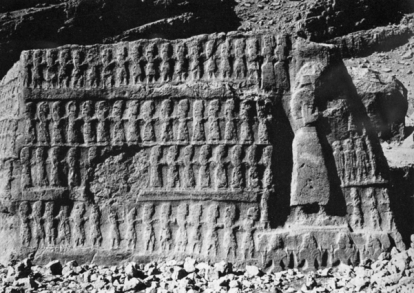
Figure 2.1 Elamite rock relief from Kul-e Farah, Izeh, Iran. Courtesy of D. T. Potts.
It is the Elamites who dominate the landscape of the historical period in southwestern Iran, until the Medes and Persians established themselves in the mid-first millennium. Khuzistan and Fars appear to have been the main areas of Elamite settlement. That statement must be qualified, because excavation in eastern Iran has been relatively limited. The Elamite language has been deciphered, but its vocabulary and grammatical elements are less well understood than other languages written in cuneiform scripts, such as the Akkadian used by Elam’s neighbors in Assyria and Babylonia. The corpus of surviving Elamite texts is not nearly as large, and for many periods we lack bilingual texts, which are so critical in cracking a language’s code. Further, the Elamite language has no clear linguistic relatives to aid translation.3 Elamite has therefore not been subjected to the same intensity of analysis as Akkadian or Sumerian.
Through the second millennium, the center of Elamite civilization appears to have been in Fars, specifically the city of Anshan, approximately 30 miles west of the future Persian capital Persepolis. Yet the city of Susa, in Khuzistan, is the most visible city, thanks to over a century’s worth of archaeological work there that began in the late 1800s CE. Susa was on the eastern edge of the Babylonian flood plain, and as a consequence its history was intertwined with its Mesopotamian neighbors from its beginnings. Its importance persisted into the Persian period, when it became one of the Persian capitals.
Around 1000 BCE, Anshan was abandoned. In the roughly 150 years previous, the Elamite kings, who had styled themselves in their royal titles “King of Anshan and Susa,” were at the height of their territorial power and ambition. They even ruled Babyloniafor a time in the mid-twelfth century. The written record falls silent shortly thereafter until the eighth century. A large part of the problem in studying Elamite history in Fars during the so-called Neo-Elamite period (c. 1000–550 BCE) is that large-scale settlement there cannot be traced again until the Achamenid period, four centuries later. The most likely reason for the gap in the archaeological record is that semisedentary pastoralism became the dominant way of life during this period. In addition, only a small part of Anshan has been explored. Our assessment of this and many other areas may change dramatically as archaeological excavation proceeds.
It is ironic that the period circa 750–650 BCE is the most well-known of Neo-Elamite history, because the vast majority of documentary evidence for Elamite political history is of Assyrian origin, Elam’s rival and nemesis. Assyrian kings left extensive narratives of their military achievements (the royal annals), many of which detail campaigns against Elam. Specialists are still working through these and related materials, many of which were found in the nineteenth-century excavations, and there is much work to be done. The record is much thinner from Elam itself: a smattering of royal inscriptions (most from Susa) that are poorly understood and lack the detail and flourish of the Assyrian annals. We are thus reliant upon the perspective of Elam’s enemy for assessment of Elam’s history. Beneath the political and economic rivalries (e.g., for control of the important trade routes through the Zagros Mountains), however, was a rich network of cultural ties – including close links between the Assyrian and Elamite royal families of the seventh century. It must be recalled that the histories of Elam and Mesopotamia (Assyria in the north, Babylonia in the south) had been intertwined for centuries; it was not until the rise of the Achaemenid Empire that all these regions were brought under one rule for more than a brief period. Indeed, the history of the seventh and sixth centuries is marked most frequently by Assyria’s problems with Elamites and Babylonians, the latter two often working in tandem to thwart Assyrian ambitions. Assyrian sources reveal that the Elamites had great influence, if not direct control, over many of the various Aramaean and Chaldean groups living in southern Mesopotamia.
One of the most powerful Neo-Elamite kings was Shutruk-Nahhunte II, who ruled from 717 to 699 and from whom we have the most Elamite inscriptions. He used the royal titles “King of Anshan and Susa” and “expander of the realm.” Shutruk-Nahhunte’s actual political reach, circumscribed by Assyrian power in the west, may not have approached that of his forebears in the second millennium, but his royal titles give insight into his aspirations. Shutruk-Nahhunte’s success against Assyria provided a severe check on the latter’s hold of southeastern Babylonia and the central Zagros in the late eighth century. Shutruk-Nahhunte’s successors through the first half of the seventh century continued to challenge Assyria. By this time, though, the most consistent fighting occurred along the Elamite-Babylonian frontier, and the Assyrians generally held the upper hand in the border zones of the central Zagros Mountains. Yet the necessity of frequent military activity against Elam in Babylonia and its southern reaches reveals that Assyria, even at the height of its power under the Sargonid kings (see discussion later in this chapter), never effectively quieted the region. This assessment is based on Assyrian sources; the Elamites would have had a different spin on this running conflict.
Major Assyrian campaigns against Elam occurred with increasing frequency as the seventh century progressed from every few years to almost annually. In 653 BCE tensions between Elam and Assyria flared at the Battle of Til Tuba, along the Ulaya River in Khuzistan. The Assyrian victory was memorialized in an elaborate palace relief sequence at Nineveh and in numerous inscriptions.4 These reliefs are on display at the British Museum and acquaint the casual viewer – via depictions of humiliation, torture, and slaughter of enemies – with the cruelty for which the Assyrians were infamous. It may be countered, however, that the Assyrians were not much different than their predecessors and contemporaries in the ancient world. Their public relations were simply more compelling.
Much of the decade after the Til Tuba campaign was marked by more forceful and direct Assyrian involvement in Elamite affairs, to little positive effect. A rapid succession of kings reflected the resulting instability in Elam in the late 650s and early 640s. The political chaos did not reduce Elamite-Assyrian friction, so in 646 Ashurbanipal launched another campaign against Elam. This one resulted in the sack of Susa that, according to the Assyrian accounts, leveled the city. The devastation, while not atypical, is relayed in dramatic detail: treasuries were emptied, temples plundered and destroyed, previous kings’ graves exhumed and their corpses dishonored, and countless livestock and people removed to Assyria. It is difficult to assess the accuracy of this type of description. The victor certainly exaggerates, but beyond the hyperbole, we know that that was far from the end of the story for Susa. Scattered evidence reveals that several Elamite kingdoms in Khuzistan and Fars persisted into the sixth century. It is in this milieu that the earliest Persian kings, Cyrus the Great’s predecessors, must be located.
Assyria
The Assyrians were a Semitic-speaking people who dwelled in northern Mesopotamia, part of modern Iraq. Their history may be traced for centuries from the late third millennium BCE. The major cities of Nimrud (ancient Calah or Kalhu) and Nineveh were the two main Assyrian centers in the ninth through seventh centuries, and the nineteenth-century excavations at these places proved seminal in founding the modern discipline of Assyriology. Thousands of tablets, most famously from the Library of Ashurbanipal at Nineveh, provide continuing insights into Assyrian history and civilization. The Epic of Gilgamesh, the Epic of Creation (Enuma elish), and a variety of other famous myths and legends were uncovered there. In addition, once the cuneiform script was deciphered, a wealth of sources for the history of this period also became accessible: royal inscriptions and annals; correspondence between the king, his officials, and foreign dignitaries; cultic and omen texts detailing aspects of Mesopotamian religion and ritual; and administrative and legal texts revealing – in sometimes mind-numbing but massively useful detail – the bureaucratic workings of empire, temple, and even private commercial interests.
By the time of Tiglath-pileser III (ruled 744–727 BCE), the Assyrians were embarking on a new, imperial phase, one that would make them the largest empire to date and offer a model – ideological and organizational – for the much larger Achaemenid Empire to come later. Assyria reached the height of its power and territorial aspirations in the late eighth and seventh centuries under the Sargonid kings: Sargon II, Sennacherib, Esarhaddon, and Ashurbanipal. The Assyrian Empire controlled or held tributary large areas of south central and southeastern Turkey (Urartu), northwestern Iran (various Iranian groups), Babylonia, Syro-Palestine (Israel, Judah, Phoenicia, and other small kingdoms), Cyprus, and, briefly, Egypt (Map 2.1).
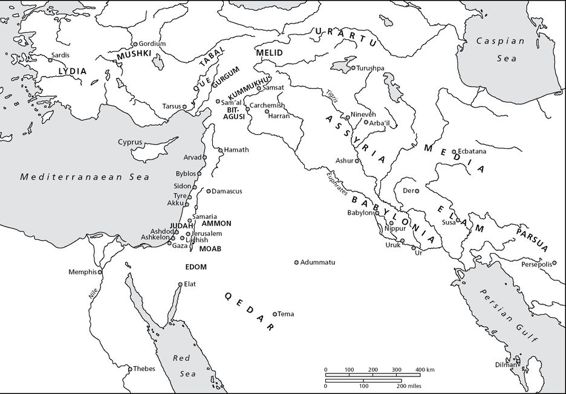
Map 2.1 Assyria and its neighbors. After Cambridge Ancient History, Vol. 3, Part 2, Second Edition, 1992, map 3.
Many of the Assyrian inscriptions (especially the royal annals) detail the king’s military campaigns, and they make manifest the king as the gods’ agent who was a moral force, both required and expected to punish enemies and, as a consequence, expand Assyrian territory. How much of this imperial narrative is meant to be taken literally is open to question. It is easy in our day to attribute too much cynicism to Assyrian or Achaemenid Persian claims of divine sanction for military activity and the horrific punishments meted out to defeated enemies. As far as we can tell, though, the Assyrians and other peoples of the ancient Near East took these depictions with utmost seriousness.
Babylonia
Babylonia is the geographic term for southern Mesopotamia. The Babylonians, like the Assyrians in the north, were a Semitic-speaking people, who used a slightly different dialect of Akkadian than the Assyrians, though by the eighth century BCE the Aramaic language was becoming the lingua franca of the ancient Near East. The Babylonians constituted various Chaldean and Aramaean tribes, some living in the old urban centers and others in the rural areas, all differing in their level of political organization. Throughout this region’s long history it was no small task to keep it under one rule.
The Babylonians placed great store in being the cultural heirs of the Sumerians: the originators of civilization centered in the ancient cities of Ur, Uruk, and Nippur. Babylon itself was younger than these cities but had risen to prominence in the second millennium and retained its august position through the Achaemenid period. Sources for the study of Neo-Babylonian history are similar to those for the Neo-Assyrian Empire. Babylonian royal inscriptions focus on the building and cultic activities of the kings more than on their military deeds. Temple and private archives are in such abundance, however, that the minutiae of some temple households may be tracked at an amazingly detailed level. Records kept in these sanctuaries, from Babylon itself and other majorcities, show a level of continuity in the administration and functioning of these organizations even into the Achaemenid period and beyond.
The Neo-Babylonian Empire’s relations with Syro-Palestine and Egypt may be sketched with some confidence, but the situation on its eastern front remains opaque. What of the Medes, who, with the Babylonians, brought about the downfall of Assyria? What of the Elamites, frequent close partners with Babylonia against Assyria at its height? For that matter, what of the Persians themselves during this period, only a generation or two before Cyrus the Great? Answers to these questions remain frustratingly elusive. From Assyria’s overthrow (610s BCE) until the reign of the Neo-Babylonian king Nabonidus (556–539 BCE), there is minimal evidence for the political situation in western Iran. The first half of the sixth century remains almost blank.
A Babylonian priest of Marduk, whose name in Greek was Berossos, wrote a history of Babylonia in Greek during the reign of the Seleucid king Antiochus I, within a generation of the Achaemenid Empire’s overthrow by Alexander the Great of Macedon in the late 330s. Berossos (Fragment 8b) recorded a tradition that the Babylonian king Nebuchadnezzar married a Median princess, Amytis, the daughter of Astyages. This marriage would have occurred in the late 610s, as Babylonian and Median pressure on Assyria intensified. Presumably, however, Berossos meant Cyaxeres not Astyages, because Cyaxeres was king of the Medes at that time. Astyages was the last Median king, defeated by Cyrus. The word “presumably” is used, because Berossos’ confusion makes the tradition suspect, and some scholars reject it as fiction. A lone reference, written three centuries after the fact, does not often inspire confidence, but the study of ancient history is filled with similar examples. What if Berossos’ account is true, or contains an element of truth? This might explain the lack of references in the Babylonian tradition to any Babylonian-Median strife, because, in light of a marriage alliance that had done its job, there may have been none. On the other hand, a lack of evidence for conflict does not mean that conflict did not exist. This story reminds us that we have much to learn; discoveries from one site or even of one text may radically change our understanding.
Another piece of Greek evidence also gives pause. The Athenian Xenophon, writing in the early fourth century (roughly one hundred years before Berossos), chronicled his adventures with a Greek mercenary army aiding Cyrus the Younger’s revolt against his brother Artaxerxes II. Xenophon makes a passing reference (Anabasis 2.4.12) to a “Median Wall,” a line of fortifications purportedly built by Nebuchadnezzar that stretched between Sippar and Babylon. Xenophon provides no information about its purpose, but the label itself has been taken to imply a Median threat. Some of Nabonidus’ inscriptions about the Medes, whom he labeled with the pejorative Akkadian term umman-manda (translated as “horde” or the like), suggest a potential threat in the 550s. But, as Nabonidus’ inscriptions further relate, that potential threat was neutralized by Cyrus and the Persians’ defeat of the Medes.
Anatolian Kingdoms
Phrygia
After the fall of the Hittite kingdom in the twelfth century BCE, little is known of Anatolian history until well into the first millennium. The most important kingdoms for our purposes were Phrygia (north central and northwestern Anatolia), Urartu (east and southeastern Anatolia), and Lydia (central western Anatolia). The first of these two kingdoms are mentioned with some frequency in Assyrian sources of the eighth and seventh centuries. Phrygia is sometimes confused with Lydia in modern literature, but they were distinct kingdoms. Little is known of Phrygia’s origins in the “dark age” after the Hittite kingdom’s collapse, but by the eighth century Phrygia, from its main center Gordion, had encompassed the old Hittite capital of Hattusha (modern Boghazkoy). The Assyrians called this kingdom Mushki, of which a vague echo is preserved in the Greek myth King Midas of the Golden Touch.
Urartu
The kingdom of Urartu was a rival of the Assyrians from the eighth century until the end of the Assyrian Empire. Urartian royal inscriptions are similar to those from Babylonia and Elam, that is, they focus on the king’s building activities and his piety to the gods. We rely mainly on Assyrian accounts for reconstruction of much of Urartu’s political history, what little there is known of it. Migrating Cimmerians and Scythians in the early seventh century wreaked havoc in Urartu, as Assyrian sources attest these groups did in many areas throughout the ancient Near East. A broken reference in a Babylonian source suggests that Urartu persisted as an independent entity until the time of Cyrus, when it was incorporated into the Persian Empire.
Lydia
The kingdom of Lydia is known to us mainly through the Greek historian Herodotus’ account in Book I of his history. Herodotus starts with Lydia because of its rule of the Ionian Greeks, both Lydia and Ionia later subsumed by the rising Persian Empire. Herodotus’ history of Lydia, like that of the Medes, contains much of interest to the historian, but it must be considered more legendary than factual. That does not mean, however, that it is entirely fabricated. There is some external corroboration for the Lydian royal house. According to Herodotus, a Lydian courtier by the name of Gyges deposed the king Candaules, married Candaules’ wife, and founded a new dynasty. Herodotus’ Gyges has been identified with a king of Lydia, Gugu, in one of the Assyrian king Ashurbanipal’s inscriptions.5 Gugu’s messenger was dispatched to Nineveh to seek assistance against the continuing Cimmerian incursions of the mid-seventh century. Ashurbanipal’s inscription emphasizes the wonder that accompanied Gugu’s messenger: the distance from which he came (Sardis, in western Anatolia) and the fact that no one at the Assyrian court could understand a word he said. By the time of the Achaemenid Empire, the world had grown smaller; Lydia and other Anatolian territories were administered by Persian satraps, and Sardis was the western edge of the so-called Royal Road. Ashurbanipal’s wonder at Gugu’s message underlines the great distances and diversity between various regions that were later unified under Achaemenid power.
Classical sources indicate that Lydian power was at least in part based on gold panned from the Pactolus River that ran through Lydia. Many of the Greek city-states of western Anatolia (Ionia) were brought under Lydian rule, and Lydian kings’ donations to Greek sanctuaries – especially those of the last king, Croesus, to Delphi – also were the stuff of legend. Croesus sponsored not only Delphi but several other sanctuaries as well, including the famous Temple of Artemis at Ephesus. That temple was destroyed in a fire in the late fourth century but rebuilt; the new Temple of Artemis was designated one of the Seven Wonders of the World. Archaeological finds at Ephesus and elsewhere in Ionia confirm the intensive mingling of Greek and Lydian styles that remained typical throughout the Achaemenid period.6
Expanding Lydian influence brought Lydia into conflict with the Medes, a struggle that culminated in a standoff at the so-called Battle of the Solar Eclipse in the year 585. Here is another instance where it is difficult to separate fact from fiction in Greek accounts of this period. Herodotus set the stage for this conflict with his tale of Scythian guests at the Median court of Cyaxeres. The Scythians ran afoul of their benefactor, and, stung by Cyaxeres’ insults, they slaughtered and served as dinner (unbeknownst to Cyaxeres) a Median boy, after which they fled to Alyattes, Gyges’ great-grandson, in Lydia.7 Alyattes’ refusal to hand over the fugitives led to war. The culminating battle took its name from the solar eclipse that occurred during it, an event so momentous – and one considered of such ill omen – that the combatants ceased the war and negotiated a peace. According to Herodotus, though the names and geography appear confused, the kings of Cilicia and Babylonia (the former perhaps subject to the latter) served as witnesses and the treaty was sealed by a dynastic marriage: Alyattes’ daughter Aryenis was married to Cyaxeres’ son Astyages.
The Medes
No documentary evidence from the Medes themselves has been found. Few confidently identified Median sites have been excavated, and many questions remain about those that have been. Simply identifying a “homeland” of the Medes is a difficult task. The modern city of Hamadan, ancient Ecbatana, served as a capital, which we know from later traditions about Cyrus the Great’s victory over Astyages. Median settlements are mentioned in Assyrian sources, starting from the ninth century, throughout the central and northern Zagros Mountains, especially along the Great Khorasan Road towards modern Tehran.
We are thus beholden to Herodotus’ account of the rise and organization of the Median Empire, although he was not unique in his consideration of the Medes’ importance. Despite the problems with Herodotus’ portrayal, until recently it had been generally accepted – at least in outline – as an accurate rendition of the Medes’ rise to power. It has thus served as the basis for the picture of the Median Empire that is so prominent in modern scholarship. This is despite its clearly literary elements, and despite the fact that it is hopelessly conflated chronologically. In other words, Herodotus’ account of the Medes must be considered more legend than history. Nevertheless, read carefully, Herodotus has things to teach us about the Medes. If for no other reason than a lesson in historiography, a sketch of Herodotus’ telescoped tale (1.96–106) is useful.
A Mede named Deioces had designs on taking power, and he took advantage of the general lawlessness of the land. His reputation for justice brought more and more Medes to him to settle their disputes. As his influence grew, Deioces then stepped back; he refused to neglect his own affairs for the benefit of others. When lawlessness soon increased, the Medes decided to make Deioces their king. Once he had accepted the job, Deioces insisted on a bodyguard of spear-bearers and a fortified capital: Ecbatana, constructed with multiple walls, two of which purportedly had battlements plated in silver and gold (1.98). Deioces consolidated his position and then removed himself from sight, thereby making himself exceptional and emphasizing the august status of the king. He further secured his position by implementing certain behavioral protocols, for those few who did gain audience, and by establishing a network of spies and informers. This description matches in theme and outline accounts of the rise of tyrants in Greek city-states, though taken to another, grander level. With regard to the king’s exceptionality and the behavioral protocols, historians have noted the parallels with the later Achaemenid court, or rather, the Greeks’ stereotypical image of it. Many scholars thus take for granted the literary quality of Herodotus’ account of Deioces’ rise.
To resume the story, Deioces’ successor Phraortes subjugated the Persians and battled the Assyrians. Herodotus then notes a Scythian invasion, which put on hold (for twenty-eight years) the reign of Cyaxeres, who was Phraortes’ successor. Despite numerous ingenious attempts, modern scholars have not been able to reconcile large-scale Scythian invasions anywhere in the Near East in the late seventh century BCE. Assyrian evidence testifies to the Scythians’ and Cimmerians’ threat roughly a generation earlier, during the reign of Esarhaddon. But there is no Assyrian or Babylonian evidence for a “Scythian interlude” during Cyaxeres’ rule of the Medes. If this interlude is not simply a literary device, which is the most likely explanation, it seems that Herodotus or his sources conflated the history and chronology of this part of the narrative.
It is important at this point to extend the discussion of the early Medes beyond Herodotus and the Greek tradition. In the last decade, an increasing number of scholars have come to assert that even the outline of Herodotus’ account of the Medes, not just the particulars, is inaccurate. With an increase in the accessibility of Assyrian information on the Medes, reconsiderations of this important people and their place in ancient Near Eastern history are currently underway. Assyrian royal inscriptions and correspondence of the eighth and seventh centuries, until circa 650, provide a wealth of detail about the Medes and their interactions with Assyria. Some patterns have emerged.8 First, the Medes mentioned dwelled in fortified settlements, each headed by a city-lord (the Akkadian term b l al
l al ). Assyrian incursions into Median territory were undertaken to control important commercial routes and to capture horses, for which the Assyrian appetite – to ride, not to eat – was insatiable. There is a striking consistency in Assyrian texts in descriptions of Medes as horsemen, and on sculptures of Sargon’s palace at Dur-Sharrukin (modern Khorsabad in Iraq) the Medes are all portrayed with horses. By the end of the eighth century, many areas, especially along the Great Khorasan Road, that the Assyrians identified as “Median” were incorporated into the Assyrian Empire. The Median city-lords of these now Assyrian-held territories were bound to the Assyrian king by loyalty oaths. Evidence for the Medes becomes sparse during Ashurbanipal’s reign (669–c. 630 BCE). It is precisely in that period in which we would expect to find a fledgling Median Empire, if such an empire existed. But Assyrian sources for the three decades before Assyria’s collapse in the 610s are thin in detail, which makes historical assessment problematic.
The Assyrian evidence is not easily reconciled with the Greek tradition. Through the mid-seventh century, there is no indication of a centralized, Median authority, that is, a sole king, one who could be equated, for example, with Herodotus’ Deioces. Modern scholars have attempted to identify some Medes named in Assyrian sources with those of early Median kings mentioned in the Greek tradition. Median local rulers Dayukku (late eighth century) and Kashtaritu (early seventh century) have been equated with Herodotus’ Deioces and Phraortes, respectively, but beyond the linguistic gymnastics involved the historical context of each does not offer a good fit. Even if Dayukku and Kashtaritu left an imprint on subsequent Median tradition through oral traditions long since lost, there is no way to forge the two perspectives, Assyrian and Herodotean, into agreement.
What remains in the dark is the critical period circa 650–550 BCE, when the Medes were at the height of their power. It remains unclear how we are to move from Assyrian descriptions of the Medes as seemingly independent city-lords to the Medes as a unified force that Cyaxeres (Umakishtar in the Babylonian sources) was able to unleash against Assyria with such devastating effect in the 610s. Recent approaches have postulated that the Medes were the leaders of a large coalition of mostly Iranian peoples from across northern Iran, a coalition unified by a forceful personality such as Cyaxeres and only for the purpose of defeating Assyria. This coalition, in conjunction with the Babylonians, was successful at that task, but afterwards the coalition splintered. If this reconstruction is accurate, it remains to be reconciled with accounts of the Medes as a major power through the first half of the sixth century, an impression given not only by Greek sources but one alluded to in Babylonian and biblical traditions (such as Jeremiah 25:25–26 and 51:27–28) as well.