
5
Darius Triumphant – Bisitun Revisited
Darius’ victory in 522–521 BCE was by no means a sure thing. The Bisitun Inscription makes plain the widespread extent and ferocity of the resistance Darius faced. Darius repeated several times (DB §56, §57, §59, and §62) that he accomplished the defeat of the nine rebels in “one and the same year,” though his own dating seems to belie this claim: Gaumata was slain in late September 522, and Darius’ generals were still subduing the last of the rebels in December 521. A great deal of scholarly ingenuity has been applied to reconciling Darius’ statements.1 Rather than insist on the literal truth – which is not a vain enterprise, because Darius himself makes much of it – one might instead ask why the “one and the same year” was so important to Darius that he made the claim. In the end, it was another way to solidify his legitimacy: by divine favor (of course), by descent (exaggerated), by fitness to rule (standard for any king), and by military might (ultimately, the key element).
As always, one must examine earlier traditions for parallels, of which there are many. The “nine kings in one year” motif occurs several times in the Akkadian king Naram-Sin’s inscriptions, more than sixteen centuries earlier. Darius tapped into an ancient convention. Part of the Persian genius lay not only in their successful co-opting of the past but also in their innovations based on it. The Persians had great respect for their Mesopotamian and Elamite forebears, and they borrowed (and modified) both textual and iconographic modes of expression. The Bisitun relief’s imagery hearkens back to elements of the stele of Naram-Sin (reigned c. 2213–2176), among many others (Figure 5.1). Naram-Sin’s stele had been plundered from Sippar in the early twelfth century by the Elamite king Shutruk-Nahhunte I, who took it to Susa and added his own inscription in Elamite. The stele was found in Susa by Jacques Jean Marie de Morgan during his excavations at the very end of the nineteenth century. A separate statue plinth also found in Susa bears an inscription of Naram-Sin in which he referred to his victories in nine battles in one year.2 This antiquarian connection appealed to the Persian kings as much as it did to their predecessors. It is possible that these monuments were on display at Susa in Darius’ time and, if so, they would certainly have had an impact on him.
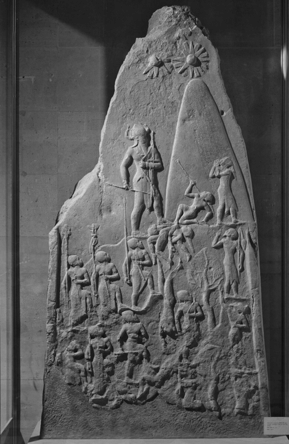
Figure 5.1 Stele of Naram-Sin, King of Akkad. Photo Credit: Gianni Dagli Orti/The Art Archive at Art Resource, NY.
Other themes prominent in the Bisitun Inscription also find precedent. The Babylonian king Nabopolassar (626–605 BCE) emphasized the truth of his assertions in his inscription. Neo-Assyrian kings frequently cast their rebellious opponents as liars.3 This phenomenon, an emphasis on truth that accompanies the rightful sovereign by virtue of divine favor, was thus not new, but one may credit Darius for taking it to another level as he disparaged his enemies as both rebels and liars. “One man called Gaumata, a magus, he lied and claimed ‘I am Bardiya, the son of Cyrus.’ He made Persia rebellious” (DB §52). And on it went for each of the challengers Darius had defeated. Most of the other rebels adopted the names of prominent kings who ruled previously in those areas. One Persian rebel, Martiya, claimed to be Ummanunu, after a previous king in Elam; another Persian, Vahyazdata, also claimed to be Bardiya. Two Babylonian rebels each styled himself after the famous Nebuchadnezzar and claimed to be the son of Nabonidus. Two Iranian rebels (one Mede, one Sagartian) claimed to be of the line of the Median ruler Cyaxeres.
To return to the fantastic elements of the story, the impostor-double appears not only in the Bisitun Inscription (Gaumata) and Herodotus (the magus Smerdis) but also in Ctesias (there called Sphendadates; Fragment 13 §11–16) and in later tradition as well. Many scholars find even the outlines of this story improbable: that Cambyses slew his real brother (Bardiya) in secret and that a magus later impersonated Bardiya so successfully that few suspected. And yet there is some precedent for the phenomenon of a royal double. In previous Near Eastern history, disastrous omens threatening the king’s person were countered by what was called the substitute-king ritual.4 A substitute would be chosen (often someone of limited mental capacity) who would literally take the king’s place on the throne. The substitute wore the king’s clothes and the royal accoutrements, sat on the throne, ate the king’s meals, and even slept in the king’s bed. The real king, meanwhile, stayed hidden. This way, the disastrous fate that had been preordained for the king would fall upon the substitute instead. Nothing was left to chance: the substitute-king would be killed at the end of his term (in Assyrian times, usually one hundred days), thus ensuring that no harm fell upon the real king – so it was believed. The substitute-king ritual was even performed during Alexander the Great’s reign in 323 BCE, in a vain attempt to forestall his death. Some scholars have postulated that such a ritual might lay behind Darius’ fantastic tale of the impostor-double. While an ingenious idea, there is no way to tell for certain. In any event, if there was a substitute, it would not have been for Darius. And if Darius did indeed kill a substitute – let us assume the substitute was for Bardiya – the question as to what happened to the real Bardiya remains. Darius’ assertion that Cambyses killed his brother, the “official version,” invites skepticism.
A later addition to the Old Persian version of the Bisitun Inscription (§71–76) celebrated victories over an Elamite named Athamaita in Elam and against a Saka named Skunkha. The Saka here were the Scythians of the “pointed-cap,” who are generally understood to have been Scythiansof Central Asia in the extreme northeast of the Empire. Remarkably, Darius chose to have Skunkha the Scythian, but not Athamaita, engraved at the end of the line of the original liar-kings. The original relief included the nine kings defeated by Darius: Gaumata supine and the eight others in a line, with hands behind their backs and a rope around each of their necks. Skunkha’s addition necessitated the defacement of part of the inscription to the right of the relief, the first Elamite version. The whole Elamite version was then reinscribed to the lower left of the relief, below the Akkadian version and to the left of the Old Persian version.
To note that this was a significant modification is an understatement. Something about the victory over Skunkha must have held great significance for Darius. What that may have been is generally not considered in modern scholarship, but here is one possibility. According to Herodotus, Cyrus died while on campaign against the Massagetae (1.201–214), a Scythian group in the extreme northeast of the Empire. Perhaps Darius considered his victory over the Scythians of such importance – he succeeded in the region where the great Cyrus had failed – that he made special provision for its commemoration in the Bisitun relief. Of course, this is speculation, and all appropriate qualifiers must be kept in mind.
Consolidation and Expansion
In Herodotus’ version of the crisis of 522 BCE, it was not a forgone conclusion that Darius would be king. In a famous passage (3.80–83), Herodotus relates a debate about the best form of government. This debate supposedly occurred between three of the conspirators against the magus: Otanes, Megabyzus, and Darius. Otanes argued for democracy, Megabyzus for oligarchy (or aristocracy), and Darius for monarchy. Although Herodotus insisted that the debate truly occurred, his readers – ancient or modern – have every right to be skeptical. Such a debate is easily imagined in fifth-century Athens, but it is inconceivable in a late sixth-century Persian context. Even if the Persian Empire was then still in a transitional phase from its tribal days, there could not have been much doubt about continuing monarchical rule – especially after a successful thirty-year run under Cyrus and Cambyses. Herodotus’ motivation for insisting on the historical truth of the debate remains opaque, but the debate itself must be considered in light of Herodotus’ ongoing examination of forms of government – in this case, the strengths and weaknesses of democracy vis-à-vis the alternatives.
Next, according to Herodotus, it was necessary for the Seven conspirators to select which of them would be king. Already we are far-removed from Darius’ assertions of legitimacy and lineage in the Bistiun Inscription, but the special place accorded his helpers (listed at DB §68) provides a link. In Herodotus, the initial chief conspirator, Otanes, chooses to step aside – making no claim on the throne – with the understanding that he and his descendants would remain absolutely free, not subject to the king’s authority except by their choice and on condition that they adhere to Persian laws. Otanes’ avowed detachment was apparently short-lived. In Herodotus, we find Otanes soon in charge of military operations in Asia Minor, especially against the Ionian island of Samos(3.141–149). Otanes the military commander must have followed royal directives. One may thus consider Otanes’ prominent place in Herodotus’ narrative, and the special privileges due him and his family, to reflect a pro-Otanes source that Herodotus used for this part of his account.
Herodotus then returned to a favorite motif, omens and the supernatural, for the next stage: the actual selection of the king among the remaining six conspirators. They staked this momentous decision on whose horse would neigh first the following morning at a prearranged meeting spot (3.84–87). Modern scholars have discerned echoes of horse oracles associated with royal ritual in ancient Iran, perhaps the ultimate origin of Herodotus’ exaggerated and garbled version. Darius’ groom Oibares arranged a clever trick – for which Herodotus himself gave two versions, more indication that the story was a popular folktale – whereby the night before Oibares allowed Darius’ horse to mate with his favorite mare at the designated spot. The next morning, when Darius’ horse reached that spot and caught the scent, the horse leaped forward and neighed. That alone fulfilled the omen, but Herodotus for good measure added a simultaneous flash of lightning and a crash of thunder, a divine omen of approval, to seal the deal.
Darius moved swiftly to consolidate his newly won throne. Darius married the daughters and wives of his predecessors: Atossa and Artystone(daughters of Cyrus), Parmys (daughter of Bardiya/Smerdis), and also Phaidymie (daughter of Otanes). Other recorded marriages included a previous one to a daughter of Gobryas and a later one to Phratagune, Darius’ own niece (daughter of his brother Artanes), the last mainly for purposes of preserving Artanes’ estate within the extended family. Through his marriages to Cyrus’ daughters, Darius joined himself to Cyrus’ family, another means by which he strengthened his hold on the throne.
A certain Oroites posed another challenge to Darius. The story is known only from Herodotus (3.120–128). Oroites had been appointed by Cyrus as satrap (or governor) of Lydia. While the false-Smerdis ruled, Oroites remained in Sardis and took no part in the war of succession. It may be assumed that Oroites remained loyal to Cyrus’ family or, perhaps more likely, was only biding his time. Oroites murdered one of Darius’ messengers (3.126), because the message did not please him. Presumably, Darius was looking for support in his gambit for the throne. The rejection of the message and murder of the messenger was a statement to Darius: an act of defiance and rebellion. Once secure in his power, Darius dispatched another messenger, this one to test the loyalty of the Persians around Oroites. A series of communiques was given to be read in succession by the royal secretary, each with a different order for Oroites’ guards. Once he was comfortable that the guards’ ultimate loyalty was to the king, the messenger directed the secretary to read the final communique: the order to put Oroites to death. Regardless of the historicity of this specific anecdote, it illustrates how the king’s power was upheld by his loyal officials and troops in the provinces. Another holdover from the Cambyses era, a man named Aryandes who governed Egypt, also posed a challenge to Darius (Hdt. 4.166). At some point during the reign of Darius, Aryandes began to mint coins with the intent to make himself the equal of Darius. Aryandes thus went beyond the normal satrapal prerogatives for minting, and Darius considered it an act of rebellion. Aryandes paid the price with his life.
Darius was not content merely to reassemble the Empire that Cyrus and Cambyses had built. Darius pushed the boundaries of the Empire eastward by incorporating the Indus River valley region (modern Pakistan and parts of India). Subsequent royal inscriptions that list the Empire’s holdings include Old Persian Hidush, a province named for the Indus River. Darius also expanded Persian territory in northeast Africa. Herodotus records a Persian expedition across Libya that culminated in Euesperides, identified with modern Benghazi (4.200–204). Some of the inhabitants of Barca, also in Libya, were deported to Bactria, at the extreme opposite end of the Empire. There is little information about the chronology and details of these conquests, but they are both usually dated in the 510s BCE.
A partially preserved statue of Darius, crafted in the Egyptian style but found near a monumental gate in Susa, offers insight into Darius’ rule and representation in Egypt (Figure 5.2). It stood about 10 feet tall on a pedestal and survived intact up to the chest. One of the folds of Darius’ garment has a short inscription in Elamite, Akkadian, and Old Persian versions. The inscription invokes Ahuramazda, celebrates Darius’ victory in Egypt, and contains Persian and Babylonian royal titles. A much longer hieroglyphic inscription on the garment’s right folds and base is done in the traditional Egyptian manner. Darius assumes Egyptian titles (e.g., “King of Upper and Lower Egypt) and incorporates Egyptian imagery. The text sets Darius firmly in Egyptian tradition by linking the king with the Egyptian gods Re and Atum of Heliopolis. The central image of the base shows the tying of the Egyptian knot – a centuries-old symbol of Egyptian unification (Upper and Lower Egypt). The subject peoples of the Empire, identified by hieroglyphic captions, are all portrayed in the Egyptian style and actually hold up the pedestal on which the statue of Darius stands. Clearly Darius, like Cambyses, understood the importance of portraying himself as a right and proper Egyptian king in that tradition.
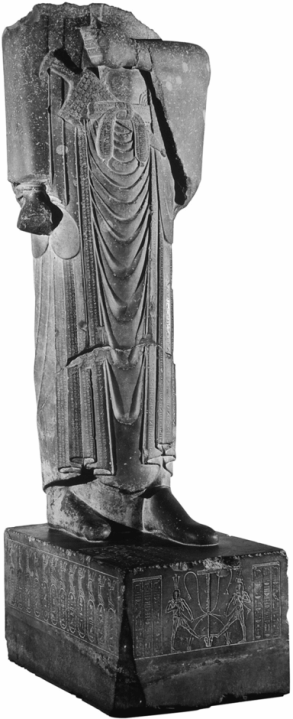
Figure 5.2 Darius Statue, Susa. Courtesy of the French Mission at Susa, dir. J. Perrot.
Darius also undertook major construction work in Egypt that included the digging of a canal from the Nile to the Red Sea, an act commemorated by four inscribed stelae. The best preserved is from a place called Kabret, roughly 80 miles north of Suez. It includes a typical Egyptian image: royal figures facing each other, but here with Persian dress and crowns, underneath a winged disk.5 The text contains a succinct statement taking responsibility for the building of the canal, which had been a major undertaking. Herodotus indicates (2.158) that it had been started by the Egyptian pharaoh Necho roughly a century earlier, but it was brought to completion by Darius.
The Scythian-Danube Expedition
Darius also campaigned against a group of Scythians in southeastern Europe, in the Danube and Black Sea regions. Herodotus is our main source. This region’s proximity to Ionia and Greece, and heavy Greek settlement in the area, meant that the Persian activity there was much closer to home for the Greeks. There were undoubtedly many Greek stories circulating about the expedition several decades later during Herodotus’ time. But Herodotus was more interested in Scythian customs and way-of-life. Most historians date the campaign sometime in the later 510s BCE. Details of the military campaign are sparse, and interpretations of its significance vary widely.
The main logistical challenge involved the crossing of the Bosporus – the narrow strait between the northern tip of the Propontis (modern Sea of Marmara) to the Black Sea – by means of a pontoon bridge. Such a feat required massive resources, engineering skill, and will. This crossing was both precedent for and parallel to Xerxes’ more famous crossing of the Hellespont preceding his invasion of Greece in 480. Herodotus was not able to locate Darius’ crossing precisely, but to his reckoning it was roughly in the middle of the strait; Darius left inscribed stelae to commemorate the occasion (4.87), but these have not been found. Darius also directed his fleet to sail to the Ister (the Danube) via the Black Sea and to build a bridge for his army there. We have no clear statement of Darius’ objectives, whether they involved additional conquest or a display of Persian might in a distant land, or both. Herodotus’ contention – that Darius sought vengeance for Scythian depredations against the Medes roughly one hundred years previous – seems a stretch. But because in the late 330s BCE Alexander the Great cast himself as taking revenge for Xerxes’ invasion roughly 150 years before him, we perhaps should not reject such propagandistic claims out of hand. Herodotus judged the campaign a failure, because Darius ultimately withdrew, but a more sober assessment of his possible objectives, and a consideration of his subsequent moves, tempers that negative judgment.
Herodotus’ concludes his account of the Scythian campaign with Darius’ ordering one of his generals, Megabazus, to subjugate Thrace, that is, southeastern Europe (4.143). His terse account relates Megabazus moving through Thrace and subjugating all the peoples in the area. Not nearly as entertaining as his ethnographic observations on the Scythian campaign, Herodotus’ brief report on Megabazus still offers important details about Persian military ambitions. In the lists of conquered peoples and territories included in some royal inscriptions (see Figure 6.2, p. 97), this area was called in Old Persian Skudra.6 The Persians held this territory, or parts of it, for some time – apparently even after Xerxes’ campaign against Greece in 480–479. In his Life of Alexander(36.4), Plutarch quotes the fourth-century historian Deinon, who noted that the Persians kept water from the Nile and the Danube in their treasury, manifest symbols of their dominion.
Darius pushed the frontiers of his empire in every direction from Persia: northeast (Skunkha and the “pointed-cap” Scythians), southeast (the Indus River region), southwest (Libya), and northwest (Thrace). The Persian Empire at its territorial height thus comprised territories stretching from the Aral Sea and the western edge of the Himalayas (Central Asia) to the Sahara (Africa), and from the Indus River Valley (Indian subcontinent) to the Danube (southeastern Europe) – the first world empire, indeed. Darius demarcates its boundaries in trilingual inscriptions from Persepolis (DPh) and Ecbatana (DH).
Darius the King proclaims: This is the kingdom that I hold: from the Scythians
who are beyond Sogdiana all the way to Kush, from Hidush all the way to Sardis, which Ahuramazda, greatest of the gods, granted me.
(DPh §2)
Sogdiana is in the extreme northeast of the Empire, so the inscription refers to the Scythians of Central Asia. Kush refers to Nubia (the Sudan), and Hidush the Indus Valley. The satrapal seat at Sardis controlled the northwestern territories.
Darius and the Aegean Periphery
As noted above, when Darius returned from his Scythian campaign he left Megabazus in charge of subjecting the rest of Thrace, a geographic area encompassing parts of modern Bulgaria, northeastern Greece, and the European portion of Turkey. Persian military activity there gives the impression of long-term, strategic planning. Thrace was a region rich in raw materials, especially timber and precious metals, and also manpower (Hdt. 5.23), of interest not only to the Persians but also to Macedonia and Athens. Details on Megabazus’ campaigns are thin, but reading between the lines in Herodotus indicates that the Persians took a systematic approach to establishing forts and supply depots.
At Darius’ command Megabazus also subjugated and deported a group of peoples called the Paeonians, who dwelled in the areas north of Macedonia. Herodotus’ story (5.14–15) of how Megabazus outflanked the Paeonians with help from guides from Thracereveals a common-sense approach: the incorporation of local assistance. Megabazus then sent envoys to Macedonia, where they received earth and water, standard tokens of submission (see pp. 123–125), from the Macedonian king, Amyntas. This made Macedon a vassal kingdom (5.17–18), though Herodotus relays an incredible tale circulating in his day to counter the Macedonian submission to the Persian king’s authority. Amyntas supposedly entertained the Persian envoys at a lavish feast, during which the increasingly intoxicated Persians demanded to see, and then sit with, the Macedonian royal women. The Persians could not keep their hands off the women, and the situation escalated. Amyntas’ son, Alexander (the subsequent King Alexander I), then persuaded the Persian delegation into believing that these women would be available for sex with them. Instead, however, Alexander and his cohorts dressed themselves as women, went to the drunken and lecherous Persians, and killed them all. Herodotus notes that when other Persians came seeking their countrymen, Alexander bought them off and married his sister Gygaea to the leader of the search party, a certain Bubares. This story shows Herodotus at his entertaining and frustrating best. Scholars give little credence to the story of the Persian party massacre – one always must consider how such tales originate7 – but a marriage alliance between the Macedonian royal family and a Persian nobleman is credible enough. Such diplomatic marriages were one way in which ties between Persians and their subjects were reinforced.
Darius solidified his hold in Ionia, Thrace, and the Aegean Islands through appointments of Greek natives as city rulers, the so-called tyrants. The Greek term tyrannos was used for a ruler who came to power through illegal means, independent of whether that ruler himself was considered a good ruler or bad. Over time the term tyrannos came to have generally negative connotations, though, as does its English derivative “tyrant” – its use herein reflects the original Greek connotation. These men included Coës of Mytilene and Histiaeus of Miletus, the latter of whom was also given control of territory in Thrace along the Strymon River. The mainland Greeks come into increasingly sharp focus during the late sixth century as well. For those Greeks who were paying attention, Persian expansion in the northern Aegean must have created some unease – and, in some cases, opportunity. The tyrant of Athens, Hippias (son of the famous Peisistratus), fled to Darius sometime after his exile in 510. Subsequent political infighting in Athens, with one faction receiving Spartan support, led to involvement with the Persian Empire that had major ramifications for subsequent Athenian and Greek history.
In 507, the Athenian faction not supported by the Spartans sent an embassy to Artaphernes, the satrap in Sardis and Darius’ brother. Artaphernes’ question – “Who are these people?” – is a recurring motif in Herodotus. Herodotus’ message here, reflective of his work’s main focus on the Greek resistance to Xerxes’ invasion in 480, is that the Persians would know soon all about these people, the Greeks. The Persians at this juncture in Herodotus’ narrative had no knowledge of the Athenians, and when they (or other mainland Greeks) appeared before the Persians they were curiosities. Artaphernes’ response was straightforward. If the Athenians wished the support of the King, they must offer earth and water, an act that manifested submission to the King. Herodotus’ account then becomes quite terse, and scholars debate the historical significance of this episode. The Athenians agreed to give earth and water – Herodotus does not expressly say that they did do so, but that is the implication – and then returned home, where they were censured for their behavior (5.73). There may be some revisionist history here, more than fifty years after the Artaphernes affair and more than thirty after Xerxes’ invasion. Athens had been a leader in the fight against Xerxes and, during Herodotus’ time, was at the height of its power in the Aegean, often at Persian expense. Athens leading the Greek fighting against Persia in the mid-fifth century did not fit well with an Athens submitting to the King even two generations earlier.
For some historians, interpretation of the embassy to Artaphernes in 507 impacts the analysis of all subsequent Athenian action vis-à-vis Persia. If the Athenian embassy offered earth and water as Artaphernes demanded, the Persians would conclude that Athenswas subject. The exact expectations on both sides of the arrangement are nowhere described, but it is beyond doubt that in any such exchange the Persians were the dominant party. The Persians appeared to view the offering of earth and water both as a diplomatic agreement and also a solemn oath. Breaking the bond was an insult, and it required the King to respond. Athens broke it.
The Ionian Revolt
Persian expansion in Thrace was accompanied by operations in the Aegean Islands. As we have seen, Persian-supported tyrants ruled in several places, including the island of Samos. A failed campaign against the island of Naxos (in the middle of the Aegean, west in a line from Halicarnassus in Ionia) served as a catalyst for a wider revolt, or series of revolts, between 499 and 494 BCE. Herodotus devotes a great deal of space to the preliminaries of the revolt – more than to the course of the revolt itself. For him it was the main precursor to Xerxes’ campaign against the Greek mainland in 480–479.
In Herodotus’ portrayal, the revolt ultimately stemmed from the misadventures of one man, Aristagoras, tyrant of Miletus and nephew of Histiaeus. Aristagoras convinced the satrap Artaphernes to sponsor a campaign against Naxos, once approval from the King had been granted. A certain Megabates, Artaphernes’ cousin (Hdt. 5.32), was appointed commander of the Persian forces, supported with troops supplied by Aristagoras. A quarrel between Megabates and Aristagoras resulted in the former betraying their plans to the Naxians and thus sabotaging the expedition – a charge so ridiculous that no one takes it seriously. Finding himself on the outs with both Megabates and Artaphernes, Aristagoras decided to revolt. He was supported by a secret message from his uncle Histiaeus in Susa, who was seeking an excuse to return home and hoped that Darius would give him a command. Aristagoras convinced several other Ionian cities to rebel. Seeking powerful allies, Aristogoras then visited the Greek mainland. His attempt to convince Spartato support him failed, but he was successful in garnering ships and men from Athens and from the city of Eretria on the island of Euboea, just off the eastern coast of Attic peninsula.
Herodotus portrays his fellow Ionians as a hapless group and, by extension, downplays the significance and spread of the revolt. Even in a tradition that framed great events around personal desires or vendettas, Herodotus overemphasizes too much the personal here. Most historians do not give much credence to Aristagoras’ singular role in initiating the revolt, identifying the causes rather in economic or other factors, such as the oppressiveness of Persian-supported tyrants. Any one of these is hard (if not impossible) to substantiate with our current evidence. Save for one tantalizing reference in an administrative document from Persepolis – a record of rations given to a certain Datiya traveling on royal business between Sardis and Persepolis in 494 BCE, perhaps in conjunction with the final phases of the revolt – we lack Persian sources that would offer a different perspective.8 A number of Carian and other non-Greek cities in southwestern Anatolia also revolted, as did the island of Cyprus, a key Persian possession in the eastern Mediterranean (5.108–116). These areas were reconquered relatively quickly, especially Cyprus: its strategic importance made it a greater priority for the Persians.
Regardless of how much responsibility Aristogoras may have had (or not) in starting it, the revolt was not a one-man show. Aristagoras, supposedly fearing Darius’s reaction, fled to Thrace where he died. The rebellion did not seem to miss him, because it took the Persians more than five years to quell it. After Aristagoras’ death, Histiaeus, Darius’ former favorite and Aristogoras’ uncle, successfully schemed for his return to Ionia from Susa. Artaphernes in the meantime had discovered that Histiaeus encouraged Aristagoras to revolt, but Histiaeus escaped to the Hellespont before Artaphernes could harm him. In a curious aside, Herodotus notes that Histiaeus had communications with several Persians in Sardis who supported the revolt (6.4). Artaphernes discovered this treason and tricked Histiaeus’ supporters into revealing their true stripes, so that they were put to death. Histiaeus himself was captured later, after the fall of Miletus, and impaled – the standard punishment for rebels.
The rebels’ success was initially spectacular, though short-lived. Much of the capital of Sardis was burned during a surprise attack, including the sanctuary to the goddess Cybele (5.102). This act rebounded upon the Greeks later, when Xerxes destroyed many Greek temples. Although the Athenians withdrew after this initial success, Herodotus emphasizes their involvement in an anecdote that heightens the tension between Persia and Athens (5.105). When Darius heard the news of the burning of Sardis, his initial reaction was to dismiss the Ionians, because they would soon be brought to heel. But he asked who the Athenians were, just as Artaphernes had done previously. Once informed, Darius, swearing vengeance upon Athens, took his bow and shot an arrow into the sky. He then instructed a servant to repeat to him three times at every meal, “My lord, remember the Athenians” – an anecdote with great entertainment value.
The Ionian rebels took control of the Hellespont, the shipping lane from the Black Sea to the Aegean, and aided the Cypriots in their rebellion. The strategic value of both these places shows what was at stake: control of the northwestern territories of the Empire. In response, the Persians were methodical and ruthless, and they did not discriminate. Each city-state was dealt with individually. In some, the previous tyrants or suitable successors were restored to power; in others democratic governments were left unmolested. The most important factor was a willingness to adhere to Persian authority. By 494 the Persians were focusing their efforts on Miletus itself, the seat of the revolt. A great sea battle at Lade, off the coast of Miletus, resulted in a Persian victory, abetted by the defections of many Ionian ships. Persian efforts to splinter the Ionian alliance had been successful. After the victory, Miletus was besieged and ultimately sacked; its inhabitants were sold into slavery or deported, and its main sanctuary at nearby Didyma was burned.
Mop-up operations continued through the following year (493 BCE) as the Persians reasserted their authority throughout Ionia. They carried through on threats made earlier, before Lade, for those who did not submit. Select girls were sent to the royal court, boys were made into eunuchs. Many cities and sanctuaries were burned – as express punishment for the rebels’ assault on Sardis – and Ionia was, as Herodotus put it, enslaved a third time (6.32): the first by the Lydians, the second by Cyrus, and the third now by Darius. The Persian response was not only military. The satrap Artaphernes subsequently undertook an administrative reorganization of all of Ionia (6.42). This included the establishment of boundaries, the fixing of tribute, and the creation of a system in which disputes were subject to arbitration. Herodotus mentions these acts with approval and notes that they minimized the quarreling among the inhabitants of Ionia and established a lasting stability.
Darius’ Second Aegean Campaign and the Battle of Marathon
After the revolt, Darius dispatched a new military commander to Ionia, his son-in-law Mardonius. Mardonius was the son of Gobryas, one of the Seven who overthrew the magus impostor, and was married to Darius’ daughter Artozostre. Herodotus relays that Mardonius overthrew all the tyrants in Ionia and replaced them with democracies (6.43). This statement has caused much consternation among historians, who find it difficult to fathom. At minimum, it is an exaggeration, and other evidence contradicts Herodotus’ blanket statement – for example, the tyrant of Samos, Aeaces, the son of Syloson, continued to rule. For the Persians on the other hand, the form of local government under their rule was less important than that government’s conscientious delivery of tribute and adherence to Persian policies. The Persians were nothing if not pragmatic and mindful of local circumstances in their approach to governing the provinces. Persian projects on their northwestern frontier were stymied for seven years by the Ionian Revolt. Once finally quelled, Mardonius worked to finish what Megabazus had started. Whether the imperial enterprise of expansion was sufficient impetus in its own right, or whether the Ionian revolt and its consequences had changed the strategic calculus in that region, is open to debate. Despite Herodotus’ dramatic portrayal of Darius obsessed with revenge, Persian ideology did require a response to those who participated in the revolt.
Herodotus claims that Mardonius’ expedition in the northern Aegean had Athens and Eretria as its main targets, but this is suspect. Mardonius’ campaign should probably be viewed as the reassertion of Persian power in Thrace and Macedonia. A sequel was being planned: a direct naval strike across the Aegean that would encompass a multitude of islands (the Cyclades) and lead through to Eretria and Athens (Map 5.1). According to Herodotus, Darius first sent out heralds demanding earth and water, as well as messengers to those Ionian cities already beholden to him ordering that they prepare warships and transports for the campaign. All the islanders agreed to submit earth and water, as did many on the Greek mainland, but Herodotus does not name names (6.48–49). In any event, the Persians met resistance on some of the islands – suggesting that Herodotus exaggerated or that the tokens were given in bad faith.
The Persian forces gathered at a traditional mustering spot, the Aleian plain in Cilicia, east of Tarsus in the northeastern Mediterranean. Artaphernes, the son of Artaphernes the satrap of Sardis (and thus Darius’ nephew) and Datis, a high-ranking Mede (perhaps the same as the Datiya mentioned above), commanded the expedition. The fleet sailed to Ionia and, from Samos, directly across the Aegean through the Cyclades Islands (6.94–95). Naxos was successfully taken and plundered, likewise Carystus. On the other hand, the Persians made offerings at Delos – sacred to the Greek gods Apollo and Artemis – and repatriated a statue of Apollo there. We see again the Persian strategy of outright conquest coupled with select support to win over opposition. The campaign continued on to Eretria where, after fierce fighting, two prominent individuals betrayed the city and opened the gates to the Persians. A later source notes that these two were given grants of land, a typical reward for service to the King. The city was plundered, the inhabitants captured and deported, and the temples burned in retaliation for the burning of Sardis at the start of the Ionian revolt. The captives were deported to Susa and resettled near there (Hdt. 6.119).
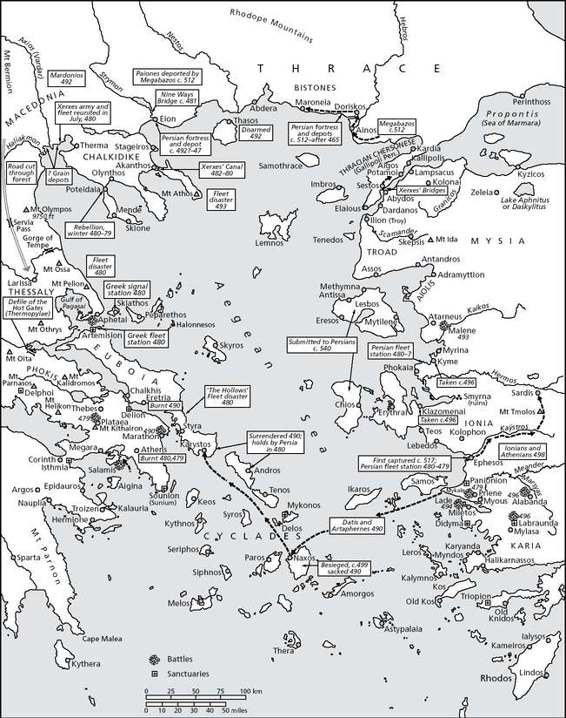
Map 5.1 Persian Campaigns in the Aegean during the Reigns of Darius I and Xerxes. After Cambridge History of Iran, Vol. 2, 1985, map 13.
The next stop was Athens, or, more specifically, the plain of Marathon, some 26 miles northeast of the city. This region was chosen so that the Persian cavalry might be used to maximum advantage. The deposed tyrant of Athens, Hippias, who had fled to Persia previously, accompanied the expedition. He provided inside information to the Persians and, had the expedition been successful, would presumably have been reinstalled as tyrant, beholden to the King. But here the Persians fell short. Herodotus relays at great length the battle and its preliminaries. The Athenians, weak in cavalry but with a strong infantry contingent, waited out the Persians and attacked as they were preparing to depart. A fierce battle ensued, as the Persians extricated their forces from the plain and prepared to sail around the Attic peninsula to attack the city itself on the west side of it. But the Athenians covered the 26 mile march – thus the origins of the modern race, the marathon – just in time and their position prevented another Persian landing. The Persian fleet remained off Phaleron (Athens’ harbor at the time) for an unspecified amount of time before it departed.
We have no Persian sources to offer insight on the Battle of Marathon, so Persian goals and perspective must be extrapolated from the Greek accounts. For the Persians it was a minor setback at the end of an otherwise successful campaign. Conversely, it is hard to overstate the importance that this battle had for the Athenian mindset and civic pride, but that is best appreciated elsewhere (see the entries under AppendixD). Until then Persian forces had been viewed as objects of terror (Hdt. 6.112). By Herodotus’ time roughly sixty years later, after the rise in Athenian hegemony in the Greek world thereafter, the Battle of Marathon had become lionized – and canonized – as the first stand against barbarian oppression on the Greek mainland. Despite claims in some modern works, it is unlikely that the Persians were planning – at least with this particular expedition – a wider domination of all Greece. If Athens and the other Greek city-states had folded like cards, there is no doubt the Persians would have welcomed the opportunity to establish mechanisms of lasting control – they already had much experience with this. But the campaign of 490 looks much more like a punitive expedition than an all-out invasion.