
4
Death of Cyrus
Cyrus’ movements between his conquest of Babylon and his death may only be guessed. The remaining major power not yet conquered was Egypt, which was supposedly one of Cyrus’ objectives that drew him away from Lydia (Hdt. 1.153). Perhaps plans were being developed for an invasion of Egypt, plans subsequently implemented by Cambyses, but there is no way of knowing. Babylonian evidence indicates that Cyrus died in August 530 BCE. According to Herodotus, Cyrus reigned for twenty-nine years (1.214) and his final campaign was in the extreme northeast.1
Herodotus’ account of Cyrus’ death focuses on his war with the Massagetae, a Scythian people who lived beyond the Araxes (or Jaxartes, the modern Syr Darya) in modern Kazakhstan. Herodotus here offers another cautionary tale – the limits and consequences of hubris – so one hesitates to take it for literal truth. As he did with Cyrus’ birth legend, Herodotus acknowledges multiple versions (1.214) but relates the one he found most plausible. The Massagetae were ruled by a widowed queen, Tomyris, whom Cyrus first attempted to wed and thus gain the territory by diplomacy before conquest.2 Tomyris rebuffed Cyrus with a warning to stay within his territory: to cease his expansionism or pay the price. Cyrus instead heeded the advice of Croesus, who counseled Cyrus to cross the river and engage Tomyris’ forces.
The Persians’ initial victory over the Massagetae, led by Tomyris’ son Spargapises, was due to a trick. The Persians laid out a great feast and then feigned a retreat, and the Massagetae raided their camp. When the entire Massagetae force became drunk on the wine “abandoned” by the Persians, the Persian forces returned. They killed many of the Massagetae and captured the rest, including Spargapises. Tomyris demanded Spargapises’ return with the threat that otherwise, because Cyrus seemed ravenous for blood, she would give him his fill of it. Spargapises committed suicide, and when Cyrus was killed in the subsequent engagement, Tomyris was true to her word: she cast Cyrus’ head into a container filled with blood.
Ctesias’ story (Fragment 9 §7–8) of Cyrus’ death is similar in outline: Cyrus died while campaigning in the far northeast but against a people called the Derbicae. Where these Derbicae dwelled is unclear, but ancient geographers place them in northeastern Iran or Central Asia. Wounded in battle but reinforced by Saka (Scythian) allies, Cyrus lived long enough to defeat the Derbicae and to arrange his succession. Cambyses was appointed king, while Cambyses’ brother Tanyoxarkes was granted a vast territory in the northeast – free from tribute – that included Bactria, Chorasmia, Parthia, and Carmania. Herodotus does not assign a formal position to Cambyses’ brother, whom Herodotus calls Smerdis.
Cambyses had been groomed for the succession for some time. An entry in the Nabonidus Chronicle noted Cyrus and Cambyses’ joint involvement in the Babylonian New Year’s festival for 538 BCE, one of the most important events of the Babylonian calendar. Several economic documents from 538 are given the date formula “Cambyses, King of Babylon, and Cyrus, King of lands.” This is striking, but it was also short-lived: the joint formula seems to have been used only that one year. Some scholars take it as evidence for co-regency, but the episode remains an enigma.3 It is unclear why this joint dating formula was used and why it was discontinued. Perhaps the joint dating formula was instituted for continuity during the transitional period of a new conquest, but that remains speculation. Various Classical sources attest to periodic special commands (e.g., Harpagus in Lydia and Asia Minor, Tanyoxarkes in Bactria), but there is no parallel for a Persian co-regency.
King Cambyses
In 530 BCE Cambyses inherited a vast empire, far larger than any previous, and one that had been formulated in just twenty years. Cambyses’ royal pursuits are hard to gauge, however, because the record is even thinner for his reign. Cambyses’ first order of business would have been arrangements for Cyrus’ burial at his tomb in Pasargadae. An incomplete structure found near Persepolis has been identified as an intentional replica of Cyrus’ tomb, and it was naturally assumed to have been for Cambyses. But some documentary evidence suggests that Cambyses’ tomb lay elsewhere, southeast of Persepolis near modern Niriz, and the evidence pointing there indicates a royally sponsored cult, similar to that associated with Cyrus’ tomb.4
Cambyses eventually turned his attention westward, where the main power was Egypt. Amasis (reigned 570–526 BCE) had conquered Cyprus and formed an alliance with the Greek ruler Polycrates of Samos, an island off the coast of Ionia. By the 520s Polycrates had become dominant in the Aegean Sea region. This alliance was fractured sometime after Cambyses’ accession, and Polycrates offered ships to Cambyses for the Egyptian expedition. Reasons for the switch may only be guessed. Perhaps the intensifying Persian hold on Ionia in conjunction with inducements (or threats?) swayed Polycrates toward Persia. Cambyses’ efforts to develop a royal navy, mainly through his Phoenician and Ionian subjects, were no doubt intended for the western front and a planned Egyptian campaign. The territories of the Levant, geographically at the crossroads between Greater Mesopotamia and Egypt, had been a point of contention between rulers of those regions for centuries. Persian control of that region was bound to inflame tensions with Egypt. With an eye on Persian expansionism, Amasis had cultivated good relations with many city-states and sanctuaries in the Aegean world. In 526 Amasis was succeeded by his son Psammetichus III, whose rule was to prove quite short.
Cambyses’ Invasion of Egypt
There is no narrative record of the preparations for the Persian invasion of Egypt in 525 BCE, but they were no doubt extensive. As part of these preparations, Cambyses fostered relations with the king of the Arabs, who controlled the desert route across the Sinai peninsula and could thus enable the successful crossing. The first engagement occurred at the easternmost branch of the Nile delta, the so-called Pelusiac mouth. The Persians put the Egyptians to flight, invaded the Nile Valley, and besieged Psammetichus in his capital, Memphis. There he was protected by fortifications named “the White Wall,” which could only be taken with support from a fleet. The city was eventually taken and Psammetichus captured. But he was spared and treated well, as per the pattern of kings previously defeated by the Persians. Herodotus even claims that if Psammetichus had comported himself appropriately he would have been made governor of Egypt (3.15). But Psammetichus subsequently plotted rebellion and was put to death.
Once Egypt was secure, Cambyses intended further military actions both west and south, following the paths of many Egyptian pharaohs. The Libyan oases offered control over strategic western trade routes. Beyond the First Cataract in the south, the kingdom of Kush had always been coveted for its gold. The installation of a Persian garrison at Elephantine – an island in the Nile near modern Aswan – reveals the strategic importance of this area at Egypt’s southern boundary.5 This garrison was one of several similar that were stationed at strategic points throughout the Empire.
Additional Persian expeditions against the oasis of Ammon in the west and against Nubia and Ethiopia in the south ended badly. The particulars may seem far-fetched, but the historicity of these campaigns, including an aborted expedition against the Carthaginians (modern Tunisia), need not be rejected out of hand. The limits of Persian imperialism had not yet been reached. It made sense to secure those borderlands that had been problems for previous Egyptian rulers for centuries. If Herodotus may be believed, the army dispatched to Libya was swallowed in a sandstorm. Cambyses himself led the expedition against Nubia and Ethiopia, but it was abandoned en route: desperate straits culminated in cannibalism among the troops. These misadventures, replete with divine portents and human warnings that Cambyses was going too far, serve as case studies for Herodotus’ portrayal of the “mad Cambyses” – more a literary exercise than a historical one. Herodotus records a litany of Cambyses’ outrages, overreach, and arrogance – directed not only at Egyptians but also at Persians and even his own family – the paradigmatic example of a stereotypical oriental despot.
Herodotus’ “mad Cambyses” shows first of all that the Father of History relied on a negative tradition of Cambyses current in Egypt when Herodotus visited in the mid-fifth century BCE. Herodotus devotes portions of his Book 3 to Cambyses’ increasing instability. Cambyses purportedly ordered Amasis’ mummy to be disinterred, abused, and finally burned – an insult, to both Persian and Egyptian religions (3.16). Other tombs were opened and cult statues mocked, particularly in the temple of Ptah, an Egyptian creator god whose sacred city was Memphis. The greatest outrage to the Egyptians was the slaying of the Apis bull (3.27–29), a sacred calf that was considered the earthly embodiment of Ptah. The Egyptian king was a central part of the Apis cult, which in turn was directly connected to the office of kingship.
When Cambyses returned to Memphis after the disastrous Ethiopian expedition, he found the Egyptians of Memphis celebrating the birth of a new Apis calf: a new beginning, their god again made manifest. Cambyses snapped. He saw their festival as an expression of joy at his misfortune, and he reacted: stabbing the Apis bull with a knife to the thigh and flogging or slaying many priests. Herodotus subsequently catalogs a cascade of misfortune and misery that brought Cambyses to his own end and shook the entire Empire to its core – the result of Cambyses’ impiety. The slaying of the Apis bull makes compelling drama, but it is mostly exaggerated if not fabricated. We have some Egyptian evidence that seems to refute Herodotus’ portrayal. Contrary to Herodotus’ assertion that the Egyptian priests buried the Apis bull without Cambyses’ knowledge, a sarcophagus from a bull buried during Cambyses’ reign is engraved with Cambyses’ own inscription in traditional Egyptian format:
The Horus Sma-Towy, King of Upper and Lower Egypt, Mesuti-Re, born of Re, Cambyses, may he live forever! He has made this fine monument, a great sarcophagus of granite, for his father Apis-Osiris, dedicated by the King of Upper and Lower Egypt, Mesuti-Re, son of Re, Cambyses, may he be granted long life, prosperity in perpetuity, health and joy, appearing as King of Upper and Lower Egypt eternally.
This inscription states that Cambyses, acting as a typical Egyptian pharaoh, took responsibility for the proper care and burial of the deceased Apis, which is understood to have died during Cambyses’ fifth regnal year. If only it were so simple. There are significant problems with our understanding of this sequence: the death and burial of the Apis bull during Cambyses’ reign, and the overlap between the birth of a successor bull and the death of the current Apis. Other inscriptions further complicate matters.6
Although the initial inclination is to reject any suggestion that Cambyses killed the Apis, it cannot be excluded that Cambyses may have killed a younger calf (the Apis successor) before the death of the one buried in the sarcophagus. The Egyptian evidence reminds us not to take Herodotus at face value. Some of the changes Cambyses wrought in the aftermath of the Persian victory must have been unwelcome, perhaps even unprecedented. For example, a reduction in support for some Egyptian temples could easily have given rise to negative stories about Cambyses.
The inscription of Udjahorresnet, a naval commander under Amasis and Psammetichus III who defected to the Persians, also provides some balance to Herodotus’ account. Udjahorresnet’s hieroglyphic inscription is carved on his votive statue from Sais, in the western Delta (Figure 4.1). The statue holds a small shrine for Osiris, god of the underworld. The autobiographical inscription chronicles Udjahorresnet’s career, with special emphasis on his service to both Cambyses and Darius I. It is invaluable as a window on how one of the Egyptian nobility secured a place for himself in the new order.
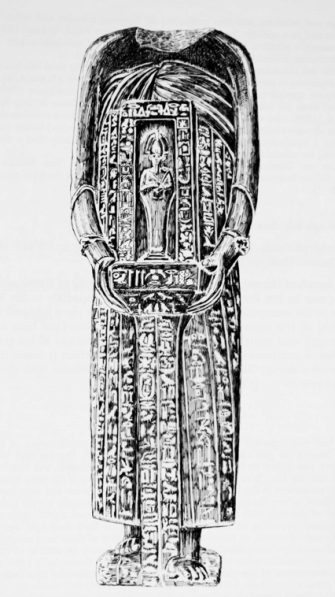
Figure 4.1 Statue of Udjahorresnet, Sais, Egypt, housed in the Vatican Museum. Drawing by Tessa Rickards, used by permission.
Udjahorresnet’s inscription provides the only surviving royal titles for Cambyses beyond Babylonian administrative documents. Cambyses adopted Egyptian titles (e.g., “King of Upper and Lower Egypt”) as would be expected from a new ruler seeking to place himself in an age-old tradition. Udjahorresnet himself would have been keen to trumpet his own titles and achievements – typical in this sort of inscription – and also to justify his collaboration with the Persians. Udjahorresnet’s inscription, and Cambyses’ titles therein, indicate that Cambyses behaved as did previous kings by restoring order and respecting religious sanctuaries. Udjahorresnet’s version is no doubt slanted as well, but the picture it provides runs directly counter to Herodotus’. It would not be surprising to discover that the respect Cambyses showed for sanctuaries included those with which Udjahorresnet had been involved, those in and near Sais, but that is unverifiable. That the Persians presented themselves as pharaohs in the traditional Egpytian manner is not surprising. Successful integration into Egyptian tradition would make Persian rule much smoother. As evidenced by subsequent Egyptian revolts, however, this integration was not always smooth.
The Death of Cambyses and the Crisis of 522 BCE
The length of Cambyses’ Egyptian campaign is uncertain, but various sources indicate that Cambyses was returning to Persia in 522 when he died. He had been away for at least three years. Babylonian economic documents reveal that Cambyses died sometime in April and was succeeded by his brother Bardiya. Bardiya ruled for six months, until he was supplanted by Darius. Darius conversely related that Cambyses had killed Bardiya sometime previously and that a look-alike double, whom Darius called Gaumata, rebelled against Cambyses in March of 522. The crisis of 522 was of epic proportions, and the stability of the fledgling Empire was at stake. Various ancient sources relay a story of fratricide; an elaborate cover-up; a body double and impostor on the throne; and a small group of heroes who discover the truth, slay the pretender, and set Persia to rights once again. Despite the fundamental interpretive problems that persist in evaluating the sources, it is clear that the Persian Empire faced a decisive moment. Darius I’s eventual, and by no means easy, victory was monumental in its own right and had lasting consequences for the durability of the Empire. The testimonies for this turbulent time are confusing and often contradictory. Separate overviews of the main ones – Darius’ Bisitun Inscriptionand Herodotus’ account – are warranted before any attempt at reconciliation.
The Bisitun Inscription of Darius I
Mt. Bisitun (or Behistun, English spelling varies) lies about halfway between modern Kermanshah and Hamadan (Ecbatana) on the main east-west road through Media and across northwestern Iran. The Greek name Bagistanon probably comes from an Old Persian word bagast na, “place of the gods,” which imparts the sacredness of the site. Roughly 200 feet above the road, Darius carved a relief showing himself triumphant over rebel kings, accompanied by two unidentified retainers behind him, and acknowledging the figure in the winged disc that hovers above the scene. This symbol is usually identified with the Zoroastrian god Ahuramazda, whom Darius invokes dozens of times in the accompanying inscription. Flanking and below the relief is the inscription itself chronicling Darius’ legitimacy, right to rule, and a narrative of his victories at the beginning of his reign. The inscription is recorded in three languages: Elamite, Akkadian, and Old Persian. The Elamite version is in two copies, the first to the right of the relief and the second to the lower left: reinscribed after the addition of the last rebel king to the relief necessitated the defacement of part of the first version. The Akkadian version is to the left of the relief, and the Old Persian version underneath the relief. Captions in all three languages identify the rebel kings, but not the retainers behind Darius or the winged symbol (see Figures 4.2–4.3). The relief would have been visible from the road, but not the inscription. Copies of the inscription were disseminated throughout the Empire.
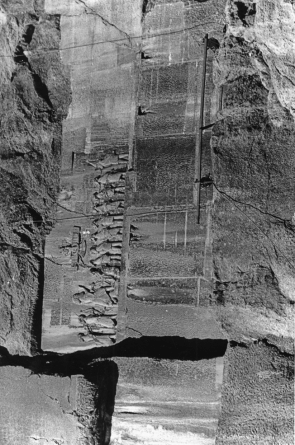
Figure 4.2 Darius, Bisitun Relief and Inscriptions, Mt. Bisitun, Iran. Courtesy of the Cameron Archive, Kelsey Museum of Archaeology, University of Michigan.
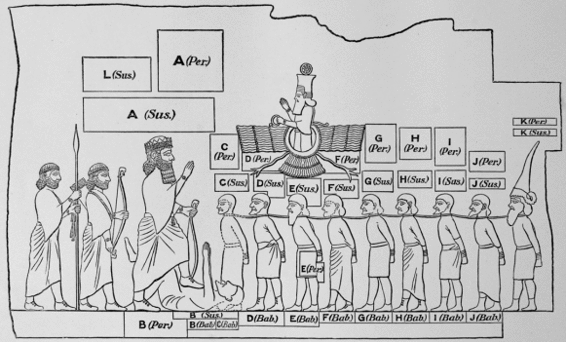
Figure 4.3 Drawing of Bisitun Relief, L. W. King and R. Campbell Thompson, Sculptures and Inscription of Darius the Great, on the Rock of Behistûn in Persia, London, 1907, Plate XIII. The capital letters indicate separate inscriptions, and the abbreviations Per., Sus., and Bab. stand for Old Persian, Susian (rather: Elamite), and Babylonian (Akkadian), respectively.
The Bisitun Inscription’s significance goes far beyond its place in understanding this critical historical period. It also served as the fundamental document in the foundation of the modern discipline of Assyriology. Bisitun provided the key to the decipherment of the Old Persian, Elamite, and Akkadian cuneiform scripts. The formulaic nature of Achaemenid royal titles allowed patterns in the scripts to be discerned straightaway. The Old Persian script has only a few dozen signs, formally a syllabic system but one not far removed from an alphabet. Old Persian was cracked first thanks to parallels with Avestan and Sanskrit, closely related Indo-Iranian languages. Akkadian and Elamite scripts were more complex, with many more signs. Akkadian was realized to have known linguistic relatives in other Semitic languages such as Aramaic and Hebrew. The Elamite version was eventually translated from the other two versions and based on comparisons with earlier Akkadian-Elamite bilingual texts. In a short overview it is impossible to do justice to the painstaking work, and enormous ingenuity and erudition of the various scholars in the nineteenth century who deciphered these languages.7 Suffice it to note that the translation of the Bisitun Inscription opened the door to a vast catalog of lost Near Eastern literature, including the Epic of Gilgamesh and many others.
Darius I’s trilingual inscription at Bisitun is the only narrative Persian royal inscription extant, and it was the blueprint for subsequent Persian royal ideology. The organization of inscriptions around the relief figures suggests that the Elamite version was inscribed first, then the Akkadian version, and the Old Persian added subsequently. The three inscriptions are meant to be copies of each other, but occasional differences between them – along with the fragmentary Aramaic copy from Elephantine in Egypt – provide much fodder for specialist discussions. The Old Persian (OP) version is considered the primary one, mainly because it is assumed to have been the language of the Persians themselves and because the OP version contains two extra sections, added after the original was complete, that were not added to the other two versions. In the discussion that follows, the parenthetical references to Darius’ inscription follow standard scholarly practice: DB (standing for “Darius, Bisitun”) followed by the paragraph (§) number, which follows the division into sections of the OP version of the inscription.
Darius’ Bisitun Inscription was the official version, and it of course becomes the main source for these events. Darius provides only a brief narration of the circumstances surrounding the first few critical months of 522 (DB §10–14). A summary follows. Darius tersely noted that Cambyses had a full brother named Bardiya, whom Cambyses slew in secret sometime before the Egyptian campaign. Darius described Cambyses’ end obliquely, literally “he died his own death” (DB §10). In some modern works, Darius’ phrasing is erroneously translated to the effect that Cambyses committed suicide. The wording in all three versions – Elamite, Akkadian, and Old Persian – is straightforward, and suicide is not meant. The ambiguity lies in what the statement “he died his own death” really means, whether Darius was concealing something with such drab wording. No other details are offered.
In March of 522 a man named Bardiya rebelled, and in July he claimed the kingship. This Bardiya was Cambyses’ full brother, but Darius claimed otherwise: in the Bisitun Inscription that man who claimed the kingship was Gaumata, an impostor who pretended to be the real Bardiya. The impostor threw the Empire into chaos. The people became disloyal and “the Lie” became great. Darius’ antipathy against the Lie – the word is usually capitalized in English translations – reflects a Mazdaean worldview so fundamental to the king’s ideology.8 It is introduced for the first time in the Bisitun Inscription and recurs throughout to describe the reasons for the Empire’s descent into chaos under the false kings. Darius as the agent of truth, supported by his god Ahuramazda, is the proper king who overcame the forces of chaos and returned the Empire to its proper order. This is all properly cast in the terms of the victorious king’s justification of his right to rule.
According to Darius, the Lie impelled Gaumata to rebel, and this Gaumata represented himself as Bardiya, the son of Cyrus. Subsequent rebels whom Darius defeated were also cast as impelled by the Lie, and most of them claimed descent from prominent figures among their predecessors; for example, two Babylonian rebels claimed to be descended from the famous Nebuchadnezzar II, King of Babylonia in the early sixth century. Darius claimed that the people were terrified of Gaumata, because in order to cover his tracks he slew many who knew the real Bardiya (§13). Nevertheless, Darius, with the help of a few men – at least six of whom are specifically mentioned late in the inscription as his prominent supporters (§68) - was able to kill this Gaumata and his entourage in Media (see Map 4.1, pp. 70–72).
After his vague accounting of the opening gambit, Darius then returned to exact dates in his account, starting with September 29, 522 BCE, for Gaumata’s death. How and why Gaumata moved from the place of his initial rebellion in Parsa to a fortress in Media is not explained. In the Bisitun relief, Gaumata is supine, extending his arms imploringly while Darius rests his foot on him in triumph. Darius concluded the section on Gaumata’s usurpation with a laundry list of Gaumata’s misdeeds and outrages against cult-centers and personal property. This passage is difficult to interpret in its particulars, even if in general it follows the tradition of a new conqueror vilifying the previous regime: one that lacked order. Darius emphasized that he reestablished order by restoring that which had been taken away or destroyed, “in accordance with what had been done previously” (§14). Darius further emphasized that Gaumata had stolen the kingship from Darius’ family, which specifically included Cambyses (§10), and that Darius thus restored his family’s long established right to rule. His emphasis on descent from Achaemenes forms a central component in Achaemenid royal ideology.
The bulk of the Bisitun Inscription relates the victories of Darius and his lieutenants over the numerous rebel kings who challenged him, primarily in Persia (Parsa) itself, Elam, Babylonia, Media, and other points in northern and eastern Iran. The elimination of Cyrus’ sons left an open field for the succession, if there was to be a succession at all – in 522 there was a real threat that the Empire would splinter irrevocably. Armies ranged across the Iranian plateau, the Zagros regions, and Mesopotamia. Darius was relentless, and he recorded his exploits on the model of the Assyrian kings’ annals, with a repetitive precision that highlighted his inexorable victory. Each of the rebel armies was defeated, and the rebel kings hunted down and impaled, as in this example with Fravartish (Greek Phraortes):
Darius the King proclaims: I went forth from Babylon and went to Media. When I arrived in Media, at a place named Kunduru, a town in Media, there that Fravartish, who called himself king in Media, came with an army against me to give battle. Then we gave battle. Ahuramazda bore me aid. With the support of Ahuramazda, I completely defeated the army of Fravartish … Afterward that Fravartish with a few horsemen fled. He went to a place named Raga in Media. Then I sent an army after him. Fravartish was seized and was led to me. I cut off his nose and ears and tongue, and put out one of his eyes. At my gate, bound, he was held. All the people saw him. Later I impaled him at Ecbatana.
(condensed from DB §31–32)
The Akkadian version of DB, along with a fragmentary Aramaic copy found in Elephantine in southern Egypt, gives casualty and prisoner figures for many of these battles. We have no independent check on the veracity of these numbers, which run from the hundreds to the thousands and, in two instances – in battles fought in Media (§31) and in Margiana (§38) – perhaps the tens of thousands.9 Beyond his undeniable military success against imposing odds, Darius’ right to rule was sketchy. His blood links to Cyrus’ family are stretched, at best, if not entirely fabricated. Darius supplies a Teispes, son of Achaemenes, in his line (DB §2) that links him to Cyrus’ ancestor Teispes listed in the Cyrus Cylinder (line 21). Both Darius’ father Hystaspes (OP Vishtaspa) and grandfather Arsames (OP Arshama) were yet living when Darius took the throne. Hystaspes, commanding a military force in Parthia in north central Iran, is specifically mentioned in the Bisitun Inscription (§35) as aiding his son. Herodotus called Hystaspes a governor (Greekhyparch – a term loosely applied to ruling officials of varying rank) in Persia itself, but that is different from Darius’ account.
Herodotus’ Version of Darius’ Accession (3.61–88)
Herodotus called Cambyses’ brother Bardiya “Smerdis.” Smerdis had initially accompanied Cambyses on the Egyptian expedition. The Ethiopians had sent Cambyses a bow with the message that, when he could draw it, it would be safe to attack them (3.21). Not one of the Persians was able to do so, but Smerdis could bend it, just slightly. Cambyses sent Smerdis home out of jealousy and subsequently had a dream in which he saw Smerdis sitting on the royal throne. Cambyses interpreted this as a threat and dispatched a trusted advisor, Prexaspes, to kill Smerdis in secret (3.30).
Sometime later Cambyses received word of a revolt by Smerdis. By the chronology discussed above (Herodotus himself is not specific), this would be the Spring of 522 BCE. After Cambyses’ initial assumption that Prexaspes had betrayed him and that his brother Smerdis yet lived, he soon learned that two Magi brothers had instead rebelled. Herodotus called the first brother Patizeithes and the second brother Smerdis. The second brother had the same name, Smerdis, as Cambyses’ brother and, further, they looked exactly alike (3.61). Patizeithes proclaimed that his brother Smerdis was the real Smerdis, installed his brother as king, and sent out heralds demanding allegiance to this false-Smerdis instead of Cambyses, who was at that point en route back to Persia. When Cambyses uncovered the truth of the matter – that it was two Magi brothers revolting against him and that he had killed his brother Smerdis for nothing – in rage and despair he sprang into action. The cap of his scabbard fell off as he leaped onto his horse, and he was stabbed in the thigh with his own sword. Gangrene set in the wound, and Cambyses died within a few weeks. The wound was in the exact spot where Cambyses had stabbed the Apis bull, which provided Herodotus another opportunity for a moral lesson (3.64), a fitting end for the “mad Cambyses.”
Shortly before his death, Cambyses assembled those noble Persians on campaign with him and gave a tearful confession (3.65) of his murder of the real Smerdis and details of the Magian revolt. But he was not believed; the Persian nobles thought Cambyses had made these admissions and accusations out of malice. Once Cambyses was dead, Prexaspes denied any involvement; the admission of his murder of a son of Cyrus would not have gone over well. The false-Smerdis thus ruled for seven months, during which he was well-regarded by his subjects (3.67) – because he released them from military service and tribute – and they later regretted his passing. The Magi, seeking to ensure their security, ostensibly won over Prexaspes, who knew their secret. In exchange for his compliance, the Magi promised to make him incredibly wealthy. They asked him to make a public proclamation: to allay any doubts that the Persians were being ruled by anyone other than the son of Cyrus. But Prexaspes instead revealed all during his speech, enjoined the Persians to react against the false rule of the Magi, and then he threw himself from the balcony from which he spoke.
Other Persians had been planning to act. Their leader was named Otanes, whose daughter Phaidymie had been married to Cambyses and then became a wife of the false-Smerdis as well. Herodotus relates a lengthy and entertaining anecdote about Phaidymie’s discovery that it was indeed the magus Smerdis who ruled, not Cambyses’ brother. The story allows Herodotus to include some salacious details about the Persian harem and the royal caprice in punishments, both subjects always popular with a Greek audience. Because of the number of royal wives and concubines, Phaidymie had to wait her turn to lay with him. When that time came, Phaidymie was able to confirm that it was the false-Smerdis by the fact that he had no ears, which had been previously removed as punishment by Cyrus.
Otanes shared his suspicions with two other noble Persians, Aspathines and Gobryas. These three each brought one additional person into the group: Intaphernes, Megabyxos, and Hydarnes. The names of these six match, with one exception, those helpers mentioned by Darius in his inscription (DB §68).10 The group is then joined by Darius, son of Hystaspes. Although the last to join the conspiracy in Herodotus’ version, Darius quickly took on the most vocal and forceful role. This Persian “Magnificent Seven” moved quickly, especially when news of Prexaspes’ speech and suicide reached them (3.76). Because these seven were among the noblest of Persian families, the palace guards allowed them entry into the inner court. From there they forced their way in and a melee broke out. As Gobryas struggled with the magus he urged Darius to strike, but because it was dark Darius did not wish to hit Gobryas. Gobryas told him to kill both, if necessary, and Darius managed to slay only the imposter.
Comparisons
Despite the relative richness of the source material, the circumstances surrounding Cambyses’ death and the forces unleashed by it remain opaque. What was the relationship between Cambyses and the real Bardiya? Did Cambyses die first and Bardiya succeed without incident? Or did Bardiya revolt from Cambyses? Were people really expected to believe that Cambyses’ murder of Bardiya, if even true, could be kept secret? What was the real relationship between Darius’ family and Cyrus’ family? Who was the magus Gaumata? Did Cambyses die of natural causes, or does Darius’ account hide something more sinister?
Many elements of Herodotus’ account are difficult to reconcile with Darius’ Bisitun Inscription, so the truth remains elusive. For example, Herodotus’ summary statement that the false-Smerdis’ rule was well-received is not easily reconciled with Darius’ assertions of chaos (DB §13–14), though it would hardly be expected that Darius would paint his predecessor’s rule in a favorable light. There are a number of other curious elements here as well beyond the fantastic tale of the impostor’s usurpation. Herodotus’ seven-month reign for the false-Smerdis may be made to fit into Darius’ chronology (counting inclusively) from Gaumata’s revolt in March to his death in September of 522 BCE. Darius gave few details about the death of the impostor, only that Darius and a few others slew him at a fort in Media.
As is evident by now, Darius’ account invites a great deal of skepticism. Indeed, many modern scholars believe that Darius killed the real Bardiya – even though the circumstances around Bardiya’s rule and relationship with Cambyses remain unclear – in his seizure of the throne. Darius as the victor was in a position to write the history but his account, despite its primacy, must be read with a careful eye. Even a casual read suggests important details were either glossed or ignored. Careful study reveals a number of questionable components of Darius’ claims to legitimacy, and it throws large parts of his version of his rise into question. Realistically, of course, we should not expect Darius to provide an objective account, at least not by our standards. Darius’ foremost goal was to legitimize his succession.
Darius’ late and initially secondary involvement in Herodotus’ version also raises questions. In another part of his account (3.139), Herodotus relays the story of a Greek from Samos named Syloson, who gave Darius his cloak while both were in Egypt during Cambyses’ invasion. After Darius’ accession, Syloson received rule of the island of Samos in gratitude. In that anecdote Herodotus labeled Darius a person of no great importance, but the fact that Darius was in Egypt as a member of Cambyses’ personal guard indicates otherwise. Herodotus’ description “of no great account” has meaning only relative to Darius’ later position as king. In fact, Darius was a “spear-bearer” (Greek doruphoros) of Cambyses. The same title in Old Persian (arshitibara) accompanies the image of Gobryas (another of the Seven, and Darius’ father-in-law) engraved on Darius’ tomb – clearly a position of high honor. But in any event, reading Herodotus makes it plain that Darius had no a priori claim to the throne.
Fission or Fusion?
If one considers the situation in the Empire in the immediate aftermath of Cambyses death, there was no guarantee who would rule. Numerous individuals put themselves forward as kings, and the Empire that Cyrus and Cambyses had assembled was in real danger of splintering. How did Darius secure sufficient support to win the throne? The narrative of his military victories – all, of course, reflecting Ahuramazda’s divine favor – constitutes the bulk of the Bisitun Inscription, which in the end is a victory monument. And even though it is all about Darius, the new king acknowledged the names, lineages, and ethnic backgrounds of many of his supporters and enemies. He also specified the locations and dates of various battles. Other members of the Persian “Magnificent Seven” are named as active participants in the battles: Intaphernes against a Babylonian revolt (DB §50); Hydarnes against rebellious Medes (DB §25); and Gobryas against an Elamite revolt (DB §71).
Darius’ father Hystaspes and the satraps Vivana and Dadarshi are also explicitly named by Darius. It appears that they held their respective positions before Darius became king, which means that they were appointed by Cyrus or Cambyses. Hystaspes held a military command and may have been a satrap, though Darius does not use that term for him, Old Persian x açapv. Vivana was the satrap of Arachosia and battled the rebel Vahyazdata there (DB §45). Dadarshi was the satrap of Bactria and battled the rebel Fradain Margiana (DB §38).11 All three are identified as Persians. Thus, beyond the six coconspirators, Darius had additional supporters who held important positions based in the north (Parthia), east (Arachosia), and northeast (Bactria) – directions from a compass point based in Fars. It is difficult to determine the political and military strength of these individuals, even relative to the forces arrayed against them, because we lack the necessary demographic information12 Darius relied upon these men to defeat rivals on the Iranian plateau and in eastern Iran, while Darius himself and other commanders addressed threats in the core of the Empire: Parsa (Fars) itself, Elam, Media, and Babylonia. These regions were the mainstays of Cyrus’ family’s power, and it is probably not a coincidence that they gave Darius so much difficulty.
Appendix – Darius’ War for the Succession
Map 4.1 Main Battles Mentioned in the Bisitun Inscription. After Cambridge Ancient History, Vol. 4, Second Edition, 1988, map 1.
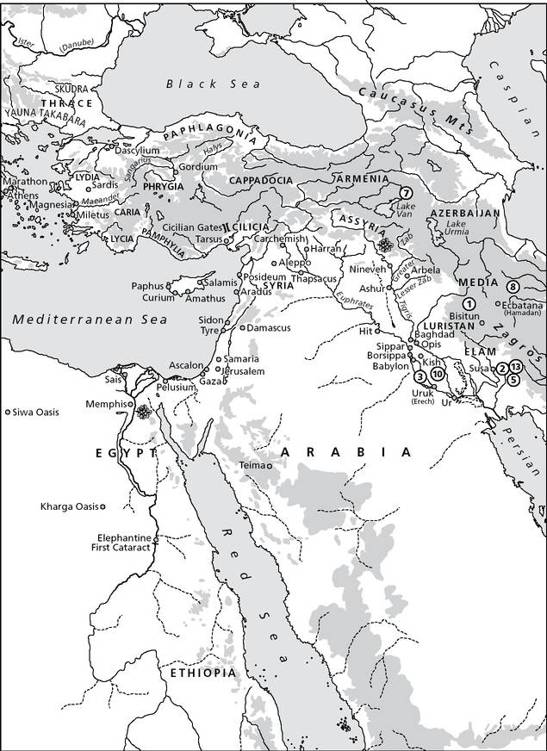
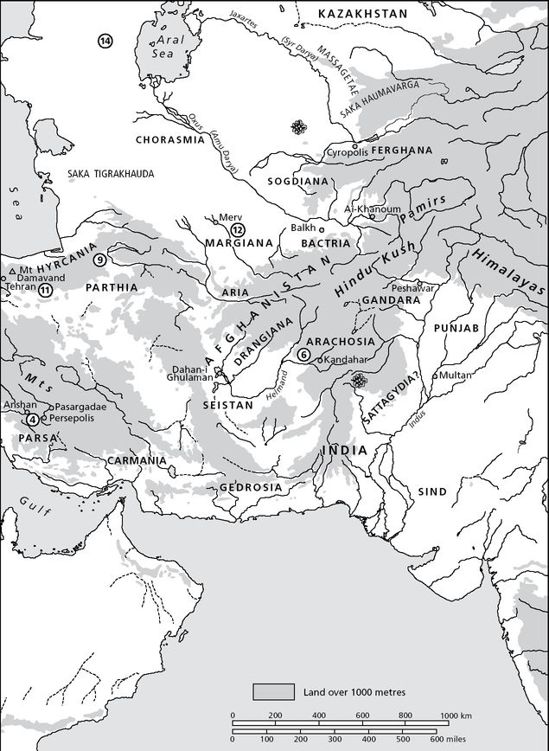
Map 4.1 offers a visual aid for the geographic scope of the resistance encountered by Darius, as he himself relayed in the Bisitun Inscription. Darius provides at some points an impressive specificity (e.g., with regard to most dates) and at others quite the opposite (e.g., the exact circumstances of the slaying of the purported impostor). The locations indicated on the map are only approximated by region and numbered roughly in order of sequence; there is much uncertainty and overlap. In several instances, there were multiple engagements over time. Was military action in a given place continuous or sporadic between given dates?
See Amélie Kuhrt The Persian Empire: A Corpus of Sources from the Achaemenid Period (pp. 140–158) for a precise chronology, translation of the Old Persian version, and copious notes and references.
1: Gaumata slain in Media, September 522
2: Against Acina in Elam, October 522
3: Against Nidintu-Bel/Nebuchadnezzar III in Babylonia, October 522 and December 522
4: Against Vahyazdata in Parsa, December 522, May 521, and July 521
5: Against Martiya in Elam, December 522
6: Against Vahyazdata’s army in Arachosia, December 522 and February 521
7: Against Armenians, December 522, May 521 (two battles) and June 521 (two battles)
8: Against Medes and Fravartish in Media, December 522, January 521, and May 521
9: Against Fravartish’s supporters in Parthia and Hyrcania, March 521 and July 521
10: Against Arakha/Nebuchadnezzar IV in Babylonia, August 521 and November 521
11: Against Cicantakhma in Sagartia (location of this region uncertain), October 521
12: Against Frada in Margiana, December 521
13: Against Athaimaita in Elam, 520
14: Against Skunkha in Scythia (location uncertain), 519
DB §21 also indicates rebellions in Egypt, Assyria, Sattagydia, and Scythia (location of last two uncertain), but no further details about any of those are provided in the Bisitun Inscription.