
7
The Death of Darius and the Accession of Xerxes
Stung by the defeat of his forces at Marathon, Darius was furious and immediately began to prepare a much larger campaign. At least this is what Herodotus tells us (7.1) – not that the Father of History would have had any chance of knowing Persian strategic concerns in 490 or, for matter, Darius’ actual words. Herodotus supplies such details, some perhaps from oral tradition, for dramatic effect. That Darius intended another campaign would be no surprise; the Persians were relentless, after all, but no short-term preparations can be confirmed. Darius died in 486, and his son and successor Xerxes had, on his succession, far larger problems than Greece. Herodotus offers no details about Darius’ death but notes that he reigned for thirty-six years, a number confirmed by Babylonian documentation. The latest text to Darius’ reign dates from late December 486; the first to Xerxes’ reign is from early December of the same year, so there may have been some confusion, even in Babylonia, as to the exact date of the transition. Ctesias indicates that Darius died of illness (Fragment 13 §23).
The succession of Xerxes was not without controversy. Herodotus sets his story (7.2–3) near the end of Darius’ reign, when Darius was compelled to choose a successor before he went on campaign, “according to the law of the Persians.” There is no other record of such a Persian practice, and Herodotus’ reference to it here is a bit odd. Darius had undertaken many campaigns previously, as Herodotus himself related without mention of the succession. It is probably a rhetorical statement that served Herodotus’ literary purpose here. Regardless, the issue turned on which son should be successor: his eldest son from his first marriage (before he became king) or his eldest son after he became king. By his earlier marriage to a daughter of Gobryas, Darius had three sons, the eldest of whom was named Artobazanes. Xerxes was the eldest child from Darius’ marriage to Atossa, the daughter of Cyrus, after Darius ascended to the throne. Xerxes’ descent, and the timing of his birth, became the compelling arguments. Herodotus has these arguments presented to Darius by an exiled Spartan king named Demaratus. Demaratus later accompanied Xerxes on his invasion of Greece and became one of Herodotus’ stock characters, the wise adviser. Herodotus adds that the influence of Xerxes’ mother, Atossa, would have carried the day in any case, because she had such enormous influence upon Darius. But Atossa’s purported influence, as described by Herodotus, represents the popular Greek stereotype of the dominant (and often domineering) position royal women held at the Persian court. Herodotus is unsubstantiated here.
Xerxes himself provides some backdrop for Herodotus’ story, as he makes oblique reference to a succession controversy in an inscription from Persepolis (XPf §4). “Xerxes the King proclaims: Darius had other sons as well, but thus was the desire of Ahuramazda: Darius my father made me greatest after himself. When my father Darius died, by the favor of Ahuramazda I became king in my father’s place.” The rest of the inscription emphasizes Xerxes’ continued building works at Persepolis and reinforces the continuity between Darius and Xerxes. No specifics of his mother, birth order, or succession politics are revealed here, nor would we expect them to be. The only salient point is that Darius, and of course Ahuramazda, chose Xerxes; therefore, Xerxes is the rightful king. It is usually presumed to be Xerxes standing behind the enthroned Darius in the so-called Treasury Relief (Figure 7.1) at Persepolis, though the figures are not labeled.1
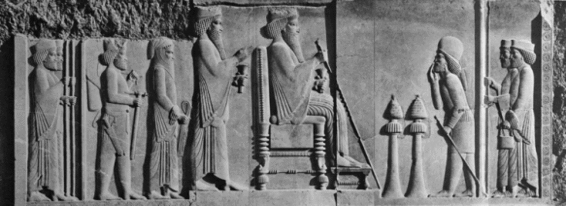
Figure 7.1 Treasury Relief, Persepolis. Courtesy of the Oriental Institute of the University of Chicago.
The new King Xerxes was immediately confronted by a revolt in Egypt that had actually begun before Darius’ death. By virtue of its geography and its wealth, Egypt had greater strategic significance than any other western region. We know little about the revolt beyond allusions in Classical sources, so it is difficult to gauge its magnitude or Xerxes’ response. Herodotus notes that Xerxes crushed the revolt and adds the cryptic note that he made Egypt “more enslaved than it was under Darius” (7.7). It is difficult to determine what that means, but the response appears to have been effective. Xerxes installed his full brother, Achaemenes, as satrap there, and the sources indicate no serious trouble on the Egyptian front for roughly two decades.
Xerxes also faced one, and perhaps two, revolts in Babylonia, an area of course even more important than Egypt. A few Babylonian economic documents name two kings who reigned for only a few months: Bel-shimanni and Shamash-eriba. Details elude us here also. The main trouble appears to have been localized in northern Babylonia, including Babylon itself. Dates proposed for the rebellion have ranged from 484 to 479 BCE, and the latter date carries heavy interpretive significance. If a revolt in Babylon could be dated to 479, it would impact analysis of Xerxes’ actions against Greece, with wide-ranging ramifications. Most scholars now accept a date of 484, based on a thorough analysis of the relevant evidence.2
Both Herodotus and Ctesias relate a story of Xerxes visiting the ziggurat of Babylon, the god Marduk’s sanctuary, and either plundering the temple or violating a tomb. Herodotus claims that Xerxes removed a solid gold statue and in the process killed the priest who tried to stop the sacrilege (1.183). Ctesias offers a more convoluted story (Fragment 13b). Xerxes opened a sarcophagus, which bore an inscription indicating that whoever opened it must make sure it was filled with oil. Xerxes was unable to fill it, despite his continued efforts. Of course, this was a bad omen, and Xerxes’ failed expedition against Greece and his assassination by his own son (see discussion later in this chapter) were regarded as manifestations of divine displeasure with his impiety.
A lively debate continues as to whether Xerxes truly did any of these things. It remains unclear whether the stories are simply anti-Persian sentiment expressed in Greek sources or whether certain Babylonian rituals were misinterpreted by the Greeks. With regard to Ctesias’ story, it has been suggested that it stemmed from confusion with a well-attested ritual that involved the pouring of oil on foundation walls.3 Modern interpretations often trace these stories to reaction against Persian reprisals for the Babylonian revolt, though Herodotus makes no mention of a revolt in Xerxes’ reign.
Xerxes’ Royal Inscriptions
Xerxes left numerous dedications on buildings and sculptures at several sites, though mainly at Persepolis, second only to Darius in the number extant. The basic formula established by Darius persisted: Ahuramazda is the king’s main benefactor, and the king is an Achaemenid. As has been noted, this template – emphasizing divine legitimacy and royal lineage – was one used by Near Eastern kings for centuries. With Xerxes the formula was reinforced. Not only was Xerxes a son of Darius, thus an Achaemenid, but through his mother Atossa he was also descended from Cyrus the Great. All subsequent kings likewise had to be of Achaemenid descent, even if born of secondary wives. There is some irony, then, that all the kings except Darius himself could draw their bloodline to Cyrusas well (see Appendix C).
Attempts to read significance into minor variations in Xerxes’ titles – for example, “king of lands” or “king of this earth far and wide” – are generally met with skepticism. Not surprisingly, there is heavy emphasis on his continuation of Darius’ legacy: in the ideological sense of his capabilities as an effective ruler and in the tangible sense of his construction work at Persepolis. A trilingual inscription from the apadana at Persepolis (XPg) offers an example: “Xerxes the Great King proclaims: By the favor of Ahuramazda, King Darius, who was my father, did much that is good. And by the favor of Ahuramazda, I added to what had been done and I built more. May Ahuramazda, together with the gods, protect me and my kingdom.” Another inscription, in Old Persian only (XPl), is almost an exact copy of one from Darius’ tomb (DNb), but this one bearing Xerxes’ name also enumerates the royal qualities – physical, mental, and emotional – that typified a proper king.
Xerxes’ most famous royal inscription is the so-called daiva-inscription, in which Xerxes makes forceful but vague reference to punishment meted out against those who did not worship Ahuramazda but instead worshipped daiv (the long a indicates the plural form) – a word roughly translated as “demons” or false gods.
And among these lands there was a place where daiv were worshipped.
By the favor of Ahuramazda I subsequently destroyed the sanctuary of the daiv, and I commanded “The daiv will no longer be worshipped!”
Where formerly the daiv were worshipped, there I worshipped Ahuramazda as appropriate.
(XPh §4)4
In this inscription Xerxes reasserts Achaemenid royal ideology and elaborates the centrality of Ahuramazda to the King’s, and by extension the Empire’s, success and well-being. The inscription begins and ends with invocation of Ahuramazda. It begins with the god’s creation of the world and of heaven; it ends with a blessing for the one who obeys Ahuramazda’s law (understood as manifest in the King) and who worships him appropriately, and it adds a benediction for the god’s protection of Xerxes, his house, and his realm.
Xerxes’ imprecation against the daiva-worshippers has received much attention in modern treatments of XPh. The very existence of the daiv stands in antithesis to Ahuramazda, the epitome of righteousness, a contrast that impacts our understanding of Achamenid religious practices. Xerxes’ sentiment here parallels that of Darius in the late addition to the Bisitun Inscription (DB §71–76) identifying the failure to worship Ahuramazda as an offense, a marker of rebellion. This is clearly an ideological signpost, but as a motivator of applied strategy it is much more problematic. It is one thing for the king to cast rebels as liars or enemies of the king’s god, but it is another to assume that the king actively sought to compel others to the worship of Ahuramazda. As a practical matter we do not see this sentiment beyond formal expressions in the royal inscriptions and, in fact, there is plenty of evidence that contradicts a notion of exclusive worship of Ahuramazda (see pp. 155–156).
Xerxes takes Darius’ sentiment one step further but only in this one inscription. In it, Xerxes’ claims are strident but not specific: he restored order by defeating offenders. In those places where the daiv were worshipped – and, by extension, where Ahuramazda was not worshipped – Xerxes made certain that the proper worship of Ahuramazda was (re?)-instituted. What does that mean? Is Xerxes referring to Babylonia, Greece, Egypt, somewhere else? Perhaps the best answer is all of them and none of them – by that it is meant that Xerxes’ expression is an idealized one: a powerful, but generalized, expression of the royal ideology that may not apply to one specific episode or place. We cannot say that Xerxes did not specifically apply these sentiments to one or more of his conquests, but we also cannot find evidence that the compulsory worship of Ahuramazda was instituted anywhere.
Xerxes’ dahyva-list (XPh §3, see Figure 6.2, p. 97) is notable as the longest such list on record. Unlike the general east-west arrangement (from the center, Parsa) found in Darius’ lists, there is no clear rationale for the order given in XPh. We do not know the exact date of this inscription. If it was commissioned after Xerxes’ failed invasion of Greece (480–479 BCE), there is no acknowledgement of any loss of territory. From the ideological perspective, we should not expect to find one. The Greeks by the sea and beyond the sea are listed. There are two new dahyva here as well: the Dahae of Central Asia and the Akaufaka, whose location is unknown. We cannot track the historicity of these conquests, but it is not an accident that Xerxes’ list is longer. Regardless of the impact of the Greek campaign, Xerxes had to develop his father’s territorial dominion further. The ideology demanded it of the king, “the expander of the realm” – a traditional concept in Near Eastern royal ideology and an actual title used by some Elamite kings. It is notable that Xerxes’ dahyva-list is the last extant. Whether it is a matter of not having found one from subsequent kings, or whether the formal presentation of a list was later deemed no longer necessary, is unclear. Some scholars would correlate the latter possibility with a cessation of Persian expansionism after Xerxes – an assessment that matches our (thin) extant record, and makes perfect sense within that record, but one that in the end cannot be currently confirmed.
Xerxes and the Invasion of Greece – Sources and Problems
The Persian invasion of Greece in 480–479 BCE is one of the most readily identifiable sequences in both Achaemenid Persian and Greek history. Our image of Achaemenid Persia is usually one of a tyrannical enemy that unleashed an overwhelming onslaught against the freedom-loving Greeks, who, because of their society’s values and virtues, were able to defeat them. This is the stereotypical view, one as indebted to modern recasting of that historical sequence as it is to the Greek tradition itself. Herodotus wrote roughly two generations after the invasion, and his first six (of nine total) books build toward the cataclysmic confrontation. His account is suffused with cautionary tales of hubris and imperial overreach. Despite all the necessary caveats and qualifications – foremost among which is that we have no Persian sources whatsoever for the invasion – there is no doubt that Xerxes’ invasion of Greece and the Greeks’ reaction to it marked a turning point in the history of the western world. Some hyperbole is inevitable for such a momentous historical event.
According to Herodotus, when Darius died in 486 BCE, Xerxes took on the responsibility of retribution against Athens for their involvement in the Ionian revolt. After handling the more pressing problems in Egypt and Babylon (see discussion earlier in this chapter), Xerxes was able to turn his attention to a full-scale invasion of Greece. Herodotus relates that the preparations for this campaign, the assembling of manpower as well as the necessary supplies and logistical support, took four years. These preparations tell us as much about Persian military and administrative logistics as does the invasion itself – at least from a Greek perspective.
With his sense of drama, Herodotus sets the decision to invade Greece in a gripping debate at the Persian court. Mardonius, whom Darius sent on campaign to Thrace in the 490s, exhorts Xerxes to punish Athens, to finish the job that stalled in 490 at Marathon(7.5–6). Herodotus also includes a cast of Greek characters lobbying the King: Athenian exiles, aristocrats from northern Greece seeking support, and the exiled Spartan king, Demaratus. In contrast to Mardonius’ headstrong and selfish motivation for glory, Xerxes’ uncle Artabanus sounds notes of caution, but Xerxes’ ominous dreams forewarn him of disaster if he does not invade. As intimated by Herodotus during this lengthy excursus (7.12–19), even the gods impel the doomed Xerxes toward his fate.5
A military campaign understood as retribution fits nicely with Persian royal ideology, and that is generally how Darius’ expedition against Marathon is interpreted. Xerxes’ invasion was on a larger scale, and that retribution as the sole motivator seems unlikely, even if it may have been the main one. Persian campaigns in southeastern Europe and the Aegean Islands during Darius’ reign foreshadowed Persian expansion in this region, and Xerxes’ campaign may well have been a logical outgrowth of Persian expansionism. Mardonius’ argumentation rings true that it was critical for the King to display his power: the overwhelming spectacle of the King’s forces in full pageantry, the King receiving tribute and homage from subjects both old and new.
The scale of Xerxes’ army arrayed against Greece, as relayed by Herodotus (7.184–187), defies reality. By the numbers: 277,610 men on 1,207 warships; 240,000 men on 3,000 transport ships; 1,700,000 infantry; 100,000 cavalry and charioteers; along with 300,000 men drafted from the Empire’s European territories, who joined the expedition en route. This gives a grand total of 2,617,610 combatants, and Herodotus does not count the camp followers and other peripheral elements. Even if these numbers were factors of ten – assuming a tenfold exaggeration – the numbers still are too high for effective logistics. On the other hand, the greater the numbers of these “barbarian hordes” the greater and more glorious the Greek victory that Herodotus describes. With such wildly exaggerated numbers, it is no wonder that the motif of the army drinking rivers dry runs through Herodotus and later Classical accounts. Modern estimates range from 50,000 to 200,000 for the army and from 500 to 1,000 for the navy, and most realistic assessments tend toward the lower side of these ranges. Occasional references by Herodotus’ younger contemporary Thucydides also support a lower number. Thucydides’ work chronicles the war between Athens and Sparta in the late fifth century. Thucydides periodically mentions Xerxes’ invasion, mainly in rhetorical contexts. But there is a common theme in these references. Thucydides points to the Persians’ mistakes and their relatively small numbers as the main reasons why the invasion did not succeed.
Some other elements of Greek historiography must be mentioned here. The term “Persian Wars” is a label that reflects a Greek perspective. In any context that emphasizes a Persian perspective, a reversal seems more appropriate: the “Greek wars” or something to that effect. Also, Herodotus, Thucydides, and several other Classical writers refer to the Persians as “barbarians.” This terminology, read at a superficial level in English translation, lies at the root of no shortage of misapprehension and stereotyping. The Greek term barbaros, whence the English term “barbarian,” initially was used to refer to anyone who was not Greek, and who when speaking made sounds – to Greek ears – only like “bar-bar-bar-bar …” in other words, nonsense. From this the Greeks created the onomatopoeic word barbaros. In some Greek writings, the word certainly carried (and was meant to carry) a negative stereotype. The Greeks, ethnocentric as anyone else in that day, believed non-Greeks to be inherently inferior. But such a value judgment depends on one’s perspective. The Persians were highly advanced, heirs to and innovators in civilizations that predated the Greeks by centuries. In any event, the Persians probably held similar views about the “barbarous” Greeks, the Yauna – differentiated only by geography and occasionally by their hats – to the Persians an insignificant, but troublesome, people on the far-flung edge of their empire.
Medism
Another important issue of terminology involves the Greek phenomenon of Medism. This term and its varying manifestations as verb and noun – “to Medize,” “to go over to the Mede,” “Medizer,” etc. – referred to Greeks or others who supported the Persians, either by offering tokens of submission (earth and water) or by outright support. The term might apply whether the “Medizing” was compelled or voluntary. This is common but somewhat curious phraseology throughout the Classical accounts: we are dealing with Persians, of course, not Medes, though the latter were subjects of the Persian Empire. So, why “Medize” instead of “Persianize”? Scholars have struggled with this issue for a long time, and explanations vary.6 Did the Greeks simply not differentiate between the culturally and linguistically related Medes and Persians? Did the Greeks simply see the Persian Empire as a continuation of the Median? Even though Herodotus uses the term “Medism” and its variants throughout his work, he clearly distinguishes the two peoples. One piece of evidence comes from a poet named Xenophanes, from the Ionian city of Colophon. Xenophanes was born circa 570 BCE and lived during both Lydian and Persian domination – or, as expressed in the following fragment – the Median domination.7
Such are the things to discuss by the fire in winter while reclining on a soft couch, well-fed, drinking sweet wine, snacking on seeds: Who are you, and from where among men? How many years have passed you by, good man? How old were you when the Mede came?
This is one of our earliest references to the Persian conquest of Ionia. Why does Xenophanes attribute it to “the Mede”? It is good to recall here that after the conquest of Lydia, according to Herodotus’ account, Cyrus turned over operations in Anatolia toMazares and then to Harpagus (see pp. 41–42). These two Medes must have left an impression. If they commanded Median (or even primarily Median) forces, it was thus the Median troops who conquered Ionia, even though they did it under Persian auspices. The conquered Ionians may not have given such distinctions high priority, at least not at first. Questions about the origins of the term “Medism” are certainly more complex, but in this early usage we find some explanation for the use of the term to designate the Persians.
Earth and Water
Another recurrent motif in Herodotus is the Persian demand for earth and water as tokens of submission to the King. We find such requests first during Darius I’s reign: made of the Scythians (4.126–132), of the Macedonians (5.18), and of the Athenian embassy to Artaphernes in 507 BCE (see p. 84), and especially in conjunction with the campaign that culminated in the Battle of Marathon in 490 BCE. Before that expedition, Darius sent heralds throughout Greece to ask for earth and water (Hdt. 6.48). There were not many city-states that refused. The implication is that the mere refusal to a formal request for earth and water put one at odds with the King and that in itself demanded retribution. According to Herodotus’ account, those Persian heralds sent to Athens were thrown into a pit for condemned criminals, and those visiting Sparta into a well, and they were told that they could seek their earth and water there.
Before his campaign, Xerxes made the same request of Greek city-states. Herodotus provides a list of specific city-states that offered earth and water to Xerxes (7.132). The list cannot be specifically correlated with the city-states submitting to Darius: no specific city-states are named in that passage (6.48). When Xerxes sent out heralds before his campaign, he purposely neglected sending them to either Athens or Sparta because of their mistreatment of Darius’ heralds. It seems a safe assumption that a large number of city-states gave earth and water to Darius and again to Xerxes some ten years later, but this is unverifiable. By the time Herodotus wrote, there was likely a fair amount of revisionist history among some states about their fortitude in resisting the Persians in 480.
The full significance of the giving of earth and water, especially the symbolism associated with the actual elements themselves, is yet debated. Were they meant to represent Persian possession of the (now formally subject) territory? Was there some religious significance to these elements? The request for earth and water appears closely tied to Achaemenid imperial ideology, but its meanings for both parties, and especially for the King, is harder to grasp. In context, it was clearly meant as one ritual to establish the trustworthiness and loyalty of the contracting party to the King.8 But what specific obligations did it entail? That is harder to answer. With the first evidence for such requests dating to Darius’ reign, one cannot help but be tempted to apply some religious significance to earth and water in an early Zoroastrian, or Mazdaean, context.
The Greek city-states that complied with the request acknowledged the king’s superiority in exchange for his protection and patronage. It is notable that requests for earth and water disappear from the sources after Xerxes’ invasion – perhaps such requests were linked only to acquisition of new territory – and with Persian expansion beyond the Aegean mostly thwarted after 479. But Persian influence, in theory if not in applicable practice, swept through much of Greece in the early fourth century, yet no requests for earth and water are recorded in the sources we have for that period of Artaxerxes II’s diplomatic triumph in 387/386 BCE (pp. 185–188). To assert that submission of earth and water was no longer relevant after Xerxes risks what historians call an argument from silence: simply because the sources do not mention a phenomenon does not mean that the phenomenon did not occur. Also curious, Herodotus preserves a fair amount of information from the reigns of Cyrus and Cambyses, both of whom were active in Ionia and the Aegean. Yet not once were either of these kings in Herodotus’ account associated with requests of earth and water from conquered or potential subjects. If Cyrus or Cambyses requested it, it is a striking omission in Herodotus’ account, but the perils of an argument from silence apply here also.
The Invasion of Greece
Preparations for Xerxes’ campaign, a display of Persian might and grandeur as much as a military expedition, were extensive. The force needed supplies, and earlier campaigns against Thrace, which also brought Macedon into the Empire, offered numerous depots for provisions along the planned route. A great pontoon bridge was constructed over the Hellespont at Abydos, a span that Herodotus measured at almost a mile. The first bridge was destroyed by a storm, and here Xerxes’ hubris was put on display. The Hellespont was whipped and branded – branding served as a mark of ownership – with Xerxes ordering the following curse (7.35): “O Bitter Water, your Master, who has done you no wrong, inflicts this punishment upon you. But King Xerxes will cross you, whether you will it or not. It is right that no one among men sacrifices to you, a foul and bitter river.”
The Phoenician and Egyptian engineers responsible for the first pontoon bridge were beheaded. The second bridging attempt was successful; one might note that the second group of engineers clearly had greater motivation to make the second bridge sturdier. How much of this is apocryphal and literary is impossible to discern. Among other possibilities: the whipping of the Hellespont may have been a ritual misconstrued by the Greeks.9 Smaller bodies of rivers, for example the River Strymon in Thrace, also needed bridging en route. A far more involved work of engineering took place at the easternmost finger of the Chalcidian peninsula in the northern Aegean, the site of Mt. Athos. There a canal was dug, roughly a mile and three-quarters long, the work on which took three years according to Herodotus (7.22–24). He attributes one impetus for its construction to Mardonius’ fleet having been previously wrecked off Mt. Athos in 492 BCE and another to Xerxes’ wish (in his arrogance, of course) to leave a monument to his power – rather than to rely on the more sensible plan of dragging the ships across the isthmus instead. Arrogance perhaps, but Herodotus’ caricature of Xerxes here offers little historical insight. Kings frequently expressed their piety – if not their egos – through monuments and other construction works, and a parallel to the Mt. Athos project may be found in Darius’ work at Suez in Egypt (see p. 80). Practicality and vanity are not necessarily mutually exclusive.
Infantry and naval forces were summoned from throughout the Empire, and we may readily visualize royal dispatches requesting troops and provisions according to each individual satrap’s means. The forces mustered in Cappadocia (southern Anatolia), with the infantry then moving along the road through Phrygia to Sardis in Lydia. From there, the road led to the Hellespont, at which point Xerxes himself offered sacrifices in person. After crossing the Hellespont, the forces reassembled again at Doriscus, one of the Persian depots in southern Thrace. Herodotus’ detailed account gives the names of many of the commanders and delineates the individual ethnic contingents, highlighting their appearance and equipment and the splendor of their jewelry and fine clothing, especially of the Persians themselves (7.61–100). Such prestige items were not worn for their effectiveness in battle but were marks of honor within the royal system.
The mere passing of such a host was memorable in itself, as revealed by Herodotus’ precise itinerary and the occasional aside, for example, that the Thracians still held Xerxes’ path in reverence during his time (7.115). Much of Herodotus’ account focuses on Xerxes as a tourist, marveling for example at a particularly impressive gorge (7.128–130). These vivid descriptions permitted Herodotus the ethnographer to flourish in his own element. Herodotus juxtaposed his descriptions of Xerxes’ leisurely approach with divine omens that consistently prophesied certain doom for the expedition – just as he had done previously with his portrayals of Cyrus and the Massagetae, Cambyses and the Ethiopians, and Darius and the Scythians. The themes of hubris and imperial overreach are everywhere; the Persians are, once again, violating the natural order of things. So masterfully is this arranged, one tends to forget that Herodotus was imposing his artistry on a historical event. None of the preceding should be taken to imply that this was not a serious campaign, even at greatly reduced estimates of the numbers involved. Of primary concern here is gauging Persian aims and perspectives and, where possible, gauging the Greek response as the Persians saw it. (See Map 5.1 for the progression of Xerxes’ army.)
Once the Greeks decided to hold the strategic pass of Thermopylae in northern Greece, the first line of battle had been drawn. It was here that Xerxes’ hammer would fall, accompanied by an attack on the Greek naval forces at nearby Artemisium. Thermopylae was well-suited for defense by a small number of men, in the end somewhere between 3,000 and 4,000, most famously the 300 Spartans who fought to the death under one of their kings, Leonidas. The narrow pass by the sea offered a bottleneck that would need to be forced. According to Herodotus, Xerxes’ best troops were singularly ineffective despite multiple attempts (7.210–212): Medes, Elamites (Cissians), even the Immortals were repelled. The Greek forces had chosen well. Unable to force the passage head-on, Xerxes seized on an offer of treachery by a man named Ephialtes, a local Greek: to lead the Persians around the pass by way of an obscure mountain trail. By sending a force around the pass, the Persians were able to trap the remaining Greek forces, mainly Spartans, who fought to the finish while the others retreated.
This is one of the most celebrated battles in the western tradition, one that became equated with self-sacrifice and heroism, the stand of free men against tyranny. It has been told and retold countless times. And all retellings are indebted to Herodotus. Some take more liberties than others and add to an already weighty legend, with the result that the truth becomes even harder to discern. The symbolism and significance attached to the battle make it easy to forget that the pass was indeed forced. From the Persian perspective, Thermopylae was a victory. Despite heavy (exaggerated?) losses at sea, the Persians triumphed at Artemisium as well. That engagement is described in less detail by Herodotus. The Persians won mainly after news from Thermopylae arrived: once the Persians had gained the pass there was no point for the Greek fleet to wait there anymore, so they departed. These victories opened the road to southern Greece for the Persian army. The Greeks were not unified even at this point. Among those who chose to fight, members of the so-called Hellenic League (most prominently Sparta and Athens), there were incessant arguments over who would hold command and other strategic matters. Many Greek city-states, especially in the north, medized: some by choice, others by necessity. The oracle of Delphi had been depressingly pessimistic about the Greeks’ chances; careful and calculating, it operated on the assumption of a Persian victory.
With Xerxes bearing down on southern Greece, many of the fissures between city-states became more pronounced. The Spartans and other Peloponnesians who yet fought argued strenuously that all their efforts should be applied to defense of the Isthmus of Corinth, the narrow stretch of land that connected the Peloponnesian peninsula to the rest of Greece. Many of the allies were unhappy with such a strategy. Herodotus alludes to construction of a wall across the isthmus, fortifications to defend against a possible Persian attack there, but no archaeological evidence for such a wall has ever been found. Time and again, characters in Herodotus’ work offer Xerxes advice: Demaratus urges Xerxes to exploit the Spartans (7.235); Artemisia advises him to ignore Salamis and focus on the Peloponnese (8.68); the Thebans desired to use Persian financial resources to encourage factional strife among Greek city-states (9.2). Had Xerxes followed any of these courses he would have caused a complete rupture among his enemies. These anecdotes are also difficult to interpret. Are these accurate renderings of strategic considerations (however such may have been transmitted to Herodotus)? Or are they simply manifestations of Greek hindsight common in the later fifth century?
Athens remained the main goal of the expedition. Once the remaining city-states of Boeotia – on Xerxes’ direct route toward Athens – had medized (8.34), there was nothing to stop the Persians. The Athenians decided to abandon their city, and the people removed from Athens across the Saronic Gulf to Troezen and some of the nearby islands, including Aegina and Salamis, the site of the later decisive naval battle. The Persians sacked Athens and plundered and burned its sanctuaries upon the acropolis (8.53). This act was cast as retribution for Athenian involvement in the Ionian revolt and the burning of Sardis. We may assume, if the Persians believed that the Athenians had formally entered into a treaty relationship with them – because of the offering of earth and watermade in Sardis in 507 BCE – that this sack was also understood in Persian ideological terms as due punishment for a recalcitrant vassal. Herodotus emphasizes the significance of this victory to Xerxes by noting that he sent a special messenger to Susa to relay the good news to Artabanus, his uncle and regent (8.54). Athens was his.
The naval battle at Salamis in September 480 proved a turning point in the invasion. Herodotus attributes the Greek victory to the Athenian admiral Themistocles’ tenacity and trickery. His manipulation of his Greek allies to fight in the narrow strait gave advantage to the Greek triremes, fast and maneuverable ships with metal bows for ramming. Themistocles sent a slave to feign desertion and convince Xerxes that the Greeks were about to disperse, and Xerxes was thus led to believe that the opportune moment was at hand. Xerxes’ decision to attack played right into Themistocles’ stratagem: to force the Persians to fight in the narrow and shallow waters that favored the Greek ships’ maneuverability and speed over the more cumbersome ships in the Persian fleet. The clandestine, false message tricking the Great King makes great theater, but is it accurate? There is no way to know. Similarly, when Herodotus attributes the heavy Persian losses also to the Persian crews’ inability to swim (8.89) we must ponder the likely interplay between fact, stereotype, and anecdote. The Greek victory may be attributed to superior tactics or Persian ineptitude (or both, as per 8.86). In such contexts, it is useful to recall the historian Thucydides’ comments (e.g., 1.69 and 6.33) that it was Persian mistakes and misfortune that ultimately decided the day.
Xerxes watched the Battle of Salamis accompanied by scribes who wrote down the names of those who fought valiantly and otherwise. This too may seem anecdotal, but we do have references to Assyrian scribes of the seventh century tracking such details of battles, so that fitting rewards might be distributed thereafter. In this case there is a historical parallel that supports Herodotus’ depiction. The Greek tradition suggests that the defeat at Salamis broke Xerxes. Herodotus tracks him and his escort making an ignoble retreat to Sardis, abandoning royal implements (such as the King’s sacred chariot), and at times eating the bark off trees in their plight. Yet it is clear that more than one version of Xerxes’ withdrawal was available to Herodotus (cf. 8.115 and 8.118), which implies that at least two versions – likely more – were yet circulating in the later fifth century. Furthermore, Xerxes left behind a picked force under Mardonius to continue the campaign, so a pell-mell withdrawal is hard to credit.10 In the end, we do not know what motivated Xerxes to depart, but a significant Persian force stayed in Greece for almost a year thereafter, with logistical support and aid from Greek vassals and allies.
Mardonius encamped in Thessaly and the military maneuvering continued. The Greek fleet’s attempts to separate some Aegean Islands from the Persian cause, or to compel money from them for the war effort, met with mixed results. Much time remains unaccounted for between late fall of 480 and summer of 479. Herodotus and other sources offer little information for this critical interlude. Possibly the Peloponnesians continued work on the wall across the isthmus (9.7–8). In the summer of 479 Athens was again evacuated, before Mardonius invaded it a second time. Mardonius had previously sent Alexander I of Macedon (an ancestor of Alexander the Great of the fourth century), a Persian subject and friend of Athens, with an offer to the Athenians to join the Persian side with no further penalty: resistance, Alexander said, was futile. But he was rebuffed (8.143). The Athenians used this offer to compel the Spartans, who were still trusting in their isthmus wall, to assist them rather than watch the Athenians medize.
Once Mardonius had sacked Athens a second time, destroying all that he could, he withdrew to Thebes: a friendly (medizing) territory and a place more suited to Persian cavalry. The next and main infantry engagement of the war took place at nearby Plataea. Herodotus attributes the Greek victory here to Greek superiority in armor: the hoplite panoply versus light-armed soldiers on the Persian side. It is generally granted that there is some truth to this assessment, but we know that not all Persian troops were light-armed. There is not enough data, despite Herodotus’ catalog of the Persian force en route to Greece, to discern the facts. The clash at Plataea resulted in the death of several noble Persians and of Mardonius himself, at which point the remainder of the Persian army under Artabazus withdrew from Greece. As tradition has it, on the very same day in late August 479 the Greeks also won a significant victory at Mycale in Ionia, considered by Herodotus proof that divine favor was supporting the Greek cause. The Persian navy was defeated at sea and, when the remnants disembarked on the beach, they were defeated there as well (9.99–102).
The Greek repulsion of Persian forces from Greece was the beginning, not the end, of the matter. Ionia immediately revolted again (9.104), and much of the rest of the fifth century saw shifting in the strategic situation on the Persians’ far northwestern frontier. It was no longer an uncontested region but one in which the Persians were constantly forced to defend their territories and react against Athenian-led aggressiveness. On the other hand, the development of Athenian power was confined mainly to the Aegean world and occurred in the context of a constant Persian threat. In the immediate aftermath of Xerxes’ defeat, it was more than a hypothetical question. Were the Persians going to come back? The frenetic military activity in the Hellespont and Ionia during the early 470s was not only for “Greek liberty” but should be viewed through a strategic lens as well: the projection of Athenian power and influence, and control of territory, was as much to create a buffer zone as it was for any imperialistic pretensions. The Hellespont was an Athenian lifeline; it was the main supply route that fed Athens – literally, as the main sea lane for via grain imports from the Black Sea region – as the fifth century progressed. Athenian military activity not only served their economic and political interests but also enabled them to challenge Persian control in that region and, if necessary, forestall any further Persian advances into Europe.
While Xerxes’ defeat certainly imposed new challenges for the Persians in the northwest, we discern no impact on the Empire in its integrity or its stability. Some previous scholarly treatments attribute the downfall of Persia to Xerxes’ defeat. But that “downfall” was 150 years in the making and, when cast in such terms, nonsense. Salamis, Plataea, and Mycale were not the first Persian setbacks in the field, nor were they the last. Xerxes’ defeat in Greece and Alexander the Great’s successful conquest of Persia are linked only in propaganda.
Dio Chrysostom, a Greek philosopher and orator of the first century CE, relays that the Persians rejected outright the Greek version of events and had their own take:
Xerxes invaded Greece and on the one hand defeated the Spartans at Thermopylae and killed their king, Leonidas, and on the other hand he captured the city of the Athenians and demolished it, and those who did not escape he sold into slavery. After he accomplished this he imposed tribute on the Greeks and returned to Asia.
(11.149)
The reliability of this report must also remain open to question, as has been the case with Herodotus and other accounts datable much closer to the events. But it seems reasonable enough as a Persian perspective – it echoes in outline what one would expect from a royal inscription (such as Bisitun) about a successful campaign. In the final analysis it is correct to view Thermopylae and Artemisium as Persian victories: the Greeks were slaughtered or routed and the Persian advance continued. The punishment of Athens (sacked twice) was one point of the campaign, and Xerxes could view that mission as accomplished.
The Aegean Front and the Athenian Problem
After the Battle of Mycale and into the year 478 BCE, Greek forces moved to push their advantage in Ionia and even to challenge Persian control in Cyprus. Initial Greek success in securing the Hellespont was soon bogged down by concerns and complaints about the Spartan general Pausanias, the leader of the expedition who had become flush with his own success and power and who, according to several sources, even made friendly overtures to Xerxes. This sort of treachery no doubt continued to feed concerns of another Persian expedition. The Spartans, always conservative and distrustful of foreign ventures, recalled Pausanias and gave way to Athenian leadership for the next phase.
The formation of what was initially called the “Delian League” was thus dominated by Athens, the League’s premier power in terms of size and number of ships. The league took its name from the island of Delos, the original home to the league treasury until it was moved to Athens in 454. Under Athenian leadership, the League coerced several city-states in Ionia and southwestern Anatolia, in the territories of Caria and Lycia, to join them. These were Persian-held territories, and members of the League from those regions were, in effect, considered rebels by the King. There is no evidence that the Persians ever relinquished claim upon these territories.
Attacks against Persian interests and forts in the Hellespont and Thrace also were a high Greek priority. Herodotus preserves record of a Persian named Mascames, in charge of the important Persian staging point of Doriscus; he was highly honored by the King because no one was able to dislodge him. The implication is that Doriscus continued to be controlled by the Persians, an ongoing thorn in the side of Athenian military activities in this region. Another Persian, Boges, was lauded by the King for his bravery and sacrifice. Boges was the commander of a Persian fort at Eion (along the Strymon River in southern Thrace) who fought to the bitter end and committed suicide rather than be caught in failure (7.106–107). The high point of Athenian aggression came in the early 460s BCE, when Athenian forces won successive victories over Persian naval and infantry sources at Eurymedon in southern Anatolia. But any Athenian designs eastward were short-lived. The Delian League did not have the cohesion or resources to sustain a challenge to the Persian Empire on a broad scale.
Beyond these moves and countermoves in the Aegean – again, all traceable only from Greek sources – we know little of the rest of Xerxes’ reign. A terse reference in a Babylonian astronomical tablet refers to the death of Xerxes at the hands of his son; the killer’s name is not given. Details are not divulged in such texts, but there is no shortage of innuendo from Greek sources.