
8
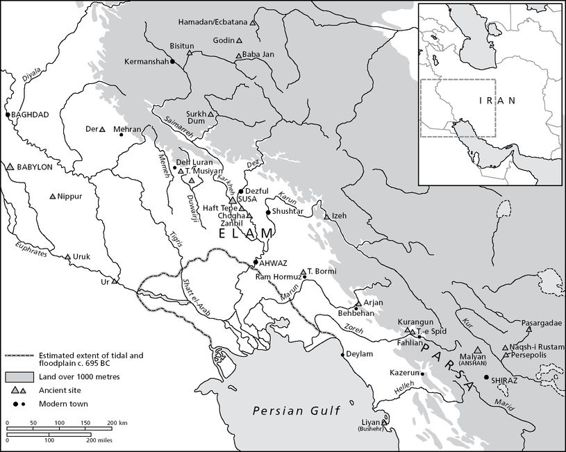
Map 8.1 Map of Western Iran and Mesopotamia, with Persian Capitals. After J. Álvarez-Mon, The Arj n Tomb, Plate 2 and P. de Miroschedji, “Susa and the Highlands,” figure. 3.1.
Royal Capitals
An empire of such scope as the Achaemenid Persian Empire could hardly have just one capital. The Persian kings had five, all in the center of the Empire (Map 8.1). Four straddled the Zagros mountain chain – Pasargadae and Persepolis in Fars (Parsa), Susa in Khuzistan, and Ecbatana in Media – and the fifth, Babylon, near modern Baghdad. Only the first two were new cities, founded by Cyrus and Darius, respectively, though not completed in their reigns. Susa and Babylon were centuries old. Susa is prominent in the Classical sources, but whether it was the capital at which the kings spent much of their time, or whether it was simply the horizon of most Greek experience, is unclear. Greek and Roman-era descriptions of these cities focus on the wealth and opulence of the King and his court. Few state archives from the capitals have been found; the main exception, the Persepolis Treasury and Fortification tablets, were discussed in Chapter 6. The main capital was, of course, wherever the King and his court happened to be at a given moment. They may have moved as much for the climate as for other reasons, such as the King’s required involvement in certain rituals. Susa or Babylon in the low-lying plains appealed during the winter, Ecbatana in the mountains was attractive during the summer. The court on parade was a spectacle in itself, an awesome display of the splendor of the King, and this was no doubt one of the desired results.
Ecbatana
Ecbatana is the modern city of Hamadan, and large scale excavations there are impossible. The apparent capital of the Medes, it fell to thePersians with Cyrus’ conquest of Astyages. Its location astride the major east-west trade route in northwestern Iran (the forerunner of the Silk Road) attests to its strategic importance. Herodotus’ description of Median Ecbatana seems mainly imaginative:
[Ecbatana’s] walls were built so that each circuit is higher than the one that circles it by the height of its ramparts … There are seven circuits in all, within the last one are the palace and the treasuries. The largest of the walls is about the size of the wall around Athens. The ramparts of all the walls are painted in colors: those of the first circuit are white, while those of the second black, of the third purple, of the fourth blue, and of the fifth orange. But the final two walls have plated ramparts, one in silver, the other in gold.
(Hdt. 1.98)
Ctesias attributes the legendary queen Semiramis with supplying irrigation works for the city. (Fragment F1b = DS 2.13.6). Despite the lack of excavation, a number of objects purportedly from Hamadan have circulated in modern museums, though whether that locale was the actual findspot or not is open to question. The tagline “from Hamadan” has been a favorite for illegally excavated materials (from whatever region in Iran) and, in some cases, forgeries.1
Babylon
Babylon had been an important city since the eighteenth century BCE and the time of King Hammurabi, he of the famous law code. It was the dominant city of southern Mesopotamia during most of the first millennium, the intellectual and cultural capital of the region. Babylon had undergone massive rebuilding during the Neo-Babylonian period, especially under King Nebuchadnezzar II in the early sixth century, and these remains dominate the excavated sections. Most of the Classical sources about the early Achaemenid kings and Babylon deal with conquest and revolt of the city, but it was fully incorporated into the Empire and served as a focal point for the blending of Persian and Babylonian traditions. The Achaemenid kings supported many of the important cults and shrines there, and they recognized the strategic and symbolic importance of the city. Darius II and his queen, Parysatis, had Babylonian mothers, and we have important evidence about the estates held in that region by many members of the Persian nobility during the late fifth and early fourth centuries (see pp. 168–171).
Susa
There is no evidence for major Achaemenid-period works at Susa before Darius I, but the magnitude of Achaemenid construction at Susa reflects its importance as a focal point of imperial expression. A number of inscriptions testify to Darius’ building activities there, especially his great palace and the adjoining apadana (an Old Persian word often translated as “audience hall”); they offer many parallels to earlier Mesopotamian rulers’ inscriptions, including the Cyrus Cylinder from Babylon. Darius aligned himself with that earlier tradition: his building and restoration works are contextualized with his establishment of order and the right to rule.
Darius the King proclaims: much that was out of place I put right. The lands were in an uproar, one was battling another. That which I have done I accomplished by the favor of Ahuramazda: one no longer battles another, each one is in its place. It is my law that they fear, so that the strong neither oppresses nor overpowers the weak. Darius the King proclaims: By the favor of Ahuramazda, there was much construction work done before which was in need of attention. That I accomplished.2
(DSe §4–5)
An idealized version of the Empire emerges at Susa, in the roster of subject peoples assigned specific tasks in the (re)building efforts. The so-called foundation charter (DSf) from Susa survives in dozens of fragments of the original trilingual inscription. Groups of subject peoples are associated with a particular raw material or skill: Assyrians and Babylonian transported cedar timbers from Lebanon, Lydians and Bactrians brought gold, Sogdians (from the northeast) brought lapis lazuli, and several others are mentioned.
Pasargadae
In the tradition of previous conquerors, Cyrus founded a new capital, one with aspirations that matched his new world empire: Pasargadae (Elamite Bakratatash). Pasargadae is located in Fars, on a plain surrounded by high mountains. Herodotus, in his list of the six Persian tribes (1.125), describes the Pasargadae tribe as the noblest, a distant echo of the city’s site and significance. The Greek geographer Strabo describes the site’s importance to Cyrus:
Cyrus held Pasargadae in honor, because there he defeated Astyages the Mede in the final battle, transferred the rule of Asia to himself, founded a city, and built a palace as memorial to his victory.
(15.3.8)
Archaeological work at Pasargadae has revealed the grandeur of the site, though the excavated remains make up only a portion of the whole settled area. The main features include two palaces, an elaborate gate, and a garden area. The chronology of Cyrus’ building activity here is uncertain; there have been no archives yet found from Pasargadae that allow chronological demarcation. The capital was far from complete when Cyrus died, and construction continued there into the reign of Darius.
The remains at Pasargadae testify to Cyrus’ willingness to adopt from his predecessors and neighbors, to make something uniquely Persian. Among many examples, the most striking is the famous guardian figure from a gateway in Palace R: a hybrid figure wearing an Elamite garment, with Assyrian-type wings and an Egyptian triple crown (Figure 8.1). This figure is stunning in its execution, symbolism, and internationalism. The inclusion of the Egyptian headdress is curious, because Cyrus did not conquer Egypt; perhaps the figure was finished or refashioned in the time of Cambyses or even Darius. Drawings of the guardian figure from the nineteenth century show a copy of an inscription attributed to Darius (labeled CMa in modern works, see discussion later in this chapter), the implication being that he finished those pieces or added the inscription subsequently.
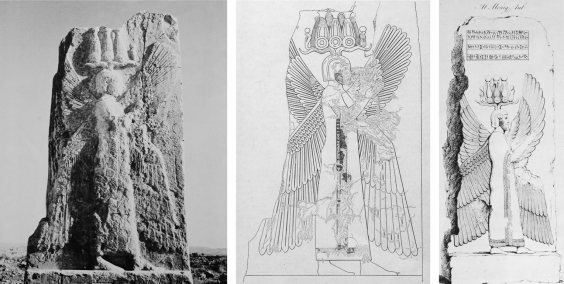
Figures 8.1a-c Winged Guardian Genius, Pasargadae. Figures 8a and 8b courtesy of David Stronach. Figure 8c from Sir Robert Ker Porter, Travels in Georgia, Persia, Armenia, Ancient Babylonia, Vol. I, 1821, opposite p. 492.
Outside the central complex are two structures of note. One is a square tower roughly 275 yards to the northeast of the central complex. The tower, called the Zendan-i-Suleiman (the “Prison of Solomon”), is nearly 46 feet tall, and its purpose is uncertain. The other is Cyrus’ plain but elegant tomb, roughly a half mile southwest of the palace complex (Figure 8.2). Cyrus’ tomb itself measures roughly 44 feet by 40 feet and has a sloped roof, approximately 40 feet off the ground. The tomb sits on a monumental stepped platform of six tiers that calls to mind not only the stepped pyramids of Egypt but also, and more directly,the ziggurats (temple towers) in Mesopotamia and Elam. Tombs with similar tiers have been found elsewhere in Fars and even in Lydia and western Anatolia.
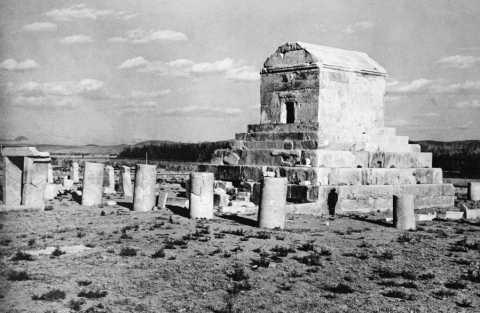
Figure 8.2 Tomb of Cyrus, Pasargadae. Photo courtesy of David Stronach.
Already we see in Pasargadae’s impressive garden and integrative sculptures parts of the new Persian vision. The Persians became renowned in particular for their gardens (Greek paradeisoi). Pasargadae also held an important place in a royal coronation ritual linked to the founder Cyrus. The Greek writer Plutarch reports (Life of Artaxerxes 3.1–2) on a royal rite administered by Persian priests, in which the King entered the sanctuary of the warrior goddess and donned the clothing that Cyrus wore before he became king. The new king then ate a cake of figs and some bitter leaves of a terebinth tree, and drank a bowl of sour milk. Plutarch implies there was more to the ritual, unknown to outsiders. The significance of these foods and their consumption in this context is unclear – perhaps a reminder of earlier, humbler days – but the link with Cyrus is telling. The ritual was clearly meant to establish the new king’s connection with and continuity from the first ruler of their world empire. Despite being overshadowed by Persepolis, Pasargadae retained its importance.
Persepolis
Persepolis is Greek for Old Persian Parsa (Elamite Parsha), a word that could refer to the city itself and the surrounding region. Located roughly 20 miles southwest of Pasargadae and 30 miles east of Anshan, Persepolis dominated its portion of the Marv Dasht plain in Fars. When one speaks of Persepolis today, the reference point is usually the terrace, a complex of buildings raised on a platform (the walls of which are roughly 40 feet high) that covered 30 acres. It included monumental gates, the treasury, palaces, the so-called Harem, the Hall of 100 Columns (the Throne Hall), and the Apadana.
Much of the construction of the Persepolis terrace was initiated during Darius’ reign, with significant portions added or completed by Xerxes and Artaxerxes I (Figure 8.3). Other evidence of buildings in the vicinity suggests urban areas and construction that occurred before Darius’ reign. For example, 2.5 miles from the terrace were found the remains of foundations for a columned palace and platform, the Takht-i Rustam (“the throne of Rustam” – an Iranian hero), which shares structural elements similar to the base of the tomb of Cyrus. Persepolis was both an administrative and ceremonial center, a focal point for the King’s displays of the royal ideology and of the scope and grandeur of Persian power. It is the enduring symbol of the Achaemenid legacy.
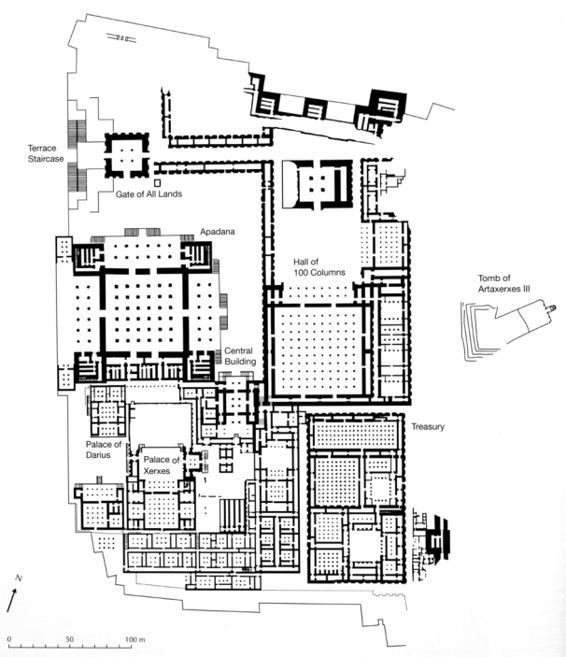
Figure 8.3 Plan of the Persepolis Terrace, courtesy of David Stronach.
Diodorus Siculus provides vivid description of the city in context of describing Alexander the Great’s sack of it in 330 BCE, an excerpt of which follows:
[Persepolis] … was the richest city of all those under the sun and the private houses had been filled with all sorts of wealth accumulated over a long time … many residences were filled with furniture and decorations of all sorts, much silver and no small amount of gold, loads of extravagant clothing … its sprawling palaces renowned throughout the world.
(17.70.1–3)
The main entrance to the terrace is through the Gate of Xerxes (sometimes called the Gate of All Nations) in the northwest corner, a monumental gate on the pattern of Neo-Assyrian ones from Nineveh and other cities in the eighth and seventh centuries. South of that gate are the main buildings that figure most often in discussions of Persepolis: the Hall of 100 Columns and the Apadana. Each of the four main doorways to the interior of the Hall portrayed a royal hero figure in combat with an animal – the same motif found elsewhere on the site (Figure 8.4). This image is an age-old apotropaic (i.e., protective) one, where the hero figure wards off the forces of chaos.
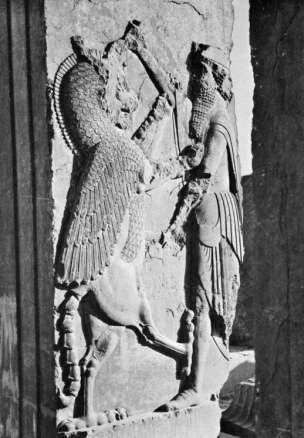
Figure 8.4 Darius as Royal Hero, Persepolis, Palace of Darius. Courtesy of the Oriental Institute of the University of Chicago.
Moving south through the Gate of Xerxes one encounters the Apadana. This square hall measured almost 200 feet long on each side with 36 columns supporting a roof that was over 80 feet high. Also remarkable are the sculptures along the north and east staircase facades: a procession of Persians, Medes, and the subjects of the Empire bearing gifts to the King, a record in ornately sculpted stone representing an actual procession (Figure 8.5).3 The various peoples of the Empire are led toward the center point, the stairway providing access to the Apadana’s columned hall. Each delegation is depicted in that people’s distinctive dress, and each delegation bears an offering (Figure 8.6). The delegations are not labeled, but by comparing the characteristics of each with similarly labeled portrayals on other monuments (e.g., those of Darius I’s tomb), many are identifiable.
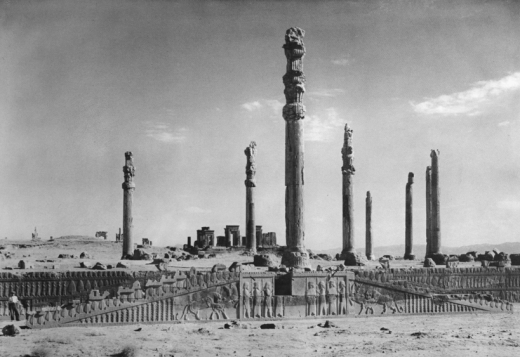
Figure 8.5 Apadana, North Stairway, Persepolis. Courtesy of the Oriental Institute of the University of Chicago.
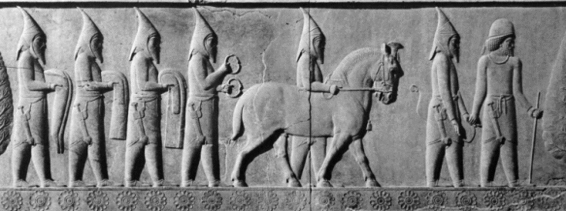
Figure 8.6 Scythians in Procession, Apadana, East Stairway, Persepolis. Courtesy of the Oriental Institute of the University of Chicago.
What messages were the portrayals of these subject peoples meant to send? The short-answer is: “many.” Unlike their Assyrian predecessors, the Achaemenid kings did not portray in their monumental sculptures the violent subjugation of enemies. With the sole exception being the Bisitun relief of Darius I, subject peoples are not portrayed as humiliated or violently subdued. The message of the Apadana reliefs seems rather one of solidarity or inclusiveness between the King – to whom the procession and the gifts are directed – and his subjects. The nuances may be cast in a multitude of ways, but the underlying message is one of an order established and preserved by a benign king, the agent of Ahuramazda. Not surprisingly or accidentally this matches the rhetoric of the royal inscriptions. Even though the program at Persepolis may have been the most elaborate, its message was clearly not confined to this one place but was propagated throughout the Empire in word, image, and shared customs. There is little doubt that Persepolis is a stunningly effective portrayal of that message. But how successful that message was among the Persians’ subjects is another matter. They may well have had an entirely different perspective.
Naqsh-i Rustam
Naqsh-i Rustam (in Persian “the picture of Rustam”) is roughly 3.5 miles north of Persepolis. It is not a capital but rather the site of four royal Achaemenid tombs and the Ka’ba-i Zardusht (“the cube of Zoroaster”), a structure very similar in shape to the Zendanof Pasargadae. As with the Zendan, the function of the Ka’ba-i Zardusht remains unclear. Naqsh-i Rustam was a sacred place from the time of the Elamites through the Sassanian period; reliefs from each of the successive historical periods may be found there. The name Naqsh-i Rustam stems from the later association between these reliefs and the Iranian hero Rustam, as was the Takht-i Rustam mentioned earlier in this chapter.
At Naqsh-i Rustam the Achaemenid tombs are the main monuments, cut into the rock of the cliffside. One is dated by its inscriptions to Darius I (Figure 8.7). The others are generally attributed to Xerxes, Artaxerxes I, and Darius II. The tomb of Darius I has three registers, or panels, the middle one set roughly 60 feet above the ground. The entrance to the tomb itself is in the middle register, which is sculpted like the façade of an Achaemenid palace. There were three burials within, all empty when excavated in the 1930s CE. The upper register portrays the king on a plinth facing a fire altar (see Figure 1.1). Ahuramazda (the winged disk) hovers over the center of the scene, in the typical pose: the king raises one hand toward the god and in the other holds a bow. To the right of Ahuramazda is the symbol of a crescent moon.
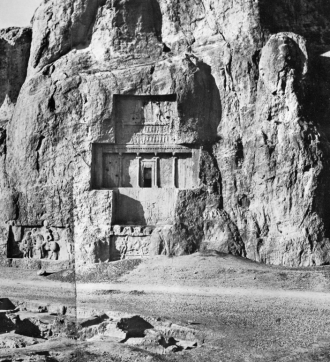
Figure 8.7 Tomb of Darius I, Naqsh-i Rustam. Courtesy of the Oriental Institute of the University of Chicago. See also Figure 1.1.
The large platform is flanked on the side walls by reliefs of Persian courtiers. The two foremost among them, on the left side, are labeled: “Gobryas the Pateischorean, the spear-bearer of Darius the King” and “Aspathines, the garment-bearer, holds the bow case of Darius the King.”4 Gobryas is also named as one of Darius’ helpers in the Bisitun Inscription (§68) and also is prominent in Herodotus’ account. Aspathines is not named in the Bisitun Inscription but is named in Herodotus’ writings. Their positions are clearly of the highest honor, and the titles they bear likewise, even if their exact court functions are not fully understood. The entire platform is portrayed on the relief as held up by the various subject peoples of the Empire. At first glance this could be construed as a posture of humiliation, but the style in which the figures are portrayed suggests otherwise. Many modern scholars interpret this sculpture, and similar representations of the throne-bearer reliefs at Persepolis, as reflecting an inclusive ideology, one that emphasizes the subject peoples’ important role in upholding – figuratively and literally – the King’s power and thus the Empire’s stability. Even more, the thirty platform-bearer subjects are labeled by ethnicity, which allows comparisons with other portrayals of subject peoples, where they are not labeled.
Achaemenid Royal Ideology
Darius I expressed a cohesive ideology in his inscriptions, his construction works, and his sculptural program – in part to legitimize his newly won throne. This program was so pervasive and effective that it persisted for the remainder of the Achaemenid era, so much so, in fact, that even subtle differences in the formulae attract scholars’ notice. Because Achaemenid royal ideology remained virtually unchanged for the next two centuries, it has been at times viewed as static or even stultifying. More recent interpretations of Darius’ program, however, focus on its impact, the resounding success of its application.
The Bisitun Inscription served as the blueprint for a new Achaemenid royal ideology. Darius’ royal titles and lineage (DB §1–4) give his descent, with emphasis on Achaemenes, for whom the dynasty is named. Darius does not provide his full lineage in subsequent inscriptions. Although he often mentions his father and occasionally his grandfather, he is always an Achaemenid. He also placed great emphasis on being Persian, which is somewhat curious. What else would he be? In two of his inscriptions from Naqsh-i Rustam and Susa (DNa and DSe) there is emphasis on being Iranian (from OP Ariya) as well; this emphasis also occurs once in one of Xerxes’ inscriptions from Persepolis (XPh). A king’s titles and epithets may vary in given contexts, but their use is never random. Some scholars have suggested plausibly that the marker “Iranian” serves to distinguish Iranian speakers from non-Iranian as, for example, when both Persians and Medes are frequently mentioned together in the Bisitun Inscription. This phenomenon is on par with the ethnocentrism one finds in the Greek world and is hardly unique. What is striking about Darius’ emphasis is that it differs so markedly from Cyrus’ use of the title “King of Anshan,” which recalls an Elamite tradition. Darius’ emphatic inclusion of his ethnicity may have served to distinguish his heritage, but the data sample is small. We are comparing Darius I’s inscriptions from mainly Iranian sites with Cyrus’ inscriptions from strictly Babylonian ones. Further, as discussed previously, after decades (even centuries) of Elamite-Persian acculturation, attempts to strictly delineate between the traditions oversimplifies many complex issues.
Cyrus’ capital Pasargadae was not complete when Cyrus died or during Cambyses’ reign. Darius added many finishing touches and in doing so took full advantage to co-opt the founder’s legacy and to strengthen his own legitimacy. Evidence for this comes mainly from two curious inscriptions found there. It is highly unlikely that Cyrus himself commissioned them, as they were installed near the end of the construction work sometime in the 510s BCE. Multiple copies of the two inscriptions were found on column remains of Palace S and Palace P (Figure 8.8). These trilingual inscriptions were originally attributed to Cyrus because of their content, and they are labeled in the scholarly literature CM for “Cyrus, Murghab” (i.e, a modern name for Pasargadae) with a lowercase letter designating the individual inscriptions.5
CMa: I am Cyrus the King, an Achaemenid
CMc: Cyrus the Great King, an Achaemenid
CMc is extant only in Elamite and Akkadian versions, on the garment folds of one of the figures from Palace P, but it is generally assumed that there was an Old Persian version as well, on parallel with CMa, which is inscribed in all three languages.
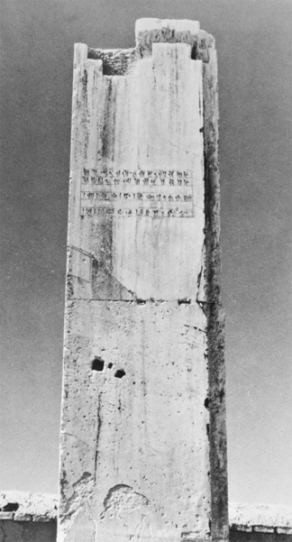
Figure 8.8a Anta from Palace P, Pasargadae, with CMa at top. Courtesy of David Stronach.
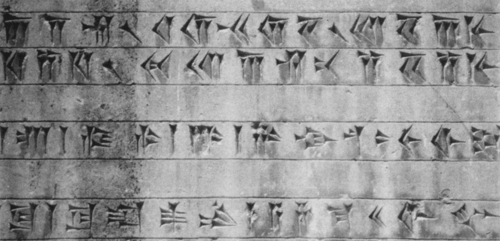
Figure 8.8b Close-up view of CMa, inscribed in Old Persian, Elamite, and Akkadian. Courtesy of David Stronach.
These two short inscriptions have caused no end of controversy within the field. On their face, they label Cyrus an Achaemenid, of the same dynastic heritage as Darius. Darius indirectly made the same implication in the Bisitun Inscription, by his assertion that Cambyses was of his family (DB §10). Darius also claimed to create the Old Persian writing system (DB §70), a claim that is irreconcilable with Cyrus having used Old Persian in any inscriptions at Pasargadae. Most scholars take Darius at his word on this particular issue, that is, that he was the one who first inscribed in Old Persian and thus was, in effect, its inventor. Old Persian inscriptions that purport to date before Darius, including CMa and CMc from Pasargadae, are all suspect.
There are other problems with taking the Pasargadae inscriptions at face value. A comparison with Cyrus’ inscriptions from Babylonia reveals major differences. Variation in style may be attributed to the different, Babylonian context. Variation in the dynastic line and royal titles are harder to reconcile. In the Cyrus Cylinder, Cyrus traces his descent in the Cyrus Cylinder from Teispes. Achaemenes is not mentioned. Cyrus uses the title “King of Anshan” in his inscriptions in Babylon but never the label “Achaemenid.” It defies imagination why Cyrus would not use the title “king of Anshan” in the region of Anshan itself (the older name for Parsa), at his capital Pasargadae in that very region. The implications are clear enough. Darius not only finished the work at Pasargadae but he also added inscriptions in Cyrus’ name that identified Cyrus as an Achaemenid. Darius thus retroactively transformed the illustrious Cyrus into one of his own ancestors and strengthened his own legitimacy.
Darius’ main emphasis at Bisitun and thereafter is his special relationship with Ahuramazda, which provided him the legitimizing factor so central to all kings in Near Eastern history. The name of the deity is new to our eyes. Ahuramazda does not occur in any earlier written sources. That phenomenon is closely bound with questions about early Persian religion, which will be taken up later in this chapter. It is from Darius also that we find the first enumeration of certain qualities that the Persian king had to possess. These qualities are frequently emphasized in the royal inscriptions, and the foremost expressions are the inscriptions at Darius I’s tomb: DNa and DNb, the second essentially copied by Xerxes at Persepolis (XPl). Reading these inscriptions is tantamount to reading a guide book on Achaemenid royal ideology. The King is the guardian of order as the divine agent, created by and supported by Ahuramazda (who created all else). Those who respect and support the will of Ahuramazda, and by extension the King, will prosper; those who do not will be destroyed. The King creates order out of chaos, and wars must be fought to do this, especially if it is a matter of protecting the King’s integrity. The King places fundamental importance on what is right and, by extension, he is the antithesis of what is wrong.
The proper display of “kingly qualities” as relayed in DNb may be condensed, at the risk of oversimplification, to one word: balance.
Darius the King proclaims: By the favor of Ahuramazda, I am the type who is pleased by what is right. I am not pleased by what is wrong.
(DNb §2)
And that is only the beginning. Darius continues with a long list of the appropriate royal attributes and behaviors. The King must respect the interests of all his subjects, strong and weak; he must protect what is right and thus strive actively against the Lie(drauga). The King controls his impulses and his temper, because he models intelligence, good thought, and calm in the face of threats. He is a paragon of order; he must reward good behavior and faithful service as well as punish disloyalty and wickedness – those things that are a threat to order. Beyond these attributes of good character and intelligence, the King himself is also effective in combat; this involved being an accomplished warrior on horse and on foot, with both bow and with spear. These qualities also appear in descriptions of the Persian kings in non-Persian sources, especially Greek. Xenophon’s lengthy encomium of Cyrus the Younger relays the exact qualities mentioned above (Anabasis 1.9). Herodotus (1.138) emphasizes how important it was to the Persians to tell the truth, though later (3.72) he has Darius, of all people, advocate an outright lie when necessary.6
Achaemenid Religion
Any overview of religious traditions and practices – with emphasis on the plural – in the Achaemenid period must begin by setting parameters.7 An overview of the wide array of religious practices across the scope of the entire Empire is one that would fill volumes by itself, because of the number and diversity of the peoples in it. In this book, the phrase “Achaemenid religion” (or “Persian religion”) refers to the Achaemenid Persians themselves, especially the religious sentiments expressed in the royal inscriptions. As discussed earlier, Parsa (Fars), by the Achaemenid period, had undergone several centuries of Elamite-Iranian acculturation. This phenomenon is critical, but not always easily visible, to contextualizing numerous aspects of Persian culture, including cultic practices and ritual traditions. The persistence of Elamite practices and sacred places testifies to a rich and complex heritage, one that is especially traceable in both text and image of the administrative documentation from Persepolis. Study of the administrative documentation in particular is changing our understanding of Achaemenid religion in significant ways, a process yet at the nascent stages.
The Achamenids are often described as Zoroastrians. This is perhaps an apt characterization on the surface – especially if one focuses only on the ideology as expressed in the royal inscriptions – but one that does not do justice to the variety of evidence. Zoroastrianism is an age-old religion in its own right that reached its floruit during the Sassanian period (c. 250–700 CE), and it was never static. Based on teachings of the prophet Zoroaster (the Greek name of Zarathustra), over time Zoroastrianism became strongly dualistic – light against dark, good against evil – with emphasis on the cosmic struggle between Ahuramazda and Ahriman (or Angra Mainyu). Zoroastrianism, like its Indian counterpart Hinduism, has Indo-Iranian origins, but the development of Zoroastrianism took place in an Iranian milieu. Zoroastrianism’s most central texts – among them Zoroaster’s hymns, the Gathas – were passed down orally for centuries before they were written down: chronology therefore is not an insignificant problem.
The Gathas form the core of a much longer work, the Avesta. The Avesta is a complex collection of works of which the earliest extant copies date several centuries after the Achaemenid period. There is no evidence that Avestan – the language of the text – was used outside the religious context, and the language (and wider tradition, for that matter) was thus one transmitted mainly by the Zoroastrian priesthood, the magi. Because of the manifold problems in assessing this material’s relevance to the Achaemenid historical period, it is difficult to use it as a source. On the other hand, there is much relevant material gleaned from Achaemenid royal inscriptions, iconography (both monumental and personal), Classical sources on the Persians, and, as indicated earlier, the administrative documents from Persepolis.
The date of Zoroaster himself is still debated, with estimates ranging from c. 1800 to the sixth century BCE, the latter contemporary with Cyrus the Great. Thus Zoroaster’s relevance to Achaemenid history as a living person is dependent on one’s assessment about when he lived. The early dating is based on Zoroaster’s surviving hymns, the Gathas, and their presumed age based on linguistic analysis of the words in their Indo-Iranian context; written copies date centuries later than the hymns are assumed to have been composed. The late date for Zoroaster stems from a Greek tradition that dates Zoroaster 258 years before Alexander the Great, which could mean 258 years before Alexander’s birth or before his overthrow of the Persian Empire. The last option, which has achieved acceptance by many scholars, has significant ramifications for our understanding of Zoroastrianism and the early Persian Empire. For many other scholars, such questions of date are meaningless; they doubt that Zoroaster ever existed, or see him as a literary creation that lent credibility to an evolving belief system.
Another approach to dating Zoroaster essentially splits the difference: locating Zoroaster circa 1000 BCE by incorporating the linguistic arguments into a historical context and setting Zoroaster in the wave of Iranian migrations into northeastern Iran at the turn of the second millennium. Later Zoroastrian tradition locates Zoroaster’s homeland and activity in that region. The Achaemenids’ ubiquitous references to Ahuramazda in the royal inscriptions obviously provide pieces to the puzzle. But a central problem in establishing a mid-first-millennium historical context for the Avesta is that none of the texts therein contains clear reference to the Medes or the Achaemenid Persians. However one defines a Zoroastrian stream of tradition, the Achaemenid kings were instrumental in shaping it. Instead of forcing the Achaemenids into a preconceived Zoroastrian system, we should consider the Achaemenids’ impact on a still nascent and evolving tradition.
There are many Zoroastrian, or Mazdean, elements to be found in the religious traditions of the Achaemenid period.8 Among others, these include the ubiquity of Ahuramazda in the royal inscriptions, especially as a creator god; the antipathy toward the Lie(see discussion earlier in this chapter); and the central place of fire in certain rituals. Greek writers emphasize that the Persians did not have temples. Remnants of what are presumed to have been fire altars have been found in excavation, and they are also identified in sculpture, for example on Darius I’s tomb facade.
Herodotus’ brief survey (1.131–132) of Persian religious practices has served for a long time as one of our main sources, and it is a mixed bag.
I know that the Persians employ the following customs. It is not their custom to dedicate statues, temples, or altars, but they assail as folly those who do so, and so it seems to me, that they do not think of their gods as humanized in the fashion that the Greeks do. They worship Zeus by ascending to the loftiest places to make offerings, they call the entire circle of heaven Zeus. They sacrifice to both the sun and to the moon, as well as to the earth, to fire, to water, and to the winds. At first they sacrificed to these only, but subsequently they learned from both the Assyrians and Arabs to sacrifice to Heavenly Aphrodite. The Assyrians call Aphrodite Mullissu, the Arabs call her Alilat, and the Persians Mithra. The Persians make sacrifice to these deities in this way. When they are about to sacrifice they neither construct altars nor light fire; they do not use libations, reed pipes, garlands, or barley.
(1.131–132.1)
The passage continues to describe, in some detail, the Persian procedure for sacrificing an animal and emphasizes that a magus must be present. Herodotus mentions fire altars, and we do have many depictions (e.g., on seal impressions) of worship before divinities. The name Zeus presumably refers to Ahuramazda, a Greek syncretism common not only in Herodotus. His descriptions of sacrifices to the celestial bodies and the elements are in some ways harder to reconcile with our knowledge of Persian religious practices. Worship of the sun may be equated with Mithra, and if one considers that the Persians sacrificed with fire and water instead of to them, Herodotus may be given some credit. Sealings from the Persepolis Fortification archives are replete with divinely-associated astral imagery.9 Worship of Heavenly Aphrodite (Ourania) is generally believed to refer to Persian Anahita – as later Classical writers noted – but many non-Greek female deities are associated with Aphrodite, so Herodotus’ meaning here is ultimately unclear. Assyrian Mullissu was at times synchronized with Ishtar, another deity with whom Anahita shares several attributes. Mithra is a male god in Persian and Indo-Iranian tradition.
The plural magi comes from singular Latin magus, taken directly from Greek magos, which in turn is a loan word from Old Persian, magush. The word has broad application in Greek and Roman texts: from its primary usage to refer to the priests of the Persian kings to a pejorative used for charlatans of the sort who foretell the future; it is from this latter sense that we get the word “magician.” In the Achaemenid period, the magi are generally understood as priests, but that does not do full justice to the range of functions they fulfilled. Magi were the transmitters of Iranian lore and traditions, not just religious ones, and they both performed rituals as well as served as dream (and other omen) interpreters. For example, in Herodotus they interpreted Astyages’ ominous dreams about his daughter Mandane and the birth of Cyrus (1.107–108), and they recur as functionaries performing sacrifices and warding off evil omens, such as when Xerxes is marching against Greece (Hdt. 7.113, 7.191, etc.). Parallels to their function and influence may be found in the cadre of scholars that surrounded the Assyrian and Babylonian kings, the Persians’ predecessors.
Herodotus names the Magi as one of six Median tribes (1.101). Historians still do not know what to make of this. Does it imply that these priests or learned men were exclusively from one Median tribe? That does not seem to be the case during the Achaemenid period, though it is impossible to confirm. As noted previously, the Medes seem to have held a special place in the Persian Empire’s hierarchy – politically, militarily, and culturally – more so than any other ethnic group besides the Persians themselves. Forging a connection between this and the presumed Median origins of the magi may make sense but is not definitive.10 Scholars are also divided on the extent to which practices and rituals attributed to the magi may be considered truly Zoroastrian or not, but attempts to delineate this run the danger of becoming circular, a caveat that applies to the entire study of Achaemenid religious beliefs. Some take the magi as the original Zoroastrian priests, others see them as the antithesis, as the daiva-worshippers attacked by Xerxes. That they were key state functionaries is beyond doubt, and they certainly left an imprint on the Greek imagination.
Zoroaster himself is not mentioned in any extant Persian text from our period. The names of many Achaemenid elites clearly come from Zoroastrian tradition. Darius I’s father Hystaspes (Old Persian Vishtaspa), for example, shares his name with Zoroaster’s patron Vishtaspa in the Avesta. Few scholars think this is a coincidence, though fewer still uphold an exact correlation between the two. That is, few hold that Darius’ father was the same person as Zoroaster’s patron, a key assertion for supporters of a late (sixth century) date for Zoroaster himself.
Most twentieth-century discussions of Achaemenid religion focus on reconciling the strong assertions of piety in the royal inscription with no evidence that the Achaemenids forcibly compelled worship of Ahuramazda among their subjects. This seeming dichotomy led to extreme approaches, either attributing religious significance to everything the kings did or emphasizing a religious tolerance totally removed from the ideology expressed in the royal inscriptions. Either of these approaches is tricky to apply consistently. Persian royal inscriptions typically lack specificity – the Bisitun Inscription notwithstanding – and specific historical events are usually only recorded in non-Persian sources. Evidence for Persian reprisals against religious sites or groups is often ambiguous. The severity and extent of Cambyses’ purported actions against Egyptian temples remain unclear, and because that information is filtered through a hostile source (the Egyptian priesthood) via Herodotus there is much room for skepticism. In any event, there is no traceable instance of compulsory worship of Ahuramazda. The expressions of the king’s piety in the royal inscriptions are, as has been noted, standard for kings in the ancient Near East. An important corollary is the overwhelming evidence that the Achaemenid kings’ emphasis on Ahuramazda did not displace older or local gods. The Persepolis Fortification archive indicates that well over a dozen Iranian, Elamite, and Mesopotamian deities were worshipped in the core of the Empire, testimony to the continuity and compatibility of several traditions.