
ROBIN CONINGHAM
There are many noblemen and rich householders within the city. The houses of the [Sabaean] merchants are very beautifully adorned. The streets and passages are smooth and level … there are in the country altogether fifty or sixty thousand priests, all of whom take their meals in common … the King supplies five or six thousand persons [monks] in the city with food.
FAXIAN, MID-5TH CENTURY AD
Constructed across a shallow valley in the northern plains of Sri Lanka, Anuradhapura was the island’s capital for over 1,500 years and one of Asia’s most important Buddhist pilgrimage sites. Its ruins today form a series of concentric bands centred on the Citadel. Surrounding this secular core was an area of shrines and temples, grouped around three viharas or monastic communities. Beyond this was a band formed by major irrigation reservoirs, while a ring of forests, villages and hermitages was outermost. This vast complex, with monuments comprising 200 million bricks each and reservoirs containing up to 42 million cu. m (1,500 million cu. ft) of water, were part of an organic development over a thousand years in the making.
According to the Mahavamsa or ‘Great Chronicle’, compiled by Buddhist monks centuries later, Anuradhapura was founded by Minister Anuradha after his arrival from northern India in the middle of the 1st millennium BC, accompanying Prince Vijaya. Together they colonized Sri Lanka, having defeated its population of Yakshas or demons. Later chronicles recorded that the settlement was selected as a suitable location for a palace and reservoir by Prince Anuradha, one of nine brothers. Defeated by his nephew, King Pandukabhaya (r. 437–367 BC), Anuradha escaped the bloody fate of his siblings but surrendered his settlement, which was re-founded as Anuradhapura or ‘City of Anuradha’. It remained the capital of the island until AD 1017, when the last king, Mahinda V, abandoned it and died in exile.
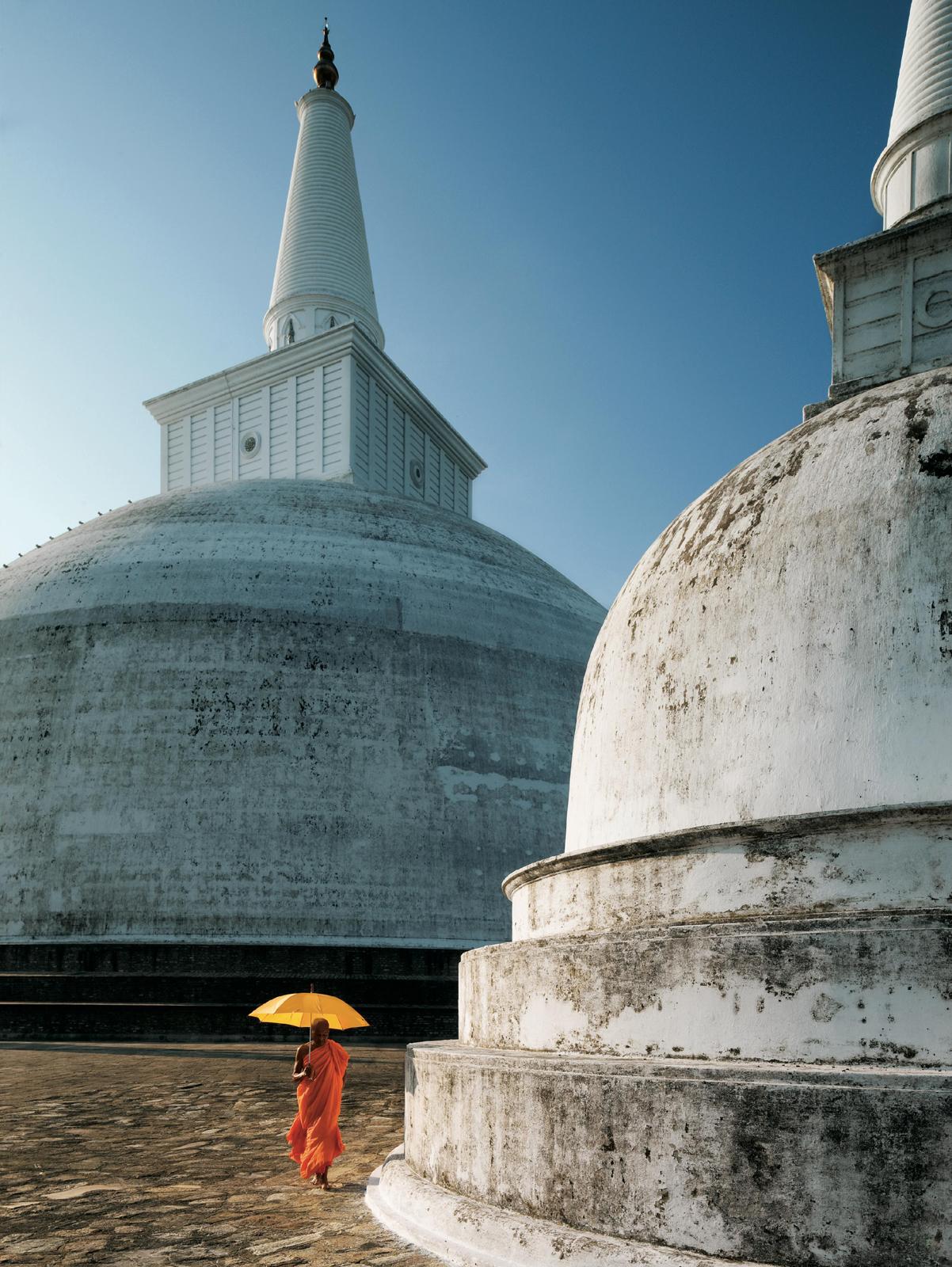
A Buddhist pilgrim walks in front of the Ruvanvalisaya stupa, one of three belonging to the Mahavihara, or ‘great monastery’, the largest in Anuradhapura. Constructed from solid brick in the 2nd century BC, it has been much restored.
Massimo Ripani/SIME/4Corners.
While sections of the Mahavamsa are legendary in nature, excavations within the Citadel have confirmed that it was fortified by the 4th century BC. Traces of a greater antiquity for the site have also been found, with occupation dating back to the beginning of the 1st millennium BC in the form of a settlement of round houses established by farmers on a rise above the Malwattu Oya (river). Even this was not the earliest human presence, as 10 m (30 ft) below the surface microlithic tools left behind by hunter-gatherers have been discovered. Far from being from northern India (as the legend relates), the early settlers appear to have shared a material culture with Peninsular India.
Anuradhapura grew until it became the island’s primary settlement, and by the 4th century BC it was integrated into Indian Ocean exchange networks, as shown by lapis lazuli beads from Afghanistan and carnelian from west India, as well as sherds marked with Early Brahmi script bearing the vernacular language of northern India. With the construction of fortifications around the Citadel and the introduction of rectangular buildings, Anuradhapura became the southernmost example of South Asia’s Early Historic urban phenomenon. An integral aspect of the city was royal patronage of Buddhism, and the Mahavamsa recorded the arrival of missionaries from Emperor Asoka’s court. King Devanampiya Tissa (r. 250–210 BC) converted to the new religion after meeting Asoka’s son, the monk Mahinda, and donated a royal garden as the Mahavihara or ‘great monastery’. Soon after, Asoka’s daughter, the nun Sanghamitta, brought a cutting of the Bodhi tree under which the Buddha had achieved enlightenment. With increasing numbers of Buddhist relics, Anuradhapura featured on pilgrim itineraries despite never having been visited by the Buddha.
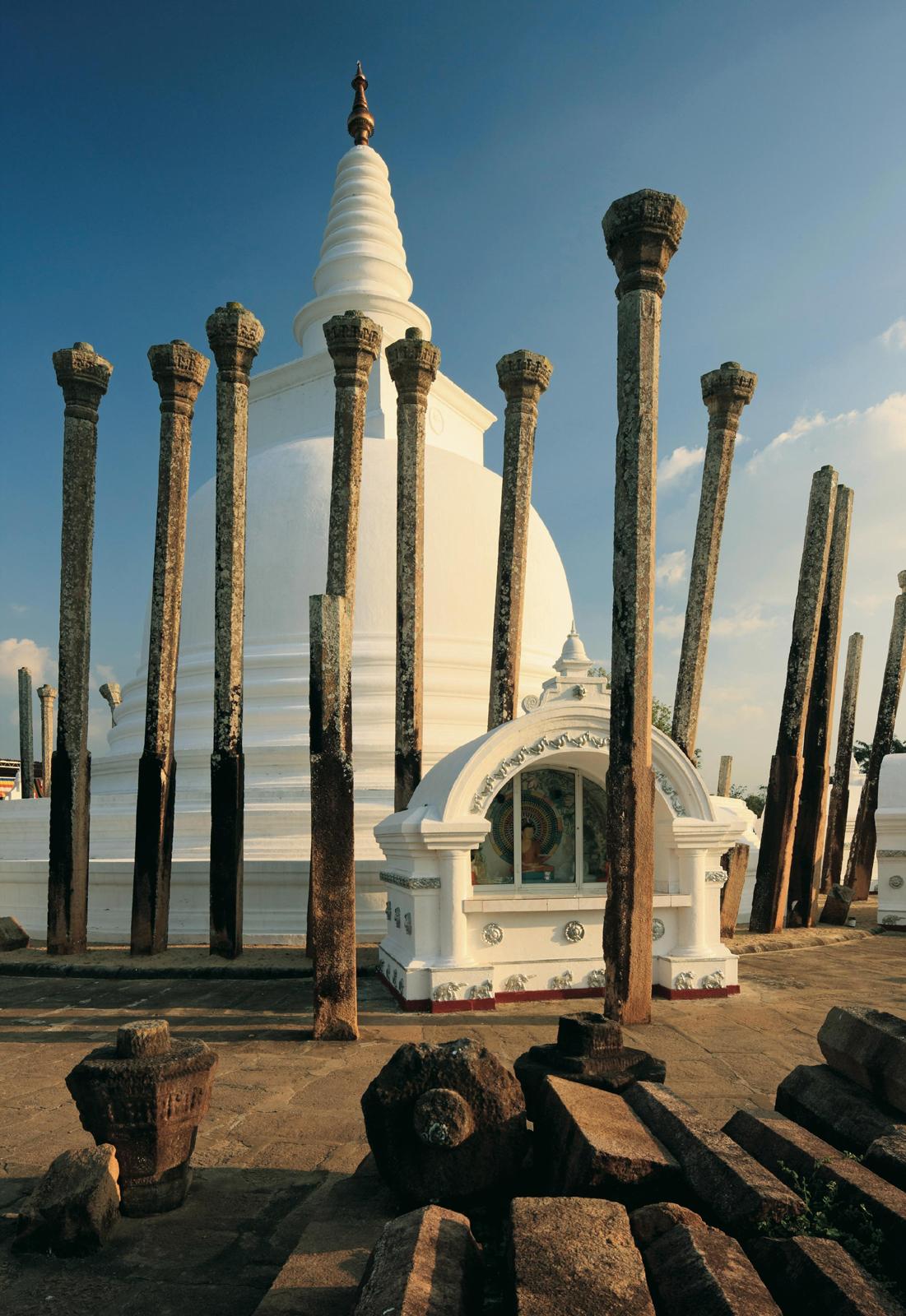
Also originally dating to the 3rd century BC, the Thuparama stupa of the Mahavihara monastery was built over a collar bone of the Buddha. The stone pillars or columns are thought to have belonged to a colonnade that once supported a wooden roof protecting the stupa.
Reinhard Schmid/4Corners.
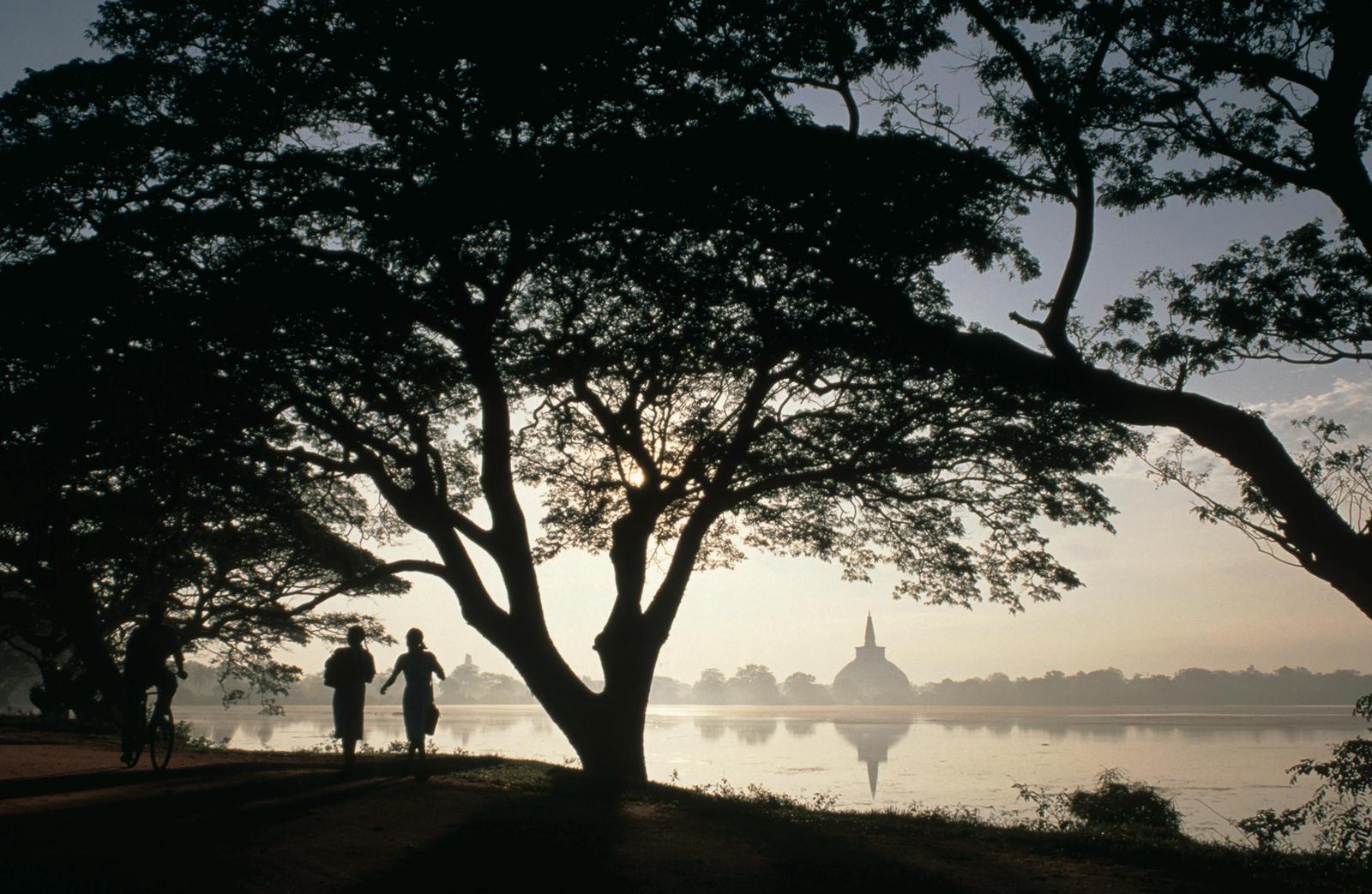
The Basawakkulam reservoir, one of several outside the city that provided the water supply for the inhabitants of Anuradhapura. Such a system was necessary since the city was situated in the island’s ‘Dry Zone’.
© Michael Freeman/Corbis.
The Mahavihara was Anuradhapura’s largest monastery, containing residences, refectories and shrines. It also had three massive domes of solid brick, known as stupas, the earliest of which, the 3rd-century BC Thuparama, was built over a collar bone of the Buddha. The others are the 2nd-century BC Ruvanvalisaya, over 100 m (300 ft) high, and the slightly later Mirisavati stupa, which was some 58 m (190 ft) high. Two other monasteries were also established – the Jetavana in the 3rd century BC and the Abhayagiri in the 1st century BC. Both also featured stupas, the latter standing 71.5 m (235 ft) high and the former 160 m (525 ft) – the tallest structure in the island. Far from co-existing peacefully, the Mahavamsa recorded that Abhayagiri’s monks stripped the Mahavihara of materials after temporarily forcing its incumbents to leave in the 3rd century AD. Survey beyond Anuradhapura’s walls suggests that the social and economic authority of the city’s monastic communities penetrated deep into the villages of the hinterland to the exclusion of the development of a network of secular towns.
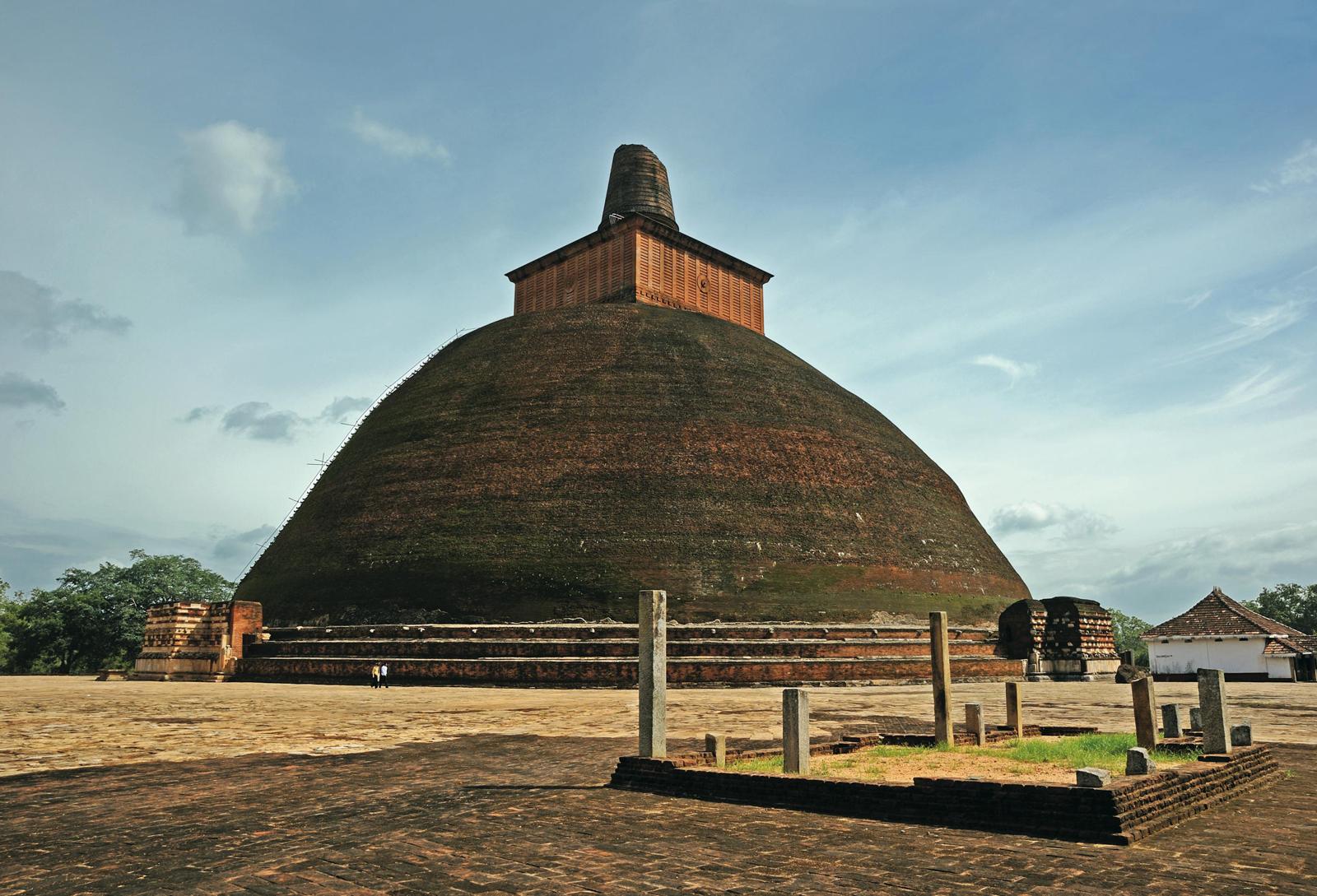
The large stupa of Jetavana monastery, which was founded in the 3rd century BC; made of millions of bricks, this is still the tallest structure in Sri Lanka and represents a great feat of engineering and construction.
© Jane Taylor (www.janetaylorphotos.com).
Although their stupas have survived, Anuradhapura’s monasteries have been reduced to the stone pillars that once supported timber-and-tile superstructures. Fortunately, we have descriptions of Anuradhapura in the middle of the 5th century AD by the Chinese pilgrim Faxian. He reported that 3,000 monks lived in the Mahavihara monastery and 5,000 in the Abhayagiri, and he also described his visits to the key shrines, including the Bodhi tree and the Buddha’s Tooth Relic. According to Faxian, the king fed 5,000 monks daily, in a building equipped with a stone trough for rice. The Chinese monk also noted the presence of foreign merchants in the Citadel, and excavations have yielded evidence of Late Hellenistic cut glass, Roman metalwork, early Islamic glass and Chinese glazed ceramics.
Remarkably for such a large city, Anuradhapura was established in the ‘Dry Zone’, which receives most of its 1,500 mm (60 in.) of rainfall between October and February. The settlement’s inhabitants thus experimented by damming shallow valleys to store water for the dry season. As the city expanded, so did the hydraulic network, with the 91-ha (225-acre) Basawakkulam reservoir constructed in the 5th century BC, the 160-ha (395-acre) Tissawewa in the 3rd century BC and the 1,288 ha (3,180-acre) Nuwarawewa in the 1st century BC. It was later recognized that the supply would be more reliable if sources closer to the island’s ‘Wet Zone’ could be tapped, and this phase saw the construction by King Dhatusena (r. 455–473) of the huge 2,582-ha (6,380-acre) Kalawewa tank, with its 87-km (54-mile) long canal linking it to the Tissawewa. Investment in sluices and silt traps ensured that increasing numbers of humans, animals and crops could be supported, despite the environmental challenges.
By the 11th century AD, the city covered over 40 sq. km (15 sq. miles). However, within a century its irrigation reservoirs and canals had silted up and Anuradhapura was abandoned in favour of Polonnaruva to the south. Explained by the Mahavamsa as the result of invasions from south India, the abandonment has been attributed by others to epidemics, environmental catastrophes and tax inequalities. Although the jungle reclaimed Anuradhapura, its location was never forgotten, and a band of monks dragged stone pillars from the ruins to create a wall around the Bodhi tree to prevent it from being damaged by wild elephants; its descendant is still there today. Such was its ritual importance that the British selected Anuradhapura as the capital of the North Central Province, and it still hosts millions of Buddhist pilgrims annually.
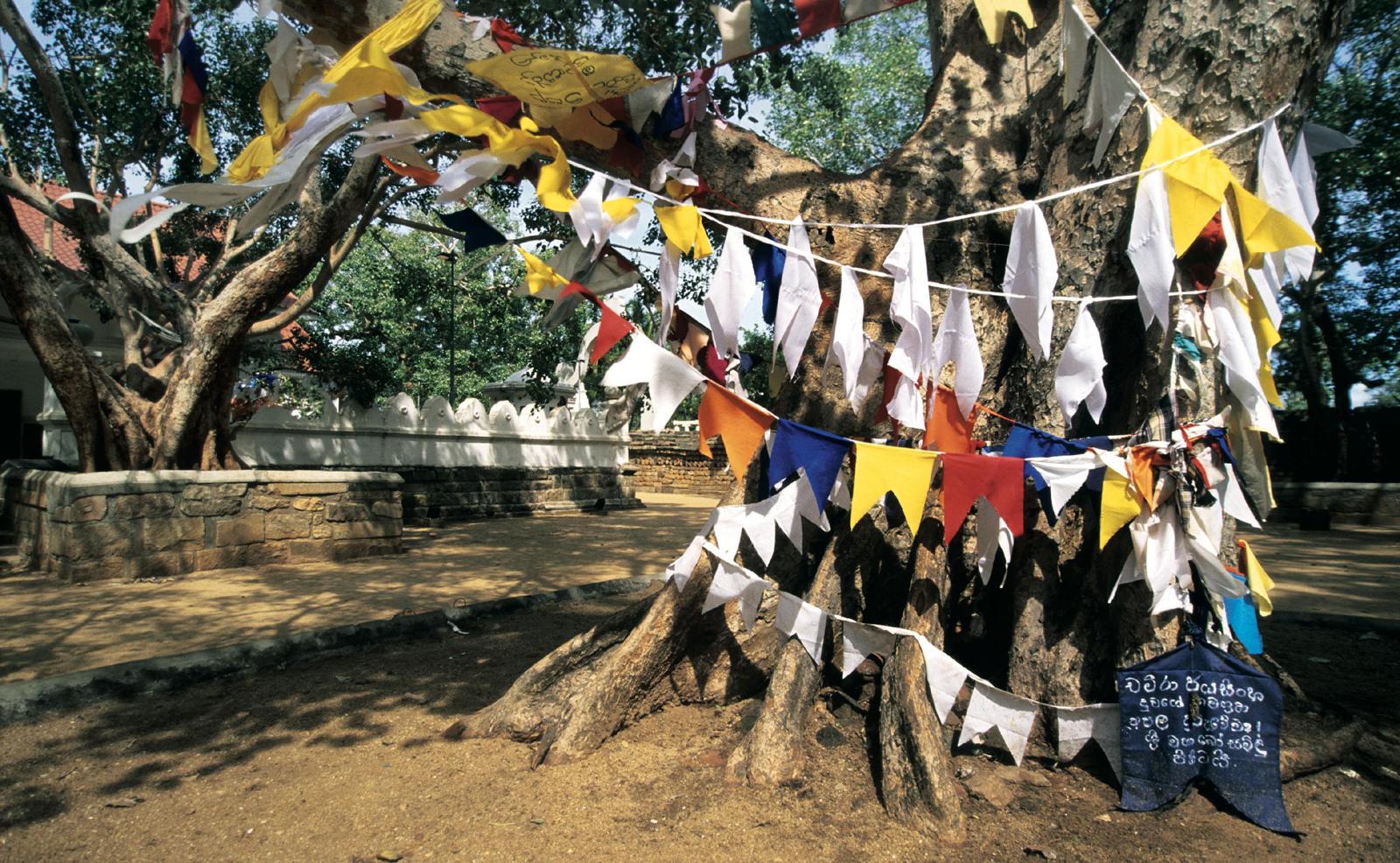
Anuradhapura was one of South Asia’s great medieval capitals and is still one of the principal places of Buddhist pilgrimage. The sacred Bodhi tree is a descendant of the original one at the site, which itself grew from a cutting from the tree that the Buddha achieved enlightenment under. It has survived despite the abandonment and decline of the city.
© McPhoto/Blickwinkel/agefotostock.com.